
慢牛行情

Search documents
大科技或仍为慢牛主线,关注A500ETF易方达(159361)、科创板50ETF(588080)等产品配置机会
Sou Hu Cai Jing· 2025-10-31 06:58
Group 1 - The market continues to show volatility in the afternoon, with storage chips and CPO hardware experiencing a pullback, while sectors such as software, innovative pharmaceuticals, and robotics remain active [1] - As of 14:35, the CSI A500 index has dropped over 1%, and both the ChiNext index and the STAR Market 50 index have fallen more than 2%. However, funds are flowing into related ETFs, with the A500 ETF (E Fund, 159361) seeing net subscriptions exceeding 100 million units, and the ChiNext ETF (159915) reaching net subscriptions of 200 million units [1] - The National Development and Reform Commission has noted that several international economic organizations have raised their forecasts for China's economic growth. For instance, the International Monetary Fund and the World Bank have increased their 2025 growth predictions by 0.8 percentage points compared to their April forecasts [1] Group 2 - Huaxi Securities indicates that the 20th National Congress has solidified long-term policy expectations for investors, combined with expectations of US-China interactions at the APEC summit and potential interest rate cuts by the Federal Reserve, which may boost short-term risk appetite. The "slow bull" market in A-shares is expected to continue, with "big technology" remaining the main theme for the medium to long term [1] - The CSI A500 index consists of 500 stocks with large market capitalization and good liquidity across various industries, balancing "core assets" and "new productive forces." The ChiNext index includes 100 stocks from the ChiNext board with high market capitalization and liquidity, focusing on strategic emerging industries like new energy [2] - The STAR Market 50 index comprises 50 stocks from the STAR Market, with over 65% of its composition in the semiconductor industry. The A500 ETF (E Fund, 159361), ChiNext ETF (159915), and STAR Market 50 ETF (588080) all implement a management fee rate of 0.15% per year, providing investors with diversified investment options [2]
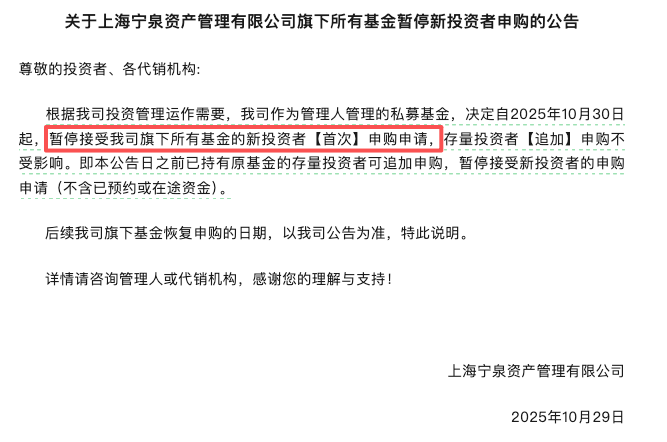
A股站上4000点后,宁泉资产为何对新钱“按下暂停键”?
2 1 Shi Ji Jing Ji Bao Dao· 2025-10-30 10:21
Core Viewpoint - The A-share market continues to show strong fluctuations, with the Shanghai Composite Index closing at 4016.33 points, marking a nearly ten-year high, which has raised concerns about market overheating and potential bubbles in certain sectors [1][2][13]. Market Performance - As of October 29, the Shanghai Composite Index reached 4016.33 points, the third time in history it has closed above 4000 points, following similar occurrences in May 2007 and April 2015 [1]. - The rapid rise in market temperature has been noted, with clear bubbles visible in some popular sectors and stocks [4][13]. Company Actions - Ningquan Asset announced a suspension of new client subscriptions for all its funds starting October 30, 2025, while existing clients can still add to their investments. This decision has drawn significant market attention [2][11]. - The firm has a management scale exceeding 450 billion yuan and employs a team of 27, with 19 dedicated to investment research [4]. Investment Philosophy - Ningquan Asset adopts a "farming-style" investment approach, focusing on stable, high-dividend assets rather than chasing high-risk opportunities. This strategy aims for consistent returns over time [7][14]. - The firm emphasizes maintaining a diversified portfolio, with significant holdings in real estate, basic chemicals, and electric power sectors, which are viewed as stabilizing assets during market volatility [9][10]. Market Sentiment and Future Outlook - The recent limit on subscriptions is interpreted as a cautious signal regarding the overheated market, with Ningquan Asset highlighting the rapid market rise and the presence of bubbles [4][13]. - Other private equity firms are also adopting similar cautious strategies, with several announcing subscription limits across various fund types [12][11]. Broader Industry Trends - The asset management industry is experiencing a wave of subscription limits as firms balance growth and performance, with both private and public funds taking similar actions [11][12]. - Some firms remain optimistic about structural opportunities in the market, while others express caution, indicating a divergence in strategies among leading private equity firms [16][18].

今天,你慌了吗?
IPO日报· 2025-10-30 09:39
Market Overview - On October 30, the A-share market experienced a low opening followed by a brief rise, but ultimately closed lower, indicating increasing panic among investors [2] - The number of stocks that rose was 1,242, while 4,100 stocks fell, with a total trading volume of 24,643 billion yuan, an increase of approximately 1,736 billion yuan compared to previous days [2] - The market saw a net outflow of funds amounting to 1,345 billion yuan, despite a trading volume returning to the previous "normal" level of around 25,000 billion yuan [2] Sector Performance - The rare earth and energy metal sectors performed well, while previously strong sectors like storage chips and optical modules (CPO) saw significant declines, leading to a broader downturn in technology stocks [2] - The market's "连板" (continuous rise) situation was weak, with most stocks showing poor performance, particularly small-cap stocks with poor earnings [2] Investor Sentiment - The market's adjustment is viewed as a normal correction within an overall upward trend, primarily driven by profit-taking [3][4] - Individual investors expressed mixed feelings, with some experiencing significant losses while others reported gains from stocks like Tianqi Lithium and Industrial Fulian [3] Economic Context - The decline of the Shanghai Composite Index below 4,000 points is considered a normal correction, with the market's liquidity remaining robust and domestic policies stable [4] - Recent diplomatic engagements, such as the meeting between the Chinese and U.S. presidents, are seen as beneficial for stabilizing economic relations and the global political landscape [4] Investment Opportunities - Investors are encouraged to analyze market rotation styles and identify sectors worth investing in, as many companies are showing improved profitability [5] - For instance, New Yisheng reported a revenue of 16.5 billion yuan for Q3, a year-on-year increase of 221%, and a net profit of 6.327 billion yuan, up 284.37% [5] Conclusion - Patience, calmness, and thorough analysis are essential for investors to find wealth-building opportunities in the A-share market [6]

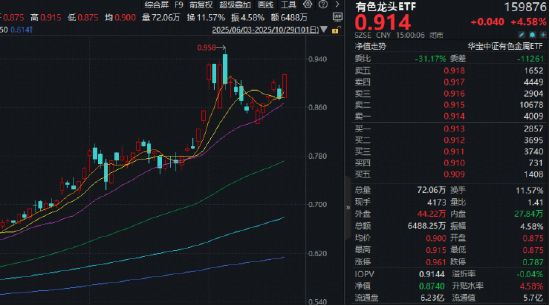
明日!美联储议息靴子落地!有色龙头ETF(159876)反包大涨4.58%!细分品种携手涨价,伦铜、伦铝齐创新高
Xin Lang Ji Jin· 2025-10-29 11:46
Core Viewpoint - The non-ferrous metal sector has seen significant inflows, with over 15.8 billion in main funds entering the market, ranking second among 31 primary industries in the Shenwan classification [1][3]. Group 1: Market Performance - The non-ferrous metal sector's leading ETF (159876) experienced a substantial increase of 4.58% in price, with a total trading volume of 64.88 million, reflecting a 35% increase in trading activity [1]. - Among the 60 constituent stocks of the non-ferrous metal ETF, 52 stocks rose over 2%, and 25 stocks increased by more than 5%. Notably, Nanshan Aluminum and Zhongfu Industrial hit the daily limit, while Jiangxi Copper and Western Superconducting surged over 9% [1][3]. - Key stocks such as China Aluminum, Northern Rare Earth, and Zijin Mining also showed significant gains, with increases of over 7%, 4%, and 3% respectively [1]. Group 2: Positive Factors - Macroeconomic factors are favorable, with expectations of a potential interest rate cut by the Federal Reserve due to weak employment data [3]. - The industry is experiencing price increases across various segments, with LME copper reaching an all-time high and LME aluminum hitting a three-year peak. Additionally, the price of tungsten has doubled this year, and lithium hexafluorophosphate has seen a nearly 60% increase in just over two weeks [3]. - The earnings reports from the non-ferrous metal sector are promising, with 40 out of 44 companies reporting profits, and 31 companies showing year-on-year growth in net profit. Notably, Chuangjiang New Material reported a 20-fold increase in net profit [3]. Group 3: Investment Strategy - The non-ferrous metal sector is viewed as a key player in the current commodity bull market, driven by supply constraints and increasing demand for strategic metal resources amid de-globalization trends [3]. - The non-ferrous metal ETF (159876) and its linked funds provide a diversified investment approach, tracking the Zhongzheng Non-Ferrous Metal Index, which includes significant weights in copper, gold, aluminum, rare earths, and lithium [4]. - As of October 28, the ETF had a total scale of 544 million, making it the largest among three similar products [6].
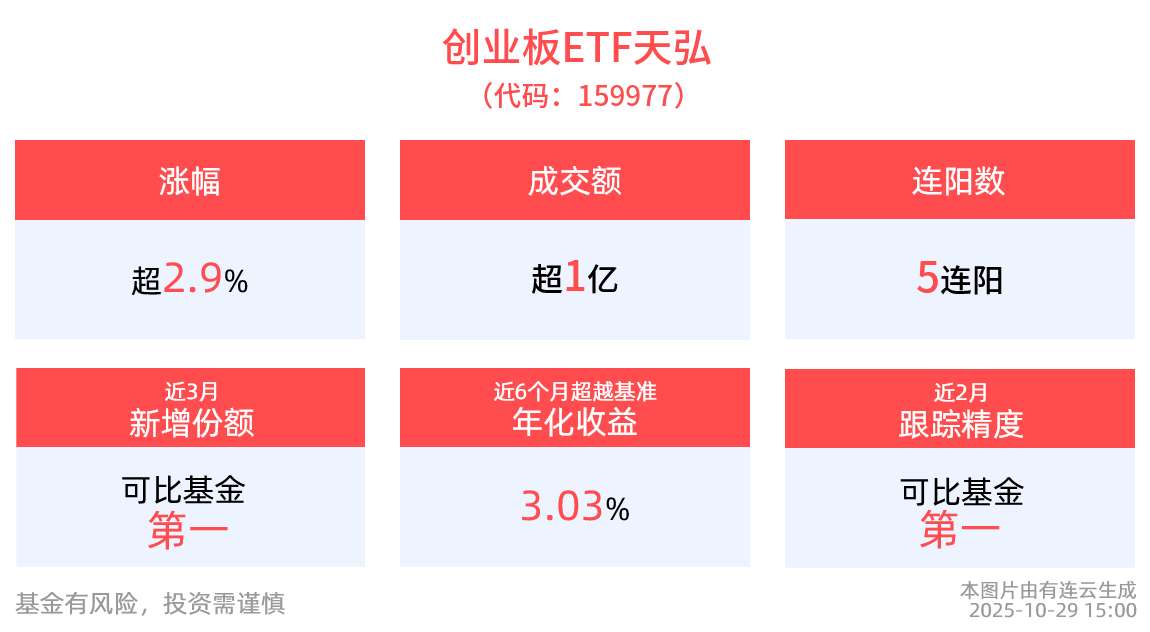
重磅!双方会晤将至!“上涨先锋”创业板ETF天弘(159977)大涨3%,实现五连阳
Xin Lang Cai Jing· 2025-10-29 08:17
Core Insights - The article highlights the performance of various ETFs, particularly the Tianhong ChiNext ETF (159977), which has seen a significant increase in both price and trading volume, indicating strong investor interest and market momentum [3][4]. Product Highlights - The Tianhong ChiNext ETF (159977) has risen by 2.99% with a trading volume of 138 million yuan, benefiting from the performance of key stocks like Sungrow Power (300274) which increased by 15.44% [3]. - Over the past three months, the Tianhong ChiNext ETF has grown by 582 million yuan in scale and has added 2.081 billion shares, leading among comparable funds [3]. - The Tianhong A500 ETF (159360) covers 35 secondary industries and tracks 500 core assets of the Chinese economy, providing a balanced investment strategy to mitigate rotation risks [3]. Industry Context - The ChiNext Index is positioned as a key player in China's emerging industries, benefiting from improved Sino-U.S. relations, which may attract more incremental capital [3]. - The article suggests that as the A-share market enters a bull market phase, broad-based ETFs are becoming the optimal choice for retail investors to capitalize on growth opportunities [3]. Related Products - The article lists several related ETFs, including the Tianhong Sci-Tech Index ETF (589860), which covers 97% of the Sci-Tech board's market value and focuses on strategic emerging industries such as semiconductors and AI [4]. - Other mentioned products include the Tianhong ChiNext ETF (159977) and the Tianhong A500 ETF (159360), along with their respective off-market connections [4]. Market Events - A significant upcoming event is the scheduled meeting between U.S. and Chinese leaders in Busan, South Korea, which is expected to address strategic issues affecting bilateral relations [4]. - The article notes that recent developments, including the 20th National Congress of the Communist Party and expectations from the APEC summit, may enhance short-term risk appetite in the A-share market [4].

上证指数十年后再破4000点 老股民的赚钱经验失效了?
Nan Fang Du Shi Bao· 2025-10-29 06:30
Core Points - The Shanghai Composite Index (SHCI) has surpassed the 4000-point mark for the first time since August 18, 2015, marking the third historical breakthrough of this level [1][2] - This milestone has sparked a debate among investors, particularly between new and old stockholders, regarding market sentiment and investment strategies [2][3] - Historical data indicates that previous surges past 4000 points occurred during bull markets in May 2007 and April 2015, leading to optimistic expectations for the current market [2][4] Market Performance - On October 28, the SHCI reached a peak of 4010.73 points, with trading volume at 2.17 trillion yuan, slightly down from 2.36 trillion yuan the previous day but still above 2 trillion yuan, indicating active market participation [2][5] - Despite the index's rise, many investors feel that making profits in the current A-share market has become more challenging, attributed to sector rotations and varying performance across industries [4][6] Investor Sentiment - There is a noticeable divide in sentiment between seasoned investors, who are cautious due to past market volatility, and newer investors, who are more optimistic about the current market dynamics [3][4] - A significant number of investors have expressed concerns about historical patterns repeating, while others believe in the transformative potential of current market conditions [4][7] Fund Management Trends - The number of new A-share accounts opened in September reached 2.937 million, the second-highest monthly figure of the year, reflecting growing interest despite being lower than the peak in October 2024 [5][6] - Active management equity funds have seen a resurgence in new issuances, with 561 billion yuan raised in Q3 2025, while also experiencing significant redemptions, indicating a shift in investor behavior [5][6] Market Structure and Future Outlook - The current market rally is primarily driven by the technology sector, with high levels of institutional investment in growth-oriented industries [7][8] - Analysts suggest that a stable and healthy slow bull market is necessary to alleviate concerns among older investors and validate the optimistic outlook driven by technological advancements [7][8] - Regulatory measures aimed at enhancing investor protection are expected to bolster confidence in the market, contributing to its maturation and the potential for sustained growth [8]
上证指数十年后再破4000点,老股民的赚钱经验失效了?
Nan Fang Du Shi Bao· 2025-10-29 06:21
Core Points - The Shanghai Composite Index (SHCI) has surpassed the 4000-point mark for the first time since August 18, 2015, marking the third historical breakthrough of this level [2][3] - Investor sentiment remains cautious despite the index's rise, with trading volume slightly decreasing to 2.17 trillion yuan from 2.36 trillion yuan on the previous trading day [3] - The breakthrough has sparked a debate between new and old investors regarding their experiences and strategies, highlighting differing perceptions of market conditions [3][4] Market Dynamics - The SHCI reached a peak of 4010.73 points, creating a new high in over a decade, while historical data indicates that previous breakthroughs occurred during bull markets in May 2007 and April 2015 [3][5] - Many investors express optimism about the current market, citing historical patterns where the index's rise above 4000 points coincided with bullish trends [3][4] - A significant portion of investors, particularly older ones, remain cautious due to past market volatility and the potential for historical patterns to repeat [4][5] Investor Behavior - There has been a notable increase in new investor accounts, with 2.94 million new accounts opened in September, indicating growing interest in the market [6] - Active management equity funds have seen a trend of "buying new and redeeming old," reflecting a shift in investor preferences and market dynamics [6][7] - The market is experiencing structural differentiation, with technology sectors driving the current rally, while traditional sectors lag behind [7][8] Future Outlook - Analysts suggest that a stable and healthy slow bull market is necessary to alleviate concerns among older investors about historical market patterns [8] - The transition from a liquidity-driven market to one supported by fundamentals and new growth drivers is seen as essential for sustainable growth [8] - Regulatory measures aimed at enhancing investor protection are expected to bolster confidence in the market, contributing to its maturation [8]

沪指再上4000点牛气冲冲!顶流“旗手”券商ETF(512000)、金融科技ETF(159851)双双大涨超2%
Mei Ri Jing Ji Xin Wen· 2025-10-29 05:16
Core Insights - The Shanghai Composite Index has surpassed 4000 points, driven by strong performance from brokerage firms, with the leading brokerage ETF (512000) rising over 2% and achieving a trading volume exceeding 1.9 billion yuan [1] - Ten listed brokerages have reported double-digit growth in net profit for Q3, with CITIC Securities achieving a record quarterly profit of 9.44 billion yuan [1][2] - Despite the positive earnings, the brokerage sector's index has only increased by 6.99% year-to-date, ranking 26th out of 32 sectors, indicating a potential undervaluation [1] Brokerage Sector Performance - The brokerage ETF (512000) has seen a net inflow of over 1.5 billion yuan in the last 10 days, reflecting strong investor interest [1] - The price-to-book (PB) ratio for the brokerage index stands at 1.58, which is relatively low compared to historical levels, suggesting a mismatch with current earnings growth [1] Market Outlook - Major foreign institutions like Goldman Sachs and JPMorgan are optimistic about the Chinese stock market, suggesting a shift in investor strategy from "selling on highs" to "buying on lows" [2] - The financial technology ETF (159851) has also shown strong performance, with a recent trading volume exceeding 500 million yuan and a significant increase in average daily trading volume [2] ETF Overview - The brokerage ETF (512000) has a current scale of approximately 39 billion yuan and an average daily trading volume of over 1 billion yuan, making it one of the largest and most liquid ETFs in the A-share market [2] - The financial technology ETF (159851) has a scale exceeding 10 billion yuan and leads in liquidity among its peers, indicating strong investor interest in the sector [2]
中航资本:A股市场或有望延续偏强运行
Sou Hu Cai Jing· 2025-10-29 03:19
Core Viewpoint - The A-share market is expected to maintain a strong performance in the short term due to multiple positive factors, including policy support and potential interest rate cuts by the Federal Reserve, which may enhance market risk appetite [1][5]. Group 1: Market Performance - On Tuesday, the A-share market indices experienced a pullback after initially rising, with the Shanghai Composite Index briefly surpassing 4000 points but later retreating due to insufficient trading volume and profit-taking [5]. - The market is currently in a critical phase as it approaches the 4000-point mark, with a high level of recognition for the ongoing "slow bull" market, leading to a cautious stance among investors at significant price levels [5]. Group 2: Economic Indicators - The 20th Central Committee's Fourth Plenary Session report has clarified the main goals for economic and social development during the 14th Five-Year Plan period, which is expected to effectively boost market confidence [1]. - The earnings situation of listed companies is anticipated to gradually improve, providing additional upward momentum for the market, despite current earnings still being in a stabilization phase [1]. Group 3: Future Outlook - The market environment is likely to continue improving marginally in the short term, supported by the upcoming release of the "14th Five-Year Plan" recommendations, progress in US-China negotiations, and the nearing end of the A-share third-quarter report disclosures [5]. - In the medium term, factors such as anti-involution policies, increased household savings entering the market, potential interest rate cuts by the Federal Reserve, and technical reversals are expected to support a bullish trend in the A-share market for the fourth quarter [5].


大盘重返4000点,你的基金为何没跟上?
Guo Ji Jin Rong Bao· 2025-10-29 03:07
Core Insights - The A-share market has returned to the 4000-point level for the first time in ten years, with the Shanghai Composite Index reaching a high of 4010.73 points on October 28, 2023, before closing at 3988.22 points, down 0.22% for the day, and showing an annual increase of nearly 19% [1][2] - Despite the overall market rally, over 80 active equity funds reported negative returns year-to-date, with some funds experiencing net value losses exceeding 15%, indicating a significant divergence in fund performance during this bullish market [1][3] Market Performance - The Shanghai Composite Index has seen a "slow bull" market since April 7, 2023, rising nearly 1000 points, with the technology growth sector being a major contributor, as evidenced by the ChiNext Index and the STAR 50 Index rising 50.8% and 48.82% respectively year-to-date [2][3] - The average year-to-date returns for ordinary stock and mixed equity funds are 33.3% and 32.93%, respectively, with some funds doubling their net value [3] Fund Performance Discrepancies - A significant number of funds, particularly those heavily invested in traditional value sectors such as banking, real estate, and liquor, have underperformed. For instance, some mixed equity funds have reported losses exceeding 15% [5][6] - Long-term underperforming funds have continued to struggle in the current market, with several funds showing net value losses of over 30% in the past three years [6] Investment Strategies and Market Dynamics - The divergence in fund performance is attributed to differing investment strategies, with many funds failing to adapt to the rapidly changing market conditions and sector rotations [4][7] - Funds that have heavily invested in sectors with significant year-to-date declines, such as consumer and healthcare, have also faced challenges, leading to poor performance [7][8] Future Outlook - The recent breakthrough of the Shanghai Composite Index above 4000 points raises questions about potential upward momentum from previously lagging sectors, which may attract capital inflows [8] - Historical data suggests that sectors that have lagged may see a rebound following such market milestones, although caution is advised against overly relying on historical trends for future performance predictions [8]