
结构性牛市

Search documents
消费策略&组合配置:新消费创造成长主线,结构性牛市曙光已现
2025-06-30 01:02
Summary of Key Points from Conference Call Records Industry Overview - **Consumer Sector**: The consumer sector in China is currently facing challenges due to a lack of growth engines, but there are signs of recovery driven by export growth and improvements in domestic economic activities. [1][4] - **Retail Sector**: The retail sector is experiencing supply surplus and insufficient demand, necessitating a focus on new demand opportunities, including traditional channel transformations and the rise of instant retail. [1][7] Core Insights and Arguments - **Economic Recovery**: The recovery of exports is expected to positively impact domestic economic activities and consumption, with a notable rebound in personal income tax indicating a gradual recovery in residents' income. [1][4] - **Investment Strategy**: In July, the investment strategy should avoid liquidity-driven assets and focus on service consumption and high-turnover goods that are less affected by liquidity pressures. [1][4] - **New Consumption Trends**: New consumption is identified as a key growth driver for the next two to three years, emphasizing the creation of new consumption scenarios and business models, particularly in high-turnover and low-leverage service consumption. [1][5][6] Specific Areas of Focus - **Service Consumption**: Investment opportunities in the consumer sector are concentrated in emotional value consumption (e.g., trendy toys, pets) and functional value consumption (e.g., AI-related products). [6] - **Cross-Border Trade**: Companies engaged in cross-border trade should focus on supply chain management, brand premium capabilities, and channel premium capabilities due to tightening trade policies. [8] - **E-commerce Performance**: The 2025 618 e-commerce promotion met expectations, with Douyin's growth exceeding forecasts, highlighting a trend of collaboration across platforms. Instant retail channels performed exceptionally well during this event. [9][10] Additional Important Insights - **Tobacco Industry**: The tobacco industry is showing a stable upward trend, with new products like Glohilo from British American Tobacco expected to perform well in Japan. [3][11][12] - **Home Appliances**: The home appliance sector is expected to see double-digit growth driven by national policy support, with leading companies using pricing strategies to enhance market share. [3][22] - **Household Goods**: The household goods sector is stabilizing at the bottom, with a focus on companies that can demonstrate alpha capabilities. [3][13] - **Competition in Cleaning Appliances**: The competition in the cleaning appliance sector is easing, benefiting companies like Roborock and Ecovacs, with expectations of rising industry profit margins. [3][20] Conclusion The conference call highlighted the complexities and opportunities within various sectors of the Chinese economy, particularly in consumer and retail markets. The focus on new consumption trends, service-oriented products, and strategic adjustments in response to economic conditions will be crucial for navigating the current landscape.
6.10午评|静待趋势明朗!
Sou Hu Cai Jing· 2025-06-10 04:43
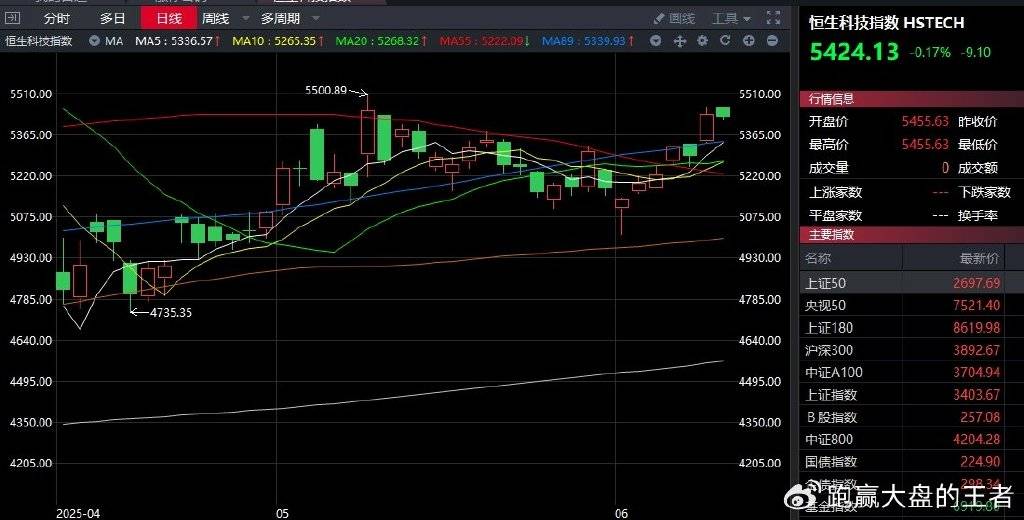
Market Overview - The overall market continues to show a fluctuating trend, with the Shanghai Composite Index maintaining a slight increase while the ChiNext Index is in a downward state [1] - The Hang Seng Index is rising, but the Hang Seng Tech Index is experiencing a pullback from its high [1] Key Technical Levels - The previous high of 5500.89 for the Hang Seng Tech Index is identified as a critical resistance level; a breakthrough could justify short-term bullish positions [3] - Current market conditions are sensitive, suggesting a cautious approach with a focus on observation rather than immediate action [3] Market Dynamics - The global landscape is characterized by major power competition, presenting challenges for the A-share market to achieve a comprehensive upward trend, which is more likely to manifest as a structural bull market [3] - Identifying and participating in mainstream hot sectors is crucial during a structural bull market, with previous recommendations including precious metals and commercial chain concepts showing good performance [3] Sector Rotation and Strategy - In a structural bull market, different sectors exhibit varying performance and rotation patterns, necessitating the ability to recognize these phases [4] - Active participation is encouraged during clear upward trends, while patience is advised during adjustment phases to wait for better entry points [4] - Continuous research and analysis of potential hot sectors are essential for timely opportunity capture [4]

各大券商密集召开中期策略会 普遍看好下半年行情
Shen Zhen Shang Bao· 2025-05-29 06:09
Core Viewpoint - Major brokerages are optimistic about the A-share market in the second half of 2025, anticipating a structural bull market driven by multiple policy benefits and industrial upgrades [1][2]. Market Outlook - Brokerages such as Industrial Securities, CITIC Securities, and Everbright Securities predict a "structural bull" market for the capital market in the second half of 2025 [2]. - Industrial Securities' chief strategist Zhang Yidong believes that A-shares will exhibit characteristics of "stable index, structural bull" in the long term, highlighting the attractive valuation of Chinese assets [2]. - CITIC Securities' chief A-share strategist Qiu Xiang expects a bull market for equity assets starting from Q4 2025, with a significant shift in market style towards core assets [2]. - Everbright Securities' chief strategist Zhang Yusheng notes that the gradual recovery of fundamentals, along with macro and micro liquidity, will drive market growth, leading to a structural bull market [2][3]. Sector Preferences - Investment opportunities in the second half of the year should focus on four key areas according to Industrial Securities' chief strategist Zhang Qiyao: technology trends marked by DeepSeek, domestic service consumption, dividend assets, and sectors like gold and military [4]. - Qiu Xiang emphasizes the importance of increasing allocations to Hong Kong stocks and focusing on leading companies in emerging and traditional industries [4]. - Open Source Securities' chief strategist Wei Jixing suggests five focus areas: domestic consumption, technology growth in AI and robotics, industries with improved costs, sectors benefiting from overseas opportunities, and stable dividend stocks [4]. - Li Chao from Zheshang Securities advocates for a focus on dividend-related sectors and technology, anticipating adjustments in institutional allocation due to new public fund regulations [4].



聚焦券商2025年中期策略 A股升势可期、科技消费引领结构性机遇
Zheng Quan Ri Bao· 2025-05-23 15:54
Group 1 - Major brokerages are optimistic about the A-share market performance in the second half of 2025, expecting stabilization and upward movement driven by multiple policy benefits and industrial upgrades [1][2] - Key investment opportunities are emerging, particularly in the technology and domestic consumption sectors, as highlighted by various analysts [1][3] - The market is anticipated to exhibit a "dual bull" trend in stocks and bonds, with a focus on value discovery and structural bull market characteristics [2][3] Group 2 - Analysts recommend focusing on sectors with favorable conditions and policy support, while also considering defensive assets that can hedge against potential external risks [3][4] - The research perspective has expanded to global trade, with recommendations for sectors such as home appliances, food and beverages, cosmetics, and online retail, which are expected to benefit from the establishment of a long-term domestic consumption mechanism [4] - Key areas for investment include technology growth, military industry, and sectors with improved cost structures, as well as stable dividend stocks suitable for long-term holdings [4]

还在学习新知识?你看不上的板块,已悄然新高——道达投资手记
Mei Ri Jing Ji Xin Wen· 2025-05-21 09:07
Group 1 - The core driver for the formation of a bull market is the recovery of the fundamentals, with liquidity easing and industrial trends often creating a resonance effect [1] - When the fundamentals improve comprehensively, it typically leads to a full bull market; during a structural improvement phase, if it resonates with liquidity easing and industrial trends, it may also give rise to a bull market [2] - The distinction between a structural bull market and a full bull market depends on the main sources of incremental capital; individual investors tend to drive a broad market rally, while institutional investors are more likely to create structural opportunities [1][2] Group 2 - The current recovery process of the fundamentals is expected to be mild and gradual, with macro and micro liquidity resonance and industrial upgrades likely to drive market increases [2] - The easing of monetary policy in both China and the US is anticipated to provide liquidity support, as domestic residents accelerate their asset allocation towards equity markets in a declining interest rate environment [2] - Breakthroughs in artificial intelligence technology and the "AI+" initiative are expected to create an industrial revolution, leading to a comprehensive upgrade in the TMT sector, which may attract incremental capital inflows [2] Group 3 - The conclusion drawn is that the three-dimensional resonance of fundamentals, industry, and capital markets suggests that A-shares may enter a new cycle of structural bull market [3] - The market has experienced a significant rally since late September last year, followed by nearly eight months of wide fluctuations, leading to skepticism about the medium to long-term market outlook [3] - While quantitative funds have influenced profit expectations, there are methods to navigate or follow new profit models in the market [3][4] Group 4 - The market is currently characterized by a rotation trend, with sectors such as scarce resources, gold concepts, solid-state batteries, and innovative drugs showing significant gains [10] - Despite the focus on various sectors, some overlooked sectors like pharmaceuticals, food and beverage, and water utilities have recently reached new highs this year [10] - Blue-chip stocks such as Kelun Pharmaceutical, BYD, and several banks have also reached historical highs, indicating that institutional funds are actively participating in the market [11]

A股有望开启结构性牛市新周期,沪深300ETF(159919)配置价值进一步凸显
Xin Lang Cai Jing· 2025-05-20 02:26
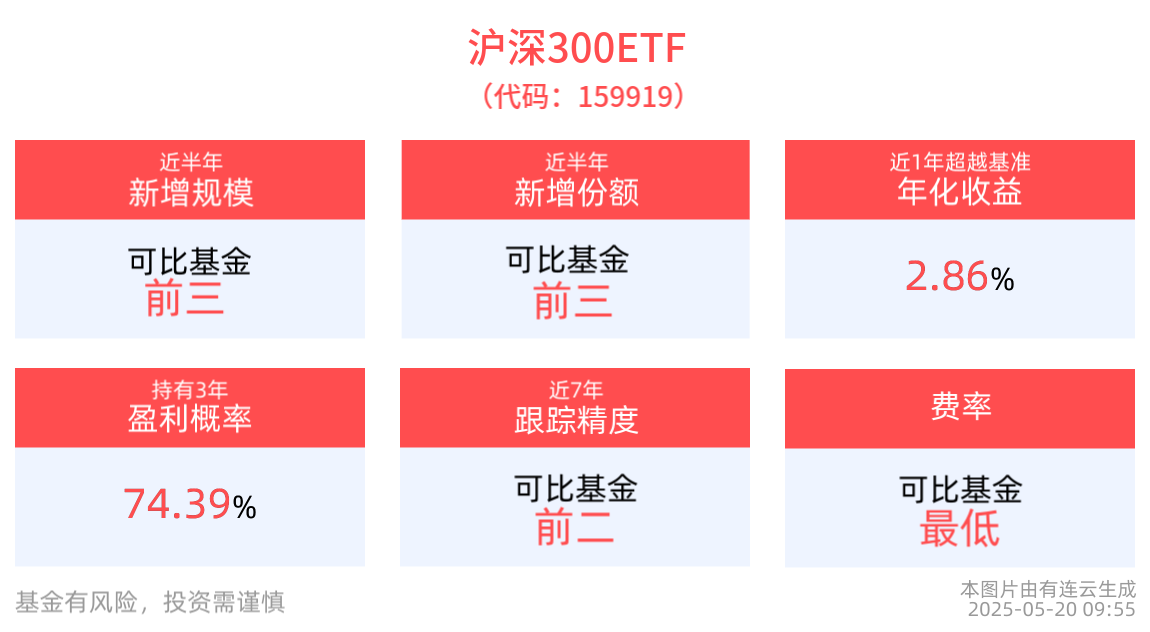
Group 1 - The core viewpoint indicates that the A-share market is expected to enter a new structural bull market cycle driven by the convergence of fundamentals, industry dynamics, and liquidity [4] - The recent trading volume of the CSI 300 ETF reached 58.92 million yuan, with an average daily trading volume of 1.27 billion yuan over the past year, ranking among the top three comparable funds [3] - The CSI 300 ETF has seen significant growth in scale, increasing by 9.89 billion yuan in the past six months, also ranking in the top three for comparable funds [3] Group 2 - The CSI 300 ETF's shares increased by 3.99 billion shares in the last six months, marking a significant growth and ranking in the top three for comparable funds [3] - Leveraged funds have been actively investing in the CSI 300 ETF, with a net purchase of 4.31 million yuan on the highest single day, bringing the latest financing balance to 1.10 billion yuan [3] - The CSI 300 index is currently at a historical low valuation, with a price-to-book ratio (PB) of 1.3, which is lower than 81.5% of the time since the index's inception, indicating strong valuation appeal [3] Group 3 - The top ten weighted stocks in the CSI 300 index account for 22.85% of the index, including major companies like Kweichow Moutai, CATL, and Ping An Insurance [3] - The current price-to-earnings ratio (PE) of the CSI 300 is 12.6, significantly lower than major overseas market indices, highlighting further investment value [3] - The market outlook suggests that the fundamental recovery process will be gradual, with macro and micro liquidity dynamics and industrial upgrades expected to drive market growth [4]
复盘A股历史牛市!猜想:现在会是起点吗?
光大证券研究· 2025-05-19 09:14
Group 1 - The article distinguishes between comprehensive bull markets and structural bull markets in the A-share market, highlighting their different market characteristics [1] - Since 2000, there have been four bull markets in A-shares: comprehensive bull markets from 2005-2007 and 2013-2015, and structural bull markets from 2016-2018 and 2019-2021 [1][3] - Comprehensive bull markets are characterized by higher average daily increases in the Shanghai Composite Index and market turnover rates compared to structural bull markets, with a greater proportion of stocks rising over 100% and equity funds yielding over 100% [1][3] Group 2 - The core driver of bull markets is the recovery of fundamentals, with liquidity easing and industrial trends often creating a resonance effect [3] - Comprehensive bull markets typically arise when fundamentals improve broadly, as seen in the 2005-2007 bull market, while structural bull markets can occur during periods of structural improvement in fundamentals combined with liquidity easing and industrial trends [3][4] - The 2005-2007 bull market saw the Shanghai Composite Index rise by 502%, with nominal GDP maintaining double-digit growth and A-share net profit growth rebounding from -5.8% to 63.5% [4] Group 3 - The 2013-2015 bull market was driven by a combination of monetary easing in China and the U.S., along with the influx of leveraged funds, resulting in a 164% increase in the Shanghai Composite Index [4] - The structural bull markets from 2016-2018 and 2019-2021 were influenced by improvements in fundamentals and inflows of northbound capital, with the latter period seeing a 49% increase in the Shanghai Composite Index [4] - The article suggests that the A-share market may enter a new cycle of structural bull markets driven by the three-dimensional resonance of fundamentals, industry, and capital [4][5] Group 4 - Looking ahead, the recovery of fundamentals is expected to be gradual, with macro and micro liquidity resonating with industrial upgrades to drive market growth [5] - The potential for simultaneous monetary easing in China and the U.S. could lead to a shift of domestic assets towards equity markets, supported by a slowdown in IPOs and restrictions on shareholder reductions [5] - The article posits that while a comprehensive bull market may be unlikely due to the broad scope of the A-share market, new incremental capital could drive a structural bull market, with 2025 being a potential starting point [5]

A500指数ETF(159351)上周日均成交额超25亿元,机构:A股有望开启结构性牛市新周期
2 1 Shi Ji Jing Ji Bao Dao· 2025-05-19 02:12
Group 1 - The A-share market opened lower on May 19, with the CSI A500 Index down 0.45%, while stocks like Haige Communication and others saw gains [1] - The A500 Index ETF (159351) recorded over 1 billion yuan in trading volume within the first ten minutes of opening [1] - The average daily trading volume of the A500 Index ETF from May 12 to May 16 was 25.32 billion yuan, with a latest circulation scale of 143.68 billion yuan and 14.843 billion shares as of May 16 [1] Group 2 - Xiangcai Securities indicates that the A-share market is likely to experience a "slow bull" trend by 2025, influenced by the new "National Nine Articles" and a "four trillion" investment overlap [2] - According to Everbright Securities, a structural bull market may begin due to the three-dimensional resonance of fundamentals, industry, and capital, with gradual recovery expected in the fundamental landscape [2] - Key focus areas for the market in the future include technology, green initiatives, consumption, and infrastructure, as highlighted in the 2025 government work report [2]
中美关税博弈的经济逻辑与中国关键抓手!中邮证券黄付生专业解读
Sou Hu Cai Jing· 2025-05-16 05:49
Core Viewpoint - The recent joint statement from the China-US Geneva economic talks on May 12 is seen as a potential turning point in easing tensions between the two nations, with significant tariff reductions announced [1][2]. Economic Rebalancing - The joint statement indicates a notable decrease in tariffs, with China reducing tariffs on US goods from 125% to 10% within the first 90 days, while the US will lower tariffs on Chinese goods to 30% [2][3]. - A 24% tariff will be suspended for 90 days, allowing for negotiations before July [3]. US Economic Context - The US has historically maintained high tariffs, averaging around 30%, which has been a part of its economic development strategy [3]. - The current economic situation suggests that the US cannot revert to pre-April 2 conditions, with markets anticipating fiscal easing from China and tax cuts from the US [3]. US Fiscal Pressure - As of March 2025, the US national debt is projected to reach approximately $36.6 trillion, with a significant portion of low-interest bonds maturing between 2025 and 2027, leading to increased interest payments [4]. - The US government is using tariff increases as a means to alleviate fiscal pressure, with potential tariff revenues significantly exceeding current levels [4][5]. Chinese Economic Strategy - China is focusing on boosting domestic consumption, particularly in the service sector, to counteract economic pressures [9]. - The first quarter of 2023 saw a GDP growth rate of 5.4%, driven by strong exports and a gradual recovery in consumption [9]. Key Economic Drivers for 2025 - The "Two New" and "Two Heavy" initiatives are identified as critical for China's economic development in 2025, focusing on equipment upgrades and major strategic projects [10][11]. - The expected policy support for these initiatives could reach around 3 trillion yuan, with investment multipliers anticipated to be higher than in 2024 [11]. Stimulus Measures - Six potential measures to stimulate the economy include expanding fertility subsidies, injecting capital into state-owned banks, increasing consumer subsidies, advancing supply-side reforms, issuing special government bonds, and raising rural pension levels [12][13][14][15][16]. Market Outlook - The equity market is expected to enter a "long-cycle, structural bull market," with monetary policy supporting the stock market while fiscal measures are necessary for economic recovery [16]. - The bond market may face risks in the second half of the year, with a potential upward trend in yields as economic conditions stabilize [16].
中美“联合声明”重磅发布 A股重启结构牛 A500指数ETF(159351)收盘上涨1.15%
Mei Ri Jing Ji Xin Wen· 2025-05-12 08:17
Group 1 - The A-share market continues its strong performance in May, with the Shanghai Composite Index closing at 3369.24 points, up 0.82% [1] - The A500 Index ETF (159351) saw a trading volume of 2.325 billion yuan, ranking fourth among similar products in the market, with a turnover rate of 16.11%, the second highest [1] - The A500 Index ETF (159351) experienced a net subscription of 33 million units, indicating optimistic market expectations [1] Group 2 - The recent high-level economic and trade talks between China and the U.S. in Geneva resulted in substantial progress and important consensus, with both sides agreeing to establish a consultation mechanism [2] - Short-term outlook suggests a potential strong recovery in the A-share market as external uncertainties diminish, while long-term prospects indicate a possible structural bull market driven by technological advancements [2] - The A500 Index ETF, which tracks the CSI A500 Index, consists of 500 large-cap stocks with balanced industry distribution, providing investors with a tool to access representative A-share companies [3]