
降息预期

Search documents
金融期货早评-20250806
Nan Hua Qi Huo· 2025-08-06 01:50
Report Industry Investment Ratings No relevant information provided. Core Views of the Report - Domestically, the economy shows downward pressure as the manufacturing PMI declines. It enters a policy observation period, and incremental policies may be introduced if economic data continues to weaken. Overseas, it's an inflation observation period. Despite a hawkish speech from Powell, the Fed's core targets are employment and inflation. With poor non - farm data and high inflation in the US service sector, there may be fluctuations in the Fed's interest - rate cut expectations [2]. - For the RMB exchange rate, without new shock factors, it is expected to be supported in the 7.15 - 7.23 range, with a likely central anchor at 7.20 [4]. - The A - share market is expected to show a structural and volatile trend. The adjustment of US tariff policies may reduce risk appetite [6]. - For the bond market, there is a mild price repair. Although the stock market is strong, the bond market is at most suppressed, and a band - trading strategy is recommended [7]. - For the shipping industry, the container shipping index is expected to be volatile and may decline in the medium - term [9]. - In the precious metals market, due to the increased expectation of a Fed rate cut in September, gold and silver are expected to be strong in the medium - to - long - term and are mainly controlled by bulls in the short - term [11]. - In the non - ferrous metals market, copper may be volatile and weak; aluminum is expected to be under pressure and volatile; alumina is expected to be weak; cast aluminum alloy is expected to be volatile; zinc is expected to rebound after reaching the bottom; nickel and stainless steel are expected to be volatile in the short - term; tin may rise slightly; and the recommended strategies vary for each metal [13][15][16][17][18][19]. - In the black metals market, steel products' prices have limited upward and downward space; iron ore is expected to be strong; coking coal and coke may have increased price fluctuations, and the medium - to - long - term trend is not pessimistic; silicon iron and silicon manganese are not overly pessimistic despite the decline in sentiment [21][23][26][27]. - In the energy and chemical market, crude oil is under supply pressure and has limited upward space; LPG is in a loose supply situation; PX - TA can be considered for expanding processing fees at low prices; MEG - bottle chips are expected to be range - bound; methanol's fundamentals are weak in the short - term; PP is driven up by coal prices; PE needs to wait for demand recovery; PVC's pricing returns to the industry, and short - selling is recommended; pure benzene and styrene are expected to be volatile; fuel oil is weak; low - sulfur fuel oil is recommended for short - selling; asphalt is expected to be weakly volatile; urea is expected to be weakly volatile; glass, soda ash, and caustic soda show a pattern of near - term weakness and long - term strength; pulp is expected to be volatile after a decline; and propylene's price in the Shandong market has a slight increase [31][33][35][37][39][42][45][47][48][50][51][53][54][56][58][59][60][61][66]. - In the agricultural products market, for live pigs, short - selling at high prices is recommended; for oilseeds, long - buying in the far - month contracts is recommended [67][69]. Summaries by Relevant Catalogs Financial Futures Macro - Market information includes policies on financial support for new - type industrialization in China, the US service - sector PMI causing concerns about stagflation, Trump's statements on tariffs and the Fed, and the high proportion of seriously overdue consumer loans in the US [1]. RMB Exchange Rate - The previous trading day's RMB exchange - rate performance shows a decline in the on - shore RMB against the US dollar. Trump's tariff policies and the decline in the US non - manufacturing index are important factors. Without new shock factors, the short - term exchange rate is expected to be supported in the 7.15 - 7.23 range [3][4]. Stock Index - The stock index continued to rise yesterday, and the small - cap stocks were strong. The A - share market is expected to show a structural and volatile trend due to policy support and the adjustment of US tariff policies [5][6]. Treasury Bonds - Treasury futures fluctuated upward, and the price is in a mild repair state. The bond market is at most suppressed by the strong stock market, and a band - trading strategy is recommended [7]. Shipping - The container shipping index futures opened low and fluctuated. The spot prices of major shipping companies have been continuously reduced, and the futures price is expected to be volatile and may decline in the medium - term [8][9]. Commodities Non - Ferrous Metals - **Gold & Silver**: The price of precious metals rose due to the increased expectation of a Fed rate cut in September. They are expected to be strong in the medium - to - long - term and are mainly controlled by bulls in the short - term [11]. - **Copper**: The copper price rebounded slightly, mainly to correct the previous decline. It may be volatile and weak in the short - term, and investors are advised to hold cash and wait [13][14]. - **Aluminum Industry Chain**: Aluminum is expected to be under pressure and volatile; alumina is expected to be weak; cast aluminum alloy is expected to be volatile, and an arbitrage strategy can be considered when the price difference is large [15][16]. - **Zinc**: Zinc is expected to rebound after reaching the bottom. The supply is gradually changing from tight to surplus, and the demand is weak in the traditional off - season [16][17]. - **Nickel & Stainless Steel**: They are expected to be volatile in the short - term. The fundamentals of nickel have no obvious changes, and the supply of nickel - iron is supported by the expected increase in steel - mill production in August. The stability of the stainless - steel price needs to be tested [18]. - **Tin**: Tin rose slightly, showing strong resilience. The supply problem has not been resolved, and the demand weakness has not fully affected the price. Inventory hedging can be considered at an appropriate time [19]. Black Metals - **Steel Products**: Steel products' prices have limited upward and downward space. Although the export orders have weakened, the market pressure is temporarily relieved, and the coal - mine inspection and military - parade limit - production expectations provide support [20][21]. - **Iron Ore**: Iron ore is expected to be strong. The short - term fundamentals are good, and the supply is neutral while the demand is expected to remain high. The price is expected to break through the 800 - yuan pressure level [22][23]. - **Coking Coal & Coke**: The prices of coking coal and coke rose strongly. The "anti - involution" policy may lead to increased price fluctuations, and the medium - to - long - term trend is not pessimistic. It is not recommended for non - spot - handling investors to participate in the 09 - contract delivery game [25][26]. - **Silicon Iron & Silicon Manganese**: Although the sentiment has declined, there is no need to be overly pessimistic. The supply is increasing, and the demand is supported by high steel - mill profits in the short - term, but the long - term demand is uncertain [27][28]. Energy and Chemicals - **Crude Oil**: The crude oil price fell overnight, and the market is under supply pressure. The seasonal demand is weakening, and the upward space is limited [30][31]. - **LPG**: LPG is in a loose supply situation. The domestic supply is abundant, and the demand has little change. The price is expected to be under pressure [32][33]. - **PX - PTA**: The PX - TA price has fallen. The current TA processing fee is at a historical low, and there are many expected TA maintenance plans. It is recommended to expand the processing fee at low prices [34][35]. - **MEG - Bottle Chips**: The "anti - involution" premium has been squeezed out, and the fundamentals have insufficient driving force. They are expected to be range - bound [36][37]. - **Methanol**: The "anti - involution" sentiment has subsided, and the methanol market has returned to fundamentals, which are weak in the short - term. Attention should be paid to downstream resistance and port - to - inland price differences [38][39]. - **PP**: PP's price rose driven by coal prices. The supply pressure is increasing, and the demand is weak, so the market is in a weak pattern [40][42]. - **PE**: PE's price was driven up by the coal - market. The current demand is weak, and the inventory is high, but the demand is expected to recover in August [43][45]. - **PVC**: PVC's pricing has returned to the industry. The supply is increasing, the demand is weak, and the inventory is rising. Short - selling is recommended [46][47]. - **Pure Benzene & Styrene**: Pure benzene and styrene are expected to be volatile. The supply and demand of pure benzene are both increasing, and the supply of styrene is expected to increase in August and September [48][50]. - **Fuel Oil & Low - Sulfur Fuel Oil**: Fuel oil is weak, and low - sulfur fuel oil is recommended for short - selling due to weak supply, demand, and high inventory [51][53]. - **Asphalt**: Asphalt is expected to be weakly volatile, following the cost - end. The supply has increased, but the demand is affected by weather and funds. The medium - to - long - term demand is expected to improve [53][54]. - **Urea**: Urea is under pressure. Although the export demand provides some support, the agricultural demand is weakening [55][56]. - **Glass, Soda Ash & Caustic Soda**: They show a pattern of near - term weakness and long - term strength. Soda ash has a strong supply and weak demand; glass is in a weak - balance state; and caustic soda may start the delivery logic in August [57][58][59][60]. - **Paper Pulp**: Paper pulp is expected to be volatile after a decline. The supply and inventory are high, and the demand has no obvious long - term increase, but there is seasonal support in August [61][62]. - **Propylene**: The price of propylene in the Shandong market has a slight increase. The supply is loose, and the demand has little change. The cost is affected by multiple factors [64][66]. Agricultural Products - **Live Pigs**: The spot price of live pigs is stable, and the supply exceeds demand. It is recommended to short - sell at high prices [67]. - **Oilseeds**: The outer - market US soybeans are weak, and the inner - market soybeans are pricing the far - month supply gap. It is recommended to long - buy in the far - month contracts [68][69].
利空突袭!暴跌!
券商中国· 2025-08-06 01:43
Group 1: Earnings Reports Impact - Several tech stocks, including Supermicro, Snap, and AMD, experienced significant declines in after-hours trading due to disappointing earnings reports, with Supermicro dropping over 16%, Snap over 14%, and AMD over 6% [2][3] - Supermicro's Q4 FY2025 net sales were $5.76 billion, below the analyst expectation of $6.01 billion, with a gross margin of 9.6%, lower than the expected 10% [2] - Snap reported Q2 sales of $1.345 billion, slightly below the expected $1.35 billion, and a net loss of $262.6 million, compared to a loss of $248.6 million in the same period last year [3] - AMD's Q2 revenue grew 32% year-over-year to $7.7 billion, exceeding the analyst expectation of $7.43 billion, but adjusted EPS was $0.48, below the expected $0.49 [3] Group 2: Market Reactions and Economic Indicators - The ISM services PMI for July was reported at 50.1, below the expected 51.5, indicating near stagnation in the services sector, with the employment index dropping to 46.4, the lowest since the pandemic [8] - The price index rose to 69.9, suggesting increased inflationary pressures, which complicates the Federal Reserve's policy decisions [8] - The overall market sentiment was negatively impacted by President Trump's announcement of new tariffs, including a potential 250% tariff on imported drugs and upcoming tariffs on semiconductors [8][9] Group 3: Broader Market Trends - Major U.S. stock indices closed lower, with the Dow Jones down 0.14%, S&P 500 down 0.49%, and Nasdaq down 0.65%, with over 4,700 stocks declining [6][7] - Other large tech stocks also saw declines, including Microsoft, Meta, and Nvidia, while Amazon managed a slight increase of 0.99% [5]


地缘冲突升级,美联储换帅,金价保持强势丨黄金早参
Sou Hu Cai Jing· 2025-08-06 01:34
Group 1 - The core viewpoint of the articles highlights the strong rise in gold prices driven by increased demand for safe-haven assets due to geopolitical tensions and changes in the Federal Reserve's leadership [1][2] - On August 5, gold prices reached a peak of $3444 per ounce before slightly retreating to close at $3435 per ounce, reflecting a 0.25% increase in COMEX gold futures [1] - The announcement by Trump regarding the potential replacement of Federal Reserve Chairman Powell and the geopolitical situation in Israel are significant factors influencing market sentiment [1] Group 2 - The analysis indicates that the recent surge in gold prices is supported by expectations of interest rate cuts, inflation pressures from tariffs, and changes in Federal Reserve personnel [2] - Short-term forecasts suggest that gold prices may remain strong, with a potential breakthrough of the recent high of $3390 per ounce, contingent on safe-haven demand and interest rate expectations [2] - Long-term outlooks emphasize that global economic uncertainty and geopolitical risks will continue to support gold prices, with key variables being Trump's trade policies and the direction of Federal Reserve monetary policy [2]
两个凯文领跑“影子联储主席”人选! 特朗普盛赞“凯文双星” 沃勒预测热度降温
智通财经网· 2025-08-06 01:24
智通财经APP获悉,白宫国家经济委员会主任凯文·哈塞特、前美联储理事凯文·沃什、现任美联储理事 克里斯托弗·沃勒以及现任财政部长斯科特·贝森特均被华尔街分析师们提出作为领导美联储的候选人, 但随着特朗普表示贝森特希望专注于财长一职,市场的焦点集中在两个"凯文"(Kevin)——即凯文·哈塞 特与凯文·沃什。据了解,在接受 CNBC 《Squawk Box》节目的广泛采访中,特朗普高度评价了凯文·哈 塞特与凯文·沃什。 哈塞特和沃什都主张降低利率。现任美联储主席鲍威尔的任期将于2026年5月结束,他因维持高利率而 屡遭特朗普批评。 美联储理事阿德里亚娜·库格勒上周五宣布本周生效的辞职决定,特朗普称此举"是个惊喜"。此举为特 朗普安排人选进入美联储理事提供重大机会,而获美联储理事任命者在鲍威尔任期结束时极有可能晋升 为美联储主席。 在 Kalshi上,特朗普首个总统任期的前经济顾问朱迪·谢尔顿被赋予6%的概率成为鲍威尔的接班人。曾 于2019至2023年担任世界银行行长的前政府官员戴维·马尔帕斯目前在该预测市场上的概率为4%。 甚至特朗普本人在 Kalshi 上也获得了1%的"票数"来领导美联储。 在接受CNBC ...
降息预期利好人民币、黄金
Di Yi Cai Jing Zi Xun· 2025-08-05 16:00
Group 1: Employment Data Impact - The U.S. non-farm payroll report showed a significant drop in employment, with only 73,000 jobs added in July, far below the expected 104,000, and revisions in June and May data resulted in a total loss of 258,000 jobs over two months [3][4][5] - The report has raised the probability of a Federal Reserve rate cut in September to 75%, influencing asset allocation strategies, including the outlook for the Chinese yuan and gold [2][5] - The downward revision of employment data is the largest in two months since 1968, indicating a concerning trend in the labor market [4] Group 2: Market Reactions - Despite the poor employment data, the stock market only experienced a one-day pullback, as strong earnings reports from major tech companies boosted investor sentiment [6][7] - Goldman Sachs predicts that the Federal Reserve will implement three rate cuts of 25 basis points each by the end of the year, with a potential 50 basis point cut if August employment data worsens [6] - Morgan Stanley expresses increased confidence in the stock market for the next 12 months, citing strong earnings from large tech firms and a potential end to the rolling earnings recession that began in early 2022 [6][7] Group 3: Currency and Gold Outlook - The U.S. dollar index fell back to the 98 range following the non-farm report, with expectations of a weaker dollar benefiting U.S. corporate earnings, particularly for companies with significant overseas revenue [8] - Predictions for the Chinese yuan remain mixed, with potential downward pressure due to tariffs and a shift in policy focus towards inflation [9][10] - Gold prices have seen a boost, rising to around $3,400 per ounce, driven by expectations of rate cuts and ongoing central bank demand, despite a slight slowdown in purchases in the second quarter [11][12]

一场财富大转移,开始了!
大胡子说房· 2025-08-05 13:02
Core Viewpoint - The article suggests that a new wealth cycle in the capital market may have begun, driven by recent disappointing U.S. employment data and its implications for the economy [2]. Group 1: U.S. Employment Data and Market Reaction - The recent U.S. non-farm payroll data fell short of market expectations, with previous employment figures revised down significantly by 90%, leading to a collapse in market confidence regarding the U.S. economy [3][6]. - Global stock markets experienced a collective plunge, with European markets dropping over 2% and the U.S. Dow Jones falling over 600 points [4][6]. - The downward revisions of employment data for June and May were drastic, with June's figures adjusted from 147,000 to 14,000 and May's from 125,000 to 19,000, indicating that only 10% of the reported data may be accurate [11][12]. Group 2: Market Dynamics and Capital Flows - The article posits that the capital markets in East Asia (referred to as "东大") are increasingly decoupling from U.S. dollar assets, allowing them to react independently to U.S. economic news [19][24]. - Despite the global panic triggered by the U.S. employment data, East Asian markets saw a rebound, with the Shanghai Composite Index rising by 23 points and the Hang Seng Index increasing by 225 points [16][18]. - The article emphasizes that the East Asian capital market is preparing for a potential decoupling from U.S. policies, which could lead to a unique market trajectory [20][25]. Group 3: Future Projections and Federal Reserve Decisions - The sustainability of the current market rally in East Asia is contingent upon the Federal Reserve's decisions, particularly regarding interest rate cuts [28][30]. - Market expectations for a rate cut in September have surged from 39% to 77%, indicating a significant shift in sentiment [38]. - If the Federal Reserve chooses not to cut rates in September, it could mark the end of the current rally, while a rate cut could trigger a substantial shift of capital from dollar assets to non-dollar assets, including precious metals and East Asian markets [33][35][46].

DLSM外汇平台:周一一轮暴涨之后,美股真的又“安全”了吗?
Sou Hu Cai Jing· 2025-08-05 10:05
Group 1 - The major U.S. stock indices experienced significant gains, with the Dow Jones Industrial Average, S&P 500, and Nasdaq rising by 1.34%, 1.47%, and 1.95% respectively, marking the largest single-day percentage increase since May 27 [1] - The market's rebound is driven by the "bad news is good news" logic, particularly in response to disappointing employment data, which is interpreted as increasing the likelihood of interest rate cuts by the Federal Reserve [3] - Technology stocks, especially the Nasdaq, benefited significantly from this sentiment, with Tesla's stock rising due to Elon Musk receiving a new round of stock options, signaling management's confidence in the company's long-term value [3] Group 2 - Despite strong performances from major tech companies during the earnings season, there is structural differentiation, with Spotify rising 5% due to a price adjustment announcement, while Berkshire Hathaway fell 2.7% after disclosing a $3.8 billion write-down, highlighting the risks even for stable companies [4] - The S&P 500 and Nasdaq have reached historical highs, but valuations are nearing the top of the past decade's range, raising concerns about sustainability amid high U.S. Treasury yields and ongoing global geopolitical risks [4] - The current market rally appears to be a technical correction rather than a trend reversal, with ongoing volatility expected as investors need to remain rational and identify assets with fundamental support rather than chasing high prices blindly [4]

降息预期升温,美债“牛陡”行情再现
证券时报· 2025-08-05 09:18
Core Viewpoint - The unexpected performance of the non-farm employment data has ignited market expectations for interest rate cuts by the Federal Reserve, leading to a significant rally in the U.S. Treasury market [1][5]. Group 1: Non-Farm Employment Data - In July, the U.S. non-farm sector added only 73,000 jobs, significantly below expectations, with the unemployment rate slightly rising to 4.2% [6]. - The non-farm employment figures for May and June were drastically revised downwards, with May's jobs revised from 144,000 to just 19,000, and June's from 147,000 to 14,000 [6]. Group 2: Market Reactions - Following the release of the non-farm data, the 2-year Treasury yield fell over 25 basis points from 3.953% to 3.696%, while the 5-year yield dropped over 20 basis points from 3.967% to 3.755% [4]. - The 10-year and 30-year Treasury yields also saw declines of over 15 and 20 basis points, respectively, reflecting a broad-based drop in yields across the curve [4]. Group 3: Interest Rate Expectations - According to CME's FedWatch, the probability of the Federal Reserve maintaining rates in September is only 5.6%, while the probability of a 25 basis point cut is 94.4% [6]. - The market has priced in a high likelihood of rate cuts in September, a shift from less than 40% before the non-farm data release [7]. Group 4: Economic Outlook - Despite the weak employment data, some analysts caution that the current "recession trade" does not equate to an actual recession, as other economic indicators, such as average hourly earnings, have shown improvement [9][10]. - The overall economic slowdown, indicated by recent employment and GDP data, provides conditions for the Federal Reserve to consider rate cuts [9].

美债专题跟踪 | 美7月非农数据遭遇“滑铁卢”,10年期美债收益率大幅下行
Sou Hu Cai Jing· 2025-08-05 08:43
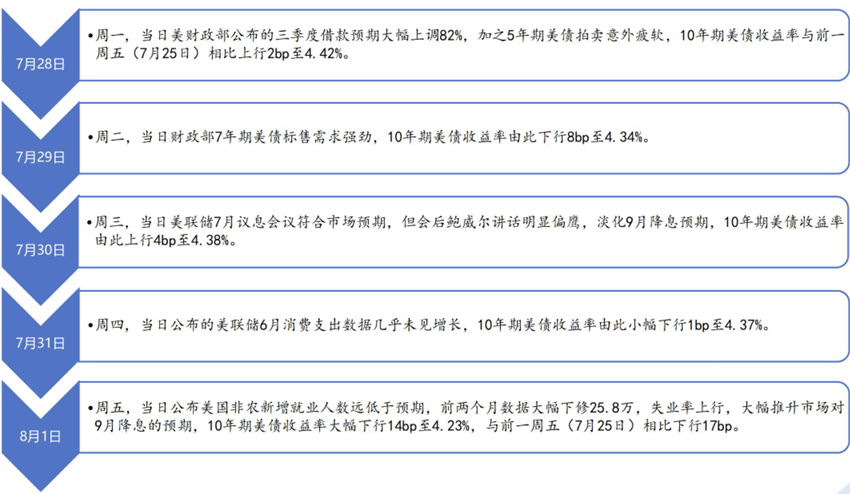
来源:东方金诚 上周美债收益率走势回顾 2025年7月28日当周,10年期美债收益率大幅下行。具体来看:周一,当日美财政部公布的三季度借款预期大幅上调 82%,加之5年期美债拍卖意外疲软,10年期美债收益率与前一周五(7月25日)相比上行2bp至4.42%;周二,当日财政 部7年期美债标售需求强劲,10年期美债收益率由此下行8bp至4.34%;周三,当日美联储7月议息会议符合市场预期,但 会后鲍威尔讲话明显偏鹰,淡化9月降息预期,10年期美债收益率由此上行4bp至4.38%;周四,当日公布的美联储6月消 费支出数据几乎未见增长,10年期美债收益率由此小幅下行1bp至4.37%;周五,当日公布的美国非农新增就业人数远低 于预期,前两个月数据大幅下修25.8万,失业率上行,大幅推升市场对9月降息的预期,10年期美债收益率大幅下行14bp 至4.23%,与前一周五(7月25日)相比下行17bp。 2.短期走势展望 在7月非农数据的推动下,目前市场对降息已重新定价(9月降息概率超过80%),除非8月7日公布的初请失业金人数大 幅低于预期,否则预计本周降息预期仍将继续发酵,从而推动10年期美债收益率继续探底。此外,特朗 ...
非农下修+人事变动,黄金迎金融、货币属性共振
Tianfeng Securities· 2025-08-05 08:15
Investment Rating - Industry Rating: Outperform the market (maintained rating) [6] Core Viewpoints - The report highlights three significant events in early August that may drive gold prices upward: a downward revision of non-farm employment data, a key resignation at the Federal Reserve, and political interference in employment statistics [2][3][4] - The downward revision of July's non-farm employment figures to 73,000, below the expected 110,000, along with substantial downward adjustments to previous months' data, reflects a weakening economic backdrop and raises expectations for interest rate cuts, which is favorable for gold's financial attributes [3] - The resignation of a hawkish Federal Reserve member and changes in employment data leadership raise concerns about the independence of monetary policy, potentially leading to a loss of credibility in economic data and a favorable environment for gold prices [4] Summary by Sections Non-Farm Employment Data - July's non-farm employment added 73,000 jobs, significantly below the expected 110,000, with a total downward revision of 258,000 jobs for May and June [2][3] - The report notes a structural divide in employment growth, with private sector jobs increasing only by 74,000, the lowest since October of the previous year [3] Monetary Policy and Economic Outlook - The report suggests that the changes in leadership at the Federal Reserve could mirror historical instances where political pressures compromised monetary policy independence, potentially leading to stagflation [4] - The probability of a rate cut by the Federal Reserve for the September meeting surged from under 40% to nearly 90% following the employment data release [3] Investment Recommendations - The report maintains a positive outlook on the gold sector, recommending attention to companies such as China National Gold International, Shandong Gold, and others in the gold mining industry [4]