去美元化

Search documents
加拿大反水,狂抛567亿美债,白宫梦碎,中国持仓一夜回到17年前
Sou Hu Cai Jing· 2025-12-22 06:25
美国国债曾经是全球金融市场的"定海神针",无数国家将其视为最安全的资产储备,然而时至2025年 末,再看这一切,人们发现:世界变了,美国国债的神话正在逐步瓦解。 根据美国财政部最新发布的数据,2025年10月,中国再度大幅减持美国国债,单月减持额高达118亿美 元,将中国持有的美债总规模削减至6887亿美元。 这一数字不仅创下自2008年以来的最低纪录,更意味着中国对美债的持仓已回到17年前的水平,中国的 美债持仓已连续数月跌破7000亿美元的"心理防线"。 值得注意的是,此次减持并非孤例,加拿大同期抛售行为更为剧烈,此前数月持续增持的加拿大突然转 向,单月减持规模高达567亿美元,成为当月全球减持规模最大的经济体。 这已经不再是简单的经济账,而是对债务人偿付能力的信任危机。要知道,此时的美国财政早已千疮百 孔。仅仅在2025年第一季度,美国用来偿还债务利息的支出就达到了惊人的1.1万亿美元。 这是什么概念?相当于政府全年税收的四分之一,还没来得及用于修桥铺路、改善民生,就已经作为利 息流进了债权人的口袋。 一个是东方大国的战略定力与防御,另一个则是北方邻居的愤怒反击与背刺。而这一切的导火索,都要 归结于华盛 ...

西南期货早间评论-20251222
Xi Nan Qi Huo· 2025-12-22 05:58
Report Industry Investment Ratings No relevant content provided. Core Views - The macroeconomic recovery momentum needs to be strengthened, and it is expected that the monetary policy will remain loose. There is still some pressure on treasury bond futures, so stay cautious [6]. - The domestic economic recovery momentum is not strong, but the valuation repair of domestic assets still has room, and the market sentiment has warmed up recently. It is expected that the central fluctuation range of stock index futures will gradually move up, and investors can choose the right time to go long [8]. - The global trade and financial environment is complex. The trends of "anti - globalization" and "de - dollarization" are beneficial to the allocation and hedging value of gold. It is expected that precious metals will continue to rise. Investors can wait and see for now and wait for opportunities to go long [10]. - The supply - demand pattern of steel products such as rebar and hot - rolled coils is weak, and the prices may continue the weak and volatile pattern. Investors can pay attention to short - selling opportunities at high levels during rebounds [11]. - The supply - demand pattern of iron ore is weak, and the futures may face resistance near the previous high. Investors can pay attention to short - selling opportunities at high levels [13]. - Coke and coking coal futures may continue to rebound in the short term. Investors can pay attention to buying opportunities at low levels [15]. - The overall surplus pressure of ferroalloys continues, but the downward space of costs is limited. After a decline, investors can consider long - position opportunities at low levels when the spot losses expand [17]. - The trend of crude oil is uncertain. The price of Brent crude oil is near the $60 integer mark. Investors need to wait for the market to become clear and temporarily stay on the sidelines [20]. - The spot supply of fuel oil in Asia is suddenly tight, and the cost - end crude oil stabilizes. The fuel oil price has fallen to a new low this year and has a large rebound space. Investors can temporarily stay on the sidelines [23]. - The polyolefin market is still in a negative feedback stage, but the reduction of standard product supply may boost market sentiment to some extent. Investors can pay attention to long - position opportunities [27]. - Synthetic rubber is expected to fluctuate [30]. - Natural rubber is expected to show a volatile trend [33]. - The PVC market continues to have a supply - surplus situation, and investors should pay attention to changes in the supply side [34]. - The downward space of urea prices is limited [37]. - PX may fluctuate strongly in the short term. Investors can pay attention to opportunities to participate at low levels and be vigilant about changes in crude oil and macro - policies [38]. - PTA may have an upward driving force in the short term. Investors can consider participating at low levels, control risks, and pay attention to oil price changes [39]. - Ethylene glycol may maintain a bottom - oscillating pattern in the short term. Investors can consider trading within the range and pay attention to port inventory and supply changes [40]. - Short - fiber may follow the raw material price to oscillate. Investors should control risks and pay attention to cost changes and macro - policy adjustments [41]. - Bottle chips are expected to follow the cost side to oscillate. Investors should control risks [42]. - The supply and demand of lithium carbonate are both strong, and the social inventory is gradually being depleted. Investors should pay attention to the sustainability of consumption [43]. - Copper prices are expected to maintain a high - level oscillation [46]. - Aluminum prices are expected to maintain a high - level oscillation [48]. - Zinc prices are expected to maintain an oscillating adjustment [51]. - Lead prices are expected to oscillate weakly within a range [53]. - Tin prices are expected to oscillate strongly [54]. - Nickel is still in a surplus pattern, and investors should pay attention to relevant policies in Indonesia [56]. - For soybean meal, investors can pay attention to long - position opportunities in the low - cost support range; for soybean oil, the short - term downward space may be limited, and investors can pay attention to long - position opportunities in call options [59]. - Palm oil investors should temporarily stay on the sidelines [61]. - Rapeseed meal and rapeseed oil investors should temporarily stay on the sidelines [64]. - Cotton prices are expected to run strongly [68]. - Sugar prices are expected to run weakly and oscillate [71]. - Apple prices are expected to run strongly [73]. - For live pigs, investors should continue to follow the marginal changes in consumption brought by subsequent cooling and consider waiting and seeing [76]. - For eggs, investors should consider temporarily staying on the sidelines [78]. - Corn and corn starch may follow the market trend. Investors should wait patiently for the further release of supply pressure [80]. Summaries by Related Catalogs Treasury Bonds - On the previous trading day, treasury bond futures closed up across the board. The central bank conducted reverse - repurchase operations, with a net investment of 357 billion yuan on the day. It is expected that there is still some pressure on treasury bond futures, so stay cautious [5][6]. Stock Index Futures - On the previous trading day, stock index futures showed mixed trends. The domestic economic recovery momentum is weak, but the valuation repair of domestic assets has room, and the market sentiment has warmed up. It is expected that the central fluctuation range will gradually move up, and investors can choose the right time to go long [8]. Precious Metals - On the previous trading day, gold and silver futures closed down. The Bank of Japan raised interest rates, and the US consumer confidence index was lower than expected. The global trade and financial environment is complex, which is beneficial to the allocation and hedging value of gold. It is expected that precious metals will continue to rise. Investors can wait and see for now and wait for opportunities to go long [10]. Rebar and Hot - Rolled Coils - On the previous trading day, rebar and hot - rolled coil futures oscillated. The demand for rebar is in a year - on - year decline, and the market will enter the off - season. The production capacity is in surplus, and the inventory pressure is obvious. The prices may continue the weak and volatile pattern. Investors can pay attention to short - selling opportunities at high levels during rebounds [11]. Iron Ore - On the previous trading day, iron ore futures rose slightly. The national hot - metal daily output has been declining since October, the supply has increased, and the port inventory has continued to rise. The supply - demand pattern is weak, and the futures may face resistance near the previous high. Investors can pay attention to short - selling opportunities at high levels [13]. Coke and Coking Coal - On the previous trading day, coke and coking coal futures oscillated. The production of domestic coking coal has decreased, and the demand from downstream coking enterprises has increased. The third - round price cut of coke spot procurement has started, and the demand from steel mills has weakened. The futures may continue to rebound in the short term. Investors can pay attention to buying opportunities at low levels [15]. Ferroalloys - On the previous trading day, manganese - silicon and silicon - iron futures closed up. The supply of manganese ore has decreased, and the cost of ferroalloys has increased. The production of ferroalloys has continued to decline, and the demand is weak. The overall surplus pressure continues, but the downward space of costs is limited. After a decline, investors can consider long - position opportunities at low levels when the spot losses expand [17]. Crude Oil - On the previous trading day, INE crude oil rebounded after reaching a low. The US imposed sanctions on Venezuelan oil tankers. The CFTC data showed that fund managers reduced their net short positions in US crude oil futures and options. The number of active oil and gas rigs in the US decreased. Barclays maintained its forecast for Brent crude oil prices in 2026. The trend of crude oil is uncertain, and investors need to wait for the market to become clear and temporarily stay on the sidelines [19][20]. Fuel Oil - On the previous trading day, fuel oil fell sharply. The supply of marine fuel oil in Asia is suddenly tight, and the cost - end crude oil stabilizes. The fuel oil price has fallen to a new low this year and has a large rebound space. Investors can temporarily stay on the sidelines [22][23]. Polyolefins - On the previous trading day, the prices of PP and LLDPE in the market fell. The production of polyolefins is expected to be stable with slight fluctuations. The supply pressure of standard products may be slightly relieved, but the downstream demand is expected to weaken. The market is still in a negative feedback stage, but the reduction of standard product supply may boost market sentiment to some extent. Investors can pay attention to long - position opportunities [25][27]. Synthetic Rubber - On the previous trading day, synthetic rubber futures closed down. The price has been rising slightly recently, supported by costs and demand. The follow - up needs to focus on changes in supply - side devices and the recovery of demand [29]. Natural Rubber - On the previous trading day, natural rubber futures closed down. It is expected that the market will continue the long - short game, and the rubber price may show a volatile trend. The supply is affected by overseas conflicts, the demand from the tire industry is slow, and the inventory continues to accumulate [31]. PVC - On the previous trading day, PVC futures closed down. The supply - surplus situation continues, but the downward space may be limited. The upward trend needs to wait for the improvement of the fundamentals. After the festival, focus on exports and supply reduction [34]. Urea - On the previous trading day, urea futures closed down. It is expected that the urea market will rise slightly this week. The daily production is expected to fluctuate slightly, the industrial demand is strong, and the agricultural demand is weak. The downward space of prices is limited [35]. PX - On the previous trading day, PX futures rose. The PXN spread has been repaired to a moderately high level, and there may be pressure above. The short - term profit has improved, the start - up rate is stable, and the cost - end crude oil has a short - term rebound drive. The supply - demand pattern has improved month - on - month. In the short term, PX may fluctuate strongly. Investors can pay attention to opportunities to participate at low levels and be vigilant about changes in crude oil and macro - policies [38]. PTA - On the previous trading day, PTA futures rose. The supply of PTA has decreased, and the demand from the polyester industry is stable, but the terminal loom load has declined. The processing fee has rebounded slightly, and the inventory is still at a low level. In the short term, PTA may have an upward driving force. Investors can consider participating at low levels, control risks, and pay attention to oil price changes [39]. Ethylene Glycol - On the previous trading day, ethylene glycol futures closed down. The new investment and restart of ethylene glycol devices have increased, the supply pressure still exists, the port inventory continues to accumulate, and the pre - arrival at the port has increased. In the short term, it may maintain a bottom - oscillating pattern. Investors can consider trading within the range and pay attention to port inventory and supply changes [40]. Short - Fiber - On the previous trading day, short - fiber futures rose. The supply of short - fiber has declined but remains at a relatively high level, the demand support has weakened, but the cost drive has increased, and the inventory is at a low level. In the short term, it may follow the raw material price to oscillate. Investors should control risks and pay attention to cost changes and macro - policy adjustments [41]. Bottle Chips - On the previous trading day, bottle - chip futures rose. The processing fee has been adjusted to around 500 yuan/ton. The load of bottle - chip factories has decreased, the export growth rate has increased, and the supply - demand structure has improved slightly month - on - month. It is expected to follow the cost side to oscillate. Investors should control risks [42]. Lithium Carbonate - On the previous trading day, lithium carbonate futures rose. The supply is still at a high level, and the consumption in the energy - storage and power - battery sectors has improved. The social inventory is gradually being depleted. Investors should pay attention to the sustainability of consumption [43]. Copper - On the previous trading day, copper futures rose. The US employment data and inflation data have affected market expectations. The fundamentals are in a tight balance, the supply shortage risk remains, and the demand has short - term pressure. The copper price is expected to maintain a high - level oscillation [44][45]. Aluminum - On the previous trading day, aluminum futures rose, and alumina futures fell. The alumina market is in surplus, and the electrolytic aluminum supply is stable. The demand is average, and the inventory has changed. The aluminum price is expected to maintain a high - level oscillation [47]. Zinc - On the previous trading day, zinc futures rose. The zinc concentrate processing fee is under pressure, the refined zinc production has decreased, the downstream demand has declined, and the LME zinc inventory has increased. The zinc price is expected to maintain an oscillating adjustment [49][50]. Lead - On the previous trading day, lead futures rose. Some primary lead enterprises are under maintenance, and some secondary lead enterprises have resumed production. The consumption has entered the off - season, and the inventory has decreased. The lead price is expected to oscillate weakly within a range [52]. Tin - On the previous trading day, tin futures rose. The supply of tin ore is tight, the production in Wa State is progressing slowly, and the import from Indonesia may be affected. The demand shows certain resilience. The refined tin inventory has decreased. The tin price is expected to oscillate strongly [54]. Nickel - On the previous trading day, nickel futures rose. Indonesia plans to reduce the nickel - ore quota in 2026 and may tax associated resources. The nickel - ore price is stable, but the downstream demand is weak, and the inventory is at a relatively high level. Nickel is still in a surplus pattern, and investors should pay attention to relevant policies in Indonesia [55][56]. Soybean Meal and Soybean Oil - On the previous trading day, soybean meal and soybean oil futures closed down. Brazilian soybean planting is nearly completed, and the US soybean price has declined. The domestic soybean arrival volume is at a high level, the oil - mill crushing is in a loss, and the inventory pressure is still large. The demand for soybean meal is growing moderately, and the demand for soybean oil has improved slightly. For soybean meal, investors can pay attention to long - position opportunities in the low - cost support range; for soybean oil, the short - term downward space may be limited, and investors can pay attention to long - position opportunities in call options [57][59]. Palm Oil - Malaysian palm oil has fallen for two consecutive weeks. The inventory in Indonesia has decreased, and the export in Malaysia has increased. The domestic palm - oil inventory is at a medium - low level in the past seven years. Investors should temporarily stay on the sidelines [60][61]. Rapeseed Meal and Rapeseed Oil - Canadian rapeseed futures have fallen for six consecutive days. The domestic import of rapeseed meal and rapeseed oil has changed, and the inventory has decreased. Investors should temporarily stay on the sidelines [62][64]. Cotton - On the previous trading day, domestic cotton futures oscillated strongly, and overseas cotton futures rebounded slightly. The 2026 Xinjiang cotton industry policy will reduce the sown area by more than 10%. The global and US cotton inventories have increased. The domestic cotton harvest is nearly completed, and the demand is average. The cotton price is expected to run strongly [65][67]. Sugar - On the previous trading day, domestic sugar futures fell, and overseas raw - sugar futures rose. The domestic sugar import in November decreased year - on - year, and the Brazilian sugar export decreased slightly. India's sugar production is expected to increase significantly. The domestic new - sugar supply pressure is increasing, and the import volume in December is expected to be high. The sugar price is expected to run weakly and oscillate [69][71]. Apples - On the previous trading day, domestic apple futures oscillated and rose. The inventory in the main producing areas has decreased, and the new - season apple production and quality have declined. The apple price is expected to run strongly [72][73]. Live Pigs - The national average price of live pigs has fallen. The northern market may turn strong, and the southern market's decline expectation may converge. The supply and demand situation and inventory have changed. Investors should continue to follow the marginal changes in consumption brought by subsequent cooling and consider waiting and seeing [74][76]. Eggs - The average price of eggs in the main producing and selling areas has remained flat. The egg - chicken inventory is at a high level, and the consumption may weaken after the winter solstice. The supply improvement is offset by weak demand. Investors should consider temporarily staying on the sidelines [77][78]. Corn and Corn Starch - On the previous trading day, corn and corn - starch futures closed down. The northern - port corn inventory is accumulating, the import may increase in the future, the new - season corn in the main producing areas is expected to be a bumper harvest, and the cost may be revised down. The demand for corn is growing slightly, and the corn - starch demand has recovered slightly, but the inventory is at a high level. They may follow the market trend. Investors should wait patiently for the further release of supply pressure [79][80].
金价再创新高,永赢基金刘庭宇:降息周期下黄金及黄金股或开启新一轮主升浪
Xin Lang Cai Jing· 2025-12-22 05:42
Core Viewpoint - The recent increase in spot gold prices to historical highs is driven by expectations of interest rate cuts by the Federal Reserve, which opens up medium-term upward potential for the gold sector [1] Group 1: Economic Indicators and Federal Reserve Actions - The U.S. unemployment rate rose unexpectedly in November, while non-farm employment exceeded expectations, indicating a slowdown in economic growth, which supports further easing by the Federal Reserve [1] - Citigroup has raised its forecast for interest rate cuts in 2026 to three times, influenced by the White House's pressure due to rising debt interest payments and a dovish stance among most candidates for the Federal Reserve chair [1] - Historical data shows that during periods of interest rate cuts, gold, as a non-yielding asset, tends to appreciate significantly due to reduced opportunity costs [1] Group 2: Long-term Demand for Gold - The weakening independence of the Federal Reserve and the global trend of de-dollarization enhance the long-term investment value of gold [2] - The probability of stagflation in the U.S. is high, and major European economies are also facing fiscal deterioration and stagflation risks, making gold more attractive compared to other asset classes [2] - Emerging market central banks are increasing their gold reserves, which are currently below the global average, indicating strong demand for gold [2] Group 3: Performance of Gold Stocks - Gold stocks are experiencing high growth, with the top ten constituents of the CSI Gold Index showing a 62% growth rate in the first three quarters of 2025, driven by rising gold prices and increased production [3] - As of November 30, 2025, major gold mining companies have an average PE ratio of 11-15 times based on a gold price of $3,800 per ounce, indicating significant room for valuation recovery compared to the historical average of 20 times [3] - The influx of absolute return-oriented funds into gold and gold stocks is expected to provide stable support for the sector, reducing volatility and enhancing attractiveness [3] - The gold stock sector is currently in a phase of "macro policy benefits + long-term demand + strong fundamentals," suggesting a potential for continued performance improvement [3]
有色金属行业报告(2025.12.15-2025.12.19):美国CPI超预期回落,关注有色板块
China Post Securities· 2025-12-22 05:35
Investment Rating - The industry investment rating is "Outperform the Market" and is maintained [2] Core Views - Precious metals are recommended to be held firmly due to their continued price increase, driven by a decrease in the US CPI and expectations of interest rate cuts in 2026, which enhances the probability of a soft landing. Industrial precious metals like silver and platinum are favored, while gold is expected to underperform in the short term. The long-term trend of de-dollarization is anticipated to continue, and investors are advised to hold low-cost positions despite market volatility [5] - Copper prices are expected to rise again due to a soft landing scenario, with LME copper increasing by 2.75% this week. The anticipated supply-demand tightness in 2026, coupled with increased fiscal spending expectations from the US government, suggests that price adjustments should be viewed as buying opportunities [6] - Aluminum prices have increased by 2.80%, supported by low inventory levels and resilient demand from sectors like automotive and electronics, despite December being a traditional off-peak season. Investors are encouraged to buy aluminum and related equities on dips [6] - Tin prices have surpassed 340,000 yuan/ton, driven by reduced macroeconomic uncertainty and speculative trading, although high prices have led to stagnant spot transactions. A significant inventory buildup is noted, and while short-term price corrections may occur, the long-term price center is expected to remain above 300,000 yuan [7] - Tungsten prices continue to reach new highs, with black tungsten concentrate prices rising to 430,000 yuan/ton. Supply constraints and strong demand from sectors like defense and controlled nuclear fusion are expected to maintain upward pressure on prices [8] Summary by Sections Industry Performance - The non-ferrous metals sector saw a weekly increase of 1.16%, ranking 14th among industry indices [17] Price Movements - Basic metals: LME copper up 2.75%, aluminum up 2.80%, zinc down 1.94%, lead up 0.94%, tin up 4.50% - Precious metals: COMEX gold up 0.90%, silver up 8.55%, NYMEX palladium up 16.03%, platinum up 14.27% - New energy metals: LME nickel up 1.92%, cobalt up 1.21%, lithium carbonate up 3.33% [20] Inventory Levels - Global visible inventories increased: copper by 19,262 tons, aluminum by 6,978 tons, zinc by 31,871 tons, lead by 21,368 tons, tin by 1,575 tons, nickel by 3,870 tons [34]
贵金属全线狂飙,黄金、白银、铂金集体创新高
Sou Hu Cai Jing· 2025-12-22 05:11
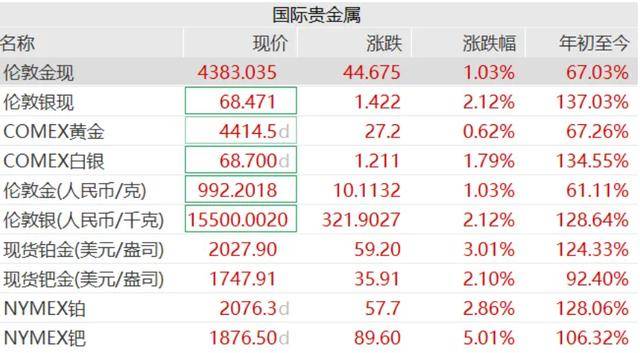
现货铂金持续走高,现涨超3%,报2002.3美元/盎司,为自2008年以来首次升破2000美元/盎司,今年累 涨超120%。 专家普遍认为,全球央行持续购金已成为打破传统供需平衡的关键变量,而美联储货币政策转向宽松预 计将进一步利好黄金。长期来看,美元购买力变化、央行储备行为及地缘政治风险仍是影响金价的核心 因素。 据世界黄金协会12日报告显示,11月全球实物黄金ETF流入达52亿美元,已连续六个月实现流入。截至 11月底,资产管理总规模增至5300亿美元,环比增长5.4%;总持仓上升1%至3932吨,均创新高,今年 全球黄金ETF流入总量有望创下历史最佳年度表现。 12月22日,贵金属集体大涨,多个品种创新高。 | | 不需給馬 | | | | | --- | --- | --- | --- | --- | | 名称 | 现价 | 涨跌 | 涨跌幅 | 年初至今 | | 伦敦金现 | 4383.035 | 44.675 | 1.03% | 67.03% | | 伦敦银现 | 68.471 | 1.422 | 2.12% | 137.03% | | COMEX黄金 | 4414.5d | 27.2 | 0.6 ...
现货黄金盘中创历史新高!全市场费率最低一档黄金ETF基金(518660),助力一键捕捉低成本配置黄金机遇
Sou Hu Cai Jing· 2025-12-22 04:58
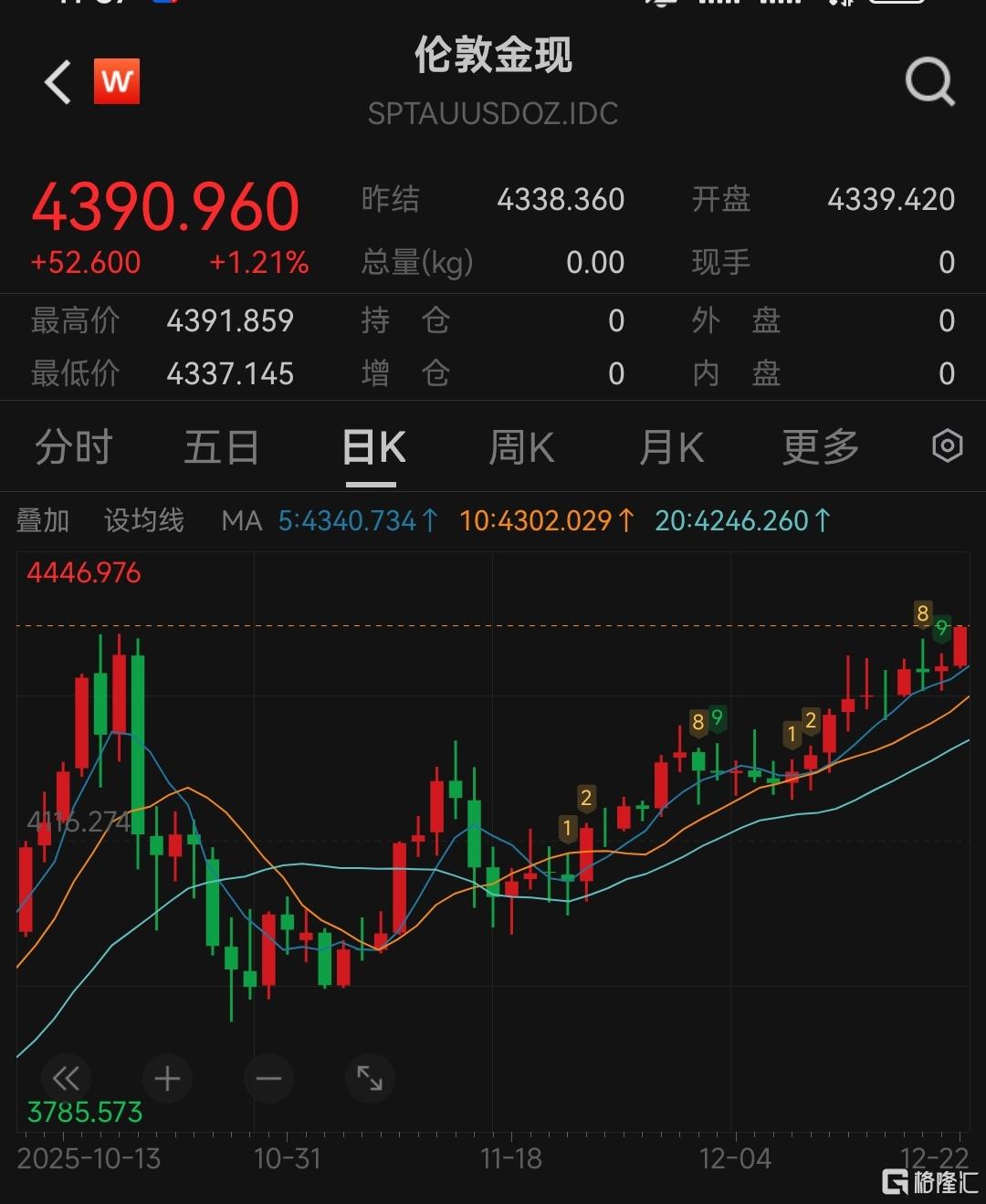
Group 1 - The core viewpoint is that gold prices have reached a historical high of $4,390 per ounce, driven by factors such as the Federal Reserve's interest rate cuts, increasing macroeconomic uncertainty, and a global trend towards "de-dollarization" [1] - The macro environment is expected to remain favorable for precious metals and non-ferrous metals, with gold's upward trend likely to continue due to its higher safety margin compared to other precious metals [1] - The expectation of lower real interest rates on U.S. Treasury bonds due to the Fed's rate cuts will reduce the opportunity cost of investing in gold, thereby increasing its demand as a safe-haven asset [1] Group 2 - The management and custody fee rate for the gold ETF (518660) is 0.2%, making it one of the lowest in the market, which enhances its attractiveness for investors seeking low-cost gold exposure [2] - The gold ETF and its related products provide an opportunity for investors to easily and cost-effectively allocate to gold [2]
刚刚,金价又爆了!创历史新高!
Sou Hu Cai Jing· 2025-12-22 04:09
此外,世界黄金协会12日报告显示,11月全球实物黄金ETF流入达52亿美元,已连续六个月实现流入。 截至11月底,资产管理总规模增至5300亿美元,环比增长5.4%;总持仓上升1%至3932吨,均创新高, 今年全球黄金ETF流入总量有望创下历史最佳年度表现。 芦哲表示,央行购金趋势未变、全球去美元化与地缘政治碎片化仍是长期过程、美国等主要经济体财政 与债务风险仍存等各种基础仍然稳固,对黄金的信用对冲需求继续存在且可能继续扩张,黄金牛市的核 心逻辑未被颠覆。 ※ 编辑:胡婧 ※ 校对:张铭革 ※ 审核:陈文强 陈祥旺 22日早间,现货黄金(伦敦金现)强势拉涨,盘中突破10月20日创下的历史纪录(4381.484美元),再 创新高。截至发稿,报4380.290美元/盎司,涨近1%。 Wind数据显示,现货黄金价格年内涨幅超65%。 对于年内金价强劲上涨,东吴证券首席经济学家芦哲此前表示,是多重引擎共振效应的结果。一是全球 央行延续2022年以来的购金趋势,这也是2022年以来黄金牛市最坚实的基础。二是地缘政治风险和代关 税政策带来较大不确定性。三是金融市场对美联储降息周期与债务问题的重定价。 ...
“贵金属牛”彻底燃爆!黄金、白银、铂金集体新高
Ge Long Hui· 2025-12-22 03:47
2025年收官之际,全球贵金属市场迎来历史性狂欢。 12月22日(周一)亚市早盘,现货黄金加速上涨,突破4384美元/盎司,创下10月以来历史新高,年内累计涨幅超65%;白银、铂金价格也同步刷新纪录 高位,白银以126%的惊人涨幅成为"黑马",铂金紧随其后暴涨116%。 金银铂均创历史新高 今日,现货黄金突破10月20日高点4381.4美元/盎司,再创历史新高。截至发稿,报4390.96美元/盎司,涨超1%。数据显示,现货黄金价格年内涨幅超 65%。 现货白银涨破69美元/盎司关口,刷新历史高点,日内涨超3%。沪银期货主力合约涨超5%,突破16000元/千克关口,续创历史新高,今年迄今累计涨超 114%。 现货铂金持续走高,涨超3%,报2002.3美元/盎司,为自2008年以来首次升破2000美元/盎司,年内累涨超120%。 LME铜价飙升至创纪录高位,逼近每吨12000美元。 | W | | | LME铜 | | | | | | --- | --- | --- | --- | --- | --- | --- | --- | | | CA.LME | | | | | | | | 11925.0 | | 昨结 ...
现货黄金突破4381美元,再创历史新高
Sou Hu Cai Jing· 2025-12-22 03:41
Wind数据显示,现货黄金价格年内涨幅超65%。 12月22日早间,现货黄金(伦敦金现)强势拉涨,盘中突破10月20日创下的历史纪录(4381.484美元),再 创新高。截至发稿,报4380.290美元/盎司,涨近1%。 对于年内金价强劲上涨,东吴证券首席经济学家芦哲此前表示,是多重引擎共振效应的结果。一是全球 央行延续2022年以来的购金趋势,这也是2022年以来黄金牛市最坚实的基础。二是地缘政治风险和代关 税政策带来较大不确定性。三是金融市场对美联储降息周期与债务问题的重定价。 芦哲表示,央行购金趋势未变、全球去美元化与地缘政治碎片化仍是长期过程、美国等主要经济体财政 与债务风险仍存等各种基础仍然稳固,对黄金的信用对冲需求继续存在且可能继续扩张,黄金牛市的核 心逻辑未被颠覆。 此外,世界黄金协会12日报告显示,11月全球实物黄金ETF流入达52亿美元,已连续六个月实现流入。 截至11月底,资产管理总规模增至5300亿美元,环比增长5.4%;总持仓上升1%至3932吨,均创新高, 今年全球黄金ETF流入总量有望创下历史最佳年度表现。 ...
黄金将成2026年涨幅最大的金属?
Sou Hu Cai Jing· 2025-12-22 03:21
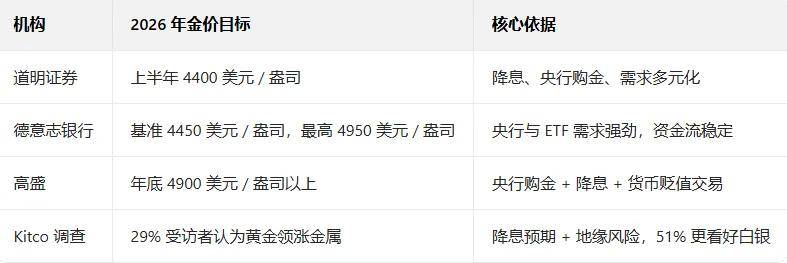
Core Viewpoint and Target Price - The target price for gold is projected to reach a quarterly high of $4,400 per ounce in the first half of 2026, with a long-term price range of $3,500 to $4,400 per ounce, and potential peaks even higher [1] - The core judgment indicates that gold will benefit from Federal Reserve rate cuts, a weaker dollar, and increased central bank and investment demand, while platinum and palladium are expected to lead the rise in precious metals, with silver potentially retreating to the mid-$40 range [1] Bullish Core Logic - Anticipation of a 100 basis point rate cut by the Federal Reserve in 2026 will lower the opportunity cost of holding gold, while a steepening yield curve and concerns over Fed independence will further enhance safe-haven buying demand [2] - High U.S. debt levels, de-dollarization, and the push for de-globalization are driving central banks to continue increasing gold holdings, with investors reallocating to commodities and sustained net inflows into gold ETFs indicating rising investment demand [2] - Limited supply growth and diversified demand (from central banks, investors, and industrial uses) are supporting prices, with the long-term price range moving up to $3,500 to $4,400 per ounce [2] Downside Risk Factors - Strengthening U.S. risk assets may lead to capital outflows from safe-haven assets, diminishing the attractiveness of gold allocations [3] - Resilient employment data and persistent inflation may result in the Federal Reserve cutting rates less than expected or pausing easing, which could strengthen the dollar and real interest rates, thereby suppressing gold prices [4] - Easing geopolitical tensions and a slowdown in de-dollarization may reduce gold's priority as a safe-haven and allocation asset [5] Market and Institutional Comparison - Various institutions have set different target prices for gold in 2026, with TD Securities projecting $4,400 per ounce based on rate cuts and central bank purchases, Deutsche Bank at a baseline of $4,450 per ounce with a peak of $4,950 per ounce due to strong central bank and ETF demand, and others indicating even higher targets based on similar factors [6] Key Operations and Observations - Monitoring the Federal Reserve's policy path and inflation data, particularly the extent and timing of rate cuts in 2026, is crucial as it serves as a core catalyst for gold prices [7] - Tracking central bank gold purchases and gold ETF fund flows will help assess the strength of physical and investment demand [8] - If gold prices retreat to around $3,600 per ounce, it is considered a favorable buying opportunity by TD Securities [9]