
供应短缺

Search documents
供应短缺 白银长期滚动做多逻辑不变
Jin Tou Wang· 2026-01-20 07:04
Core Viewpoint - The silver futures market is experiencing a significant surge, with the main contract reaching a peak of 23,568.00 yuan, reflecting a 4.09% increase [1] Group 1: Market Performance - The main silver futures contract reported a rise of over 4%, indicating strong market performance [2] - As of the latest report, the main silver futures contract is priced at 23,167.00 yuan [1] Group 2: Institutional Insights - Copper Crown Jin Yuan Futures predicts that precious metals will maintain a strong performance in the short term due to increased demand for safe-haven assets amid geopolitical tensions [2] - Hualian Futures expects the medium to long-term trend of silver to remain strong, driven by rising market demand and supply constraints [3] - Zhonghui Futures maintains a long-term bullish outlook on silver, emphasizing the ongoing supply-demand gap and favorable macroeconomic conditions [3] Group 3: Market Drivers - The geopolitical situation regarding Greenland has heightened market risk, prompting investors to seek refuge in precious metals like silver [2] - The silver market is facing a significant supply shortage for the fifth consecutive year, while demand is bolstered by sectors such as photovoltaics, electric vehicles, and AI data centers [3] - Continuous inflows into global silver ETFs and declining COMEX inventories have resulted in historically low deliverable silver stocks [3]
“战术性看涨”原油和贵金属,“结构性看涨”铝,铜价“或一个月内见顶”--这家投行的“最新商品判断”
Hua Er Jie Jian Wen· 2026-01-15 04:48
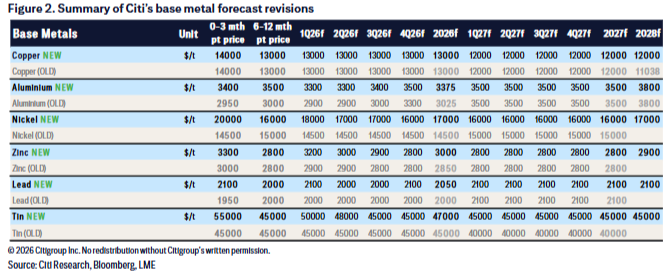
Core Viewpoint - The commodity market is at a critical turning point influenced by geopolitical tensions and supply shortages, with specific forecasts for various commodities through 2026 [1][20]. Oil Market - The short-term oil market is driven by geopolitical premiums, with a price target of $70 per barrel for Brent crude, influenced by tensions in Iran and the Russia-Ukraine conflict, as well as export disruptions in Kazakhstan and Libya [3][6]. - However, the long-term outlook is bearish due to expected supply surplus and policy pressures, particularly from the U.S. government aiming for lower oil prices [6][20]. Precious Metals - In the precious metals sector, silver is expected to outperform gold, with target prices set at $100 per ounce for silver and $5,000 for gold, driven by current market momentum and capital flows [7][20]. - The report suggests that these high price levels may trigger hedging actions from producers and central banks [7]. Base Metals - Aluminum is identified as having the most structural opportunity, facing a significant supply deficit, with short-term price targets of $3,400 per ton and mid-term targets of $3,500 [8][20]. - In contrast, copper is forecasted to reach $14,000 per ton, but the confidence in this projection has weakened significantly since December, with a warning that January may be the peak for the year [11][20]. Lithium Market - The lithium market has seen a rebound of over 50%, primarily due to supply constraints from delays in mining operations and tightening policies [12][14]. - Citigroup has raised the three-month price target for lithium carbonate to $25,000 per ton, reflecting strong demand from battery manufacturers [13][20]. - Despite the short-term strength, there is a cautious long-term outlook for lithium prices, anticipating downward pressure as supply increases [14]. Natural Gas and Agriculture - The natural gas market is expected to face long-term supply surplus challenges, with bearish views on LNG and European TTF gas prices starting from 2027 [15][20]. - In agriculture, a bullish outlook is maintained for most commodities, with sugar prices expected to rebound in 2026 due to increased demand from China and changes in Brazilian production [19][20].

需求端有明显增量 白银中长期走势预计保持强劲
Jin Tou Wang· 2026-01-14 06:08
Group 1 - The core viewpoint is that the silver market is experiencing a significant supply shortage, which is expected to continue driving prices upward in the medium to long term [2][3]. - The Chicago Mercantile Exchange (CME) announced a change in margin requirements for precious metals contracts, shifting from fixed dollar amounts to a percentage of the contract's nominal value [2]. - The global silver market has faced a continuous shortage for five years, with an estimated shortfall of approximately 3,660 tons in 2025, exacerbated by China's new export regulations [2]. Group 2 - Dongwu Futures emphasizes that the long-term trends in precious metals, particularly silver, will be influenced by structural shortages and global monetary policy rather than isolated exchange measures [3]. - Hualian Futures notes that the supply side of silver is significantly constrained while demand is increasing, driven by sectors such as photovoltaics, electric vehicles, and AI data centers [3]. - The global silver ETF inflows are ongoing, and the available deliverable inventory is at historical lows, indicating a tight market situation [3].
“金属风暴”席卷全球商品市场
Di Yi Cai Jing· 2026-01-07 15:19
Core Viewpoint - The global industrial metal market is experiencing a significant surge in prices, driven by supply concerns and geopolitical events, particularly in the context of nickel and copper markets [2][3][4]. Group 1: Market Performance - On January 6, 2026, LME copper, aluminum, zinc, nickel, tin, and lead futures prices all surged, with LME copper reaching a new high and LME nickel prices increasing by over 10% [2][3]. - Domestic markets in China also saw a strong performance, with nickel futures hitting the daily limit and other metals like tin and alumina rising by 5.3% and 4.97%, respectively [3]. - The overall trend indicates a robust start to the year for industrial metals, with copper prices up over 5% since the beginning of 2026 [6]. Group 2: Supply Concerns - The primary driver for the recent price increases is supply disruptions, particularly in nickel due to production cuts announced by Indonesia, the world's largest nickel producer, which plans to reduce its output target by 34% [4][5]. - The International Nickel Study Group (INSG) forecasts a demand of 3.82 million tons for nickel in 2026, with production at 4.09 million tons, indicating potential oversupply despite the recent cuts [5]. - High inventory levels, with LME nickel stocks at 25.4 million tons, are currently exerting downward pressure on prices in the medium term [5]. Group 3: Copper Market Dynamics - LME copper prices rose by 1.9% on January 6, reaching $13,238 per ton, with a peak of $13,387.5, marking a significant increase driven by structural supply shortages and rising demand from sectors like electrification and data centers [6][7]. - Recent disruptions, including strikes at copper mines in Chile and delays in projects, have heightened concerns over copper supply [6][7]. - Financial institutions like Citigroup have raised their short-term copper price forecasts, reflecting bullish sentiment in the market [6][7]. Group 4: Broader Metal Market Trends - Other industrial metals also showed strong performance, with LME tin rising by 4.8%, aluminum by 1.4%, zinc by 1.8%, and lead by 2.6% [8]. - The aluminum sector is particularly highlighted, with supply constraints due to high domestic utilization rates and limited overseas production capacity [8]. - Significant capital inflows into metal ETFs in China indicate a growing interest in the sector, with notable net inflows into various funds [8][9]. Group 5: Investment Opportunities - The performance of the metals sector in 2025 was notable, with a 94.73% increase in the A-share metals sector, indicating strong investor interest [9]. - Macro factors such as lower-than-expected inflation data in the U.S. and geopolitical uncertainties are expected to support the valuation of the metals sector [9]. - Policy initiatives aimed at enhancing industry concentration and resource pricing power are anticipated to provide long-term support for the sector [9].

铜铝锌镍锡铅集体狂飙 “金属风暴”席卷全球商品市场
Di Yi Cai Jing· 2026-01-07 14:04
Group 1: Market Overview - The global metal futures market experienced a strong start in 2026, with significant price increases across major metals including copper, aluminum, zinc, nickel, tin, and lead on January 6 [1] - LME copper futures reached a new high, while LME nickel futures saw intraday gains exceeding 10%, hitting $18,800 per ton [1] - Domestic markets also saw a surge in investment in non-ferrous metals, with notable price increases in nickel, tin, and aluminum [1] Group 2: Supply Concerns - The surge in nickel prices is primarily driven by supply concerns, particularly due to Indonesia's plan to cut its nickel production target from 379 million tons to 250 million tons, a reduction of 34% [2] - The International Nickel Study Group (INSG) projects a global nickel demand of 3.82 million tons and a production of 4.09 million tons in 2026, indicating potential oversupply despite Indonesia's production cuts [3] - High inventory levels, with LME nickel stocks at 254,000 tons and domestic stocks in China significantly above the five-year average, are exerting long-term pressure on prices [3] Group 3: Copper Price Dynamics - LME copper prices rose by 1.9% to $13,238 per ton, with a peak of $13,387.5, marking a cumulative increase of over 5% since the beginning of 2026 [4] - The price increase is attributed to structural supply shortages and accelerating demand driven by investments in electrification and data centers [4] - Recent disruptions, such as strikes at Capstone Copper's Mantoverde mine and delays in Ecuador's copper projects, have heightened supply concerns [5] Group 4: Investment Trends - Significant capital inflow into the non-ferrous metals sector has been observed, with various ETFs seeing substantial net inflows, particularly in the first two trading days of 2026 [6] - The non-ferrous metals sector was a standout performer in 2025, with a 94.73% increase in the A-share market and many stocks doubling in value [7] - Analysts suggest that macroeconomic factors, including lower-than-expected U.S. inflation data and geopolitical uncertainties, are driving investment demand in the sector [7]

每日机构分析:12月30日
Xin Hua Cai Jing· 2025-12-30 08:48
Group 1: US Bond Market - The volatility of the US bond market is expected to record its largest annual decline since 2009, with the ICE BofA MOVE index dropping to approximately 59, the lowest level since October 2024 [1] - The index has decreased from around 99 at the end of 2024, indicating one of the most significant annual declines since data began in 1988, second only to the crash in 2009 [1] Group 2: South Korea's Export Growth - Strong growth momentum in South Korea's exports is likely to continue into December, with a median forecast of an 8.3% year-on-year increase, slightly down from 8.4% in November [2] - Imports are expected to rise by 2.4%, resulting in a trade surplus of $10 billion for December, up from a revised surplus of $9.74 billion in the previous month [2] - The growth is supported by strong external demand and a recent trade agreement with the US, which is anticipated to bolster manufacturing output and export growth [2] Group 3: Indonesia Stock Market - Despite foreign capital outflows, Indonesia's stock market is on track to achieve its best performance in eleven years, driven by the increasing influence of local retail investors [2] - The Jakarta Composite Index has risen nearly 22% year-to-date, marking the largest annual increase since 2014 [2] - Retail investors are actively buying speculative stocks, seeking higher returns amid declining bond yields, despite concerns from foreign investors regarding economic growth and government spending risks [2] Group 4: Copper Market - Copper prices are poised to achieve the longest consecutive increase since 2017, with a recent rise of 2.2% to $12,493 per ton, indicating strong bullish sentiment in the market [3] - The increase is driven by expectations of heightened supply chain pressures and the need for buyers to complete purchases before potential tariffs are imposed [3] - Supply issues from major copper-producing countries, including Indonesia, Chile, and the Democratic Republic of the Congo, are central to the market dynamics, with warnings of severe copper supply shortages by 2026 [3] Group 5: Precious Metals Market - Spot silver experienced a drop of up to 8%, while gold fell below $4,400 per ounce, as traders took profits after record highs [4] - Both gold and silver are currently in overbought territory, suggesting a need for a healthy correction before any continuation of the upward trend [4] - Analysts expect further price correction for gold as investors adjust and rebalance their positions towards the end of the month and year [4]
金荣中国:银价早盘低位震荡盘子,亚盘市场支撑位多单布局
Sou Hu Cai Jing· 2025-12-30 07:24
Fundamental Analysis - Silver experienced extreme volatility on December 30, with a significant drop of 8.9% to $72.10 per ounce after reaching a historical high of $83.94, marking an increase of nearly 150% for the year, far exceeding gold's performance [1][3] - The surge in silver prices is attributed to supply shortages, rising industrial demand, and increased investment interest, with experts maintaining a positive outlook for silver's performance in 2026 despite short-term corrections [1][3] - The entire precious metals sector, including platinum and palladium, also saw considerable annual gains due to industrial applications and supply constraints [1] Market Dynamics - Recent geopolitical developments, particularly regarding the Russia-Ukraine conflict, have influenced gold prices, which are closely tied to geopolitical risks [1][3] - The market is currently experiencing a correction phase, characterized by profit-taking among short-term traders, but the overall upward trend remains intact [4][5] - The upcoming Federal Reserve meeting minutes and potential changes in leadership at the Fed are critical factors for market participants to monitor [3][5] Technical Analysis - The silver market is showing a price uptrend, with key support levels identified around $70.50, while resistance levels are noted at $72.50 and $73.00 [9] - The current trading strategy suggests a cautious approach, with recommendations for light positions and a focus on support and resistance levels for potential trades [9] - The price movements in the next few days will be crucial for determining the future trajectory of both gold and silver prices [4][5]

期铜削减涨幅,盘中飙升至近13000美元纪录新高【12月29日LME收盘】
Wen Hua Cai Jing· 2025-12-30 00:56
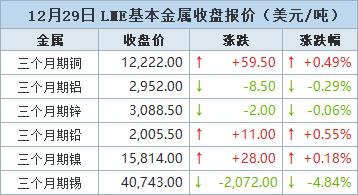
Core Viewpoint - The London Metal Exchange (LME) copper prices surged close to record highs due to market catch-up after a holiday break, driven by supply concerns and strong performance in other financial markets [1][3]. Group 1: Price Movements - On December 29, LME three-month copper rose by $59.5, or 0.49%, closing at $12,222.0 per ton, with an intraday peak of $12,960 per ton [1][2]. - Year-to-date, LME copper prices have increased by 41%, influenced by supply shortages and a weak dollar [3]. - The Comex copper futures reached a record high of $5.8395 per pound before dropping 4.2% to $5.593 on the following Monday [3]. Group 2: Market Dynamics - U.S. copper inventory buildup is tightening supply in other markets, with production disruptions leading analysts to predict shortages in the coming year [4]. - The recent price fluctuations have reduced the Comex premium over LME copper to $112 per ton, the lowest since late August [4]. - Broader risk appetite in the market is supported by rising global stock markets and oil prices [5]. Group 3: Future Outlook - Analysts expect demand for copper to exceed mine supply by 2030, with prices remaining high in the upcoming year [6]. - Factors contributing to the copper price surge include easing trade tensions, negotiations for peace in Ukraine, and the impact of U.S. import tariffs [6]. - The Shanghai Futures Exchange saw its main copper contract reach a record high of 102,660 yuan per ton, supported by government initiatives to optimize resource-intensive industries [7].
Elon Musk Warns China Restricting Silver Exports Is 'Not Good'
Yahoo Finance· 2025-12-29 19:01
Core Insights - Tesla CEO Elon Musk expressed concerns regarding China's plan to restrict silver exports starting in January, emphasizing the metal's critical role in various industrial processes [1] - Spot silver prices reached an all-time high of $79.16 per troy ounce, reflecting a significant increase of 10% [2] - The silver market is experiencing notable fluctuations, with prices hitting record highs, indicating a broader trend of rising demand and potential supply issues [5][6] Silver Market Dynamics - Silver prices surged to a record high of $51 per ounce in October, marking a psychological milestone for investors [6] - Analysts predict that the explosive move in silver prices may continue, driven by severe physical market stress and a structural supply crunch [6] - Despite recent gains, silver is considered relatively undervalued compared to gold, as indicated by the high gold-to-silver ratio, suggesting potential for further price adjustments [6] Economic Perspectives - Economist Peter Schiff raised concerns about Bitcoin, suggesting that the market dynamics for Bitcoin may soon mirror those of silver, but in reverse [3][4] - Schiff noted that market downturns typically occur more rapidly than upturns, indicating a potentially expedited timeline for shifts in cryptocurrency values [4]
铜价暴涨盘中创新高铜价一度刷新历史纪录
Xin Lang Cai Jing· 2025-12-29 12:00
Core Viewpoint - Copper prices have surged significantly, reaching a historical high due to expectations of continued loose monetary policy from the Federal Reserve and a weaker dollar, which lowers holding costs for investors [1] Group 1: Price Movement - During the Asian trading session on December 29, copper futures prices rose sharply, with three-month copper prices on the London Metal Exchange hitting $12,960 per ton, marking a record high with an increase of 6.56% [1] - As of 10 AM Beijing time on December 29, the three-month copper price on the London Metal Exchange was reported at $12,822.05 per ton, reflecting a gain of 5.42% [1] Group 2: Market Drivers - Market expectations of the Federal Reserve continuing its loose monetary policy next year have contributed to the rise in copper prices [1] - A weaker dollar has reduced the holding costs for copper, further supporting the price increase [1] - Strong demand coupled with supply shortages caused by multiple mine shutdowns globally has also played a significant role in driving copper prices higher [1]