利率前景

Search documents
美联邦政府重启后,首个关键经济数据将出炉
第一财经· 2025-11-16 02:52
Market Overview - The U.S. stock market experienced fluctuations with the Dow Jones increasing by 0.34% and the Nasdaq decreasing by 0.45% during the week [3] - European stock indices saw gains, with the UK FTSE 100 up by 0.16%, Germany's DAX 30 up by 1.30%, and France's CAC 40 up by 2.77% [3] Economic Data and Federal Reserve - Following the end of the U.S. government shutdown, investors are closely monitoring the release of economic data, including the September employment report, which is expected to be the first data released post-shutdown [6] - The market remains cautious regarding the Federal Reserve's potential interest rate decisions, with probabilities for a rate cut in December being nearly equal to maintaining the current rate [6][10] - The upcoming release of the Federal Reserve's October meeting minutes on November 19 is anticipated to provide insights into future monetary policy [6] Earnings Reports - The earnings season is nearing its end, with significant attention on Nvidia's performance and retail giants like Walmart and Target, which will indicate consumer demand in the U.S. [7] - Several Chinese concept stocks, including Baidu, NetEase, and Pinduoduo, are set to release their third-quarter operational results [7] Commodity Prices - International oil prices saw an increase, with WTI crude oil rising by 0.57% to $60.09 per barrel and Brent crude oil up by 1.19% to $64.39 per barrel, influenced by supply disruptions from Russia [9] - The International Energy Agency noted that the increase in oil prices is partly due to rising inventories of sanctioned crude oil, indicating buyers' concerns over compliance risks [9] European Economic Outlook - The European Commission's autumn economic outlook report is scheduled for release on November 17, with market focus on the latest Purchasing Managers' Index (PMI) data from France, Germany, and the Eurozone [12][13] - Upcoming data releases include Germany's October Producer Price Index (PPI) and the Eurozone's November Consumer Confidence Index [12][14]

Gold price today, Friday, November 14: Gold hangs around $4,200 amid unclear rate outlook
Yahoo Finance· 2025-11-10 13:00
Core Insights - Gold futures opened at $4,174.90 per ounce, down 0.3% from the previous close of $4,186.90, indicating a decline in early trading [1] - Central bank demand and investor interest in gold for safety continue despite uncertainty in short-term interest rates, influenced by a pause in government data releases [1] - The one-year gain for gold as of October 30 was 42.1%, reflecting strong performance over the past year [3][7] Interest Rate Impact - Minneapolis Federal Reserve President Neel Kashkari disagreed with the rate reduction in October, awaiting more data for December [2] - Cleveland Federal Reserve President Beth Hammack expressed concerns about inflation, favoring steady rates, which typically support gold prices as lower rates enhance gold's competitiveness against yield-bearing assets [2] Gold Price Trends - The current gold price has shown significant changes: a 4.9% increase over the past week, 1% over the past month, and 63.4% over the past year [7] - The opening price of gold futures on Friday reflects a slight decrease compared to the previous day, indicating ongoing volatility in the market [3] Investment Strategies - Experts recommend varying gold allocations based on investment goals, with suggestions ranging from 0% to 20% [4][5][8][10][11][13] - Robert R. Johnson advises against gold investing for long-term returns, while others suggest allocations of 2% to 15% depending on individual risk tolerance and financial asset composition [5][8][11] - Vince Stanzione advocates for a 20% allocation in gold as a wealth protection strategy, emphasizing gold's ability to retain purchasing power amid currency devaluation [13]
加拿大标普/TSX综合指数收跌0.90%,报30144.78点,微幅高开之后走低,美联储主席鲍威尔讲话前持稳于30300点附近
Sou Hu Cai Jing· 2025-10-29 21:48
Group 1 - The S&P/TSX Composite Index in Canada closed down by 0.90%, at 30,144.78 points, after a slight opening increase before declining [1] - The Canadian 10-year benchmark government bond yield rose by 11.5 basis points to 3.158%, showing a continuous and smooth increase throughout the day [1] - The two-year Canadian bond yield increased by 8.5 basis points to 2.440%, significantly rising after the Bank of Canada announced its interest rate decision [1] - The five-year Canadian bond yield rose by 11.7 basis points to 2.742%, reflecting market reactions to interest rate discussions [1]
Gold price today, Thursday, October 30: Gold falls as investors weigh rate outlook and China trade truce
Yahoo Finance· 2025-10-27 12:01
Group 1 - Gold futures opened at $3,942.80 per ounce, down 1% from the previous close of $3,983.70, marking the third consecutive day below $4,000 after a two-week period above this threshold [1][4] - The Federal Reserve's recent quarter-point interest rate reduction has influenced gold prices, with Fed Chair Jerome Powell indicating a divided committee on future rate decisions, creating uncertainty about further reductions [2][3] - The U.S. and China have agreed to pause retaliatory trade measures for one year, which includes reduced tariffs from the U.S. and a pause on rare-earth export restrictions from China, potentially impacting gold demand as investors adjust to the new interest-rate outlook and trade truce [3] Group 2 - The price of gold futures has increased by 50% compared to one year ago, with a recent weekly change of -3.3%, a monthly change of +3%, and a yearly change of +42.1% [4][9] - The gold industry is seeing interest in gold IRAs, which allow for the holding of physical gold and other precious metals, providing potential tax benefits and diversification for retirement wealth [5][6]
每日机构分析:10月20日
Xin Hua Cai Jing· 2025-10-20 16:18
Group 1: Eurozone and US Economic Outlook - Monex Europe analysts indicate that the weak growth and fiscal concerns in the Eurozone will limit the euro's appreciation potential, suggesting that the euro may only see slight increases if market risk appetite remains strong and interest rate differentials favor the euro [1] - Societe Generale strategist Kit Juckes warns that the US economy faces risks of a mild recession, which could lead to significant rate cuts and a weaker dollar, drawing parallels to the 2001-2003 period when the Fed drastically reduced rates from 6.5% to 1.0% [2] - Kudotrade analysts highlight that the upcoming US inflation data will be crucial for assessing future interest rate prospects, with expectations that if the data meets or falls below forecasts, it could reinforce market expectations for deeper policy easing in 2025-2026 [1][2] Group 2: Credit Market and Bond Ratings - Concerns over the stability of US regional banks persist, keeping the cost of credit default swaps for US bank bonds at elevated levels, as two banks recently disclosed exposure to bad loans [2] - Danske Bank notes that S&P's downgrade of France's credit rating may increase pressure on French government bonds, with expectations that Moody's will also revise France's outlook from stable to negative [2] Group 3: Gold and Swiss Monetary Policy - ANZ analysts report that investors are increasingly seeking refuge in gold amid rising trade tensions and economic uncertainties, with gold experiencing its largest weekly gain in five years due to the collapse of the US credit market [3] - Capital Economics economists predict that the Swiss National Bank may reintroduce negative interest rates due to near-zero inflation levels and ongoing geopolitical risks, potentially lowering the key rate from 0% to -0.25% [3]
山金期货资讯周报-20250930
Shan Jin Qi Huo· 2025-09-30 11:27
1. Report Industry Investment Rating No relevant content provided. 2. Core Viewpoints of the Report - Since 2025, precious metals have continued to rise, but gold and silver have shown divergence. Gold has repeatedly reached new historical highs, while silver has followed up slowly and faced pressure to fall back. The main driving factors include increased risk - aversion sentiment, expectations of interest rate cuts, and central banks' continued gold purchases. The current bull market in precious metals differs significantly from previous ones in terms of driving logic, amplitude, and the role of central banks. [4][5][7] - Looking ahead, before the Fed hints at the end of interest rate cuts around mid - 2026, precious metals may continue to rise. However, after the interest rate cuts enter the second half, attention should be paid to the risk of a rapid decline in precious metal prices due to profit - taking, and the overall volatility of precious metals may further increase. [64] 3. Summary by Relevant Catalogs 3.1. Market Review - Since 2025, gold has reached new highs, with London gold reaching a maximum of $3057.14 per ounce, Comex gold reaching $3065.2 per ounce, and domestic Shanghai gold reaching a maximum of 711.24 yuan per gram. Silver has followed up slowly, with London silver reaching a maximum of $34.224 per ounce and domestic Shanghai silver reaching a maximum of 8444 yuan per kilogram. [4] - The main logics for the rise of precious metals since the beginning of the year are: increased risk - aversion sentiment due to global economic and political restructuring, expectations of interest rate cuts, and central banks' continued gold purchases. [5][7] - This bull market in precious metals differs from previous ones in terms of driving logic (from "cyclical" to "structural"), amplitude and breadth (unprecedented global general increase), and the role of central banks (from "participants" to "leading forces"). [9][10] - The bull market in silver also differs from previous ones in terms of driving logic (from "investment - led" to "investment + industrial demand dual - driven"), breadth and synchronicity (global value re - evaluation), and the relationship with gold (from "following" to "potentially leading"). [12][13] 3.2. Evolution Logic of Safe - Haven Attribute - The world is in the process of transitioning to a new order, with the US no longer the dominant power. There are risks of trade wars, government shutdowns, and potential geopolitical conflicts, which may increase the demand for safe - haven assets. Trump's policy expectations affect precious metal prices through multiple channels, and in the short term, risk - aversion sentiment may support precious metal prices, while in the long term, trade frictions may increase inflation or lead to economic recession, making precious metals more attractive. [14][16] - The volatility of the US stock market may rise, which will increase the safe - haven value of precious metals. [19] 3.3. Evolution Logic of Monetary Attribute - In 2025, US inflation may experience "re - inflation", and the eurozone is close to achieving its anti - inflation target, but trade war risks pose pressure on future interest rate cuts. The Fed has adjusted its monetary policy framework, which may lead to potential changes in US dollar liquidity and have different impacts on various countries. [23] - The US employment situation may continue to weaken, and Trump's new policies may accelerate the decline in employment. Non - farm payroll data has a significant impact on the Fed's interest rate decisions and precious metal prices. [32][35] - The Fed is expected to continue to cut interest rates in 2025, with a total interest rate cut of about 50 basis points and the process expected to be completed around mid - 2026. The CME FedWatch Tool can help investors predict the Fed's interest rate trends. [41][42] - Global central bank monetary policies have shown significant divergence in recent years. The difference in interest rate cut expectations between the US and non - US countries is crucial. Later, the Fed's larger interest rate cut space may put pressure on the US dollar index. [45] 3.4. Evolution Logic of Commodity Attribute - In 2024, the global gold supply increased steadily, but demand declined. In 2025, demand is expected to continue to show structural divergence. Jewelry demand is suppressed by high gold prices, but official and private gold purchases offset some negative impacts. Gold ETFs, bars, and coins have strong demand, while gold jewelry demand shows a tonnage - consumption divergence. [51] - The World Silver Association predicts that in 2025, the global silver supply - demand gap will narrow by 21% to 117.6 million ounces (about 3658 tons) due to a 1% decline in demand and a 2% increase in total supply. [56] 3.5. Technical Analysis - London gold has been in an upward trend since 2000. After reaching a high in 2011 and then falling back, it has started a new upward trend since 2016. In 2025, it has accelerated its upward movement. It is expected to continue to rise before the Fed hints at the end of interest rate cuts around mid - 2026. Attention should be paid to the pressure levels of $3750 - 4000 (about 850 - 910 yuan for Shanghai gold) and the support level of $3400 (about 770 yuan for Shanghai gold). [58][59] - London silver has followed a similar trend to gold since 1994. Since 2016, it has oscillated upward along the 20 - year line. The recent rebound in global silver industrial demand may drive its price up. Attention should be paid to the pressure range of $49.8 - 55 (about 11780 - 13000 yuan for Shanghai silver) and the support level of $37.9 (about 8960 yuan for Shanghai silver). [62] 3.6. Future Market Development Direction from the Perspective of Long - Short Game - The reconstruction of the global economic and political system promotes the reconstruction of the monetary system. The safe - haven demand under global economic uncertainty and policy game are complexly intertwined. The continuous gold purchases by global central banks, the long - term Sino - US game, and repeated geopolitical conflicts still support the precious metal market. Before the Fed hints at the end of interest rate cuts around mid - 2026, precious metals may continue to rise, but attention should be paid to the risk of a rapid decline. [64] 3.7. Overview of the Domestic Precious Metal Industry Chain - In the first half of 2025, domestic raw material gold production was 179.083 tons, a year - on - year decrease of 0.31%. After including imported raw material gold, the total gold production was 252.761 tons, a year - on - year increase of 0.44%. Key gold mine projects are advancing rapidly, and large - scale gold enterprises' overseas mine production has increased. [67][68] - In the first half of 2025, domestic gold consumption was 505.205 tons, a year - on - year decrease of 3.54%. Gold jewelry consumption was suppressed by high prices, while demand for gold bars and coins increased, and industrial and other gold uses also increased. [69]
美联储决定前,黄金触及3703美元历史高点
Sou Hu Cai Jing· 2025-09-17 08:26
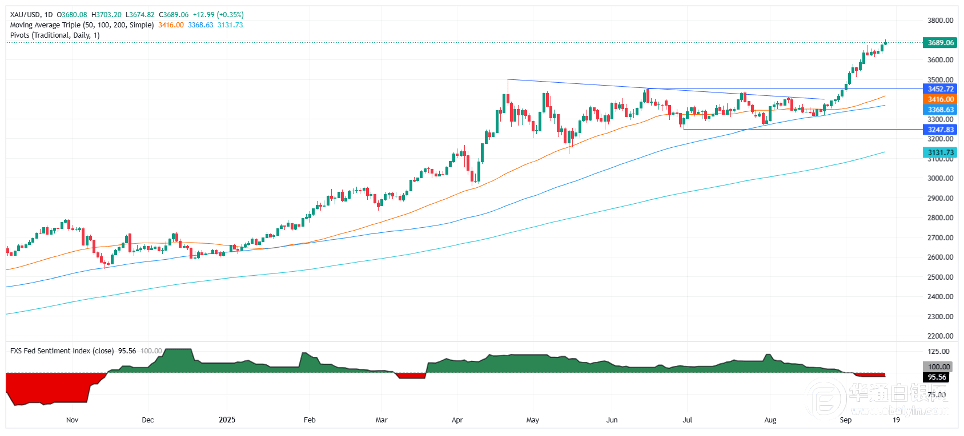
Core Viewpoint - Despite strong retail sales and industrial production data in the U.S. for August, gold prices continue to rise, reaching historical highs [1][3]. Economic Data - U.S. retail sales for August increased by 0.6% month-over-month, surpassing the expected 0.2% [6]. - Industrial production in August showed a slight increase, with factory output rising by 0.1%, indicating moderate growth in manufacturing activities [6]. Federal Reserve Outlook - Weak employment data supports a dovish stance from the Federal Reserve, with market participants awaiting policy decisions and economic forecasts [2][4]. - The market has fully priced in a 25 basis point rate cut, with minimal expectations for a 50 basis point cut [8]. - Deutsche Bank and other banks anticipate three rate cuts of 25 basis points this year, bringing the federal funds rate to a range of 3.50%-3.75% [9]. Geopolitical Factors - Progress in U.S.-China trade negotiations provides geopolitical support for gold prices [5]. Market Movements - The gold price reached a record high of $3,703 before retreating slightly, currently trading around $3,690 [3][12]. - The U.S. dollar index fell by 0.74% to 96.62, while U.S. Treasury yields remained stable [10][11]. Technical Analysis - Gold is hovering around $3,690, with bullish sentiment aiming for a challenge of the historical high, potentially extending to $3,750 and $3,800 [12]. - The Relative Strength Index (RSI) indicates overbought conditions, suggesting limited short-term upside [13].
美股愁了
Hu Xiu· 2025-08-21 06:15
Core Viewpoint - The U.S. stock market is experiencing a correction, primarily driven by concerns over AI bubbles, regulatory policies, and interest rate outlooks, leading to a shift in investor behavior towards undervalued and defensive assets [1] Group 1: Market Reaction - On August 20, major U.S. stock indices continued their downward trend, with the Nasdaq falling by 0.67%, while the S&P 500 also declined, and the Dow Jones showed relative resilience [1] - Investors are moving towards undervalued sectors and defensive assets, indicating a rapid decline in market risk appetite, which has also contributed to a 1% increase in gold prices on COMEX [1] Group 2: Federal Reserve's Stance - The Federal Reserve's July meeting minutes, released on August 20, revealed that most members are more concerned about inflation risks than employment risks, maintaining the benchmark interest rate in the 4.25%-4.50% range [2] - The market interpreted the minutes as hawkish, leading to a significant reduction in expectations for a large rate cut in September, with the probability of a 25 basis point cut remaining high at 81.9% according to CME's FedWatch tool [2] Group 3: Political Pressure on the Federal Reserve - President Trump publicly called for the resignation of Federal Reserve Governor Lisa Cook, citing allegations of mortgage fraud, which is seen as a serious political intervention that could undermine market confidence in U.S. monetary policy [3] - This political noise has increased investor uncertainty regarding policy direction, prompting a shift of funds towards safe-haven assets like gold, while also creating a dual sentiment in the futures market regarding potential policy easing and political uncertainty [3] Group 4: Implications for Gold and Tech Stocks - The current environment suggests that while rate cuts are typically seen as beneficial for stocks, if perceived as a response to increased recession risks, it could negatively impact future earnings and thus be detrimental to tech stocks [4] - Gold prices are currently supported by uncertainties surrounding the Russia-Ukraine negotiations and the Federal Reserve's policy direction, with potential for a pullback if these uncertainties ease [4][5] - For investors, gold serves as a necessary but costly insurance, and while some defensive positioning is reasonable, expectations for excessive returns should be tempered, especially in a market driven by domestic policies and liquidity [5]
8.12黄金原油日内走势分析
Sou Hu Cai Jing· 2025-08-12 05:40
Group 1 - The core viewpoint of the articles indicates that gold prices have experienced significant volatility, with a notable drop of 1.6% following President Trump's announcement that there will be no tariffs on imported gold [1] - The international gold price saw a decline of over 2%, marking the largest drop in nearly three months, as investors await upcoming inflation data that could influence the Federal Reserve's interest rate outlook [1] - The demand for gold as a safe-haven asset has weakened due to the potential for a ceasefire in the Russia-Ukraine conflict, leading to increased market caution [1] Group 2 - After a significant bearish movement, indicators for gold have entered an oversold state, suggesting that a strong rebound is possible without further major declines [2] - The market is exhibiting caution ahead of the upcoming U.S.-Russia meeting, with oil prices also showing a consolidation pattern after previous declines [2]

市场避险情绪消退 投资者“弃债从股”
Xin Hua Cai Jing· 2025-07-23 23:27
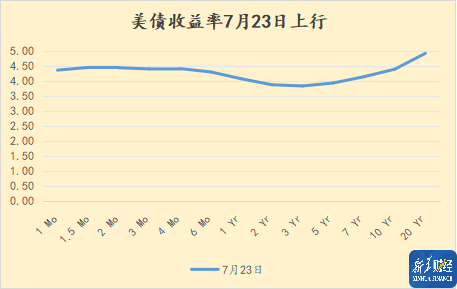
Group 1 - Global stock markets surged on July 23 due to the US-Japan trade agreement, leading to a decline in market risk aversion and a shift from bonds to stocks [1] - US Treasury yields rose slightly, with the 2-year yield increasing by 5 basis points to 3.88%, the 10-year yield rising by 5 basis points to 4.4%, and the 30-year yield up by 5 basis points to 4.95% [1] - The focus is now on the Federal Reserve's monetary policy meeting on July 29-30, where it is widely expected that interest rates will remain unchanged despite political pressure for cuts [3] Group 2 - The S&P 500 index is expected to rise further as the US economy withstands the global trade war, although unpredictable trade policies and attacks on the Fed's independence could trigger market declines [4] - European stock markets rose on hopes of a trade agreement, with bond yields increasing across the board, including a 6.7 basis point rise in the 10-year German bond yield to 2.666% [4] - In the Asia-Pacific region, Australian bond yields also rose, with the 2-year yield increasing by 2 basis points to 3.355% and the 10-year yield up by 3.6 basis points to 4.332% [4] Group 3 - Japanese bond yields increased overall, with the 10-year yield reaching a high of 1.6010%, the highest since October 2008, before closing at 1.594% [8] - The US Treasury plans to issue $201 billion in bonds, including $95 billion in 4-week and $85 billion in 8-week short-term bonds, amid expectations of significant short-term debt issuance [8][9] - The actual net financing needs of the US Treasury in Q2 reached $514 billion, exceeding earlier estimates by $391 billion, indicating a strong demand for short-term bonds [9]