实物再通胀

Search documents
——2026年度投资策略:牛市下半场,实物再通胀
Huachuang Securities· 2025-12-02 14:13
Group 1 - The report emphasizes a shift in investment strategy for Chinese assets from a short-term focus to a long-term perspective, driven by significant changes in long-term factors and a restructuring of the valuation system [2][15][32] - It highlights the advantages of RMB assets from a global perspective, including a stable fiscal environment, a complete industrial chain, a talent pool, and attractive valuations [2][3][15] - The report identifies key points for sustaining growth, focusing on economic construction and the expansion of the middle class, indicating a transition from low prices to a new phase of recovery [2][3][15] Group 2 - The report discusses a new macro paradigm characterized by a shift from quantity-driven growth to quality-driven growth, emphasizing efficient operations and high return on equity (ROE) [3][16] - It notes the completion of the transition from old to new economic drivers, with a decline in the real estate sector's drag on A-share ROE, and a focus on technology and manufacturing sectors [3][16] - The report mentions a change in the investment landscape, where equities are seen as a preservation tool rather than just a financing instrument, leading to improved asset quality and reduced volatility [3][16] Group 3 - The analysis predicts a "re-inflation" phase in the second half of the bull market, driven by improved liquidity, supply-side adjustments, and demand stimulation, with a projected net profit growth of 11.1% for non-financial A-shares in 2026 [4][17] - It outlines the expected performance of the stock market, with a neutral return of 7.8% and an optimistic scenario suggesting a 31.5% return, indicating a strong bullish sentiment [4][17] - The report emphasizes the importance of tracking service consumption subsidies and housing price stabilization as key demand drivers [4][17] Group 4 - The report advocates for a focus on growth quality factors and large-cap growth stocks, suggesting that high-quality growth will outperform pure cash dividends in the current market environment [5][18] - It identifies key sectors for investment, including finance, high-end manufacturing, electronics, and consumer goods, which are expected to lead the market upward [5][18] - The report highlights the importance of technology and cyclical sectors, as well as the potential for overseas expansion and the real estate consumption chain to drive future growth [5][18] Group 5 - The report recommends a diversified investment strategy focusing on four key areas: technology innovation, cyclical sectors, overseas expansion, and the real estate consumption chain [6][19] - It emphasizes the importance of identifying high-potential stocks, referred to as "ten-bagger" opportunities, and building a core portfolio of quality large-cap growth stocks [6][19] - The report suggests that the current market environment presents unique opportunities for investors to capitalize on structural transformations and growth potential [6][19]
拉锯战的攻守道:总量创辩第115期
Huachuang Securities· 2025-11-11 04:14
Export Analysis - October exports unexpectedly turned negative year-on-year, influenced by base effects, with a two-year average year-on-year growth of 5.5%, similar to September's 5.3%[2] - For Q4, attention should be on the impact of reduced fentanyl tariffs on U.S. exports and the risk of weakening demand from the EU[2] - The core contradiction in exports is global trade volume (external demand), which can be tracked using a leading indicator system[2] Monetary Policy and Market Trends - In October, the central bank purchased 20 billion yuan in bonds, significantly below market expectations, indicating a cautious approach to bond buying[4] - The U.S. Treasury has increased bond supply to boost cash reserves, leading to a rise in short-term dollar financing pressures[5] - The average yield on 10-year government bonds has stabilized around 1.8% following various market influences[4] Investment Strategies - The stock fund total position is at 97.52%, down 54 basis points from last week, indicating a slight reduction in equity exposure[6] - The average return for balanced mixed funds was 0.7%, while stock ETFs averaged 0.43%[6] - The insurance sector has seen 34 instances of stake acquisitions this year, primarily in banking and public utilities, reflecting a focus on high dividend assets[9] Economic Outlook - The leading indicators suggest that export growth may rebound in November and December, with an annual export growth target around 5%[11] - The overall economic environment is expected to improve, with policies aimed at stabilizing asset quality and promoting credit growth[9]
反内卷牛市——A股一周走势研判及事件提醒
Datayes· 2025-11-09 14:39
Core Viewpoint - The article discusses the recent focus on price-increasing industries, highlighting a shift from financial re-inflation to physical re-inflation, with an emphasis on cyclical industries and essential sectors that are experiencing price increases [1][2]. Group 1: Industry Trends - Recent price increases in essential commodities are attributed to a phenomenon termed "physical re-inflation," with significant attention on cyclical industries such as non-ferrous metals, steel, coal, and petrochemicals [1]. - The market is witnessing a surge in cyclical stocks, driven by expectations of a strong economic cycle in the coming year, particularly in infrastructure projects linked to the five-year planning cycle [2]. - The supply-side constraints due to anti-involution policies are influencing price dynamics, with industries facing greater anti-involution measures showing higher price elasticity [2]. Group 2: Economic Indicators - The Consumer Price Index (CPI) for October rose by 0.2% year-on-year, up from a decline of 0.3% the previous month, indicating a shift in consumer prices [5]. - The Producer Price Index (PPI) showed a month-on-month increase of 0.1%, marking the first rise of the year, although it still reflects a year-on-year decline of 2.1% [8][9]. - The service price growth rate increased from 0.6% to 0.8% year-on-year, driven by seasonal demand and ongoing reforms in medical service pricing [6]. Group 3: Sector Performance - The electric power equipment sector has seen significant capital inflows, with net purchases reaching 483.93 billion yuan, indicating strong market interest [30][31]. - The basic chemical and banking sectors also attracted substantial investments, with net inflows of 216.79 billion yuan and 65.96 billion yuan, respectively [30]. - The storage sector is experiencing price hikes, with NAND flash memory prices increasing by up to 50%, impacting the entire supply chain [10]. Group 4: Future Outlook - The article anticipates continued inflationary pressures from rising commodity prices, although the impact on downstream prices may experience a time lag due to anti-involution measures [9]. - The construction of major infrastructure projects, such as the "Yin Da Ji Min" water diversion project, is expected to stimulate economic growth in the Chengdu Plain economic zone [4].



不只高低切,更是反内卷
Huachuang Securities· 2025-11-07 06:46
Group 1 - The report highlights the ongoing "anti-involution" policies that have been catalyzed by recent government actions, which are expected to extend investment durations and shift market dynamics towards supply-side constraints and orderly competition [2][3][4] - The "anti-involution" policies are now integrated into the five-year plan, indicating a shift in focus from short-term inventory cycles to medium-term capacity cycles, which is anticipated to positively influence prices and performance in the coming year [3][4][14] - The report notes that the current bull market is transitioning from liquidity-driven to inflation-driven, with M1 and corporate cash recovery providing a conducive environment for inflation to return, thereby enhancing the elasticity of tightly supplied cyclical products [4][5][17] Group 2 - The report identifies specific industries that are likely to benefit from the "anti-involution" policies, particularly those with tight supply conditions, including non-ferrous metals, steel, coal, petrochemicals, and certain consumer sectors [6][26] - It emphasizes the importance of monitoring cyclical industries that are undervalued yet exhibit high elasticity, such as coal, steel, and construction materials, which are expected to see significant profit growth as the economic environment improves [5][26] - The report suggests that the recovery of commodity prices, such as polysilicon and coal, indicates a potential bottoming out of prices, which could lead to a new cycle of profit growth driven by the "anti-involution" measures [26]
半导体设备ETF(159516)盘中上涨超2.2%,规模超64亿居同类第一,行业趋势与需求增长引关
Sou Hu Cai Jing· 2025-09-26 06:12
Core Viewpoint - The central government emphasizes anti-involution policies in high-end manufacturing sectors like electronics and semiconductors to enhance international competitiveness and secure a favorable position in global competition [1] Group 1: Industry Insights - Anti-involution policies combined with corporate cash activation are shifting the bull market's main driver towards physical re-inflation, benefiting industries like electronics and semiconductors through supply-side optimization [1] - The short-term performance of the sci-tech sector is active, with a significant increase in the distribution of five-fold stocks in the Sci-Tech Innovation Board and the Growth Enterprise Market [1] - In the medium term, attention is directed towards cyclical industries with tight supply, such as consumer electronics and optical optoelectronics within technology, where inventory and capital expenditure are at low levels, potentially benefiting leading companies' profit recovery due to increased industry concentration [1] Group 2: Market Trends - Anti-involution policies are expected to drive a rebound in inflation expectations, with the electronics and semiconductor sectors showing more resilience in growth styles amid breakthroughs in AI, the Sino-U.S. tech competition, and a global interest rate reduction cycle [1] - The Semiconductor Equipment ETF (159516) tracks the semiconductor materials and equipment index (931743), focusing on upstream materials and equipment in the semiconductor industry, reflecting the overall performance of key enterprises in this sector [1] - The index covers high-tech barrier and growth characteristic sub-sectors, serving as an important reference for investors to grasp opportunities in the semiconductor industry [1] Group 3: Investment Products - Investors without stock accounts can consider the Guotai Zhongzheng Semiconductor Materials and Equipment Theme ETF Initiated Link A (019632) and Link C (019633) [1]
反内卷牛市下的投资策略与市场展望
Xin Lang Cai Jing· 2025-09-21 16:52
Group 1: Policy Background and Market Dynamics - The central government emphasizes the importance of anti-involution policies to eliminate low-price and disorderly competition among enterprises, aiming to enhance the international influence of high-end manufacturing [1] - The shift from a liquidity-driven bull market to a physical re-inflation and anti-involution bull market indicates a change in market dynamics, with future PPI potentially rising, suggesting a focus on corporate profits and inflation recovery [1] Group 2: Market Stability and Investment Trends - Stabilizing the stock and real estate markets is crucial for improving residents' asset-liability balance, with a noticeable trend of residents converting savings into financial and physical investments as the stock market stabilizes [2] - Improved corporate cash flow and the activation of M1 provide liquidity support, laying the foundation for price recovery [2] Group 3: Investment Strategies and Sector Focus - In an environment of rising inflation expectations, the anti-leverage allocation strategy becomes increasingly important, favoring large-cap stocks over small-cap stocks and growth stocks over value stocks [3] - Cyclical sectors such as non-ferrous metals, chemicals, and consumer goods are benefiting significantly from the implementation of anti-involution policies, with notable increases in ETF holdings in these areas [3] - Investors should focus on cyclical industries like non-ferrous metals, steel, chemicals, and consumer goods, which are expected to benefit from improved supply-demand relationships under the anti-involution policy [4] - The technology sector, particularly in AI breakthroughs and US-China tech competition, presents significant investment opportunities, especially in consumer electronics and optical electronics with strong global competitive advantages [4]
自由现金流资产系列13:现金流指数为何今年偏弱,往后会强吗?
Huachuang Securities· 2025-08-22 06:35
Group 1 - The cash flow index has shown weak performance in 2025, primarily due to the profit fluctuations in the coal and petrochemical industries leading to valuation adjustments [5][10][29] - The absolute return of the cash flow index is significantly lower compared to historical averages, with the National and CSI cash flow total return indices yielding 4.1% and 4.6% respectively, while the broader market (Wande All A) returned 13% [5][10] - The banking sector's absence has been a major drag on the cash flow index's relative performance against the dividend index, which has benefited from strong bank contributions [29][30] Group 2 - The value strategy should not only focus on the level of ROE but also on the stability of ROE to enhance returns and mitigate volatility during periods of declining profitability [7][18] - The Huachuang strategy's cash flow combination has achieved a cumulative return of 31% from April 2024 to August 2025, outperforming benchmarks significantly [7][20] - The cash flow index tends to favor large-cap stocks, which has contributed to its underperformance in small-cap favorable market conditions [30][31] Group 3 - The expectation of a return to inflation could lead to the cash flow index outperforming both the dividend index and the broader market, as historical patterns suggest [31] - The cash flow index's performance is expected to improve as M1 growth has been rising for three consecutive quarters, indicating a potential shift in asset allocation logic [31]
自由现金流策略优势显著,最低费率一档的自由现金流 ETF(159201)震荡上行
Mei Ri Jing Ji Xin Wen· 2025-08-08 05:48
Core Viewpoint - The market is experiencing a bullish trend driven by the performance of the National Index of Free Cash Flow, with significant gains in related stocks and ETFs, indicating a shift towards a focus on cash flow accumulation in corporate management [1]. Group 1: Market Performance - On August 8, major indices opened lower but rebounded, with the National Index of Free Cash Flow rising over 0.6% during the session [1]. - Notable gainers among constituent stocks included Chuangfeng Power, which rose over 5%, along with Xuefeng Technology, Jiejia Weichuang, and Luoyang Molybdenum [1]. - The Free Cash Flow ETF (159201) closely tracked the index's performance, with a trading volume exceeding 200 million yuan, indicating active trading [1]. Group 2: Economic Outlook - Huachuang Securities suggests that the second half of the year will see a physical re-inflation, contributing to a more stable bull market [1]. - The ability of free cash flow to create compounding miracles is highlighted, with expectations of a gradual recovery in credit growth, although it is unlikely to return to the rapid capital expenditure expansion levels seen a decade ago [1]. - The changing economic operating model is expected to shift the long-term logic of stock market pricing from front-end expansion to back-end prudent management and cash flow accumulation [1]. Group 3: Investment Strategy - The Free Cash Flow ETF (159201) compensates for the traditional dividend strategy's shortcomings in industry coverage and future performance predictions, focusing on endogenous growth capabilities [1]. - The strategy emphasizes financial health and sustainability, aligning with the needs of investors seeking long-term growth and capital appreciation [1].
总量“创”辩第107期:资产配置快评政治局会议后怎么看
Huachuang Securities· 2025-08-05 06:57
Group 1: Macro Insights - The relative value of stocks compared to bonds has significantly improved, indicated by a ten-year divergence in the Sharpe ratio difference between stocks and bonds, suggesting a resurgence in the attractiveness of equities[2][13][17]. - Policy measures have provided a rare certainty that limits downside risks in the stock market, reducing volatility and drawdowns[2][14][19]. - Economic leading indicators have shown signs of bottoming out, with the corporate and household deposit scissors gap improving since September 2024, indicating a potential stabilization in profit growth[2][14][20]. Group 2: Market Trends - The bull market is expected to continue, transitioning from financial re-inflation to real asset re-inflation, with a focus on structural optimization rather than total expansion[3][24]. - New trends above 3500 points include accelerated inflow of incremental funds, with margin trading and active equity funds driving significant volume increases, reaching an average daily turnover of 1.6 trillion CNY in July[3][25]. - The market is witnessing a shift towards mid-cap growth stocks, with a notable increase in earnings per share (EPS) revisions, indicating a recovery in corporate performance expectations[3][27]. Group 3: Fixed Income Adjustments - The recent adjustment in the value-added tax (VAT) on bond interest income is expected to create a favorable environment for older bonds, leading to a decrease in yields and a return of alpha spread value in the bond market[4][29][32]. - The long-term impact of the VAT changes will depend on the issuance of new government bonds and the market's response to these adjustments, with expectations of a potential upward shift in the yield curve[4][32][33]. Group 4: U.S. Federal Reserve Signals - The July Federal Reserve meeting maintained the federal funds rate at 4.25%-4.5%, with indications that inflation risks outweigh employment risks, suggesting a cautious approach to future rate cuts[5][34][35]. - The Fed's stance reflects a focus on managing inflationary pressures while acknowledging the uncertainties surrounding economic growth, particularly in light of tariff impacts on consumer prices[5][34][36].
新股民跑步入场?7月A股新开户激增71%
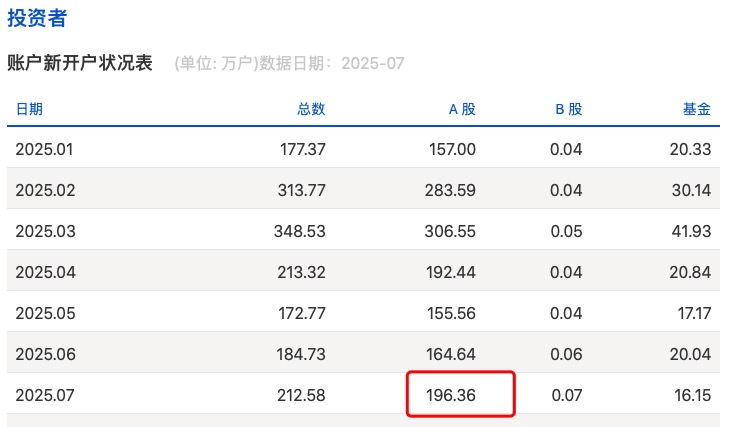
Sou Hu Cai Jing· 2025-08-05 04:41
Core Viewpoint - The significant increase in new A-share investor accounts in July 2025, driven by market performance and policy support, indicates a strong investor sentiment and potential for continued growth in the market [1][5]. Summary by Sections New Account Openings - In July 2025, the number of new A-share investor accounts reached 1.96 million, a 71% increase compared to 1.15 million in July 2024 [1]. - The total number of new accounts opened in the A-share market for the first seven months of 2025 has reached 14.56 million [2]. Monthly Account Data - Monthly new account openings showed fluctuations: January had 1.57 million, February saw a near doubling to 2.84 million, and March exceeded 3 million. April experienced a 37.22% decline due to market volatility, while July saw a 19.27% increase from June [3]. Market Performance and Investor Sentiment - The strong performance of the A-share market in July, with the Shanghai Composite Index rising by 3.74%, the Shenzhen Component by 5.20%, and the ChiNext Index by 8.14%, contributed to heightened investor confidence and enthusiasm for opening new accounts [5]. - The collaboration between brokerage firms and internet platforms has facilitated the influx of younger investors, injecting new energy into the A-share market [5]. Brokerage Performance - Many brokerage firms reported positive growth in new account openings in their 2024 annual reports, with some mid-sized firms experiencing increases exceeding 90% [6]. Market Outlook - Despite some market corrections, the Shanghai Composite Index has shown a year-to-date increase of 6.61%, with expectations for further highs in the future [8]. - Analysts suggest that the market may experience fluctuations in early August but is likely to return to an upward trend later in the month, driven by performance disclosures and easing concerns over trade tensions [9].