
工业增加值

Search documents
中金:经济偏弱运行——12月经济数据前瞻
中金点睛· 2026-01-06 23:47
Core Viewpoint - The economic indicators for December are expected to show a year-on-year decline, with fixed asset investment continuing to decrease, retail sales growth remaining weak, and export growth slightly declining due to base effects. The GDP growth rate for Q4 is projected at 4.6%, with an annual GDP growth rate of 5.0% [2][8]. Group 1: Retail Sales and Consumption - Retail sales are anticipated to continue low growth, with a 30% year-on-year decline in retail sales of four major home appliances in December. The passenger car retail volume is expected to drop by 12.7% year-on-year, a 4.6 percentage point increase in the decline compared to November [3]. - The restaurant industry is experiencing a downturn, with the December restaurant PMI at 42.0%, down 1.8 percentage points from the previous month, which is below the average performance from 2010 to 2024 [3]. Group 2: Fixed Asset Investment - The decline in fixed asset investment growth is expected to continue, with a projected annual decrease of -3.0% for January to December, compared to -2.6% for the first eleven months [3]. - Manufacturing investment is projected to have a cumulative year-on-year growth of 1.6% for the entire year, down from 1.9% in the first eleven months [3]. Group 3: Infrastructure and Real Estate - Infrastructure investment is expected to turn negative, with a cumulative year-on-year decline of -0.4% for the year. Although there are new policies to support investment, the effects may not be fully realized until early 2026 [4]. - Real estate development investment is projected to have a cumulative year-on-year decline of -16.5% for the year, with December sales showing a year-on-year drop of 27.3% [4]. Group 4: Exports and Industrial Production - Export growth is expected to decline due to base effects, with a projected year-on-year growth of 3.0% in December, down from 5.9% in November. Imports are expected to decrease by 2.9% year-on-year [5]. - Industrial production is projected to grow by 6.0% year-on-year in December, influenced by seasonal effects and increased operating rates in major industries [5]. Group 5: Inflation and Price Indices - The Consumer Price Index (CPI) is expected to remain stable at 0.7% year-on-year, with food prices showing slight improvements and energy prices declining [6]. - The Producer Price Index (PPI) is projected to narrow its year-on-year decline to -2.0% in December, with fluctuations in raw material prices impacting the overall index [7]. Group 6: Financial Data - Social financing and monetary growth are expected to decline, with new loans projected to reach 900 billion yuan in December. The net issuance of government bonds is expected to decrease significantly year-on-year [7].


股指注意回调风险,债市或震荡运行
Chang Jiang Qi Huo· 2026-01-05 03:43
Report Industry Investment Rating - Not provided in the content Core Viewpoints of the Report - The market's main line rotates rapidly, and stock index futures may fluctuate. Attention should be paid to the risk of correction. The follow - up trend needs to closely monitor the change in trading volume. If the trading volume remains at the current relatively high level, the index is still expected to continue to expand upward after fully digesting floating chips; otherwise, if the volume significantly shrinks, short - term correction risk should be vigilant. The bond market sentiment has been frustrated, and the future sustainability of the rebound in the manufacturing PMI in December remains to be observed. In 2026, as the starting year of the 14th Five - Year Plan, the pressure and necessity for stable growth are still relatively large, and it is highly likely that policies will be implemented at the beginning of the year to support the economy [9][11] Summary by Relevant Catalogs Financial Futures Strategy Recommendations Stock Index Strategy Recommendations - Stock index trend review: The Shanghai Composite Index rose 0.09% to close at 3968.84 points. For the whole year, the Shanghai Composite Index increased by 18.41% [9] - Core view: The manufacturing PMI in December rebounded to 50.1%, returning above the boom - bust line after 8 months and significantly higher than the consensus expectations of Bloomberg and Reuters. The rebound in the manufacturing PMI in December has strong certainty at the structural level but faces uncertainty at the aggregate level. The market's main line rotates rapidly, and stock index futures may fluctuate. Attention should be paid to the risk of correction [9] - Technical analysis: The MACD indicator shows that the broader market index may fluctuate [9] - Strategy outlook: Range - bound fluctuations [9] Treasury Bond Strategy Recommendations - Treasury bond trend review: The 30 - year main contract fell 0.35%, the 10 - year main contract fell 0.07%, the 5 - year main contract fell 0.04%, and the 2 - year main contract fell 0.03% [11] - Core view: The composite PMI, manufacturing PMI, and non - manufacturing PMI are all above the boom - bust line of 50, and the bond market sentiment has been frustrated. The rebound in the manufacturing PMI in December exceeded expectations, and its future sustainability remains to be observed. In 2026, as the starting year of the 14th Five - Year Plan, the pressure and necessity for stable growth are still relatively large. Whether it is the remaining fiscal resources at the end of the year or the room for monetary easing, it indicates that it is highly likely that policies will be implemented at the beginning of the year to support the economy. Attention should be paid to the stock - bond seesaw, whether the central bank's scale of treasury bond trading will further expand, and the implementation rhythm of monetary policies after the new year [11] - Technical analysis: The MACD indicator shows that the T main contract may fluctuate [11] - Strategy outlook: Fluctuating operation [11] Key Data Tracking PMI - In December, the manufacturing PMI rebounded to 50.1%, returning above the boom - bust line after 8 months [18] - It was significantly stronger than the seasonal trend. In previous Decembers, the manufacturing PMI decreased by an average of 0.3 pct compared with November, while it increased by 0.9 pct this month [18] - The PMI of high - tech manufacturing industries rebounded significantly by 2.4 pct to 52.5%, indicating a good growth trend in the industry [18] - Large and medium - sized enterprises led the improvement. Although the PMI of small enterprises declined, large and medium - sized enterprises' PMIs both rebounded significantly [18] CPI - In November, the year - on - year increase in CPI strengthened, and the month - on - month PPI remained positive, which was the result of the combined effects of seasonal factors, low - base effects, and "anti - involution" [21] - It is worth noting that the year - on - year CPI has fluctuated below 1% for 33 consecutive months, and the year - on - year PPI has been negative for 38 consecutive months, indicating that domestic demand is still relatively weak [21] - At the end of the year and during the Spring Festival, driven by seasonal effects and rising gold prices, the year - on - year CPI is expected to continue to fluctuate upward [21] - Since November 2024, the year - on - year base of PPI has entered a downward range again. Affected by low - base effects and the orderly progress of "anti - involution", the year - on - year PPI is also expected to rebound [21] Import and Export - In November, China's exports were $330.35 billion, imports were $218.67 billion, and the trade surplus was $111.68 billion [23] - In terms of representative export commodities, labor - intensive products, mechanical and electrical products, and high - tech products drove the overall export in November by - 1.33%, 5.81%, and 2.01% respectively, with the driving rates increasing by 1.03 pp, 5.06 pp, and 1.55 pp respectively compared with the previous month [23] - The strengthening of exports to the EU, Africa, and Latin America drove the year - on - year increase in exports this month, showing a relatively strong performance. Since November 9th, the year - on - year growth rates of global and US imports and China's container bookings to the US have continued to decline week by week, indicating a high probability of pressure on exports in December [24] Industrial Added Value - In November, the year - on - year growth rate of industrial added value dropped to 4.8%, and the service industry production index dropped to 4.2%. The production - end data has declined for two consecutive months [25] - There are two reasons for the weakening of industrial added value. First, "anti - involution" has begun to suppress the output of key industries. In November, the year - on - year growth rate of industrial added value in the automobile industry dropped by 4.9 pct to 11.9%, the year - on - year growth rate of industrial added value in the steel industry dropped by 0.5 pct to 0.9%, and the chemical industry dropped by 0.4 pct to 6.7%. In terms of microscopic output, the year - on - year output of automobiles, ethylene, and steel also weakened. Second, after the policy took effect on September 24th last year, the production increase established a relatively high base. From the perspective of the two - year compound growth rate, the year - on - year growth rate of industrial added value in November was basically the same as that in October [28] Fixed - Asset Investment - From January to November, the year - on - year growth rate of fixed - asset investment dropped by 2.6%. It is estimated that the year - on - year growth rate of fixed - asset investment in November was - 11.1%, a slight increase compared with October [31] - By type, the year - on - year growth rate of private investment rebounded to - 12.9%, and the year - on - year growth rate of public investment continued to drop to - 8.9% [31] - By expenditure direction, it is estimated that the year - on - year growth rates of construction and installation projects/equipment and tool purchases in November dropped to - 16.1% and 6.3% respectively, and the year - on - year growth rate of other expenses rebounded slightly to - 13.8% [31] - By the three major categories, the year - on - year growth rates of infrastructure and real estate investment are still declining at a low level, but manufacturing investment has a slight rebound [31] Social Retail - In November, the year - on - year growth rate of social retail sales dropped to 1.3%, lower than market expectations and the weakest since 2023 [34] - There are three factors for the weakening of social retail sales in November. First, after the weakening of national subsidy funds, the weakening of durable - goods consumption is the main drag. In November, the year - on - year growth rate of optional consumption dropped to - 10%, and among them, automobiles and home appliances cumulatively dragged down the year - on - year growth rate of social retail sales in that month by 1.2 pct. Second, the overall weak performance of the "Double Eleven" sales also dragged down the social retail sales for the whole month. In November, the online retail sales of physical goods dropped by 3.3 pct to 1.5%, and the two - year compound year - on - year growth rate turned negative for the first time this year. Third, the consumption in the post - real - estate cycle continued to be weak. Restricted by the long - term weak real - estate sales, the year - on - year growth rates of social retail sales of building materials and furniture both dropped and turned negative [34] Social Financing - In November, the new social financing was 2.5 trillion yuan, a year - on - year increase of 0.2 trillion yuan. Corporate bonds and non - standard financing were the main supports, while government bonds and credit were the main drags [37] - Bills continued to boost the volume, and the year - on - year increase in medium - and long - term loans for residents and enterprises continued to be less than the previous year [37] - In November, the year - on - year growth rate of social financing remained flat at 8.5%, and the growth rate of credit in the social financing caliber remained flat at 6.3% [37] - The growth rates of M1 and M2 declined. Attention should be paid to the process of deposit currentization in the future [37]
三重因素影响下的超预期——12月PMI数据点评
Huachuang Securities· 2025-12-31 11:44
PMI Overview - December manufacturing PMI increased to 50.1%, up from 49.2% in November[1] - The production index rose to 51.7%, an increase of 1.7 percentage points from the previous value of 50.0%[1] - New orders index improved to 50.8%, up from 49.2%[1] - New export orders index increased to 49.0%, compared to 47.6% previously[1] Influencing Factors - Year-end factors contributed to a rise in construction PMI to 52.8%, up 3.2 percentage points from 49.6%[4] - Seasonal effects led to a strong production index at 51.7%, marking the highest for the quarter[5] - External demand showed resilience with the new export orders index at 49.0%, indicating a recovery in exports[6] Price and Inventory Insights - December's PMI factory price index was 48.9%, slightly up from 48.2%, remaining below the neutral line[2] - The main raw materials purchase price index stood at 53.1%, above the neutral line, indicating ongoing high demand[2] - Inventory indicators showed signs of replenishment, with the purchasing index at 51.1%, up from 49.5%[23] Economic Outlook - Manufacturing activity expectations index rose to 55.5%, up from 53.1%, reflecting improved sentiment[24] - Comprehensive PMI output index increased to 50.7%, indicating overall expansion in production activities[24]
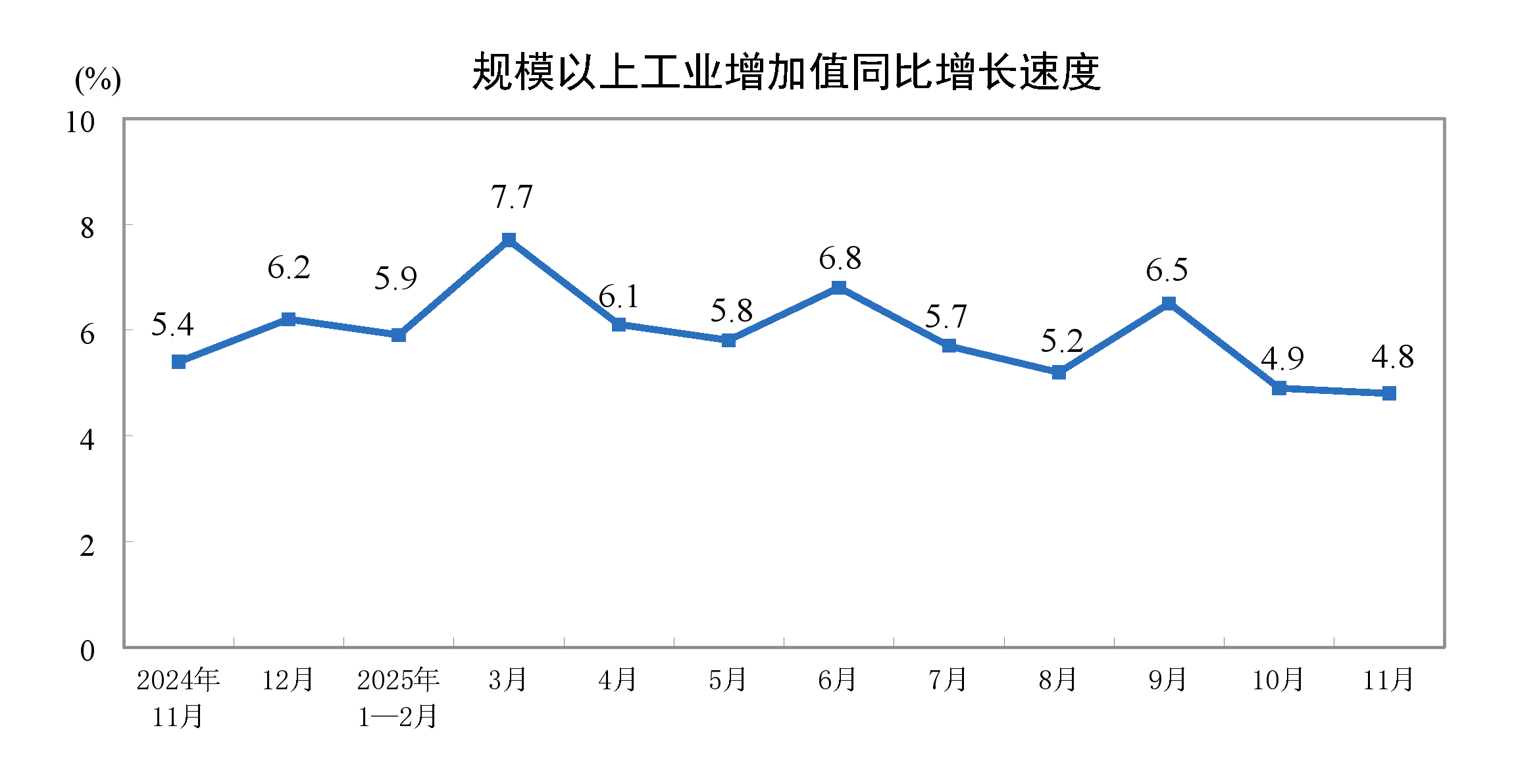
2025年11月份规模以上工业增加值增长4.8% - 国家统计局
Guo Jia Tong Ji Ju· 2025-12-29 09:36
Core Insights - In November, the industrial added value of large-scale enterprises increased by 4.8% year-on-year, with a month-on-month growth of 0.44% [1] - From January to November, the industrial added value grew by 6.0% year-on-year [1] Group 1: By Industry - In November, the mining industry saw a year-on-year increase of 6.3%, manufacturing grew by 4.6%, and the production and supply of electricity, heat, gas, and water increased by 4.3% [3] - Among 41 major industries, 30 reported year-on-year growth in added value, with coal mining and washing growing by 7.5%, oil and gas extraction by 5.1%, and food processing by 1.7% [3] - The automotive manufacturing sector experienced significant growth of 11.9%, while the production of new energy vehicles surged by 17.0% [4][11] Group 2: By Economic Type - In November, state-controlled enterprises' added value increased by 4.2%, while joint-stock enterprises grew by 5.2%, foreign and Hong Kong, Macao, and Taiwan-invested enterprises by 3.4%, and private enterprises by 3.2% [3] Group 3: Product Output - Out of 623 industrial products, 310 saw year-on-year output growth in November, including ethylene at 309,000 tons (up 7.3%) and automotive production at 3.519 million units (up 2.4%) [4][14] - The sales rate of products from large-scale industrial enterprises was 96.5%, a decrease of 0.8 percentage points year-on-year [4][16] - The export delivery value of large-scale industrial enterprises was 1.361 trillion yuan, a nominal decrease of 0.1% year-on-year [4][16]
南京1—11月经济运行简况发布 我市持续推动经济回升向好
Nan Jing Ri Bao· 2025-12-29 02:48
Economic Overview - Nanjing's economy has shown signs of recovery in 2023, with a focus on implementing central and provincial government policies to stabilize and promote growth [1] Industrial Performance - From January to November, the city's industrial added value increased by 5.8% year-on-year, with state-owned enterprises growing by 7.8%, joint-stock enterprises by 9.3%, and private enterprises by 10.7% [1] - Key sectors such as instrument manufacturing, general equipment manufacturing, and specialized equipment manufacturing saw year-on-year growth of 13.5%, 10.3%, and 10.1% respectively [1] - Notable product outputs included 3D printing equipment (up 21.4%), industrial robots (up 27.3%), new energy vehicles (up 59.1%), and integrated circuit products (up 30.6%) [1] Consumer Market - The total retail sales of consumer goods reached 739.55 billion yuan from January to November, reflecting a year-on-year growth of 3.9% [1] - Essential consumer goods such as grain and oil, and daily necessities showed strong growth, increasing by 11.5% and 4.2% respectively [1] - There was significant growth in discretionary spending categories, with cultural and office supplies up 19.5%, communication equipment up 26.5%, jewelry up 14.1%, and sports and entertainment goods up 3.6% [1] Fixed Asset Investment - Fixed asset investment decreased by 4.2% year-on-year, but the decline was less severe than in the previous months, narrowing by 1.0 percentage point [2] - Infrastructure investment grew by 4.3%, while manufacturing investment increased by 11.9% [2] - High-tech industry investments rose by 9.3%, with aerospace equipment manufacturing, computer and office equipment manufacturing, and medical instruments and equipment manufacturing seeing increases of 45.9%, 21.5%, and 23.7% respectively [2] Consumer Price Index - In November, the consumer price index rose by 0.4% year-on-year, an increase of 0.3 percentage points from the previous month [2] - Price changes varied by category, with food and tobacco prices down 0.8%, clothing prices up 2.1%, and living supplies and services up 1.6% [2] - Overall, the consumer price index decreased by 0.3% from January to November [2]
铝周报:沪铝或高位震荡运行-20251222
Hua Long Qi Huo· 2025-12-22 02:26
Report Summary 1. Industry Investment Rating No investment rating information provided in the report. 2. Core View - Aluminum prices are expected to fluctuate at a high level. Arbitrage opportunities are limited, and it is recommended to adopt a wait - and - see approach for option contracts. [5][31] 3. Summary by Directory 3.1 Market Review - Last week, the price of the main contract AL2602 of Shanghai aluminum futures fluctuated between around 21,600 yuan/ton and a maximum of about 22,200 yuan/ton. [7] 3.2 Macroeconomic Aspects - In November, the added value of industrial enterprises above designated size increased by 4.8% year - on - year and 0.44% month - on - month. From January to November, it increased by 6.0% year - on - year. Among 41 major industries, 30 had year - on - year growth in added value in November. The US November unadjusted CPI annual rate was 2.7%, significantly lower than the market expectation of 3.1%. The core CPI also significantly missed expectations, rising 2.6% year - on - year, the lowest since March 2021. [4][10][11] 3.3 Supply and Demand Situation - In November 2025, there was an alumina supply surplus of 590,000 tons. As of November 2025, domestic alumina production was 8.138 million tons, a month - on - month increase of 273,000 tons and a year - on - year increase of 7.6%. As of December 11, 2025, the total domestic alumina inventory was 58,000 tons, a decrease of 10,000 tons from the previous period. [13] 3.4 Inventory Situation - As of December 19, 2025, the Shanghai Futures Exchange electrolytic aluminum inventory was 120,510 tons, an increase of 515 tons from the previous week. As of December 18, 2025, the LME aluminum inventory was 519,600 tons, unchanged from the previous trading day, with the cancelled warrant ratio at 14.2%. As of December 18, 2025, the total social inventory of electrolytic aluminum was 510,000 tons, a decrease of 1.8 tons from the previous day. [21]
利率债周报:短债利率下行,超长债波动幅度较大-20251219
BOHAI SECURITIES· 2025-12-19 09:22
1. Report Industry Investment Rating No industry investment rating is provided in the report. 2. Core Viewpoints of the Report - Currently, it's hard to say that the bond market has returned to fundamental pricing. Policy expectations, asset price - to - ratio, and institutional behavior are still the main influencing factors. In 2026, the influence of fundamentals on bond market pricing is expected to increase [1][22]. - After the content of the Central Economic Work Conference is clear, the bond market within the year will revolve around institutional behavior and the equity market. The bond market is expected to be mainly volatile, with a high probability of a steeper yield curve. Ultra - long bonds will still have high volatility, and it's not advisable to overly expect an end - of - year rush - to - buy market [1][22][24]. - One can moderately grasp the spread between China Development Bank bonds and Treasury bonds with a maturity of 7 years or less, as well as the term spread of 5Y - 3Y Treasury bonds [1][24]. 3. Summary by Directory 3.1 Important Event Reviews 3.1.1 Financial Data - As of the end of November 2025, the year - on - year growth rate of the stock of social financing scale was 8.5%. In the first eleven months, RMB loans increased by 15.36 trillion yuan, and the balance of M2 at the end of November increased by 8% year - on - year. In November, social financing increased year - on - year, with an increase in corporate bond financing scale. However, government bond financing and on - balance - sheet credit financing were still drag factors. RMB loans decreased year - on - year in November. In terms of structure, short - term corporate loans improved, while medium - and long - term corporate loans still decreased year - on - year, and the bill financing impulse was obvious. The household sector continued to de - leverage. The year - on - year growth rates of M1 and M2 both declined in November [7]. - Looking ahead, policy - based financial instruments are expected to boost credit, but the high base of government bond financing remains a drag. The year - on - year growth rate of the social financing stock may decline slightly, and the progress of household deposit transfer is still worthy of attention [7]. 3.1.2 Economic Data - In November 2025, the year - on - year growth rate of the added value of industries above the designated size was 4.8%, the cumulative year - on - year growth rate of fixed - asset investment was - 2.6%, and the year - on - year growth rate of total retail sales of consumer goods was 1.3%. Domestic demand continued to be weak, and effective demand still needed to be boosted. In terms of production, the year - on - year growth rate of industrial added value slowed down slightly in November. In terms of investment, the decline in the cumulative year - on - year growth rate of fixed - asset investment further expanded in November. In terms of consumption, the year - on - year growth rate of total retail sales of consumer goods slowed down in November, while the cumulative year - on - year growth rate of service consumption increased slightly [8][9]. - Looking ahead, it is expected that the "anti - involution" and a slight weakening of exports will restrict production in December. The growth rate of industrial production in 2025 is expected to be about 5.8%, the growth rate of manufacturing investment is expected to be about 2.0%, the infrastructure investment is expected to show a recovery trend with a growth rate of about 1.0% in 2025, and the growth rate of total retail sales of consumer goods in 2025 is expected to be around 3.7% [9]. 3.1.3 Fiscal Data - From January to November 2025, the national general public budget revenue increased by 0.8% year - on - year, and the expenditure increased by 1.4% year - on - year; the national government - funded budget revenue decreased by 4.9% year - on - year, and the expenditure increased by 13.7% year - on - year. In terms of public finance revenue, the year - on - year increase in tax revenue was slightly expanded. In terms of public finance expenditure, the year - on - year growth rate of expenditure declined, mainly due to the earlier expenditure rhythm this year. In terms of the expenditure structure, the three focuses of public finance expenditure from January to November were people's livelihood, science and technology, and green, and efforts were further increased in the science and technology field in November. In terms of government - funded revenue and expenditure, the revenue side was still dragged down by the land market [10]. - Looking ahead to 2026, the Central Economic Work Conference continued to describe fiscal policy as "more proactive", emphasizing the guarantee of necessary expenditures. In terms of rhythm, it will "actively act ahead" and "reasonably speed up the allocation and disbursement of funds". In terms of structure, attention can be paid to strengthening the financial guarantee for major national strategies, accelerating debt resolution, and tax system reform [10]. 3.2 Funding Prices: Central Bank's Injection of Cross - Year Funds - During the period from December 12th to December 18th, the central bank's net injection of funds in the open market was 134 billion yuan. The central bank over - renewed 200 billion yuan of 6 - month repurchase agreements and conducted 100 billion yuan of 14 - day reverse repurchase operations to support the cross - year funding situation. On December 18th, DR014 and R014 increased by 10bp and 6bp respectively, while DR001 and DR007 remained stable. The yield of inter - bank certificates of deposit declined slightly, which is in line with the seasonal characteristic of the decline in CD yields at the end of the year [11][12]. 3.3 Primary Market: Decrease in Supply Scale - From December 12th to December 18th, a total of 46 interest - rate bonds were issued in the primary market. There was no end - of - year surge in the issuance of special bonds. Since December, the issuance frequency of the China Development Bank and the Export - Import Bank of China has also decreased, and the supply pressure of interest - rate bonds is limited [14]. 3.4 Secondary Market: Steeper Yield Curve - During the period from December 12th to December 18th, the yields of Treasury bonds with different maturities showed differentiation. The yields of medium - and short - term Treasury bonds mostly declined, while the yields of ultra - long - term Treasury bonds increased slightly, showing a steeper yield curve. The decline in medium - and short - term interest rates may be related to the loose funding situation. The winning bid rate of the 14 - day reverse repurchase operation may have decreased compared with that in September, driving up the short - term bullish sentiment. The long - term interest rate has a strong gaming sentiment, with a larger single - day fluctuation range. The 10 - year Treasury bond yield has a psychological support level of 1.85%, while the 30 - year Treasury bond yield has less upward resistance and greater fluctuation [16]. 3.5 Market Outlook 3.5.1 Fundamental Aspect It's difficult to say that the bond market has returned to fundamental pricing currently. Policy expectations, asset price - to - ratio, and institutional behavior are still the main influencing factors. In 2026, the influence of fundamentals on bond market pricing is expected to increase, and price signals are the key [1][22]. 3.5.2 Policy Aspect - In 2026, fiscal policy will "actively act ahead" and "reasonably speed up the allocation and disbursement of funds", with a similar rhythm to 2025. In terms of expenditure structure, it will "strengthen the financial guarantee for major national strategies and promote more funds and resources to be invested in people", and supporting people's livelihood remains an important direction [1][22]. - Monetary policy emphasizes "striving to achieve economic growth and price recovery" and supplements the original statement of "matching the growth of social financing scale and money supply with economic growth and price level expectations". Reserve requirement ratio cuts, interest rate cuts, and liquidity injection tools of various maturities will be used flexibly [1][22]. 3.5.3 Funding Aspect As the cross - year period approaches, funding prices may rise slightly, but with the central bank's open - market operations, the possibility of a significant tightening of funds is limited [1][22].
浙江:11月规模以上工业增加值同比增长6.5%
Di Yi Cai Jing· 2025-12-19 01:34
Core Insights - In November, the industrial added value of large-scale industries in Zhejiang Province increased by 6.5% year-on-year, with 24 out of 37 major industrial sectors showing positive growth [1] Industrial Performance - The industries with significant growth in added value include: - Petroleum processing: 31.4% - Automotive: 23.2% - Railway and shipbuilding: 17.5% - Computer, communication, and electronic products: 15.7% - Chemical fiber: 9.9% - These sectors collectively contributed 4.5 percentage points to the growth of large-scale industrial added value [1] Innovation and New Products - The value rate of new products in large-scale industries reached 44.4%, an increase of 2.1 percentage points year-on-year [1] - The added value of high-tech manufacturing, strategic emerging industries, core digital economy industries, and equipment manufacturing grew by: - High-tech manufacturing: 11.8% - Strategic emerging industries: 11.5% - Core digital economy industries: 11.0% - Equipment manufacturing: 10.2% [1] Year-to-Date Performance - From January to November, the industrial added value of large-scale industries increased by 7.0% [1]
——11月经济数据点评:需求延续弱势,生产保持韧性
Shenwan Hongyuan Securities· 2025-12-16 11:28
Group 1 - The report highlights a continued weakness in demand, particularly in consumer spending, which has been significantly impacted by a decline in automobile sales and the reduction of government subsidies for trade-ins [2][3] - Cumulative retail sales growth for January to November 2025 is reported at 4.0%, a decrease of 0.3 percentage points compared to the previous month, with automobile sales showing a cumulative year-on-year decline of 1.0% [3][22] - Industrial value-added growth for November 2025 is at 6.0%, down 0.1 percentage points from October, indicating a divergence between traditional industries related to real estate and high-tech sectors [3][4] Group 2 - The report notes a rebound in inflation, primarily driven by rising food prices, with the Consumer Price Index (CPI) increasing to 0.7% year-on-year in November, marking a 0.5 percentage point rise [3][5] - Fixed asset investment shows a cumulative year-on-year decline of 2.6% for November, with real estate investment down 15.9% and infrastructure investment at 0.13% [3][7] - The report indicates that the overall economic fundamentals are weakening, with investment growth and consumer spending declining, while inflation recovery remains uncertain [3][23]
11月经济数据点评:需求延续弱势,生产保持韧性
Shenwan Hongyuan Securities· 2025-12-16 10:50
Group 1 - The report highlights a continued weakness in consumer demand, particularly impacted by a decline in automobile sales and the reduction of government subsidies, indicating that sustained policy support is necessary to boost consumer spending [3] - Industrial value-added growth remains resilient at 6.0% year-on-year, although there is a clear divide between traditional industries, such as real estate, which are contracting, and high-tech industries that are supporting growth [3][4] - Inflation is showing signs of recovery, primarily driven by rising food prices, with the Consumer Price Index (CPI) increasing to 0.7% year-on-year, marking the first positive change in food prices this year [3][5] Group 2 - Fixed asset investment has seen a further decline, with a cumulative year-on-year decrease of 2.6% in November, driven by downturns in real estate, infrastructure, and manufacturing investments [3][7] - The report notes that the economic fundamentals are weakening, with investment growth and consumer spending both declining, while inflation recovery remains uncertain [3] - The real estate sector continues to face challenges, with cumulative sales area down 11.1% year-on-year, indicating a persistent contraction since the second quarter of this year [3][10]