
美联储降息路径

Search documents
受助于美元走软和逢低买盘,金价反弹
Sou Hu Cai Jing· 2025-10-22 05:57
Core Viewpoint - Gold prices rebounded on Wednesday, supported by a weaker dollar and bargain buying, as investors focus on the upcoming U.S. inflation data set to be released on Friday, which will provide clues for the Federal Reserve's interest rate path [1] Group 1 - The rebound in gold prices is attributed to a softening dollar and increased buying interest at lower price levels [1] - Investors are particularly attentive to the U.S. Consumer Price Index (CPI) data for September, which is expected to influence the Federal Reserve's decisions regarding interest rate cuts [1] - StoneX senior analyst Matt Simpson noted a significant shift in gold trading momentum, indicating a technical repositioning in the market after surpassing the $4000 mark, suggesting a potential need for a market correction [1]
SEB:若美国政府关门,亚洲货币的涨势将是短暂的
Sou Hu Cai Jing· 2025-09-29 05:31
Core Viewpoint - Asian currencies and emerging market stocks rose on Monday due to a decline in the US dollar for the second consecutive day, with traders focusing on upcoming US employment data for clues on the Federal Reserve's interest rate cut path [1] Group 1 - The rise in Asian currencies is linked to the recent drop in the US dollar, which has been observed for two days [1] - Traders are particularly attentive to US employment data scheduled for release this week, as it may provide insights into the Federal Reserve's potential interest rate cuts [1] - The preferred inflation indicator of the Federal Reserve aligned with expectations last Friday, contributing to the current market sentiment [1] Group 2 - Eugenia Fabon Victorino, the Asian strategy head at Nordea Bank, cautioned that if the US government shutdown delays the employment report, it could increase uncertainty and potentially limit the gains in Asian currencies [1] - The performance of Asian currencies against the US dollar is expected to be influenced by fluctuations in the dollar until Wednesday [1]
沪铜日评:矿端偏紧但需求趋弱使铜价震荡-20250929
Hong Yuan Qi Huo· 2025-09-29 02:39
Report Summary 1. Report Industry Investment Rating - Not provided in the given content. 2. Core View of the Report - Overseas copper mine production disruptions lead to an expectation of tight supply and demand, but the Fed's hawkish future interest - rate cut path and high copper prices suppressing downstream purchasing willingness may cause the Shanghai copper price to remain volatile [2] 3. Summary by Relevant Data 3.1 Shanghai Copper Futures Active Contract - Closing price on 2025 - 09 - 26 was 82710, down 240 from the previous value; trading volume was 174625, with a decrease of 160268 compared to the previous value; open interest was 23853, down 9473; inventory was 27662 tons, a decrease of 1105 tons; the basis was - 205, an increase of 220 [2] 3.2 SMM Copper Prices and Premiums - SMM 1 electrolytic copper average price on 2025 - 09 - 26 was 82505, down 20; SMM semi - water copper average discount was - 10, down 30; SMM premium copper average premium was 80, down 40; SMM mixed copper average discount was - 60, down 45; SMM Guixi copper average premium was 100, down 40; EQ copper average discount was - 130, down 80; SMM RMB Yangshan copper average premium was 412.49, an increase of 0.19; SMM Yangshan copper (warehouse receipt) average premium was 53, unchanged; SMM Yangshan copper (bill of lading) average premium was 58, unchanged [2] 3.3 Shanghai Copper Spreads - Shanghai copper near - month minus continuous - first was - 50, an increase of 50; continuous - first minus continuous - second was 20, down 30; continuous - second minus continuous - third was 0, an increase of 60 [2] 3.4 LME Copper Futures - LME 3 - month copper futures closing price (electronic trading) on 2025 - 09 - 26 was 10205, down 70.5; LME copper futures 0 - 3 - month contract spread was - 38.91, down 7.36; LME copper futures 3 - 15 - month contract spread was - 50.2, down 10.22; the Shanghai - LME copper price ratio was 8.0813, an increase of 0.03 [2] 3.5 COMEX Copper - COMEX copper futures active contract closing price on 2025 - 09 - 26 was 4.8275, down 0.06; total inventory was 315206, an increase of 4055 [2] 4. Trading Strategy - Wait for the price to fall before mainly laying out long positions. Pay attention to the support level around 78000 - 81000 and the resistance level around 83000 - 86000 for Shanghai copper; the support level around 9800 - 10000 and the resistance level around 10500 - 10800 for LME copper; the support level around 4.3 - 4.5 and the resistance level around 4.8 - 5.0 for US copper [2]
ETO Markets 每日汇评: 镑日“过山车”惊魂!61.8%黄金分割位遇阻,199.5成多头“生死线”?
Sou Hu Cai Jing· 2025-09-26 05:01
Group 1: Gold Market Analysis - On Thursday, gold (XAU/USD) experienced fluctuations, rising to the 61.8% Fibonacci retracement level before retreating, forming a bearish engulfing pattern on the H4 chart, and reaching a new low of 3722 during the US session before recovering, with a total daily range of 398 points [3] - The current market focus is on the Federal Reserve's interest rate cut path and geopolitical tensions, leading to a tug-of-war in gold prices [3] Group 2: Key Levels and Trading Recommendations for Gold - Resistance levels are identified at 3757-3760, while support levels are at 3722-3717; trading strategy suggests entering positions based on these levels—shorting at resistance with a stop loss at 3760 and a target of 70-100 points, and going long at support with a stop loss at 3717 and a target of 70-100 points [4] - The H1 trend line remains green, with a previous short position at 3748 yielding a profit of 100 points, and the strategy will continue to incorporate the M5 model for trading [4] Group 3: Euro Market Analysis - The Euro (EUR/USD) was negatively impacted by the deterioration of the German GfK consumer confidence index and US initial jobless claims data, resulting in a bearish daily close with a range of 108 points [6] - Weak European economic data combined with protectionist trade policy pressures are suppressing the Euro's performance [6] Group 4: Key Levels and Trading Recommendations for Euro - Resistance levels are set at 1.174/1.178, with support at 1.156/1.161; the trading strategy suggests shorting in the 1.171-1.170 range with a stop loss at 1.175 and a target of 30-50 points [8] - The H1 trend line remains green, with a previous short position at 1.1754 achieving the profit target, and the M5 model will be referenced for short-term trading [8] Group 5: Pound Market Analysis - The Pound (GBP/USD) faced pressure due to the UK CBI retail sales differential and fiscal deficit, closing bearish with a range of 145 points; the resilience of the US labor market has reinforced expectations for a Federal Reserve rate cut, adding to the Pound's challenges [10] Group 6: Key Levels and Trading Recommendations for Pound - Resistance levels are identified at 1.342/1.347, with support at 1.323/1.327; the strategy suggests shorting in the 1.339-1.338 range with a stop loss at 1.345 and a target of 30-50 points [12] - The H1 trend line remains green, with a previous short position at 1.3467 achieving profitability, and the M5 model will continue to be utilized for trading [12] Group 7: GBP/JPY Market Analysis - The GBP/JPY pair saw fluctuations, rising to the 61.8% Fibonacci retracement level before retreating, forming a bearish engulfing pattern on the H4 chart, with a daily range of 85 points [14] Group 8: Key Levels and Trading Recommendations for GBP/JPY - Resistance levels are set at 200.7/201.3, with support at 199.1/198.6; the strategy suggests shorting in the 199.9-200 range with a stop loss at 200.4 and a target of 40-60 points [15] - The H1 trend line shifted from red to yellow, with a previous long position at 199.7 yielding a profit of 70 points, and the focus will be on the green signal from the three-color line strategy combined with the M5 model for trading [16] Group 9: Upcoming Economic Focus - Key economic indicators to watch include Canada's July GDP, the US August core PCE price index, monthly personal spending, the University of Michigan consumer confidence index, and speeches from Federal Reserve officials, with caution advised regarding data volatility risks [18]

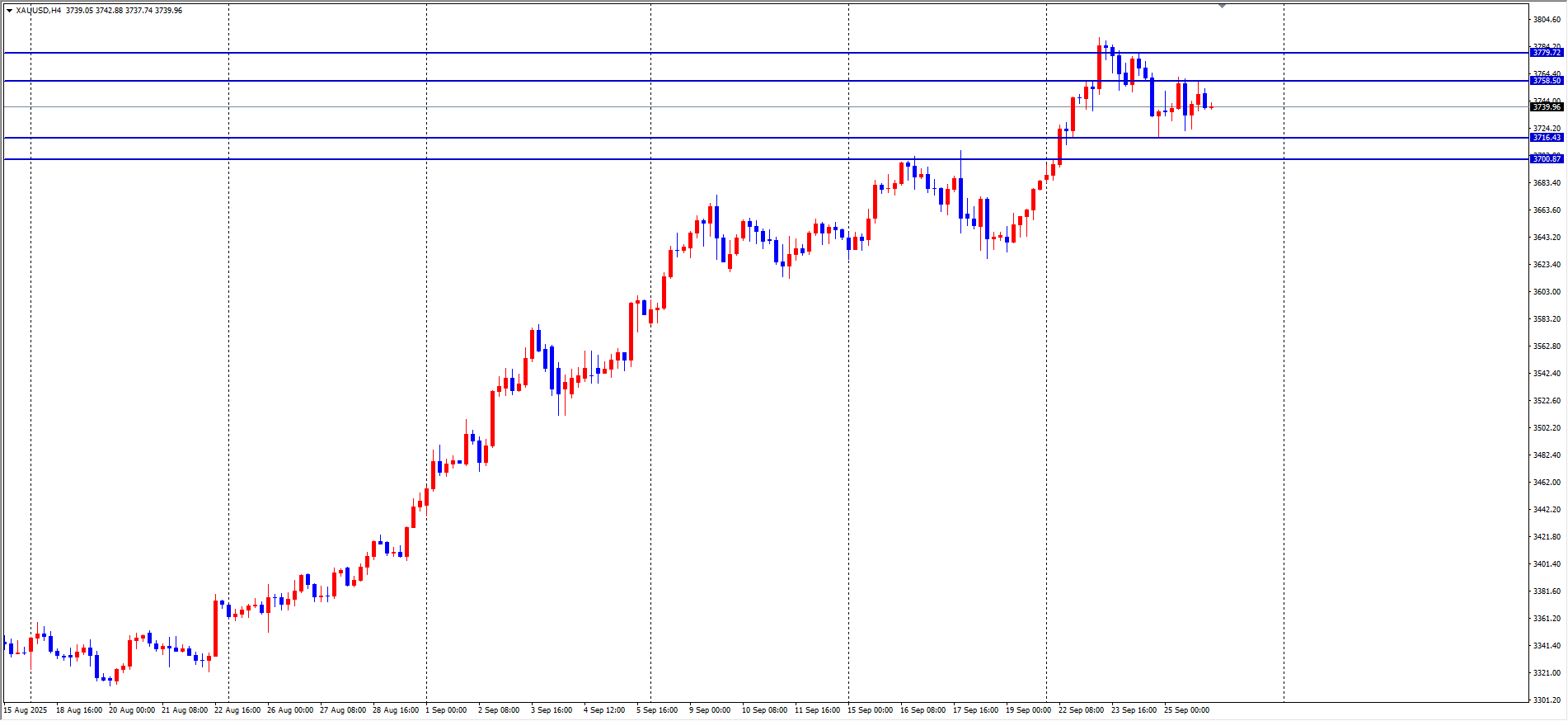
天风证券:美联储未来降息路径有3种情形 哪种概率最大?
智通财经网· 2025-09-18 23:52
Core Viewpoint - The Federal Reserve's September FOMC meeting emphasized the risks of employment slowdown and raised the expectation for interest rate cuts in 2025, indicating a cautious but dovish stance from Chairman Powell [1][2][3] Summary by Sections FOMC Meeting Highlights - The Federal Reserve lowered the federal funds target rate by 25 basis points, marking the first rate cut of the year, with expectations of two more cuts within the year [2] - The statement highlighted the risks of employment downturn, removing previous language about a robust labor market and introducing concerns about slowing job growth [2] Economic Forecasts - The Fed improved GDP forecasts for 2025, 2026, and 2027 while slightly lowering unemployment rate projections for 2026 and 2027 [2] - The dot plot indicated an increase in expected rate cuts for 2025 from two to three, with further divergence in future rate expectations among committee members [2] Powell's Remarks - Chairman Powell described the rate cut as a "risk management cut," indicating no need for significant cuts at this time and emphasizing a data-dependent approach for future decisions [3] - He noted that while unemployment remains low, there are rising risks, attributing job growth slowdown to factors like reduced immigration and declining labor participation rates [3] Market Reactions - Following the FOMC announcement, U.S. Treasury yields rose, and stock markets showed mixed results, reflecting market sensitivity to Powell's cautious tone regarding future rate cuts [4] - Market confidence in two additional rate cuts this year increased, although expectations for 2026's rate cuts were pushed back [4] Future Rate Cut Scenarios - Three potential scenarios for future rate cuts were outlined: 1. **Soft Landing Scenario**: The economy achieves a soft landing with no major recession, leading to two more cuts this year and three in 2025 [5] 2. **Recession Scenario**: A significant economic downturn occurs, prompting aggressive rate cuts, potentially including a 50 basis point cut [6] 3. **High Inflation Scenario**: Persistent high inflation forces the Fed to maintain higher rates for an extended period [6] - The soft landing scenario is considered the most probable, while the recession and high inflation scenarios are viewed as less likely at this time [6]

黄金新高后怎么看?
2025-09-07 16:19
Summary of Key Points from Conference Call Industry Overview - The focus is on the **gold market** and its price dynamics influenced by macroeconomic factors and geopolitical events [1][2][3]. Core Insights and Arguments - **Gold Price Trends**: After breaking the $3,500 per ounce mark at the end of August, market attention on gold has significantly increased, aligning with expectations that the price movements are driven by different factors in the first and second halves of the year [2][3]. - **Impact of Tariffs**: The conclusion of the China-US Geneva Agreement in May reduced tariff uncertainties, leading to a decrease in the political risk premium that previously supported gold prices [2][4]. - **US Labor Market Data**: A downward revision of US labor market data has raised concerns about economic performance, which in turn supports gold prices as it increases expectations for Federal Reserve rate cuts [2][5]. - **Geopolitical Factors**: The weakening of geopolitical pricing and a significant decline in global demand expectations have contributed to volatility in the commodity markets, including gold [3][4]. - **Federal Reserve Policy**: The potential for the Federal Reserve to cut rates without waiting for significant inflation decreases is a key factor influencing gold prices, with expectations of a terminal rate around 3% [8][9]. - **Inflation and Stagflation**: The current economic slowdown may support gold prices, with market concerns about stagflation, which typically benefits gold [8][9]. Important but Overlooked Content - **Long-term Debt Risks**: The resignation of Federal Reserve officials and increasing long-term debt risks have heightened market concerns about the independence of the Fed and the sustainability of developed countries' debt levels, contributing to rising gold prices [6][10]. - **Future Price Predictions**: For 2026, key factors to monitor include US labor data, global long-term debt risks, and geopolitical tensions, which will significantly impact gold prices [5][12]. - **Market Sentiment**: The upcoming US-China meetings may provide optimistic news, but the market has already priced in the easing of trade uncertainties, limiting the potential for significant gold price corrections [10][11]. Conclusion - The gold market is currently influenced by a complex interplay of economic data, geopolitical events, and Federal Reserve policies, with expectations of continued price support in the near term due to anticipated rate cuts and economic conditions. Future price movements will depend heavily on the evolution of these factors.
人民币汇率走势分析:能否升破7.0?关注中间价与套息交易变化
Sou Hu Cai Jing· 2025-08-31 17:48
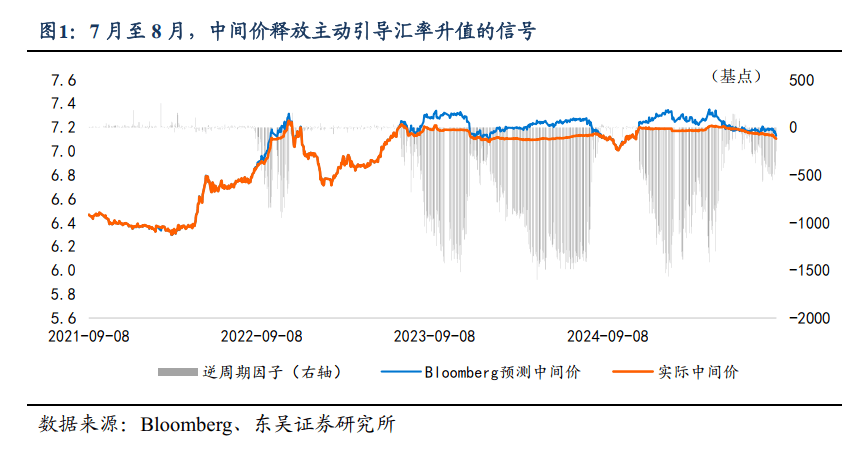
Core Viewpoint - The recent fluctuations in the RMB to USD exchange rate have drawn significant market attention, with the onshore and offshore RMB rates showing a trend towards convergence with the central parity rate [1][2]. Group 1: Exchange Rate Trends - On August 28, the onshore and offshore RMB against the USD broke through key levels of 7.15, 7.14, and 7.13, with the offshore rate (USDCNH) dipping below 7.12 [1]. - The central parity rate for USD to RMB on August 29 was reported at 7.1030, an increase of 33 basis points from the previous trading day, yet still 251 basis points lower than Bloomberg's forecast, indicating a signal for potential appreciation [2]. Group 2: Market Reactions and Expectations - The narrowing gap between the central parity and actual trading rates suggests active management of exchange rate expectations, potentially leading to RMB appreciation [2]. - Following the break of 7.15 in USDCNY and USDCNH, the market anticipates a quicker convergence of the spot rate towards the central parity [2]. Group 3: Impact on Trading Strategies - The recent increase in RMB exchange rate volatility may affect "carry trade" strategies, which have been popular due to low volatility and a significant interest rate differential of approximately 260 basis points since May [2]. - The rise in volatility on August 28 may indicate a shift in the carry trade environment, posing potential risks for traders [2]. Group 4: Export and Investment Implications - While the appreciation of the RMB against the USD may attract foreign investment in RMB-denominated assets, it could also impact exports [6]. - The RMB exchange rate index, such as the CFETS index, is more reflective of the export fundamentals, showing depreciation against a basket of currencies while appreciating against the USD, which helps mitigate risks from overseas tariffs [6]. Group 5: Uncertainties and Investor Considerations - The trajectory of the RMB exchange rate remains uncertain due to factors such as unclear Federal Reserve interest rate paths, delayed effects of China's easing policies, and fluctuations in non-USD currencies like the Euro and Yen [6]. - Investors are advised to closely monitor these factors to make more informed investment decisions [6].
贵金属日报:白宫筹划美、俄、乌三方会晤,避险溢价短期趋弱-20250820
Hua Tai Qi Huo· 2025-08-20 05:14
Report Industry Investment Rating - Gold: Neutral [8] - Silver: Neutral [9] - Arbitrage: Short the gold-silver ratio at high levels [9] - Options: Hold off [9] Core Viewpoints - Geopolitical risk premium is weakening due to the expected "Putin-Zelensky meeting", and there are still strong differences in the market regarding the Fed's interest rate cut path. Therefore, it is expected that the gold price will mainly fluctuate in the near future and wait for Powell's guidance at the Jackson Hole meeting on Friday. The oscillation range of the Au2510 contract may be between 750 yuan/gram and 795 yuan/gram [8][9]. - The trading logic of silver prices is still synchronized with that of gold, mainly based on the Fed's interest rate cut path on the macro - level, and its pricing weight is higher than the supply - demand fundamentals of silver. With the weakening of geopolitical risk premium and differences in the Fed's interest rate cut path, the silver price is also expected to maintain an oscillating pattern, and the oscillation range of the Ag2510 contract may be between 8900 yuan/kilogram and 9400 yuan/kilogram [9]. Summary by Related Catalogs Strategy Summary - The US Department of Commerce added 407 product categories to the steel and aluminum tariff list with a 50% tax rate, covering various products such as wind turbines and furniture [1]. - The White House is planning a possible meeting among the leaders of the US, Russia, and Ukraine in Budapest, and geopolitical risks are expected to cool significantly [1]. - Fed's Bowman suggested allowing Fed staff to hold a small amount of crypto - products, reflecting the US government's friendly attitude towards cryptocurrencies [1]. Futures Quotes and Volumes - On August 19, 2025, the Shanghai gold futures main contract opened at 776.98 yuan/gram, closed at 775.06 yuan/gram, down 0.33% from the previous trading day. The trading volume was 41,087 lots, and the open interest was 129,725 lots. The night - session closed at 772.60 yuan/gram, down 0.32% from the afternoon close [2]. - On August 19, 2025, the Shanghai silver futures main contract opened at 9263.00 yuan/kilogram, closed at 9187.00 yuan/kilogram, down 0.77% from the previous trading day. The trading volume was 272,701 lots, and the open interest was 342,500 lots. The night - session closed at 9061 yuan/kilogram, down 1.37% from the afternoon close [2]. US Treasury Yield and Spread Monitoring - On August 19, 2025, the US 10 - year Treasury yield closed at 4.31%, unchanged from the previous trading day. The 10 - 2 year spread was 0.56%, down 0.8 BP from the previous trading day [3]. SHFE Gold and Silver Position and Volume Changes - On the Au2508 contract on August 19, 2025, the long - position and short - position changes were 0 lots. The total trading volume of gold contracts was 163,718 lots, up 0.28% from the previous trading day [4]. - On the Ag2508 contract on August 19, 2025, the long - position changed by 2 lots, and the short - position changed by - 2 lots. The total trading volume of silver contracts was 411,181 lots, down 10.67% from the previous trading day [4]. Precious Metals ETF Position Tracking - The gold ETF position was 962.21 tons, down 3.15 tons from the previous trading day. The silver ETF position was 3.15 tons, down 16.95 tons from the previous trading day [5]. Precious Metals Arbitrage Tracking - On August 19, 2025, the domestic gold premium was - 2.34 yuan/gram, and the domestic silver premium was - 710.76 yuan/kilogram. The ratio of the main gold and silver contracts on the SHFE was about 84.36, up 0.44% from the previous trading day, and the overseas gold - silver ratio was 87.91, up 1.19% from the previous trading day [6]. Fundamentals - On August 19, 2025, the trading volume of gold on the Shanghai Gold Exchange T + d market was 21,362 kilograms, down 3.88% from the previous trading day. The silver trading volume was 333,308 kilograms, up 22.46% from the previous trading day. The gold delivery volume was 6506 kilograms, and the silver delivery volume was 10,140 kilograms [7].
重新审视关税、美国经济与降息路径
IMF· 2025-08-04 05:49
Economic Data - The US GDP for Q2 2025 showed a seasonally adjusted annualized growth rate of +3.0%, exceeding expectations of +2.4%[17] - Personal Consumption Expenditures (PCE) increased by 0.4% month-on-month in June, with a year-on-year increase of 4.7%[19] - Non-farm payrolls added only 73,000 jobs in July, significantly below the expected 110,000, with prior months' data revised down by a total of 258,000 jobs[27] Market Trends - The S&P 500 index decreased by 2.36% to 6238.01, while the Nasdaq index fell by 2.17% to 20650.13[2] - The US 10-year Treasury yield dropped by 17 basis points to 4.23%, and the 2-year yield fell by 22 basis points to 3.69%[2] - The US dollar index rose by 1.04% to 98.6900, indicating a stronger dollar amidst economic uncertainty[2] Inflation and Employment - The unemployment rate increased to 4.25% in July, up from 4.11% in the previous month, while the U3 unemployment rate reflects a cooling labor market[29] - Core PCE inflation rose to 2.8% year-on-year, slightly above the expected 2.7%[23] - Job openings in June decreased to 7.437 million, with a vacancy rate of 4.4%, indicating a tightening labor market[25] Policy and Trade - President Trump announced a new tariff list affecting nearly 70 countries, raising concerns about potential inflationary pressures and trade negotiations with China[3] - The Federal Reserve's decision-making is complicated by the dual pressures of weakening economic data and ongoing tariff implications, with a 80% probability of a rate cut in September following the weak non-farm payroll data[11]
周周芝道 模型跟踪:关税对美国通胀影响
2025-07-21 00:32
Summary of Key Points from Conference Call Industry and Company Involved - The analysis focuses on the impact of tariffs on inflation in the United States, particularly in relation to various industries and consumer behavior. Core Insights and Arguments - **Tariff Rate Increase**: The effective tariff rate in the U.S. rose significantly from 2.5% at the beginning of 2025 to 8.8% by mid-year, with tariffs on imports from China increasing from 10% to nearly 40% [1][5] - **Impact on Different Industries**: The metal industry saw a 50% increase in tariffs, while small appliances, furniture, and toys experienced a 20% increase [1][5] - **Cost Burden Distribution**: Tariff costs are primarily borne by exporters, U.S. companies, and consumers, with historical data indicating that consumers ultimately shoulder most of the burden [1][3][11] - **Inflation Transmission**: As of June 2025, approximately 40% of tariff costs have been passed on to the Consumer Price Index (CPI), with the remaining 60% potentially absorbed by businesses [1][9][11] - **Correlation Between Actual and Theoretical Inflation**: There is a positive correlation between actual inflation and theoretical predictions, with a correlation coefficient of about 0.4 [1][9] - **Modeling Approach**: A comprehensive panel regression model was developed to track the impact of tariffs across 212 industries, allowing for detailed analysis of long-term effects on inflation [2][5] Additional Important Content - **Consumer Price Index (CPI) and Federal Reserve Policy**: The CPI is crucial for determining the Federal Reserve's interest rate decisions, with expectations of potential rate cuts in late 2025 [3][12] - **Differential Impact on Product Categories**: Certain product categories, such as small appliances and audio equipment, are experiencing significant inflation, while the automotive sector shows no notable price increases [10] - **Weak Dollar Effects**: A weaker dollar limits exporters' ability to absorb tariff costs, leading to increased pressure on importers [13][14] - **Future Economic Indicators**: The future path of interest rate cuts by the Federal Reserve will depend on economic data and the observed effects of tariffs on inflation [7][12] - **Monitoring Future Trends**: Continuous tracking of CPI data from July to September will help assess the transmission of tariff costs between businesses and consumers [16]