赚钱效应

Search documents
申万宏源策略一周回顾展望(26/01/05-26/01/10):赚钱效应扩散尚不充分
申万宏源研究· 2026-01-10 15:03
Group 1 - The report emphasizes that the spring market has a continuous favorable time window for bullish strategies, with a significant increase in risk appetite. There are no major downside risks, only short-term adjustments after market performance is fully realized. Overall profit-making effects may continue to expand to higher levels, indicating that the short-term market performance is not yet fully realized [4][5]. - The report reaffirms the logic of the spring market, highlighting that there is ample liquidity and favorable conditions for bullish strategies. Key factors include ETF inflows, insurance sector performance, and expectations of foreign capital inflows, which have accelerated the inflow of retail investors and increased trading activity [4][5]. - The report identifies specific time windows in the spring that are conducive to market performance, including potential rebounds before the Lunar New Year in February, policy catalysts from the National People's Congress in March, and the anticipated visit of Trump to China in April, which could stabilize market expectations [4][5]. Group 2 - The report discusses the marginal trading funds and dominant market styles, noting that the net inflow of the CSI A500 ETF has plateaued. The expected incremental inflows are primarily from the insurance sector and foreign capital, while retail investor inflows and increased trading activity are contributing to faster growth in marginal trading funds [8]. - The report maintains that industry themes, such as commercial aerospace, robotics, and nuclear fusion, remain the strongest directions for profit-making effects. The report also highlights the high elasticity of venture capital and pre-IPO technology leaders, which are benefiting from mid-term bull market expectations [12]. - The report predicts that the second quarter of 2026 will still exhibit a volatile pattern, with technology and advanced manufacturing sectors likely to lead the market ahead of a full bull market in the second half of 2026 [12].
量化择时周报:市场于周二再度重回上行趋势,保持积极-20251228
ZHONGTAI SECURITIES· 2025-12-28 12:44
- The report introduces a timing system that uses the distance between the 120-day long-term moving average and the 20-day short-term moving average of the WIND All A Index to determine market trends. The short-term moving average is above the long-term moving average, with a distance of 3.38%, which is significantly greater than 3%, indicating the market has returned to an upward trend[2][6][11] - The "profitability effect" is used as a core indicator to assess market conditions. The current market trend line is at 6237 points, and the profitability effect is 3.12%, which is significantly positive, suggesting the upward trend is likely to continue[5][7][11] - The "Mid-term Distress Reversal Expectation Model" signals a focus on retail, tourism, and other service-oriented consumption sectors[5][7][11] - The "TWO BETA Model" continues to recommend the technology sector, with a focus on domestic computing power and commercial aerospace[5][7][11] - The "Industry Trend Model" indicates that sectors such as communication, industrial metals, and energy storage are maintaining an upward trend[5][7][11] - The valuation metrics for the WIND All A Index show that the PE ratio is at the 85th percentile, indicating a relatively high level, while the PB ratio is at the 50th percentile, indicating a medium level[5][7][11] - Based on the "Position Management Model," the report suggests an 80% equity allocation for absolute return products using the WIND All A Index as the primary stock allocation benchmark[5][7][11]
中泰证券:居民资金会否缺席明春行情?
Xin Lang Cai Jing· 2025-12-26 05:22
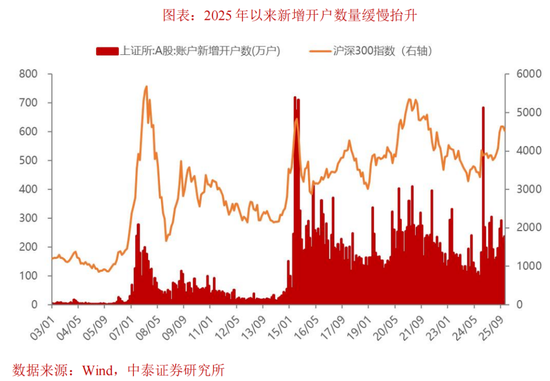
Core Viewpoint - The current investment behavior of residents in the stock market is characterized by a "de-leveraging" trend, reflecting a cautious approach to asset allocation amid macroeconomic changes, contrasting sharply with previous market exuberance periods [1][41]. Group 1: Resident Investment Behavior - The number of new account openings in November 2025 was 2.38 million, showing a recovery from the July low but still significantly lower than previous bull market levels, indicating a slow entry of retail investors [2][41]. - The current market activity is primarily driven by the activation of dormant accounts rather than new retail investors entering the market, with a focus on systematic investment rather than speculative trading [4][44]. - The financing net buying ratio has returned to positive territory, indicating a slight recovery in leveraged funds, but the intensity remains weaker compared to the strong net buying phases of 2019-2020 [5][47]. Group 2: Changes in Fund Flows - The structure of resident fund flows is changing, with a significant shift towards passive investment products like ETFs, which accounted for approximately 72% of new fund issuance in 2025, reflecting a preference for lower-cost investment options [7][49]. - The total issuance of new funds from January to November 2025 was about 530.8 billion yuan, with a monthly average of 48.3 billion yuan, indicating a lack of enthusiasm in the fund issuance market [7][47]. - The net subscription of stock ETFs remained strong, with a single-month net subscription reaching 177.2 billion yuan in April, highlighting the attractiveness of low-cost investment tools for residents [9][49]. Group 3: Economic Context and Implications - The slow entry of resident funds is primarily due to the negative feedback from the wealth effect caused by declining real estate prices, which has led to a cautious outlook on future income and increased preference for savings [10][52]. - As of November 2025, cumulative new resident savings deposits reached 12.06 trillion yuan, continuing a trend of high savings since 2022, with a significant portion in fixed-term deposits reflecting risk aversion [12][52]. - The decline in real estate values has resulted in a substantial reduction in household wealth, leading to a defensive accumulation of cash and deposits among residents [13][53]. Group 4: Future Capital Inflows - Insurance funds saw a significant increase in stock and securities investments, with a quarterly growth of 863.9 billion yuan in Q3 2025, indicating a strong entry of institutional capital into the market [22][61]. - The projected incremental capital from insurance funds for 2026 is estimated to be around 620 billion yuan, driven by regulatory changes and the need for higher returns in a low-interest-rate environment [24][63]. - The upcoming maturity of high-yield deposits from 2025 to 2026 is expected to create a significant shift in capital flows, potentially leading to increased investment in equity markets as residents seek better returns [25][68]. Group 5: Seasonal Market Trends - The spring season historically shows a significant increase in market activity, with a notable rise in retail investor participation and liquidity, driven by seasonal effects and credit expansion [30][69]. - The financing net buying ratio typically peaks in January, indicating a period of heightened activity and potential for thematic investments during the spring [32][71].


居民资金会否缺席明春行情?
李迅雷金融与投资· 2025-12-26 05:06
Core Viewpoint - The article discusses the current state of resident capital entering the market, highlighting a trend of "de-leveraging" and cautious investment behavior among residents, contrasting it with previous market cycles where there was more aggressive entry of funds [1][12][16]. Group 1: Resident Capital Behavior - The pace of new account openings has slowed, with November 2025 seeing 2.38 million new accounts, which is significantly lower than the 4.05 million during the 2020 fund craze and the 2.02 million in March 2019 at the start of the last bull market [2]. - The current market activity indicates that the majority of new capital is coming from the activation of dormant accounts rather than new investors entering the market in a panic [6]. - The financing net buying ratio has returned to positive territory, indicating a slight recovery in leveraged funds, but the intensity remains weaker compared to the aggressive net buying seen in 2019-2020 [7]. Group 2: Structural Changes in Investment Preferences - There is a notable shift towards passive investment products, with 72% of new funds issued in 2025 being passive index funds, reflecting a growing preference for lower-cost investment options among residents [11]. - The high management fees associated with actively managed funds have led to a "scar tissue effect" among residents, making them more cautious about investing in equities [12]. - The trend of residents moving towards fixed-term deposits indicates a risk-averse mindset, driven by the negative wealth effect from declining real estate prices [15][16]. Group 3: Insurance Capital and Market Dynamics - Insurance capital has seen a significant increase, with a quarterly growth of 863.99 billion yuan in Q3 2025, indicating a strong entry into the market [26]. - Regulatory changes have facilitated insurance capital's ability to invest in equities, with a projected annual increment of 620 billion yuan in 2026 [28]. - The pressure on the liability side of insurance companies is driving them to seek higher dividend-paying assets to cover the gap between their costs and returns [28]. Group 4: Market Outlook and Seasonal Trends - The upcoming spring season is expected to see a "spring rally," characterized by a structural loosening of funds and increased participation from retail investors, albeit at a more cautious pace compared to previous years [35]. - Historical data shows that the spring season typically favors small-cap and growth stocks, with an average rally of around 15% [38]. - The article suggests that the current market dynamics will likely lead to a more gradual and sustained rally, with specific sectors such as technology and consumer goods expected to perform well [42][43].

投资者微观行为洞察手册·12 月第 2 期:融资资金流入加速,外资重回流入
GUOTAI HAITONG SECURITIES· 2025-12-15 14:59
Market Pricing Status - The market transaction activity has increased, but the profit-making effect has marginally decreased. The average daily trading volume for the entire A-share market rose to 2 trillion yuan, while the proportion of stocks that increased in value dropped to 31.8% [6][12][9] - The trading concentration has improved, with five industries showing turnover rates above the 90th percentile historically, including defense and military, commercial retail, and light industry manufacturing [6][12] A-Share Liquidity Tracking - The issuance of new equity funds has decreased to 9.11 billion yuan, while financing capital inflow has accelerated, with net buying amounting to 26.04 billion yuan [6][23][16] - The confidence index for private equity funds remained stable compared to November, with positions nearing the highest level of the year as of December 5 [6][34] - Foreign capital inflow into the A-share market was 0.1 million USD as of December 10, with the proportion of northbound capital transactions dropping to 30.0% historically [6][35][39] - The net amount raised from IPOs was 1.27 billion yuan, and the scale of private placements was 1.34 billion yuan, with a total of 13.03 billion yuan in restricted shares set to be unlocked in the coming week [6][16] A-Share Industry Allocation - Foreign and financing capital have both flowed into the electronics sector, with net inflows of 13.8 million USD and 70.6 billion yuan respectively [6][3.1] - In the ETF market, net inflows were concentrated in non-ferrous metals (2.2 billion yuan) and transportation (860 million yuan), while outflows were seen in non-bank financials (2.9 billion yuan) and defense and military (2.6 billion yuan) [6][3.2] - The top three industries in the龙虎榜 (top trading list) were electronics, light industry manufacturing, and environmental protection [6][3.4] Hong Kong and Global Fund Flow - Southbound capital has turned to outflows, while foreign capital has marginally flowed into the US and emerging markets. The Hang Seng Index decreased by 0.4% during this period [6][4.1] - The net outflow of southbound capital was 3.44 billion yuan, placing it in the 6% percentile since 2022 [6][4.2] - In the global context, foreign capital has marginally flowed into the US and South Korea, with inflows of 2.03 billion USD and 610 million USD respectively [6][4.3]
视频|李蓓:股市形成泡沫需要3个前提
Xin Lang Zheng Quan· 2025-12-01 10:17
Core Insights - The 2025 Analyst Conference highlighted the potential for a bull market in A-shares, driven by global capital inflows [1] Group 1: Market Conditions - Historical bubbles require three key conditions: a low interest rate environment, a market with profit-making effects, and a lack of investment opportunities in major global markets [1] - The example of the 2006-2007 A-share market surge illustrates how external factors, such as the collapse of the US real estate market, can create favorable conditions for domestic markets to thrive [1]
广发证券:A股赚钱效应最好的时间窗即将打开,2026年A股春季躁动值得期待
Xin Lang Cai Jing· 2025-11-30 11:24
Core Viewpoint - The most unfavorable phase for institutions is about to pass, with a shift in market dynamics expected as December approaches, leading to a stronger correlation between market movements and fundamentals [1] Group 1: Market Timing and Trends - The period from December to January is identified as an excellent time for positioning in the market, particularly for sectors with favorable annual report forecasts [1] - The "spring market excitement" window, lasting approximately 20 trading days, is anticipated between the Spring Festival and the Two Sessions, characterized by a shift from low to high win rates and a transition from large-cap to small-cap styles [1] Group 2: Market Adjustments - Many sectors have already experienced an average adjustment of around 20%, aligning with historical averages for mainline varieties, suggesting that December is a suitable time to start monitoring these sectors [1]

再次冲高回落,还缩量,再摸前低?
Sou Hu Cai Jing· 2025-11-27 12:24
Market Sentiment - The current market sentiment is weak, leading to low trading volumes and a lack of confidence among investors [3] - There is a perception that the current market position lacks value, and there are no sustainable leading sectors at the moment [3] Market Trends - The market has experienced three consecutive days of gains followed by declines, which has significantly hurt investor sentiment [2] - The trading volume has been shrinking, with a peak trading volume of 3.2 trillion, and a current volume of approximately 1.73 trillion, indicating a potential emotional low point [3] Economic Indicators - Recent declines in the market were attributed to high positioning, expectations of interest rate cuts by the Federal Reserve, and liquidity issues in the U.S. and global markets [2] - The expectation of a Federal Reserve interest rate cut in December has returned, as evidenced by the strength in precious metals like gold and silver, and the appreciation of the Chinese yuan [2] Technical Analysis - The market is currently facing resistance at key trend lines, with a combination of minute-level and 15-minute level structures indicating a potential top [6] - The absence of a significant left-side signal at the bottom suggests that the current rebound is not a reversal but merely a temporary reaction [6]
11月14日大盘简评
Mei Ri Jing Ji Xin Wen· 2025-11-14 09:08
Group 1 - The A-share market showed weakness today, influenced by a drop of over 2% in the Nasdaq, with the Shanghai Composite Index closing at 3990.49 points, down 0.97% [1] - The market experienced a mixed performance this week, with multiple attempts to break the 4000-point mark, reflecting underlying participant divergence despite initial optimism [1] - The trading volume in both Shanghai and Shenzhen markets was below 2 trillion, indicating a lack of active trading [1] Group 2 - The market has been searching for new leading narratives since the CPO sector, with sectors like new energy and battery showing temporary strength but lacking sustainability [2] - Economic indicators such as social financing are showing mediocre performance, indicating a lag in the recovery of confidence in the real economy [2] - The pressure from profit-taking in certain sectors, where some stocks have seen gains exceeding 50%, poses a risk to the continuation of the current market trend [2] Group 3 - Investors are advised to avoid unilateral bets and consider a strategy of high selling and low buying, focusing on a "core position + satellite rotation" approach [3] - Recommended core ETFs include the CSI A500 ETF and the CSI 300 Enhanced ETF, while satellite opportunities may arise in sectors that have underperformed during the recent adjustments [3] - The Hong Kong and US markets showed weaker performance compared to A-shares, with the Hang Seng and Hang Seng Tech indices closing below water, reflecting higher sensitivity to US dollar liquidity [3]
盘得越久,越要警惕日线级别回撤的凶险
猛兽派选股· 2025-11-04 16:02
Group 1 - The overall market sentiment has been poor since September, with limited profit opportunities except for a few individual stocks [1] - Retail investors often struggle with recognizing the diminishing profit effects and confuse short-term fluctuations with long-term trends [1] - The performance of different market segments varies significantly, with some experiencing substantial gains while others face corrections [2][3] Group 2 - The transition between leading sectors is often painful, as seen in the shift from the robotics sector to the blockchain computing sector, which experienced significant volatility [3] - Certain stocks have seen over 30 times increases from their cyclical lows, indicating potential bubbles, as such valuations are rare even in bull markets [3] - The concept of a "slow bull market" is misunderstood; it involves periods of stagnation and corrections rather than continuous upward movement [4]