金融市场流动性

Search documents
光大期货:银铂钯依然跟随金价走势 但表现更为强势
Sou Hu Cai Jing· 2025-12-22 01:37
Group 1 - The core viewpoint of the article highlights the strong performance of precious metals futures, with platinum and palladium rising over 5% and silver increasing over 4% [1] - Despite market skepticism regarding the Federal Reserve's future interest rate cuts, discussions around the potential candidates for the Fed chair and the number of rate cuts in 2016 are influencing market sentiment [1] - The current gold price is close to its historical high, with attention on whether it can effectively break through this level to open up upward potential for 2026 [1] Group 2 - Silver, platinum, and palladium continue to follow gold's trend, with stronger performance observed in these metals [1] - The sustained strength in gold prices provides market confidence for bullish positions in silver, platinum, and palladium, leading to a rapid return of the gold-silver ratio, which extends to the gold-platinum and gold-palladium ratios [1] - While prices are rising quickly, caution is advised to prevent overheating in the market, suggesting that chasing high prices should be approached with care [1]
大摩2.4万亿转投美债引流动性担忧
Sou Hu Cai Jing· 2025-12-19 00:59
Group 1 - The core viewpoint of the article highlights that JPMorgan is reallocating $350 billion (over 2.4 trillion RMB) from its Federal Reserve account to U.S. Treasury bonds to lock in yields before potential interest rate cuts [1] - The article notes that the recent liquidity tightening in the financial system is showing signs of strengthening, despite the Federal Reserve's indication of quantitative easing (QE) [1] - The shadow banking system, valued at $63 trillion, is identified as a potential source of instability in the global financial market, with the private credit market, currently around $1.8 trillion, also seen as a risk factor [1] Group 2 - Analysts suggest that JPMorgan's large-scale operation could significantly impact the liquidity of the entire financial system [1]


光大期货1216黄金点评:今夜非农来袭,关注数据与预期值的差异
Xin Lang Cai Jing· 2025-12-16 05:23
Core Viewpoint - The article discusses the recent fluctuations in gold prices and the economic indicators from the New York Federal Reserve, highlighting a mixed outlook for the manufacturing sector and potential implications for future monetary policy decisions by the Federal Reserve [3][7]. Economic Indicators - On December 15, COMEX gold prices initially rose before falling, closing at $4334.3 per ounce, with a gain of 0.14%. In contrast, the domestic SHFE gold night market price decreased, closing at 975.52 yuan per gram, down 0.18% [3][7]. - The New York Federal Reserve reported a significant drop in the general business conditions index, falling approximately 23 points to -3.9, indicating a contraction in the manufacturing sector. However, the outlook for the next six months improved, with the outlook index rising 16.6 points to its highest level since the beginning of the year, reflecting increased optimism regarding orders and shipments [3][7]. Federal Reserve Insights - The President of the Boston Federal Reserve expressed support for the recent interest rate cut, acknowledging the difficulty of the decision due to ongoing concerns about high inflation [3][7]. - Market discussions are focused on the future chairperson of the Federal Reserve and the pace of interest rate cuts in 2016. The market remains optimistic, considering the liquidity in financial markets and the weak employment outlook, which supports a stronger gold price trend [3][7]. Upcoming Data - Non-farm payroll data is set to be released on Tuesday evening, which may guide future Federal Reserve monetary policy. If the data significantly underperforms expectations, it could lead to further pricing in of liquidity easing. Conversely, stronger-than-expected data may pose a risk of short-term corrections in precious metals [3][7].

金融市场流动性与监管动态周报:保险资金持续流入股票市场,美联储降息不确定性增强-20251118
CMS· 2025-11-18 14:33
Group 1 - The core viewpoint of the report indicates that insurance funds continue to flow into the stock market, while uncertainty regarding the Federal Reserve's interest rate cuts has increased [2][4][55] - As of the end of Q3, the total balance of insurance funds reached 37.5 trillion yuan, reflecting a year-to-date growth of 12.6% and a quarter-on-quarter increase of 3.4% [4][8] - The proportion of equity assets held by insurance funds has risen to a historical high of 14.85%, with total equity assets amounting to 5.56 trillion yuan [4][10] Group 2 - In terms of liquidity, the report notes that the net inflow of funds in the secondary market has narrowed, with a decrease in financing balance and net selling of financing funds amounting to 8.2 billion yuan [4][25] - The report highlights that the net inflow of ETFs was 123.1 billion yuan, while the issuance of new equity public funds decreased [4][25] - The report identifies a preference for sectors such as power equipment, basic chemicals, and non-ferrous metals, which saw significant net inflows from various funds [44][45] Group 3 - The report discusses the impact of recent hawkish signals from Federal Reserve officials, which have led to a downward adjustment of interest rate cut expectations for the year [55][56] - It emphasizes that the market's risk appetite is influenced by the lack of key economic data due to the government shutdown, creating a need for clearer signals to reduce uncertainty [2][55] - The report also notes that the VIX index has risen, indicating a decline in market risk appetite [35]
美媒警告美国金融市场流动性偏紧
Sou Hu Cai Jing· 2025-08-28 11:19
Core Insights - The U.S. financial market is expected to experience turbulence in September due to tight liquidity conditions [1] - Despite widespread expectations for a rate cut by the Federal Reserve in September, a key indicator of idle funds has remained at very low levels since mid-August, raising doubts about the need for the Fed to inject liquidity [1] Group 1: Market Conditions - As of August 14, the usage of the Federal Reserve's overnight reverse repurchase agreement tool fell below $50 billion, reaching a recent low [1] - During peak periods in 2022 and 2023, the average daily usage of this tool was as high as $2 trillion [1] Group 2: Future Projections - A report from Bank of America’s global interest rate strategy team predicts that by the end of August, the usage of the reverse repurchase tool by the Federal Reserve will drop to zero, with a slight recovery expected in September [1]
【微特稿】美媒警告美国金融市场流动性偏紧
Sou Hu Cai Jing· 2025-08-28 09:39
Core Viewpoint - The U.S. financial market is expected to experience turbulence in September due to tight liquidity, despite widespread expectations of a rate cut by the Federal Reserve [1] Group 1: Market Conditions - A key market indicator for idle funds has remained at a very low level since mid-August, raising doubts about the need for the Federal Reserve to inject liquidity [1] - As of August 14, the usage of the Federal Reserve's overnight reverse repurchase agreement tool fell below $50 billion, marking a recent low compared to an average daily usage of $2 trillion during peak periods in 2022 and 2023 [1] Group 2: Predictions and Implications - A report from Bank of America’s global rates strategy team predicts that the usage of the reverse repurchase tool will drop to zero by the end of August, with a slight recovery expected in September [1] - The current situation may lead to a repeat of the liquidity crisis seen in September 2019, when repo loan rates surged to nearly 10%, prompting the Federal Reserve to inject liquidity to stabilize the market [1] Group 3: Market Reactions - U.S. money market funds utilizing the Federal Reserve's overnight reverse repurchase tool are currently focused on purchasing a large volume of U.S. Treasury securities released by the "big and beautiful" tax and spending plan of former President Trump [1] - A report from Canadian Imperial Bank of Commerce's rates strategy team anticipates greater fluctuations in funding supply at the end of the month and quarter in the U.S. financial markets [1]
金融市场流动性与监管动态周报:汇金增持ETF,公募对于港股配置创新高-20250722
CMS· 2025-07-22 14:33
Group 1 - The "national team" continued to increase its holdings, with an estimated total purchase of over 200 billion in ETFs during the second quarter [3][11][12] - The public funds' allocation to Hong Kong stocks reached a historical high, with the proportion of Hong Kong stocks in actively managed equity funds reaching 16.85%, a quarter-on-quarter increase of 1.12% [13][15] - Tencent has become the largest holding for public funds for two consecutive quarters, with four Hong Kong stocks among the top ten holdings [13][14] Group 2 - The second quarter saw a significant increase in the holdings of ETFs, particularly in the CSI 300, SSE 50, CSI 1000, and CSI 500 ETFs [11][12] - The public funds that can invest in Hong Kong stocks have increased to 50.97%, with the proportion of Hong Kong stocks in these funds reaching 33% [15][16] - The net inflow of funds in the secondary market has turned into a slight net inflow, with financing balances rising and net purchases of financing reaching 265.9 billion [32][41] Group 3 - The market sentiment has shown increased trading activity, particularly in the healthcare, TMT, and ChiNext indices [52][56] - The sectors that attracted significant net inflows included computer, non-bank financials, and media, while sectors like healthcare and electric equipment experienced net outflows [56][57] - The overall market performance indicated a preference for large-cap growth stocks over small-cap value stocks [6]
7月利率展望:震荡格局下波段为主,关注大会增量
2025-07-03 15:28
Summary of Conference Call Notes Industry Overview - The notes primarily discuss the **Chinese bond market** and its dynamics, including interest rates, government debt supply, and macroeconomic factors affecting the market. Key Points and Arguments 1. **Bond Market Performance**: In June, the bond market experienced overall fluctuations, with real bond yields slightly decreasing to approximately 1.65%. The central bank's unexpected reverse repurchase operations supported liquidity, while U.S.-China tariff negotiations and geopolitical conflicts influenced market sentiment [1][5][16]. 2. **Interest Rate Trends**: The bond market's yield rates have shown a trend of first rising and then falling throughout the year, stabilizing at lower levels due to the long-term U.S.-China trade tensions and the central bank's growth-stabilizing policies [3][19]. 3. **Government Debt Supply**: It is anticipated that the supply of government bonds will peak in July 2025, with special government bonds expected to exceed 190 billion and ordinary bonds net financing around 280 billion. The net supply of government bonds in July could reach approximately 3 trillion, which is expected to have a minimal impact on the market [4][14]. 4. **Inflation and CPI Predictions**: The Consumer Price Index (CPI) is expected to hover around 0% year-on-year, with pork prices declining and oil prices rising due to geopolitical tensions. Core CPI is projected to recover moderately, influenced by seasonal factors, but the internal driving force for consumption recovery remains weak [7][8]. 5. **Export Growth Outlook**: Exports maintained a positive growth of 4.8% in May, supported by resilient demand from ASEAN, India, and Europe. However, there is a risk of negative growth in export rates in the second half of the year, particularly as the U.S. stance on tariffs may change as the tariff exemption period approaches its end [9][2]. 6. **Institutional Investment Behavior**: Public funds became the largest holders of interest rate bonds in June, increasing their holdings by approximately 500 billion compared to May. They shifted their strategy from short-term bonds to longer-term and ultra-long-term bonds [18][17]. 7. **Market Liquidity and Central Bank Policies**: The liquidity in the financial market remains relatively loose, with the central bank's actions expected to maintain this trend. The overall monetary policy is anticipated to remain accommodative, with a focus on potential structural monetary policy tools to support key projects [15][19]. 8. **PMI and Economic Activity**: The Purchasing Managers' Index (PMI) is close to the threshold line, indicating a slight recovery in economic activity. However, corporate profit data suggests ongoing pressures in production and operations, which may limit further PMI recovery [11]. Other Important but Possibly Overlooked Content - The notes highlight the importance of monitoring the upcoming political bureau meeting for potential new policies that could impact the market [19]. - The potential for a shift in investment strategies among institutions as they respond to changing market conditions and central bank policies is emphasized [10][17].
金融市场流动性与监管动态周报:融资资金延续净流入,政府债券贡献社融主要增量-20250617
CMS· 2025-06-17 13:33
Group 1 - The core viewpoint of the report indicates that in May, credit data was primarily contributed by the government, while the performance in the household and corporate sectors was relatively flat. The M1 money supply grew by 2.3% year-on-year, mainly due to a low base from the previous year [4][12]. - The report highlights that the issuance of government bonds has accelerated, aligning with the government's directive to implement policies promptly. It is anticipated that with more proactive fiscal policies and moderately loose monetary policies, social financing (社融) is likely to maintain a relatively high growth rate in the short term [4][12]. - The report notes that the financing balance has increased, with net financing purchases amounting to 80.2 billion yuan, while ETF saw a net outflow of 149.4 billion yuan. The overall market financing balance reached 1,804.43 billion yuan as of June 13 [4][26]. Group 2 - In terms of market sentiment, the report indicates that the trading activity of financing funds has increased, with the equity risk premium declining. The focus has shifted towards style indices and major sectors such as the North Certificate 50, consumer discretionary, and TMT [4][35]. - The report identifies that the sectors with the highest net inflows of various funds include food and beverage, non-ferrous metals, and media. Conversely, the sectors with significant net outflows include pharmaceuticals, computers, and non-bank financials [4][44]. - The report also mentions that the net buying scale of financing funds was highest in the pharmaceutical sector (+20.6 billion yuan), followed by non-ferrous metals (+15.7 billion yuan) and food and beverage (+15.4 billion yuan) [4][46].
继放缓缩表步伐后 美联储再出招护航金融市场流动性:拟将“早期回购”常态化
智通财经网· 2025-05-09 14:33
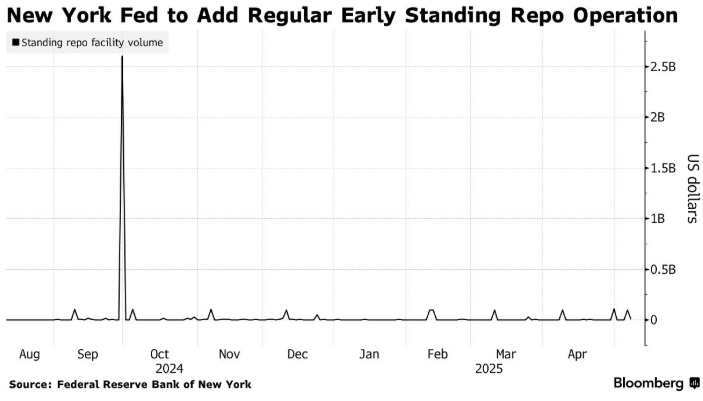
Core Viewpoint - The New York Federal Reserve plans to incorporate early settlement operations of a key liquidity support tool into its regular schedule to enhance and strengthen this liquidity tool, supporting stable financial market operations [1] Group 1: Federal Reserve Actions - The Federal Open Market Committee (FOMC) agreed in March to "significantly slow" the pace of balance sheet reduction to prevent excessive liquidity withdrawal from the market [1] - The New York Fed's recent normalization of early repurchase operations is seen as a measure to ensure market stability and liquidity, especially in light of volatility in the U.S. Treasury market due to tariff policies [1][6] - The Fed is expanding the liquidity "insurance layer" in financial markets to prevent short-term funding mismatches and liquidity shortages during high yield fluctuations [1][7] Group 2: Market Reactions and Concerns - The global financial market's renewed focus on the Standing Repo Facility (SRF) follows significant volatility in the U.S. Treasury market triggered by new trade policies [5] - Concerns about market movements due to trade policy uncertainty have led to a "real and significant" deterioration in financial market liquidity, although the repo market has shown resilience [5][6] - The New York Fed had already begun providing additional daily repo operations before the recent market volatility, aiming to prevent repo market rates from exceeding the Fed's target range [6] Group 3: Future Implications - The adjustments in monetary policy reflect the Fed's intention to add safety measures against potential funding mismatches in a high-rate environment, avoiding a repeat of the 2019 liquidity crisis [7] - The FOMC noted that while reserves remain high at approximately $3 trillion, certain indicators are nearing buffer limits, necessitating caution to avoid approaching critical points similar to those in 2019 [7] - If the 10-year Treasury yield exceeds 5% again, the Fed may consider pausing balance sheet reduction or even targeted expansion to stabilize the financial market's benchmark interest rate corridor [7]