高库存

Search documents
新能源及有色金属日报:宏观情绪退潮,镍不锈钢震荡走弱-20260114
Hua Tai Qi Huo· 2026-01-14 03:11
Report Industry Investment Rating No information provided. Core View of the Report - Short - term nickel prices face multiple pressures such as high inventory, weak demand, and the ebb of macro - sentiment, and may continue to decline in a volatile manner. However, attention should be paid to the implementation of Indonesia's nickel quota adjustment policy. If the policy is tightened more than expected, it may support prices. - Short - term stainless steel may maintain a weak and volatile trend, mainly affected by high inventory, weak demand, and cost - side fluctuations. Attention should be paid to the implementation of Indonesia's nickel ore quota policy and the production and stocking rhythm of steel mills [1][3]. Summary According to Relevant Catalogs Nickel Variety Market Analysis Futures - On January 13, 2026, the main contract of Shanghai nickel 2602 opened at 145,000 yuan/ton and closed at 138,450 yuan/ton, a change of - 2.21% from the previous trading day's closing price. The trading volume was 1,277,690 (+194,488) lots, and the open interest was 119,485 (-4,663) lots. The main contract showed a "high - opening, low - running + volatile downward" trend, driven by the ebb of macro - sentiment, high inventory on the supply side, weak demand, and the fading of geopolitical risk premium [1]. Nickel Ore - Mysteel reported that there were transactions in the nickel ore market recently. The CIF price of domestic 1.3% nickel ore was 42 US dollars. The overall nickel ore resources in the market were limited, and the nickel ore price was running strongly. Philippine mines were eager to sell at higher prices. The downstream nickel - iron price reached 1,000 yuan/nickel (including tax at the hatch bottom) and above. In Indonesia, the domestic trade benchmark price in January 2026 (Phase II) was expected to rise by 2.8 - 4.9 US dollars/wet ton. The current mainstream premium was +25, and the premium range was mostly between +25 - 26. Factories may push down the premium due to cost pressure [1]. Spot - Jinchuan Group's sales price in the Shanghai market was 148,600 yuan/ton, an increase of 100 yuan/ton from the previous trading day. Spot trading was average, and the spot premiums of refined nickel brands were slowly falling. The premium of Jinchuan nickel changed - 100 yuan/ton to 8,900 yuan/ton, the premium of imported nickel changed 0 yuan/ton to 600 yuan/ton, and the premium of nickel beans was 2,450 yuan/ton. The previous trading day's Shanghai nickel warehouse receipt volume was 39,436 (-234) tons, and the LME nickel inventory was 284,148 (-414) tons [2]. Nickel Variety Strategy - Unilateral: Mainly operate within a range; Cross - period: None; Cross - variety: None; Spot - futures: None; Options: None [3]. Stainless Steel Variety Market Analysis Futures - On January 13, 2026, the main contract of stainless steel 2603 opened at 13,890 yuan/ton and closed at 13,790 yuan/ton. The trading volume was 256,128 (-551) lots, and the open interest was 130,200 (-4,171) lots. The contract opened higher due to the overnight rise of LME nickel but was dragged down by the rapid decline of Shanghai nickel, and the price fluctuated downward with weakening spot trading. In the afternoon, the continuous decline of Shanghai nickel triggered selling pressure, and the price fell below 13,800 yuan/ton, reaching a minimum of 13,705 yuan/ton and finally closing at 13,790 yuan/ton [3]. Spot - In the morning, the spot price rose slightly due to the increase in futures prices, but the market was afraid of high prices, and the inquiry and trading were poor. The stainless steel price in the Wuxi market was 13,900 (+0) yuan/ton, and in the Foshan market, it was 13,750 (-25) yuan/ton. The premium of 304/2B was between 175 - 375 yuan/ton. The ex - factory average price of high - nickel pig iron changed 8.50 yuan/nickel point to 980.5 yuan/nickel point [4]. Stainless Steel Variety Strategy - Unilateral: Neutral; Cross - period: None; Cross - variety: None; Spot - futures: None; Options: None [5].
宏观金融类:文字早评2026/01/13星期二-20260113
Wu Kuang Qi Huo· 2026-01-13 00:53
1. Report Industry Investment Rating No relevant content provided. 2. Core Viewpoints of the Report - For stocks, with the entry of incremental funds at the beginning of the year, the financing scale has increased significantly, and the market trading volume has rapidly expanded. In the long - term, the policy support for the capital market remains unchanged. Strategically, the idea of buying on dips is recommended [4]. - For bonds, the improvement of economic expectations may put pressure on the bond market, but the sustainability of economic recovery momentum needs to be observed. The central bank's attitude of caring for funds remains, and the bond market is expected to be volatile and weak [8]. - For precious metals, if the silver price stabilizes, it will continue a new upward trend, and the driving force for the gold price remains strong. It is recommended to pay attention to the support of gold and silver prices around the BCOM and tariff adjustment nodes and buy on dips after short - term negative factors end [10]. - For non - ferrous metals, most metal prices are expected to be volatile. For example, copper prices are expected to fluctuate and consolidate in the short term; aluminum prices are expected to remain high; zinc and lead prices are expected to fluctuate widely following the sentiment of the non - ferrous sector [13][15][18]. - For black building materials, steel prices are expected to continue to fluctuate at the bottom; iron ore prices are expected to fluctuate at a relatively high level; glass and soda ash markets are generally weak; coking coal and coke prices are expected to fluctuate in a range [32][34][37]. - For energy and chemicals, different products have different trends. For example, rubber is recommended to be treated neutrally; the valuation of heavy - quality oil products is raised; methanol has the feasibility of buying on dips; urea is recommended to take profits on rallies [55][57][59]. - For agricultural products, the short - term trend of hog prices is expected to be stable or slightly rising, and different trading strategies are recommended for different contract periods; egg prices are expected to be stable or rising, and different strategies are also recommended for different contract periods [79][80][81]. 3. Summary by Relevant Catalogs 3.1 Macro - financial 3.1.1 Stock Index - **Market Information**: China Chamber of Commerce for Import and Export of Machinery and Electronic Products promoted a "soft landing" of the EU's anti - subsidy case on electric vehicles; Lihong No.1 completed its first sub - orbital flight test; Brain - Machine Haihe Laboratory completed the first "space brain - machine interface experiment"; prices of multiple non - ferrous and precious metal futures reached new highs [2]. - **Basis Ratio of Stock Index Futures**: Different ratios are provided for IF, IC, IM, and IH contracts in different periods [3]. - **Strategy Viewpoint**: With incremental funds entering at the beginning of the year, the financing scale has increased significantly, and the market trading volume has rapidly expanded. In the long - term, the policy support for the capital market remains unchanged. Strategically, the idea of buying on dips is recommended [4]. 3.1.2 Treasury Bonds - **Market Information**: On Monday, the closing prices of TL, T, TF, and TS main contracts changed by 0.30%, 0.07%, 0.05%, and 0.00% respectively. The Canadian Prime Minister will visit China, and the National Development and Reform Commission and other departments issued relevant policies on government investment funds [5]. - **Liquidity**: The central bank conducted 861 billion yuan of 7 - day reverse repurchase operations on Monday, with a net investment of 361 billion yuan [6][7]. - **Strategy Viewpoint**: The improvement of economic expectations may put pressure on the bond market, but the sustainability of economic recovery momentum needs to be observed. The central bank's attitude of caring for funds remains, and the bond market is expected to be volatile and weak [8]. 3.1.3 Precious Metals - **Market Information**: Shanghai gold rose 1.31%, and Shanghai silver rose 7.23%. The US federal prosecutor launched a criminal investigation into Fed Chairman Powell, which impacted the Fed's independence [9]. - **Strategy Viewpoint**: If the silver price stabilizes, it will continue a new upward trend, and the driving force for the gold price remains strong. It is recommended to pay attention to the support of gold and silver prices around the BCOM and tariff adjustment nodes and buy on dips after short - term negative factors end [10]. 3.2 Non - ferrous Metals 3.2.1 Copper - **Market Information**: Silver prices were strong, and the domestic equity market strengthened, driving copper prices to rise. LME copper inventory decreased, and domestic electrolytic copper social inventory increased [12]. - **Strategy Viewpoint**: The Fed's interest - rate cut expectation has weakened, and short - term sentiment may cool down. The copper mine supply is in a tight pattern, and copper prices are expected to fluctuate and consolidate in the short term [13]. 3.2.2 Aluminum - **Market Information**: The general atmosphere of bulk commodities was strong, and aluminum prices fluctuated and rose. LME aluminum inventory decreased, and domestic aluminum ingot and aluminum rod social inventories increased [14]. - **Strategy Viewpoint**: The high - level fluctuations of precious metals and non - ferrous metals have increased, and short - term sentiment may cool down. Aluminum prices are expected to remain high [15]. 3.2.3 Zinc - **Market Information**: The Shanghai zinc index rose, and LME zinc also increased. Zinc ingot social inventory decreased slightly [16][17]. - **Strategy Viewpoint**: The zinc price has a large room for catch - up compared with copper and aluminum. It is expected to fluctuate widely following the sentiment of the non - ferrous sector [18]. 3.2.4 Lead - **Market Information**: The Shanghai lead index rose, and LME lead also increased. Lead ingot social inventory increased [19]. - **Strategy Viewpoint**: The lead price is approaching the upper edge of the long - term oscillation range, and it is expected to fluctuate widely following the sentiment of the non - ferrous sector [19]. 3.2.5 Nickel - **Market Information**: Nickel prices rebounded, and the prices of nickel ore and nickel iron also changed accordingly [20]. - **Strategy Viewpoint**: The oversupply pressure of nickel is still large, and it is expected to fluctuate widely in the short term. It is recommended to wait and see in the short term [20][21]. 3.2.6 Tin - **Market Information**: Tin prices rose significantly. The supply in Myanmar is gradually recovering, and the demand is mainly for rigid needs [22]. - **Strategy Viewpoint**: The tin market demand is weak, and the supply is expected to improve. It is recommended to wait and see. The price is expected to fluctuate following the market risk preference [22]. 3.2.7 Carbonate Lithium - **Market Information**: The spot index of carbonate lithium rose, and the futures price also increased [23]. - **Strategy Viewpoint**: The "rush to export" effect has increased the demand expectation, but the rapid rise may increase the callback risk. It is recommended to wait and see or try with a light position [23]. 3.2.8 Alumina - **Market Information**: The alumina index rose, and the inventory continued to accumulate [24]. - **Strategy Viewpoint**: The mine price is expected to decline, and the alumina market continues to face over - capacity. It is recommended to wait and see and consider shorting on rallies [25]. 3.2.9 Stainless Steel - **Market Information**: The stainless steel main contract price was stable, and the social inventory decreased [26]. - **Strategy Viewpoint**: The optimistic expectation of Indonesia's RKAB supports the price. The price is expected to remain high and volatile in the short term [27]. 3.2.10 Casting Aluminum Alloy - **Market Information**: The price of casting aluminum alloy rose, and the inventory increased slightly [28]. - **Strategy Viewpoint**: The cost is strong, and the supply is disturbed. The price is expected to remain high in the short term [29]. 3.3 Black Building Materials 3.3.1 Steel - **Market Information**: The prices of rebar and hot - rolled coil increased, and the inventory of rebar increased slightly while that of hot - rolled coil decreased slightly [31]. - **Strategy Viewpoint**: The steel price is expected to continue to fluctuate at the bottom. It is necessary to pay attention to the de - stocking of hot - rolled coil and relevant policies [32]. 3.3.2 Iron Ore - **Market Information**: The iron ore main contract price rose, and the port inventory continued to accumulate [33]. - **Strategy Viewpoint**: The overseas iron ore shipment is in the off - season, and the iron ore price is expected to fluctuate at a relatively high level. It is necessary to pay attention to the steel mill's replenishment and iron - making rhythm [34]. 3.3.3 Glass and Soda Ash - **Market Information**: The glass main contract price decreased slightly, and the inventory decreased. The soda ash main contract price increased, and the inventory increased [35][37]. - **Strategy Viewpoint**: The glass price is expected to fluctuate, and it is recommended to wait and see. The soda ash market is generally weak [36][37]. 3.3.4 Coking Coal and Coke - **Market Information**: The prices of coking coal and coke rose. The spot prices of coking coal and coke also changed [38]. - **Strategy Viewpoint**: The commodity market sentiment is positive, but the fundamental support for the price is limited. The price is expected to fluctuate in a range [40][41]. 3.3.5 Manganese Silicon and Ferrosilicon - **Market Information**: The prices of manganese silicon and ferrosilicon rose. The spot prices also changed [42]. - **Strategy Viewpoint**: The future market trend is mainly affected by the overall market sentiment and cost factors. It is recommended to pay attention to manganese ore and "dual - carbon" policies [45]. 3.3.6 Industrial Silicon and Polysilicon - **Market Information**: The price of industrial silicon rose slightly, and the price of polysilicon decreased. The inventory of industrial silicon may increase, and the supply of polysilicon may be adjusted [46][48]. - **Strategy Viewpoint**: Industrial silicon is expected to face inventory pressure, and polysilicon is expected to be weak and volatile. It is necessary to pay attention to relevant policies and production plans [47][49]. 3.4 Energy and Chemicals 3.4.1 Rubber - **Market Information**: The rubber price fluctuated and rebounded. The tire start - up rate had marginal fluctuations, and the inventory increased [51][53]. - **Strategy Viewpoint**: The overall commodity atmosphere is positive, but the rubber seasonality is weak. A neutral strategy is recommended, and short - selling can be considered if the price falls below a certain level [55]. 3.4.2 Crude Oil - **Market Information**: The main contract price of INE crude oil rose, and the inventories of refined oil products changed [56]. - **Strategy Viewpoint**: The Latin American geopolitical situation does not have enough positive impact on the overall oil price, but the valuation of heavy - quality oil products is raised [57]. 3.4.3 Methanol - **Market Information**: The regional spot prices of methanol changed, and the main contract price decreased [58]. - **Strategy Viewpoint**: The current valuation of methanol is low, and it has the feasibility of buying on dips [59]. 3.4.4 Urea - **Market Information**: The regional spot prices of urea changed slightly, and the main contract price increased [60]. - **Strategy Viewpoint**: The import window has opened, and it is recommended to take profits on rallies [62]. 3.4.5 Pure Benzene and Styrene - **Market Information**: The prices of pure benzene and styrene rose. The inventory of pure benzene increased, and the inventory of styrene decreased [63]. - **Strategy Viewpoint**: The non - integrated profit of styrene can be long - bought before the first quarter [64]. 3.4.6 PVC - **Market Information**: The PVC main contract price rose, and the inventory increased [65]. - **Strategy Viewpoint**: The domestic PVC market has a pattern of strong supply and weak demand. It is recommended to short on rallies [66]. 3.4.7 Ethylene Glycol - **Market Information**: The ethylene glycol main contract price rose, and the inventory increased [67]. - **Strategy Viewpoint**: The ethylene glycol market needs to increase production cuts to improve the supply - demand pattern. It is necessary to beware of rebound risks [68]. 3.4.8 PTA - **Market Information**: The PTA main contract price rose, and the inventory decreased [69]. - **Strategy Viewpoint**: The PTA is expected to enter the Spring Festival inventory - accumulation stage. It is recommended to pay attention to long - buying opportunities on dips [70]. 3.4.9 p - Xylene - **Market Information**: The p - xylene main contract price rose, and the inventory decreased [71][72]. - **Strategy Viewpoint**: The p - xylene load is high, and it is recommended to pay attention to long - buying opportunities following the crude oil price [73]. 3.4.10 Polyethylene (PE) - **Market Information**: The PE main contract price rose, and the inventory increased [74]. - **Strategy Viewpoint**: The PE price may be supported, and it is recommended to long - buy the LL5 - 9 spread on dips [75]. 3.4.11 Polypropylene (PP) - **Market Information**: The PP main contract price rose, and the inventory situation was complex [76]. - **Strategy Viewpoint**: The PP price may bottom out in the first quarter of next year [77]. 3.5 Agricultural Products 3.5.1 Hogs - **Market Information**: The domestic hog price was mixed, and the price may stabilize or rise slightly [79]. - **Strategy Viewpoint**: The short - term hog price may support the futures price, but in the medium - term, supply pressure exists. Different trading strategies are recommended for different contract periods [80]. 3.5.2 Eggs - **Market Information**: The national egg price mostly rose, and the price is expected to be stable or rise [81]. - **Strategy Viewpoint**: The short - term egg price may support the futures price, but in the medium - term, supply pressure exists. Different trading strategies are recommended for different contract periods [82]. 3.5.3 Soybean and Rapeseed Meal - **Market Information**: The protein meal futures price fluctuated. The import cost of soybeans may have a bottom, but the fundamental situation is weak [83][84]. - **Strategy Viewpoint**: It is recommended to wait and see in the short term due to the combination of long - and short - term factors [84]. 3.5.4 Oils and Fats - **Market Information**: The oil futures price fluctuated. The palm oil inventory in Malaysia increased, and the domestic three - major oil inventories were at a relatively high level [85][86]. - **Strategy Viewpoint**: The current fundamental situation is weak, but the long - term expectation is optimistic. The oil price may be close to the bottom [86]. 3.5.5 Sugar - **Market Information**: The Zhengzhou sugar futures price fluctuated. The spot price of sugar decreased slightly [87]. - **Strategy Viewpoint**: The international sugar price may rebound after February, and it is recommended to wait and see in the short term [89]. 3.5.6 Cotton - **Market Information**: The Zhengzhou cotton futures price decreased. The cotton supply and demand situation changed [90]. - **Strategy Viewpoint**: The cotton price may fluctuate after rising. It is recommended to wait for a callback to buy [91].
2025年LLDPE跌幅近30% 2026年首季LDPE承压最大
Zhong Guo Neng Yuan Wang· 2025-12-29 09:31
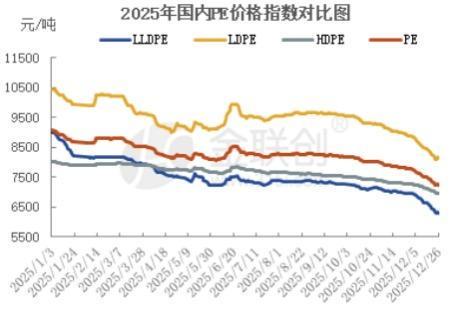
Group 1 - The domestic polyethylene (PE) market in 2025 continued to decline, with LLDPE experiencing the largest drop of 29.76% year-on-year, followed by LDPE at 22.35% and HDPE at 13.45%, resulting in an overall decline of 20.28% for polyethylene [2] - The market faced a severe contradiction of "high supply, weak demand, and high inventory," leading to a significant loss of market confidence and a continuous decline in LLDPE futures [2] - The first half of 2025 saw a downward trend in the market, with a slight rebound due to temporary factors such as the easing of US-China trade tensions and rising oil prices, but overall demand remained weak [2] Group 2 - In the second half of 2025, the decline in prices accelerated, with LLDPE and LDPE becoming the hardest hit, as the market faced a "cold wave" of accelerated decline, with price indices hitting multi-year lows [2] - The domestic supply pressure reached a peak, leading petrochemical companies and traders to engage in aggressive price cuts to capture market share, resulting in a vicious cycle of "price cuts - poor transactions - further price cuts" [2] - On December 24, 2025, a slight recovery in low-end pricing occurred due to technical rebounds in futures, but this was not indicative of a demand reversal, merely a temporary stabilization after significant declines [2] Group 3 - In the North China market, LLDPE prices ranged from 6,100 to 9,000 CNY/ton, with the lowest point on December 23 and the highest on January 1; LDPE prices ranged from 7,800 to 10,550 CNY/ton, with similar low and high points [3] - The polyethylene market in the first quarter of 2026 is expected to face challenges due to "strong supply and high inventory" against a backdrop of "weak recovery and slow destocking," limiting the potential for price rebounds [3] Group 4 - BASF's 500,000 tons/year polyethylene facility in Guangdong successfully produced qualified products on December 21, 2025, marking a successful startup [4] - Shandong Yulong Petrochemical's 500,000 tons/year LDPE/EVA facility is scheduled to start production in March 2026, while Zhejiang Petrochemical's new high-pressure and LDPE/EVA facilities are also set to commence in the first quarter of 2026 [4] - The expansion of high-pressure capacity and the continued release of capacity from ExxonMobil's Huizhou facility are expected to exert significant pressure on high-pressure market prices, while low-pressure prices will continue to seek new equilibrium points due to increased supply [4]

纯苯、苯乙烯日报:纯苯苯乙烯高库存淡季,承压震荡运行-20251218
Tong Hui Qi Huo· 2025-12-18 07:12
1. Report's Industry Investment Rating - No relevant information provided 2. Core Views of the Report - Pure benzene is in a short - term pattern of "high inventory, weak demand, and low profit", with prices mainly in a fluctuating state [2] - The short - term supply - demand of styrene is becoming more balanced, with insufficient upward price drivers, and attention should be paid to inventory changes and device dynamics [3] 3. Summary by Relevant Catalogs 3.1 Daily Market Summary 3.1.1 Fundamentals - **Price**: On December 17, the main styrene contract closed down 1.37% at 6,404 yuan/ton, and the main pure benzene contract closed down 0.96% at 5,388 yuan/ton [2] - **Cost**: On December 17, Brent crude closed at $55.1/barrel (-$1.7/barrel), WTI crude closed at $58.9/barrel (-$1.7/barrel), and the spot price of pure benzene in East China was 5,285 yuan/ton (-10 yuan/ton) [2] - **Inventory**: Styrene port inventory was 14.7 tons (-1.4 tons), and pure benzene port inventory was 26.0 tons (+3.6 tons) [2] - **Supply**: Styrene production was 34.2 tons (+0.7 tons) with a capacity utilization rate of 68.3% (-0.6%) [2] - **Demand**: The overall demand of downstream 3S industries is recovering. EPS capacity utilization was 53.8% (-2.6%), ABS was 70.5% (+2.2%), and PS was 58.3% (-0.7%) [2] 3.1.2 Views - **Pure benzene**: The peak of domestic pure benzene arrivals has ended, but high inventory suppresses prices. Overseas, the marginal support of gasoline blending for aromatics is weak, and the US - South Korea price difference is being repaired. Supply has decreased due to low profits, and demand remains weak as downstream industries are in the off - season [2] - **Styrene**: East China port and commercial inventories are decreasing but still being rebuilt. The basis has peaked and started to decline. The market focuses on device restart progress, and downstream提货 is slowing down. Supply is at a medium - low level, and non - integrated device profits are under pressure. Demand is in the off - season, and downstream load is weak [3] 3.2 Industrial Chain Data Monitoring 3.2.1 Styrene & Pure Benzene Prices | Data Indicator | 2025/12/16 | 2025/12/17 | Change Rate | |---|---|---|---| | Styrene (Futures Main Contract) | 6,493.0 yuan/ton | 6,404.0 yuan/ton | -1.37% | | Styrene (Spot) | 6,780.0 yuan/ton | 6,776.0 yuan/ton | -0.06% | | Pure Benzene (Futures Main Contract) | 5,440.0 yuan/ton | 5,388.0 yuan/ton | -0.96% | | Pure Benzene (East China) | 5,295.0 yuan/ton | 5,285.0 yuan/ton | -0.19% | | Pure Benzene (South Korea FOB) | $656.3/ton | $656.3/ton | 0.00% | | Pure Benzene (US FOB) | $840.3/ton | $834.1/ton | -0.74% | | Pure Benzene (China CFR) | $663.8/ton | $663.8/ton | 0.00% | | Pure Benzene Domestic - CFR Spread | -367.9 yuan/ton | -375.6 yuan/ton | -2.09% | | Pure Benzene East China - Shandong Spread | -5.0 yuan/ton | -15.0 yuan/ton | -200.00% | | Brent Crude | $56.8/ton | $55.1/ton | -2.97% | | WTI Crude | $60.6/ton | $58.9/ton | -2.71% | | Naphtha | 7,066.5 yuan/ton | 7,016.5 yuan/ton | -0.71% | [5] 3.2.2 Styrene & Pure Benzene Production and Inventory | Data Indicator | 2025/11/28 | 2025/12/05 | Change Rate | |---|---|---|---| | Styrene Production (China) | 33.5 tons | 34.2 tons | 2.32% | | Pure Benzene Production (China) | 44.6 tons | 43.9 tons | -1.70% | | Styrene Port Inventory (Jiangsu) | 16.4 tons | 16.1 tons | -2.19% | | Styrene Factory Inventory (Domestic) | 19.0 tons | 17.6 tons | -7.49% | | Pure Benzene Port Inventory (National) | 16.4 tons | 22.4 tons | 36.59% | [6] 3.2.3 Capacity Utilization Rate | Industry | Capacity Utilization Rate | 2025/11/28 | 2025/12/05 | Change | |---|---|---|---|---| | Pure Benzene Downstream - Styrene | % | 67.3 | 68.9 | +1.56 | | Pure Benzene Downstream - Caprolactam | % | 86.7 | 79.2 | -7.53 | | Pure Benzene Downstream - Phenol | % | 81.2 | 81.7 | +0.57 | | Pure Benzene Downstream - Aniline | % | 77.2 | 77.2 | +0.04 | | Styrene Downstream - EPS | % | 54.7 | 56.4 | +1.61 | | Styrene Downstream - ABS | % | 71.2 | 68.3 | -2.90 | | Styrene Downstream - PS | % | 57.6 | 59.0 | +1.40 | [7] 3.3 Industry News - Canada provided an additional CAD 235 million in aid to Ukraine [8] - The US ADP employment in November decreased by 32,000, falling short of market expectations [8] - Fitch lowered the oil price forecast from 2025 to 2027, indicating market oversupply [8] - Venezuela's daily oil exports exceeded 900,000 barrels in November despite US pressure [8] - US Treasury Secretary Yellen said that some areas of the US economy showed signs of weakness and needed interest rate cuts [8] - The US EIA crude inventory for the week ending November 28 increased by 574,000 barrels, and the strategic petroleum reserve increased by 250,000 barrels [8] 3.4 Industrial Chain Data Charts - The report includes charts of pure benzene prices, styrene prices, styrene - pure benzene spread, SM import pure benzene cost vs. domestic pure benzene cost, styrene port and factory inventory, pure benzene port inventory, ABS inventory, and capacity utilization rates of related industries [13][18][22]
过剩局面不改,镍不锈钢弱势震荡
Hua Tai Qi Huo· 2025-12-16 03:27
1. Report's Industry Investment Rating - Not provided in the content 2. Core Viewpoints of the Report - Due to high inventory and oversupply, nickel prices are expected to remain in a low - level oscillation. For stainless steel, with weak demand, high inventory, and a continuous downward shift in cost center, it is also expected to maintain a low - level oscillation [1][3] 3. Summary by Related Categories Nickel Market Analysis - On December 15, 2025, the Shanghai nickel main contract 2601 opened at 115,070 yuan/ton and closed at 114,690 yuan/ton, a change of - 0.88% from the previous trading day's closing price. The trading volume was 129,996 (+29,560) lots, and the open interest was 105,210 (+252) lots. The price trend continued the recent weakness, showing a pattern of "rising and then falling, oscillating downward" under the triple pressure of supply - demand surplus, high inventory, and technical breakdown [1] - The nickel ore market remained calm with stable prices. Philippine mines mainly fulfilled previous orders, maintaining a price - holding attitude. Downstream factories' production plans remained unchanged, and their pressure on nickel ore purchase prices might ease. In Indonesia, the December (second - phase) domestic trade benchmark price was expected to drop by 0.11 - 0.18 US dollars/wet ton, and the current mainstream premium was + 25, with the premium range mostly between + 25 - 26. The overall domestic trade price of nickel ore was expected to decline [1] - Jinchuan Group's sales price in the Shanghai market was 120,200 yuan/ton, a decrease of 800 yuan/ton from the previous trading day. Spot trading was fair, and the spot premiums and discounts of various refined nickel brands were mostly stable. The premium of Jinchuan nickel changed by 100 yuan/ton to 5,300 yuan/ton, the premium of imported nickel changed by 0 yuan/ton to 400 yuan/ton, and the premium of nickel beans was 2,450 yuan/ton. The previous trading day's Shanghai nickel warehouse receipt volume was 37,872 (+2,622) tons, and the LME nickel inventory was 253,392 (+360) tons [2] Strategy - With high inventory and an unchanged oversupply situation, nickel prices are expected to remain in a low - level oscillation. The strategy is mainly range - bound operation for the single - side, and no operations are recommended for inter - period, cross - variety, spot - futures, and options [1][2][3] Stainless Steel Market Analysis - On December 15, 2025, the stainless steel main contract 2602 opened at 12,560 yuan/ton and closed at 12,480 yuan/ton. The trading volume was 177,564 (+56,756) lots, and the open interest was 118,271 (-4,171) lots. The trend continued the recent weakness, showing a pattern of "rising and then falling, oscillating downward" under the pressure of supply - demand imbalance, high inventory, and export policy disturbances. In the short term, there was unlikely to be an obvious rebound, and it was expected to oscillate and consolidate in the range of 12,400 - 12,600 yuan/ton [3] - The futures market weakened, and downstream purchasing enthusiasm was low, with purchases mainly on an as - needed basis. Inventory reduction slowed down. The stainless steel price in the Wuxi market was 12,750 (+0) yuan/ton, and in the Foshan market was 12,750 (+0) yuan/ton. The premium and discount of 304/2B was 265 - 465 yuan/ton. According to SMM data, the ex - factory tax - included average price of high - nickel pig iron changed by - 1.00 yuan/nickel point to 887.5 yuan/nickel point [3] Strategy - Due to weak demand, high inventory, and a continuous downward shift in the cost center, stainless steel is expected to maintain a low - level oscillation. The single - side strategy is neutral, and no operations are recommended for inter - period, cross - variety, spot - futures, and options [3][4]
数据点评 | PMI修复的“短期掣肘”?(申万宏观·赵伟团队)
赵伟宏观探索· 2025-11-30 16:35
Core Viewpoints - The PMI for November shows limited recovery, primarily influenced by high inventory levels and the fading effects of holidays [2][4][88] - In the manufacturing sector, the PMI increased slightly to 49.2%, reflecting weak overall performance despite a low base [2][10][44] - The production index remains weak, with only a minor increase to the threshold line of 50%, indicating ongoing production challenges [2][10][19] Manufacturing Sector - The manufacturing PMI rose by 0.2 percentage points to 49.2%, with production and new orders indices showing slight improvements of 0.3 and 0.4 percentage points, respectively [5][44][89] - High inventory levels from previous months continue to constrain current production, with the finished goods inventory index decreasing to 47.3% [2][19][87] - Key industries such as high-tech manufacturing and consumer goods have seen their PMIs fall into contraction territory, while energy-intensive industries have shown some improvement [3][22][88] Non-Manufacturing Sector - The non-manufacturing PMI decreased to 49.5%, primarily due to a high base from the previous month and the impact of holiday effects [3][36][59] - Service industries, including retail and hospitality, experienced declines in their PMIs, while sectors like telecommunications and financial services remained in a high growth zone [3][36][88] - The construction sector's PMI improved to 49.6%, with significant increases in new orders and employment indices, indicating a potential recovery in this area [30][36][76] Economic Outlook - The short-term disturbances from high inventory levels are expected to dissipate, and with supportive fiscal policies being implemented, economic growth is anticipated to remain resilient [4][42][88] - The easing of debt-related investment constraints is reflected in the improvements seen in energy-intensive and construction sectors [4][42][88] - Overall, the combination of external demand stability and the rollout of fiscal measures is projected to support economic resilience through the end of the year [4][42][88]
中采PMI点评(25.11):PMI修复的“短期掣肘”?
Shenwan Hongyuan Securities· 2025-11-30 13:13
Manufacturing PMI Insights - November Manufacturing PMI increased slightly to 49.2%, up 0.2 percentage points from October's 49%[2] - Production index rose marginally by 0.3 percentage points to 50%, indicating weak production performance[8] - New orders index improved by 0.4 percentage points to 49.2%, slightly better than the same period last year[2] Inventory and Production Constraints - High inventory levels from previous months continue to constrain current production, with finished goods inventory index at 47.3%, down 0.8 percentage points[3] - The purchasing quantity index rose by 0.5 percentage points to 49.5%, but this increase is weaker compared to the previous month's decline of 2.6 percentage points[3] Sector Performance - High-tech manufacturing PMI fell to 50.1%, while equipment manufacturing and consumer goods sectors dropped into contraction territory at 49.8% and 49.4% respectively[3] - High-energy consumption industries saw a PMI increase of 1.1 percentage points to 48.4%, reflecting some improvement in investment dynamics[3] Non-Manufacturing PMI Trends - Non-manufacturing PMI decreased to 49.5%, down 0.7 percentage points, entering contraction territory primarily due to high base effects and holiday impact[4] - Service sector indices for shopping, accommodation, transportation, and tourism all showed declines, with real estate and residential services below critical levels[4] Economic Outlook - Despite short-term disruptions from high inventory, the economy is expected to maintain resilience due to supportive fiscal policies and sustained external demand[4] - The construction sector's PMI rose by 0.5 percentage points to 49.6%, indicating potential for continued improvement in business activity[22]
浮法玻璃周报:分析师范阿骄-20251121
Hong Ye Qi Huo· 2025-11-21 07:43
1. Report Industry Investment Rating There is no information about the report industry investment rating in the provided content. 2. Core Viewpoints - The current glass market is under the triple - pressure pattern of "high inventory, weak demand, and low profit", with the price downward trend remaining unchanged. Although there is support from production line cold - repairs in the short term, there is no systematic production reduction, and there is a lack of substantial demand recovery signals. The far - month contract discount structure is stable, reflecting the market's cautious attitude towards the demand recovery in the first quarter of 2026. The market is pessimistic about the future trend of glass. If demand does not improve significantly in the short term, prices may continue to be weakly sorted, and the long - term trend still depends on the substantial improvement of the demand side or the further contraction of the supply side [4]. 3. Summary by Relevant Catalogs 3.1. Spot Overview - As of November 20, 2025, the national average price of 5mm float glass was 1,106 yuan/ton, down 45 yuan/ton from the previous week, a decline of about 3.9%. The prices in major production areas such as Shahe and Hubei weakened, and the production - sales ratio was low. Some enterprises adopted the "price - for - volume" strategy to reduce inventory. The futures price maintained a downward trend, and the main contract was approaching the historical low, with weak market sentiment. The supply - demand fundamental was under pressure, inventory was at a high level, and industry profits continued to narrow. The total trading volume of glass futures increased significantly this week, reaching 1.9229 million lots on November 20, a recent peak, indicating active market trading but intensified divergence in directions. The open interest remained at a high level, reaching 1.9437 million lots as of November 21, reflecting the continuous accumulation of short - selling power [3]. 3.2. Supply Side - A 600 - ton/day production line in Benxi was cold - repaired this week, and the domestic daily output in production decreased to 158,100 tons. This was the only clear capacity exit this week, but the overall supply was still at a high level, and no systematic production reduction was formed. The national weekly output was 1.1102 million tons, down 0.34% from the previous week and up 0.08% year - on - year [3]. 3.3. Demand Side - Demand remained weak. As of November 17, 2025, the average order days of national deep - processing sample enterprises was 9.9 days, down 8.9% from the previous week and 24.2% year - on - year. Since November, the average orders held by deep - processing samples in each region have declined compared with the beginning of the month. The real estate market was continuously sluggish, the terminal project procurement willingness was low, most processing plants did not have a rush - to - work phenomenon, and generally maintained just - in - time restocking, with strong market wait - and - see sentiment [4]. 3.4. Inventory - As of November 20, 2025, the total inventory of national float glass sample enterprises was 63.303 million heavy boxes, up 56,000 heavy boxes from the previous week, a month - on - month increase of 0.09% and a year - on - year increase of 30.72%. The inventory days were 27.7 days, 0.2 days more than the previous period. The inventory of regional enterprises varied, with the overall inventory increasing slightly month - on - month, and the industry showed a trend of inventory accumulation [4]. 3.5. Cost and Profit - This week, the average weekly profit of float glass using natural gas as fuel was - 206.84 yuan/ton, a decrease of 19.14 yuan/ton from the previous week; the average weekly profit of float glass using coal - made gas as fuel was 25.79 yuan/ton, a decrease of 25.47 yuan/ton from the previous week; the average weekly profit of float glass using petroleum coke as fuel was 8.52 yuan/ton, a decrease of 24.00 yuan/ton from the previous week [4].
高库存强供应预期 预计铁矿石盘面震荡为主
Jin Tou Wang· 2025-11-21 06:02
消息面 近期矿价上涨,市场心态有所好转,但在高库存、低利润、强供应预期的三重压制下,铁矿石价格仍将 承压。建议个人投资者不追高,前期空单继续持有,可将98-100美元作为第一下行目标;现货企业继续 采取低库存策略和按需补库模式。 国投安信期货: 供应端,全球发运偏强,四季度发运量预计维持高位,国内到港量阶段回落,港口库存保持累库趋势, 短期存在一定结构性扰动。需求端,钢材表需环比有所反弹,但目前进入淡季并且钢厂盈利情况较差, 铁水本周小幅减产,仍然处于季节性减产趋势中,减产速度有所放缓,短期关注宏观层面是否会有利好 政策出台。铁矿石基本面边际转宽松,我们预计盘面走势震荡为主。 全国45个港口进口铁矿库存总量15054.65万吨,环比下降75.06万吨;日均疏港量329.92万吨,增2.97万 吨;在港船舶数量120条,增4条。 11月21日当周,铁矿石港口库存录得15734.85万吨,较上一周减少77.99万吨,减少幅度达0.49%;最近 一个月,铁矿石港口库存累计增加625.36万吨,增加幅度为4.14%。 机构观点 国都期货: 11月20日:全国主港铁矿石成交91.8万吨,环比上涨27.32%;远期现货成 ...
数据点评 | 10月PMI:偏弱的“三大症结”(申万宏观·赵伟团队)
赵伟宏观探索· 2025-10-31 16:03
Core Viewpoint - The weak PMI in October is primarily due to weak demand, with deeper issues stemming from high inventory levels negatively impacting production indices [2][68]. Group 1: Manufacturing PMI Analysis - The manufacturing PMI fell to 49% in October, down 0.8 percentage points from the previous month, indicating a contraction in the manufacturing sector [2][68]. - The production index dropped significantly, falling to 49.7%, which is a decrease of 2.2 percentage points, marking a return to the contraction zone for the first time in six months [2][9]. - New orders index saw a smaller decline of 0.9 percentage points, indicating that while demand is weakening, it is not as severe as the production index [2][9]. Group 2: Causes of Weakness - The significant drop in the production index may be attributed to the retreat of the "rush production" effect, high inventory levels, and the nature of the PMI as a month-on-month indicator [2][14]. - In September, there was a temporary "stock-up rush" phenomenon, which led to a spike in production and inventory levels, but this created constraints for October's production capacity [14][68]. - The new export orders index fell sharply by 1.9 percentage points to 45.9%, the second-lowest point of the year, influenced by fluctuating tariff policies [3][69]. Group 3: Domestic Demand and Investment - Domestic demand remains resilient overall, but the acceleration of debt reduction has weakened investment demand, particularly affecting high-energy-consuming industries and construction [3][23]. - The PMI for high-energy industries dropped to 47.3%, reflecting strong pressure on real estate and infrastructure investment due to debt reduction efforts [3][23]. - The construction PMI also remains low, falling to 49.1%, but recent fiscal policies are expected to alleviate some investment pressures, with the business activity expectation index for construction rising by 3.6 percentage points [3][23]. Group 4: Future Outlook - Despite the recent setbacks in manufacturing sentiment, the short-term disturbances from high inventory levels are expected to dissipate, and proactive fiscal policies are being implemented [4][35]. - The manufacturing sector is anticipated to maintain resilience as external uncertainties ease and new policies are rolled out to support production and demand [4][35]. - Continuous monitoring of the marginal changes in manufacturing sentiment will be essential as the situation evolves [4][70]. Group 5: Non-Manufacturing PMI Insights - The non-manufacturing PMI showed a slight increase to 50.1%, indicating some recovery in the service sector, driven by holiday travel and pre-sales activities [5][51]. - The service sector PMI rose by 0.1 percentage points, with the employment index also improving, suggesting a positive trend in service-related employment [5][55]. - In contrast, the construction sector experienced a slight decline in PMI, although the new orders index saw a significant rebound, increasing by 3.7 percentage points [6][60].