
弱需求

Search documents
造纸板块3月月报-20260227
Yin He Qi Huo· 2026-02-27 09:17
1. Report Industry Investment Rating No relevant content provided. 2. Core Views of the Report - In February 2026, the pulp market was in a game between "cost support, high inventory, and weak demand". The supply was generally loose, with high - level imports gradually decreasing, high domestic production, and rising port inventories. The demand was structurally differentiated, with packaging paper having rigid demand for broad - leaf pulp, the recovery of the tissue paper industry, and weak cultural paper demand dragging down the consumption of softwood pulp. The total consumption of wood pulp decreased month - on - month [4][50]. - In March, the pulp market is expected to oscillate moderately and move upward slightly, with the valuation center likely to rise slightly. However, the high inventory of softwood pulp and the delayed recovery of cultural paper demand will limit the increase. The double - offset paper market is expected to remain "weakly stable with marginal improvement", and it is difficult for the valuation to fluctuate significantly [5][50][52]. 3. Summary by Directory 3.1 First Part: Preface - The pulp market in February was characterized by the game between cost support, high inventory, and weak demand. The Spring Festival holiday exacerbated the supply - demand contradiction, with high inventory and difficult price increases for paper mills [3][4]. 3.2 Second Part: Fundamental Situation 3.2.1 Pulp Futures and Spot Price Trends Review - In February 2026, the domestic pulp market showed a differentiated pattern of "weak oscillation before the Spring Festival and improved sentiment after the festival". In the spot market, softwood pulp rose with the futures, broad - leaf pulp increased significantly due to foreign price hikes, and other types of pulp remained stable or had regional differences. In the futures market, the contract oscillated upward after the festival driven by funds [10][13]. 3.2.2 Pulp Supply - Import: The import volume was at a high level but gradually decreased. The supply of softwood pulp remained stable, and the import of broad - leaf pulp was supported by foreign price hikes. In the future, the import scale may decline slowly but remain high in the short term [20]. - Domestic production: The domestic production capacity was accelerating, and the output remained at a high level. The expansion was mainly concentrated in the broad - leaf pulp field, and the substitution effect of non - wood pulp was gradually increasing [21][22]. - Port inventory: The port inventory continued to accumulate, reaching over 240.1 million tons. The de - stocking pressure was mainly on softwood pulp, while broad - leaf pulp was in a tight - balance state [22]. 3.2.3 Pulp Demand - Cultural paper: Affected by the Spring Festival and the off - season, the demand was weak, and the profit was under pressure. Paper mills purchased pulp cautiously [26]. - Packaging paper: Supported by pre - festival order completion and post - festival restocking, the demand for broad - leaf pulp was rigid [26]. - Tissue paper: After the festival, paper mills resumed production, and the consumption of softwood and broad - leaf pulp increased steadily [29]. 3.2.4 Cultural Paper Market Review - In February, the cultural paper market continued the pattern of "stable price, weak volume, and pressured profit". The prices of double - offset paper and coated paper remained stable, but the industry loss increased, and the inventory continued to accumulate [30]. 3.2.5 Cultural Paper Supply - Demand and Inventory - Production: Affected by the Spring Festival, the production capacity utilization rate of double - offset paper and coated paper was at a low level [38]. - Inventory: The inventory of double - offset paper reached a new high, and the inventory days were far beyond the reasonable range. The inventory removal was difficult [39][40]. - Profit: Although paper mills intended to raise prices, it was difficult to implement due to sufficient downstream inventory, loose supply - demand, and "low - price order - grabbing" by small and medium - sized paper mills [41]. 3.2.6 Cultural Paper Demand Analysis - Import and export: The export volume of double - offset paper was stable but the price was weak, and the cumulative decline narrowed. The export of coated paper remained at a low level [46]. - Downstream demand: Affected by the Spring Festival, the apparent consumption of double - offset paper and coated paper decreased. The demand from the publishing and social printing sectors was weak, and the real demand recovery was slower than expected [46][47]. 3.3 Third Part: Future Outlook and Strategy Recommendations 3.3.1 Pulp Fundamental Analysis - In March, the pulp market is expected to oscillate moderately and move upward slightly. The support factors include continuous foreign price hikes, the recovery of downstream demand, and the possible de - stocking of port inventory. The restrictive factors are the high inventory of softwood pulp and the delayed recovery of cultural paper demand [50]. 3.3.2 Pulp Futures Strategy Analysis - Unilateral: Adopt a low - level long - buying strategy. - Arbitrage: Wait and see. - Options: Sell SP2605 - P - 5200 [51]. 3.3.3 Double - Offset Paper Fundamental Analysis - In March, the double - offset paper market is expected to remain "weakly stable with marginal improvement". The positive factors are the marginal recovery of downstream demand and the support of pulp prices. The negative factors are the high inventory and the "low - price order - grabbing" by small and medium - sized paper mills [52]. 3.3.4 Double - Offset Paper Strategy Analysis - Unilateral: Adopt a high - level short - selling strategy and pay attention to the post - Spring Festival resumption of work. - Arbitrage: Wait and see. - Options: Pay attention to the opportunity to sell call options [55].
长安期货侯荃宇:期现共振下行 价格反弹承压
Xin Lang Cai Jing· 2026-01-28 07:15
Core Viewpoint - The caustic soda futures market is experiencing significant downward pressure due to high supply, high inventory, and weak demand, leading to prices hitting new lows since listing [5][34]. Supply Side - Supply surplus is the fundamental driver of the current price decline, with the domestic caustic soda industry operating at high capacity. As of January 23, the weekly operating rate reached 87.7%, an increase of 1 percentage point, with weekly production rising to 863,000 tons [9][27]. - The total domestic caustic soda capacity is projected to reach approximately 52.23 million tons per year by 2025, with an additional 2.56 million tons planned for 2026. Despite expectations for potential production cuts, no large-scale reductions have been observed as of the end of January [9][27]. Demand Side - Demand is weak, particularly in the alumina sector, which consumes over 60% of caustic soda. The overall operating rate in the domestic alumina industry was 85.18%, down 0.65% from the previous period, indicating cautious purchasing behavior [12][30]. - Other sectors such as viscose staple fiber, paper, and dyeing chemicals show limited demand growth, further contributing to the overall weakness in the caustic soda market [12][30]. Inventory - Domestic liquid caustic soda inventories have reached record highs, with major enterprises maintaining stocks above 450,000 tons. As of January 23, inventories stood at 509,600 tons, an increase of 67,400 tons from the end of December [14][32]. - High inventory levels continue to suppress the potential for price rebounds, with the need for inventory reduction becoming increasingly pressing [14][32]. Summary - The caustic soda futures market is characterized by a downward trend, with prices breaking new lows and current prices approaching or even breaching production cost lines in some regions. The core issues are high supply, high inventory, and weak demand, which are expected to persist in the short term [16][34]. - The market is likely to remain in a low-price oscillation pattern, with potential for short-term support from downstream replenishment needs post-Chinese New Year. However, any rebound will face significant challenges until there is a substantial improvement in the supply-demand balance [34][35].


新能源及有色金属日报:宏观情绪退潮,镍不锈钢震荡走弱-20260114
Hua Tai Qi Huo· 2026-01-14 03:11
Report Industry Investment Rating No information provided. Core View of the Report - Short - term nickel prices face multiple pressures such as high inventory, weak demand, and the ebb of macro - sentiment, and may continue to decline in a volatile manner. However, attention should be paid to the implementation of Indonesia's nickel quota adjustment policy. If the policy is tightened more than expected, it may support prices. - Short - term stainless steel may maintain a weak and volatile trend, mainly affected by high inventory, weak demand, and cost - side fluctuations. Attention should be paid to the implementation of Indonesia's nickel ore quota policy and the production and stocking rhythm of steel mills [1][3]. Summary According to Relevant Catalogs Nickel Variety Market Analysis Futures - On January 13, 2026, the main contract of Shanghai nickel 2602 opened at 145,000 yuan/ton and closed at 138,450 yuan/ton, a change of - 2.21% from the previous trading day's closing price. The trading volume was 1,277,690 (+194,488) lots, and the open interest was 119,485 (-4,663) lots. The main contract showed a "high - opening, low - running + volatile downward" trend, driven by the ebb of macro - sentiment, high inventory on the supply side, weak demand, and the fading of geopolitical risk premium [1]. Nickel Ore - Mysteel reported that there were transactions in the nickel ore market recently. The CIF price of domestic 1.3% nickel ore was 42 US dollars. The overall nickel ore resources in the market were limited, and the nickel ore price was running strongly. Philippine mines were eager to sell at higher prices. The downstream nickel - iron price reached 1,000 yuan/nickel (including tax at the hatch bottom) and above. In Indonesia, the domestic trade benchmark price in January 2026 (Phase II) was expected to rise by 2.8 - 4.9 US dollars/wet ton. The current mainstream premium was +25, and the premium range was mostly between +25 - 26. Factories may push down the premium due to cost pressure [1]. Spot - Jinchuan Group's sales price in the Shanghai market was 148,600 yuan/ton, an increase of 100 yuan/ton from the previous trading day. Spot trading was average, and the spot premiums of refined nickel brands were slowly falling. The premium of Jinchuan nickel changed - 100 yuan/ton to 8,900 yuan/ton, the premium of imported nickel changed 0 yuan/ton to 600 yuan/ton, and the premium of nickel beans was 2,450 yuan/ton. The previous trading day's Shanghai nickel warehouse receipt volume was 39,436 (-234) tons, and the LME nickel inventory was 284,148 (-414) tons [2]. Nickel Variety Strategy - Unilateral: Mainly operate within a range; Cross - period: None; Cross - variety: None; Spot - futures: None; Options: None [3]. Stainless Steel Variety Market Analysis Futures - On January 13, 2026, the main contract of stainless steel 2603 opened at 13,890 yuan/ton and closed at 13,790 yuan/ton. The trading volume was 256,128 (-551) lots, and the open interest was 130,200 (-4,171) lots. The contract opened higher due to the overnight rise of LME nickel but was dragged down by the rapid decline of Shanghai nickel, and the price fluctuated downward with weakening spot trading. In the afternoon, the continuous decline of Shanghai nickel triggered selling pressure, and the price fell below 13,800 yuan/ton, reaching a minimum of 13,705 yuan/ton and finally closing at 13,790 yuan/ton [3]. Spot - In the morning, the spot price rose slightly due to the increase in futures prices, but the market was afraid of high prices, and the inquiry and trading were poor. The stainless steel price in the Wuxi market was 13,900 (+0) yuan/ton, and in the Foshan market, it was 13,750 (-25) yuan/ton. The premium of 304/2B was between 175 - 375 yuan/ton. The ex - factory average price of high - nickel pig iron changed 8.50 yuan/nickel point to 980.5 yuan/nickel point [4]. Stainless Steel Variety Strategy - Unilateral: Neutral; Cross - period: None; Cross - variety: None; Spot - futures: None; Options: None [5].
纸浆数据日报-20260108
Guo Mao Qi Huo· 2026-01-08 03:17
1. Report's Industry Investment Rating - Not provided in the given content 2. Core View of the Report - Pulp is currently pulled by the trading logic of "strong supply" and "weak demand". With a relatively strong recent macro - sentiment, the 05 contract is expected to oscillate strongly in the range of 5400 - 5700 yuan/ton [6] 3. Summary According to the Catalog Price Data - **Futures Prices**: On January 7, 2026, SP2601 was 5520 yuan/ton, down 0.14% day - on - day and up 1.47% week - on - week; SP2609 was 5644 yuan/ton, down 0.07% day - on - day and up 1.55% week - on - week; SP2605 was 5596 yuan/ton, down 0.29% day - on - day and up 1.56% week - on - week [6] - **Spot Prices**: Coniferous pulp Silver Star was 5600 yuan/ton, unchanged day - on - day and week - on - week; Coniferous pulp Russian Needle was 5400 yuan/ton, unchanged day - on - day and week - on - week; Hardwood pulp Goldfish was 4720 yuan/ton, up 0.43% day - on - day and 1.07% week - on - week [6] - **Foreign Quotes**: Chilean Silver Star was 710 dollars/ton, up 1.43% month - on - month; Brazilian Goldfish was 560 dollars/ton, up 3.70% month - on - month; Chilean Venus was 620 dollars/ton, unchanged month - on - month [6] - **Import Costs**: Chilean Silver Star was 5802 yuan/ton, up 1.42% month - on - month; Brazilian Goldfish was 4587 yuan/ton, up 3.66% month - on - month; Chilean Venus was 5073 yuan/ton, unchanged month - on - month [6] Fundamental Data Supply - **Import Volume**: In November 2025, coniferous pulp imports were 72.5 tons, up 4.92% month - on - month compared to October; hardwood pulp imports were 176.5 tons, up 33.92% month - on - month compared to October [6] - **Domestic Production**: In December 2025, the domestic production of hardwood pulp fluctuated between 23 - 25.2 tons; the domestic production of chemimechanical pulp fluctuated between 23.6 - 23.9 tons [6] - **Shipments to China**: In November 2025, pulp shipments to China were 178 thousand tons, up 3.00% month - on - month [6] Inventory - **Port Inventory**: As of January 4, 2026, the inventory of mainstream pulp ports in China was 199.7 tons, up 9.1 tons from the previous period, a 4.8% increase, ending five consecutive weeks of destocking [6] - **Futures Delivery Warehouse Inventory**: It fluctuated between 9.9 - 22.2 tons from November 2025 to December 2025 [6] Demand - **Finished Paper Production**: From November 2025 to December 2025, the production of offset paper fluctuated between 20.4 - 20.9 tons; coated paper between 8 - 8.6 tons; tissue paper between 28.48 - 29.07 tons; white cardboard between 35.3 - 38.4 tons [6]
日度策略参考-20260106
Guo Mao Qi Huo· 2026-01-06 02:51
Report Industry Investment Rating No relevant information provided. Report Core Viewpoints - Short - term, the stock index may continue a relatively strong trend, but attention should be paid to the impact of overseas geopolitical events on market risk appetite. In the long - term, the stock index is expected to rise in 2026 based on 2025 [1]. - Asset shortage and weak economy are beneficial to bond futures, but the central bank has recently warned of interest - rate risks, and attention should be paid to the Bank of Japan's interest - rate decision [1]. - Different commodities have various trends, including price increases, oscillations, and potential reversals, with corresponding investment strategies recommended [1]. Summary by Related Catalogs Macro Finance - Short - term, the stock index may continue to be strong, and in the long - term (2026), it is expected to rise on the basis of 2025 due to factors like continuous policy efforts, inflation recovery, capital market reform, and the support of Central Huijin [1]. - Asset shortage and weak economy benefit bond futures, but the central bank warns of interest - rate risks, and the Bank of Japan's interest - rate decision should be watched [1]. Metals Non - ferrous Metals - Copper: The price has further increased due to weak industry fundamentals but positive macro sentiment and continuous premium. However, short - term adjustment risks should be guarded against, and the upward trend is expected to continue [1]. - Aluminum: Domestic electrolytic aluminum has accumulated inventory, but positive macro sentiment and the early fermentation of supply - tightness expectations are likely to keep the price strong [1]. - Alumina: The supply side has a large release space, and the weak industry fundamentals put pressure on the price. However, the current price is near the cost line, so it is expected to oscillate [1]. - Zinc: The fundamentals have improved, the cost center has moved up, recent negative factors have been mostly realized, and market sentiment is volatile, leading to price oscillations [1]. - Nickel: Positive macro sentiment, concerns about supply due to Indonesian events, slow inventory accumulation, and unconfirmed Indonesian policies are likely to keep the short - term price strong. It is recommended to go long at low prices and control risks [1]. - Stainless Steel: Positive macro sentiment, concerns about raw - material supply, a rebound in nickel - iron prices, a slight reduction in social inventory, and an increase in January production plans are likely to keep the short - term futures price strong. It is recommended to go long at low prices, and enterprises should wait for opportunities to sell and hedge [1]. - Tin: The industry association's initiative has put pressure on the price, but considering the tense situation in Congo - Kinshasa, the supply may still be affected. After a short - term decline, the downward space is limited, and low - long opportunities near the support level are recommended [1]. - Precious Metals: Geopolitical risks and international - order uncertainties have boosted the demand for hedging, making the price strong in the short - term. However, the high VIX of silver indicates potential risks. Platinum and palladium are expected to fluctuate widely in the short - term, and platinum can be bought at low prices or a [long - platinum short - palladium] arbitrage strategy can be adopted in the long - term [1]. Black Metals - Iron Ore: There is a combination of weak reality (weak direct demand, high supply, and inventory accumulation) and strong expectation (potential supply disturbances from energy - consumption control and anti - involution). The near - month contract is restricted by production cuts, while the far - month contract has upward potential [1]. - Steel (including Rebar): The valuation of the price is not high, and it is not recommended to short. Positions in cash - and - carry arbitrage can take rolling profits [1]. - Glass: Supply and demand are acceptable, and the valuation is low, so the downward space is limited, and it may be under pressure to oscillate [1]. - Soda Ash: It follows the trend of glass, with acceptable supply and demand, low valuation, and limited downward space, and may oscillate under pressure [1]. - Coking Coal: The fourth - round spot price cut has started. After the futures price dropped to the corresponding position and rebounded, attention should be paid to whether it can reach a new low during the implementation of the price cut. There is a high possibility of wide - range oscillations [1]. - Coke: The logic is the same as that of coking coal [1]. Energy and Chemicals - Crude Oil: OPEC + has suspended production increases until the end of 2026, the uncertainty of the Russia - Ukraine peace agreement, and US sanctions on Venezuelan oil exports have an impact on the price [1]. - Fuel Oil: The short - term supply - demand contradiction is not prominent, and it follows the trend of crude oil. The probability of the 14th Five - Year Plan's rush - work demand is falsified, the supply of Marey crude oil is sufficient, and the asphalt profit is high [1]. - Asphalt: The cost is strongly supported, the spot - futures price difference is low, and the mid - stream inventory may tend to accumulate [1]. - Rubber: For natural rubber, the mid - stream inventory may tend to accumulate, and the price oscillates. For BR rubber, the futures position has declined, the price increase has slowed down, the processing profit is gradually repaired, it maintains high - level operation in terms of production and inventory, and the spot trading is weak [1]. - PTA: The PX market has experienced a sharp increase, and the domestic PTA maintains high - level operation, benefiting from stable domestic demand and the recovery of exports to India since the end of November [1]. - MEG: Two sets of MEG devices in Taiwan, China, are planned to stop production due to efficiency reasons. The price has rebounded rapidly due to supply - side news, and the downstream polyester operating rate is over 90%, with better - than - expected demand [1]. - Short - fiber: The price continues to fluctuate closely following the cost [1]. - Styrene: The Asian styrene market is generally stable. Suppliers are reluctant to reduce prices due to continuous losses, while buyers keep pressing prices due to weak downstream demand and profit compression. The market is in a weak - balance state, and the short - term upward momentum depends on overseas market drive [1]. - Steam: The upward space is limited due to insufficient domestic demand, but there is support from anti - involution and the cost side [1]. - Propylene: The supply pressure is large, the downstream improvement is less than expected, the cost is strongly supported by high - level propylene monomers and rising crude - oil prices, and there is a risk of rising crude - oil prices due to intensified geopolitical conflicts [1]. - PVC: The global production in 2026 is expected to be low, but currently, new capacity is being released, the supply pressure is increasing, and the demand is weak [1]. - Chlorine: The inventory pressure in Shandong is large, the supply pressure is high due to high - level operation and few overhauls, the non - aluminum demand is in the off - season, and the cost support is weakened by the rising price of liquid chlorine [1]. - LPG: The January CP has risen unexpectedly, providing strong cost - end support. Geopolitical conflicts in the US, Venezuela, and the Middle East have increased the short - term risk premium. The EIA weekly C3 inventory is in an accumulation trend, with a temporary slowdown in overseas demand. The domestic PDH maintains high - level operation but is deeply in deficit, and the overseas olefin blending - oil demand is acceptable [1]. New Energy and Silicon Industry - Polysilicon: There is production increase in the northwest and decrease in the southwest. The December production plan has decreased. A capacity storage platform company has been established, with a long - term expectation of capacity reduction. The terminal installation in the fourth quarter has increased marginally. Large enterprises are willing to support the price but not to deliver. The short - term speculative sentiment is high [1]. - Lithium Carbonate: It is the traditional peak season for new - energy vehicles, the energy - storage demand is strong, the supply - side production resumption has increased, and the price has risen rapidly in the short - term [1]. Agricultural Products - Palm Oil: The MPOB December data is expected to be negative, but it may reverse under themes such as seasonal production reduction, the B50 policy, and US biodiesel. If the price gaps up due to geopolitical events, short - selling can be considered [1]. - Soybean Oil: It follows the trend of other oils in the short - term, and waiting for the January USDA report is recommended [1]. - Rapeseed Oil: News of blocked trader purchases and Australian seed imports has led to a large rebound in the single - side price and the 1 - 5 spread, but it is difficult to change the subsequent loosening of the fundamental situation. A decline in sentiment is expected, and short - selling on rebounds can be considered [1]. - Cotton: The domestic new - crop harvest is expected to be good, but the purchase price of seed cotton supports the cost of lint. The downstream operation rate remains low, but the yarn - mill inventory is not high, with rigid restocking demand. The cotton market is currently in a situation of "having support but no driver", and attention should be paid to factors such as the central government's No. 1 Document in the first quarter of next year, planting - area intentions, weather during the planting period, and peak - season demand [1]. - Sugar: There is a global surplus and a large supply of domestic new - crop sugar, with a strong consensus on short - selling. If the futures price continues to fall, the cost support is strong, but the short - term fundamentals lack continuous driving forces, and attention should be paid to changes in the capital side [1]. - Corn: The grass - roots grain - selling progress is relatively fast, the current port and downstream inventory levels are still low, and most traders have not started strategic inventory building. The spot price is expected to be strong in the short - term, and the futures price is expected to have limited decline and then maintain an oscillating and strengthening trend [1]. - Soybeans: Attention should be paid to the adjustment in the January USDA report and the impact of Brazilian harvest selling pressure on CNF premiums. The M05 contract is expected to be relatively weak, while the M03 - M05 spread is expected to be in a positive - arbitrage situation in the short - term, but caution should be exercised due to potential changes in customs policies, soybean auctions, and directional policies [1]. - Pulp: The 05 contract is expected to oscillate in the range of 5400 - 5700 yuan/ton due to the tug - of - war between "strong supply" and "weak demand" [1]. - Logs: The spot price has shown signs of bottom - rebounding, and the downward space of the futures price is limited. However, the January overseas quotation has slightly declined, and there is a lack of upward - driving factors in the spot - futures market. It is expected to oscillate in the range of 760 - 790 yuan/m³ [1]. Livestock - Hogs: The spot price has gradually stabilized recently, with demand support. The slaughter weight has not been fully cleared, and the production capacity still needs to be further released [1].
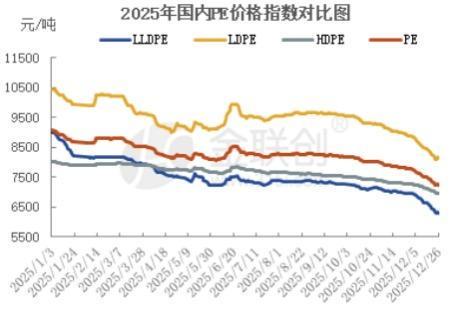
2025年LLDPE跌幅近30% 2026年首季LDPE承压最大
Zhong Guo Neng Yuan Wang· 2025-12-29 09:31
Group 1 - The domestic polyethylene (PE) market in 2025 continued to decline, with LLDPE experiencing the largest drop of 29.76% year-on-year, followed by LDPE at 22.35% and HDPE at 13.45%, resulting in an overall decline of 20.28% for polyethylene [2] - The market faced a severe contradiction of "high supply, weak demand, and high inventory," leading to a significant loss of market confidence and a continuous decline in LLDPE futures [2] - The first half of 2025 saw a downward trend in the market, with a slight rebound due to temporary factors such as the easing of US-China trade tensions and rising oil prices, but overall demand remained weak [2] Group 2 - In the second half of 2025, the decline in prices accelerated, with LLDPE and LDPE becoming the hardest hit, as the market faced a "cold wave" of accelerated decline, with price indices hitting multi-year lows [2] - The domestic supply pressure reached a peak, leading petrochemical companies and traders to engage in aggressive price cuts to capture market share, resulting in a vicious cycle of "price cuts - poor transactions - further price cuts" [2] - On December 24, 2025, a slight recovery in low-end pricing occurred due to technical rebounds in futures, but this was not indicative of a demand reversal, merely a temporary stabilization after significant declines [2] Group 3 - In the North China market, LLDPE prices ranged from 6,100 to 9,000 CNY/ton, with the lowest point on December 23 and the highest on January 1; LDPE prices ranged from 7,800 to 10,550 CNY/ton, with similar low and high points [3] - The polyethylene market in the first quarter of 2026 is expected to face challenges due to "strong supply and high inventory" against a backdrop of "weak recovery and slow destocking," limiting the potential for price rebounds [3] Group 4 - BASF's 500,000 tons/year polyethylene facility in Guangdong successfully produced qualified products on December 21, 2025, marking a successful startup [4] - Shandong Yulong Petrochemical's 500,000 tons/year LDPE/EVA facility is scheduled to start production in March 2026, while Zhejiang Petrochemical's new high-pressure and LDPE/EVA facilities are also set to commence in the first quarter of 2026 [4] - The expansion of high-pressure capacity and the continued release of capacity from ExxonMobil's Huizhou facility are expected to exert significant pressure on high-pressure market prices, while low-pressure prices will continue to seek new equilibrium points due to increased supply [4]
纯苯、苯乙烯日报:纯苯苯乙烯高库存淡季,承压震荡运行-20251218
Tong Hui Qi Huo· 2025-12-18 07:12
1. Report's Industry Investment Rating - No relevant information provided 2. Core Views of the Report - Pure benzene is in a short - term pattern of "high inventory, weak demand, and low profit", with prices mainly in a fluctuating state [2] - The short - term supply - demand of styrene is becoming more balanced, with insufficient upward price drivers, and attention should be paid to inventory changes and device dynamics [3] 3. Summary by Relevant Catalogs 3.1 Daily Market Summary 3.1.1 Fundamentals - **Price**: On December 17, the main styrene contract closed down 1.37% at 6,404 yuan/ton, and the main pure benzene contract closed down 0.96% at 5,388 yuan/ton [2] - **Cost**: On December 17, Brent crude closed at $55.1/barrel (-$1.7/barrel), WTI crude closed at $58.9/barrel (-$1.7/barrel), and the spot price of pure benzene in East China was 5,285 yuan/ton (-10 yuan/ton) [2] - **Inventory**: Styrene port inventory was 14.7 tons (-1.4 tons), and pure benzene port inventory was 26.0 tons (+3.6 tons) [2] - **Supply**: Styrene production was 34.2 tons (+0.7 tons) with a capacity utilization rate of 68.3% (-0.6%) [2] - **Demand**: The overall demand of downstream 3S industries is recovering. EPS capacity utilization was 53.8% (-2.6%), ABS was 70.5% (+2.2%), and PS was 58.3% (-0.7%) [2] 3.1.2 Views - **Pure benzene**: The peak of domestic pure benzene arrivals has ended, but high inventory suppresses prices. Overseas, the marginal support of gasoline blending for aromatics is weak, and the US - South Korea price difference is being repaired. Supply has decreased due to low profits, and demand remains weak as downstream industries are in the off - season [2] - **Styrene**: East China port and commercial inventories are decreasing but still being rebuilt. The basis has peaked and started to decline. The market focuses on device restart progress, and downstream提货 is slowing down. Supply is at a medium - low level, and non - integrated device profits are under pressure. Demand is in the off - season, and downstream load is weak [3] 3.2 Industrial Chain Data Monitoring 3.2.1 Styrene & Pure Benzene Prices | Data Indicator | 2025/12/16 | 2025/12/17 | Change Rate | |---|---|---|---| | Styrene (Futures Main Contract) | 6,493.0 yuan/ton | 6,404.0 yuan/ton | -1.37% | | Styrene (Spot) | 6,780.0 yuan/ton | 6,776.0 yuan/ton | -0.06% | | Pure Benzene (Futures Main Contract) | 5,440.0 yuan/ton | 5,388.0 yuan/ton | -0.96% | | Pure Benzene (East China) | 5,295.0 yuan/ton | 5,285.0 yuan/ton | -0.19% | | Pure Benzene (South Korea FOB) | $656.3/ton | $656.3/ton | 0.00% | | Pure Benzene (US FOB) | $840.3/ton | $834.1/ton | -0.74% | | Pure Benzene (China CFR) | $663.8/ton | $663.8/ton | 0.00% | | Pure Benzene Domestic - CFR Spread | -367.9 yuan/ton | -375.6 yuan/ton | -2.09% | | Pure Benzene East China - Shandong Spread | -5.0 yuan/ton | -15.0 yuan/ton | -200.00% | | Brent Crude | $56.8/ton | $55.1/ton | -2.97% | | WTI Crude | $60.6/ton | $58.9/ton | -2.71% | | Naphtha | 7,066.5 yuan/ton | 7,016.5 yuan/ton | -0.71% | [5] 3.2.2 Styrene & Pure Benzene Production and Inventory | Data Indicator | 2025/11/28 | 2025/12/05 | Change Rate | |---|---|---|---| | Styrene Production (China) | 33.5 tons | 34.2 tons | 2.32% | | Pure Benzene Production (China) | 44.6 tons | 43.9 tons | -1.70% | | Styrene Port Inventory (Jiangsu) | 16.4 tons | 16.1 tons | -2.19% | | Styrene Factory Inventory (Domestic) | 19.0 tons | 17.6 tons | -7.49% | | Pure Benzene Port Inventory (National) | 16.4 tons | 22.4 tons | 36.59% | [6] 3.2.3 Capacity Utilization Rate | Industry | Capacity Utilization Rate | 2025/11/28 | 2025/12/05 | Change | |---|---|---|---|---| | Pure Benzene Downstream - Styrene | % | 67.3 | 68.9 | +1.56 | | Pure Benzene Downstream - Caprolactam | % | 86.7 | 79.2 | -7.53 | | Pure Benzene Downstream - Phenol | % | 81.2 | 81.7 | +0.57 | | Pure Benzene Downstream - Aniline | % | 77.2 | 77.2 | +0.04 | | Styrene Downstream - EPS | % | 54.7 | 56.4 | +1.61 | | Styrene Downstream - ABS | % | 71.2 | 68.3 | -2.90 | | Styrene Downstream - PS | % | 57.6 | 59.0 | +1.40 | [7] 3.3 Industry News - Canada provided an additional CAD 235 million in aid to Ukraine [8] - The US ADP employment in November decreased by 32,000, falling short of market expectations [8] - Fitch lowered the oil price forecast from 2025 to 2027, indicating market oversupply [8] - Venezuela's daily oil exports exceeded 900,000 barrels in November despite US pressure [8] - US Treasury Secretary Yellen said that some areas of the US economy showed signs of weakness and needed interest rate cuts [8] - The US EIA crude inventory for the week ending November 28 increased by 574,000 barrels, and the strategic petroleum reserve increased by 250,000 barrels [8] 3.4 Industrial Chain Data Charts - The report includes charts of pure benzene prices, styrene prices, styrene - pure benzene spread, SM import pure benzene cost vs. domestic pure benzene cost, styrene port and factory inventory, pure benzene port inventory, ABS inventory, and capacity utilization rates of related industries [13][18][22]
浮法玻璃周报:分析师范阿骄-20251121
Hong Ye Qi Huo· 2025-11-21 07:43
1. Report Industry Investment Rating There is no information about the report industry investment rating in the provided content. 2. Core Viewpoints - The current glass market is under the triple - pressure pattern of "high inventory, weak demand, and low profit", with the price downward trend remaining unchanged. Although there is support from production line cold - repairs in the short term, there is no systematic production reduction, and there is a lack of substantial demand recovery signals. The far - month contract discount structure is stable, reflecting the market's cautious attitude towards the demand recovery in the first quarter of 2026. The market is pessimistic about the future trend of glass. If demand does not improve significantly in the short term, prices may continue to be weakly sorted, and the long - term trend still depends on the substantial improvement of the demand side or the further contraction of the supply side [4]. 3. Summary by Relevant Catalogs 3.1. Spot Overview - As of November 20, 2025, the national average price of 5mm float glass was 1,106 yuan/ton, down 45 yuan/ton from the previous week, a decline of about 3.9%. The prices in major production areas such as Shahe and Hubei weakened, and the production - sales ratio was low. Some enterprises adopted the "price - for - volume" strategy to reduce inventory. The futures price maintained a downward trend, and the main contract was approaching the historical low, with weak market sentiment. The supply - demand fundamental was under pressure, inventory was at a high level, and industry profits continued to narrow. The total trading volume of glass futures increased significantly this week, reaching 1.9229 million lots on November 20, a recent peak, indicating active market trading but intensified divergence in directions. The open interest remained at a high level, reaching 1.9437 million lots as of November 21, reflecting the continuous accumulation of short - selling power [3]. 3.2. Supply Side - A 600 - ton/day production line in Benxi was cold - repaired this week, and the domestic daily output in production decreased to 158,100 tons. This was the only clear capacity exit this week, but the overall supply was still at a high level, and no systematic production reduction was formed. The national weekly output was 1.1102 million tons, down 0.34% from the previous week and up 0.08% year - on - year [3]. 3.3. Demand Side - Demand remained weak. As of November 17, 2025, the average order days of national deep - processing sample enterprises was 9.9 days, down 8.9% from the previous week and 24.2% year - on - year. Since November, the average orders held by deep - processing samples in each region have declined compared with the beginning of the month. The real estate market was continuously sluggish, the terminal project procurement willingness was low, most processing plants did not have a rush - to - work phenomenon, and generally maintained just - in - time restocking, with strong market wait - and - see sentiment [4]. 3.4. Inventory - As of November 20, 2025, the total inventory of national float glass sample enterprises was 63.303 million heavy boxes, up 56,000 heavy boxes from the previous week, a month - on - month increase of 0.09% and a year - on - year increase of 30.72%. The inventory days were 27.7 days, 0.2 days more than the previous period. The inventory of regional enterprises varied, with the overall inventory increasing slightly month - on - month, and the industry showed a trend of inventory accumulation [4]. 3.5. Cost and Profit - This week, the average weekly profit of float glass using natural gas as fuel was - 206.84 yuan/ton, a decrease of 19.14 yuan/ton from the previous week; the average weekly profit of float glass using coal - made gas as fuel was 25.79 yuan/ton, a decrease of 25.47 yuan/ton from the previous week; the average weekly profit of float glass using petroleum coke as fuel was 8.52 yuan/ton, a decrease of 24.00 yuan/ton from the previous week [4].
综合晨报-20250818
Guo Tou Qi Huo· 2025-08-18 05:22
Report Industry Investment Ratings No relevant content provided. Core Viewpoints of the Report - The overall market shows a complex situation with various commodities and financial products presenting different trends. Commodities are affected by factors such as supply - demand relationships, geopolitical situations, and policy expectations. Financial products are influenced by macro - economic data and policy orientations. - Investors should adopt different strategies according to the characteristics of different products, including holding options, going long or short, and paying attention to price resistance levels and inventory changes. Summary by Related Catalogs Energy and Commodities - **Crude Oil**: Last week, international oil prices fluctuated. The SC09 contract was relatively weak, falling 0.71% due to position - shifting. After the US - Russia presidential meeting, the risk of Russian oil sanctions weakened, and oil prices further declined. Continue to hold the long - straddle strategy of out - of - the - money crude oil options [2]. - **Precious Metals**: The US retail sales monthly rate announced on Friday was in line with expectations, and precious metals had limited fluctuations. After the positive signals from the US - Russia meeting over the weekend, the adjustment of precious metals may continue [3]. - **Base Metals** - **Copper**: Copper prices fluctuated narrowly last Friday. The market expects a high probability of a September interest rate cut. The 2508 contract entered delivery with a spot premium. It is advisable to hold short positions at high levels [4]. - **Aluminum**: Shanghai aluminum declined slightly on Friday. The downstream start - up is stable, and the inventory reduction is slowing down. The short - term trend is mainly oscillatory, with resistance at 21,000 yuan [5]. - **Zinc**: Low inventory supports the LME zinc price. The SHFE zinc has priced in the weak reality and expectations. The short - term directional signal is weak, and the medium - term strategy is to short on rebounds [8]. - **Lead**: The SMM aluminum social inventory increased. The lead price has limited downward space. It is advisable to hold long positions based on 16,600 yuan/ton and pay attention to the end - of - life call option opportunities [9]. - **Nickel and Stainless Steel**: Shanghai nickel rebounded. The market is expected to return to fundamentals. Pay attention to inventory changes [10]. - **Tin**: Both domestic and international tin prices rebounded last Friday. Hold short - term long positions based on the MA60 moving average [11]. - **Non - Ferrous Metal Products** - **Cast Aluminum Alloy**: It fluctuates with Shanghai aluminum. The spot - to - AL cross - variety spread may gradually narrow [6]. - **Alumina**: The operating capacity is at a historical high, and there is adjustment pressure on the alumina futures [7]. - **Energy - Related Products** - **Fuel Oil & Low - Sulfur Fuel Oil**: The Asian fuel oil market has sufficient arrivals, and both LU and FU are under pressure [22]. - **Asphalt**: The asphalt futures fluctuated narrowly. The 8 - month production plan decreased, and the cost - side weakness puts pressure on BU [23]. - **Liquefied Petroleum Gas**: Overseas exports are loose, and the price is stabilizing. The futures are in a low - level oscillation [24]. - **Chemical Products** - **Urea**: The agricultural demand is in the off - season, and the supply - demand is loose. The market may oscillate within a range [25]. - **Methanol**: The import volume is high, and the port inventory is increasing. The downstream "Golden September and Silver October" demand is approaching [26]. - **Pure Benzene**: The price is falling, and the fundamentals are improving. It is recommended to operate on the monthly spread [27]. - **Benzene Ethylene**: The futures are in a consolidation pattern. The supply increases, and the demand lacks upward drive [28]. - **Polypropylene, Plastic & Propylene**: Propylene sales are weak, polyethylene production enterprises are inclined to raise prices, and polypropylene is under supply pressure [29]. - **PVC & Caustic Soda**: PVC is in a weak operation, and caustic soda is strong in the short - term but may face supply pressure in the long - term [30]. - **PX & PTA**: The prices rebounded and then declined. Pay attention to the oil price direction and demand recovery [31]. - **Ethylene Glycol**: The price is oscillating at 4400 yuan/ton. The short - term trend is low - level oscillation [32]. - **Short - Fiber & Bottle Chip**: Short - fiber may be considered for long - position allocation in the medium - term, and bottle - chip has long - term over - capacity pressure [33]. - **Glass**: The industry may accumulate inventory. Consider a low - long strategy near the cost [34]. - **20 - Number Rubber, Natural Rubber & Butadiene Rubber**: The supply of natural rubber is increasing, and the inventory is decreasing. Adopt a wait - and - see strategy for RU and a bullish strategy for NR and BR [35]. - **Soda Ash**: The supply is increasing, and the short - term news is disturbing. The long - term supply pressure exists [36]. Agricultural Products - **Soybeans and Related Products** - **Soybeans & Bean Meal**: The USDA August report is bullish for US soybeans. Domestic soybean imports are expected, and bean meal is cautiously bullish [37]. - **Soybean Oil & Palm Oil**: Pay attention to the crop inspection results of US soybeans and policy changes in Indonesia. Increase the expected price fluctuation range [38]. - **Rapeseed & Rapeseed Oil**: The Canadian rapeseed weather impact is small. The mid - term strategy is to be bullish, and the short - term trend is expected to be stable and oscillatory [39]. - **Domestic Soybeans**: The recent auctions may drag down the price. Pay attention to the price difference with imported soybeans [40]. - **Other Agricultural Products** - **Corn**: The US corn price is falling, and the domestic corn may continue to be weak at the bottom [41]. - **Pigs**: The supply is expected to increase in the second half of the year. The spot price may decline, and the futures can be hedged at high prices [42]. - **Eggs**: The spot price is rising seasonally. The futures still face over - capacity pressure [43]. - **Cotton**: US cotton and Zhengzhou cotton are both oscillating strongly. Consider a low - buying strategy [44]. - **Sugar**: US sugar is under pressure, and the domestic sugar price may oscillate [45]. - **Apples**: The market focuses on the new - season output estimate. Adopt a wait - and - see strategy [46]. - **Timber**: The supply - demand situation is improving. Pay attention to whether the futures price can stop falling and stabilize [47]. - **Pulp**: The pulp is oscillating strongly. Consider a low - buying strategy [48]. Financial Products - **Stock Index**: Most broad - based indexes rose, and the policy focus is shifting to the structure. Increase the allocation of technology - growth sectors and pay attention to consumption and cyclical sectors [49]. - **Treasury Bonds**: Treasury futures mostly fell. The yield curve may steepen in the future [50].
纯碱周报:"高供应、高库存、弱需求",纯碱价格持续承压-20250818
Hua Long Qi Huo· 2025-08-18 02:23
Report Industry Investment Rating No relevant information provided. Core View The current soda ash market is under triple pressure of "high supply, high inventory, and weak demand." Although the price is at a historically low level, the market is expected to remain under pressure until there is a substantial reduction in inventory. Future focus should be on enterprise production cut trends and marginal changes in terminal demand [9][40]. Summary by Directory 1. Soda Ash Supply and Demand Situation - **Production and Capacity Utilization Increase**: As of August 14, 2025, the weekly domestic soda ash production was 761,300 tons, a week - on - week increase of 16,600 tons or 2.24%. The comprehensive capacity utilization rate was 87.32%, a week - on - week increase of 1.91%. Among them, the ammonia - alkali capacity utilization rate was 88.78% (down 0.42% week - on - week), the co - production capacity utilization rate was 78.74% (up 4.82% week - on - week), and the overall capacity utilization rate of 15 enterprises with an annual capacity of one million tons or more was 90.39% (up 3.12% week - on - week) [10][12]. - **Inventory Pressure Increases**: As of August 14, 2025, the total inventory of domestic soda ash manufacturers was 1.8938 million tons, an increase of 17,600 tons or 0.94% from the previous Monday. Compared with the same period last year, it increased by 745,500 tons or 64.92%. Although transportation improved and shipments increased, the overall inventory continued to accumulate [8][14]. - **Shipment Volume and Rate Improve**: Last week, Chinese soda ash enterprises' shipment volume was 732,600 tons, a week - on - week increase of 8.48%. The overall shipment rate was 96.23%, a week - on - week increase of 5.54 percentage points [17]. - **Profit Analysis**: As of August 14, 2025, the theoretical profit of Chinese ammonia - alkali soda ash was 34.40 yuan/ton, a week - on - week decrease of 21.80 yuan/ton. The theoretical profit of Chinese co - production soda ash (double - ton) was 9 yuan/ton, a week - on - week decrease of 59.50 yuan/ton [20][24]. 2. Downstream Industry Situation - **Float Glass Industry Production Increases**: As of August 14, 2025, the daily output of national float glass was 159,600 tons, the same as on the 7th. The weekly production from August 8 - 14, 2025, was 1.117 million tons, the same as the previous week but a year - on - year decrease of 5.29% [28]. - **Float Glass Industry Inventory Decreases**: As of August 14, 2025, the float glass industry's operating rate was 75.34%. The total inventory of national float glass sample enterprises was 63.426 million weight boxes, a week - on - week increase of 1.579 million weight boxes or 2.55%, and a year - on - year decrease of 5.94%. The inventory days were 27.1 days, an increase of 0.7 days from the previous period [31]. 3. Spot Market Situation - The prices of most soda ash products in different regions showed a downward or stable trend. For example, the price of light soda ash in Central China decreased from 1,200 yuan/ton to 1,180 yuan/ton, a decrease of 1.67%. The price of heavy soda ash in East China decreased from 1,300 yuan/ton to 1,250 yuan/ton, a decrease of 3.85% [36][39]. 4. Comprehensive Analysis - The domestic soda ash market continued to operate weakly last week, with the supply - demand contradiction further deepening. Supply pressure increased, inventory pressure was significant, cost - end support weakened, and downstream demand did not improve. The market is expected to remain under pressure until inventory is substantially reduced [40]. 5. Operation Suggestions - **Single - side**: Look for long - position opportunities based on the cash cost line. - **Arbitrage**: Wait and see. - **Options**: Wait and see [41].