新消费

Search documents
当面包开始「奶茶化」
36氪· 2026-01-10 01:19
Core Viewpoint - The article discusses the trend of "milk tea-ification" in the baking industry, where traditional baked goods are increasingly incorporating popular ingredients from the milk tea sector to attract younger consumers and enhance product appeal [4][6][22]. Group 1: Milk Tea-ification in Baking - The baking industry is experiencing a transformation where products are no longer limited to traditional ingredients, with items like taro and glutinous rice becoming central components in baked goods [6][10]. - The trend reflects a broader consumer preference for visually appealing and flavorful products, as seen in the rise of items like "taro snow mountain buns" and "glutinous rice soft European bread" [8][10]. - The incorporation of diverse fillings and flavors is becoming a key selling point, with consumers increasingly valuing products that are rich in ingredients and visually attractive [11][13]. Group 2: Consumer Behavior and Market Dynamics - Despite a general trend of consumption downgrade, consumers are willing to pay a premium for innovative and high-quality baked goods, indicating a shift in spending habits towards frequent, enjoyable food experiences [22][25]. - The average price of baked goods has risen significantly, with items like bagels and ciabatta now commanding prices well above their previous levels, reflecting a willingness to invest in quality [22][28]. - Data shows that while luxury goods are seeing a decline in sales, the demand for high-quality baked products is increasing, with an average annual growth of 8% to 10% in the sector [28][29]. Group 3: Innovation and Product Development - The article highlights the innovative approaches taken by various baking brands, such as integrating local flavors and ingredients into traditional recipes, which enhances the appeal of products like ciabatta [18][20]. - The concept of "doing addition" in product development is emphasized, where brands are not just adding ingredients but also creating new culinary experiences that resonate with consumer preferences [29][31]. - The success of these products is attributed to their ability to balance flavors and meet the emotional needs of consumers, leading to a new wave of popular items in the market [31].


可选消费2026年展望:内需待修复,出海进行时
野村东方国际证券· 2026-01-09 10:11
Core Viewpoint - The consumer sector in 2025 shows weak stock performance with significant structural differentiation, where new consumption companies outperform traditional ones, indicating a trend of generational transition in consumer behavior [2][4]. Group 1: Consumer Market Trends - The consumer sector's stock prices have been weak, with all sub-sectors underperforming the CSI 300 index except for media [2]. - The transition from traditional to new consumption reflects a slowdown in the growth of the main consumer demographic and a shift in consumption structure among younger groups [2]. - As of the end of 2024, China's total population is approximately 1.408 billion, with a declining birth rate and an increasing death rate, leading to a potential decrease in the main consumer population aged 20-59 [2]. Group 2: Economic Factors Affecting Consumption - The real estate market is under pressure, with new housing prices declining for 29 consecutive months and second-hand housing prices for 30 months, impacting consumer willingness to spend [4]. - Consumer price index (CPI) has shown negative growth for six months in 2025, indicating weakened consumer purchasing power, with urban residents' disposable income growth lagging behind GDP growth since Q2 2024 [4]. Group 3: Consumer Confidence and Market Sentiment - Consumer confidence in China has been gradually recovering since October 2024, following a significant drop in 2022, likely due to policy support and stock market rebounds [6]. - Current valuations of consumer sub-sectors are generally below the average levels from 2016-2019, reflecting a pessimistic market sentiment, with any positive news potentially boosting consumer confidence [6][10].

成都太古里,迎来国产女包中的“长期主义者”
盐财经· 2026-01-09 09:41
Core Viewpoint - The article discusses the evolution of the "new consumption" landscape in China, highlighting the contrasting paths of domestic brands, particularly in the women's bag industry, with a focus on the brand Qiu Zhen, which emphasizes product quality and supply chain control over internet-driven models [2][4][6]. Group 1: Brand Growth and Market Position - In 2025, Qiu Zhen achieved significant growth, surpassing many international brands to rank among the top three in Tmall's bag sales during the "Double 11" shopping festival [4]. - Qiu Zhen's expansion into offline markets includes opening stores in high-end shopping centers across major cities like Chongqing, Nanjing, and Chengdu [4]. - The brand's rise reflects a shift towards quality and value, appealing to consumers' demand for better price-performance ratios [6]. Group 2: Brand DNA and Product Philosophy - Qiu Zhen's brand DNA is rooted in "pragmatism," with a founding team comprised of professionals from the leather industry, emphasizing a "product-first" perspective [8]. - The brand invests heavily in its supply chain, including building its own leather factory to ensure high-quality materials, such as 3A-grade leather [10][12]. - Qiu Zhen's commitment to quality is evident in its use of traditional Italian dyeing and tanning techniques, which enhance the product's craftsmanship [12]. Group 3: Design Philosophy and Market Trends - Qiu Zhen's design philosophy focuses on simplicity and functionality, aligning with modern consumer preferences for understated luxury [19][26]. - The brand's products are characterized by minimalistic designs that prioritize material quality over flashy branding, resonating with the growing trend of "low-key luxury" [31]. - Qiu Zhen has successfully created trends rather than following them, introducing popular styles like bucket bags and hobo bags that have gained traction on social media [24]. Group 4: Operational Model and Future Challenges - Qiu Zhen's operational model contrasts with many new consumer brands that rely on internet efficiency, focusing instead on a robust supply chain and craftsmanship [33]. - The brand's heavy investment in quality and production may limit its scalability, as it faces challenges related to cash flow and market fluctuations [36]. - Despite the risks associated with its asset-heavy model, Qiu Zhen exemplifies the potential for domestic brands to maintain quality and competitiveness in the international market [36].

上证指数站上4100点
Sou Hu Cai Jing· 2026-01-09 06:39
Core Viewpoint - Goldman Sachs predicts that the MSCI China Index and the CSI 300 Index will rise by 20% and 12% respectively by 2026 [6] Group 1: Market Performance - On January 9, 2026, the Shanghai Composite Index broke through the 4100-point mark, marking a significant milestone not seen in ten years [3] - The Shanghai Composite Index achieved a fifteen-day consecutive rise, reaching a high of 4095.33 points, up 0.30% on January 9 [3] - The market showed strong trading activity with a half-day turnover exceeding 2 trillion yuan [3] Group 2: Factors Driving Market Growth - The recent rise in A-shares is attributed to a combination of positive factors, including high liquidity, favorable policy expectations, and investor sentiment [4] - The liquidity outlook improved due to anticipated interest rate cuts by the Federal Reserve and a dual easing monetary policy set by the domestic central economic work conference [4] - The central economic work conference emphasized expanding domestic demand and technological innovation as key focuses for 2026, providing structural investment opportunities [4] Group 3: Institutional Outlook - Citic Securities forecasts a continued bull market in 2026, driven by policy shifts and improved liquidity, alongside a focus on technology sector growth [5] - The investment community is optimistic about the Chinese market, with Goldman Sachs maintaining an overweight rating on A-shares and H-shares [6] - Morgan Stanley also raised its rating on the Chinese market to "overweight," citing reasonable valuations and light positioning by international investors [6] Group 4: Earnings Growth Expectations - Goldman Sachs anticipates that corporate earnings in China will grow by 14% and 12% in 2026 and 2027 respectively, with overseas revenue growth contributing to performance [6] - UBS projects that the overall A-share earnings growth rate will increase from 6% in 2025 to 8% in 2026, driven by GDP growth and supportive policies [7]





西南证券:紧扣顺周期复苏与成长 四大主线布局结构性机会
Zhi Tong Cai Jing· 2026-01-09 01:33
Core Viewpoint - The report from Southwest Securities indicates that the performance of the light industry sector in 2025 is expected to be flat, with cyclical and traditional manufacturing valuations under pressure, while packaging, exports, and personal care sectors show differentiated performance [1] 2025 Sector Review - In 2025, the light industry sector experienced relatively flat performance, with traditional cyclical and manufacturing companies facing valuation pressure. However, the packaging and printing sectors benefited from price increases and cross-industry transformations, leading to better stock performance [1] - The export sector showed some differentiation due to tariff policy disruptions, with companies that have balanced production capacity, strong demand resilience, and low tariff impact performing better [1] - The personal care sector achieved excess returns in the first half of the year but entered a valuation digestion phase in the second half due to intensified competition in e-commerce channels. However, domestic brands are expected to continue their growth trajectory due to product structure optimization and channel expansion [1] 2026 Stock Selection Strategy - The focus will be on undervalued cyclical assets as valuation recovery is anticipated amid changes in the bulk commodity cycle, gradually realizing allocation value [2] - There is a need to balance the valuation and growth potential of new consumption and export sectors, favoring high-growth or low-valuation, high-safety stocks [2] - Four main lines of focus for stock selection include: 1. Gradually emphasizing undervalued cyclical stocks, particularly in the paper sector, which is expected to see price increases driven by "anti-involution" and traditional peak season factors, with net profit per ton likely to recover [2] 2. Export stocks with strong demand resilience and manufacturing capabilities are still considered valuable for allocation, especially those with good growth potential in niche categories and minimal tariff impact [2] 3. Domestic personal care brands are expected to see upward trends in market share and growth potential due to rapid product iteration and competitive pricing [2] 4. New consumption trends in AI glasses, new tobacco products, pet supplies, and trendy toys are expected to continue their upward trajectory, contributing to the growth of the consumption sector [2] Recommended Stocks - Recommended stocks include Sun Paper, Bohui Paper, Weigao Medical, Baiya Co., Nobon Co., Yiyi Co., Mengbaihe, and Gujia Home [3]





轻工行业2026年投资策略:掘金情绪消费,重估周期价值
Southwest Securities· 2026-01-08 12:34
Core Insights - The report emphasizes the importance of capitalizing on emotional consumption trends and reassessing cyclical value in the light of the 2026 investment strategy for the light industry sector [1][3]. 2025 Sector Review - In 2025, the light industry sector experienced relatively flat performance, with traditional cyclical and manufacturing companies facing valuation pressure. However, packaging and printing sectors benefited from price increases and cross-industry transformations, leading to better stock performance [4]. - The export sector showed some differentiation due to tariff policy disruptions, with companies that had balanced production capacity and strong demand performing better. The personal care sector saw excess returns in the first half of the year but faced valuation digestion in the second half due to intensified e-commerce competition [4][5]. - The report suggests a dual focus for stock selection in 2026: on one hand, to pay attention to undervalued cyclical assets for valuation recovery; on the other hand, to balance the valuation and growth potential of new consumption and export sectors [4]. Stock Selection Strategy - The report recommends four main lines for stock selection: 1. Gradually focus on undervalued cyclical stocks, particularly in the paper sector, which is expected to see price increases driven by seasonal demand and low channel inventory [4]. 2. Maintain a high allocation to export stocks with strong demand resilience and manufacturing capabilities, especially those less affected by tariffs [4]. 3. Invest in high-quality domestic personal care brands benefiting from product structure optimization and channel expansion [4]. 4. Explore new consumption trends in categories like AI glasses, new tobacco products, pet supplies, and trendy toys, which are expected to see significant growth [4]. Recommended Stocks - The report lists several recommended stocks, including: - Sun Paper Industry (002078.SZ) - Bohui Paper Industry (600966.SZ) - Weigao Medical (300888.SZ) - Baiya Co., Ltd. (003006.SZ) - Nobon Co., Ltd. (603238.SH) - Yiyi Co., Ltd. (001206.SZ) - Mengbaihe (603313.SH) - Gujia Home (603816.SH) [4]. 2025 Sector Performance Data - As of December 31, 2025, the SW light industry manufacturing sector had an overall increase of 20.1%, outperforming the Shanghai Composite Index by 1.7 percentage points. The packaging and printing sector performed particularly well with a 35.4% increase [12]. - The report highlights that the packaging sector benefited from price increases and cross-industry transformations, while the home and entertainment sectors also saw significant gains [12][14]. Export Sector Insights - The report notes that from November 2025, the U.S. reduced tariffs on Chinese imports to 20%, leading to a gradual recovery in orders. The fluctuations in tariff policies had previously caused delays in orders from U.S. buyers [76]. - The report indicates that the export sector is expected to see a return to competitive pricing against ASEAN countries following the tariff adjustments, which may accelerate industry consolidation [76][81]. Personal Care Sector Trends - The personal care sector is experiencing product structure upgrades and channel benefits, with brands focusing on high-demand segments such as oral care and women's hygiene products [31][50]. - The report forecasts that the market for women's hygiene products will reach 1079.6 billion yuan in 2025, with a compound annual growth rate (CAGR) of 3.0% from 2025 to 2029 [50][51]. Baby Care Market Dynamics - The baby care market is projected to grow at a CAGR of 3.1% from 2025 to 2029, with a focus on premiumization and specialized products to counteract declining birth rates [59][66]. - The report highlights that single-child consumption is increasing, which helps mitigate the impact of declining birth rates on the market [69].


外资看好2026年中国市场,高盛、瑞银唱多MSCI中国指数
Di Yi Cai Jing· 2026-01-08 11:04
Group 1 - The core viewpoint of the articles is that the Chinese capital market is expected to perform beyond expectations in 2026, with significant interest from foreign investors and a shift towards active participation in the market [1][3][5] - UBS highlights that the MSCI China Index's price-to-earnings ratio is around 13 times, slightly above the ten-year average, indicating that the market is not overheated [3][4] - Goldman Sachs maintains an overweight rating on A-shares and H-shares, predicting a 20% increase in the MSCI China Index and a 12% increase in the CSI 300 Index in 2026 [5][6] Group 2 - In 2025, major A-share indices saw significant increases, with the Shanghai Composite Index rising by 18.41%, the Shenzhen Component Index by 29.87%, and the ChiNext Index by 49.57% [2] - UBS expects a 14% or higher profit growth for the MSCI China Index in 2026, driven by sectors such as internet platforms, high-end manufacturing, and companies with global expansion capabilities [3][4] - Goldman Sachs forecasts that the growth momentum in 2026 will shift from valuation expansion to profit-driven growth, particularly in the TMT sector, which is expected to see a profit increase of about 20% [6][7] Group 3 - Foreign investors' interest in Chinese assets has significantly increased, with a notable shift from passive observation to active participation, as evidenced by the re-establishment of teams focused on China [3][4] - The allocation of global top 40 international investors to Chinese assets has rebounded but still has room for growth compared to the averages from 2017 to 2021 [4] - Goldman Sachs suggests focusing on four investment themes: companies benefiting from AI development, sectors supported by the 14th Five-Year Plan, leading export companies, and firms with substantial shareholder returns [7]

酸奶机变身宠物饮水器:传统产能在拼多多的新消费革命
36氪· 2026-01-08 10:22
Core Viewpoint - The efficiency of various segments in the pet economy industry determines the market competitiveness of businesses [2] Group 1: Industry Transformation - The transformation of traditional small appliance manufacturers into players in the pet economy is a significant trend, with companies like "Kawu" successfully pivoting to produce pet products such as heated bowls [5][8] - Platforms like Pinduoduo provide substantial support to these businesses, facilitating their transition from traditional industries to new consumer trends [9][40] Group 2: Market Opportunities - The emotional connection that young people have with pets has surpassed many other relationships, making pets a central part of their lives [11] - The market for pet products is seen as an extension of previous consumer insights from other sectors, such as baby products, allowing for the reuse of supply chains [12] Group 3: Consumer Insights - Understanding the dual needs of both pets and their owners is crucial for success in the pet economy, as consumer motivations often extend beyond the pet's needs to include aesthetic and social factors [27][28] - Brands like "Zhe Zhe" have capitalized on the demand for innovative pet apparel, achieving significant sales growth by addressing consumer desires for stylish pet products [30][33] Group 4: Challenges in Transition - Businesses transitioning from traditional industries face challenges in aligning their products with consumer demands, as the value of pet products often intertwines with human emotional needs [24][26] - The complexity of the pet economy requires businesses to balance practicality for pets with the desires of pet owners, which can lead to misunderstandings in product expectations [35] Group 5: Role of E-commerce Platforms - Pinduoduo's model of "short links, high efficiency, and quality-price ratio" has created a conducive environment for pet product businesses, allowing for rapid market testing and feedback [40][41] - The platform's support in reducing unnecessary complexities enables businesses to focus on optimizing supply chains and product development, enhancing their competitive edge in the emerging pet economy [41]

长城基金曲少杰:港股市场有望持续走强,但需理性看待上涨节奏
Xin Lang Cai Jing· 2026-01-08 06:32
Core Viewpoint - The Hong Kong stock market is expected to continue its strong performance in 2026, supported by reasonable valuations and improving corporate earnings [1][4]. Group 1: Market Outlook - The overall sentiment for the Hong Kong stock market in 2026 is optimistic yet cautious, with expectations of sustained strength while maintaining a rational view on the pace of growth [1][4]. - Despite a year of previous gains, the market's valuation remains relatively reasonable or even low, alleviating concerns over valuation levels for 2026 [1][4]. Group 2: Earnings Support - Three main factors are identified as supporting the positive earnings outlook for Hong Kong stocks: 1. Technology stocks, particularly those with strong AI capabilities and high technical barriers, are expected to show significant earnings potential [1][4]. 2. The consumer sector, despite showing signs of divergence, has bright growth prospects in the new consumption area, with companies maintaining strong fundamentals likely to continue high growth in 2026 [1][4]. 3. High dividend assets in the Hong Kong market are anticipated to provide effective support for stable returns [1][4]. Group 3: Catalysts for Strength - Three core drivers for the continued strength of the Hong Kong stock market in 2026 are highlighted: 1. A strong cycle driven by technological innovation, with the Hong Kong market poised to benefit from the AI and technology industry development [2][5]. 2. The ongoing trend of foreign capital inflow, as foreign investors increasingly recognize the long-term investment value of core Chinese assets, which is expected to bolster market strength [2][5]. 3. Record net inflows of southbound funds into the Hong Kong market in 2025, providing liquidity support for the market's continuation [2][5].
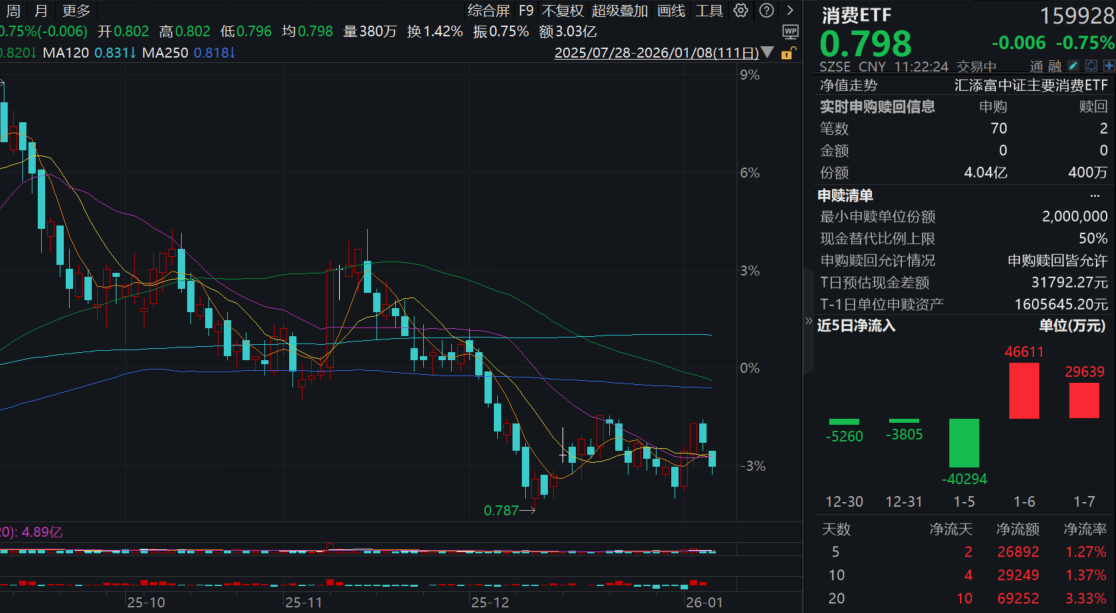
伊利董事长拟减持不超过0.98%股份!消费ETF(159928)弱势两连阴,近3日超10亿元资金布局!大消费当前估值性价比如何?
Sou Hu Cai Jing· 2026-01-08 03:52
Market Overview - The Shanghai Composite Index experienced a slight increase, while the consumer sector faced a second consecutive day of decline, with the Consumer ETF (159928) retreating by 0.75% after two days of gains [1] - The trading volume for the Consumer ETF exceeded 300 million yuan, with a net inflow of over 760 million yuan in the previous two days, and an additional net subscription of 460 million units [1] Company News - Yili Group announced that its Chairman and CEO, Pan Gang, plans to reduce his holdings by up to 62 million shares, accounting for 0.98% of the company's total shares. The proceeds will be used to repay expired stock pledge financing loans [3] - The Consumer ETF (159928) has a current scale exceeding 21.5 billion yuan, leading its peers in the same category [3] Industry Insights - Guolian Minsheng Securities highlighted that the food and beverage sector is showing signs of recovery, with expectations for CPI to turn positive by 2026, which may benefit the liquor and food segments [7] - The liquor industry is expected to see a phase of recovery in 2026, with a projected 20% decline in demand during the Spring Festival, but potential improvement by the Dragon Boat Festival [8] - The traditional consumption sector is experiencing a reversal of difficulties, with demand hitting bottom and supply chain adjustments underway [9] - The health and wellness sector is benefiting from the aging population and increased health awareness among younger consumers, with significant growth in the health supplement market [10] ETF Composition - The Consumer ETF (159928) includes major stocks with over 68.55% weight in the top ten holdings, including four leading liquor stocks accounting for 32% and major players like Yili Group (10%) and Haitian Flavoring (4%) [10]