
节能降碳

Search documents
中原证券晨会聚焦-20251015
Zhongyuan Securities· 2025-10-15 01:05
Core Insights - The report highlights the significant growth in the automotive industry, with production and sales reaching 24.33 million and 24.36 million units respectively from January to September, marking a year-on-year increase of 13.3% and 12.9% [5][8] - The report emphasizes the positive performance of the financial and liquor sectors in the A-share market, indicating a potential for investment opportunities in these areas [5][9] - The gaming sector is projected to perform well due to favorable policies and AI-driven advancements, with a notable increase in revenue and profit for gaming companies [27][29] Domestic Market Performance - The Shanghai Composite Index closed at 3,865.23, down 0.62%, while the Shenzhen Component Index closed at 12,895.11, down 2.54% [3] - The A-share market is experiencing a period of consolidation, with significant trading volumes indicating investor interest [5][9] International Market Performance - The Dow Jones closed at 30,772.79, down 0.67%, and the S&P 500 closed at 3,801.78, down 0.45%, reflecting a general downturn in major international indices [4] Industry Analysis - The basic chemical industry showed a slight increase in revenue and profit in the first half of 2025, with total revenue reaching 1.300467 trillion yuan, a year-on-year growth of 4.7% [20][21] - The gaming industry is experiencing robust growth, with a nearly 24% increase in revenue and a 75% increase in net profit year-on-year [29][27] - The photovoltaic industry is facing challenges with a significant decline in new installations, down 55.29% year-on-year in August [23][24] Investment Recommendations - The report suggests focusing on investment opportunities in the soft drink, health products, and snack sectors, highlighting specific companies for potential investment [19][27] - In the gaming sector, the report recommends monitoring companies with strong product cycles and performance metrics, as well as those leveraging AI technologies [29][27]

鲍威尔暗示再次降息,央行开展了910亿元7天期逆回购操
Dong Zheng Qi Huo· 2025-10-15 00:47
1. Report Industry Investment Ratings No relevant content provided. 2. Core Views of the Report - Powell's latest remarks suggest that the Fed needs to cut interest rates again and stop balance - sheet reduction, indicating a non - changing trend of monetary policy easing and a weakening US dollar index [14]. - On October 14, the stock market closed lower again with significant trading volume. Due to the lag and long - tail effects of the tariff war and more upcoming negotiations, the situation needs to be observed [2]. - Sino - US trade relations are an incremental positive for the bond market. If the equity market is confirmed to be in high - level consolidation, the bond market will see a slight upward trend [3]. - Steel prices continue to be weak, with iron ore price declines bringing cost - side risks. There is still inventory pressure on finished products, and caution is advised regarding steel prices [4]. - In the short term, lithium prices may show a combination of strong reality and weak expectations, with narrow - range fluctuations. It is advisable to focus on short - selling opportunities on price rallies [5]. - The IEA monthly report slightly lowers the global demand growth forecast, and concerns about oversupply have pushed oil prices down [6]. 3. Summary by Directory 3.1 Financial News and Comments 3.1.1 Macro Strategy (Foreign Exchange Futures - US Dollar Index) - Trump announced the end of the war, but the path to peace in the Middle East remains fragile. The US government shutdown has entered its 14th day, and the White House vows to continue layoffs [12][13]. - Powell suggests that the Fed may cut interest rates by 25 basis points later this month and stop balance - sheet reduction in the coming months. This indicates a non - changing trend of monetary policy easing and a weakening US dollar index [14]. - Investment advice: Expect the US dollar index to weaken [15]. 3.1.2 Macro Strategy (Stock Index Futures) - The National Development and Reform Commission issued a management method to support energy - saving and carbon - reduction renovations in key industries [16]. - The Premier of the State Council held an economic situation symposium. On October 14, the stock market closed lower with significant volume. Due to the tariff war uncertainties and more upcoming negotiations, the situation needs to be observed [17][18]. - Investment advice: Allocate evenly among stock indices [19]. 3.1.3 Macro Strategy (US Stock Index Futures) - Powell leaves the door open for interest rate cuts and may stop balance - sheet reduction in the future. Fed Governor Bowman expects two more interest rate cuts by the end of the year [20][21]. - Goldman Sachs' Q3 revenue reached a record high for the same period. Fed officials' dovish remarks support market sentiment, and the 10 - month interest rate meeting is expected to cut rates [22]. - Investment advice: Given the lingering tariff threat, pay attention to negotiation progress and look for opportunities to enter the market on dips [23]. 3.1.4 Macro Strategy (Treasury Bond Futures) - The central bank conducted 600 billion yuan of 6 - month (182 - day) outright reverse repurchase operations on October 15 and 91 billion yuan of 7 - day reverse repurchase operations on October 14 [24][25]. - Sino - US trade relations are positive for the bond market. However, factors such as the stock market adjustment rhythm, policy expectations, and the fund fee rate new regulations may affect the bond market. - Investment advice: Hold existing long positions, be cautious about adding new long positions. There will be opportunities to buy on dips after the fund fee rate new regulations are implemented [26]. 3.2 Commodity News and Comments 3.2.1 Black Metals (Coking Coal/Coke) - The coking coal market in Hebei is stable. Coal mine production is stable, and high iron - water production supports coking coal demand. However, the steel market still faces supply - demand pressure, and short - term steel prices may be under pressure [27]. - Investment advice: In the short term, the coking coal fundamentals are weak. Pay attention to future demand [28]. 3.2.2 Agricultural Products (Soybean Meal) - ANEC predicts that Brazil's soybean exports in October will be 731 million tons. The estimated soybean crushing volume of NOPA members in September is 186.34 million bushels. CONAB predicts an increase in Brazil's soybean production and exports in the 25/26 season [29][30][31]. - Investment advice: The domestic and international futures prices are expected to remain weak and volatile. Pay attention to Brazilian weather, Sino - US relations, and whether the M2601 contract can find support at 2900 [31]. 3.2.3 Agricultural Products (Cotton) - In Xinjiang, the purchase price of cottonseed in the northern region has stabilized, and the "fixed - price" sales model is becoming more popular. The global textile industry is facing challenges, and China's textile and clothing exports from January to September decreased by 0.3% year - on - year [32][33][34]. - Investment advice: In the short term, Zhengzhou cotton is expected to be weak and volatile. Pay attention to new cotton purchases, Sino - US relations, and macro - level dynamics [35]. 3.2.4 Agricultural Products (Soybean Oil/Rapeseed Oil/Palm Oil) - Indonesia is considering regulating palm oil exports to meet B50 demand, which may reduce global edible oil supply [36]. - Investment advice: The B50 policy in Indonesia will cause supply shortages. Unless the policy fails, it is advisable to buy on dips [37]. 3.2.5 Black Metals (Rebar/Hot - Rolled Coil) - The world steel demand in 2025 is expected to be about 1.75 billion tons, and it will rebound by 1.3% in 2026. In early October, the daily output of crude steel by key steel enterprises was 2.032 million tons, and the inventory increased [38][39]. - Investment advice: In the short term, adopt a weak - volatility mindset, short on price rebounds, or wait for price drops [41]. 3.2.6 Agricultural Products (Red Dates) - The price of red dates in the Guangzhou Ruyifang market is stable. The futures price of the main contract slightly declined. The Xinjiang production area is in the drying - on - the - tree period, and the demand in distribution areas is stable [42][43]. - Investment advice: Before the main trading logic becomes clear, it is advisable to wait and see. Pay attention to price negotiations and purchase progress in the production area [43]. 3.2.7 Agricultural Products (Corn Starch) - On October 14, 2025, the theoretical profits of corn starch enterprises in Heilongjiang, Jilin, Hebei, and Shandong were 12 yuan/ton, 56 yuan/ton, 69 yuan/ton, and 57 yuan/ton respectively, with an increase in losses [44]. - Investment advice: Continue to look for opportunities to narrow the spot rice - flour price spread in the long - term. If the deterioration of the real - world fundamentals is slow, the 11 - contract rice - flour price spread may still have room for upward correction [44]. 3.2.8 Black Metals (Steam Coal) - In September, brown coal imports were 46 million tons, a year - on - year decrease of 3.3%. From January to September 2025, the cumulative coal imports decreased by 11.1% year - on - year [45][46]. - Investment advice: Due to supply reduction, strong thermal power demand, and winter storage, steam coal prices are unlikely to fall significantly in the short term, and there is strong support around 700 yuan/ton [46]. 3.2.9 Black Metals (Iron Ore) - Rio Tinto's Pilbara iron ore production in Q3 2025 was 84.1 million tons. Iron ore prices may fluctuate narrowly between 100 - 110 US dollars due to insufficient finished - product demand and stable iron - water production [47]. - Investment advice: Iron ore is expected to fluctuate narrowly between 100 - 110 US dollars. Maintain a volatility - market mindset [47]. 3.2.10 Agricultural Products (Corn) - Domestic corn prices are weak. The futures price of the main contract has fallen below 2100 and then rebounded. The basis is expected to weaken, and the futures price may gradually outperform the spot price [48]. - Investment advice: Hold existing short positions and closely monitor market sentiment. Do not enter long positions too early for a rebound [49]. 3.2.11 Non - Ferrous Metals (Polysilicon) - South Korea's OCI acquires a Vietnamese silicon wafer factory. The spot price of polysilicon is stable, and the production in October is expected to increase. The prices of silicon wafers and battery cells are stable, and the component price may fluctuate [50][51][52]. - Investment advice: The progress of platform companies may cause market fluctuations. It is advisable to consider going long on the PS2512 contract when it is at a discount to the spot. Look for reverse - arbitrage opportunities between the PS2511 - PS2512 contracts at around - 2000 yuan/ton [53]. 3.2.12 Non - Ferrous Metals (Industrial Silicon) - Dongyue Silicon Materials' net profit in the first three quarters of 2025 is expected to decline significantly. The start - up of northern silicon plants is increasing, while southern plants may reduce production. There may be seasonal inventory accumulation and depletion, but the supply - demand contradiction is not obvious [54]. - Investment advice: It is more advisable to go long on industrial silicon at low prices, but be cautious about chasing up [55]. 3.2.13 Non - Ferrous Metals (Lead) - On October 13, the LME 0 - 3 lead was at a discount of 45.35 US dollars/ton. The Shanghai lead futures price fluctuated downward, and the LME lead price was weak. The domestic lead - ingot import window opened briefly, and the social inventory decreased [56]. - Investment advice: For single - side trading, look for opportunities to buy on dips and beware of delivery risks. For arbitrage, look for positive - arbitrage opportunities in the month - spread and short - term internal - external reverse - arbitrage opportunities [56]. 3.2.14 Non - Ferrous Metals (Zinc) - On October 13, the LME 0 - 3 zinc was at a premium of 201.6 US dollars/ton. The zinc - ingot export window has opened, and the LME inventory has increased. The domestic demand improvement is limited [57][58]. - Investment advice: For single - side trading, it is advisable to wait and see. For arbitrage, look for medium - term positive - arbitrage opportunities and maintain a positive - arbitrage mindset for internal - external trading, and take profits on positive - arbitrage positions in batches on dips [58]. 3.2.15 Non - Ferrous Metals (Lithium Carbonate) - In September, the combined production of power and other batteries in China increased by 35.4% year - on - year. Currently, the lithium carbonate market is in the peak - season inventory - depletion phase, but the supply is expected to remain high, and the demand may face a decline [59]. - Investment advice: In the short term, lithium prices may fluctuate narrowly. It is advisable to focus on short - selling opportunities on price rallies and look for reverse - arbitrage opportunities between the LC2511 - 2512 contracts [59]. 3.2.16 Non - Ferrous Metals (Nickel) - A fire occurred at an HPAL project in Indonesia, but it does not affect the project progress. Short - term macro factors are volatile. The nickel ore price is expected to rise in Q4, and the refined nickel may face inventory accumulation pressure in Q4 [60][61]. - Investment advice: Consider going long on nickel after macro risks stabilize [61]. 3.2.17 Energy Chemicals (Crude Oil) - The IEA monthly report slightly lowers the global demand growth forecast, and concerns about oversupply have pushed oil prices down [6]. - Investment advice: Oil prices are expected to be weak and volatile in the short term [63]. 3.2.18 Energy Chemicals (Carbon Emissions) - On October 14, the CEA closing price was 55.82 yuan/ton, a decrease of 2.33% from the previous day. The carbon market trading volume has not increased significantly, and the price is under pressure [63]. - Investment advice: The CEA price is expected to be weak and volatile in the short term [64]. 3.2.19 Energy Chemicals (Caustic Soda) - On October 14, the price of high - concentration caustic soda in Shandong decreased. The supply has increased, and the demand is average [66]. - Investment advice: Due to the weakening of the Shandong spot price and the poor performance of the macro - economy and coal market, be cautious about bottom - fishing [66]. 3.2.20 Energy Chemicals (PVC) - On October 14, the domestic PVC powder market price decreased, and the trading volume was weak. The supply pressure is increasing due to new capacity releases, and the demand is pessimistic due to anti - dumping measures [67][68]. - Investment advice: The PVC fundamentals are weak, and the inventory is accumulating. The price is expected to remain weak and volatile in the short term, with limited room for further decline [68]. 3.2.21 Energy Chemicals (Bottle Chips) - Bottle - chip factory export prices continue to decline. Polyester raw material prices have fallen, and bottle - chip factories have lowered their prices. The short - term supply - demand contradiction is not prominent, but it may accumulate in Q4 [69][71]. - Investment advice: Pay attention to the resumption of factory production and new capacity releases. The supply - demand contradiction may increase in Q4, putting pressure on processing fees [71]. 3.2.22 Energy Chemicals (Soda Ash) - On October 14, the soda ash market in Shahe was volatile. The futures price decreased due to the overall risk - appetite decline in the commodity market. The new capacity of Yuangxing's Phase II project is delayed, but the supply is high, and the demand is average [72]. - Investment advice: In the medium - term, maintain a short - selling mindset on price rallies and pay attention to new capacity releases [72]. 3.2.23 Energy Chemicals (Float Glass) - On October 14, the float glass price in the Shahe market decreased. The glass futures price continued to fall, mainly due to the delay in the coal - to - gas conversion of several coal - fired production lines in Shahe [73]. - Investment advice: The glass market shows a lack of peak - season strength. Due to supply - side uncertainties, single - side trading is risky. It is recommended to look for arbitrage opportunities by going long on glass and short on soda ash when the price spread widens [74]. 3.2.24 Energy Chemicals (Urea) - In September 2025, China's fertilizer imports were 122,400 tons, and exports were 5.438 million tons. From January to September, imports decreased by 6.7% year - on - year, and exports increased by 45.4% year - on - year [75]. - Investment advice: Due to weather - related demand delays, pay attention to whether the demand in Northeast China can be released. When the 2601 contract falls below 1600 yuan/ton, gradually close out short - selling positions. Reserve entities are advised to continue with a dispersed purchasing strategy [77].
【钛晨报】李强主持召开经济形势专家和企业家座谈会;入局造车?京东:联合宁德时代、广汽,新车将于11.11期间发布;沃尔玛与OpenAI合作,将在Chat...
Tai Mei Ti A P P· 2025-10-14 23:35
Group 1 - The meeting chaired by Premier Li Qiang highlighted the resilience and vitality of China's economy amidst challenges, with experts suggesting that favorable factors are accumulating despite existing difficulties [2][3] - Li emphasized the importance of implementing counter-cyclical adjustments and enhancing policy effectiveness to support economic recovery and high-quality development [3] - The focus will be on expanding domestic demand, strengthening the domestic circulation, and fostering a favorable industrial ecosystem to stimulate market vitality and increase quality supply [3] Group 2 - JD.com announced a collaboration with CATL and GAC to launch a new vehicle, aiming to integrate resources for enhanced safety, battery technology, and a comprehensive car ownership experience [6] - The departure of key executives from Wahaha raises concerns about leadership stability within the company, although official responses remain pending [8] - DJI is appealing a decision by the U.S. Department of Defense that classified it as a "Chinese military enterprise," asserting its commitment to preventing military misuse of its products [10][11] Group 3 - The Abu Dhabi Investment Authority signed a strategic cooperation agreement with Stellantis to develop an integrated automotive ecosystem in the UAE [11] - Ansem Semiconductor appointed its CFO as interim CEO following export control measures imposed by the Chinese Ministry of Commerce, indicating ongoing communication efforts to mitigate impacts [12] - Salesforce and OpenAI announced a partnership to enhance enterprise experiences through AI, integrating OpenAI's models with Salesforce's platform [13] Group 4 - Johnson & Johnson plans to spin off its orthopedic business to enhance strategic focus and create shareholder value, establishing a new independent company [14] - Walmart is collaborating with OpenAI to enable direct shopping through ChatGPT, expanding its digital presence and customer engagement [14] Group 5 - The Shanghai Municipal Economic and Information Commission released an action plan to enhance the scale of intelligent computing terminals, promoting the application of core components like GPUs [15] - The National Development and Reform Commission issued guidelines to support energy-saving and carbon reduction projects in key industries, including power and steel [17] - The Market Supervision Administration approved China's first national standard for livable cities, aiming to improve urban planning and management [18] Group 6 - The Shanghai Stock Exchange and China Securities Index Co. will launch the Shanghai Stock Exchange Sci-Tech Innovation Board Growth Strategy Index, reflecting the performance of innovative companies [20] - Pony.ai received approval for its Hong Kong IPO, marking a significant step in its dual listing strategy after its initial public offering in the U.S. [20] - Mindray Medical announced plans to issue H-shares and list on the Hong Kong Stock Exchange, pending shareholder and regulatory approvals [21] Group 7 - Sunac China Holdings' offshore debt restructuring plan received overwhelming support from creditors, paving the way for court approval [21] - The International Monetary Fund projected a global economic growth rate of 3.2% for 2025, highlighting the impact of rising tariffs on global uncertainty [22]


每日债市速递 | 央行将开展6000亿买断式逆回购操作
Wind万得· 2025-10-14 22:35
1. 公开市场操作 央行 公告称, 10 月 14 日以固定利率、数量招标方式开展了 910 亿元 7 天期逆回购操作,操作利率 1.40% ,投标量 910 亿元,中标量 910 亿元。 Wind 数据显示,当日无 逆回购到期 ,据此就算,单日净投放 910 亿元。 (*数据来源:Wind-央行动态PBOC) 2. 资金面 尽管当日有 8000 亿元买断式 逆回购到期 ,银行间市场周二资金面充盈局面不改,存款类机构隔夜回购利率还在 1.31% 低位附近盘旋。匿名点 击( X-repo )系统上,隔夜报价在 1.3% 仍有巨量供给;非银机构以信用债为抵押借入隔夜,报价低至 1.4% 一线。 海外方面,最新美国隔夜融资担保利率为 4.13% 。 (IMM) // 债市综述 // (*数据来源:Wind-国际货币资金情绪指数、资金综合屏) 3. 同业存单 全国和主要股份制银行一年期同业存单最新成交在 1.67% 附近,较上日小幅上行。 (*数据来源:Wind-同业存单-发行结果) 4. 银行间主要利率债收益率 | | 14 | | 28 | | 51 | | 21 | | 11 | | IUY | | 起 风风 ...

节能降碳中央预算内投资专项管理办法印发
Ren Min Ri Bao· 2025-10-14 22:12
Core Viewpoint - The National Development and Reform Commission (NDRC) has issued a management approach for central budget investment in energy conservation and carbon reduction projects, emphasizing support for regions and projects that excel in carbon peak and carbon neutrality efforts, energy savings, and circular economy development [1] Group 1: Investment Focus - The management approach prioritizes support for energy conservation and carbon reduction projects in key industries, clean coal consumption replacement projects, circular economy initiatives, low-carbon and zero-carbon demonstration projects, and foundational capacity building for carbon peak and carbon neutrality [1] - Specific measures include supporting energy conservation and carbon reduction transformations implemented on a large scale in industrial parks and clusters, as well as low-carbon transformations of coal-fired power units and coal chemical projects [1] Group 2: Regional Support - The NDRC will allocate resources based on the nature of projects, regional economic and social development levels, and the completion status of local energy conservation and carbon reduction targets, with a focus on areas that perform well in these aspects [1] - There is a particular emphasis on supporting regions designated as national ecological civilization pilot areas [1] Group 3: Infrastructure Development - The approach includes support for the construction of standardized recycling stations and green sorting centers to facilitate large-scale recycling efforts [1]
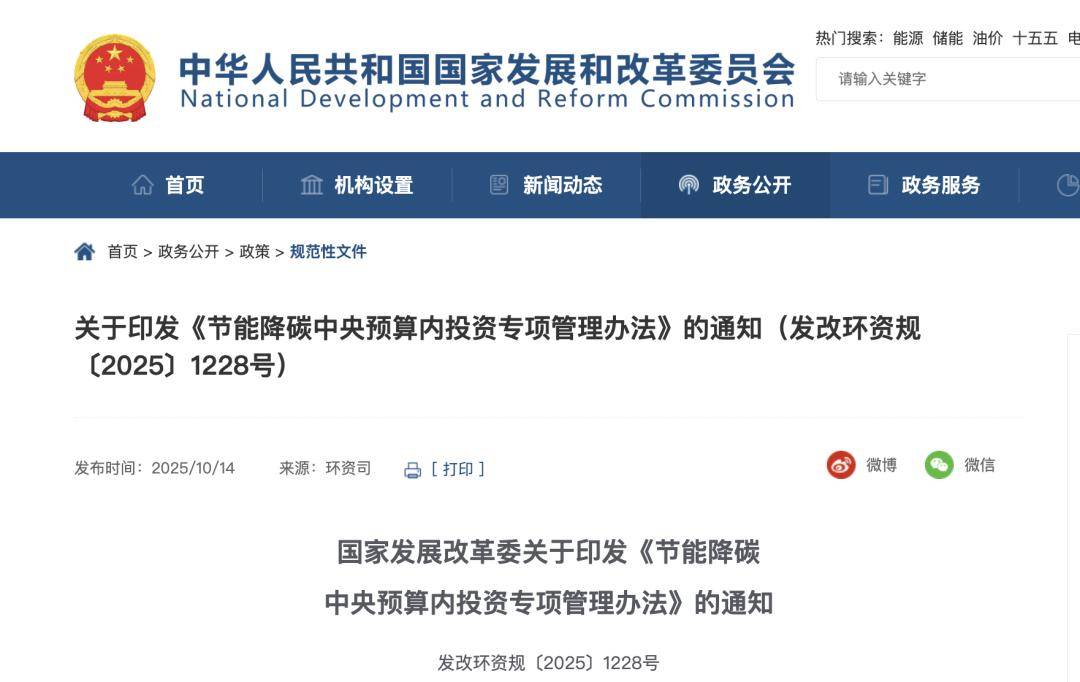
国家发改委关于印发《节能降碳中央预算内投资专项管理办法》的通知(发改环资规〔2025〕1228号)
Sou Hu Cai Jing· 2025-10-14 08:16
Core Points - The article outlines the management measures for central budget investments aimed at energy conservation and carbon reduction, emphasizing the importance of these projects in achieving carbon peak and carbon neutrality goals [3][4][30] - The National Development and Reform Commission (NDRC) will prioritize projects that align with national strategies and have significant potential for energy savings and carbon reduction [4][7] Investment Management - The NDRC will organize annual investment plans based on national priorities and the 14th Five-Year Plan, focusing on projects that contribute to carbon neutrality and energy conservation [3][4] - The investment will support both "hard investments" and "soft construction," aiming to establish long-term mechanisms for green and low-carbon development [4][5] Support Scope and Standards - The investment will target key industries such as electricity, steel, non-ferrous metals, building materials, petrochemicals, and machinery for energy-saving transformations [6][7] - Specific projects include clean replacement of coal consumption, circular economy initiatives, low-carbon demonstration projects, and foundational capacity building for carbon peak and neutrality [5][6][7] Application and Approval Process - Provincial development and reform departments are responsible for project application and must ensure that projects meet the specified criteria and are included in the national major construction project database [8][9] - Applications must include detailed project information, including economic indicators, expected benefits, and compliance with national standards [10][11] Performance Monitoring and Evaluation - The NDRC will conduct performance evaluations of funded projects, focusing on energy-saving and carbon reduction outcomes, and will adjust funding based on project performance [16][19][23] - Projects must adhere to strict management regulations, including independent accounting and dedicated use of funds [20][22] Compliance and Accountability - There are strict penalties for projects that fail to meet performance targets or engage in fraudulent activities, including potential suspension of funding and legal consequences [24][25][28] - Regular audits and oversight will be conducted to ensure compliance with investment regulations and project execution standards [27][29]
A股冲高回落,沪指半日微涨0.21%
Mei Ri Jing Ji Xin Wen· 2025-10-14 04:49
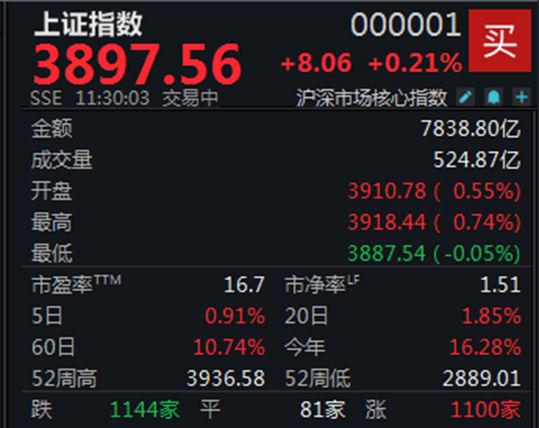
Market Overview - The market opened higher but experienced a pullback, with the ChiNext Index leading the decline. As of the morning close, the Shanghai Composite Index rose by 0.21% to 3897.56 points, while the Shenzhen Component fell by 1.02% and the ChiNext Index dropped by 2.24% [1] - The total trading volume in A-shares reached 1.68 trillion yuan [1] Sector Performance - The insurance sector showed significant strength, with New China Life Insurance's better-than-expected earnings forecast leading to a rise of over 6%. China Life and China Pacific Insurance also increased by more than 3% [3][4] - The superhard materials concept saw a substantial rebound, with companies like Strength Diamond and Huifeng Diamond rising over 10% [3] - Banking stocks stabilized, with Chongqing Bank increasing by over 5% and Jiangsu Bank and China Merchants Bank rising by more than 3% [3] Policy and Industry Developments - The opening of the Global Digital Trade Center in Yiwu marks a significant upgrade in the market, transitioning from traditional trade to a digital trade ecosystem. The project, initiated in 2022, covers an area of 1.25 million square meters and focuses on upgrading key elements of trade [3] - The National Development and Reform Commission issued a management method for energy-saving and carbon reduction projects, supporting key industries such as electricity, steel, and chemicals in their energy-saving transformations [3] Company Insights - New China Life Insurance reported rapid growth in NBV and premiums, with profits and ROE reaching historical highs. The company is expected to maintain its current growth rate in NBV due to various contributing factors [7] - China Life Insurance has a clear dividend policy, showing a strong willingness to maintain stable dividend growth, combining dividend certainty with investment performance flexibility [8] - China Pacific Insurance is advancing its "Long航" transformation, focusing on balanced business development and stable value growth [9] - Ping An Insurance is implementing a dual strategy of "comprehensive finance + medical care and elderly care," enhancing its core competitiveness through differentiated services [9]



国家发改委发布通知!
中国能源报· 2025-10-14 03:08
Core Viewpoint - The article discusses the implementation of the "Central Budget Investment Management Measures for Energy Conservation and Carbon Reduction," which aims to support key industries in energy conservation and carbon reduction projects, focusing on sectors such as electricity, steel, non-ferrous metals, building materials, petrochemicals, chemicals, and machinery [1][3][4]. Group 1: Investment Focus Areas - The measures support energy conservation and carbon reduction projects in key industries, including electricity, steel, non-ferrous metals, building materials, petrochemicals, chemicals, and machinery [10][11]. - Projects for clean replacement of coal consumption are supported, including low-carbon transformation of coal power units and coal chemical projects, as well as clean energy alternatives for coal-fired boilers in various industries [10][11]. - The initiative promotes circular economy projects, including the construction and transformation of resource recycling bases and the utilization of agricultural and forestry waste [11][12]. Group 2: Support Standards and Funding - The support ratio for energy conservation and carbon reduction projects in key industries, clean coal consumption replacement projects, and circular economy projects is set at 20% of the approved total investment [12]. - For local government investment projects focused on carbon peak and carbon neutrality capacity building, the support ratios vary by region, with eastern, central, western, and northeastern regions receiving 60%, 70%, 80%, and 80% respectively [12]. Group 3: Project Application and Management - Provincial development and reform departments are responsible for project application and must establish a dynamic project reserve mechanism to ensure quality and compliance with national standards [14][15]. - The application for investment funds must include detailed project information, including basic conditions, construction scale, total investment, and expected economic and social benefits [16][17]. - Projects must adhere to strict management and reporting requirements, including performance evaluation and compliance with national laws and regulations [18][19].
国家发改委:支持园区循环化改造、国家“城市矿产”示范基地和资源循环利用基地等建设和改造
Zhong Guo Neng Yuan Wang· 2025-10-14 02:38
Core Points - The National Development and Reform Commission (NDRC) has issued the "Special Management Measures for Central Budget Investment in Energy Conservation and Carbon Reduction" [1] - The measures support the construction and renovation of park circular economy transformation, national "urban mining" demonstration bases, and resource recycling bases [1] Group 1 - The measures promote the establishment of standardized recycling stations and green sorting centers [1] - Support is provided for the recycling and comprehensive utilization of renewable resources and bulk solid waste, as well as the remanufacturing of retired equipment [1] - The measures encourage the resource utilization and energy utilization of agricultural and forestry by-products [1] Group 2 - The production and application promotion of biodegradable plastics and recyclable express packaging products are supported [1] - The construction of infrastructure and the production application promotion of bamboo substitutes for plastics are also encouraged [1]
开源证券-建筑材料行业周报:政策继续推动行业供给转型,积极布局建材机会-251012
Xin Lang Cai Jing· 2025-10-12 14:11
Core Viewpoint - The Ministry of Housing and Urban-Rural Development is pushing for a transformation in the construction industry towards industrialization, digitalization, and greening, aiming for high-quality development and sustainability in "Chinese construction" [1] Industry Policy and Trends - The reform focuses on promoting prefabricated buildings, accelerating the application of construction robots, and widely promoting green building materials and practices [1] - The goal is to enhance the quality, efficiency, and sustainability of the construction industry, creating new growth opportunities in green materials and smart construction sectors [1] Investment Recommendations - Recommended companies in the consumer building materials sector include: - Sanke Tree (channel penetration, retail expansion) - Dongfang Yuhong (waterproof leader, optimized operational structure) - Weixing New Materials (high-quality operations, significant retail business) - Jianlang Hardware [1] - Beneficiary companies include: - Beixin Building Materials (gypsum board leader, diversified expansion in coatings and waterproof sectors) [1] - Cement sector beneficiaries include: - Conch Cement, Huaxin Cement, and Shangfeng Cement, as the industry aims to control cement clinker capacity and improve energy efficiency [1] Market Performance - The building materials index rose by 2.66% in the week of October 6-10, 2025, outperforming the CSI 300 index by 3.18 percentage points [2] - Over the past year, the building materials index increased by 21.26%, surpassing the CSI 300 index by 4.71 percentage points [2] Price Trends - As of October 10, 2025, the average price of P.O42.5 bulk cement was 287.21 RMB/ton, down 0.26% month-on-month [3] - The average price of float glass was 1301.65 RMB/ton, with a slight increase of 0.72% [3] - Prices for various fiberglass products ranged from 3400 to 6500 RMB/ton, depending on the type [4] Raw Material Prices - As of October 10, 2025, crude oil prices were 65.05 USD/barrel, down 3.59% week-on-week [4] - Asphalt prices remained stable at 4570 RMB/ton, while acrylic acid and titanium dioxide prices saw declines [4]