
行业自律

Search documents
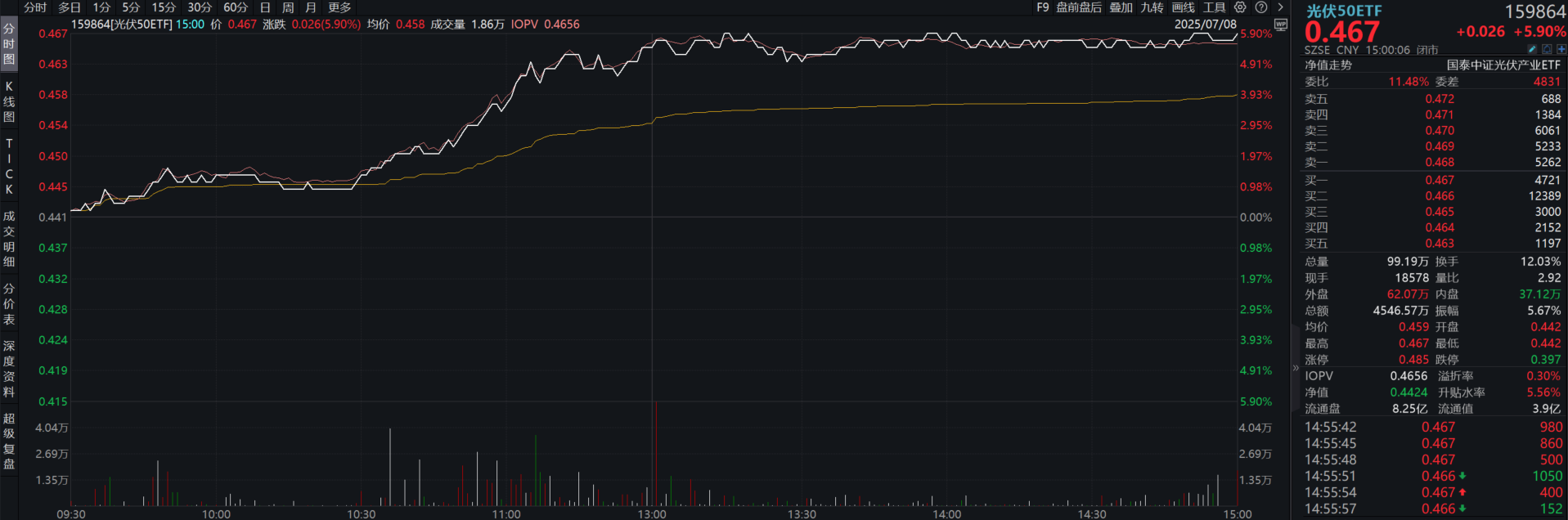
光伏50ETF大涨5.9%点评
Mei Ri Jing Ji Xin Wen· 2025-07-08 12:26
Core Viewpoint - The A-share market has shown a collective increase, with significant gains in the photovoltaic sector driven by a renewed "anti-involution" trend aimed at promoting healthy industry development [1][3]. Group 1: Market Performance - The three major A-share indices rose collectively, with the Shanghai Composite Index up by 0.7%, the Shenzhen Component Index up by 1.47%, and the ChiNext Index up by 2.39% [1]. - The total market turnover reached 1.47 trillion yuan, indicating strong trading activity [1]. - The photovoltaic 50 ETF (159864) saw a notable increase of 5.9% [1]. Group 2: Industry Dynamics - The photovoltaic industry has experienced two "anti-involution" trends, with the first occurring in late 2023 and the second currently underway, aimed at curbing unhealthy competition [3][4]. - The Chinese Photovoltaic Industry Association has initiated self-regulation measures, including the publication of fair component costs and the signing of self-discipline agreements among companies [3][4]. - Recent government policies have emphasized the need to eliminate low-price disorderly competition and promote the exit of backward production capacity [3][4]. Group 3: Supply and Demand Analysis - The photovoltaic industry is currently characterized by significant homogeneity, with supply far exceeding demand; existing capacity is projected to meet demand until 2030 without supply-side reforms [4]. - Operating rates across various segments of the photovoltaic industry are between 40% and 60%, with polysilicon operating rates around 40% due to high existing capacity and inventory [4]. - The prices of photovoltaic components have seen fluctuations due to installation rushes, but are expected to stabilize as demand normalizes [4][5]. Group 4: Future Outlook - The main theme for the future remains capacity clearance, particularly in the polysilicon segment, which is crucial for balancing supply and demand across the entire photovoltaic supply chain [5][6]. - The photovoltaic glass market is stable, with leading companies holding over 50% market share; proactive capacity reduction measures are anticipated to alleviate inventory pressures [5][6]. - Technological advancements, such as the development of BC batteries and the reduction of silver usage in cell production, are expected to drive down costs and improve efficiency [6].

建材ETF(159745)涨超1.0%,行业自律或支撑水泥价格修复
Mei Ri Jing Ji Xin Wen· 2025-07-08 06:00
Group 1 - The construction materials ETF (159745) has increased by over 1.0% [1] - Hunan Yunfeng Cement completed the transfer of 2500t/d cement clinker capacity on July 4, 2025 [1] - Gezhouba Cement's Xili Company won an industry award in Kazakhstan's Kyzylorda region for 2025 [1] Group 2 - The cement industry is currently facing challenges such as weak demand, overcapacity, and inventory pressure [1] - The China Cement Association has issued opinions to promote "anti-involution" and "stable growth" for high-quality development in the cement industry [1] - It is expected that cement prices will receive support and recovery, leading to improved profitability for companies [1] Group 3 - Leading companies are expected to shift from price competition to value creation through technological innovation [1] - Mergers and acquisitions will be utilized to extend the industrial chain and increase overseas expansion for further growth [1] - Enhanced industry self-discipline measures are anticipated to optimize the supply-demand structure and promote high-quality development in the industry [1] Group 4 - The construction materials ETF tracks the construction materials index, which reflects the overall performance of representative listed companies in the cement, glass, and ceramics sub-industries [1] - The index has a high degree of industry concentration and cyclical characteristics, providing a comprehensive view of market trends in the construction materials sector [1]
头部多晶硅厂部分订单报价上调
news flash· 2025-07-07 06:55
Core Insights - The price of N-type polysilicon recycled material is 36 yuan per kilogram, while the N-type polysilicon price index stands at 35.6 yuan per kilogram, and granular silicon is priced at 34 yuan per kilogram, indicating a stable market with slight fluctuations over the weekend [1] - Recently, leading polysilicon manufacturers have raised the prices of certain orders for dense/recycled materials to 37 yuan per kilogram, attributed to recent anti-involution policy guidance and industry self-discipline [1] Price Trends - The overall polysilicon prices have remained stable, with companies adjusting their cost quotes upwards last week [1] - The current market sentiment is characterized by a wait-and-see approach as it is not yet the period for signing contracts [1]
新能源及有色金属日报:政策及情绪扰动较大,多晶硅盘面触及涨停-20250703
Hua Tai Qi Huo· 2025-07-03 05:28
Report Industry Investment Rating - Industrial silicon: Interval operation is the main strategy, and upstream companies should sell hedging at high prices. Unilateral is neutral. [2][8] - Polysilicon: Unilateral is neutral. There are no suggestions for inter - period, cross - variety, spot - futures, and options operations. [8] Core Viewpoints - Industrial silicon: On July 2, 2025, the industrial silicon futures price rose significantly. Short - term supply - demand margin improved due to large factories' production cuts and a slight increase in downstream production schedules, but the high total industry inventory led to hedging pressure after the rebound. The market was affected by policy expectations, and short - term observation was recommended. [1][2] - Polysilicon: On July 2, 2025, the polysilicon futures main contract hit the daily limit. Affected by policies and industry self - discipline, leading companies uniformly raised quotes, but the supply - demand fundamentals remained weak. Policy game had a large impact, and participants needed to manage risks and follow up on policy implementation. [2][6] Market Analysis Industrial Silicon - Futures: On July 2, 2025, the main contract 2509 opened at 7,805 yuan/ton and closed at 8,210 yuan/ton, up 4.79% from the previous settlement. The closing position was 386,361 lots, and the number of warehouse receipts was 51,916 lots, a decrease of 221 lots from the previous day. [1] - Supply: The spot price of industrial silicon rose slightly. The prices of some silicon in different regions increased, while the price of 97 - silicon remained stable. [1] - Consumption: The domestic monomer enterprise's operation rate continued to increase slightly, reaching about 70%. It was expected that the DMC production schedule in July would increase by about 10,000 tons, increasing the consumption of industrial silicon. [1] Polysilicon - Futures: On July 2, 2025, the main contract 2508 hit the daily limit, opening at 33,350 yuan/ton and closing at 35,050 yuan/ton, up 6.99%. The position was 95,005 lots, and the trading volume was 411,586 lots. [2] - Spot: The spot quotes of polysilicon were raised. The N - type polysilicon price index rose by 2 yuan/kg to 36 yuan/kg, with a daily increase of 5.88%, but there was no spot transaction. [2][6] - Inventory and Production: Polysilicon inventory was 27.00, a month - on - month increase of 3.05%; silicon wafer inventory was 20.11GW, a month - on - month increase of 7.30%. The weekly polysilicon production was 23,600.00 tons, a month - on - month decrease of 3.67%; the silicon wafer production was 13.44GW, a month - on - month increase of 4.10%. [4] Silicon Wafer, Battery Chip, and Component - Silicon Wafer: The prices of domestic N - type 18Xmm, N - type 210mm, and N - type 210R silicon wafers remained unchanged. [4] - Battery Chip: The prices of various types of battery chips remained unchanged. [4] - Component: The mainstream transaction prices of various types of components remained unchanged. [5] Strategy Industrial Silicon - Unilateral: Interval operation is the main strategy, and upstream companies should sell hedging at high prices. [2] - Others: There are no suggestions for inter - period, cross - variety, spot - futures, and options operations. [2][3] Polysilicon - Unilateral: Neutral. [8] - Others: There are no suggestions for inter - period, cross - variety, spot - futures, and options operations. [8] Risk Factors Industrial Silicon - Re - production and new capacity investment in the northwest and southwest regions. - Changes in polysilicon enterprise operation rates. - Policy disturbances. - Macroeconomic and capital sentiment. - Operation conditions of organic silicon enterprises. [3] Polysilicon - Impact of industry self - discipline on upstream and downstream operation rates. - Impact of futures listing on the spot market. - Impact of capital sentiment. - Impact of policy disturbances. [8]
多家人力资源服务行业协会和机构倡议规范招聘市场秩序促进行业健康发展
news flash· 2025-07-03 04:37
Core Viewpoint - The human resources service industry is taking collective action to enhance self-regulation and create a fair and trustworthy market environment, particularly during the peak job recruitment season, to protect the rights of both job seekers and employers [1][2]. Group 1: Industry Initiatives - Multiple associations and organizations, including the Beijing Human Resources Service Industry Association and BOSS Zhipin, have issued a joint initiative to standardize recruitment market practices and combat "black intermediaries" [1][2]. - The initiative emphasizes the importance of legal operation and maintaining industry credibility, urging human resources service companies to comply with relevant laws and regulations [1][2]. Group 2: Service Quality and Market Integrity - Companies are encouraged to publish authentic and lawful job postings, avoiding discriminatory conditions and ensuring fair recruitment practices [2]. - The initiative calls for the establishment of a shared blacklist for non-compliant organizations, promoting transparency and accountability within the industry [2]. Group 3: Self-Regulation and Social Responsibility - The industry is urged to adopt self-regulatory measures, including internal audits and risk control systems, to uphold the rights of job seekers [2]. - Human resources service organizations are reminded of their role in facilitating employment and are encouraged to provide public employment services and engage in integrity recruitment campaigns [2].
A股光伏板块逆势大涨、多只股票封板,原因找到了!
2 1 Shi Ji Jing Ji Bao Dao· 2025-07-02 12:51
Group 1 - The A-share photovoltaic sector experienced a significant surge on July 2, with nine stocks hitting the daily limit, including Shuangliang Energy, Yijing Photovoltaic, and others, while Daqo New Energy rose over 15% [1] - The surge in stock prices is primarily attributed to the recent signals from the central government regarding the regulation of disorderly competition in the industry, particularly in the silicon material and photovoltaic auxiliary materials segments [1][2] - The Central Financial Committee emphasized the need to address low-price disorderly competition and promote the exit of backward production capacity, which has led to increased market expectations for substantial policy measures [2][3] Group 2 - The analysis team from CMB International noted that the central government's heightened attention to the challenges faced by the photovoltaic industry indicates a commitment to resolving these issues, suggesting that targeted policies may soon be introduced [3] - Reports indicate that leading photovoltaic glass manufacturers plan to collectively reduce production by 30% starting in July, which is expected to lower the output to approximately 45 GW [3] - The price of polysilicon has shown a slight increase, with the average transaction price for N-type polysilicon rising to 34,700-38,000 CNY per ton, reflecting improved market expectations due to government measures [5] Group 3 - The photovoltaic industry is currently in a deep integration phase, with less competitive production capacity expected to gradually exit the market, leading to an optimized production structure and improved supply-demand dynamics [6] - Companies are exploring various strategies to break through the current downturn, including new technologies, products, and leveraging overseas channels, although results will require time to validate [6]
又一轮价格战的喧嚣散去,被忽视的问题是什么?
晚点Auto· 2025-06-30 14:20
Core Viewpoint - The article discusses the ongoing price war in the Chinese automotive market, emphasizing that while price competition is a natural market behavior, the industry lacks clear rules and regulations to govern such competition [4][11][14]. Price War Dynamics - Tesla's announcement of price cuts for Model 3 and Model Y triggered a price war, with BYD and other domestic brands quickly following suit [2][3]. - The first five months of 2024 saw a significant increase in vehicle production and sales, yet the industry's profitability continued to decline, leading companies to prioritize market share over profits [4][3]. Market Conditions - The automotive market has shifted to a buyer's market, where consumers have more choices and are highly price-sensitive, prompting companies to lower prices to clear inventory [7][8]. - The concept of "orderly price wars" is rejected, with the focus instead on the need for established rules to prevent excessive competition and ensure fair practices [9][11]. Regulatory and Industry Response - Industry leaders call for the establishment of clear regulations to govern pricing and competition, emphasizing the importance of legal frameworks such as the Price Law and Anti-Monopoly Law [11][12]. - The role of industry organizations is highlighted as crucial in creating fair contracts and facilitating self-regulation among members [12][14]. Dealer Dynamics - The relationship between manufacturers and dealers remains strained, with dealers facing pressure from manufacturers to maintain inventory while dealing with fluctuating market prices [15][16]. - Regional dealers have shown better adaptability compared to national groups, as they can pivot more quickly to new market demands, particularly in the growing electric vehicle sector [16][18]. Transition to New Energy Vehicles - The transition to new energy vehicles is deemed essential for traditional dealers, with a significant market shift already underway, as evidenced by a penetration rate exceeding 50% for new energy vehicles [18].



北京市银行业协会:多家银行已完成内部系统调整与定价重检,新发放汽车贷款利率较此前普遍呈现下降趋势
news flash· 2025-06-27 10:59
Core Viewpoint - The implementation of the "Self-Regulatory Agreement for Automotive Consumer Finance Business in Beijing" aims to lower financing costs for consumers and stimulate the automotive consumption market, aligning with national policies to promote consumption [1][2]. Group 1: Financial Services and Consumer Impact - The banking sector in Beijing is actively responding to the self-regulatory agreement by reducing interest rates on personal auto loans and credit card installment products, thereby alleviating the financial burden on consumers [1][2]. - This initiative is expected to enhance consumer confidence and purchasing experience by providing transparent financial services and addressing concerns about predatory lending practices [1][2]. Group 2: Industry Direction and Future Outlook - The self-regulatory action signifies a shift from price competition to service and efficiency competition within the automotive consumer finance sector, promoting a healthier market environment [1][2]. - Banks are adjusting their pricing strategies and improving risk management and operational efficiency to pass on cost savings to consumers, reinforcing the industry's commitment to serving the real economy and enhancing consumer welfare [2].
“限产保价”预期再起?光伏50ETF(159864)涨近2%
Mei Ri Jing Ji Xin Wen· 2025-06-20 02:14
Group 1 - The core theme of the recent meeting held by the China Photovoltaic Industry Association is "production limits to maintain prices," with expectations of a 10%-15% reduction in operating rates in the third quarter [1] - The photovoltaic 50 ETF (159864) has seen an increase of nearly 2% due to favorable catalysts [2] - Dongxing Securities indicates that the rush for photovoltaic installations will lead to a recovery in Q1 2025 performance, although the entire industry is still in a loss phase, and capacity clearance is ongoing [2] Group 2 - Industry self-discipline and technological innovation are deemed crucial for breaking the current deadlock, with leading companies potentially establishing a capacity planning coordination mechanism to avoid vicious competition [2] - New battery technology is improving mass production efficiency, and breakthroughs in silver-free technology are accelerating the upgrade of production lines [2] - With the improvement of self-discipline mechanisms and technological advancements, the photovoltaic industry is expected to accelerate the elimination of outdated capacity and optimize the supply structure [2]
治理汽车业“长账期”问题可探索强化立法
2 1 Shi Ji Jing Ji Bao Dao· 2025-06-11 18:47
Core Viewpoint - The automotive industry in China is collectively committing to standardize supplier payment terms to within 60 days, in response to the "anti-involution" policy and the upcoming "Regulations on Payment of Funds to Small and Medium-sized Enterprises" effective June 1, 2025, aimed at improving the business environment and addressing payment delays to suppliers [1][4]. Group 1: Industry Context - The rapid development of the new energy vehicle sector has led to price wars that have negatively impacted supplier margins, with net profit margins for domestic parts suppliers dropping from 9% in 2015 to 3.8% in Q1 2025 [2]. - The average accounts payable turnover days for 16 listed Chinese car companies is estimated to be 182 days in 2024, significantly longer than the 60 days maintained by 14 international car manufacturers [2][3]. Group 2: Financial Implications - The profit margin for the Chinese automotive industry is projected to decline from 4.3% in 2024 to 3.9% in Q1 2025, which is below the average for the manufacturing sector, indicating a risk of increased losses for more vulnerable companies [3]. - Companies with high accounts payable ratios and extended payment terms face the dilemma of either participating in price competition, risking further profit loss, or abstaining, which could affect sales and cash flow [3]. Group 3: Regulatory and Structural Considerations - The need for stronger legislation to address delayed payments and protect supplier profits is emphasized, alongside the establishment of a reliable execution mechanism to enforce these regulations [4]. - The current commitments from some companies regarding payment terms lack sufficient binding power, as they may be contingent on further price reductions or cost-shifting to suppliers [3].