地缘风险

Search documents
突破整数关口后,金银去向何方?
Zhong Xin Qi Huo· 2026-01-26 08:51
Group 1: Report's Investment Rating for the Industry - No relevant content provided Group 2: Core Viewpoints of the Report - On January 26, gold and silver prices rose significantly, with Shanghai gold up 3.67% and Shanghai silver up 12.78%. London gold exceeded $5100/oz and London silver approached $110/oz. Geopolitical risks and the implied US dollar credit crisis are the driving factors [4]. - The uncertainty of the Fed chair nomination and independence risk are more important than the delayed rate - cut expectation. The market focuses on the Fed's independence as a new chair nomination nears [5]. - Short - term over - heating risk of gold and silver is increasing, and investors should pay attention to trading rhythm. The long - term upward trend is expected to continue, and the annual target range is raised [6]. Group 3: Summary by Related Content 1. Price Movement and Driving Factors - On January 26, gold and silver prices soared. Geopolitical conflicts in January, such as those between the US and South America, Europe, and Iran, led to a US dollar credit crisis, driving up precious metals. The US's actions around Greenland also affected the market [4]. 2. Fed - Related Factors - US economic data is resilient, and the expected Fed rate - cut is postponed to June. But the market focuses on the Fed's independence risk as a new chair nomination nears. Reed is the most likely nominee and his dovish remarks support long - term rate - cut expectations [5]. 3. Market Outlook and Target Range - Short - term over - heating risk of gold and silver is rising. If geopolitical issues ease or the Fed makes unexpectedly hawkish statements, short - term market adjustments may occur. The annual target range for spot gold is raised to $5900 - 6000/oz, and for spot silver to $120 - 150/oz [6]
机构还在看涨黄金 金价创历史新高
Ge Long Hui· 2026-01-26 08:44
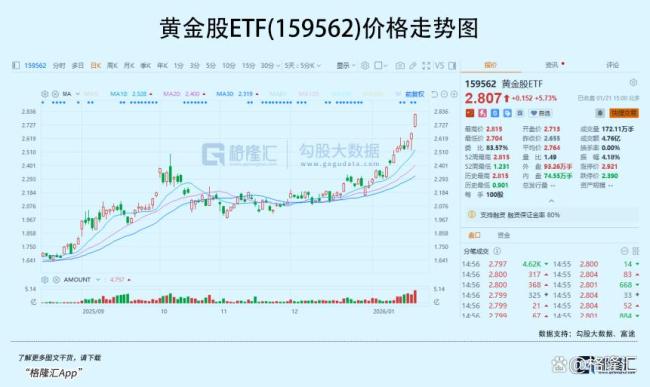
Group 1 - The international gold market has experienced an unexpected strong rally since the beginning of 2026, with gold prices reaching a historical high of $4891.1 per ounce by January 21, marking a cumulative increase of 12.7% within 20 days [1] - Domestic gold futures also surged, with the main contract price exceeding 1100 yuan per gram, reflecting a significant increase of 4.61% [1] - Gold stocks have seen a wave of limit-up trading, with multiple companies such as Zhaojin Gold and Chifeng Jilong Gold experiencing substantial gains, and the gold stock ETF (159562) rising by 5.73% on the day and 25.82% over the past 13 trading days [3] Group 2 - The recent surge in gold prices is attributed to multiple factors, including geopolitical risks, monetary policy, central bank allocations, and the reconstruction of dollar credit, with heightened geopolitical tensions being a primary driver for increased safe-haven investments [5] - The escalation of geopolitical conflicts, such as the U.S. imposing tariffs on several countries and the subsequent military exercises led by Denmark, has intensified trade tensions and contributed to the influx of capital into gold [5]

沪金飙涨近4%新高之下暗藏疲态
Jin Tou Wang· 2026-01-26 07:00
Core Viewpoint - Gold prices are experiencing significant fluctuations, with a recent surge attributed to geopolitical tensions and a weakening dollar, but signs of potential fatigue in the market are emerging [3]. Group 1: Current Market Conditions - As of January 26, gold futures are trading around 1146.74, with a current price of 1144.12 yuan per gram, reflecting a 3.74% increase, and a high of 1147.00 yuan per gram [1]. - The recent price movement shows a strong bullish trend, with gold prices having doubled over the past two years and an increase of 15% this year [3]. Group 2: Influencing Factors - The geopolitical situation in the Middle East is a key driver, with the U.S. deploying the "Lincoln" aircraft carrier strike group and increasing military presence, which has heightened market uncertainty [3]. - The recent surge in gold prices, including an 8.5% increase last week, is linked to a weakening dollar, as indicated by a 1.6% drop in the Bloomberg Dollar Index [3]. Group 3: Technical Analysis - Technical indicators suggest that gold is showing signs of fatigue, with patterns resembling past market tops, including rapid increases followed by sharp declines [3]. - The market is advised to be cautious, with current buying opportunities considered limited, and a suggested entry point around 1120 for potential upward movement towards 1200 [4].
海外宏观与交易复盘:特朗普再度“TACO”,金银续创新高
Soochow Securities· 2026-01-26 05:48
Market Overview - The overseas market from January 19-25 was dominated by Trump's tariff threats regarding Greenland and Japan's fiscal issues, leading to significant gains in precious metals and commodities, while global stocks, bonds, and the dollar index performed poorly[1] - London spot silver surged by 14.5%, breaking the $100 mark to reach $103.2 per ounce, while gold prices increased by 8.5%, both hitting new highs[3] Economic Indicators - The U.S. economic data remained robust, with the economic surprise index for Europe turning positive for the first time in nearly a year, indicating a recovery[1][10] - The U.S. economic surprise index fell slightly from 0.148 to 0.129, while the European index rose from -0.015 to 0.04, reflecting improved economic momentum in Europe[9][10] Federal Reserve Outlook - The market is fully pricing in no interest rate cuts for January, with the focus on Powell's assessment of the U.S. economy and future rate paths during the upcoming FOMC meeting on January 29[1][17] - Recent hawkish signals from Federal Reserve officials suggest caution regarding further rate cuts, with market expectations for a potential new chairperson rising significantly[19][23] Political Developments - Trump's renewed tariff threats against Canada could impose a 100% tariff on all goods if Canada continues trade agreements with China, adding to geopolitical tensions[20] - The Supreme Court's oral arguments in the Trump v. Cook case suggest a likely ruling against Trump's dismissal of the Fed board member, with a predicted 7-2 vote[25] Risk Factors - Potential risks include unexpected outcomes from Trump's tariff cases, excessive rate cuts by the Fed leading to inflation spikes, and prolonged high rates causing liquidity crises in the financial system[29]
有色金属基础周报:海外地缘风险快速升温,有色金属走势整体高位续升-20260126
Chang Jiang Qi Huo· 2026-01-26 05:19
1. Report Industry Investment Rating No relevant content provided. 2. Core Viewpoints of the Report - The overall trend of non - ferrous metals is rising at a high level, with overseas geopolitical risks rapidly increasing. The macro - environment has both supporting and restrictive factors for non - ferrous metals prices. Different metals have different trends and influencing factors, with some showing high - level shocks, some adjusting, and some continuing to rise [1][2][3]. 3. Summary by Relevant Catalogs 3.1 Main Variety Viewpoint Summaries Copper - **Trend Status**: High - level shock in the range of 98,500 - 105,000 [2]. - **Market Viewpoint**: Supported by strong macro - factors such as China's GDP growth in 2025, loose monetary policy in 2026, and a 40% increase in power grid investment during the "15th Five - Year Plan", as well as overseas geopolitical risks, a weak US dollar, and strong precious metals. However, the fundamentals are weak, with falling ore processing fees, increasing smelting losses, and low consumption due to the off - season and high copper prices. Social inventory has increased to 335,200 tons, and spot transactions are light. It is expected that copper prices will fluctuate at a high level with limited upside potential. It is recommended to wait and see and pay attention to inventory changes and policy implementation progress [2]. Aluminum - **Trend Status**: High - level adjustment [2]. - **Market Viewpoint**: Alumina production capacity has increased, and inventory has also risen. The production capacity of electrolytic aluminum remains stable. New production capacity is being put into operation. The downstream processing industry's start - up rate has increased slightly, but overall demand is entering the off - season. Aluminum ingot inventory continues to accumulate, but the accumulation speed has slowed down. Aluminum prices are affected by capital sentiment and are expected to remain in high - level shock in the short term [2]. Zinc - **Trend Status**: Stabilize and rebound, high - level shock [2]. - **Market Viewpoint**: Zinc concentrate processing fees are at a low level, and production may shrink in January due to some smelter maintenance. Consumption has entered the traditional off - season, and downstream acceptance of high - priced zinc ingots is low. The social inventory of zinc ingots in seven regions in China is 119,000 tons, remaining basically unchanged from last week. It is expected that Shanghai zinc will maintain high - level shock [2]. Lead - **Trend Status**: Range shock between 16,800 - 17,200 [2]. - **Market Viewpoint**: LME and COMEX lead inventories have increased, while Shanghai Futures Exchange lead inventories have decreased. Lead prices have fallen, and downstream transactions have weakened, putting pressure on futures prices. In the long term, lead prices may show a shock - consolidation trend, and it is recommended to operate within the range [2]. Nickel - **Trend Status**: High - level shock [3]. - **Market Viewpoint**: Affected by news from Indonesia, nickel prices are strong, but the spot inventory is accumulating, and the fundamentals are weak. It is expected that the upward momentum of nickel prices is limited. It is recommended to wait and see for both nickel and stainless steel [3]. Tin - **Trend Status**: Return to an upward trend [3]. - **Market Viewpoint**: Supply remains tight, and prices are strongly fluctuating. The semiconductor industry is expected to recover, and downstream demand is in rigid need. Overseas raw material supply disturbances need to be noted. It is expected that tin prices will continue to rise, and it is recommended to hold long positions and pay attention to supply resumption and downstream demand recovery [3]. Industrial Silicon - **Trend Status**: Wide - range shock [3]. - **Market Viewpoint**: Production and inventory of industrial silicon have changed. The production of polysilicon has decreased, and the photovoltaic industry has mixed trends. If a large - scale industrial silicon producer in Xinjiang cuts production by half, it will drive up industrial silicon prices. Polysilicon is expected to fluctuate at the current position [3]. Carbonate Lithium - **Trend Status**: Return to an upward trend [3]. - **Market Viewpoint**: Affected by mining permit disturbances in Yichun, supply - side risks exist. Downstream demand for exports is strong, and inventory is decreasing. It is expected that prices will continue to show a strong shock [3]. 3.2 Macroeconomic Data China - In 2025, China's GDP increased by 5% year - on - year, with a 4.5% increase in the fourth quarter. The real estate development investment decreased by 17.2% year - on - year, and the fixed - asset investment decreased by 3.8% year - on - year. In December 2025, the added value of industrial enterprises above designated size increased by 5.2% year - on - year, and the LPR remained unchanged in January 2026 [13][15][16][18]. USA - The average weekly new employment in the US ADP was 8,000, lower than the previous value of 11,750. The PCE price index in November 2025 met expectations, and the real GDP quarterly growth rate in the third quarter was revised up to 4.4%, the fastest in two years [19][21][22]. 3.3 Next Week's Macroeconomic Data Calendar - A series of economic data from the US and the Eurozone are scheduled to be released next week, including the Chicago Fed National Activity Index, the Dallas Fed Business Activity Index, consumer confidence indexes, and inflation - related data [24].
刚刚!A股,突变!两大变量,集中来袭!
券商中国· 2026-01-26 03:11
Market Overview - A-shares experienced a sudden shift in style and risk preference, with major indices turning from gains to losses, particularly the ChiNext index which fell nearly 1% [1] - The number of rising stocks decreased to less than 2000, indicating a market trend towards defense [1] Risk Preference Changes - Two significant variables affecting risk appetite emerged: escalating geopolitical risks and a sharp decline in the US dollar index, leading to a surge in gold and silver futures [1][4] - Popular stocks collectively plummeted, with satellite ETFs dropping nearly 5%, signaling a retreat from speculative trading [1] Sector Performance - A notable increase in the number of declining stocks was observed, particularly in sectors like semiconductor chips, commercial aerospace, robotics, and AI applications, with nearly 4000 stocks declining and 17 hitting the daily limit down [3] - Precious metals surged, with silver futures reaching a limit up with a 17% increase, and gold prices exceeding $5088.39 per ounce, marking a rise of over 2% [3] Capital Flow Dynamics - Recent data indicated a significant outflow of approximately 450 billion yuan from stock ETFs over the past two weeks, with broad-based ETFs seeing outflows exceeding 570 billion yuan [6] - In contrast, thematic ETFs related to TMT and cyclical resources saw inflows of around 50 billion yuan and 40 billion yuan respectively, highlighting structural differentiation in capital flows [6] Market Sentiment and Future Outlook - The market is experiencing increased volatility, with external factors weakening the narrative logic in capital markets and stock valuations appearing less attractive [6] - Analysts suggest that sectors at relatively low valuations with strong narratives may see recovery, particularly in consumer chains and real estate, as the market anticipates upcoming events [6][7] - The current market environment is characterized by a slow bull trend, with a focus on "technology + resource" as the dual mainline for investment strategies [7]

原油成品油早报-20260126
Yong An Qi Huo· 2026-01-26 03:10
Group 1: Report Industry Investment Rating - No relevant content provided Group 2: Core Viewpoints of the Report - This week, crude oil rebounded, and geopolitical risks escalated. Over the weekend, the unstable situation in Iran persisted. Trump received a briefing on military strike plans against Iran but had not made a final decision on authorizing the strike. Israel is highly vigilant about the possibility of US intervention in Iran, and Iran has warned that if attacked, it will strike back against Israel and the US. The Iranian president has shown a tendency towards reconciliation by expressing willingness to meet with protest groups. If the US launches a strike against Iran, oil prices are at risk of surging due to geopolitical risks. From a fundamental perspective, oil inventories increased this week, the Dubai monthly spread strengthened slightly after opening low, gasoline cracking strengthened while diesel cracking fluctuated, and European refinery profits weakened. Attention should be paid to the geopolitical situation, and the price center in the first quarter is expected to be high and volatile [4]. Group 3: Summary by Relevant Catalogs 1. Oil Price Data - From January 19 - 23, 2026, WTI increased by 1.71, BRENT by 1.82, and DUBAI by 0.27. The BRENT 1 - 2 month spread increased by 0.09, and the WTI - BRENT spread decreased by 0.11. The DUBAI - BRT (EFS) increased by 0.35 [3]. - During the same period, SC decreased by 4.50, OMAN increased by 1.27, and the SC - BRT decreased by 2.38. Domestic gasoline remained unchanged, and the domestic gasoline - BRT decreased by 102 [3]. - Japan naphtha - BRT decreased by 15.13, the上期所FU main contract increased by 51, and the上期所FU - BRT decreased by 5.60. The上期所BU decreased by 6, and the上期所BU - BRT decreased by 13.64. HH natural gas decreased by 1.03 [3]. 2. Daily News - The CPC Black Sea terminal, which handles about 90% of Kazakhstan's crude oil exports, has restored its transport capacity as one of its offshore mooring facilities has been put back into use. However, the 2nd terminal remains out of service, and no update on its resumption has been provided [3]. - Tensions between the US and Iran have escalated. The US is sending additional troops to the Middle East, and Iran's military has stated that it is ready to respond to any potential attacks [4]. - There are signs that Israel is still seeking to attack Iran, according to the Turkish Foreign Minister [4]. 3. Inventory - In the week ending January 16, US crude oil exports decreased by 618,000 barrels per day to 3.688 million barrels per day [4]. - US domestic crude oil production decreased by 21,000 barrels to 13.732 million barrels per day [4]. - Commercial crude oil inventories (excluding strategic reserves) increased by 3.602 million barrels to 426 million barrels, a 0.85% increase [4]. - The four - week average supply of US crude oil products was 19.946 million barrels per day, a 1.5% increase compared to the same period last year [4]. - US Strategic Petroleum Reserve (SPR) inventories increased by 806,000 barrels to 414.5 million barrels, a 0.19% increase [4]. - US commercial crude oil imports (excluding strategic reserves) were 6.447 million barrels per day, a decrease of 645,000 barrels per day from the previous week [4].
品种晨会纪要:宝城期货原油早报-2026-01-26-20260126
Bao Cheng Qi Huo· 2026-01-26 02:38
Report Summary Investment Rating - No investment rating provided in the report Core View - The crude oil market is expected to operate in a moderately strong manner. In the short - term (within a week), it will be volatile; in the medium - term (two weeks to a month), it will also show a volatile trend, and it will be moderately strong on the day [1][5] Summary of Related Content - **Price Movement and Judgment Criteria** - For varieties with night trading, the starting price is the night trading closing price; for those without night trading, it's yesterday's closing price, and the end price is the day - trading closing price to calculate the price change [2] - A decline greater than 1% is considered weak, a decline of 0 - 1% is moderately weak, a rise of 0 - 1% is moderately strong, and a rise greater than 1% is strong [3] - The moderately strong/moderately weak judgment only applies to the intraday view, not to short - term and medium - term views [4] - **Driving Logic of Crude Oil Price** - Recently, US President Trump has frequently sent out geopolitical risk signals, with Greenland and Canada potentially being the next targets for the US to seize and attack. The arrival of a US aircraft carrier in the Middle East and Iran's strong statements may lead to a new round of military conflicts between the US and Iran, threatening Middle East crude oil exports. Geopolitical risks have overshadowed the weak supply - demand fundamentals of the oil market, boosting the sharp rise of domestic and foreign crude oil futures prices on the night of last Friday. It is expected that domestic crude oil futures will maintain a moderately strong and volatile trend on Monday [5]
【中金外汇 · 周报】地缘风险如何影响美元汇率?
Xin Lang Cai Jing· 2026-01-26 00:26
Core Viewpoint - The geopolitical risks have led to a significant decline in the US market, experiencing a "triple kill" in stocks, bonds, and currencies, primarily triggered by Trump's tariff threats against several European countries regarding Greenland [1][2][3]. Group 1: Market Reactions - On January 20, the S&P 500, Nasdaq, and Dow Jones indices fell by 2.1%, 2.4%, and 1.8% respectively, while the 10-year Treasury yield rose by approximately 7 basis points, and the dollar index weakened by 0.8% [1]. - The divergence between interest rates and exchange rates indicates that the rise in rates reflects a risk premium rather than economic fundamentals [1][2]. Group 2: Geopolitical Context - Trump's longstanding interest in acquiring Greenland has resurfaced, with threats of imposing tariffs on goods from Denmark and other European nations, escalating tensions [2][3]. - The situation peaked on January 17, when Trump announced a 10% tariff on goods from several European countries, set to increase to 25% until a Greenland purchase agreement is reached [2][3]. Group 3: Short-term Developments - Following Trump's softened stance, the immediate impact on the market has lessened, but the Greenland issue is seen as a reflection of broader US national security strategy adjustments, which may lead to ongoing geopolitical tensions [3][4]. - The report indicates that Europe is heavily reliant on the US in key areas such as defense and finance, making unified counteractions against the US challenging [3][4]. Group 4: Long-term Implications - The geopolitical disputes over Greenland are viewed as part of a larger trend of the US government adopting an "America First" approach, which may lead to increased tensions with other nations and affect global risk sentiment [4][5]. - The Trump administration's policies may challenge the status of the dollar as a reserve currency, potentially leading to a weaker dollar environment and increased demand for currency hedging [5][12]. Group 5: Currency Market Dynamics - The recent geopolitical tensions have prompted a "sell America" sentiment in the market, with investors potentially reducing dollar positions or increasing forex hedging, which could further weaken the dollar [5][6]. - Historical data from the "Liberation Day" event in April 2025 suggests that the recent Greenland incident may have a similar one-time impact on the dollar, with expectations of a gradual return to levels implied by US fundamentals as risks subside [7][12]. Group 6: Future Outlook - The upcoming FOMC meeting is anticipated to provide insights into the Fed's views on the labor market and inflation, which could influence future rate cut expectations [20][31]. - The dollar is expected to continue facing downward pressure in the medium to long term, particularly if the labor market weakens further [20][31].
1.24金价走势,历史行情或将重现,别再犹豫抓紧机会
Sou Hu Cai Jing· 2026-01-25 16:09
Core Viewpoint - The recent surge in gold prices, reaching $4,963 in London, is driven by long-term capital and policy expectations rather than short-term speculation, indicating a robust fundamental backdrop for gold [1] Monetary Policy - The Federal Reserve is expected to hold an FOMC meeting on January 29, with market consensus predicting 2 to 3 rate cuts by 2026, leading to a weaker dollar and reduced opportunity cost for holding gold [1] - Historically, gold prices tend to rise ahead of a Fed policy shift, and this trend appears to be repeating [1] Geopolitical Risks - Ongoing geopolitical tensions, including conflicts in the Middle East and Arctic, are fueling demand for gold as a safe-haven asset, with institutions raising their price targets, such as Goldman Sachs predicting $5,400 [3] - The combination of central bank purchases, expectations of monetary easing, and heightened risk aversion historically leads to significant gold price increases [3] Short-term Market Dynamics - Gold prices are likely to test the $5,000 psychological barrier before the FOMC meeting, with potential minor corrections expected between 1% to 3% [5] - Suggested support levels for gold are between $4,850 to $4,900, with corresponding domestic prices at 1,090 to 1,100 yuan per gram [5] Investment Strategies - Investors are advised to adopt a strategic approach to buying gold, suggesting phased purchases rather than waiting for perfect timing, which may lead to missed opportunities [5] - For conservative investors, a 5% to 10% allocation to gold in their portfolio is recommended as a risk management strategy [8] Institutional Insights - Goldman Sachs' price target of $5,400 reflects research expectations, but investors should treat institutional targets as references rather than absolute predictions [12] - The current gold price movement is a result of coordinated actions from central banks, monetary policies, and geopolitical risks, creating a favorable environment for gold [14] Market Outlook - The short-term market may present opportunities, especially during minor corrections, while the medium-term outlook depends on central bank actions and the Fed's policy trajectory [15] - Continued central bank purchases and sustained geopolitical risks could lead to further increases in gold prices, benefiting both physical asset allocation and financial hedging tools [15]