
稳增长

Search documents
钢铁价格磨底蓄势,重申看多板块配置 | 投研报告
Zhong Guo Neng Yuan Wang· 2025-11-17 02:48
Core Viewpoint - The steel industry is experiencing fluctuations in production and demand, with a notable increase in capacity utilization rates, while prices and profits remain under pressure. The overall outlook suggests potential for recovery driven by government policies and market stabilization efforts. Supply Situation - As of November 14, the capacity utilization rate for blast furnaces in sample steel companies is 88.8%, an increase of 0.99 percentage points week-on-week [2][3] - The capacity utilization rate for electric furnaces is 53.2%, up by 2.31 percentage points week-on-week [2][3] - The production of five major steel products is 7.261 million tons, a decrease of 229,800 tons or 3.07% week-on-week [2][3] - Daily average pig iron production is 2.3688 million tons, an increase of 26,600 tons week-on-week and 28,200 tons year-on-year [2][5] Demand Situation - The consumption of five major steel products is 8.606 million tons, down by 63,300 tons or 0.73% week-on-week [2][3] - The transaction volume of construction steel by mainstream traders is 100,000 tons, an increase of 3,700 tons or 3.87% week-on-week [2][3] Inventory Situation - Social inventory of five major steel products is 10.614 million tons, a decrease of 136,100 tons or 1.27% week-on-week, but an increase of 306,100 tons year-on-year [3] - Factory inventory of five major steel products is 4.16 million tons, down by 126,100 tons or 2.94% week-on-week, with a year-on-year increase of 6.35% [3] Steel Prices & Profits - The comprehensive index for ordinary steel is 3,422.3 yuan/ton, an increase of 2.47 yuan/ton or 0.07% week-on-week, but down by 6.85% year-on-year [3] - The comprehensive index for special steel is 6,581.9 yuan/ton, a decrease of 10.59 yuan/ton or 0.16% week-on-week, and down by 3.37% year-on-year [3] - The profit for rebar from blast furnaces is -29 yuan/ton, an increase of 10.0 yuan/ton or 25.64% week-on-week [3] - The profit for construction steel from electric furnaces is -155 yuan/ton, an increase of 7.0 yuan/ton or 4.32% week-on-week [3] Raw Material Situation - The spot price index for Australian powder ore (62% Fe) at Rizhao Port is 786 yuan/ton, up by 10.0 yuan/ton or 1.29% week-on-week [4] - The price for main coking coal at Jingtang Port is 1,830 yuan/ton, an increase of 30.0 yuan/ton week-on-week [4] Market Outlook - The initiation of the 2025 Central Safety Production Assessment is expected to stabilize market confidence and positively impact steel prices [5] - The steel industry is anticipated to maintain a stable supply-demand balance, supported by government "stability growth" policies, with potential improvements in demand from real estate and infrastructure sectors [6] - The industry is expected to see structural investment opportunities, particularly in high-margin special steel companies and leading steel enterprises with strong cost control [6]
【石油化工】反内卷政策逐步落地,持续看好化工行业迎来估值修复——行业周报428期(1110—1116)(赵乃迪/蔡嘉豪/王礼沫)
光大证券研究· 2025-11-16 23:03
Core Viewpoint - The article emphasizes the ongoing efforts by the government to optimize market competition and promote stable growth in the chemical industry, particularly through measures to eliminate backward production capacity and enhance industry health [4][5]. Group 1: Government Initiatives - The Ministry of Industry and Information Technology (MIIT) has announced a new round of stable growth work plans for key industries, including steel, non-ferrous metals, petrochemicals, and building materials, focusing on structural adjustments and supply optimization [4]. - A draft amendment to the Price Law has been proposed to strengthen the regulation of irrational price wars and improve standards for identifying low-price dumping [4]. - The MIIT and other departments have issued a stable growth work plan for the petrochemical industry for 2025-2026, targeting an average annual growth of over 5% in the industry's added value [4]. Group 2: Industry Trends - The MIIT has convened a meeting to address the development of purified terephthalic acid (PTA) and bottle-grade polyester chips, aiming to mitigate inward competition and promote stable industry operations [5]. - The chemical industry has seen a peak in new capacity investments in recent years, but the overall capital expenditure is expected to decrease moving forward [6]. - Fixed asset investment in the chemical raw materials and products manufacturing sector decreased by 5.6% year-on-year from January to September 2025, marking a decline for the first time since 2020 [6]. Group 3: Market Outlook - The financial data from listed companies indicate a 12.5% year-on-year decrease in capital expenditure for the basic chemical industry in the first half of 2025, with total ongoing projects down by 12.2% [6]. - As capital expenditures decline and demand gradually recovers, the supply-demand dynamics in the chemical industry are expected to improve, leading to a potential increase in industry prosperity [6][7]. - The current price-to-book (PB) valuation of the basic chemical industry is close to historical lows, suggesting that the sector may be poised for a valuation recovery as market conditions improve [7].


10月经济数据点评:稳增长的重要性有所上升
Bank of China Securities· 2025-11-16 12:19
Economic Performance - In October, industrial added value grew by 4.9% year-on-year, down 1.6 percentage points from September and below the consensus expectation of 5.52%[3] - The cumulative year-on-year growth rate of fixed asset investment from January to October decreased by 1.7%, a decline of 1.2 percentage points compared to the first nine months[19] - Real estate investment from January to October fell by 14.7% year-on-year, with new construction area down 19.8%[24] Consumer Trends - Social retail sales in October increased by 2.9% year-on-year, marking the fifth consecutive month of decline, but was better than expected due to a high base last year[29] - Excluding automobiles, retail sales of consumer goods rose by 4.0% year-on-year, indicating a positive trend in non-auto consumption[12] - Jewelry consumption surged by 37.6% year-on-year in October, highlighting significant price effects on retail sales growth[29] Investment Insights - Cumulative fixed asset investment growth in the manufacturing sector from January to October was 2.7%, while infrastructure investment fell by 0.1%[21] - The cumulative year-on-year decline in private fixed asset investment reached 4.5% from January to October, indicating a weakening investment environment[19] - The government has pre-allocated 500 billion yuan in local government bonds to support infrastructure investment, reflecting a proactive fiscal policy stance[30] Policy Outlook - There is a potential for monetary policy easing in the short term, focusing on quantitative measures such as reserve requirement ratio cuts and structural monetary policy tools[30] - The emphasis on stabilizing growth suggests a reliance on domestic demand amid global economic uncertainties[30] Risks - Risks include a potential resurgence of global inflation, a faster-than-expected economic slowdown in Europe and the U.S., and increasing complexity in international relations[30]
10月金融数据点评:四季度仍需稳增长
Bank of China Securities· 2025-11-16 08:55
宏观经济 | 证券研究报告 — 总量点评 2025 年 11 月 16 日 10 月金融数据点评 四季度仍需稳增长 10 月新增社融、新增信贷、M1 同比增速和社融同比增速均低于万得一致预 期,仅 M2 同比增速高于万得一致预期,一方面表明适度宽松的货币政策仍 在发力,另一方面表明年内货币政策或仍有加码宽松的客观需求。 相关研究报告 《 中 银 量 化 多 策 略 行 业 轮 动 周 报 – 20251113》20251114 《策略点评》20251113 《2025 年三季度货币政策执行报告学习》 20251112 中银国际证券股份有限公司 具备证券投资咨询业务资格 图表 1.新增社融构成和变化(单位:亿元) | | | 社融 | 人民币贷款 | 外币贷款 | 委托贷款 | 信托贷款 | 汇票 | 企业债 | 股票融资 | 政府债券 | | --- | --- | --- | --- | --- | --- | --- | --- | --- | --- | --- | | 新增 | | 8,150 | (201) | (200) | 1,653 | 156 | (2,894) | 2,469 | 696 ...
三季度陕西省级重点项目完成投资4200多亿元
Shan Xi Ri Bao· 2025-11-16 00:07
Core Insights - Shaanxi province has implemented 3,482 key projects at both provincial and municipal levels this year, with 625 provincial key projects and an annual investment reaching 500 billion yuan [1] - The province has publicly promoted over 690 major projects suitable for private enterprises, resulting in intention agreements involving over 29 billion yuan [3] Group 1: Project Implementation and Progress - In the first three quarters, the investment in provincial key projects exceeded 420 billion yuan, with 92% of the 211 planned new projects already commenced, marking a 9 percentage point increase compared to the same period last year [1] - A series of measures have been implemented to enhance project service efficiency, including a leadership mechanism to provide targeted support for key projects [2] - 96% of the 625 provincial key projects have received complete or partial land guarantees, with land approval processes shortened to 12 working days [2] Group 2: Environmental and Archaeological Approvals - 97.6% of the provincial key projects have completed environmental impact assessments, facilitated by a specialized operation and early intervention [2] - The province has streamlined archaeological processes, saving approximately 165 million yuan in exploration costs for project units by reducing the exploration area by about 33.56 million square meters [2] Group 3: Investment and Economic Growth - Innovative measures have been introduced to support new private investment projects and provincial key industrial projects through loan interest subsidies [3] - The province has established a management model focusing on 50 key industrial chains, promoting targeted investment and project planning [3] - Over 1,000 investment projects have been identified in the provincial "four batches" project database, with 400 projects dynamically converted, and a total of 2,224 contracts signed in various investment activities, amounting to nearly 430 billion yuan [3]
稳增长仍是主线,国债可逢低做多
Ge Lin Qi Huo· 2025-11-14 13:13
Report Summary 1. Report Industry Investment Rating No relevant content provided. 2. Core View of the Report - The theme of stabilizing growth remains the main line for the macro - economy in the fourth quarter. The short - term treasury bond futures may continue to fluctuate, and the impact of the stock index should be continuously monitored. Investors are advised to consider moderately buying on dips and conduct trading - type investment in a band - trading manner [44][45]. 3. Summary by Relevant Catalogs Treasury Bond Futures Market Review - This week, the main contract of treasury bond futures showed a narrow - range horizontal fluctuation. The 30 - year treasury bond closed up 0.11% for the week, while the 10 - year, 5 - year, and 2 - year treasury bonds fell 0.06%, 0.04%, and 0.02% respectively [4]. - As of November 14, compared with November 7, the overall change in the yield - to - maturity curve of treasury bond cash bonds was small. The 2 - year treasury bond yield remained flat at 1.43%, the 5 - year yield dropped 1 BP to 1.58%, the 10 - year yield remained flat at 1.81%, and the 30 - year yield dropped 1 BP to 2.15% [7]. Macroeconomic Data - **Investment Data**: From January to October, the national fixed - asset investment decreased by 1.7% year - on - year (market expectation: - 0.7%, - 0.5% in January - September). General infrastructure investment (including electricity) increased by 1.5% year - on - year (market expectation: 2.8%, 3.3% in January - September, 9.2% in 2024). Narrow infrastructure investment (excluding electricity) decreased by 0.1% year - on - year (1.1% in January - September, 4.4% in 2024). Manufacturing investment increased by 2.7% year - on - year (market expectation: 3.4%, 4.0% in January - September, 9.2% in 2024). Real estate development investment decreased by 14.7% year - on - year (market expectation: - 14.5%, - 13.9% in January - September, - 10.6% in 2024) [10]. - **Real Estate Data**: From January to October, the sales area of new commercial housing was 71,982 million square meters, a year - on - year decrease of 6.8% (- 5.5% in January - September, - 12.9% in 2024); the sales volume was 6,901.7 billion yuan, a year - on - year decrease of 9.6% (- 7.9% in January - September, - 17.1% in 2024). In October, the year - on - year decline in the sales area and volume of new homes nationwide widened significantly. In October, among 70 large and medium - sized cities, the second - hand housing prices in first - tier cities decreased by 0.9% month - on - month (the decline narrowed by 0.1 percentage points), second - tier cities decreased by 0.6% (the decline narrowed by 0.1 percentage points), and third - tier cities decreased by 0.7% (the decline widened by 0.1 percentage points) [13][16]. - **Consumption Data**: In October, the total retail sales of consumer goods were 4,629.1 billion yuan, a year - on - year increase of 2.9% (market expectation: 2.7%, 3.0% in September). From January to October, the total retail sales of consumer goods increased by 4.3% (4.5% in January - September, 3.5% last year). From January to October, service retail sales increased by 5.3% year - on - year [19][21]. - **Service Industry Data**: In October, the national service industry production index increased by 4.6% year - on - year (a new low for the year, 5.6% in September). From January to October, it increased by 5.7% year - on - year (5.2% in 2024) [23]. - **Industrial Data**: In October, the added value of industrial enterprises above designated size increased by 4.9% year - on - year (market expectation: 5.5%, 6.5% in September). From January to October, it increased by 6.1% year - on - year (5.8% in 2024) [26]. - **Employment Data**: In October, the national urban surveyed unemployment rate was 5.1%, a decrease of 0.1 percentage points from the previous month and an increase of 0.1 percentage points from the same period last year [29]. Financial Data - **Social Financing Data**: In October, the social financing scale increased by 815 billion yuan (market expectation: 1.5 trillion yuan, 597 billion yuan less than the same period last year). The net financing of government bonds increased by 489.3 billion yuan (560.2 billion yuan less than the same period last year), and corporate bond net financing was 246.9 billion yuan (148.2 billion yuan more than the same period last year) [32]. - **Loan Data**: In October, RMB loans increased by 220 billion yuan (market expectation: 460 billion yuan, 280 billion yuan less than the same period last year). Corporate medium - and long - term loans increased by 30 billion yuan (140 billion yuan less than the same period last year), and corporate short - term loans decreased by 190 billion yuan [34]. - **Money Supply Data**: At the end of October, the balance of broad money (M2) was 335.13 trillion yuan, a year - on - year increase of 8.2% (market expectation: 8.0%, 8.4% in September). The balance of narrow money (M1) was 112 trillion yuan, a year - on - year increase of 6.2% (market expectation: 6.6%, 7.2% in September) [36]. - **Interest Rate Data**: This week, short - term capital interest rates rose. The weighted average of DR001 for the whole week was 1.42%, and the weighted average of DR007 was 1.49% (1.424% last week). The average issuance rate of one - year AAA inter - bank certificates of deposit remained stable at 1.636% (1.637% last week) [41].
超139亿件,创历史新高!“小包裹”释放“扩内需、促消费、稳增长”大动能
Yang Shi Wang· 2025-11-13 02:56
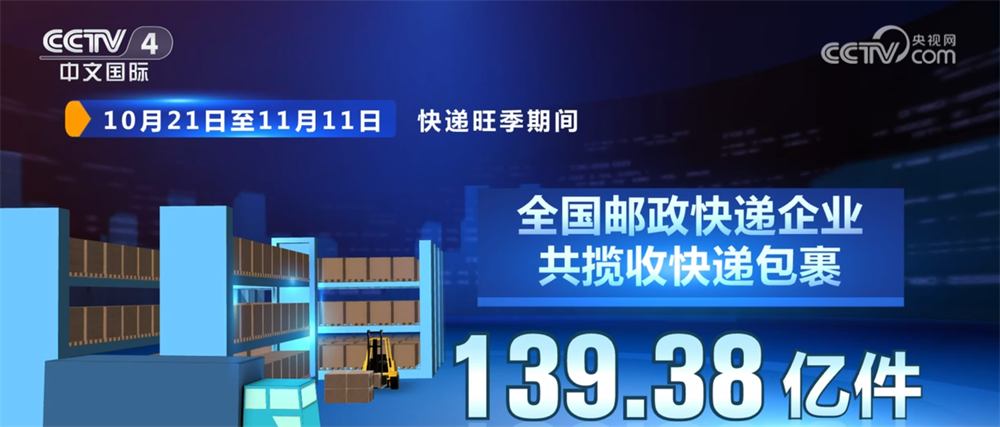
国家邮政局发展研究中心战略规划研究部主任刘江称:"快递市场规模持续扩大,彰显了邮政快递业在扩内需、促消费、稳增长中发挥的 关键作用。快递业通过拓展农村市场,实现上下游双向高效流动,有效激发了农村服务需求。同时,通过与先进制造业的深度融合,快递供应 链正朝着高端化、智能化方向转型。" 央视网消息:记者从国家邮政局了解到,从10月21日至11月11日,快递旺季期间,中国快递业务量增长明显,单日业务量峰值达7.77亿 件,创历史新高。 国家邮政局最新数据显示,10月21日至11月11日,快递旺季期间,全国邮政快递企业共揽收快递包裹139.38亿件,日均揽收量是日常业务 量的117.8%,旺季单日业务量峰值达7.77亿件,创历史新高。 ...
国泰海通|策略:科技制造景气延续,地产内需仍偏弱
国泰海通证券研究· 2025-11-12 14:02
Core Insights - The technology manufacturing industry continues to show high prosperity, with rising memory prices and an improved outlook for the lithium battery supply chain due to tight supply and demand [1] - Real estate demand remains weak, leading to pressure on passenger vehicle sales, while coal demand has improved significantly, resulting in a sharp price increase [1] Downstream Consumption - Real estate sales have seen a significant decline, with a year-on-year drop of 41.4%, particularly in first, second, and third-tier cities, where transaction volumes fell by 45.2%, 38.2%, and 43.9% respectively [2] - Passenger vehicle retail sales in October decreased by 0.8% year-on-year, primarily due to the high base effect from subsidy policy changes [2] - Agricultural prices show mixed trends, with live pig prices down 3.1% month-on-month, while domestic staple grain prices continue to rise [2] - Service consumption is also under pressure, with a 22.8% year-on-year decline in movie box office revenues [2] Technology & Manufacturing - The electronic industry remains robust, driven by AI, with a significant increase in storage demand and a 15.0% year-on-year rise in semiconductor sales in September [3] - Construction demand is weak, influenced by seasonal factors, leading to a decline in building material demand and pressure on the construction materials industry [3] - The lithium battery industry is experiencing heightened demand, with a substantial increase in the price of lithium hexafluorophosphate due to tight supply [3] - Coal prices have surged due to increased demand for heating and ongoing supply-side checks, while international metal prices have declined [3] Human Flow and Logistics - Passenger transport demand has decreased month-on-month, although it shows year-on-year improvement, with a 4.2% drop in long-distance travel demand [4] - Freight logistics have seen a slight decline, with national highway truck traffic down 2.1% month-on-month, while railway freight volume increased by 3.9% [4] - Port throughput remains stable, with shipping prices experiencing a month-on-month decline [4]

英大证券晨会纪要-20251112
British Securities· 2025-11-12 02:08
Market Overview - The A-share market is currently experiencing a tug-of-war around the 4000-point mark, with indices showing fluctuations and a cautious market sentiment reflected in declining trading volumes [2][4][11] - Short-term market consolidation around the 4000-point level is expected to strengthen the market foundation, potentially leading to new highs within the year [2][4][11] - Domestic economic indicators, such as stabilizing price levels, suggest a recovery in internal economic momentum, while upcoming important meetings in December are anticipated to set the tone for next year's economic policies [2][4][11] Sector Analysis New Energy Sector - The new energy sector, particularly solar equipment and battery stocks, has shown significant activity, with a rebound expected due to ongoing global efforts to achieve carbon neutrality [6][9] - The Ministry of Industry and Information Technology has emphasized the need for standards in electric vehicles and solid-state batteries, which may further support the sector's growth [6] - The new energy sector is projected to continue its rebound, especially for leading companies with core technological reserves [6][9] Consumer Sector - The consumer sector remains active, with food and beverage stocks leading the gains, supported by government initiatives to stimulate consumption [7][9] - The focus on domestic consumption is expected to drive economic recovery in the fourth quarter, with particular attention to sectors catering to the elderly and younger consumers [7] - Agricultural products may present investment opportunities as the government promotes policies to optimize production structures [7] Chemical Sector - The chemical sector is showing signs of recovery, with specific segments like agricultural chemicals and electronic chemicals benefiting from policy support and increasing demand [8][9] - Many chemical companies have reported significant earnings growth in the first three quarters of the year, indicating a positive outlook for the sector [9] Investment Strategy - A cautious approach is recommended, with an emphasis on balanced allocation across technology growth, cyclical stocks, consumer goods, and dividend stocks [3][10] - Investors are advised to focus on technology stocks with solid earnings support while being wary of those that have seen significant price increases without corresponding performance [3][10]
Q3货政报告,重提稳增长
HUAXI Securities· 2025-11-12 01:24
Policy Changes - The focus of monetary policy has shifted back to "stabilizing growth," indicating a renewed emphasis on economic expansion[1] - The phrase "maintain policy continuity and stability" was replaced with "do a good job in counter-cyclical and cross-cyclical adjustments," suggesting a cautious approach to policy strength[1] Economic Assessment - GDP growth for the first three quarters was 5.2%, making the annual target of 5% achievable, but Q3 growth slowed to 4.8%, necessitating measures to prevent further economic deceleration[1][2] - The external environment is described as having "many unstable and uncertain factors," while domestic demand needs to be further strengthened[2] Credit and Financing - The report maintains a steady credit support stance, emphasizing "keeping social financing conditions relatively loose" without increasing total credit supply[3] - New loans decreased by 851.2 billion yuan year-on-year, reflecting a natural decline in financial growth rates as the economy transitions to high-quality development[3] Structural Support - The report highlights the importance of structural tools, focusing on key areas such as technology innovation, consumption, and support for small and micro enterprises[4] - Specific measures include enhancing financial support for county-level economic development and expanding financial supply in the consumption sector[4] Interest Rates and Costs - The report reiterates the goal of reducing financing costs, with an emphasis on lowering bank liability costs to support a decrease in overall financing costs[5] - Banks are urged to avoid issuing loans with post-tax interest rates lower than the yield on government bonds of the same maturity[5] Capital Account and Exchange Rate - The report aims to enhance the level of capital account openness and promote the internationalization of the renminbi, removing previous cautious language[6] - The focus has shifted to maintaining exchange rate flexibility and strengthening market expectations, reflecting a stable renminbi exchange rate[6] Inflation and Demand - The report emphasizes that price levels are influenced by multiple factors, with supply-demand relationships being primary, and calls for coordinated macro policies to stimulate effective demand[6]