
国际化

Search documents
东阳光药董事长张英俊: 以“创新+国际化”双引擎 开启中国药企进阶新篇章
Zheng Quan Shi Bao· 2025-11-23 21:38
Industry Overview - The Chinese pharmaceutical industry is transitioning from "generic following" to "innovation leading," with 704 original innovative drugs expected from Chinese companies in 2024, ranking first globally [1] - The industry is entering a "golden decade" following the new clinical data verification policy implemented on July 22, with continuous policy support fostering a comprehensive support system for the pharmaceutical sector [1] Company Strategy - Dongyangguang Pharmaceutical is focusing on source innovation, with a research pipeline that includes small molecules, antibodies, small nucleic acids, ADCs, and cell therapies [1] - The company's R&D strategy has shifted from "Me-too" and "Fast-follow" to pursuing "BIC" (Best-in-Class) and "FIC" (First-in-Class) [1] - Dongyangguang currently has nearly 50 research pipelines, with over 10 in registration or key clinical stages, showcasing differentiated advantages and international competitiveness in products like the hepatitis B functional cure drug and new IPF drug [1] Technological Innovation - The company is leveraging the AI revolution by developing six AI models that enable a full-chain drug discovery capability, with the first AI-driven small molecule drug entering clinical trials [2] - Dongyangguang has established multiple core technology platforms, focusing on addressing significant unmet clinical needs such as solid tumor treatment and hepatitis B cure [2] Internationalization Strategy - The internationalization strategy of Dongyangguang is diversified, involving "License-out" agreements for overseas rights and promoting self-developed products in Europe and the U.S. [2] - The company anticipates that its insulin product will be approved in the U.S. by Q1 2026, potentially becoming the first domestically produced insulin to enter the U.S. market [2] - Dongyangguang has built a global sales network, with over 60 approved overseas formulations and a leading market share for azithromycin tablets in Germany [2] Future Outlook - The company aims to become a leading comprehensive pharmaceutical company through innovation, internationalization, and sustainability, targeting over 20 billion yuan in revenue and 5 billion yuan in profit within five years [3] - Dongyangguang plans to launch over 10 new products and achieve more than five global collaborations in the same timeframe [3] - The progression of Chinese pharmaceutical companies is fundamentally about the global recognition and validation of innovation value [3]

通化东宝(600867):经营性利润快速恢复,国际化稳步推进:通化东宝(600867):2025年三季报点评
Huachuang Securities· 2025-11-23 08:14
Investment Rating - The report maintains a "Recommendation" rating for Tonghua Dongbao, with a target price of 11.0 CNY per share [2][8]. Core Insights - The company reported a significant recovery in operating profit and steady progress in internationalization. In Q3 2025, the company achieved revenue of 806 million CNY, a year-on-year increase of 13.90%, and a net profit attributable to shareholders of 984 million CNY, a remarkable growth of 499.86%, primarily due to investment income from the transfer of equity in Te Bao Biotech [2][8]. - For the first three quarters of 2025, the company recorded total revenue of 2.18 billion CNY, up 50.55% year-on-year, with a net profit of 1.20 billion CNY and a non-recurring net profit of 321 million CNY [2][8]. Financial Performance Summary - The total revenue forecast for 2025 is 2.75 billion CNY, with a year-on-year growth rate of 37.0%. The net profit attributable to shareholders is projected to be 1.40 billion CNY, reflecting a staggering growth rate of 3,366.2% compared to the previous year [4][9]. - The earnings per share (EPS) for 2025 is estimated at 0.71 CNY, with a price-to-earnings (P/E) ratio of 12 times [4][9]. - The company’s total assets are expected to reach 8.54 billion CNY by 2025, with a debt-to-equity ratio of 13.2% [9]. Business Development Highlights - The company’s insulin analogs are experiencing rapid growth, with a projected 50% increase in sales year-on-year for Q3 2025, surpassing human insulin revenue [8][9]. - The company is advancing its international business, with the BLA for Aspart Insulin accepted by the FDA, and plans to continue with the BLA submissions for Glargine and Lispro [8][9]. - An employee stock ownership plan has been introduced, aiming to enhance the motivation of core employees, with a maximum of 11.08 million shares to be allocated [8][9].

中信建投万字报告!展望2026年经济、债市、全产业链投资策略
Sou Hu Cai Jing· 2025-11-20 23:47
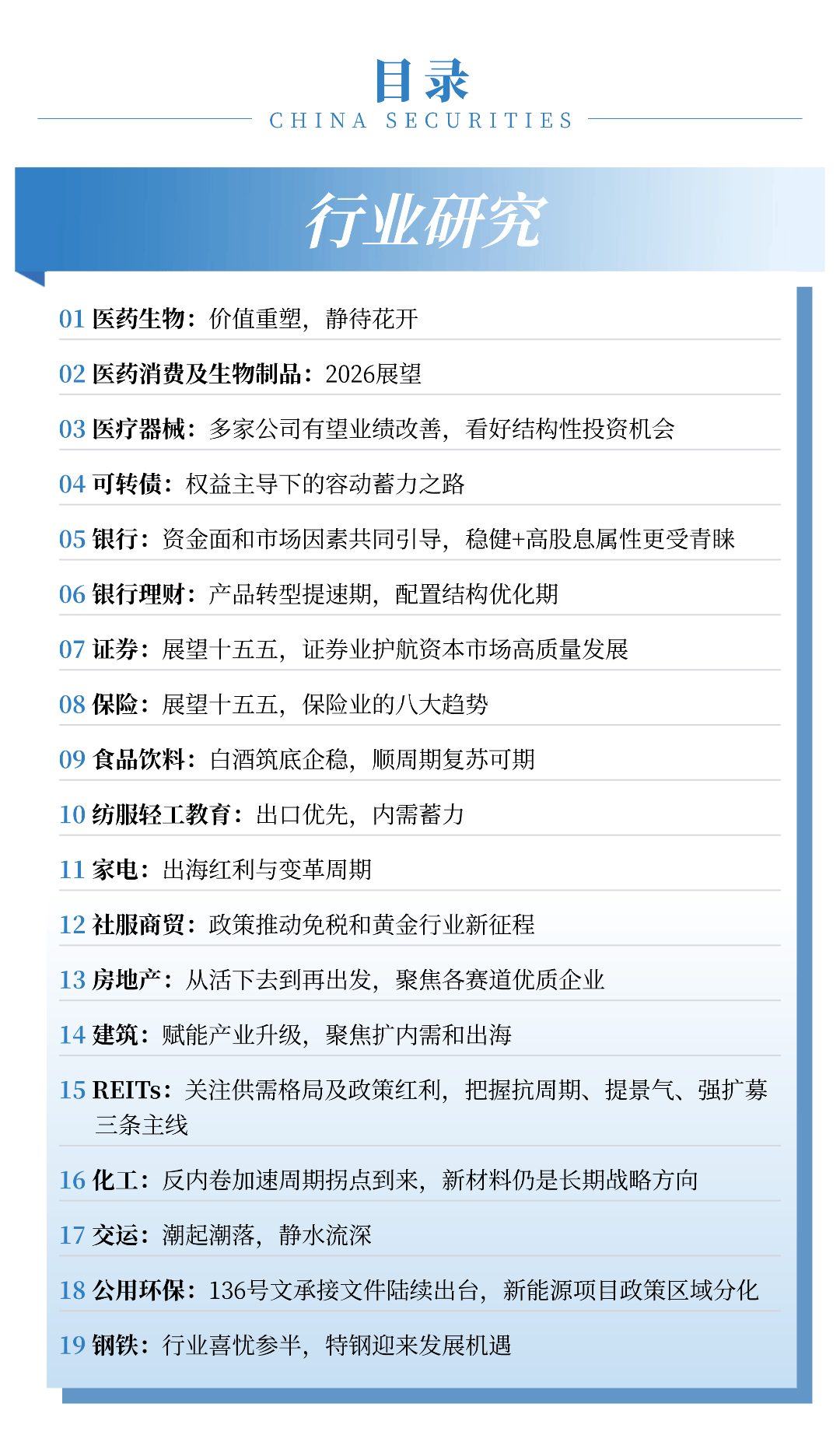
Group 1: Investment Strategies Overview - CITIC Securities released a comprehensive report on investment strategies for 2026, covering global capital markets, macroeconomic policies, A-shares, overseas markets, bond markets, asset allocation, and industry investment strategies [1] - The report includes insights from 19 research teams and spans approximately 30,000 words [1] Group 2: Pharmaceutical and Biotech Investment Strategies - The Chinese pharmaceutical industry is entering a critical phase characterized by "innovation realization + global layout," supported by population and domestic demand, as well as manufacturing capabilities [3][4] - The industry needs to focus on internal supply chain security and compliance while exploring diversified international expansion [3] - Key investment opportunities for 2026 include innovation commercialization, global breakthroughs, policy optimization, and industry mergers and acquisitions [3][5][6] Group 3: Medical Device Investment Strategies - The medical device sector is expected to see performance improvements in 2026 due to policy easing, new product launches, and international expansion [14] - The long-term investment opportunities in this sector stem from innovation, internationalization, and mergers and acquisitions [14] - The industry is witnessing a shift towards high-value consumables and innovative technologies such as brain-computer interfaces and AI in healthcare [14][15] Group 4: Consumer Healthcare and Bioproducts - The traditional Chinese medicine sector is expected to recover from short-term pressures, with improved demand anticipated by year-end [9] - The blood products industry is focusing on supply growth and consolidation, with significant demand for immunoglobulin and factor products [10] - The vaccine sector is under pressure but is expected to improve with new product sales and international expansion [10] Group 5: Banking Sector Investment Strategies - The banking sector is expected to continue its weak recovery in 2025, with a focus on high dividend strategies [25][26] - The sector's fundamentals are stabilizing, with credit growth projected at 7%-8% and non-interest income expected to improve [26] - High dividend yield strategies are favored, particularly for state-owned banks and those with solid fundamentals [27] Group 6: Wealth Management and Financial Products - The wealth management sector is entering a phase of product transformation and structural optimization, with an expected growth rate of 10% in 2026 [28][33] - The focus is on multi-asset and multi-strategy products, with a significant increase in mixed product offerings anticipated [29][30] - The integration of AI and digital technologies is expected to enhance risk management and operational efficiency in wealth management [30] Group 7: Non-Banking Financial Institutions - The securities industry is poised for a new growth cycle, driven by policies that enhance capital market inclusivity and adaptability [35][36] - The industry is experiencing a shift from self-operated models to collaborative, light-asset business strategies [36][37] - The internationalization of Chinese securities firms is gaining momentum, providing new opportunities for growth [38][39] Group 8: Insurance Sector Trends - The insurance industry is expected to undergo significant changes during the "14th Five-Year Plan" period, focusing on balancing interests among insurers, channels, and customers [43][44] - Key trends include the transformation of savings products, innovation in health insurance, and the development of new distribution channels [43][44] - The sector is anticipated to benefit from improved performance and valuation recovery, presenting investment opportunities [43][44] Group 9: Food and Beverage Sector - The food and beverage sector is recovering from a prolonged downturn, with a focus on premium products like liquor and health-oriented snacks [48][49] - The liquor industry is expected to stabilize as consumer confidence improves, with a focus on high-quality brands [49][50] - The snack and beverage segments are seeing growth driven by health trends and innovative product offerings [52][53]


招商银行行长王良:积极推进“国际化、综合化、差异化、数智化”发展
Xin Lang Cai Jing· 2025-11-20 10:34
Core Viewpoint - The 2025 Shenzhen International Financial Conference, hosted by Renmin University of China, emphasizes the transition of the Chinese banking industry from a phase of scale expansion to one of transformation and value creation [1] Group 1: Industry Transformation - The banking industry should accelerate transformation and upgrading in six key areas: enhancing specialized service capabilities, adapting to new trends in industrial transformation, and responding to changes in social financing structure [1] - Wang Liang, President of China Merchants Bank, highlighted the importance of improving distinctive service capabilities and comprehensive service capabilities in the banking sector [1] Group 2: Strategic Focus - China Merchants Bank aims to leverage opportunities from the times, advantages of the Greater Bay Area, and policy dividends to accelerate its transformation and upgrading [1] - The bank is committed to promoting "internationalization, comprehensive development, differentiation, and digital intelligence" to contribute to the construction of a financial powerhouse and the high-level opening up of the Guangdong-Hong Kong-Macao Greater Bay Area [1]

聚焦大湾区农交会|“媒体+”见证:四十年农批路,千帆竞发启新程
Nan Fang Nong Cun Bao· 2025-11-19 12:04
Core Viewpoint - The upcoming "China Agricultural Products Wholesale Market Industry Development 40th Conference" scheduled for December 12-14, 2025, in Guangzhou aims to celebrate the 40-year evolution of the agricultural wholesale market in China, highlighting its significant role in the national economy and food supply chain [3][4][9]. Group 1: Industry Development - The agricultural wholesale market has evolved from the establishment of the Shouguang Vegetable Wholesale Market in 1984 to over 4,000 markets across the country, with an annual transaction volume exceeding 6 trillion yuan [7][22]. - The industry now accounts for 70% of the national agricultural product circulation, showcasing its critical role in connecting urban and rural areas and stabilizing market prices [8][14]. - By 2025, over 250 public wholesale markets and more than 5,000 retail markets are expected to be established, indicating a well-structured system [23]. Group 2: Digital Transformation - Digitalization is reshaping the agricultural wholesale market, with leading markets like Beijing Xinfadi and Guangzhou Jiangnan achieving over 30% improvement in transaction efficiency through digital platforms [34][35]. - Advanced data analysis systems in markets allow for precise demand forecasting for over 1,000 agricultural products daily, enhancing operational efficiency and quality control [40][42]. Group 3: Internationalization - The implementation of RCEP is accelerating the alignment of China's agricultural wholesale markets with international standards, facilitating the import and distribution of foreign products [48][51]. - Shenzhen Haijixing International Agricultural Logistics Park serves as a hub for international agricultural trade, handling over 30 billion yuan in transactions [50]. Group 4: Socioeconomic Impact - The agricultural wholesale market directly supports over 10 million jobs and indirectly contributes to over 30 million jobs in related industries, playing a vital role in rural economic development [65][66]. - Successful case studies, such as the sale of 900,000 tons of apples from Luochuan County, demonstrate the market's impact on local farmers' incomes [70]. Group 5: Environmental Sustainability - The industry has made strides in reducing waste, with the fruit and vegetable loss rate decreasing from 25% to below 15% over the past decade, resulting in a reduction of over 10 million tons of waste annually [80][81]. - Innovative cold chain logistics systems in major markets are effectively minimizing product loss and promoting resource recycling [84][86]. Group 6: Future Directions - The conference will address seven key topics, including industry achievements, new trends in circulation, international standards, and the impact of digital economy thinking on market transformation [54][56]. - The integration of the "media+" model is expected to enhance operational efficiency and connect producers directly with consumers, marking a significant shift in the industry [92][96].

金山软件发布第三季度业绩 股东应占溢利约2.13亿元 同比减少48%
Zhi Tong Cai Jing· 2025-11-19 10:15
Core Insights - Kingsoft Software reported Q3 2025 earnings with total revenue of approximately RMB 2.419 billion, a year-on-year decrease of 17% but a quarter-on-quarter increase of 5% [1] - Operating profit was around RMB 277 million, down 76% year-on-year and down 28% quarter-on-quarter [1] - Net profit attributable to shareholders was approximately RMB 213 million, a decrease of 48% year-on-year and a decrease of 60% quarter-on-quarter, with basic earnings per share of RMB 0.15 [1] Business Performance - The company focused on its core business, emphasizing AI, collaboration, and internationalization as strategic priorities [1][2] - The WPS personal business saw steady growth due to the launch of new AI products and refined operations in domestic and international markets, leading to an increase in monthly active users and paid users [2] - The WPS 365 business showed rapid growth, with significant progress in covering private enterprises and local state-owned enterprises [2] Gaming Sector - The gaming business experienced a decline, primarily due to reduced revenue contributions from existing games, while new games are still in the early stages of market establishment [1] - Flagship game "Jian Wang 3" celebrated its 16th anniversary in August and launched an annual expansion pack in October, introducing innovative gameplay [2] - The sci-fi mech game "Jie Xian Ji" was globally launched and is undergoing adjustments to enhance player experience [2] Future Outlook - Kingsoft Software plans to continue focusing on its core strategy of AI, collaboration, and internationalization, leveraging its product matrix to meet the needs of individual users and large enterprises [2] - The gaming business will concentrate on developing high-quality content and global distribution, aiming to enhance the longevity of classic IPs and promote sustainable growth in new categories [2]

金山软件(03888)发布第三季度业绩 股东应占溢利约2.13亿元 同比减少48%
Zhi Tong Cai Jing· 2025-11-19 09:08
Core Insights - Kingsoft Software (03888) reported Q3 2025 earnings with total revenue of approximately RMB 2.419 billion, a year-on-year decrease of 17% but a quarter-on-quarter increase of 5% [1] - Operating profit was around RMB 277 million, down 76% year-on-year and down 28% quarter-on-quarter [1] - Net profit attributable to shareholders was approximately RMB 213 million, a decrease of 48% year-on-year and a decrease of 60% quarter-on-quarter, with basic earnings per share of RMB 0.15 [1] Business Performance - The company focused on its core business, emphasizing AI, collaboration, and internationalization as strategic priorities [1] - The office software and services segment showed stable performance, driven by significant growth in WPS software, rapid growth in WPS 365, and steady growth in WPS personal business [2] - The gaming and other businesses experienced a decline due to reduced revenue contributions from existing games, while newly launched games are still in the early stages of market establishment [1][2] Office Software and Services - WPS personal business benefited from the rollout of new AI products and refined operations in domestic and international markets, leading to steady increases in monthly active users, paid users, and user value [2] - WPS 365 business is continuously improving collaboration and AI product lines, with effective coverage of private enterprises and local state-owned enterprises [2] - Government AI products are being iterated and have been promoted in central and local government agencies, supporting the digital transformation of clients [2] Gaming Business - The flagship game "Jian Wang 3" celebrated its 16th anniversary in August and launched an annual expansion pack in October, introducing innovative gameplay [2] - The anime game "Chen Bai Jin Qu" is maintaining its core user base through long-term content updates and user operations [2] - The sci-fi mech game "Jie Xian Ji" continues to optimize gameplay and operational models post-launch to enhance player experience [2] - Two international IP games, "Goose Goose Duck" and "Angry Birds," are expected to launch in the domestic market in upcoming quarters [2] Future Outlook - Kingsoft Software plans to continue focusing on its core strategy of AI, collaboration, and internationalization, leveraging its core product matrix to meet the needs of individual users and large enterprises [2] - The gaming business will concentrate on developing high-quality content and global distribution, enhancing the longevity of classic IPs, and promoting the growth of new categories for sustainable development [2]
金山软件第三季度达营收24.2亿元 办公软件及服务业务收入同比增长26%
Xin Lang Cai Jing· 2025-11-19 09:04
Core Insights - The company reported a total revenue of RMB 2.42 billion for Q3 2025, representing a year-on-year decline of 17% but a quarter-on-quarter increase of 5% [1] - The office software and services segment generated revenue of RMB 1.52 billion, showing a year-on-year growth of 26% and a quarter-on-quarter growth of 12% [1] - The gaming and other businesses generated revenue of RMB 900 million, reflecting a year-on-year decline of 47% and a quarter-on-quarter decline of 6% [1] - The net profit attributable to the parent company was RMB 210 million, down 48% year-on-year [1] Office Software and Services - Growth in the office software and services segment was driven by the performance of WPS software, WPS 365, and personal business [1] - The strong growth of WPS software was primarily due to the boost from Xinchuang orders [1] - The rapid growth of WPS 365 was attributed to continuous improvements in collaboration and AI products, as well as effective expansion among private enterprises and local state-owned enterprises [1] - The steady growth in personal business was supported by the rollout of new AI products and refined operations, leading to an increase in paying users [1] - As of September 2025, the global monthly active devices for WPS Office reached 669 million, a year-on-year increase of 9% [1] Gaming and Other Businesses - The revenue decline in the gaming and other businesses was mainly due to a drop in earnings from several existing games, partially offset by contributions from newly launched games [1] Strategic Focus - The company will continue to focus on its core strategy of "AI, collaboration, and internationalization," leveraging its core product matrix to cover full-scenario needs from individuals to enterprises [2] - In the gaming sector, the company aims to concentrate on developing high-quality content and global distribution to promote the growth of new categories and sustainable development [2]
大家业绩都beat预期
Xin Lang Cai Jing· 2025-11-18 14:10
Core Viewpoint - Pinduoduo reported strong financial results for Q3, with a focus on international expansion despite facing challenges in revenue growth and external policy risks [1][4][5]. Financial Performance - Q3 total revenue reached 108.2765 billion yuan (approximately 11.52095 billion USD), a year-on-year increase of 9% [2]. - Net profit attributable to ordinary shareholders for Q3 was 29.3282 billion yuan (approximately 4.1197 billion USD), reflecting a year-on-year growth of 17% [2]. - The company holds over 400 billion yuan in cash reserves [3]. Competitive Landscape - Pinduoduo's GMV for Temu in Q3 reached 24 billion USD, with a year-on-year growth of 75% for the first three quarters [3]. - The company continues to focus on its core business and internationalization, contrasting with its domestic competitors who spend 30-50 billion yuan quarterly on subsidies for delivery and flash sales [3]. Challenges - Revenue growth has slowed down [4]. - Management has no plans for stock buybacks, which may exert pressure on the stock price [5]. - Temu faces significant external policy risks [5]. Market Context - The overall performance of major Chinese tech companies in Q3 has been strong, with Xiaomi reporting a 22.3% year-on-year revenue increase and Baidu's AI-related revenues showing substantial growth [6].

专用车产业迎来从“规模致胜”到“价值引领”关键转折
Zhong Guo Qi Che Bao Wang· 2025-11-17 03:43
Core Insights - The specialized vehicle industry is crucial for rural revitalization, national economic construction, and public safety, undergoing significant transformations in product management, industry structure, and market environment [1] - The 2025 Specialized Vehicle Industry Development Forum highlighted the themes of "collaboration, reshaping, and win-win" for the industry [1] Group 1: Trends in the Industry - The industry is experiencing three major trends: electrification, intelligence, and internationalization, with a focus on long-term governance, standard revisions, and access regulations [3][4] - By 2024, China's sales of new energy specialized vehicles are expected to exceed 300,000 units, with a penetration rate of nearly 30%, and projections indicate that by the end of the 14th Five-Year Plan, some public sectors may exceed a 70% penetration rate for electric vehicles [4] - In terms of internationalization, China's specialized vehicle exports are projected to reach 52,100 units in 2024, marking a year-on-year increase of 44.6%, with a shift from low-value to high-value products [4] Group 2: Challenges and Opportunities - The specialized vehicle industry faces challenges such as intensified competition and the need for transformation, requiring a shift from "scale cost" to "value innovation" and from "selling products" to "providing services" [7] - The market demand for specialized vehicles is stabilizing at a low level after years of rapid growth, with a shift from "scale construction" to "refined operation" in urban development [7] - The industry is expected to integrate deeply into the "smart city" development strategy, focusing on data interaction, intelligent decision-making, and unmanned operations [7] Group 3: Future Directions - Companies are encouraged to transition products towards cleanliness, intelligence, and platformization, evolving specialized vehicles from mere tools to mobile service platforms [7] - The industry must collectively promote innovation-driven growth, moving from price competition to value creation, and achieving an upgrade from "many weak" to "few strong" players [7][8] - The automation application in the specialized vehicle industry faces challenges due to diverse market demands, necessitating solutions for efficient production line adjustments [10]
