
供需平衡

Search documents
有色周报:碳酸锂-20251123
Dong Ya Qi Huo· 2025-11-23 02:23
1. Report Industry Investment Rating - No information provided in the document. 2. Core Viewpoints of the Report - Low inventory and demand resilience support prices, but increased production, expectations of mine复产, and exchange announcements limit the upside potential. Volatility has significantly increased, and the short - term will continue in a long - short game pattern [12]. 3. Summary According to the Table of Contents 3.1 Viewpoint Summary - Low inventory and demand resilience support prices, but production increases, mine复产 expectations, and exchange announcements suppress the upside space, with increased volatility and a short - term long - short game pattern [12]. 3.2 Balance Sheet 3.2.1 Global Balance Sheet - From 2018 - 2025E, global lithium demand has been growing, with the global effective lithium demand total increasing from 25.4 million tons LCE in 2018 to 142.3 million tons LCE in 2025E. The growth rate (yoy) has fluctuated, reaching a maximum of 50% in 2021. Global lithium supply has also been increasing, with the global effective lithium supply total rising from 30.9 million tons LCE in 2018 to 165.0 million tons LCE in 2025E. The growth rate (yoy) was highest at 45% in 2024. The global effective lithium supply has generally been in a state of surplus, with a surplus of 22.7 million tons LCE in 2025E, accounting for 16% of the total demand [15]. 3.2.2 Domestic Balance Sheet - In 2024 - 2025E, the domestic supply and demand of lithium carbonate have been in a state of imbalance. In November 2025E, the total supply of lithium carbonate was estimated to be 115,830 tons, and the total demand was 128,725 tons, with a supply - demand gap of - 12,895 tons. The import volume has been relatively large, and the export volume has been small. The production of lithium carbonate has also been increasing [16]. 3.3 Fundamental Data 3.3.1 Supply and Demand - In October, the estimated total supply of lithium carbonate was 115,895 tons, and the total demand was 124,642 tons, with a supply - demand gap of - 8,747 tons. In November, the estimated total supply was 115,830 tons, and the total demand was 128,725 tons, with a supply - demand gap of - 12,895 tons [10]. - The weekly output was 22,130 tons (a week - on - week increase of 585 tons), and the expectation of the resumption of production at the Jiangxi Ningde mine has increased, leading to a marginal increase in supply pressure [12]. 3.3.2 Inventory - SMM data shows that the monthly inventory in October was 84,234 physical tons, including 53,291 physical tons of downstream inventory and 30,943 physical tons of smelter inventory. This week's SMM weekly inventory was 118,420 physical tons, including 26,104 physical tons of smelter inventory, 44,436 physical tons of cathode factory inventory, and 47,880 physical tons of battery and trader inventory [10][75]. - The weekly inventory was 118,420 tons (a week - on - week decrease of 2,052 tons), with 14 consecutive weeks of de - stocking and a cumulative reduction of 26,000 tons. The inventory days have dropped below 30 days, and the supply - demand structure remains tight [12]. 3.3.3 Price - On November 21, the spot price of battery - grade lithium carbonate was 92,300 yuan/ton, a week - on - week increase of 8.40%, the futures price was 91,020 yuan/ton, and the basis was 1,280 yuan/ton [10][83].
储能狂飙下的价格博弈:碳酸锂10万元/吨关键位受压制
Hua Xia Shi Bao· 2025-11-22 15:14
Core Viewpoint - Lithium carbonate futures prices have experienced significant volatility, with the main contract dropping from over 100,000 yuan/ton to just above 90,000 yuan/ton, while the spot market remains relatively stable but shows signs of price decline [2][5] Price Trends - Since June, lithium carbonate prices have risen approximately 50%, from around 60,000 yuan/ton to just over 90,000 yuan/ton, with a peak of 99,300 yuan/ton on November 20 [3][4] - On November 21, the main futures contract fell by 9% to 91,000 yuan/ton, indicating a divergence between futures and spot prices [5][6] Supply and Demand Dynamics - The supply-demand balance for lithium carbonate is expected to shift, with a slight surplus projected for 2026, but potential monthly mismatches due to non-linear growth in energy storage installations [2][6] - Forecasts indicate that China's lithium carbonate demand will increase from 53.4 million tons in 2023 to 121.2 million tons in 2025, while supply is expected to reach 119.8 million tons [5][6] Market Sentiment and Divergence - There are contrasting views within the industry regarding future demand growth, with some executives expressing skepticism about a 50% increase across the board, citing potential demand destruction from rising battery prices [4][5] - The market sentiment remains cautious, with major lithium producers maintaining normal production levels and showing reluctance to increase supply significantly until prices stabilize above 100,000 yuan/ton for an extended period [6][8] Storage Demand Influence - The demand for lithium carbonate is increasingly driven by the energy storage sector, with projections indicating a significant increase in storage battery production and market growth [6][7] - The global energy storage market is expected to see substantial growth, with anticipated shipments reaching 780 GWh in 2026, a 50% increase from previous years [6][7]




建信期货能源化工周报-20251121
Jian Xin Qi Huo· 2025-11-21 11:15
行业 能源化工周报 日期 2025 年 11 月 21 日 021-60635738 lijie@ccb.ccbfutures.com 期货从业资格号:F3031215 021-60635737 renjunchi@ccb.ccbfutures.com 期货从业资格号:F3037892 028-8663 0631 penghaozhou@ccb.ccbfutures.com 期货从业资格号:F3065843 021-60635740 pengjinglin@ccb.ccbfutures.com 期货从业资格号:F3075681 021-60635570 liuyouran@ccb.ccbfutures.com 期货从业资格号:F03094925 021-60635727 fengzeren@ccb.ccbfutures.com 能源化工研究团队 研究员:李捷,CFA(原油、沥青) 研究员:任俊弛(PTA、MEG) 研究员:彭浩洲(工业硅多晶硅) 研究员:彭婧霖(聚烯烃) 研究员:刘悠然(纸浆) 研究员:冯泽仁(玻璃纯碱) 期货从业资格号:F03134307 请阅读正文后的声明 | ⇒ 原油 . | | --- ...
聚焦全球能源 | 亚太地区油气生厂商2026年展望
彭博Bloomberg· 2025-11-21 06:05
Core Insights - The global energy market is experiencing volatility due to rapid industry developments, geopolitical tensions, and fluctuating supply-demand dynamics [3][4][10] Group 1: Market Outlook - Asian oil and gas producers will face challenges from oil price fluctuations primarily influenced by supply-demand factors, with WTI crude oil prices expected to remain below $60 per barrel for most of 2026 [3][10] - The MSCI AC Asia-Pacific Energy Index's price-to-book ratio is currently at 1.2, above its 10-year average of 1.1, indicating that investors have not fully accounted for the risks of declining oil prices [3][7] Group 2: Performance Analysis - From January 1 to October 31, the Asian oil and gas index has underperformed the broader market due to weakened demand expectations stemming from U.S. tariffs and OPEC+ production increases [4][5] - The MSCI AC Asia-Pacific Energy Index rose by 13.86% during the same period, while the broader MSCI Asia-Pacific Index increased by 25.83%, highlighting a widening performance gap since August [5] Group 3: Supply Dynamics - OPEC+ is expected to increase production by 137,000 barrels per day in December as part of a gradual exit from voluntary production cuts implemented in 2023, which may lead to a supply surplus in the oil market [10] - The uncertainty surrounding Russian supply could exacerbate supply disruptions and potentially lead to spikes in oil prices in 2026 [4][5]

广发期货期现日报-20251121
Guang Fa Qi Huo· 2025-11-21 05:56
| 业期现日报 | 投资咨询业务资格:证监许可 | 【2011】1292号 | | | | | | | | | | --- | --- | --- | --- | --- | --- | --- | --- | --- | --- | --- | | 2025年11月21日 | 纪元菲 | Z0013180 | | | | | | | | | | 现货价格及主力合约基差 | 11月20日 | 11月19日 | 涨跌 | 涨跌幅 | 单位 | 品种 | | | | | | 华东通氧S15530工业硅 | 9550 | 9450 | 100 | 1.06% | 墓差 (通室S15530章准) | 475 | 60 | 415 | 691.67% | | | 华东SI4210工业硅 | 9750 | 9800 | 50 | 0.51% | 元/吨 | 基差 (Sl4210基准) | -75 | -440 | 82.95% | 365 | | 新疆99硅 | 9000 | 8850 | 1.69% | 120 | 基差(新疆) | 725 | 260 | 465 | 178.85% | | | 月间价差 | 合约 | ...
《有色》日报-20251121
Guang Fa Qi Huo· 2025-11-21 01:21
Report Industry Investment Ratings No relevant information provided. Core Views of the Reports Industrial Silicon - The industrial silicon market in November saw a decline in both supply and demand, with a larger decline in supply. However, due to the large supply base and the replenishment of the spot market by cancelled warehouse receipts, there is still pressure to accumulate inventory. In December, the decline in production is expected to narrow, but if the organic silicon industry reduces production, the inventory accumulation pressure will increase. The price is expected to fluctuate between 8,500 - 9,500 yuan/ton, and short positions can gradually take profits at low prices [1]. Polysilicon - The spot price of polysilicon is expected to stabilize. The market is in a situation of both supply and demand decline, but there is still an expectation of inventory accumulation in each link. In the short term, the supply of polysilicon is relatively high, but the long - term supply - demand balance driven by the exit of backward production capacity will support the price. The futures price has fallen back to a reasonable range, and attention should be paid to the support level, as well as the establishment of platform companies, production control, demand changes, and the digestion of warehouse receipts after the November contract cancellation [2]. Aluminum and Alumina - **Alumina**: The market maintains a supply - demand surplus pattern, with short - term supply pressure increasing. The price is expected to remain weakly volatile in the short term, with the main contract reference range of 2,700 - 2,900 yuan/ton. Attention should be paid to the production reduction trends of high - cost enterprises [3][4]. - **Aluminum**: The price will fluctuate between macro - level positive factors and weak fundamentals in the short term. The medium - term supply shortage pattern remains unchanged. Attention should be paid to downstream start - up changes, inventory reduction rhythms, and overseas policy trends [3][4]. Tin - Considering the strong fundamentals, a bullish view on tin prices is maintained. Existing long positions can be held, and attention should be paid to macro - level changes and the recovery of supply from Myanmar [6][7]. Zinc - The fundamentals provide limited support for the continuous upward movement of zinc prices. In the short term, it may still be volatile. An upward breakthrough requires an improvement in demand, and a downward breakthrough requires continuous inventory accumulation. The export of zinc ingots may boost domestic zinc prices, and the short - term main contract reference range is 22,200 - 22,800 yuan/ton [9]. Copper - The market expects the probability of an interest rate cut in December to decline, and the copper price is oscillating weakly. The long - term supply - demand contradiction supports the upward movement of the copper price's bottom center. The main contract reference range is 85,000 - 86,500 yuan/ton, and attention should be paid to changes in demand and overseas interest rate cut expectations [10]. Nickel - The macro - level exerts some pressure, and the improvement in fundamentals is limited. The medium - term supply is abundant, which restricts the upward space of the price. The short - term driving force is weak, and the main contract reference range is 113,000 - 118,000 yuan/ton. Attention should be paid to macro - level expectations and Indonesian industrial policy news [12]. Stainless Steel - Policy and macro - level driving forces are insufficient, and the fundamental structure has not improved significantly. The supply - side pressure from steel mills' production schedules and social inventory remains, and demand is weak. The short - term price is expected to be weakly volatile, with the main contract reference range of 12,300 - 12,600 yuan/ton. Attention should be paid to steel mills' production reduction and nickel - iron prices [16]. Lithium Carbonate - The market is in a situation of both supply and demand growth. The short - term price is expected to be volatile, and the main contract LC2601 has risen. Attention should be paid to the resumption of production of large enterprises, changes in demand after the peak season, and the possible acceleration of the release of upstream projects at high prices. Long positions established earlier can consider partial profit - taking [18]. Summary by Relevant Catalogs Industrial Silicon - **Spot Price and Basis**: The spot price of industrial silicon increased by 50 - 150 yuan/ton, while the futures price decreased. The basis of some varieties changed significantly [1]. - **Monthly Spread**: The monthly spreads of different contracts showed various changes, with some increasing and some decreasing [1]. - **Fundamental Data**: National and regional production, as well as the national start - up rate, showed different trends. The production of some downstream products also changed, and the inventory of industrial silicon showed an overall upward trend [1]. Polysilicon - **Spot and Futures Prices**: The spot price of polysilicon was stable, the futures price fell, and the arbitrage window closed. The component price gradually recovered [2]. - **Fundamental Data**: Weekly and monthly data showed that polysilicon production increased slightly, silicon wafer production decreased slightly, and the inventories of both increased [2]. Aluminum and Alumina - **Price and Spread**: The price of aluminum increased slightly, and the price of alumina in some regions decreased. The spreads and premiums also changed [3][4]. - **Fundamental Data**: Alumina and electrolytic aluminum production increased in October. The start - up rates of aluminum processing industries showed different trends, and the inventory of electrolytic aluminum remained stable [3][4]. Tin - **Spot Price and Basis**: The spot price of tin remained unchanged, and the LME 0 - 3 premium increased significantly [6]. - **Monthly Spread**: The monthly spreads of different contracts showed various changes [6]. - **Fundamental Data**: Tin ore imports decreased in September, while refined tin production increased in October. The import and export volumes of refined tin changed slightly [6]. Zinc - **Price and Spread**: The price of zinc increased slightly, and the spreads and import - export profits changed [9]. - **Fundamental Data**: Refined zinc production increased in October, and the start - up rates of zinc processing industries showed different trends. The inventory of LME increased, and the domestic zinc ingot inventory decreased [9]. Copper - **Price and Spread**: The price of copper increased slightly, and the spreads, premiums, and import - export profits changed [10]. - **Fundamental Data**: Electrolytic copper production and import volume decreased in October. The start - up rates of copper rod production showed different trends, and the inventory of different types of copper changed [10]. Nickel - **Price and Spread**: The price of nickel increased slightly, and the spreads and import - export profits changed [12]. - **Fundamental Data**: China's refined nickel production and import volume increased. The inventory of SHFE and social inventory increased, while the LME inventory decreased [12]. Stainless Steel - **Price and Spread**: The price of stainless steel decreased slightly, and the spreads changed [16]. - **Fundamental Data**: The production of 300 - series stainless steel increased slightly, the import volume increased, and the export volume decreased. The social inventory decreased slightly, and the SHFE warehouse receipts decreased [16]. Lithium Carbonate - **Price and Spread**: The price of lithium carbonate increased, and the spreads changed [18]. - **Fundamental Data**: The production and demand of lithium carbonate increased in October, and the inventory decreased. The production capacity and start - up rate increased [18].
碳酸锂接下来怎么走?高盛:价格或区间震荡,直至明年年中供需关系走向收紧
Hua Er Jie Jian Wen· 2025-11-20 08:37
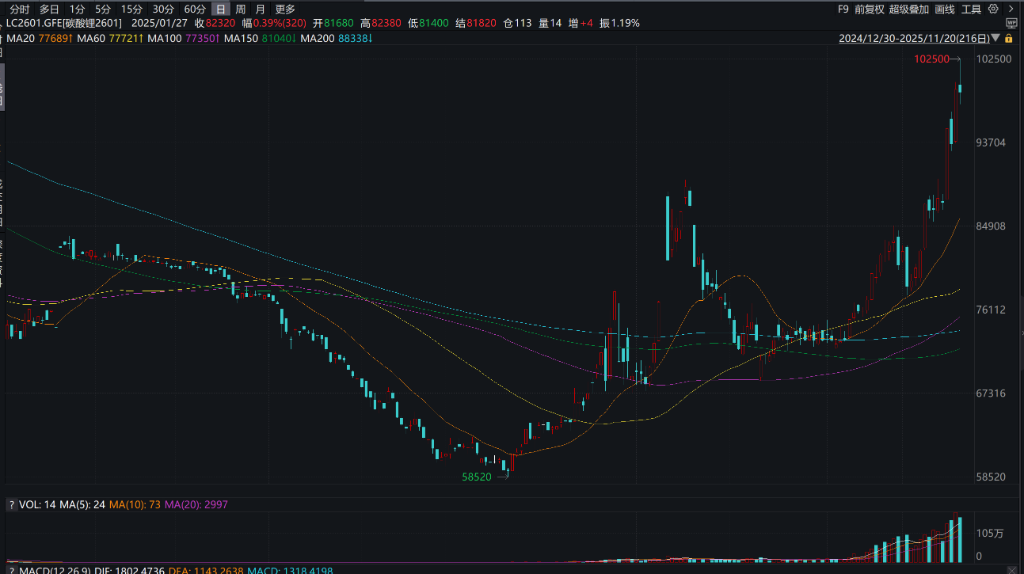
Core Viewpoint - The lithium market is experiencing significant price fluctuations, with lithium carbonate prices rising by 70% from their low point earlier this year, and a forecast of a "tight balance" in supply and demand for the next year [1][3]. Group 1: Price Trends - Lithium carbonate futures have shown an upward trend, reaching a peak of 102,500 RMB/ton, marking a new high for the year [1]. - The average price of battery-grade lithium carbonate in the spot market is currently 99,250 RMB/ton, which is a 65% increase from the year's low of 59,900 RMB/ton [1][3]. Group 2: Supply Dynamics - Supply constraints are a key driver of the price increase, with domestic lithium carbonate social inventory decreasing for 13 consecutive weeks, totaling a reduction of 22,000 tons [3]. - The average monthly production of lithium carbonate from the Ningde Times Yichun mine, which was previously around 7,000-8,000 tons, has been affected by production disruptions, raising concerns about short-term supply [3]. Group 3: Future Outlook - Goldman Sachs anticipates that while demand remains positive and inventory continues to decline, an increase in elastic supply is expected if prices rise, leading to a likely price range of 80,000-100,000 RMB/ton (approximately 10,000-12,500 USD/ton) [3][4]. - The market is expected to remain in a price range until mid-2026, when domestic supply constraints and strong demand are projected to tighten the market, with an average price forecast of 8,900 USD/ton for lithium carbonate in 2026 [4]. Group 4: Analyst Perspectives - Analysts express cautious optimism regarding future price trends, noting that while the current price surge is driven by inventory depletion and storage demand, the pace of lithium mine restarts in Jiangxi should be monitored [5][6]. - Concerns have been raised about a potential seasonal decline in demand for energy storage cells, with production exceeding demand for two consecutive months [6].
铝盐、锌合金——大宗商品热点解读
2025-11-20 02:16
Summary of Zinc Alloy Market Analysis Industry Overview - The analysis focuses on the zinc alloy market in China for the year 2025, highlighting price trends, supply-demand dynamics, and industry applications [1][5][9]. Key Points Price Trends - The overall price of zinc alloy in China showed a downward trend in 2025, with the highest price recorded at 25,389 CNY/ton in January, reflecting a year-on-year increase of 14.54%, and the lowest at 22,907 CNY/ton in September, indicating a year-on-year decrease of 7.55% [1][5]. - Factors influencing price fluctuations include global macroeconomic instability, uncertainty in Federal Reserve policies, geopolitical conflicts in the Middle East, and a supply increase coupled with weak demand [1][5]. Supply and Demand Dynamics - Supply pressure increased in 2025 due to the release of new production capacity from smelting plants, while downstream demand remained weak, leading to an oversupply situation [7]. - The operating rate decreased from 64.54% in 2023 to 61% in 2025, with a notable decline during the Spring Festival due to delays in resuming operations [7]. - Import volumes of zinc alloy decreased in 2025, primarily from South Korea, Australia, and Japan, while exports surged in April due to consumption subsidies and export policies, reaching 1,281.714 tons [8]. Processing Fees - Processing fees for zinc alloys increased, with fees for die-casting No. 3 ranging from 400 to 950 CNY/ton and No. 5 from 1,000 to 1,500 CNY/ton, indicating differentiated pricing strategies based on product specifications [6]. Industry Applications - Zinc alloy applications are diverse, with approximately 45% used in the construction industry, benefiting from real estate completion and renovation projects [9]. - The automotive industry accounts for about 21% of zinc alloy usage, with a shift towards high-strength and corrosion-resistant materials due to lightweight demands [9]. - The home appliance sector represents 13% of the market, driven by consumption upgrades from policies promoting the replacement of old appliances [9]. Future Market Outlook - The macroeconomic environment may see positive influences from U.S. trade policy changes, but challenges remain due to potential supply-demand imbalances and the impact of new smelting capacities [10]. - The overall demand for zinc alloy may face downward pressure, particularly in traditional sectors, while the performance in peak seasons is expected to be weaker than in previous years [10]. Regional Production - Major production regions in China include East China (29%), Central China (21%), and South China (18%), with significant companies like Zhuzhou Smelting Group and Yunnan Chihong Company serving the southern market [4]. Conclusion - The zinc alloy market in China for 2025 is characterized by fluctuating prices, increased supply pressures, and diverse applications across various industries. The outlook remains cautious due to potential oversupply and weak demand in traditional sectors [1][10].
工业硅期货早报-20251120
Da Yue Qi Huo· 2025-11-20 01:40
大越期货投资咨询部 胡毓秀 从业资格证号:F03105325 投资咨询证:Z0021337 联系方式:0575-85226759 交易咨询业务资格:证监许可【2012】1091号 工业硅期货早报 2025年11月20日 1 重要提示:本报告非期货交易咨询业务项下服务,其中的观点和信息仅作参考之用,不构成对任何人的投资建议 。 我司不会因为关注、收到或阅读本报告内容而视相关人员为客户;市场有风险,投资需谨慎。 目 录 1 每日观点 2 基本面/持仓数据 每日观点——工业硅 供给端来看,上周工业硅供应量为9.1万吨,环比持平。 需求端来看,上周工业硅需求为8.4万吨,环比增长2.44%.需求有所抬升. 多晶硅库存为26.7万吨,处于低位,硅片亏损,电池片亏损,组件盈利; 有机硅库存为56300吨,处于低位,有机硅生产利润为-156元/吨,处于亏 损状态,其综合开工率为72.18%,环比持平,低于历史同期平均水平;铝 合金锭库存为7.21万吨,处于高位,进口亏损为410元/吨,A356铝送至无 锡运费和利润为669.5元/吨,再生铝开工率为60.6%,环比增加2.54%,处 于高位。 成本端来看,新疆地区样本通氧5 ...
《能源化工》日报-20251120
Guang Fa Qi Huo· 2025-11-20 01:36
1. Report Industry Investment Ratings - No industry investment ratings are provided in the reports. 2. Core Views of the Reports Polyolefins - PP shows a pattern of both supply and demand growth, with reduced maintenance leading to increased supply and a slight accumulation of inventory under the pressure of new production capacity. PE shows increased supply and decreased demand. Although unplanned maintenance eases some supply pressure, imported goods are abundant, and demand is generally weak except for agricultural films. The inventory of hedging merchants is gradually decreasing, the basis is strengthening, and inventory is being cleared. When the price is below 6800, the downstream's willingness to buy increases. The cost side is affected by the shock of crude oil and the strength of coal, and the PDH profit has continued to weaken this week. [2] Methanol - In the domestic market, Baofeng continues to purchase externally, and Jiutai has an unexpected maintenance. The domestic production will continue to increase. Currently, the marginal devices in the domestic market have suffered losses. In the port market, the gas restriction in Iran has been postponed, and the shipment has accelerated. As of November 19, Iran has shipped 885,000 tons, putting significant pressure on the port methanol market. With high inventory and the profit of imported methanol from Iran, the willingness to hold goods has weakened, and the price has declined while the basis remains stable. The demand side is based on rigid procurement. The market is currently trading on the logic of "weak reality", and the core contradiction lies in the high inventory in the port. The inventory contradiction of the 01 contract cannot be resolved, and the weak reality will continue to be traded before the gas restriction in Iran. [4] Glass and Soda Ash - Soda ash: The market has returned to a weak state, and the overall pattern of oversupply is still prominent. Fundamentally, the weekly production remains at a high level of around 750,000 tons, and the oversupply is obvious compared with the current rigid demand. The inventory of manufacturers has been transferred to the middle and lower reaches, and the trade inventory has continued to rise. In the medium term, there is no expectation of a significant increase in downstream production capacity, so the overall demand for soda ash will continue the previous rigid demand pattern. If there is no actual production capacity exit or load reduction in the future, the supply - demand situation will be further pressured. - Glass: The spot sales have strengthened, and the high sales rate in some regions has continued to be above 100%. Consecutive price cuts have driven the middle and lower reaches to purchase. Although 4 production lines in the Shahe area were cold - repaired last week, there will be production lines restarting and igniting in the future, which will put pressure on the supply side. The latest deep - processing order days have improved slightly, and there is still some rigid demand support in the short term as November is the peak season for year - end rush work. However, in the medium and long term, at the end of the peak season, the market is worried about the sustainability of future demand. As the temperature in the north drops, outdoor construction will gradually stop, and the demand side will shrink after December, putting pressure on the glass price. The real estate is still in the bottom cycle, and the completion volume has decreased significantly. Therefore, in the oversupply pattern, the glass industry still needs to clear production capacity to solve the oversupply dilemma. [7] PVC and Caustic Soda - Caustic soda: The supply - demand situation of the caustic soda industry still faces certain pressure. The purchasing enthusiasm of the main downstream alumina has decreased, so the support from the main demand side of caustic soda is weak, which suppresses the caustic soda price upwards. During the northern environmental protection control period, some alumina plants may have production reduction expectations. There is an overhaul expectation in the East China region, and the supply will decrease slightly. The price in this region may be relatively stable due to certain rigid demand support, but in the long term, the supply - demand still has pressure. The non - aluminum market is still sluggish, and overall, the supply - demand pressure is still relatively large. It is expected that the caustic soda price will fluctuate weakly. - PVC: The PVC spot market continues to fluctuate weakly. This week, maintenance and partial device load reduction have led to a decrease in production on a month - on - month basis, but it is still at a high level. Affected by local logistics, the market arrivals have decreased, and the social inventory has decreased on a month - on - month basis. Next week, the supply - side operating rate will increase. The demand side is in the traditional off - season from November to January of the next year. As the outdoor construction in the north gradually decreases in winter, the overall real estate demand reduction still has a negative impact. In terms of exports, India has officially cancelled the BIS certification for imported PVC issued in 2024, which is beneficial for domestic PVC to enter the Indian market. However, there is an expectation of anti - dumping duties, and the Asian contract price for December is still to be observed next week. It is expected that the external demand will be difficult to increase. The overall demand side has limited support for PVC. The supply - demand is still in an oversupply pattern, and it is difficult for the price to form an upward drive. It is expected to continue the weak pattern at the bottom. [8] Natural Rubber - The supply side: Yunnan has encountered cold weather, which has accelerated the end of the tapping season in Yunnan. The rainy season in southern Thailand continues, and the price of overseas raw materials is high, which strongly supports the rubber price. The demand side: Currently, the overall demand is weak. Channels are cautious in purchasing and mainly focus on digesting inventory. Next week, the purchasing enthusiasm of some agents on an as - needed basis may increase slightly, which will drive the overall sales volume. However, the overall demand is weakening, and the actual increase in purchasing volume is limited. The market still mainly focuses on digesting inventory. In conclusion, the natural rubber inventory has entered the seasonal inventory accumulation period, and the terminal demand support is insufficient. There is an expectation that the operating rate of downstream enterprises will further decline. It is expected that the natural rubber market will enter a range - bound consolidation. In the future, attention should be paid to the raw material output in the peak production season of the main producing areas and macro - level changes. If the raw material supply is smooth, the rubber price is expected to decline. If the raw material supply is not smooth, the rubber price is expected to operate in the range of 15,000 - 15,500. [9] Pure Benzene and Styrene - Pure benzene: Recently, many sets of pure benzene devices have overhaul expectations, but the import expectation remains high, and the overall supply may still be relatively loose. On the demand side, the load of downstream styrene has increased due to the restart of some devices, but some loss - making varieties have reduced production to maintain prices, and the domestic demand side has limited support. The port inventory has increased, and there are still many arrivals in the future, so the supply pressure of pure benzene is relatively large. After the overhaul of the disproportionation device in the US Gulf ends, the support from blending oil may weaken, but South Korea's aromatics have an export expectation to the US, and the US dollar price of pure benzene has increased. Overall, the supply - demand expectation of pure benzene is still relatively loose, and the limited support from the cost side may limit the upward space. It may fluctuate and consolidate. However, since the current valuation of pure benzene is low, future attention should be paid to device changes. In the short term, it is advisable to wait and see for BZ2603. - Styrene: After the overhaul of the disproportionation device in the US Gulf ends, the blending oil demand may weaken. However, in November, the supply - demand situation of styrene has further improved. With the South Korean mixed aromatics trading, styrene has an export transaction expectation, and the port inventory has decreased. There are positive factors supporting styrene, and it will mainly fluctuate and repair in the short term. However, as the profit of styrene is repaired, the overhaul of some factories may be delayed. Coupled with the trial operation of new devices and the expected weakening of downstream EPS demand, it is expected that the upward space of styrene will be limited. In the short term, the price of EB01 may mainly fluctuate and consolidate. [10] Polyester Industry Chain - PX: Recently, the operating loads of Asian and domestic PX have decreased. However, the supply of Asian MX is abundant, and some factories rely on MX to supplement PX production, so the PX supply still remains at a relatively high level. On the demand side, the PTA price still has certain support this week. However, the spot floating price and monthly spread of PX are still weak, and the overall support from oil prices is limited. It is expected that the rebound space of PX is limited. Strategically, PX should be regarded as a short - term high - level shock. - PTA: As two PTA devices in East China are gradually under maintenance, the basis has slightly strengthened. According to the balance sheet, the supply - demand of PTA is in a tight balance in November, but the supply - demand of PTA is expected to be relatively loose from December to the first quarter of next year, and the upward drive of the basis is limited. In terms of absolute price, recently, the absolute price of PTA is relatively strong due to the support of blending oil demand and India's cancellation of BIS certification. However, the overall support from oil prices is limited, and the rebound space of PTA is still limited. Strategically, TA should be regarded as a short - term high - level shock, and TA1 - 5 should be treated as a rolling reverse spread. - Ethylene glycol: The operating load of ethylene glycol is at a high level. The arrival of overseas ethylene glycol shipments is relatively concentrated in November, and the port inventory will continue to increase recently, and the basis will weaken. In addition, the inventory accumulation amplitude of ethylene glycol from November to December is expected to be relatively high, and the upward pressure on ethylene glycol is significant. Strategically, the seller of the out - of - the - money call option with an exercise price of no less than 4100 for EG2601 should hold, and EG1 - 5 should be reversely spread at high levels. - Short - fiber: Although the spot processing margin of short - fiber has been significantly compressed recently, there is still profit at present, and the inventory pressure of short - fiber factories is not large, so the short - fiber supply remains at a high level. On the demand side, the terminal demand has seasonally weakened in November. In addition, the cancellation of India's BIS certification has certain benefits for PTA and filament, but has relatively little impact on short - fiber. Therefore, under the short - term weak supply - demand expectation and cost - side support, it is expected that the absolute price of short - fiber will be under pressure, and the processing margin still has room for compression. Strategically, the unilateral strategy is the same as that of PTA; the processing margin on the disk should be shorted at high levels. - Bottle - grade polyester: In mid - November, the Huarun device has both maintenance and restart. In addition, according to Longzhong Information, the commissioning of the new device of Dongying Fuhai has been postponed, and the domestic supply has not changed much. Considering that November is in the off - season of demand and the window period between the Spring Festival stocking, the demand side has insufficient support for bottle - grade polyester. The supply - demand of bottle - grade polyester remains in a loose pattern. Therefore, the social inventory of bottle - grade polyester will probably enter the seasonal inventory accumulation channel, and PR will mainly fluctuate with the cost side. The processing margin of PR is limitedly boosted by supply - demand and will change dynamically with the raw material cost. Strategically, the unilateral strategy of PR is the same as that of PTA; the processing margin of the main contract of PR is expected to fluctuate in the range of 300 - 450 yuan/ton. [12] Crude Oil - Overnight, affected by the news that Russia and Ukraine may restart peace talks, the geopolitical premium has declined, and the oil price has declined under pressure. However, EIA data shows that the US crude oil inventory has decreased more than expected, and the decline of the oil price has been slightly narrowed. Recently, attacks or sanctions caused by the Russia - Ukraine issue have had a short - term impact on the oil price. However, under the pressure of continuous production increase by OPEC+ and the record - high US crude oil production, the supply - demand pattern of crude oil is still weak, and the upward pressure on the oil price is significant. In the short term, attention should be paid to the support of Brent crude oil at $60 per barrel and the geopolitical dynamics between Russia and Ukraine. [14] 3. Summary According to Relevant Catalogs Polyolefins - **Price and Spread**: The closing prices of L2601, L2605, PP2601, and PP2605 have all increased, and the L15 and PP15 spreads have also increased. The spot prices of East China PP raffia and North China LLDPE have increased, while the North China LL basis has decreased significantly, and the East China pp basis has remained unchanged. The prices of some PE and PP non - standard products have remained unchanged, while the prices of some have decreased. - **Inventory**: PE enterprise inventory and social inventory have decreased, while PP enterprise inventory has increased, and PP trader inventory has decreased. - **Operating Rate**: The operating rate of PE devices has increased slightly, while the weighted operating rate of PE downstream has decreased slightly. The operating rate of PP devices and powder devices has increased, and the weighted operating rate of PP downstream has increased slightly. [2] Methanol - **Price and Spread**: The closing prices of MA2601 and MA2605 have decreased, and the MA15 spread has increased. The basis of Taicang has remained unchanged. The spot prices of Inner Mongolia North Line and Henan Luoyang have increased, while the spot price of Taicang Port has decreased. The regional spreads have changed significantly. - **Inventory**: Methanol enterprise inventory, port inventory, and social inventory have all decreased. - **Operating Rate**: The operating rates of domestic and overseas upstream enterprises have increased, the production - sales rate of Northwest enterprises has increased, the operating rate of downstream external - procurement MTO devices has decreased, the operating rate of downstream formaldehyde has increased slightly, the operating rate of downstream acetic acid has decreased significantly, and the operating rate of downstream MTBE has increased. [4] Glass and Soda Ash - **Price and Spread**: The prices of glass in North China have remained unchanged, while the prices in East China, Central China, and South China have decreased. The closing prices of glass 2601 have decreased, and the closing price of glass 2605 has remained unchanged. The 01 basis has increased. The prices of soda ash in North China, East China, Central China, and Northwest have remained unchanged. The closing prices of soda ash 2601 and 2605 have decreased, and the 01 basis has increased significantly. - **Supply**: The operating rate and weekly output of soda ash have decreased slightly, the daily melting volume of float glass has remained unchanged, the daily melting volume of photovoltaic glass has decreased, and the price of 3.2mm coated glass has decreased. - **Inventory**: The inventory of glass factories has increased, the inventory of soda ash factories has increased, the inventory of soda ash delivery warehouses has decreased, and the inventory days of soda ash in glass factories have remained unchanged. - **Real Estate Data**: The new construction area, construction area, completion area, and sales area have all decreased compared with the previous period. [7] PVC and Caustic Soda - **Price and Spread**: The prices of Shandong 32% liquid caustic soda and 50% liquid caustic soda have remained unchanged. The market prices of East China calcium - carbide - based PVC and East China ethylene - based PVC have decreased. The prices of SHSEOS, SH2601, V2605, and V2601 have decreased, and the V basis has increased significantly. - **Export and Profit**: The overseas quotes and export profits of caustic soda and PVC have some data unavailable, and some data have changed. - **Supply and Profit**: The operating rate of the caustic soda industry and the sample operating rate in Shandong have decreased slightly, the operating rate of PVC has decreased, the profit of externally - purchased calcium - carbide - based PVC has remained unchanged, and the profit of Northwest integrated PVC has decreased. - **Demand**: The operating rates of some downstream industries of caustic soda and PVC have increased or decreased. The pre - sales volume of PVC has decreased. - **Inventory**: The factory - warehouse inventory of liquid caustic soda in East China and Shandong has decreased, the upstream factory - warehouse inventory of PVC has decreased, and the total social inventory of PVC has decreased. [8] Natural Rubber - **Price and Spread**: The price of Yunnan state - owned full - latex has increased, the full - latex basis has decreased, the price of Thai standard mixed rubber has decreased, the non - standard price difference has decreased significantly, and the prices of some raw materials have remained unchanged. The 9 - 1 spread has remained unchanged, the 1 - 5 spread has increased, and the 5 - 9 spread has decreased. - **Production and Consumption**: The production of Thailand, Indonesia, and China in September has changed, the production of India has increased. The operating rates of semi - steel and full - steel tires have changed slightly, the domestic tire production in October has decreased, the tire export volume in October has decreased, the import volume of natural rubber in September has increased, and the import volume of natural and synthetic rubber in October has decreased. - **Inventory**: The bonded - area inventory and the factory - warehouse futures inventory of natural rubber in the SHFE have increased, the出库 rate of dry rubber in the bonded warehouse in Qingdao has decreased, and the入库 and出库 rates of dry rubber in general trade in Qingdao have increased. [9] Pure Benzene and Styrene - **Upstream Price and Spread**: The prices of Brent crude oil, WTI crude oil, and CFR Japan naphtha have decreased, the price of CFR Northeast Asia ethylene has remained unchanged, the price of CFR China pure benzene has increased, the pure benzene - naphtha spread and ethylene - naphtha spread have decreased,