
流动性

Search documents
12月资金面展望:流动性年底缺口小,预计维持均衡偏松
Sou Hu Cai Jing· 2025-12-01 10:21
财通证券认为,12 月财政支出增加而政府债发行减少对资金表现偏支持,但银行负债端扰动因素颇 多。其中,更加乐观的因素有:(1)由买断式逆回购和MLF组成的中长期流动性到期环比下降2000亿 元;(2)政府债发行进入尾声,政府债净融资大幅回落,12月政府债净融资或下降到5000亿元, 环比 11 月下降约7660亿元;(3)财政支出增加而政府债发行减少大月,对资金面有支持;(4)汇率压力 有所缓释,中央经济工作会议召开,叠加近期信用风险有所抬升,央行延续对于资金的呵护。其中扰动 更强的因素有:(1)12月缴税规模相较于11月或抬升2000亿元附近;(2)存单到期量环比抬升约8670 亿元,对银行负债端的扰动增强;(3)仍有高息定期存款到期,对负债端仍旧有影响;(4)季末月信 贷压力更大,信贷投放也对资金有影响。 华泰证券在研报中指出,跨月扰动已过,资金预计季节性净回笼,12月为税收小月、财政支出大月,叠 加政府债供给规模不高,预计资金面维持均衡偏松。 Wind数据显示,12月有3000亿元中期借贷便利(MLF)到期,同时将有4000亿元6个月期限和10000亿 元3个月期限的买断式逆回购到期。 在财政支出增加、 ...
——量化资产配置月报202512:大股票池配置仍偏价值,PPI关注度升至最高-20251201
Shenwan Hongyuan Securities· 2025-12-01 06:38
Group 1 - The core view of the report indicates that the large stock pool allocation remains biased towards value, with a focus on economic recovery, slightly tight liquidity, and credit contraction [3][6][9] - The report emphasizes the selection of factors sensitive to the economy but insensitive to credit, with a preference for value and low volatility in macroeconomic selections [9][10][31] - The allocation viewpoint for major assets suggests an increase in gold allocation to 20%, while A-shares allocation decreases due to economic conditions [27][28] Group 2 - Economic leading indicators are maintained at an upward trend, with predictions indicating a potential downturn starting in the next period [15][19] - Liquidity indicators show a slight tightening, with monetary supply remaining above zero but overall liquidity pointing towards a slightly tight condition [22][25] - Credit indicators are weak, with a low level of credit volume and structure, although there are signs of improvement in the proportion of loans to households and enterprises [26][27] Group 3 - The market focus has shifted to PPI, which has become the most concerning variable, surpassing economic indicators in recent observations [30][29] - The report suggests industry selection should favor sectors sensitive to economic changes but less affected by credit conditions, maintaining a value bias [31][32]
量化资产配置月报202512:大股票池配置仍偏价值,PPI关注度升至最高-20251201
Shenwan Hongyuan Securities· 2025-12-01 05:43
Group 1 - The core view of the report indicates that the large stock pool allocation remains biased towards value, with economic recovery observed, liquidity slightly tight, and credit indicators showing slight improvement. The macro dimensions suggest a direction of economic improvement, weak liquidity, and credit contraction [3][9][15] - The report emphasizes that the allocation of major assets has shifted, with an increased proportion of gold allocation to 20% due to economic upturn, while A-shares allocation has decreased [3][28] - Economic leading indicators are maintained at an upward trend, with predictions indicating that December 2025 will be at the end of a rising cycle since September, although the strength of the indicators is not high [3][15][19] Group 2 - The liquidity environment is slightly tight, with monetary indicators showing a decline. The overall interest rates have remained stable, and the excess reserve ratio has dropped below historical levels [3][23][26] - Credit indicators are weak, with low levels of credit volume and structure. The report notes that the total social financing stock year-on-year remains weak, although there is some improvement in the structure of loans to households and enterprises [3][27][28] - The market focus has shifted to PPI, which has become the most concerning variable, surpassing economic indicators. This reflects the market's heightened attention to future demand recovery [3][30][31] Group 3 - The industry selection from a macro perspective favors sectors that are sensitive to economic changes but insensitive to credit fluctuations, maintaining a value bias [3][32] - The report identifies the highest scoring industries based on economic sensitivity and credit insensitivity, including utilities, coal, and construction decoration as top sectors [3][32]

金属周期品高频数据周报(2025.11.24-11.30):伦敦现货金银价格比值创2024年8月以来新水平-20251201
EBSCN· 2025-12-01 05:42
Investment Rating - The report maintains an "Overweight" rating for the steel and non-ferrous metals sectors [6] Core Insights - The report highlights that the profitability of the steel sector is expected to recover to historical average levels due to government policies aimed at phasing out outdated production capacity [5] - The report notes that the liquidity environment for small and medium enterprises has improved slightly, with the BCI index at 52.50, indicating a positive trend [11] - The report indicates that the total inventory of five major steel varieties is at its highest level for the same period in four years, suggesting potential supply pressures [22] Summary by Relevant Sections Liquidity - The BCI index for small and medium enterprises in November 2025 is 52.50, up 0.17% month-on-month [11] - The M1 and M2 growth rate difference was -2.0 percentage points in October 2025, down 0.80 percentage points from the previous month [11] - The current price of London gold is $4,219 per ounce, reflecting a 3.80% increase from the previous week [11] Infrastructure and Real Estate Chain - The total inventory of five major steel varieties is at a four-year high [22] - The price changes for key materials include rebar up 0.93% and cement price index up 0.22% [22] - The national average capacity utilization rate for blast furnaces is 88%, down 0.6 percentage points [43] Industrial Products Chain - The operating rate for semi-steel tires is at a five-year median [3] - Major commodity price changes include cold-rolled steel down 0.25% and copper up 1.77% [3] - The operating rate for semi-steel tires is 69.19%, down 1.88 percentage points [3] Sub-sectors - The price of tungsten concentrate has reached a new high since 2012, at 339,000 yuan per ton, up 3.04% from last week [3] - The price of electrolytic aluminum is 21,430 yuan per ton, reflecting a 0.33% increase [3] - The price of electrolytic copper is 87,480 yuan per ton, up 1.77% [3] Price Ratio Relationships - The gold-silver price ratio has reached its lowest level since August 2024, at 78 times [4] - The price ratio of rebar to iron ore is 4.08 this week [4] - The price difference between hot-rolled and rebar steel is 40 yuan per ton [4] Export Chain - The new export orders PMI for China in October 2025 is 45.90%, down 1.9 percentage points [4] - The CCFI composite index for container shipping rates is 1,121.80 points, down 0.09% [4] - The capacity utilization rate for crude steel in the U.S. is 76.90%, up 0.70 percentage points [4] Valuation Percentiles - The CSI 300 index increased by 1.64%, with industrial metals performing best at +3.46% [5] - The PB ratio for the steel sector relative to the CSI 300 is currently at 0.53, with a historical high of 0.82 [5] - The report suggests that the profitability of the steel sector is likely to recover, leading to a potential PB ratio recovery [5]
宏观周报(11月第4周):风险偏好及流动性有所修复-20251201
Century Securities· 2025-12-01 04:22
Group 1: Market Overview - The market experienced a volume contraction with an average trading volume of 17,369 billion CNY, down 1,281 billion CNY week-on-week[2] - The Shanghai Composite Index rose by 1.40%, while the Shenzhen Component Index increased by 3.56%[2] - Industrial enterprise profit growth turned negative at -5.5% in October, following two months of over 20% growth[2] Group 2: Fixed Income Insights - Last week, bond yields rose significantly, with the yield curve steepening[2] - The central bank conducted a reverse repurchase operation totaling 15,118 billion CNY, with a net withdrawal of 1,642 billion CNY[2] - The market is expected to stabilize in the short term, despite a neutral medium-term outlook for the bond market[2] Group 3: International Market Dynamics - U.S. stock markets rose, with the Dow Jones up 3.18% and the S&P 500 up 3.73%[2] - The probability of a Federal Reserve rate cut in December is stable at over 80%[2] - The offshore RMB appreciated by 341 basis points against the USD, closing at 7.0713[2]
美联储“救市”成转折点,11月的最后一周,各类资产“强劲反弹”
3 6 Ke· 2025-12-01 01:49
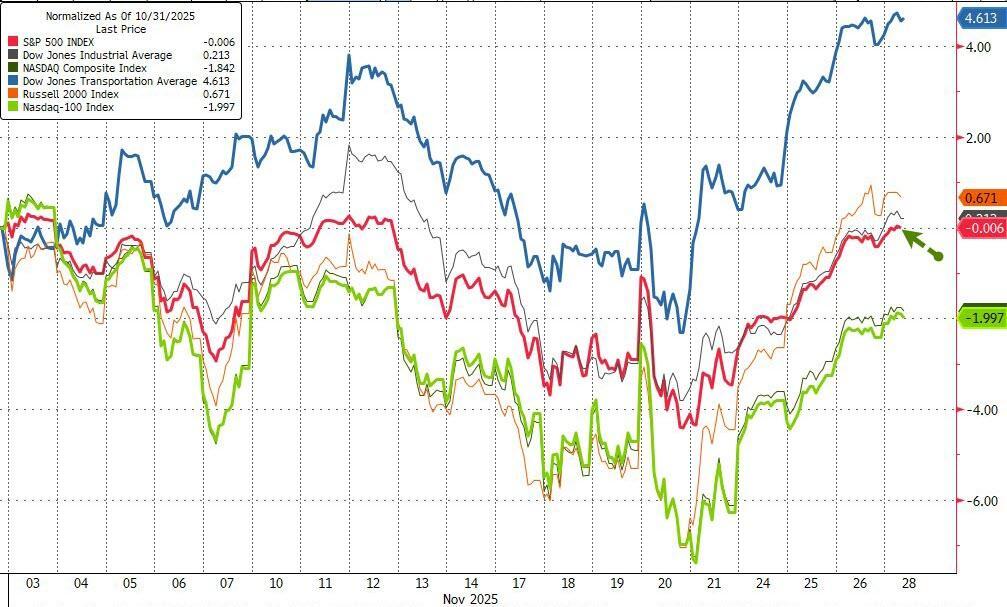
在经历了月初的动荡后,金融市场于11月的最后一周上演了一场万物反弹的行情。 本周,随着美联储12月降息预期的升温,美股、美债、大宗商品乃至加密货币等几乎所有类别的资产均协同上涨,一扫此前对AI泡沫和经济增长的忧虑。 行情逆转的关键节点出现在上周五,华尔街见闻提及,纽约联储主席威廉姆斯放鸽,市场押注12月降息概率因此从约30%突破至50%。随后"鲍威尔盟 友"连续发声支持降息,市场对美联储12月降息预期大幅升至80%。 (美股基准股指11月走势,标普500指数从月中大幅下跌中反弹,最终基本收平) (绿线美联储12月降息概率 VS 蓝线明年1月概率) 周五芝商所因数据中心故障一度暂停交易,也未能阻挡这股上涨势头。本周具体表现来看: 美国标普500指数本周大涨3.7%,创下六个月来最佳单周表现,同时也是自2008年雷曼危机以来最好的"感恩节周"表现。 (标普500指数自2008年以来感恩节期间表现最好的一周) 美国国债价格上涨,10年期国债收益率一度跌破4%的关键心理关口。 比特币也从11月的低点反弹超过7%,回升至9万美元上方,市场风险偏好显著回暖。 彭博商品指数周内上涨超过2%,现货白银和伦铜均突破历史高位。 ...

美联储转向引发全球市场,11月收官周资产集体反弹!
Sou Hu Cai Jing· 2025-11-30 17:16
Core Viewpoint - The global asset markets experienced a significant rally in the last week of November, driven by dovish statements from Federal Reserve officials, marking one of the best Thanksgiving weeks since the 2008 financial crisis [1][3] Market Performance - The S&P 500 index surged by 3.7%, achieving its best weekly performance in six months, while U.S. Treasury bonds, commodities, and cryptocurrencies also joined the rally [1][3] - The 10-year U.S. Treasury yield fell below the critical 4% psychological level, indicating strong demand for bonds [3] - The Bloomberg Commodity Index rose over 2% during the week, with spot silver and copper reaching historical highs [3] - Bitcoin rebounded above $90,000 from its monthly low, reflecting a strong recovery in the cryptocurrency market [3][7] Market Sentiment and Catalysts - The dramatic reversal in market sentiment was primarily catalyzed by dovish remarks from New York Fed President John Williams, which were interpreted as a signal of potential rate cuts by the Fed [3] - Market expectations for a December rate cut surged from approximately 30% to 80% following Williams' comments [3] - A survey by JPMorgan indicated that investors' net long positions in U.S. Treasuries reached their highest level in about 15 years [3] Liquidity Environment - The rapid market rebound was fundamentally supported by a favorable liquidity environment, with the "remaining liquidity" indicator showing positive growth, suggesting limited downside for equities [5] - The concept of "fiscal put options" provided by the U.S. Treasury through specific debt issuance strategies is countering the Fed's quantitative tightening [5] Sector Performance - The technology sector showed internal divergence, with Nvidia experiencing a significant decline of around 13% for the month, while Alphabet's announcements regarding new AI models boosted confidence in large tech companies [7] - The cryptocurrency market, being highly sensitive to liquidity changes, saw Bitcoin rebound over 7% from its lows [8] Future Outlook - The market's trajectory in December will hinge on two key variables: the Fed's interest rate decision and the upcoming Central Economic Work Conference in China [12] - Current market expectations suggest an 80% probability of a 25 basis point rate cut in December, with projections for a total of four rate cuts by the end of 2026 [12] - If the policy signals from the Central Economic Work Conference exceed expectations, it could significantly enhance market risk appetite and trigger a year-end rally [12][14]
美联储“救市”成转折点!11月的最后一周,各类资产“强劲反弹”
华尔街见闻· 2025-11-29 13:26
Core Viewpoint - The article discusses the recent surge in various asset classes, including U.S. stocks, bonds, commodities, and cryptocurrencies, driven by rising expectations of a Federal Reserve interest rate cut in December [1][3][10]. Group 1: Market Performance - The S&P 500 index experienced a significant rebound, rising 3.7% in the week, marking its best weekly performance in six months and the strongest Thanksgiving week performance since the 2008 financial crisis [7][8]. - U.S. Treasury prices increased, with the 10-year Treasury yield dropping below the critical 4% psychological level [8]. - Bitcoin rebounded over 7% from its November low, surpassing $90,000, indicating a notable recovery in market risk appetite [8]. Group 2: Federal Reserve Influence - The key turning point for the market was the dovish remarks from New York Fed President John Williams, which led to a significant increase in the market's expectation of a December rate cut from approximately 30% to 50%, and eventually to 80% [3][10]. - Analysts suggest that the market's dramatic shift in sentiment is largely attributed to strong expectations regarding a change in Federal Reserve policy [10][12]. Group 3: Liquidity and Market Dynamics - Analysts believe that despite ongoing adjustments in global asset structures, ample liquidity provides a solid foundation for risk assets, effectively limiting the potential for systemic declines [5][19]. - The concept of "fiscal put options" is introduced, where the U.S. Treasury injects liquidity into the market through specific debt issuance strategies, countering the Fed's quantitative tightening [20]. - A key liquidity indicator, "remaining liquidity," is currently positive, suggesting that when this indicator is high and rising, the downside risk for the stock market is effectively mitigated [21][22].
流动性跟踪:月初资金面或季节性转松
HUAXI Securities· 2025-11-29 13:19
Liquidity Overview - In November, the liquidity environment was stable, with overnight rates peaking above 1.50% twice during the month, reaching a high of 1.54% due to factors like Double Eleven preparation funds and government bond payments[1] - The average overnight rate (R001) for September to November was 1.36%, 1.35%, and 1.37% respectively, indicating a stable liquidity trend despite short-term fluctuations[2] Future Outlook - For the week of December 1-5, liquidity is expected to ease, with R001 likely returning to the range of 1.35-1.36% supported by fiscal spending[3] - Government bond net payments are projected to significantly decrease, with an estimated payment of 866 billion yuan compared to 3,289 billion yuan the previous week, limiting liquidity disturbances[4] Open Market Operations - From December 1-5, the total amount maturing in the central bank's open market operations is approximately 25,118 billion yuan, including 15,118 billion yuan in reverse repos and 10,000 billion yuan in 3-month reverse repos[5] - The central bank is expected to continue its practice of rolling over 3-month reverse repos to alleviate maturity pressure[6] Credit Market Insights - In November, the average 3-month bill rate was 0.56%, up 28 basis points year-on-year, indicating a potential improvement in credit conditions[7] - Major banks have shifted to net selling of bills for the first time since April, with a net sale of 46 billion yuan in November compared to a net purchase of 1,878 billion yuan in the same period last year[8] Government Debt Issuance - The net issuance of government bonds in November was 12,660 billion yuan, exceeding the initial expectation of 12,300 billion yuan, but down 5,657 billion yuan year-on-year[9] - For December, the net issuance is expected to drop to around 5,200 billion yuan, marking a significant decrease from previous months[10] Interbank Certificates of Deposit - The issuance rate for interbank certificates of deposit decreased in November, with a weighted average issuance rate of 1.64%, down from 1.67% in October[11] - The maturity pressure for certificates of deposit is expected to rise in December, with an estimated maturity scale of 37,000 billion yuan, which is relatively high compared to the median of 28,000 billion yuan for 2025[12]
【美联储“救市”成转折点!11月的最后一周,各类资产“强劲反弹”】11月最后一周,标普500指数累涨3.7%,自2008年雷曼危机以来最好的“感恩节周”表现。此外美债、大宗商品和加密货币本周均集体强劲反弹。一切转折点源于美联储官员鸽派表态。分析指出,充裕流动性为市场构筑"安全网",财政部和...
Sou Hu Cai Jing· 2025-11-29 04:42
【美联储"救市"成转折点!11月的最后一周,各类资产"强劲反弹"】11月最后一周,标普500指数累涨 3.7%,自2008年雷曼危机以来最好的"感恩节周"表现。此外美债、大宗商品和加密货币本周均集体强劲 反弹。一切转折点源于美联储官员鸽派表态。分析指出,充裕流动性为市场构筑"安全网",财政部和美 联储的"双重看跌期权"有效封锁系统性下跌空间。 ...