经济衰退

Search documents
高盛顶尖交易员:未来几个月美股的核心问题是“衰退和降息,谁站上风”
华尔街见闻· 2025-08-20 11:06
Group 1 - The U.S. stock market is facing a critical juncture, with signs of a weakening job market and rising expectations for a Federal Reserve rate cut [1][4] - Goldman Sachs highlights the challenge for investors to find assets that can benefit from anticipated rate cuts while providing protection against potential economic downturns [1][3] - The report indicates that as long as deep downside risks are avoided, the U.S. stock market can continue to "climb the wall of worry," but the risk of a market pullback is higher than usual due to already priced-in growth slowdown [1][4] Group 2 - The July non-farm payroll report has significantly altered market dynamics, drawing attention to the "employment" aspect of the Federal Reserve's dual mandate [2][3] - Employment growth has sharply declined across multiple indicators, suggesting a labor market characterized by limited hiring and no large-scale layoffs [2][3] - Goldman Sachs warns that such downward revisions are typically indicative of cyclical turning points, urging investors to take these weak signals seriously [3] Group 3 - Following the July non-farm data release, market expectations for a Federal Reserve rate cut have shifted dramatically, with a high likelihood of a rate cut in September [4] - The market has fully priced in a September rate cut, with expectations for more than two cuts throughout the year [4] - If further signs of weakness in the job market emerge, the market may price in earlier and more substantial rate cuts, leading to steepening of the 2-year and 5-year U.S. Treasury yield curve [4] Group 4 - The decline in market implied volatility makes options betting on accelerated rate cuts an attractive "recession protection" tool [5]



对美出口暴跌10.1%!日本七月出口创四年最大降幅
Hua Er Jie Jian Wen· 2025-08-20 03:44
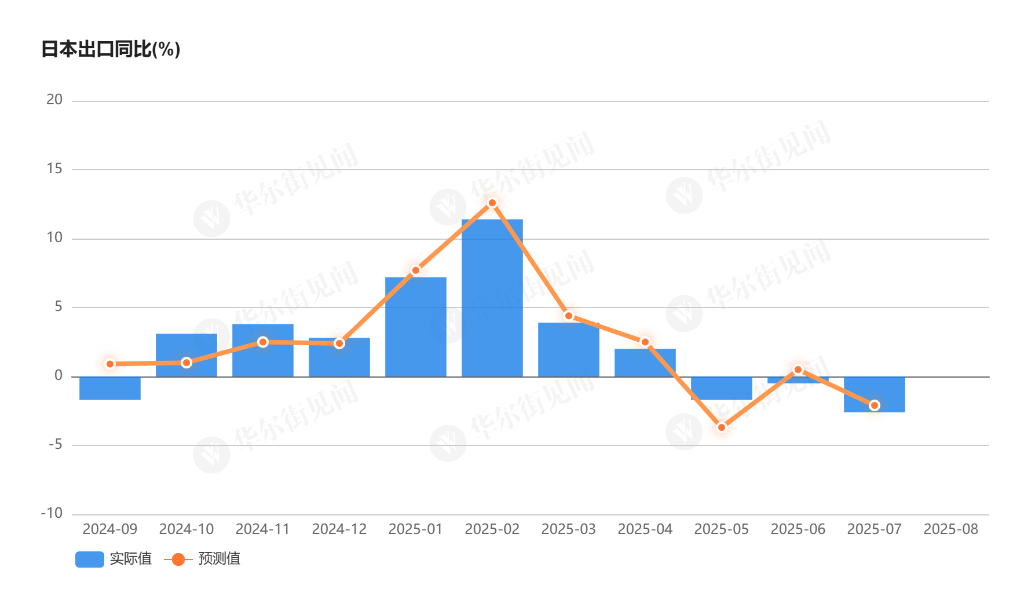
Core Viewpoint - Japan's exports in July experienced a significant decline, marking the largest year-on-year drop in four years, primarily due to weakened exports to the United States, raising concerns about the country's economic growth prospects [1][3][4]. Export Performance - In July, Japan's exports fell by 2.6% year-on-year, exceeding market expectations of a 2.1% decline, and representing the largest drop since February 2021 [1][4]. - Exports to the U.S. saw a notable decrease of 10.1%, although this was an improvement from June's 11.4% drop [4][6]. - The automotive sector was particularly hard hit, with exports of cars and parts plummeting by 28.4% and 17.4%, respectively, further exacerbating the decline in overall export figures [3][4]. Trade Agreement Impact - A trade agreement reached on July 22 between Japan and the U.S. included a 15% tariff on certain goods, with automotive tariffs reduced from 25% to 15%. However, the impact of these tariffs will be reflected in August's data, while July's figures still show the ongoing pressure from tariffs [4][6]. Economic Growth Challenges - The decline in exports poses new challenges for Japan's economic growth, which had previously shown resilience with a GDP growth of 0.3% quarter-on-quarter and 1.2% year-on-year in Q2, driven by net exports [5][6]. - Continued export weakness raises concerns about Japan's ability to sustain economic expansion, especially as domestic consumption remains sluggish [6]. Monetary Policy Implications - The persistent decline in exports is expected to influence the Bank of Japan's monetary policy decisions, with market expectations leaning towards a cautious stance in the upcoming policy meeting on September 19 [6].
海外策略周报:9月若美联储降息,全球或“Risk”-20250819
Changjiang Securities· 2025-08-18 23:30
Core Insights - The current US economic growth shows signs of comprehensive slowdown, with a cooling labor market and weak inflation reinforcing market expectations for a shift in Federal Reserve policy [2][6][14] - The anticipated interest rate cut by the Federal Reserve will significantly impact the US dollar and US Treasury markets, with historical trends indicating that Treasury yields typically decline ahead of policy shifts [2][7][30] - The impact of the Federal Reserve's interest rate cuts on global equity markets is structurally differentiated, primarily depending on the motivation behind the policy [2][8][30] Economic Indicators - Recent macroeconomic data from the US indicates a broad weakening, with key indicators falling below market expectations. Non-farm payrolls for July increased by only 73,000, significantly lower than the expected 104,000, marking the lowest monthly increase since October 2024 [6][14] - The unemployment rate has been on the rise, reaching 4.2% in July, further confirming the cooling labor market. Inflation data also shows weakness, with July's CPI growth at 2.7%, below the expected 2.8% [14][20] Interest Rate and Currency Dynamics - US Treasury yields are expected to decline ahead of the Federal Reserve's official interest rate cut, driven by the forward-looking nature of the bond market. Short-term Treasuries (e.g., 2-year) are more sensitive to interest rate changes compared to long-term Treasuries (e.g., 10-year) [7][22][29] - The US dollar index typically weakens during the Federal Reserve's interest rate cut cycles. For instance, during the 2001 rate cut cycle, the dollar index fell by 13.34%, while it has already decreased by 3.20% since the first cut in 2024 [30][33] Equity Market Reactions - The Federal Reserve's interest rate cuts have historically led to varied impacts on global equity markets, largely influenced by the underlying economic conditions. Passive easing in response to recession often results in significant declines in equity markets, while preemptive cuts in resilient economic conditions can support equity valuations [8][30][34] - In the context of the 2024 preemptive rate cuts, corporate earnings remain relatively robust, which has helped to improve market risk appetite and support equity markets [8][34] Recent Asset Movements - Major US stock indices have recently shown gains, with the Nasdaq, Dow Jones, and S&P 500 rising by 2.20%, 2.14%, and 2.03% respectively. The healthcare, financial, and consumer discretionary sectors led the gains [5][37] - In the commodities market, LME zinc, copper, and Brent crude oil have seen increases, while gold and rebar steel have declined [5][37]
关税成本压力正加速向下游传导 美国中小企业可能出现倒闭潮
Yang Shi Wang· 2025-08-17 06:51
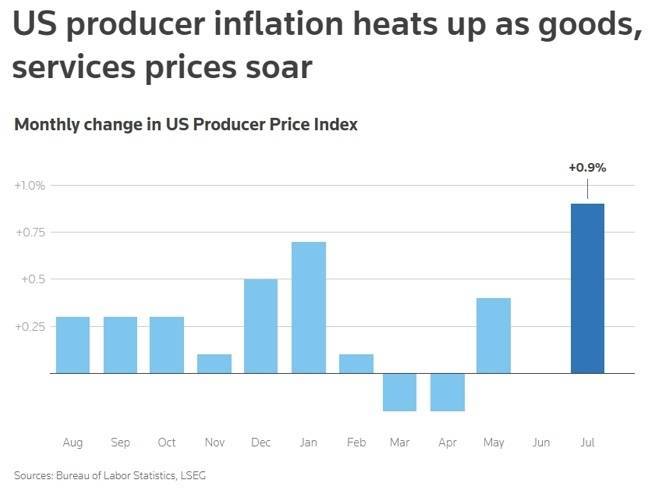
Core Insights - The Producer Price Index (PPI) in the U.S. rose significantly in July, exceeding market expectations, indicating renewed inflationary pressures in the upstream supply chain [1][3] - Experts warn that the cost pressures from tariffs are accelerating down the supply chain, potentially leading to a wave of bankruptcies among small and medium-sized enterprises (SMEs) in the U.S. [1][7] Group 1: PPI Data - The PPI increased by 0.9% month-over-month in July, marking the largest rise since June 2022 [3] - Year-over-year, the PPI rose by 3.3%, significantly higher than June's 2.3% and the market expectation of 2.6%, representing the highest level since February of this year [3] Group 2: Tariff Impact - As of June, U.S. businesses bore 64% of the tariff costs, while consumers covered 22%. If tariffs continue to rise, consumers are expected to bear 67% of the costs by October [5] - Current tariff policies may lead to a 1% decline in U.S. GDP and an increase in inflation by 1% to 1.5% [5] Group 3: Economic Outlook - The likelihood of the U.S. economy contracting for two consecutive quarters is estimated at 90% if current tariff policies remain unchanged, with a projected GDP decline of 4% [7] - SMEs are particularly vulnerable and may face a wave of bankruptcies if the economic downturn continues [7]
布米普特拉北京投资基金管理有限公司:降息预期急转弯 英国经济数据重写剧本
Sou Hu Cai Jing· 2025-08-16 19:17
Group 1 - The latest report from the UK Office for National Statistics shows that the GDP grew by 0.3% in the second quarter, significantly exceeding market expectations of 0.1% [1] - In June, GDP growth accelerated to 0.4%, doubling previous forecasts, highlighting the economic resilience amid challenging conditions [1] - Consumer spending rebounded strongly, driven by the services sector, while manufacturing output also unexpectedly improved, providing a buffer against economic challenges [4] Group 2 - The unexpected economic resilience complicates monetary policy decisions, with inflation pressures easing on one hand and stronger-than-expected growth raising the threshold for policy adjustments on the other [8] - Market expectations for further interest rate cuts this year have diminished, with rate futures indicating borrowing costs may stabilize at 3.5% next year [8] - The UK labor market shows mixed signals, with job losses smaller than initially anticipated since last autumn's fiscal adjustments, supporting consumer spending but raising concerns for monetary policy shifts [8] Group 3 - Retail sector performance serves as a key indicator of economic health, with John Lewis reporting a 12% increase in home goods sales and a 9% rise in fashion sales, indicating a recovery in consumer spending [10] - However, the British Retail Consortium's survey revealed a significant drop in retail sales balance from +24 to -6 in July, the largest decline since last winter, suggesting that the recovery may not be stable [10] - As the third quarter begins, the UK faces a delicate turning point, with positive growth data tempered by underlying challenges that may not be immediately visible [10]

关税成本传导效应显现 美国中小企业或现倒闭潮
Zhong Guo Xin Wen Wang· 2025-08-16 14:37
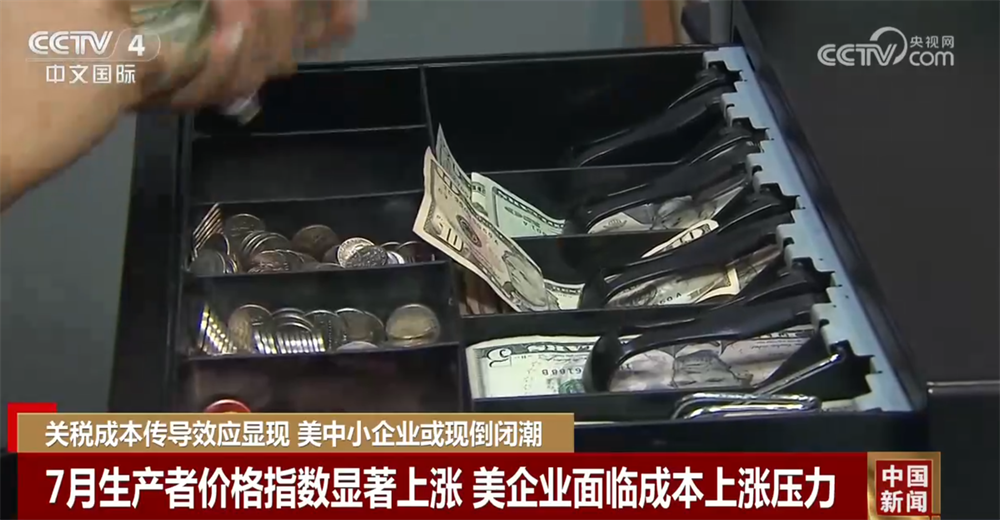
Core Viewpoint - The article discusses the significant impact of rising tariffs and producer price index (PPI) on U.S. small and medium-sized enterprises (SMEs), suggesting a potential wave of bankruptcies as these businesses struggle to absorb increased costs [1][6]. Economic Indicators - The U.S. PPI rose by 0.9% month-on-month in July, significantly higher than June's zero growth and market expectations of 0.2%, marking the largest increase since June 2022 [2][3]. - Year-on-year, the PPI increased by 3.3% in July, up from 2.3% in June and exceeding the market forecast of 2.6% [2][3]. - The core PPI, excluding volatile food and energy prices, also saw a month-on-month increase of 0.9% and a year-on-year increase of 3.7%, compared to 2.6% in the previous month [2][3]. Tariff Cost Distribution - As of June, U.S. businesses bore 64% of the tariff costs, consumers 22%, and foreign exporters 14%. Projections indicate that by October, consumers may bear 67% of the costs, while foreign companies and U.S. firms would bear 25% and 8%, respectively [5][6]. - Analysts from Goldman Sachs and JPMorgan Chase predict that tariffs could lead to a 1% decline in U.S. GDP and an inflation increase of 1% to 1.5% [5][6]. Impact on Small and Medium-Sized Enterprises - SMEs are particularly vulnerable to the rising costs associated with tariffs, with experts estimating a 90% chance of the U.S. economy contracting for two consecutive quarters, potentially leading to a 4% decline in GDP [6]. - The lack of operational capital in SMEs makes it difficult for them to absorb additional costs, leading to warnings of widespread bankruptcies among retailers if current tariff policies persist [6].
深观察丨关税成本传导效应显现 美国中小企业或现倒闭潮
Sou Hu Cai Jing· 2025-08-16 12:35
Group 1 - The Producer Price Index (PPI) in the U.S. rose significantly in July, with a month-on-month increase of 0.9%, the largest since June 2022, and a year-on-year increase of 3.3%, the highest since February of this year, indicating upward inflation pressure in the supply chain [3][6][11] - The increase in PPI is primarily driven by the service sector, which saw a month-on-month rise of 1.1%, the largest since March 2022 [6] - Analysts believe that the rising PPI will lead to increased costs for businesses, which may eventually be passed on to consumers, indicating a potential rise in consumer price inflation [9][16] Group 2 - Economic experts predict that the U.S. is likely to enter a recession this year, with small and medium-sized enterprises facing a potential wave of bankruptcies due to rising costs and insufficient operating capital [2][28] - Goldman Sachs estimates that by October, U.S. consumers will bear 67% of the tariff costs, while foreign exporters will bear 25% and U.S. companies only 8% [19][21] - The imposition of tariffs is expected to lead to a decline in U.S. GDP by 1% and an increase in inflation rates by 1% to 1.5%, with significant uncertainty regarding the transmission of these costs to consumer prices [23][26]
1 Unstoppable Growth Stock That's On Track to Double by 2030
The Motley Fool· 2025-08-16 07:48
Group 1: Company Performance - O'Reilly Automotive's share price has increased approximately 240% over the past five years, significantly outperforming the S&P 500's return of 106% [1] - The company has been expanding rapidly by opening new stores and executing stock buybacks, with a recent 15-for-1 stock split in June [2] - In the most recent quarter, diluted earnings per share rose by 11% year over year, and management anticipates a 3% net increase in store count for the year [10] Group 2: Market Conditions - Weak U.S. auto sales and recent trade policy changes are expected to negatively impact new car sales in the short term [3][4] - New tariffs on auto imports and components are likely to increase the price of new cars, which may further reduce demand for both new and used vehicles [4] - A decline in vehicle purchases leads consumers to retain their existing cars longer, increasing the likelihood of needing replacement parts, which benefits O'Reilly [5][8] Group 3: Valuation Concerns - O'Reilly's trailing price-to-sales (P/S) ratio is 5.2, significantly higher than competitors Autozone (3.6) and Advance Auto Parts (0.4) [9] - The company's price-to-earnings (P/E) ratio has reached a multidecade high of 36.4, also above its rivals [9] - Despite high valuations, the company's strong growth prospects justify its premium pricing [9] Group 4: Future Growth Potential - For O'Reilly's share price to double by 2030, a compound annual growth rate (CAGR) of about 15% per year is required, which appears achievable given current market conditions [10] - Additional sales growth may stem from the ongoing weakness in auto sales and a softening labor market, supporting the potential for a 15% CAGR [10]


特朗普政府警告法院:反对关税的裁决将引发“经济灾难”
第一财经· 2025-08-15 12:42
Core Viewpoint - The Trump administration argues that a court ruling against tariffs could undermine the President's foreign policy, jeopardize recent trade agreements, and harm the U.S. economy [3][4][7] Group 1: Legal Context and Arguments - The Trump administration is appealing a ruling that stated the President does not have "unlimited power" to impose tariffs under the International Emergency Economic Powers Act (IEEPA) [6][9] - The administration's legal team claims that tariffs are necessary to prevent a "financial collapse" and warns of potential economic recession if tariffs are overturned [7][11] - Experts suggest that if the Supreme Court rules against the Trump administration, it may lead to the refund of tariffs, impacting government revenue [6][12] Group 2: Economic Implications - As of the current fiscal year, U.S. tariff revenue has reached $142 billion, but it only accounts for 3.1% of total federal revenue [4][12] - Economists argue that the loss of tariff revenue is unlikely to cause a catastrophic economic downturn, as the U.S. government has significant debt and the tariffs do not directly fund social security or Medicare [11][12] - The current U.S. national debt is approaching $37 trillion, making tariff revenue a minor factor in the overall fiscal situation [12] Group 3: Political and Strategic Considerations - The Trump administration's strategy appears to be aimed at acting quickly on tariff issues to prevent the Supreme Court from overturning them, as the consequences could be severe [13] - Small businesses challenging the government argue that the President has other means to achieve trade goals, such as submitting agreements for Congressional approval [13]

本以为首个撑不住的是乌克兰,没想到是瑞士,瑞士金融业近乎完蛋
Sou Hu Cai Jing· 2025-08-15 08:09
Core Viewpoint - Switzerland is facing an unprecedented economic crisis due to the U.S. government's decision to impose high tariffs on Swiss exports, leading to significant capital outflows and a loss of investor confidence in the Swiss financial system [3][12]. Group 1: Historical Decisions and Trust Crisis - In February 2022, the Swiss Federal Council made a historic decision to freeze $8.23 billion in Russian assets, breaking its long-standing tradition of neutrality and participating in sanctions against Russia [7]. - This decision sparked a trust crisis among investors, leading to a significant withdrawal of funds from Swiss banks, particularly after the Swiss government intercepted humanitarian goods destined for Iran [7]. - The signing of a financial data exchange agreement with the U.S. in June 2024 further eroded the traditional banking secrecy in Switzerland, prompting wealthy clients to relocate their assets to jurisdictions like Hong Kong and Dubai [7]. Group 2: Collapse of Swiss Financial Institutions - In 2023, Credit Suisse, a 167-year-old bank, was acquired by UBS for only 3 billion Swiss francs after its market value plummeted by 97% [10]. - Over a span of 10 months, $120 billion in capital fled from Swiss banks, with significant inflows into private banks in Singapore, which saw an increase of $300 billion in assets under management [10]. - UBS itself faced challenges, including a drop in stock price by 60% from its 2023 peak due to allegations of assisting Russian oligarchs in asset transfers [10]. Group 3: Impact of U.S. Tariffs - On August 7, 2025, the Trump administration announced a 39% tariff on Swiss goods, significantly higher than tariffs faced by the EU, leading to predictions of a 0.7% decline in Swiss GDP if key industries like pharmaceuticals were affected [12]. - The tariff policy is expected to trigger a wave of unemployment and economic recession in Switzerland, exacerbating the existing financial crisis [12]. - Many Swiss companies are relocating production and R&D to countries like Singapore and Ireland in response to the economic pressures [16]. Group 4: Shift in Wealth Management - The turmoil in the Swiss financial system has led to a shift in global wealth management, with Singapore's private banking clientele increasing by 48% in 2025, largely due to capital moving from Switzerland [18]. - The private banking sector in Switzerland, which once accounted for 12% of its GDP, is now facing systemic collapse [18]. - Singapore's stock market capitalization is projected to exceed $1 trillion by 2030, as reforms attract global capital [18]. Group 5: Swiss National Bank's Response - In response to the crisis, the Swiss National Bank has engaged in "silent actions" to stabilize the Swiss franc by increasing foreign exchange reserves, which reached a record high of 716 billion Swiss francs in July 2025 [22]. - The International Monetary Fund (IMF) has indicated that Switzerland will be the most severely impacted European country by U.S. tariffs, particularly amid global supply chain restructuring [22].