
央行购金

Search documents
黄金站历史高位吵翻了!看多喊冲2600、看空喊跌2200,谁靠谱?
Sou Hu Cai Jing· 2025-11-17 06:09
Core Viewpoint - The recent surge in gold prices is attributed to a combination of factors including interest rate expectations, central bank purchases, geopolitical tensions, and increased investment flows into gold as a safe haven asset [1][3][20]. Group 1: Interest Rates and Central Bank Actions - The shift in market sentiment regarding interest rates, with expectations of 2-3 rate cuts by the Federal Reserve by May 2025, has reduced the opportunity cost of holding gold [5][6]. - Central banks have been consistently increasing their gold reserves, with China adding nearly 30 tons in Q1 2025, indicating a long-term strategy to hold gold as a stable asset [6][7]. Group 2: Geopolitical Tensions and Investment Flows - Ongoing geopolitical tensions, particularly in the Middle East and Europe, have heightened market anxiety, leading to increased demand for gold as a defensive asset [9][11]. - In Q2 2025, global gold ETF holdings increased by 5%, with significant inflows from the US and Europe, as investors shifted back to gold after previously reducing their positions [12][14]. Group 3: Market Dynamics and Future Outlook - The current high gold prices are influenced by both emotional market responses to geopolitical events and substantial capital inflows, creating a feedback loop that drives prices higher [11][14]. - There are mixed opinions on future gold price movements, with some predicting a rise to $2,600 per ounce while others caution about potential corrections to $2,200 per ounce due to over-optimism regarding interest rate cuts [16][18].

11月14日金市晚评:黄金决战4150-4250关键区 警惕获利了结冲击
Jin Tou Wang· 2025-11-14 11:00
Core Viewpoint - The gold price remains resilient despite the easing of negative factors such as the U.S. government's resumption of trade negotiations, with current trading around $4,171.89 per ounce, showing a slight increase of 0.03% [1][2]. Market Analysis - The U.S. government's resumption of operations and Trump's proposed tariff exemptions have significantly reduced risk aversion, weakening the support for gold as a safe-haven asset [2]. - The market's expectation of a potential interest rate cut has increased, with an 80% probability currently priced in, yet hawkish comments from Federal Reserve officials continue to suppress these expectations [2][3]. - The previous concerns regarding a "government shutdown" have been alleviated, leading to a decrease in geopolitical risk demand for gold [3]. Technical Analysis - Gold prices have shown strong performance, rising for four consecutive days, despite various negative factors, indicating unusual resilience [4]. - The current price range of $4,150 to $4,250 is critical, with market participants being cautious about chasing higher prices [7]. - If selling pressure emerges, gold could test support levels around $4,140 to $4,150, with a potential drop to the $4,000 mark if these levels are breached [7][8]. Future Outlook - There is a possibility of profit-taking in the coming days or weeks, which could lead to downward pressure on gold prices [5]. - If the upward momentum continues and resistance levels are broken, targets of $4,300 and $4,400 could be reached, potentially marking new historical highs for gold [8].
贵金属有色金属产业日报-20251112
Dong Ya Qi Huo· 2025-11-12 11:27
Report Industry Investment Rating No relevant content provided. Core Views of the Report - In the medium - to long - term, central bank gold purchases and growing investment demand will push up the price of precious metals [3]. - The potential end of the US government shutdown and the weakening labor market indicators have increased the market's expectation of a December interest rate cut, weakening the US dollar index and boosting copper prices. Meanwhile, the average price in the domestic spot market has risen, and the premium has slowed [12]. - For aluminum, funds are the core factor affecting prices. There is a contradiction between funds and the industry, and the upward trend of Shanghai aluminum depends on continuous fund inflows. For alumina, it is still in an oversupply situation [32]. - In November, due to intense competition for zinc ore in the smelting sector and a decrease in TC, the willingness to reduce or halt production has increased. If demand remains stable, there is a possibility of inventory reduction, and zinc prices are expected to have upward momentum [56]. - For the nickel industry chain, weak demand in the off - season suppresses the upward space. The price of nickel ore may remain strong in the short term, while nickel iron prices have been decreasing, and stainless steel faces pressure [72]. - For tin, supply is weaker than demand due to limited resumption of production in Wa State and a sharp decline in concentrate imports. Shanghai tin will maintain high - level volatility, but there is a risk of price decline [87]. - For lithium carbonate, it is currently in a state of being prone to rise but difficult to fall, maintaining a strong - side oscillation, but there is a risk of correction [103]. - For the silicon industry chain, the overall supply - demand pattern of industrial silicon and the polysilicon industry chain is weak, and they are expected to show wide - range oscillations [114]. Summary by Related Catalogs Precious Metals - Price trends: Presented data on SHFE and COMEX gold and silver futures prices, as well as price - to - ratio relationships [4][10]. - Price differences: Showed SHFE and SGX gold and silver futures - spot price differences [5][7]. - Correlation: Illustrated the relationship between gold and US Treasury real interest rates and the US dollar index [8][9]. - Fund positions: Displayed the positions of gold and silver long - term funds [10]. - Inventory: Showed SHFE and COMEX gold and silver inventories [11]. Copper - Futures data: Provided data on copper futures prices, including Shanghai and London copper, with details such as the latest price, daily change, and daily change rate [13]. - Spot data: Presented copper spot prices and premium data from different regions, as well as import profit and loss and processing fee data [17][23]. - Scrap price difference: Gave the difference between refined and scrap copper prices [27]. - Warehouse receipts: Showed the quantity and change of copper warehouse receipts in the Shanghai Futures Exchange and international markets [28][30]. Aluminum and Alumina - Price data: Provided price data for aluminum, alumina, and aluminum alloy futures, including the latest price, daily change, and daily change rate [34]. - Price difference: Showed the price differences between different contracts of aluminum, alumina, and aluminum alloy [36][38]. - Spot data: Presented aluminum spot prices, basis, and price differences in different regions, as well as alumina basis data [42][44]. - Inventory: Showed the inventory data of aluminum and alumina futures, including Shanghai and London inventory changes [50]. Zinc - Price data: Provided zinc futures price data, including Shanghai and LME zinc, with details such as the latest price, daily change, and daily change rate [57]. - Spot data: Presented zinc spot prices and premium data, as well as LME zinc premium data [65]. - Inventory: Showed the inventory data of zinc futures, including Shanghai and LME inventory changes [69]. Nickel Industry Chain - Price data: Provided price data for nickel and stainless steel futures, including the latest price, change, and change rate, as well as trading volume, open interest, and warehouse receipt data [73]. - Downstream profit: Showed the profit data of downstream products in the nickel industry chain, such as the profit rate of producing nickel sulfate and stainless steel [82][84]. Tin - Futures data: Provided tin futures price data, including Shanghai and LME tin, with details such as the latest price, daily change, and daily change rate [88]. - Spot data: Presented tin spot prices and premium data, as well as the price data of tin - related products [93]. - Inventory: Showed the inventory data of tin futures, including Shanghai and LME inventory changes [98]. Lithium Carbonate - Futures price: Provided the price data of lithium carbonate futures, including the latest price, daily change, and weekly change, as well as the price difference between different contracts [104][106]. - Spot data: Presented lithium spot prices, including the prices of different types of lithium products and their price differences [108]. - Inventory: Showed the inventory data of lithium carbonate, including exchange inventory, social inventory, and inventory in different sectors [112]. Silicon Industry Chain - Industrial silicon: Presented industrial silicon spot prices, basis, and price differences, as well as futures price data and price differences between different contracts [115][116]. - Polysilicon and related products: Showed the price data of polysilicon, silicon wafers, battery cells, components, and other products in the silicon industry chain [123][125]. - Production and inventory: Displayed the production, inventory, and cost data of industrial silicon and polysilicon, as well as the production capacity and output data of silicon wafers [130][134].
金价,爆了!最新预测:或将触及这个价格→
Sou Hu Cai Jing· 2025-11-11 14:55
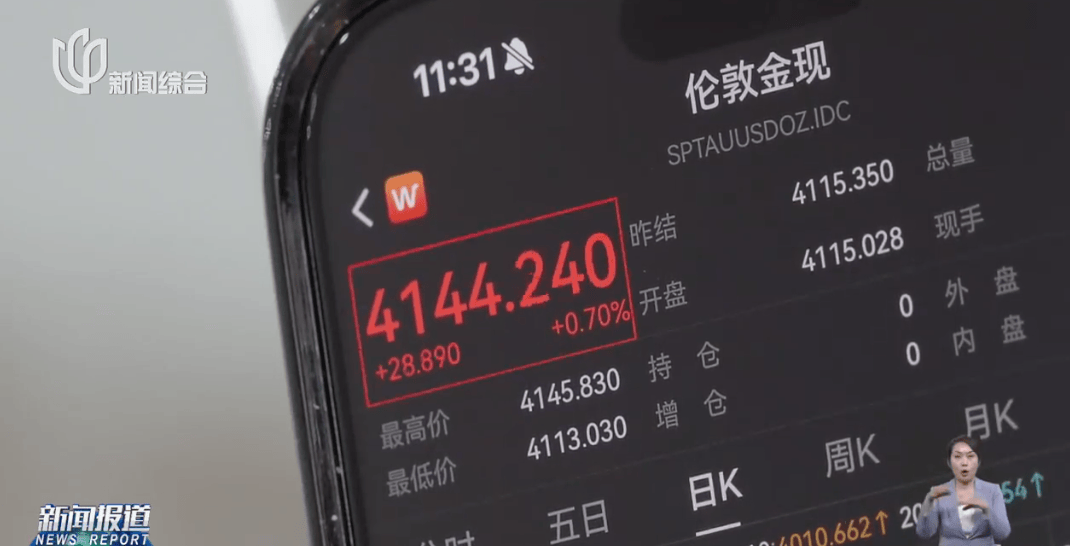
Core Viewpoint - International gold prices continue to rise, with spot gold surpassing $4,140 per ounce, marking an increase of over 3% this week [1][3]. Price Movements - Domestic gold jewelry prices have significantly increased by nearly 30 CNY per gram compared to yesterday, with some prices exceeding 1,300 CNY per gram, reaching new highs [3][5]. - Specific prices for gold jewelry include: Chow Tai Fook, Chow Sang Sang, and Chow Tai Sheng at 1,308 CNY per gram, while Lao Feng Xiang and Lao Miao gold jewelry are priced at 1,310 CNY per gram [5]. Market Dynamics - The high gold prices, combined with tax impacts, are expected to negatively affect gold sales. However, the demand for gold buying and exchanging services is anticipated to increase [9]. - A local gold shop owner noted a rise in customers exchanging old jewelry for new pieces, indicating a shift in consumer behavior due to high gold prices [11][12]. Future Outlook - Since reaching a historical high of $4,380 per ounce in mid-October, gold has decreased by approximately 6%, but it has still risen over 56% this year. Factors driving the recent price increase include a weaker dollar and geopolitical tensions [14]. - Analysts from China International Capital Corporation (CICC) predict that gold prices may continue to rise next year, supported by central bank purchases in emerging markets and potential economic pressures in the U.S. [14]. - Alex Wolf from JPMorgan forecasts that gold prices could reach $5,200 to $5,300 by the end of 2026, driven by central bank demand, particularly from countries like China, Poland, Turkey, and Kazakhstan [16]. - The People's Bank of China reported an increase in gold reserves to 74.09 million ounces as of the end of October, marking the 12th consecutive month of gold accumulation [18]. - The World Gold Council's report indicates that global central banks accelerated gold purchases in Q3, with a net purchase of 220 tons, a 28% increase from Q2 and a 10% year-on-year rise [18].
贵金属有色金属产业日报-20251111
Dong Ya Qi Huo· 2025-11-11 10:02
1. Report Industry Investment Rating No relevant content provided in the report. 2. Core Views of the Report - **Precious Metals**: In the medium - to long - term, central bank gold purchases and growing investment demand will push up the price of precious metals, but in the short - term (November), there is no strong driving force, and the market is in an adjustment phase [3]. - **Copper**: The spot market's purchasing sentiment is high, and the average price of 1 electrolytic copper is 86,535 yuan/ton with an expanding premium. However, when the price breaks through 86,000 yuan/ton, downstream counter - offer willingness increases. Whether the copper price can break through the trading - intensive area remains to be seen [12]. - **Aluminum**: Funds are the core factor affecting aluminum prices. There is a contradiction between funds and the industry. For alumina, it is on an over - supply path despite some price increases due to environmental restrictions [33]. - **Zinc**: In November, the TC dropped significantly due to intense competition for mines and limited domestic mine increments. There is a possibility of inventory reduction, and low inventory supports the price. There is some upward driving force in November, and export and macro factors need to be monitored [58]. - **Nickel**: Weak demand in the off - season suppresses the upward space. The Philippines' nickel mine production and shipment are affected by the rainy season and typhoons, and the price may remain strong in the short - term. Nickel iron prices are falling, and stainless - steel demand needs attention [74]. - **Tin**: Supply is weaker than demand due to limited resumption in Wabang and reduced concentrate imports. The Shanghai tin price will maintain a high - level shock, with a predicted support at around 276,000 yuan. There is a risk of price decline due to potential inventory accumulation [89]. - **Lithium Carbonate**: The supply increment is stable, and demand is strong in November. The market sentiment is positive. Technically, it is easy to rise and difficult to fall, maintaining a shock - upward trend [104]. - **Silicon**: The supply - demand pattern of industrial silicon and the polysilicon industry chain is weak, and both are expected to have wide - range fluctuations. Attention should be paid to market sentiment and policies [116]. 3. Summary by Relevant Catalogs Precious Metals - **Price Outlook**: Medium - to long - term upward trend, short - term adjustment in November [3]. - **Price Data**: SHFE gold and silver futures prices, COMEX gold and silver prices, and their ratios are presented in the report [4]. - **Spread Data**: SHFE and SGX gold and silver futures - spot spreads are shown [5][7]. - **Inventory Data**: SHFE and COMEX gold and silver inventories are provided [11]. Copper - **Spot Market**: High purchasing sentiment, average 1 electrolytic copper price at 86,535 yuan/ton, and expanding premium [12]. - **Futures Data**: The latest prices, daily changes, and daily change rates of Shanghai and London copper futures are given. For example, the latest price of Shanghai copper's main contract is 86,630 yuan/ton, with a daily increase of 0.17% [13]. - **Spot Data**: The latest prices, daily changes, and daily change rates of various domestic copper spot prices and premiums are presented [19][21]. - **Import and Processing**: Copper import profit is - 585.37 yuan/ton, and copper concentrate TC is - 42 dollars/ton [24]. - **Scrap - to - Refined Spread**: The current refined - scrap spread (tax - included) is 3,393.51 yuan/ton, with a daily increase of 13.58% [28]. - **Warehouse Receipts and Inventory**: Shanghai copper's total warehouse receipts are 42,964 tons, a decrease of 1.88% [29]. Aluminum - **Aluminum**: Funds drive the price, but there is a contradiction with the industry. Domestic supply is stable, and demand is weak [33]. - **Alumina**: Some price increases due to environmental restrictions, but overall in an over - supply situation [33]. - **Price Data**: The latest prices, daily changes, and daily change rates of Shanghai and London aluminum futures, alumina futures, and aluminum alloy futures are provided [35]. - **Spread Data**: Various spreads between different contracts of aluminum and alumina are presented [37][39]. - **Spot Data**: The latest prices, daily changes, and daily change rates of domestic and international aluminum spot prices and premiums are given [43]. - **Inventory Data**: Shanghai and London aluminum warehouse receipts and inventories, as well as alumina warehouse receipts, are reported [52]. Zinc - **Market Outlook**: TC dropped in November, and there is a possibility of inventory reduction. Low inventory supports the price, and there is upward driving force [58]. - **Price Data**: The latest prices, daily changes, and daily change rates of Shanghai and London zinc futures are provided [59]. - **Spot Data**: The latest prices, daily changes, and daily change rates of domestic and international zinc spot prices and premiums are presented [67]. - **Inventory Data**: Shanghai and London zinc warehouse receipts and inventories are reported [71]. Nickel - **Market Situation**: Weak demand in the off - season, affected by macro factors. Nickel mine prices may be strong, and nickel iron and stainless - steel demand need attention [74]. - **Price and Volume Data**: The latest prices, trading volumes, open interests, and warehouse receipt numbers of Shanghai and London nickel futures, as well as stainless - steel futures, are given [75]. Tin - **Market Outlook**: Supply is weaker than demand, and the price will maintain a high - level shock. There is a risk of price decline due to potential inventory accumulation [89]. - **Price Data**: The latest prices, daily changes, and daily change rates of Shanghai and London tin futures are provided [90]. - **Spot Data**: The latest prices, daily changes, and daily change rates of various tin spot products are presented [95]. - **Inventory Data**: Shanghai tin's warehouse receipts and London tin's inventory are reported [99]. Lithium Carbonate - **Market Outlook**: Supply is stable, demand is strong, and it is in a shock - upward trend [104]. - **Price Data**: The latest prices, daily changes, and weekly changes of lithium carbonate futures contracts are given [105]. - **Spot Data**: The latest prices, daily changes, and weekly changes of various lithium - related spot products, as well as their price differences, are presented [110]. - **Inventory Data**: The latest numbers, daily and weekly changes of Guangzhou Futures Exchange's lithium carbonate warehouse receipts and various social inventories are reported [114]. Silicon - **Market Outlook**: The supply - demand pattern of industrial silicon and the polysilicon industry chain is weak, with wide - range fluctuations expected [116]. - **Price Data**: The latest prices, daily changes, and daily change rates of industrial silicon spot and futures are provided [116]. - **Industry Chain Price**: The prices of polysilicon, silicon wafers, battery cells, components, and other products in the silicon industry chain are presented [123][124][125]. - **Production and Inventory**: The weekly production, inventory, and cost data of industrial silicon in Xinjiang and Yunnan, as well as the polysilicon inventory, are reported [130][134][143].
周大福、周大生收缩关店
2 1 Shi Ji Jing Ji Bao Dao· 2025-11-10 11:29
Group 1: Gold Investment Trends - Domestic gold ETF holdings increased significantly, reaching 193.749 tons by the end of September 2025, a year-on-year growth of 164.03% compared to 79.015 tons in the same period of 2024 [1] - The Shanghai Gold Exchange reported a total trading volume of 23.76 thousand tons for all gold products in the first three quarters of 2025, a year-on-year increase of 2.45%, with a trading value of 35.35 trillion yuan, up 41.55% [3] - Global gold demand reached a record high of 1313 tons in the third quarter of 2025, driven by strong investment demand, particularly in gold ETFs and central bank purchases [7][8] Group 2: Gold Consumption and Retail Challenges - Gold consumption in China declined by 7.95% year-on-year in the first three quarters of 2025, totaling 682.730 tons, with jewelry consumption dropping by 32.50% [3] - Major retail chains like Chow Tai Fook closed 905 stores in 2025, averaging 2.5 closures per day, marking a significant reduction from previous years of expansion [4] - The retail environment for gold jewelry is challenging, with companies like Chow Sang Sang reporting a net decrease of 560 stores, primarily in franchise locations, due to reduced consumer spending [5] Group 3: Central Bank Gold Reserves - As of October 2025, gold accounted for 30% of global central bank reserves, up from 24% in June, while the dollar's share decreased from 43% to 40% [7] - Central banks globally purchased 220 tons of gold in the third quarter of 2025, with total purchases for the year expected to exceed 1000 tons, continuing a strong trend from previous years [8] - Emerging markets are leading the gold buying trend, with countries like Poland and Turkey significantly increasing their gold reserves [8]

金价“狂飙”背后:深度剖析暴涨原因、投资时机与未来走向
Sou Hu Cai Jing· 2025-11-10 09:44
Group 1 - The recent surge in gold prices is attributed to multiple factors, including increased global economic uncertainty, rising geopolitical risks, and heightened market risk aversion, leading to a significant influx of funds into the gold market [3] - The fluctuation of the US dollar and expectations of interest rate cuts by the Federal Reserve have made gold more attractive as an investment, further driving up its price [3] - Central banks around the world are steadily increasing their gold reserves, providing strong support for gold prices from the demand side [3] - There has been a noticeable net inflow of funds into gold ETFs, indicating a recovery in institutional investor confidence towards gold [3] Group 2 - For long-term investors, gold plays a crucial role in risk diversification within asset allocation, and it is advisable to consider gradual investments during price dips to achieve stable asset appreciation [4] - Short-term speculators should exercise caution as gold prices are currently at relatively high levels, and market volatility may increase, necessitating careful stop-loss strategies [4] Group 3 - There are two prevailing viewpoints regarding the future trajectory of gold prices: the optimistic perspective suggests that ongoing global economic uncertainty and central bank purchasing trends will sustain demand for gold, allowing for further price increases [5] - The cautious perspective warns that gold prices may have already priced in most favorable factors, and a strengthening dollar or improved market sentiment could lead to a withdrawal of funds from the gold market, resulting in potential price corrections [5] - Overall, while the long-term allocation value of gold remains, short-term volatility is expected, and investors should maintain a rational approach to avoid impulsive trading decisions [5] Group 4 - Investors interested in gold can participate through various means, including physical gold (such as bars and coins), which is suitable for long-term holding and has preservation and collectible value [6] - Other options include paper gold or gold ETFs, which offer convenience and liquidity, as well as gold stocks and funds that are influenced by individual stock and market factors, requiring investors to possess market analysis skills and risk tolerance [7]
贵金属日评:美国就业表现趋弱支撑贵金属价格-20251110
Hong Yuan Qi Huo· 2025-11-10 05:51
1. Report Industry Investment Rating - There is no information about the report industry investment rating in the provided content. 2. Core View of the Report - The weak employment performance in the US supports the prices of precious metals. The high number of job cuts in US challenger enterprises in October and the decrease in non - farm employment private data have increased the probability of the Fed cutting interest rates in December. Additionally, factors such as geopolitical risks, expansion of fiscal deficits in many countries, and continuous gold purchases by central banks around the world may support precious metal prices [1]. 3. Summary by Related Catalogs 3.1 Market Data - **Shanghai Gold**: The closing price was 917.51 yuan/g, with a change of 0.13 yuan compared to the previous day and - 2.56 yuan compared to the previous week. The trading volume was 37,088, and the position was 255,562 [1]. - **Shanghai Silver**: The closing price was 38 yuan/10g, the trading volume was 460,064, and the position was 4,303,142 [1]. - **COMEX Gold Futures**: The closing price was 3,984.80 dollars/ounce, the trading volume was 183,645, and the position was 311,506. The inventory was 37,847,208.99 troy ounces [1]. - **London Gold Spot**: The price was 3,994.10 dollars/ounce [1]. - **COMEX Silver Futures**: The closing price was 48.23 dollars/ounce, the trading volume was 11,217, and the position was 102,295. The inventory was 483,133,331.10 troy ounces [1]. - **London Silver Spot**: The price was 48.70 dollars/ounce [1]. 3.2 Important Information - The US Treasury will auction 125 billion dollars in Treasury bonds this week, along with about 40 billion dollars in corporate bonds, posing a severe test to market liquidity. The US Bureau of Labor Statistics has postponed the release of the CPI report and suspended offline data collection [1]. 3.3 Long - Short Logic - The high number of job cuts in US challenger enterprises in October and the decrease in non - farm employment private data have increased the probability of the Fed cutting interest rates in December. The Fed provides liquidity to the inter - bank market through the Standing Repurchase Facility (SRF). Geopolitical risks in Russia - Ukraine, the Middle East, and US - Venezuela remain unresolved, and many central banks around the world are continuously buying gold, which may support precious metal prices [1]. 3.4 Trading Strategy - The strategy is to mainly lay out long positions when prices fall. For London gold, pay attention to the support level around 3,580 - 3,860 dollars/ounce and the resistance level around 4,180 - 4,384 dollars/ounce; for Shanghai gold, the support level is around 830 - 860 yuan/g and the resistance level is around 950 - 1,000 yuan/g. For London silver, the support level is around 39 - 42 dollars/ounce and the resistance level is around 50 - 55 dollars/ounce; for Shanghai silver, the support level is around 9,400 - 10,000 yuan/kg and the resistance level is around 11,600 - 12,400 yuan/kg [1].
预计黄金仍有反复
Hua Lian Qi Huo· 2025-11-09 11:56
1. Report Industry Investment Rating No relevant content provided. 2. Core View of the Report - Gold is expected to fluctuate, and there is still a probability of filling the previous gap. The medium - and long - term positive logic for gold remains, including potential Fed rate cuts, a weakening dollar, and central bank gold purchases due to global political and economic instability. It is recommended to hold the remaining long positions in gold medium - term and set stop - profits. For options, wait for opportunities to buy call options again [6]. 3. Summary According to Related Catalogs 3.1 Fundamental View - **Price Movement**: Since 2025, the price of the London gold and Shanghai gold indexes has increased by 51.55% and 49.17% respectively. Last week, they decreased by - 0.64% and - 0.07% respectively [4][17]. - **Inflation**: In June 2022, the CPI reached a high of 9.1% and then declined. The PCE also peaked in June 2022. Core CPI and core PCE showed a downward trend. Since February 2024, the CPI rebounded, and the decline of core inflation slowed or even reversed. In August, the PCE increased to 2.74% year - on - year, and the core PCE to 2.91%. In September, the US CPI inflation rose slightly, while the core CPI fell slightly and was lower than expected [4][20]. - **Interest Rates**: From mid - to late October 2023, the US medium - term Treasury bond yields declined until January this year. Since February 2024, they have rebounded, then fluctuated and declined near last year's high. Since September, they have fallen below the 2024 low and reached a new low [4][24]. - **Supply and Demand**: In 2024, the global gold supply - demand balance became less loose, mainly due to a large increase in investment demand. In China, gold supply increased slightly year - on - year, and demand also recovered, mainly due to a significant increase in investment demand. The central bank's gold purchases remained above 1000 tons. The domestic gold supply - demand is in a tight balance, mainly due to a significant increase in gold bars and coins. In the first half of 2025, investment demand increased significantly [4]. - **US Economy**: In August 2025, the US added 22,000 jobs, far lower than the market expectation of 70,000, reaching the lowest level since October last year. In August 2025, the average hourly wage of US non - farm employees increased by 0.4%, up 0.1% from the previous month. The unemployment rate in July remained at 4.3%. The non - farm employment data in August 2025 continued to be significantly weaker than expected [4][33]. 3.2 Strategy View and Outlook - **Outlook**: Last Friday, the main gold futures contract rebounded after hitting a low, with support at the 30 - day moving average. Gold is expected to fluctuate, and there is a chance to fill the previous gap. After the sharp rise in gold due to the Fed rate - cut expectations, the US government shutdown, and tariff hikes since the end of August, on the evening of October 21, the international gold price dropped significantly. The reasons are the decline in risk - aversion sentiment and profit - taking triggered by the overbought technical condition. However, the medium - and long - term positive factors for gold still exist [6]. - **Operation Suggestion**: Hold the remaining long positions in gold medium - term and set stop - profits. Wait for opportunities to buy call options [6]. 3.3 Industry Chain Structure (Periodic and Spot Markets) - Gold prices stopped falling last week. Since 2025, the London gold and Shanghai gold indexes have increased by 51.55% and 49.17% respectively, and last week they decreased by - 0.64% and - 0.07% respectively [15][17]. 3.4 Gold Supply and Demand - **Global and Domestic Supply - Demand Balance**: When the gold supply - demand is in a tight balance, it is conducive to rising gold prices; when it is in a weak balance, the impact on gold prices is small. In 2024, the global gold supply - demand became less loose, and in China, the supply increased slightly year - on - year while demand recovered, mainly due to increased investment demand [4][37]. - **Central Bank Gold Purchases**: In the second quarter of 2025, global central bank gold purchases continued to decline to 166.46 tons from 248.57 tons in the first quarter. From November 2022 to April 2024, the People's Bank of China continuously bought gold. After six consecutive months without purchases, it bought gold from November 2024 to September 2025, with a total purchase of 44.16 tons since 2024 [41]. - **ETF Demand**: In 2023, the gold holdings of ETFs decreased by 113.69 tons, and in 2024, they decreased by 28.46 tons. As of November 5, last week, gold ETFs increased their holdings by 1.55 tons, and in 2025, the holdings increased by 254.68 tons [45]. 3.5 Exchange Rate and Dollar Index - The domestic gold market has a slight premium over the international market. The report also presents data on the RMB exchange rate, the dollar index, and the exchange rates between the dollar and other currencies [69]. 3.6 Gold - Silver - Oil Ratio - The report provides data on the gold - silver ratio and the gold - oil ratio [73][75].
贵金属有色金属产业日报-20251107
Dong Ya Qi Huo· 2025-11-07 11:23
1. Report Industry Investment Rating No relevant content provided. 2. Core Viewpoints of the Report - For precious metals, although central bank gold purchases and growing investment demand will push up the price center of precious metals in the long - term, the short - term is in an adjustment phase, and there is expected to be no strong driving force in November [3]. - For copper, when the copper price drops to around 85,000 yuan/ton, downstream enterprises' replenishment enthusiasm increases, and the price has strong support at this level. However, whether orders will continue to increase needs further observation, and the upward momentum of the futures price is insufficient [17]. - For aluminum, the recent price increase is driven by speculative funds due to potential future supply - demand mismatches, but it contradicts the current fundamentals. The price of alumina may be weak in the short - term due to oversupply [37]. - For zinc, the TC in November has dropped significantly due to intense competition for ore at the smelting end. There is a possibility of inventory reduction in November, and the low inventory provides support for the price [60]. - For the nickel industry chain, the price of nickel ore may be supported during the rainy season in the Philippines. The new energy sector is in the peak season, but there is no upward driving force for prices. Nickel iron prices have been continuously lowered, and stainless steel spot sales are weak [76]. - For tin, the supply is weaker than demand, and the raw material problem at the supply end is difficult to solve in the short - term, so the Shanghai tin price will maintain a high - level shock [91]. - For lithium carbonate, the supply increment is stable, the demand is strong in November, and the price is likely to rise and difficult to fall, maintaining a shock - upward trend in the short - term [105]. - For the silicon industry chain, there is an expectation of production reduction at the industrial silicon supply end, and the demand has not improved. The fundamentals of polysilicon are still weak [116]. 3. Summaries According to Relevant Catalogs Precious Metals - **Price Trend**: The report presents the price trends of SHFE gold and silver futures, COMEX gold, and the gold - silver ratio [4]. - **Factor Analysis**: Analyzes the relationship between gold and the US dollar index, and the relationship between gold and the real interest rate of US Treasury bonds [8][15]. - **Inventory Situation**: Shows the inventory of SHFE and COMEX gold and silver [16]. Copper - **Futures Data**: The latest prices, daily changes, and daily change rates of Shanghai copper futures (main contract, continuous, etc.) and LME copper are provided [18]. - **Spot Data**: The latest prices, daily changes, and daily change rates of Shanghai Non - ferrous 1 copper, Shanghai Wumaotong, etc., as well as the spot premium and discount data are presented [23]. - **Import and Processing**: The copper import profit and loss, copper concentrate TC, and copper refined - scrap price difference are given [28][32]. - **Warehouse Receipt and Inventory**: The latest data and changes of Shanghai copper warehouse receipts and LME copper inventory are provided [33][35]. Aluminum - **Futures Data**: The latest prices, daily changes, and daily change rates of Shanghai aluminum futures, LME aluminum, and alumina futures are presented [39]. - **Spot Data**: The latest prices, daily changes, and daily change rates of East China aluminum, Foshan aluminum, etc., as well as the basis data are provided [46]. - **Inventory Situation**: The latest data and changes of Shanghai aluminum warehouse receipts, LME aluminum inventory, and alumina warehouse receipts are given [54]. Zinc - **Futures Data**: The latest prices, daily changes, and daily change rates of Shanghai zinc futures and LME zinc are provided [61]. - **Spot Data**: The latest prices, daily changes, and daily change rates of SMM 0 zinc and SMM 1 zinc, as well as the premium and discount data are presented [69]. - **Inventory Situation**: The latest data and changes of Shanghai zinc warehouse receipts and LME zinc inventory are given [73]. Nickel Industry Chain - **Futures Data**: The latest prices, changes, and trading volume of Shanghai nickel and stainless steel futures are provided [77]. - **Spot Data**: The average price of nickel spot is presented [82]. - **Downstream Situation**: The price and inventory of nickel ore, the profit rate of downstream products, and the price of nickel pig iron are analyzed [83][85][89]. Tin - **Futures Data**: The latest prices, daily changes, and daily change rates of Shanghai tin futures and LME tin are provided [91]. - **Spot Data**: The latest prices, daily changes, and daily change rates of Shanghai Non - ferrous tin ingots, 1 tin premium and discount, etc., are presented [96]. - **Inventory Situation**: The latest data and changes of Shanghai tin warehouse receipts and LME tin inventory are given [100]. Lithium Carbonate - **Futures Data**: The closing prices, daily changes, and weekly changes of lithium carbonate futures are provided [106]. - **Spot Data**: The latest prices, daily changes, daily change rates, weekly changes, and weekly change rates of lithium - related products are presented [110]. - **Inventory Situation**: The latest data and changes of Guangzhou Futures Exchange warehouse receipts and lithium carbonate social inventory are given [114]. Silicon Industry Chain - **Industrial Silicon**: The latest prices, daily changes, and daily change rates of industrial silicon spot and futures are provided [116][117]. - **Polysilicon and Downstream Products**: The prices of polysilicon, silicon wafers, battery cells, and components are presented [122][123][124]. - **Production and Inventory**: The production, inventory, and cost data of industrial silicon in Xinjiang and Yunnan are given [129][141][144].