股债跷跷板效应

Search documents
8月22日债市快讯:利率债又现跌势,扛不住了?此刻,该加仓还是减仓?
Sou Hu Cai Jing· 2025-08-23 10:47
Core Viewpoint - The bond market is experiencing significant downward pressure, with a notable increase in yields, while the stock market is thriving, leading to a shift in investor sentiment and capital allocation [1][2][4]. Group 1: Bond Market Dynamics - On August 22, the issuance of 30-year special government bonds reached 83 billion yuan, with a bid rate of 2.15%, but the subscription multiple was only 2.89 times, indicating weak market demand [1]. - The bond market has seen a decline since early August, particularly affecting long-term bond funds, with some funds experiencing daily net value drops exceeding 0.5% [1][6]. - The issuance results of the 30-year bonds heightened market concerns, as the issuance rate exceeded the secondary market rate of 2.075%, reflecting a lack of demand even for highly secure assets [6][7]. Group 2: Stock Market Influence - The A-share market is witnessing unprecedented growth, with the Shanghai Composite Index surpassing 3,800 points, leading to a significant influx of capital into equities [1][2]. - The "stock-bond seesaw" effect is evident, where a booming stock market results in a cooling bond market, as institutions prefer equities when expected returns are higher [2][4]. Group 3: Fund Performance - Different types of bond funds are showing varied performance; short-term bond funds remain stable, while ultra-long bond funds and interest rate bond funds have suffered significant losses [6][9]. - Mixed bond funds have performed well due to their limited equity exposure, effectively hedging against bond market declines [7]. Group 4: Future Outlook - The bond market's recovery may depend on the stock market's performance; if the A-share market remains strong, the bond market may continue to struggle [9][11]. - There is a potential for re-evaluation of bond investment opportunities as yields rise, with a key psychological threshold identified at a 1.80% yield for 10-year government bonds [11].

【笔记20250822— “英伟达不过如此,纳斯达克也就那样”】
债券笔记· 2025-08-22 14:23
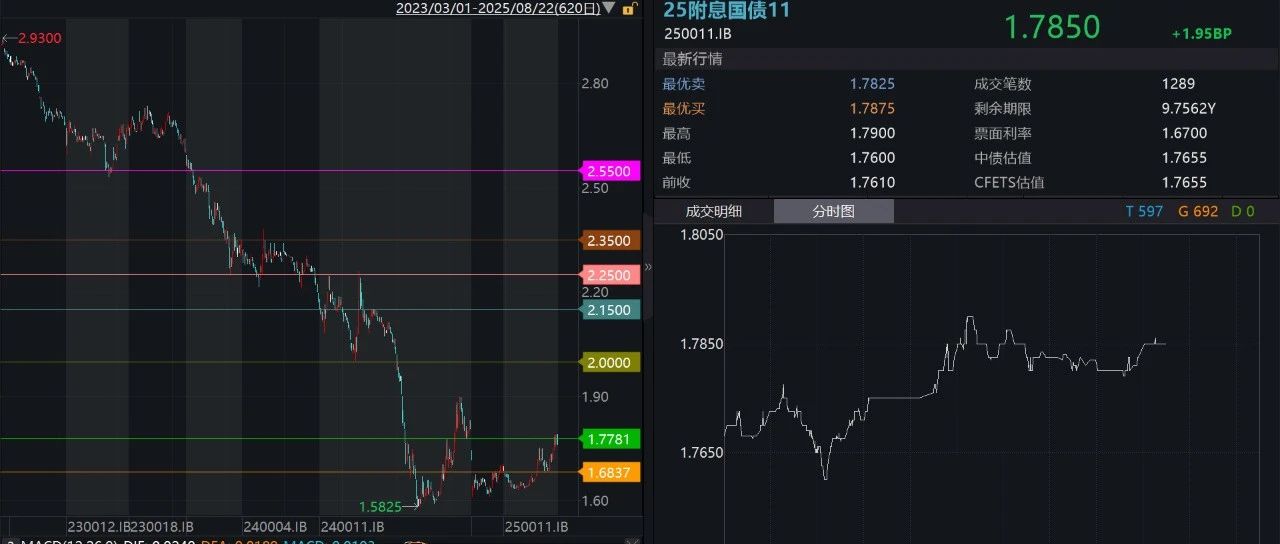
Core Viewpoint - The article discusses the current state of the stock market, which has risen above 3800 points, and the weak results of the primary issuance of government bonds, alongside a balanced and slightly loose liquidity environment [2][4]. Market Performance - The stock market showed strong performance, surpassing 3800 points, with a notable increase in trading activity. The A-share market took 5 trading days to rise from 3700 to 3800 points, indicating a rapid upward trend [4]. - The 10-year government bond yield opened slightly higher at 1.768% and fluctuated throughout the day, reaching a peak of 1.79% before settling at 1.785% [4]. Liquidity Conditions - The central bank conducted a 7-day reverse repurchase operation of 361.2 billion yuan, with 238 billion yuan maturing, resulting in a net injection of 123.2 billion yuan. Additionally, a 600 billion yuan MLF operation is scheduled for August 25, 2025, with a one-year term [2][4]. - The liquidity environment remains balanced and slightly loose, with the DR001 and DR007 rates around 1.41% and 1.47%, respectively [2]. Bond Market Insights - The primary issuance of government bonds was weak, leading to a slight increase in yields. The market reacted to guidance from major banks to purchase 30-year government bonds, which may have contributed to the observed fluctuations in bond yields [4]. - The overall trading volume in the interbank market was significant, with R001 and R007 rates at 1.45% and 1.48%, respectively, indicating a diverse range of trading activities [3].
债基八月遇冷大幅回撤,专家建议优选短债与“固收+”基金避险
Sou Hu Cai Jing· 2025-08-22 12:47
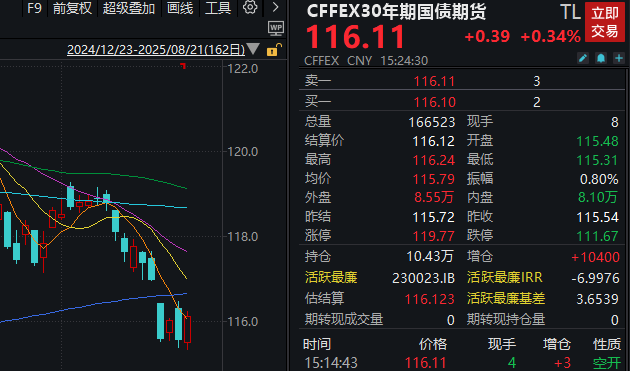
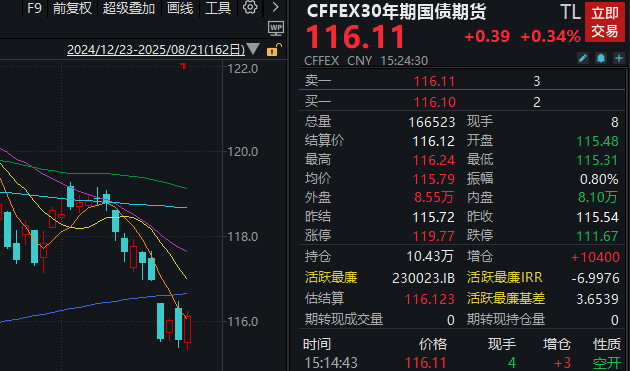
Core Viewpoint - The stock market has experienced a significant rally since August, while bond funds have struggled due to rising long-term bond yields and tightening liquidity conditions [1][4]. Group 1: Stock Market Performance - Since August 4, the A-share market has been on an upward trend, with the Shanghai Composite Index breaking a nearly ten-year high and the total market capitalization reaching a historical record [1]. - Trading activity in the A-share market has been robust, with daily transaction volumes exceeding 2 trillion yuan since August 13 [2]. Group 2: Bond Market Dynamics - The bond market has faced a sharp decline, particularly after August 7, with the 30-year government bond futures experiencing a significant drop of 1.33% on August 18 [2]. - As of August 20, over 660 bond funds reported negative returns for the month, with 86 funds experiencing net value losses exceeding 1% [4]. - The 30-year government bond yield rose from a low of approximately 1.95% to over 2.1%, while the 10-year yield increased from around 1.68% to nearly 1.79% [6]. Group 3: Fund Performance and Investor Behavior - On August 18, ten bond funds saw daily net value declines exceeding 1%, with the maximum drop reaching 1.63% [4]. - The recent strong performance of the stock market has intensified the negative correlation between stocks and bonds, leading many bond fund investors to shift towards equities [4][5]. - Institutional behavior has diverged, with funds and brokerages being net sellers of long-duration bonds, while large banks and insurance companies have increased their allocation to various durations of government bonds [5]. Group 4: Future Outlook - Analysts suggest that while the most severe adjustments in the bond market may have ended, full stabilization will depend on signals of easing liquidity or a cooling of stock market sentiment [5]. - Recommendations for bond fund investors include shortening duration to mitigate volatility and considering "fixed income plus" funds to enhance yield flexibility and reduce single-asset risk [5].
股牛来了,债市全无机会?
Hu Xiu· 2025-08-22 03:46
Core Viewpoint - The stock market is experiencing significant growth, with the Shanghai Composite Index up 12.8% and the ChiNext Index up 22% in 2025, while the bond market is facing challenges, with a 30-year government bond ETF down over 2% year-to-date and a further decline of 4% since June [1][2] Group 1: Market Dynamics - The "see-saw effect" between stocks and bonds reflects a shift in market risk appetite, where funds flow into equities during bullish phases and retreat to bonds during bearish phases [1][2] - The primary determinants of bond market trends are economic fundamentals, including macroeconomic conditions, inflation, and monetary policy, rather than stock market performance [2][3] Group 2: Economic Indicators - Recent economic data indicates a weakening trend, with July's new loans showing negative growth for the first time since 2005 and a decline in social financing year-on-year [2][3] - Despite these indicators suggesting support for the bond market, the bond market continues to decline due to strong stock performance and policy disruptions, indicating a temporary disconnection from economic data [2][3] Group 3: Investment Strategies - In a bullish stock market, the bond market may not present high value, but there are opportunities for tactical trading, suggesting a strategy of buying low and selling high [4][5] - Monitoring the 10-year and 30-year government bond yields is crucial, as bond prices and yields move inversely; rising yields lead to falling bond prices and vice versa [4][5] Group 4: Historical Context - Over the past decade, the long-term trend in China's bond market has been a decline in yields, with the 10-year government bond yield currently around 1.76% and the 30-year yield at 2.06% [5][6] - Historical data shows that current yields are at a low point, but there is potential for further declines, indicating a long-term downward trend in interest rates [6][7] Group 5: Tactical Approaches - For short-term trading, flexibility is key; if yields rise, it presents buying opportunities, while falling yields may prompt profit-taking [6][7] - For long-term investments, considerations include duration selection, risk-return trade-offs, and alignment with market conditions, emphasizing the importance of rational decision-making [7]
申银万国期货首席点评:“万亿用电+万亿成交”双破纪录背后的中国经济新韧性
Shen Yin Wan Guo Qi Huo· 2025-08-22 02:06
Report Summary 1. Report Industry Investment Rating No information provided in the report. 2. Core Viewpoints - The Chinese economy shows new resilience with the dual records of "trillion - kilowatt - hour electricity consumption and trillion - yuan trading volume". The policy combination is effective, and a positive cycle has been formed [1]. - The domestic stock market is in a resonance period of "policy bottom + fund bottom + valuation bottom", and the market trend is likely to continue, but investors need to adapt to accelerated sector rotation and structural differentiation [2]. - Various commodities have different trends affected by factors such as supply and demand, geopolitics, and policies [2][3]. 3. Summary by Relevant Catalogs a. Chief Comment - A - share market major indices are rising, with the Shanghai Composite Index, Shenzhen Component Index, and ChiNext Index up 12.51%, 14.45%, and 21.19% respectively this year. The trading volume of the Shanghai and Shenzhen stock markets frequently exceeds 2 trillion yuan, and the margin trading balance is at a historical high [1]. - In July, the total social electricity consumption reached 1.0226 trillion kilowatt - hours, a year - on - year increase of 8.6%, doubling compared to a decade ago [1]. - China's foreign trade maintains a steady - to - improving trend, with the cumulative import and export growth rate rising month by month, achieving a 3.5% increase in the first seven months [1]. b. Key Varieties - **Equity Index**: The equity index shows differentiation. The domestic liquidity is expected to remain loose in 2025, and more incremental policies may be introduced in the second half of the year. The external risks are gradually easing. The CSI 500 and CSI 1000 indices with more technology - growth components are more offensive, while the SSE 50 and CSI 300 indices with more dividend - blue - chip components are more defensive [2]. - **Precious Metals**: Gold and silver are in a volatile state. The market is waiting for signals from Powell's speech at the Jackson Hole meeting. The long - term drivers of gold still provide support, and the overall trend of gold and silver may be volatile with the increasing expectation of interest rate cuts [3]. - **Crude Oil**: International oil prices continue to rise due to the decline in US crude oil inventories, strong oil demand, and the uncertainty of efforts to end the Russia - Ukraine conflict. The hurricane season in 2025 is relatively calm so far [3]. c. Main News Concerns - **International News**: The EU and the US announced details of a new trade agreement. The US will impose a 15% tariff on most EU goods, while the EU will cancel tariffs on US industrial products and provide preferential market access for US seafood and agricultural products. The EU plans to purchase $750 billion of US liquefied natural gas, oil, and nuclear products and $40 billion of US AI chips by 2028 [5]. - **Domestic News**: The State Council agreed in principle to the "Development Plan for the Open and Innovative Development of the Whole Biopharmaceutical Industry Chain in the China (Jiangsu) Free Trade Pilot Zone" [6]. - **Industry News**: In July, the total social electricity consumption exceeded 1 trillion kilowatt - hours for the first time globally, with a significant increase in the proportion of new energy [7]. d. Morning Comments on Main Varieties - **Financial**: - **Equity Index**: The US three major indices fell. The domestic equity index shows differentiation, and the market trading volume is 2.46 trillion yuan. The market is in a favorable period, but investors need to pay attention to sector rotation [10]. - **Treasury Bonds**: Treasury bonds rebounded after reaching the bottom. The central bank's monetary policy is loose, which supports short - term treasury bond futures prices, but the stock - bond seesaw effect may suppress the bond market, and the cross - variety spread may widen [11]. - **Energy and Chemicals**: - **Crude Oil**: Oil prices continue to rise due to factors such as inventory decline and demand. The hurricane has not affected key oil and gas infrastructure. The number of initial jobless claims in the US increased, and the OPEC's production increase situation needs to be monitored [12]. - **Methanol**: Methanol prices fell at night. Coastal methanol inventories increased significantly, and the short - term trend is mainly bullish [13]. - **Rubber**: The price of rubber is mainly supported by the supply side. The demand side is weak, and the short - term trend is expected to continue to correct [15]. - **Polyolefins**: Polyolefin futures rebounded. The market is mainly driven by supply and demand. The inventory is slowly being digested, and the terminal demand may pick up in mid - to - late August [16]. - **Glass and Soda Ash**: Similar to polyolefins, the market is driven by supply and demand, and attention should be paid to the autumn stocking market and supply - cost changes [17]. - **Metals**: - **Precious Metals**: Gold and silver are volatile, waiting for signals from Powell's speech. The long - term drivers of gold still support the price, and the overall trend may be volatile [18]. - **Copper**: Copper prices may fluctuate within a range due to factors such as low concentrate processing fees and stable downstream demand [19]. - **Zinc**: Zinc prices may fluctuate widely. The supply of concentrates has improved, and the smelting supply may recover [20]. - **Lithium Carbonate**: The short - term trend is affected by sentiment. The supply is expected to increase slightly in August, and the demand is also expected to increase. The inventory situation is complex, and the price may have room to rise if the inventory is depleted [21]. - **Black Metals**: - **Iron Ore**: The demand for iron ore is supported by strong production. The global iron ore shipment has decreased recently, and the mid - term supply - demand imbalance pressure is large. The market is expected to be volatile and bullish [22]. - **Steel**: The supply pressure of steel is gradually emerging, but the supply - demand contradiction is not significant. The market is expected to be volatile and bullish [23]. - **Coking Coal and Coke**: The futures of coking coal and coke are in a wide - range volatile state, with intense long - short competition [24]. - **Agricultural Products**: - **Protein Meal**: Bean and rapeseed meal are weakly volatile at night. The US soybean production is expected to be good, but the reduction in planting area provides support. The domestic market is expected to be range - bound [25]. - **Oils and Fats**: Oils and fats rose at night. The production and export of Malaysian palm oil increased in August, but there are risks of a short - term decline due to factors such as US biodiesel news [26]. - **Sugar**: International sugar prices are expected to be volatile as the global sugar market is about to enter the inventory - accumulation stage. The domestic sugar market is supported by high sales - to - production ratios and low inventories, but import pressure may drag down prices [27]. - **Cotton**: US cotton prices fell. The domestic cotton market supply is relatively tight, but the demand is in the off - season. The short - term trend is expected to be volatile and bullish with limited upside space [28]. - **Shipping Index**: - **Container Shipping to Europe**: The EC index is weakly volatile. The freight rate has been decreasing, and the short - term decline may slow down. The high - volume capacity supply may increase the downward pressure on freight rates during the off - season [29].
“万亿用电+万亿成交”双破纪录背后的中国经济新韧性 -20250822
申银万国期货研究· 2025-08-22 00:33
Core Viewpoint - The article highlights the resilience of the Chinese economy, evidenced by record electricity consumption and trading volumes in the stock market, indicating a positive economic outlook and effective policy measures [1]. Group 1: Economic Indicators - The A-share market indices have shown strong performance, with the Shanghai Composite Index, Shenzhen Component Index, and ChiNext Index rising by 12.51%, 14.45%, and 21.19% respectively year-to-date [1]. - In July, China's total electricity consumption reached 10,226 billion kilowatt-hours, marking an 8.6% year-on-year increase and doubling compared to ten years ago [1][7]. - China's foreign trade maintained a steady growth trajectory, with total import and export value reaching 25.7 trillion yuan in the first seven months of the year, reflecting a 3.5% year-on-year increase [1]. Group 2: Policy Developments - The State Administration of Foreign Exchange has initiated pilot green foreign debt projects in 16 provinces and cities, encouraging non-financial enterprises to use cross-border financing for green or low-carbon transformation projects [1]. - The government is expected to introduce more incremental policies in the second half of the year to boost the real economy, as the domestic liquidity remains accommodative [2]. Group 3: Market Dynamics - The stock market is currently in a phase characterized by a "policy bottom + liquidity bottom + valuation bottom," suggesting a high probability of continued market performance, albeit with accelerated sector rotation and structural differentiation [2][10]. - The agricultural, forestry, animal husbandry, and fishery sectors have led the market gains, while the machinery and equipment sector has lagged [2]. Group 4: Energy Sector Insights - The significant increase in electricity consumption is paralleled by a strong performance in the energy sector, with renewable energy sources like wind and solar power rapidly increasing their share, accounting for nearly a quarter of total consumption [1][7]. - The article notes the impact of external factors, such as the U.S. Federal Reserve's interest rate decisions and trade negotiations, on market dynamics and investor sentiment [3][4].

含权类银行理财产品 吸引力凸显
Zheng Quan Ri Bao· 2025-08-22 00:02
Core Viewpoint - The recent strong performance of the equity market has led to a noticeable shift in investor preference from pure fixed-income products to "fixed income + equity" products, resulting in increased marketing efforts by banks for these products [1][4]. Group 1: Market Trends - The equity market's upward trend has caused some investors to redeem pure fixed-income products in favor of higher-risk, equity-inclusive "fixed income +" products [3]. - In July, the average annualized yield for cash management and fixed-income products decreased to 1.50% and 2.73%, respectively, while mixed and equity products saw increases to 3.64% and 9.93% [3]. - The average annualized yield for bank wealth management products dropped to 2.12% in the first half of 2025, down from 2.65% in 2024 and 2.94% in 2023, indicating a challenging environment for traditional fixed-income products [4]. Group 2: Product Characteristics - "Fixed income + equity" products typically allocate over 80% to fixed-income assets while including a small portion of equity assets, offering higher overall returns with moderate risk [2]. - Certain mixed products linked to passive indices, such as the "Zhongyin Wealth Management - Smart Index Tracking Strategy," have reported impressive annualized yields of 12.70% over the past month [3]. Group 3: Opportunities and Challenges - The rise of equity-inclusive wealth management products is driven by declining yields in traditional fixed-income products and a strong equity market performance, creating a demand for enhanced returns [4][5]. - Banks face challenges in promoting these products due to their traditional customer base's low risk tolerance and sensitivity to market fluctuations, necessitating improved research and investment capabilities [5][6]. - Recommendations for banks include enhancing investment research capabilities, optimizing product design to balance risk and return, and tailoring offerings to meet diverse investor needs [5][6].
含权类银行理财产品吸引力凸显
Zheng Quan Ri Bao· 2025-08-21 16:43
Core Viewpoint - The recent strong performance of the equity market has led to a noticeable shift in investor preference from pure fixed-income products to "fixed income + equity" products, resulting in increased marketing efforts by banks for these products [1][4]. Group 1: Market Trends - The equity market's upward trend has caused some investors to redeem pure fixed-income products in favor of higher-risk, equity-inclusive "fixed income +" products [3]. - The average annualized yield of cash management and fixed-income products has decreased to 1.50% and 2.73% respectively in July, while mixed and equity products have seen increases to 3.64% and 9.93% [3]. - The average annualized yield of bank wealth management products has dropped from 2.94% in 2023 to 2.12% in the first half of 2025, indicating a downward trend in traditional fixed-income yields [4]. Group 2: Product Development - Banks are increasingly promoting "fixed income + equity" products, which typically allocate over 80% to fixed-income assets while including a small portion of equity assets, offering higher overall returns with moderate risk [2][5]. - Certain mixed wealth management products linked to passive indices have shown impressive annualized yields, such as a product from Bank of China with a yield of 12.70% over the past month [3]. Group 3: Challenges and Opportunities - The rise of equity-inclusive wealth management products presents both opportunities and challenges, as banks must navigate the low-risk appetite of traditional clients and the inherent volatility of equity markets [5][6]. - To enhance their research capabilities, banks are encouraged to incorporate experienced equity or quantitative teams and optimize product design to balance risk and return [5][6].
股债跷跷板效应显现 债市配置价值几何?
Zhong Guo Jing Ying Bao· 2025-08-21 16:33
Core Viewpoint - The bond market is experiencing continuous adjustments due to multiple factors, including monetary policy, tax periods, and risk preferences in the equity market, leading to a challenging environment for bonds [1][2]. Group 1: Bond Market Performance - The bond market has shown weak performance since August, with long-term bond yields rising significantly during the week of August 11-17 [2]. - Current market sentiment is characterized by a "strong risk appetite, weak reality," indicating that the bond market is sensitive to risk preferences in equity and commodity markets [2][3]. - The bond market is expected to continue its weak trend in the short term, with the 10-year government bond yield anticipated to stabilize between 1.75% and 1.80% [2]. Group 2: Factors Influencing the Bond Market - The adjustment in the bond market is seen as a correction rather than a reversal, with potential investment opportunities arising from oversold conditions [2][3]. - The People's Bank of China has emphasized maintaining a balanced liquidity environment, which is expected to support short-term bonds [2]. - The ongoing "anti-involution" policies may lead to a sustained increase in market risk appetite, further impacting the bond market [2]. Group 3: Policy Support for the Bond Market - The Ministry of Finance has initiated bond market support operations to enhance liquidity and stabilize the government bond yield curve amid ongoing adjustments [4]. - Specific operations involve 2.7 billion yuan of 3-year bonds and 2.8 billion yuan of 2-year bonds, aimed at improving market dynamics [4]. - Analysts believe that the bond market's performance will ultimately depend on economic fundamentals, despite short-term disturbances from the equity market [4].
债基短期大跌 专家支招避险 →
Guo Ji Jin Rong Bao· 2025-08-21 16:26
Core Viewpoint - The recent surge in the A-share market has led to a significant decline in bond funds, with many experiencing losses that have wiped out their annual gains, indicating a strong negative correlation between the stock and bond markets during this period [1][2][4]. Group 1: Market Performance - Since August 4, the A-share market has risen sharply, with the Shanghai Composite Index reaching a nearly ten-year high and the total market capitalization of A-shares hitting a historical peak [1]. - As of August 20, over 600 bond funds reported negative returns for the month, with 86 funds experiencing net value losses exceeding 1% [1][4]. - On August 18, ten bond funds recorded single-day losses greater than 1%, with the highest loss reaching 1.63% [4]. Group 2: Bond Market Dynamics - The bond market has seen a sharp decline, particularly in long-term government bonds, with the 30-year bond yield rising from around 1.95% to over 2.1% since August 8 [6]. - The volatility in bond fund net values has become comparable to that of equity funds, with many bond funds losing all their gains from earlier in the year within a month [4][7]. - The recent bond market adjustments are attributed to multiple factors, including the strong performance of the stock market and reduced expectations for interest rate cuts [8]. Group 3: Investor Behavior and Recommendations - Investors are advised to consider shortening the duration of their bond holdings to mitigate volatility, with a preference for medium to short-term bond funds [9][10]. - The shift of funds from the bond market to the stock market has been exacerbated by the strong performance of equities, leading to a "see-saw" effect between the two markets [8]. - Institutional behaviors have diverged, with some funds and brokerages reducing their exposure to long-duration bonds, while larger banks and insurance companies are increasing their allocation to various durations of government bonds [8].