信用周期

Search documents
港股策略专题:如何在美A港三地中做出选择?
CICC· 2025-12-14 13:29
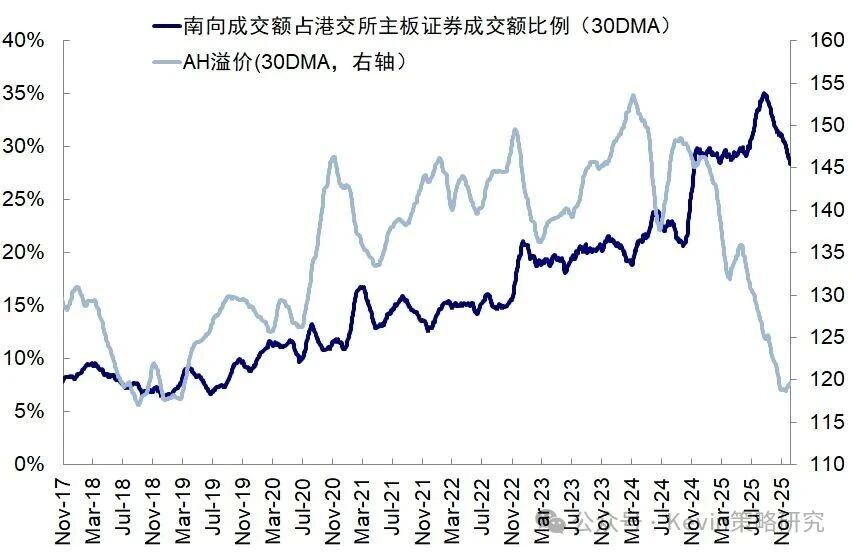
Core Insights - The report highlights the shifting dynamics among the US, A-share, and Hong Kong markets, indicating a "seesaw" effect where one market's performance impacts the others. The first quarter saw a revaluation of Chinese assets led by DeepSeek, while the second quarter was characterized by strong performance in US stocks driven by AI leaders and capital expenditure growth [1][2] - Since late November, Hong Kong stocks have underperformed compared to US and A-shares, with the Hang Seng Index and Hang Seng Tech Index showing declines of 2.2% and 0.7% respectively, while the Shanghai Composite and US indices posted gains [2][3] - The report attributes the recent weakness of Hong Kong stocks to their sensitivity to liquidity changes and structural differences, with a notable slowdown in southbound capital inflows and external liquidity support [3][4] Market Dynamics - Southbound capital inflows have decreased significantly, with a 10-day moving average dropping from an average of 7 billion HKD to below 1 billion HKD, leading to concerns about potential fund outflows due to regulatory changes [3][4] - External liquidity has also been a concern, with active foreign capital flowing out of Hong Kong while inflows into A-shares have continued. The report notes that recent hawkish signals from the Federal Reserve have contributed to a lack of external liquidity support for Hong Kong stocks [3][4] - Despite the short-term liquidity disturbances, the report suggests that the fundamental weakness in the market has amplified negative sentiment, particularly in the context of the unique industry structure of Hong Kong stocks [4][5] Sector Analysis - The technology sector, primarily focused on internet applications in Hong Kong, faces concerns over an AI bubble, while A-shares benefit from a higher proportion of hardware-related stocks, providing stronger support [5][6] - The consumer sector in Hong Kong, particularly discretionary spending, is struggling due to weak domestic consumption recovery and a declining credit cycle, which limits its potential as a market driver [5][6] - The cyclical sector has shown some strength, particularly in metals, but its overall weight in the Hong Kong market is low, limiting its ability to provide substantial support [5][6] Future Outlook - The report anticipates that Hong Kong stocks will be more sensitive to liquidity and fundamental changes, with potential for stronger performance if the credit cycle improves and risk appetite increases [5][6] - Historical patterns indicate that Hong Kong stocks tend to outperform during periods of fundamental recovery and ample liquidity, but recent trends suggest a need to consider structural differences among the markets [6][7] - For 2026, the report emphasizes the importance of liquidity, fundamental conditions, and structural opportunities in determining market performance, with a focus on the potential for recovery in the US credit cycle and the challenges facing the Chinese credit cycle [9][10]
中金:近期港股为何在三地中走得更弱?
Zhi Tong Cai Jing· 2025-12-09 09:57
Core Viewpoint - The recent underperformance of Hong Kong stocks compared to the US and A-share markets is attributed to a combination of factors including a declining credit cycle, liquidity pressure, and a mismatch between fundamentals and expectations [1][2]. Group 1: Market Performance - Hong Kong stocks have shown particular weakness among the three markets, influenced by a shrinking southbound capital flow and the upcoming expiration of lock-up periods for major IPOs [2][4]. - Concerns over the Bank of Japan's potential interest rate hike and the Federal Reserve's stance have contributed to the market's volatility, with US Treasury yields rising despite a recent rate cut by the Fed [2][4]. Group 2: Credit Cycle and Fundamentals - The key issue is the downward trend in the credit cycle, which has been evident for the past two months, leading to a likely stagnation or phase of slowdown in private credit and overall credit cycles unless there is significant policy intervention [4][6]. - The current market dynamics reflect a disconnect between the fundamentals and expectations, particularly in the technology sector, where high valuations and investor sensitivity to negative news are prevalent [6]. Group 3: Sector Analysis - The report outlines four main sectors: 1. AI requires new industrial catalysts, with hardware visibility being more significant than application visibility [6]. 2. Strong cyclical sectors are influenced by US fiscal and real estate demand, alongside rising domestic PPI [6]. 3. Consumer sectors lack fundamental support, making them less attractive [6]. 4. Dividend stocks provide stable returns but lack upward elasticity [6][7]. Group 4: Economic Indicators - Investors should monitor the PPI year-on-year growth rate and the M1 money supply growth rate, as these indicators may signal a potential turning point in private sector financing and economic activity [8].

中金研究 | 本周精选:宏观、策略、航空航天科技
中金点睛· 2025-12-06 01:08
Group 1: Strategy - The article discusses the investment strategy for the upcoming market phase, suggesting a "barbell" portfolio approach that combines dividend stocks and technology internet stocks as a base, while dynamically adjusting weights based on market conditions [6] - It emphasizes the importance of the credit cycle as a guiding framework for macroeconomic direction and investment choices, recommending cyclical sectors like non-ferrous metals and innovative pharmaceuticals as flexible options for the portfolio [6] Group 2: Macro Economy - The article highlights the divergence between A-shares and economic fundamentals since last year's "924" event, suggesting that stable profit growth and elevated valuation levels can sustain a long-term bull market in A-shares despite economic transitions [10] - It points out that both asset-side factors (growth potential, high-quality overseas expansion, and improved corporate governance) and funding-side factors (sustained domestic and foreign capital inflows) are crucial for the long-term bullish trend in A-shares [10] Group 3: Industry - The report on commercial rockets outlines their significance in achieving low-cost and large-scale access to space, detailing the development status, technological pathways, and cost-reduction strategies in the commercial rocket sector [13] - It notes that the demand for commercial rockets is expected to grow, driven by satellite internet, and highlights the investment opportunities in rocket manufacturers and their core suppliers [13]

港股及海外市场展望
2025-12-04 02:22
Summary of Conference Call Notes Industry Overview - The conference call discusses the outlook for the Hong Kong and overseas markets in 2025, highlighting frequent asset rotation driven by credit expansion expectations [1][2] - The U.S. market is experiencing a credit cycle recovery, with expectations of a volatile or slowing trend in 2026, influenced by emerging demand, government spending, and potential Fed rate cuts [1][5] - The Chinese market is characterized by excess liquidity chasing scarce return assets, but reliance solely on liquidity is insufficient for sustained market growth [1][8] Key Points and Arguments Credit Cycle and Market Dynamics - The credit cycle is expected to gradually stabilize in Q4 2025, with a focus on the gap between actual and natural interest rates, industry trends, and policy support [1][10] - The investment strategy should align with credit expansion directions, favoring stable return assets during downturns and cyclical sectors during expansions [3][4][17] U.S. Market Insights - The U.S. market is projected to have a positive outlook, supported by a 13% to 16% earnings growth, despite high short-term valuations and risks [5] - AI technology is highlighted as a significant area of potential, with companies saving an average of 10% through AI, translating to approximately $300 billion in annual savings for S&P 500 companies [5][13] Gold Market Evaluation - Gold is viewed as a long-term value asset and a partial substitute for dollar credit, with a recommendation for a dollar-cost averaging investment strategy [1][7] - If gold prices reach $5,500, its total value could exceed the total value of U.S. Treasury bonds, indicating its potential as a hedge against dollar depreciation [7] Chinese Market Challenges - The Chinese market faces challenges related to excess liquidity and the need for fundamental support to sustain growth [8][9] - Historical lessons from Japan suggest that relying solely on liquidity without addressing income expectations and debt pressures can lead to market stagnation [9] Policy Effectiveness and Investment Strategy - The effectiveness of policies is prioritized as follows: finding new growth points, enhancing income expectations, and alleviating debt pressures [11] - The Hong Kong market index is projected to reach between 26,000 and 29,000 points under baseline scenarios, with a focus on dividend stocks and banking sectors as investment strategies [2][12] Sector Opportunities - Certain sectors, particularly those with low valuations and strong demand expectations, are identified as having trading opportunities [15] - External demand is significantly impacting the economic structure, with strong export demand driven by supply chain restructuring in emerging markets [16] Additional Important Insights - The bond market is experiencing unexpected rate cut expectations, suggesting a need for intermittent trading strategies to mitigate risks associated with Fed policy changes [6] - The potential for cyclical shifts in sectors like chemicals and coal is noted, as some investors may view these as opportunities for trading based on credit cycle dynamics [14]
中金:维持恒指乐观26,000点预测不变 可延续“红利+科技互联网”组合作为配置底仓
智通财经网· 2025-12-02 02:07
Group 1 - The market has been experiencing volatility and lack of direction due to high expectations and positions in the technology growth sector, alongside concerns about the AI bubble and cooling interest rate cut expectations from the Federal Reserve, leading to a significant pullback in the Hang Seng Technology Index by approximately 16.6% from its peak [1] - The domestic consumption and real estate sectors, despite attractive valuations and positions, have seen a weakening of fundamentals, making it difficult for investors to reach a consensus [1] - The banking sector has rebounded nearly 10% from the end of September, emerging as a preferred choice in the current environment of uncertainty [1] Group 2 - Over the past two years, the essence of China's asset dynamics can be summarized as the pursuit of "scarce assets" driven by "excess liquidity," with market consensus rapidly inflating asset prices once they are recognized as scarce [2] - The technology sector remains a sustained growth direction, with hardware in A-shares showing greater elasticity and software in Hong Kong stocks demonstrating resilience, although high valuations and expectations necessitate additional industry progress or liquidity to catalyze growth [3] - Domestic consumption and real estate chains, while having low expectations and valuations, face challenges in forming a lasting consensus due to weakening fundamentals, although policy catalysts could create temporary trading opportunities [3] Group 3 - Dividend stocks continue to be a good hedge against the backdrop of domestic credit contraction [3] - External demand chains should focus on strong and early cycles, with potential catalysts from increased physical investment due to U.S. fiscal policies ahead of midterm elections and unexpected Federal Reserve rate cuts [3] - An "barbell" investment strategy combining dividends and technology internet stocks is recommended, with dynamic adjustments to weights based on market conditions to achieve effective hedging and balance [4]
信用周期与行业选择
2025-12-01 16:03
Summary of Key Points from Conference Call Records Industry Overview - The current market fundamentals and expectations are misaligned, particularly affecting the technology sector due to profit-taking pressures and negative news, leading to increased volatility. The domestic demand sector is struggling with weak fundamental data, making dividend stocks a relatively beneficial alternative choice [1][3][6]. - The domestic credit cycle is experiencing fluctuations or a potential downturn. If policy measures in Q4 are insufficient, a phase of credit contraction may occur. Foreign investment in the Chinese market shows divergence, suggesting a focus on sectors that can provide credit expansion, such as technology innovation and dividend stocks [1][3][9]. Core Insights and Arguments - The macro environment appears deflationary overall, but localized liquidity excess is causing valuation disparities in the secondary markets for technology and consumption. Effective demand is insufficient, primarily determined by the credit cycle [1][5]. - Looking ahead, the credit cycle may experience fluctuations or slowdowns due to high base effects, real estate drag, and the pace of policy implementation. It is essential to seek sectors that can provide credit expansion, such as technology innovation and dividend stocks [1][6][10]. - The Hang Seng Index is projected to reach a benchmark level between 28,000 and 29,000 points by 2026, suggesting a "barbell" strategy combining dividend stocks and AI-related internet giants to balance volatility [1][8][12]. Important but Overlooked Content - Chinese residents' personal medical and health expenditure is significantly higher than that of developed countries, with a 33.6% share of total health expenditure in 2022. This creates space for the development of commercial health insurance, although challenges such as low market share and insufficient coverage of out-of-pocket expenses need to be addressed [15][16][17]. - The development of commercial health insurance is hindered by several issues, including low market share (4%-7%), inadequate coverage of out-of-pocket expenses, and insufficient cooperation between the medical service system and commercial insurance [17][18]. - To promote the development of commercial health insurance, external forces such as the Medical Insurance Bureau and financial regulatory authorities need to intervene through reforms and policy adjustments to ensure basic medical insurance returns to its fundamental role [2][19][20]. Investment Strategy Recommendations - In the current credit cycle context, it is advisable to focus on sectors that can provide credit expansion, such as technology innovation and dividend stocks, while also considering the need for further monetary easing to address the gap between costs and returns [9][11][12]. - A "barbell" investment strategy is recommended, balancing dividend stocks with sectors benefiting from AI and innovation, while also being mindful of market conditions and the timing of policy interventions [12][22].
中金:港股震荡中红利成“避风港” 聚焦红利资产及三大结构机会
智通财经网· 2025-12-01 00:20
Core Viewpoint - The Hong Kong stock market has been experiencing volatility and lacks direction over the past two months, with dividend stocks emerging as a preferred choice in this uncertain environment [2][5]. Group 1: Market Overview - The market has been characterized by fluctuations, with high expectations and positions in the technology growth sector making investors sensitive to negative news, exacerbated by concerns over AI bubbles and the Federal Reserve's interest rate outlook [2][5]. - The banking sector has rebounded nearly 10% since the end of September, indicating a preference for dividend stocks amidst the market's indecision [2][5]. - The Hang Seng Index's optimistic target of 26,000 points remains valid despite recent fluctuations [2]. Group 2: Investment Themes - Dividend assets are seen as a hedge against weak domestic demand, with the Hong Kong stock dividend yield still attractive, although the selection of such assets is narrowing [46]. - The AI industry is expected to continue benefiting from domestic policy support, but faces challenges due to high valuations and expectations, necessitating new catalysts for growth [21][32]. - External demand is anticipated to drive a cyclical recovery in global manufacturing, although sustainability over the year remains uncertain [36][38]. Group 3: Sector Analysis - Traditional domestic demand sectors are undervalued but lack profit support, presenting potential trading opportunities if policy catalysts emerge, while caution is advised regarding "static valuation traps" [45]. - The external demand chain is expected to benefit from U.S. fiscal stimulus and interest rate cuts, with key indicators such as manufacturing PMI and existing home sales serving as timing signals [36][38]. - The AI sector's short-term focus should be on hardware domestic substitution, while long-term prospects hinge on application demand and profitability realization [21][33]. Group 4: Strategic Recommendations - Investors are encouraged to maintain a "barbell" strategy, combining dividend stocks with technology and internet sectors, while dynamically adjusting weights based on market conditions [18]. - The focus should be on sectors with strong cyclical characteristics, such as copper and aluminum, particularly in the first quarter, while traditional domestic consumption may continue to be hampered by fundamental weaknesses [18][46].

中金:下一阶段的行业选择思路
中金点睛· 2025-11-30 23:49
Core Viewpoint - The market has been experiencing volatility due to high expectations and positions in the technology growth sector, alongside concerns about the AI bubble and the Federal Reserve's interest rate outlook, leading to a significant pullback in the Hang Seng Tech index by approximately 16.6% from its peak [2] - Despite attractive valuations in domestic consumption and real estate, the recent weakening of fundamentals has hindered consensus among investors, making dividend stocks a preferred choice in the current environment [2][7] - The company maintains an optimistic outlook for the Hang Seng Index at 26,000 points, validating this view despite fluctuations in October [2] Market Dynamics - The current market turmoil reflects a disconnect between fundamentals and expectations, indicative of a weakening domestic credit cycle, as evidenced by the peak in private social financing in June and a marginal decline in M1 growth in October [7][8] - The market's oscillation between dividend and technology stocks highlights the ongoing struggle between current fundamentals and future expectations [7] Investment Strategy - Investors are advised to consider the credit cycle as a guiding framework for macroeconomic direction and asset allocation, focusing on sectors that align with credit expansion [10][11] - The past two years have seen a trend of "excess liquidity" chasing "scarce assets," with the potential for rapid price increases followed by liquidity shifts to new opportunities [12] Sector Analysis - **Technology Sector**: The AI industry remains a key growth area, supported by domestic policy, but faces challenges due to high valuations and expectations. Short-term focus should be on hardware domestic substitution, while long-term prospects depend on application demand and profitability realization [20][21] - **Domestic Consumption and Real Estate**: Although these sectors have low expectations and valuations, the weakening fundamentals make sustained consensus difficult. Potential short-term trading opportunities may arise with policy catalysts, but caution is advised against "static valuation traps" [17][42] - **Dividend Stocks**: These assets serve as a hedge against weak domestic demand, with the Hang Seng High Dividend Index offering a static yield of approximately 5.8%. However, the range of high-dividend stocks has narrowed, with less than 25% of eligible stocks yielding above 5% [43][45] External Demand and Cyclical Opportunities - The recovery of the U.S. credit cycle may boost global manufacturing, benefiting sectors tied to exports and commodity pricing. Key indicators to watch include U.S. manufacturing PMI and existing home sales [34][37] - The cyclical recovery in external demand may provide short-term trading windows, particularly in the first quarter, as domestic PPI is expected to rise [39][42] Conclusion - The investment strategy should focus on a "barbell" approach, combining dividend and technology stocks while dynamically adjusting weights based on market conditions. External demand-driven cyclical sectors and innovative pharmaceuticals may offer additional flexibility in the portfolio [17][19]

12月1日热门路演速递 | AI泡沫与价值之辨,地产风险出清,2026年资产如何重估?
Wind万得· 2025-11-30 22:34
Group 1: Macro Strategy and Industry Selection - In 2026, AI is expected to significantly drive growth in the computer industry, resonating with high-growth sectors such as domestic production, quantum technology, financial IT, and intelligent driving [2] - The rapid iteration of models and high demand for computing power may accelerate commercialization [2] - The advancement of industrial software into a "deep water zone" is anticipated to support the strategy of becoming a manufacturing powerhouse [2] - These dynamics could collectively promote both performance and valuation recovery in the industry [2] Group 2: Real Estate Strategy for 2026 - The real estate sector is projected to transition from "scale expansion" to a new phase of "quality efficiency" in 2026 [5] - Policy tools are expected to achieve a "bottom line + quality improvement" dual drive through affordable housing and urban renewal [5] - Core cities' improved residential properties may become new anchors for capital amidst differentiated demand [5] - Following supply clearance, the increase in industry concentration is likely to reshape the competitive landscape of real estate companies [5] - REITs and light asset models are anticipated to initiate a new investment logic characterized by "low volatility and stable returns" [5] Group 3: Oil and Gas Outlook for 2026 - The article discusses when the oversupply of oil may reach an inflection point and the marginal shifts in supply and demand expected next year, along with the equilibrium price of oil [7] - A global LNG expansion wave is anticipated, with ongoing interest in gas turbines, presenting opportunities in the European and American natural gas markets [7] Group 4: AI and Market Strategy - The article explores concerns regarding the AI bubble and how traditional macro strategy frameworks may fail to capture AI's impact [9] - Beyond the "bubble theory," the debt-driven growth associated with AI is expected to create various opportunities [9]

Golub Capital(GBDC) - 2025 Q4 - Earnings Call Transcript
2025-11-19 16:02
Financial Data and Key Metrics Changes - For the fiscal quarter ending September 30, 2025, adjusted net investment income (NII) per share was $0.39, translating to an adjusted NII return on equity (ROE) of 10.4% [4] - Adjusted net income per share was $0.36 for an adjusted ROE of 9.6% [4] - Cumulative distributions for fiscal year 2025 totaled $1.65 per share, representing 10.9% of end-of-year net asset value per share [4] - The net asset value per share at the end of fiscal year 2025 was $14.97, which is 34 cents above the net asset value per share at its IPO in 2010 [5] Business Line Data and Key Metrics Changes - Approximately 90% of GBDC's investment portfolio at fair value remains in the highest-performing internal rating categories [10] - Investments on non-accrual status decreased to 0.3% of the total investment portfolio at fair value, well below the BDC peer industry average [10] - GBDC's investment income yield was 10.4%, a sequential decline of 20 basis points [11] - The weighted average rate on new investments was 8.9%, a decline of 30 basis points from the prior quarter [18] Market Data and Key Metrics Changes - The private credit direct lending market is facing headwinds, including narrowed spreads and a credit cycle with an unusual level of defaults and credit stress [6][7] - The overall credit performance remained solid, but the market is experiencing tighter spreads across various debt categories [5][6] Company Strategy and Development Direction - GBDC's investment strategy focuses on providing first-lien senior-secured loans to middle-market companies backed by strong private equity sponsors [3] - The company plans to approach dividend questions with a strategy aimed at maintaining stable net asset value per share, minimizing excise taxes, and adjusting base distribution levels infrequently [8] - GBDC aims to leverage its existing sponsor relationships and portfolio company incumbencies for origination volume while remaining selective in underwriting [13] Management's Comments on Operating Environment and Future Outlook - The U.S. economy shows surprising resilience, but there are signs of weakness, particularly among lower-end consumers [25][26] - Elevated credit stress is expected to persist, impacting different BDCs in varying ways, with a widening gap between successful and struggling managers [26][27] - Management emphasizes the importance of cautious portfolio examination and early intervention to mitigate potential credit losses [28] Other Important Information - GBDC's investment portfolio decreased modestly to just under $8.8 billion at fair value due to repayments and exits [12] - The company repurchased 368,000 shares during the quarter, totaling 2.9 million shares or $40.6 million for the fiscal year [16] Q&A Session Summary Question: Changes in availability of equity co-invest - Management stated that there have been no meaningful changes in their approach or the availability of equity co-investments over the past years [31][32] Question: Themes in the economy and cost inflation - Management expressed optimism about capital spending due to new provisions but raised concerns about stress among subprime consumers [36][37] Question: Compression of spreads and future outlook - Management clarified that the compression of private credit spreads is not solely due to supply-demand imbalances and emphasized the need for a broad change in investor sentiment for spreads to change [39][40]