卖出美国

Search documents
鲍威尔多年隐忍后与特朗普硬刚!“卖出美国”重返,美股为何收于历史新高?
Sou Hu Cai Jing· 2026-01-13 06:59
Group 1 - The U.S. stock market reached a new historical high on January 13, driven by investor "buying the dip" despite concerns regarding the independence of the Federal Reserve [1] - The S&P 500 index rose by 0.2% to close at 6,977.32 points, while the Dow Jones Industrial Average also increased by 0.2% to 49,590.20 points, both marking record closing highs [1] - The Nasdaq Composite index saw a 0.3% increase, coming within 0.9% of its historical closing high from late October of the previous year [1] Group 2 - Concerns about the Federal Reserve's independence were reignited, with Fed Chair Jerome Powell stating that threats of criminal charges against him were "unprecedented" [1] - Powell indicated that public service sometimes requires standing firm in the face of threats, suggesting political pressure aimed at influencing monetary policy [1] - Morgan Stanley's Andrew Slimmon noted that the rise in U.S. stocks is fundamentally driven and is expected to continue until 2026, indicating a healthy part of a sustained bull market [3] Group 3 - The tension in the market led to a temporary resurgence of the "sell America" trade theme, particularly affecting the dollar and long-term U.S. Treasury yields [2] - Strong demand was observed in the 3-year and 10-year U.S. Treasury auctions, alleviating upward pressure on bond yields, with the 3-year yield at 3.604% and the 10-year yield at 4.184% [2] - Despite concerns, foreign investors bought more U.S. Treasuries than they sold last year, indicating a "hedge against America" strategy rather than a core concern for the year [2]
“卖出美国”交易重启:美元走弱,新兴市场货币与股市携手冲高
智通财经网· 2026-01-12 23:50
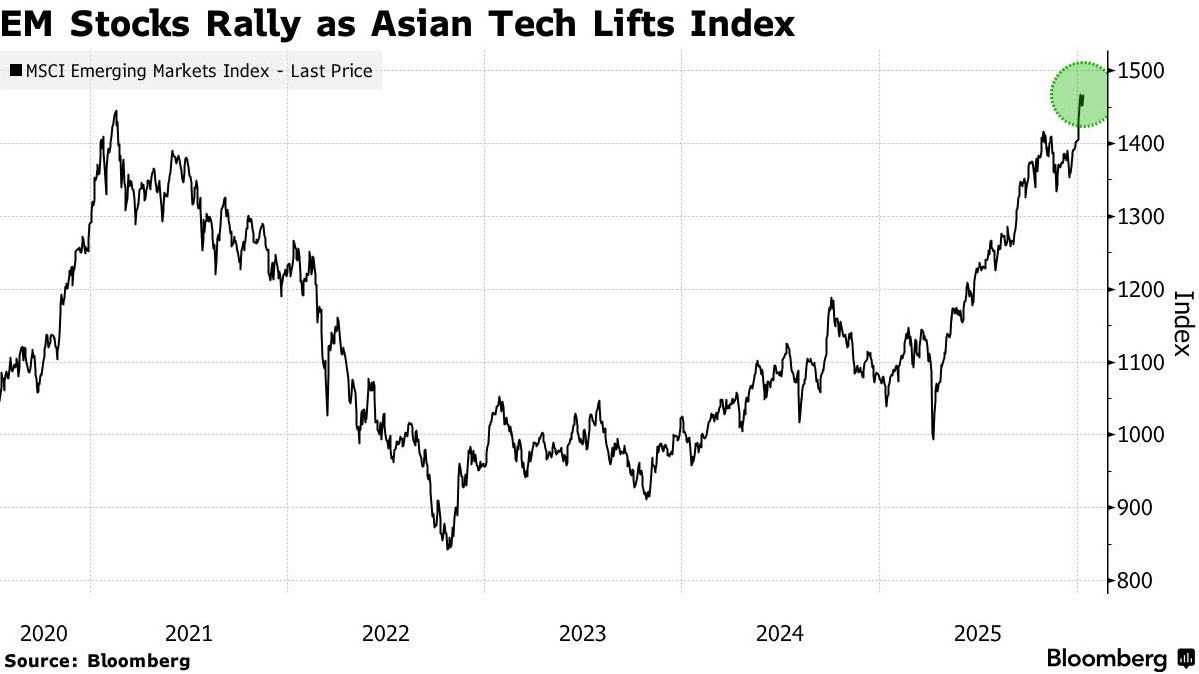
Group 1 - Emerging market assets showed an upward trend, driven by a weaker dollar and a resurgence of the "sell America" trade [1] - The Mexican peso and South African rand, seen as risk appetite indicators, led the market gains among emerging market currencies [1] - The Bloomberg Dollar Spot Index fell by 0.2%, potentially marking its largest single-day decline since December 23 [1] Group 2 - The MSCI Emerging Markets Stock Index rose by 0.9%, approaching historical highs, with Alibaba, Tencent, and TSMC leading the gains [2] - The Chinese government plans to accelerate the integration and application of digital technologies, boosting enthusiasm for AI-themed investments in the Asian market [5] - Lebanese bond prices have reached their highest level since March 2020, amid optimism regarding proposed legislation to unfreeze bank deposits [5]

关税冲击重挫“买入美国”时代,投资者路在何方?
财富FORTUNE· 2025-07-28 12:04
Core Viewpoint - The article discusses the shift in investment strategies from a passive "Buy America" approach focused on the S&P 500 and tech giants to a more diversified and active investment strategy due to market changes and overexposure to technology stocks [1][4][5]. Investment Strategy Changes - Investors are advised to reduce their concentration in U.S. assets while still recognizing the fundamental strengths of the U.S. economy and the S&P 493, which excludes the "Magnificent Seven" tech stocks [7]. - The traditional view of increasing bond allocations with age is being challenged, with a suggestion to consider high-dividend stocks instead, as many tech giants offer minimal or no dividends [8]. Global Market Opportunities - European markets are seen as undervalued, with potential growth driven by government policies aimed at stimulating the economy, making it an attractive investment area [9][16]. - Emerging markets like Japan and India are highlighted for their improving investment environments, with Japan's corporate governance reforms and India's growing industries being particularly noted [20][21]. Stock Recommendations - Specific stock picks include Intuitive Surgical, Arista Networks, and Gap Inc., which are suggested for their growth potential despite the current market challenges [13][14][15]. - The article emphasizes the importance of diversification in investment portfolios to mitigate risks associated with market volatility [6][11]. Alternative Investments - Gold is presented as a strong investment option amid economic uncertainty, with its status as a "safe-haven asset" reaffirmed by recent price increases [24]. - Various gold investment channels are analyzed, including coins, bars, and ETFs, each with its own advantages and disadvantages [26][28][29].

美股光环逐渐褪去? 美银调查:超五成基金经理押注未来五年国际股票跑赢美股
智通财经网· 2025-06-17 13:25
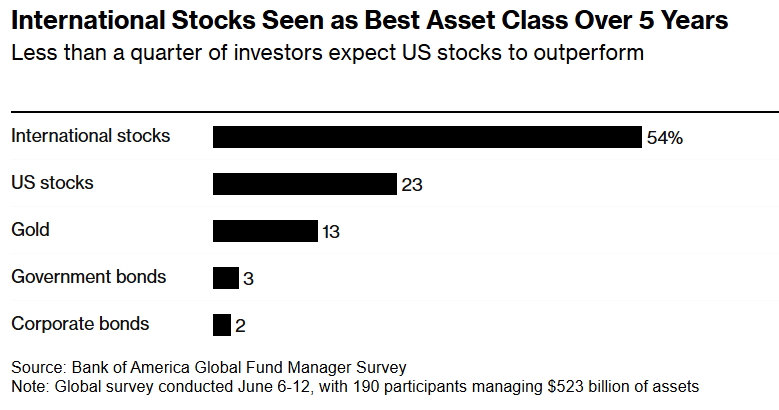
Core Insights - The Bank of America survey indicates that global stock markets, excluding the U.S., are expected to outperform the U.S. stock market over the next five years, suggesting a shift in investor sentiment away from U.S. dominance in equity markets [1][5] - 54% of fund managers believe that international stocks will be the best-performing asset class, while only 23% favor U.S. stocks [1][5] - The survey reflects a growing trend of "Sell America" trades among institutional investors, particularly in light of U.S. government policies and budget deficits [2][5] Summary by Category International Stocks - International stocks are defined as stocks outside the U.S., including developed markets (e.g., Europe, Japan) and emerging markets (e.g., China, India) [1] - The performance of international stocks is compared to U.S. stocks, with a notable shift in expectations for future returns [1][5] U.S. Market Sentiment - The survey marks the first time Bank of America has asked institutional investors to predict the best-performing asset class over a five-year horizon [2] - Historical data shows that the U.S. stock market has outperformed international stocks in 13 out of the last 15 years, but this trend is changing [5] Economic Outlook - 59% of institutional investors do not expect a boost in U.S. economic activity from the government's spending plans [8] - There is a significant negative sentiment towards the U.S. dollar and U.S. stocks, with net 31% and net 36% of investors planning to reduce their holdings, respectively [8]

大摩:忘掉“卖出美国”交易!美股、美债明年将主宰全球市场
美股研究社· 2025-05-23 09:52
Core Viewpoint - The article discusses the recent downgrade of the US credit rating by Moody's and its impact on US assets, highlighting a potential rebound in US equities despite current sell-offs [1][2]. Group 1: US Equity Market - Following the downgrade, the S&P 500 index fell approximately 1% over two days, while the 10-year Treasury yield rose by 10 basis points in four days [1]. - Morgan Stanley's strategists predict that US equities will outperform global peers next year, emphasizing the "TINA" (There Is No Alternative) theme, suggesting limited alternatives to holding stocks [1]. - The strategists forecast that the S&P 500 index will reach 6,500 points by Q2 2026, representing a 10% increase from current levels, driven by expected Fed rate cuts and a weaker dollar [1]. Group 2: US Treasury Market - Despite the recent rise in the 10-year Treasury yield, Morgan Stanley's strategists view this as a temporary trend, expecting yields to remain range-bound until Q4, when investors will start pricing in potential rate cuts for 2026 [2]. - The strategists anticipate that the 10-year Treasury yield will decline to 3.45% by mid-2026, down from the current level of approximately 4.54% [2]. - There is no evidence of a sustained "retreat" from US assets, as global stock funds have not withdrawn from the US, and foreign holdings of US dollar-denominated bonds are at an all-time high, indicating continued demand for high-quality US assets [2].


大摩:忘掉“卖出美国”交易!美股、美债明年将主宰全球市场
Zhi Tong Cai Jing· 2025-05-23 06:44
Group 1 - The recent downgrade of the US credit rating by Moody's has led to a cooling of US Treasury auctions and increased concerns about the Trump administration's tax cuts exacerbating the budget deficit, accelerating the "sell America" trade [1] - Despite the recent sell-off of US assets, Morgan Stanley's strategist team expects a rebound in US assets next year, predicting that they will outperform global peers, citing the lack of better alternatives for investors [1] - Morgan Stanley strategists forecast that the S&P 500 index will reach 6,500 points by Q2 2026, representing a 10% increase from current levels, driven by potential Fed rate cuts and a weaker dollar [1] Group 2 - Morgan Stanley strategists believe that the recent rise in 10-year Treasury yields is a temporary trend, expecting yields to remain range-bound until Q4, when investors will start to price in rate cuts for 2026 [2] - The strategists do not view the current selling of US assets as a permanent retreat, noting that global equity funds have not withdrawn from the US in the past quarter, and foreign holdings of US dollar bonds are at an all-time high [2]
“卖出美国”交易抬头 美元跌途恐漫漫
智通财经网· 2025-05-20 04:19
Core Viewpoint - The article discusses the increasing pressure on the US dollar due to trade uncertainties, rising fiscal debt, and declining confidence in the US exceptionalism, leading to a bearish sentiment towards the dollar [1]. Group 1: Dollar Valuation and Market Sentiment - The dollar has declined by 10.6% from its January peak, marking one of the largest drops in three months [1] - Speculators' net short positions on the dollar reached $17.32 billion, close to the largest short position since July 2023 [1] - The dollar's bearish sentiment is partly due to its relatively high valuation, being approximately 10% above its 20-year average [1] Group 2: Economic Concerns and Fiscal Policy - Analysts express concerns over the long-term fiscal situation of the US, with Trump's tax cuts projected to increase the national debt by $3 trillion to $5 trillion over the next decade [4] - The stagnation of US fiscal policy and persistent deficits are causing market anxiety, leading to reduced interest in US assets [4] Group 3: Foreign Investment and Asset Sales - Despite recent foreign investor sell-offs of US assets, global holdings of US stocks and bonds remain substantial, amounting to trillions of dollars [5] - The sell-off pressure is attributed to a growing skepticism about the dollar's role as a safe-haven currency [5] Group 4: Hedging and Market Dynamics - The strong dollar over the past decade has led market participants to hold US assets without significant concern for currency risk [6] - An increase in hedging could lead to reduced direct demand for the dollar, amplifying selling pressure in the forward market [6] - Asian economies have accumulated approximately $2.5 trillion in dollar exposure, posing significant downside risks to the dollar against Asian currencies [6] Group 5: Economic Resilience and Future Outlook - Despite bearish sentiments, the resilience of the US economy could support the dollar if growth unexpectedly accelerates [6] - Market participants are currently more inclined to seek opportunities to sell the dollar at high points rather than betting on a rebound [6]
失去3A评级后,多空激战“卖出美国”!
Di Yi Cai Jing Zi Xun· 2025-05-19 23:27
Group 1 - Moody's downgraded the US AAA credit rating, leading to a decline in US stock index futures and the dollar, while pushing up US Treasury yields [1][2] - The 30-year Treasury yield reached a critical level of 5%, and the dollar index fell below 101, dropping over 0.5% [1] - Despite concerns, some analysts suggest that the recent sell-off in US Treasuries and the dollar is a rare market reaction to perceived fiscal recklessness [2][3] Group 2 - Federal Reserve Vice Chairman Williams noted that there is no significant evidence of large-scale capital outflows from US assets, despite market uncertainties [3] - Analysts from Morgan Stanley and HSBC view the downgrade as a potential buying opportunity, with expectations of a rebound in the S&P 500 index [4][5] - The correlation between stock returns and bond yields has decreased significantly, indicating a potential shift in market dynamics [4]


美股如期走低!下调评级引发市场震动,“卖出美国”交易再度抬头,黄金、美债迎来波段机会;美股反弹暗藏隐患,期权到期引发变盘危机,留足子弹等待回调?警惕“聪明钱”拉高出货!解锁宏观信息差>>
news flash· 2025-05-19 14:04
Core Viewpoint - The U.S. stock market is experiencing a decline due to downgrades in ratings, leading to a resurgence of the "Sell America" trade, while gold and U.S. Treasuries are seen as potential opportunities for short-term gains [1] Group 1: Market Reactions - The downgrade in ratings has triggered significant market volatility, causing investors to reconsider their positions [1] - The "Sell America" trade is gaining traction as investors seek safer assets amid uncertainty [1] Group 2: Investment Opportunities - Gold and U.S. Treasuries are highlighted as potential short-term investment opportunities in the current market environment [1] - The market rebound is viewed with caution, as there are underlying risks that could lead to further declines [1] Group 3: Market Dynamics - The expiration of options is creating a potential turning point in the market, raising concerns about volatility [1] - There is a warning about "smart money" potentially driving prices up to offload positions, indicating a need for vigilance among investors [1]
刚刚,股债汇“三杀”!
华尔街见闻· 2025-05-19 11:28
Core Viewpoint - The article discusses the significant decline in U.S. stock futures, bond prices, and the dollar index, alongside a rise in safe-haven currencies and gold, driven by concerns over U.S. fiscal health and a recent credit rating downgrade by Moody's [10][11]. Group 1: Market Reactions - U.S. stock index futures are showing a downward trend, with the Dow futures down nearly 0.9%, S&P 500 futures down over 1%, and Nasdaq 100 futures down over 1.5% [6][7]. - The U.S. Treasury market is experiencing a large-scale sell-off, with the 30-year Treasury yield rising to 5.02%, marking the highest level since November 2023 [3][5]. - The dollar index has dropped over 0.7%, while the euro has appreciated approximately 1% against the dollar, reaching its highest level since May 9 [5]. Group 2: Bond Market Dynamics - The 30-year U.S. Treasury yield has increased by over 12 basis points, reflecting investor concerns about the long-term fiscal health of the U.S. [3][5]. - Analysts predict that the recent downgrade by Moody's could lead to an additional rise of 5-10 basis points in the yields of 10-year and 30-year U.S. Treasuries [5][11]. Group 3: Commodity and Currency Movements - Gold prices have surged over 1%, with spot gold reaching above $3,230 per ounce, benefiting from the deteriorating U.S. fiscal situation [8]. - Traditional safe-haven currencies like the yen and Swiss franc have gained strength amid rising uncertainties regarding U.S. debt [5][10]. Group 4: Credit Rating Impact - Moody's downgraded the U.S. credit rating from Aaa to Aa1, citing worsening fiscal deficits and political polarization as factors undermining the credit foundation of the world's largest economy [10][11]. - Market analysts believe this downgrade will prompt investors to reassess the risk premium associated with U.S. assets, potentially leading to a shift towards non-U.S. assets [11].