
市场降息预期

Search documents
国际金价冲高回落,亚洲央行官员建议抛售黄金
Sou Hu Cai Jing· 2025-10-30 15:02
Core Viewpoint - Recent fluctuations in gold prices have been significant, with prices experiencing both sharp declines and rebounds, reflecting a volatile market sentiment [1] Price Movements - International gold prices surged over $4,000 per ounce before quickly retreating, with a notable increase of nearly $600 per ounce in the first two weeks of October, reaching a peak of $4,381 per ounce [1] - As of October 30, gold prices were fluctuating around $3,950 per ounce, indicating a substantial drop from the earlier highs [1] Market Sentiment - The recent volatility in gold prices has led to discussions among Asian central bank officials about the potential need to sell gold [1] - The market's reaction includes profit-taking behavior following the rapid price increase, which is seen as a normal market phenomenon [1] Economic Influences - The decline in gold prices is attributed to a reduction in market risk aversion, influenced by improved U.S.-China trade relations and a more hawkish stance from the Federal Reserve regarding future interest rate cuts [1] - Federal Reserve Chairman Jerome Powell's recent statements have indicated that further interest rate cuts are not guaranteed, which has cooled market expectations and contributed to the fluctuations in gold prices [1]


黄金价格近期为什么剧烈波动?
Da Zhong Ri Bao· 2025-10-30 14:23
Core Viewpoint - Recent fluctuations in gold prices have led to significant market volatility, with prices experiencing both sharp declines and rebounds, indicating a divided market sentiment [2][6]. Group 1: Gold Price Movements - International gold prices surged past $4,000 before quickly retreating, with New York futures prices dropping while London spot prices increased [2]. - As of October 30, gold prices were oscillating around $3,950 after a peak of $4,381 earlier in the month, reflecting a nearly $600 increase in the first two weeks [6]. - The recent volatility is attributed to profit-taking after rapid price increases, which some analysts view as a normal market reaction [6]. Group 2: Central Bank Actions - Philippine central bank officials have suggested considering gold sales due to high current holdings, which stand at approximately 13% of their $109 billion international reserves [3]. - The former central bank governor indicated that an ideal gold reserve ratio should be between 8% and 12%, suggesting potential adjustments to current holdings [3]. - Analysts believe that the Philippines' gold sales would have a limited direct impact on the global gold market due to the country's small economic size, accounting for only 0.4% of the global economy [4]. Group 3: Market Sentiment and Future Outlook - The decline in gold prices is also linked to reduced market risk aversion, influenced by easing U.S.-China trade tensions and a hawkish stance from the Federal Reserve regarding future interest rate cuts [7]. - Despite the recent volatility, analysts maintain a long-term bullish outlook on gold prices, supported by ongoing U.S. fiscal risks and strong central bank demand for gold [8][9]. - Goldman Sachs predicts that central banks and institutional investors will continue to increase their gold allocations amid rising global uncertainties [8].

美联储再次降息25个基点 鲍威尔表态引发跳水 影响几何?
Sou Hu Cai Jing· 2025-10-30 01:35
Group 1 - The Federal Reserve announced a 25 basis point cut in the federal funds rate target range to between 3.75% and 4% on October 29, marking the fifth rate cut since September of the previous year [1] - The Fed will stop its balance sheet reduction starting December 1, 2023, ceasing the reinvestment of maturing U.S. Treasury securities [1] - Fed Chairman Jerome Powell indicated that the U.S. government shutdown is impacting economic activity and that many consumers remain dissatisfied with inflation levels [1] Group 2 - Following Powell's hawkish remarks, U.S. stock markets experienced a slight decline, with the Dow Jones down 0.16% and the S&P 500 nearly flat, while the Nasdaq rose 0.55% [2] - Large tech stocks, such as Nvidia, saw gains, with Nvidia's market capitalization exceeding $5 trillion [2] - The dollar strengthened post-announcement, while gold prices fell below $3,950 [2] Group 3 - Analysts suggest that the Fed's shift from tightening to a neutral stance may lead to 3-4 more rate cuts, but uncertainties remain due to data delays and leadership changes [3] - Market expectations for a December rate cut have been significantly adjusted, with short-term pressures on U.S. stocks and gold anticipated [3] - The overall liquidity in the U.S. market is expected to remain accommodative, supporting asset prices, despite potential challenges in the employment market and inflation levels [3]
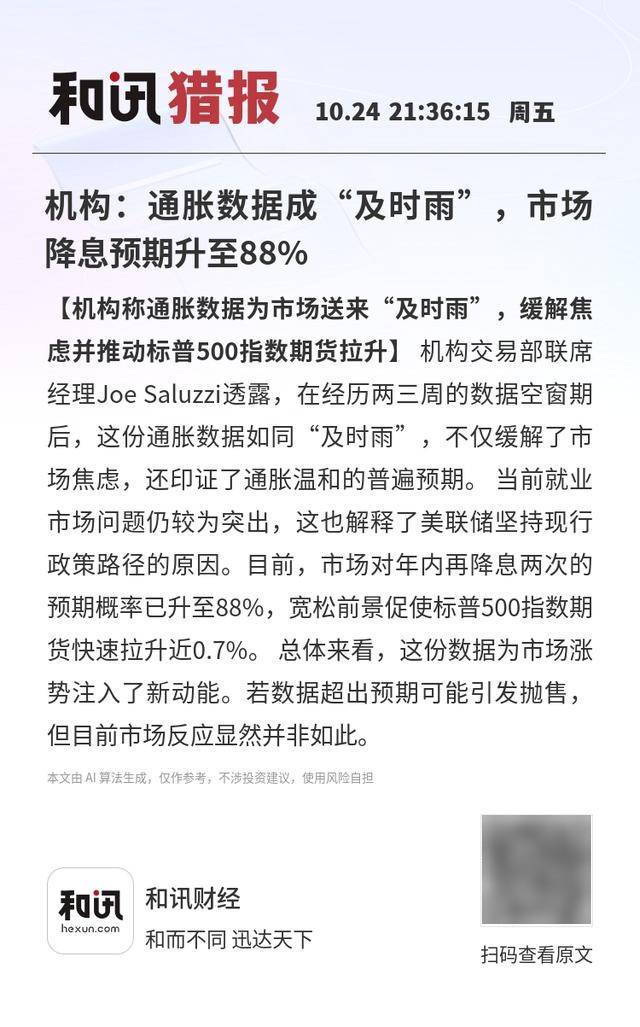
机构:通胀数据成“及时雨”,市场降息预期升至88%
Sou Hu Cai Jing· 2025-10-24 14:21
Core Insights - The recent inflation data has been described as a "timely rain" that alleviates market anxiety and supports the prevailing expectation of moderate inflation [1][2] - The current issues in the job market explain the Federal Reserve's commitment to its existing policy path [1][2] - Market expectations for two additional interest rate cuts this year have risen to 88%, which has led to a nearly 0.7% increase in S&P 500 futures [1][2] - Overall, this data has injected new momentum into the market's upward trend, although a significant deviation from expectations could trigger sell-offs [1][2]
机构:市场迎来“及时雨” 通胀温和缓解焦虑
Sou Hu Cai Jing· 2025-10-24 13:31
Core Viewpoint - The recent inflation data has alleviated market anxiety and confirmed the general expectation of moderate inflation, providing new momentum for market gains [1] Market Reaction - The probability of two more interest rate cuts by the end of the year has risen to 88%, driven by the current economic conditions [1] - The S&P 500 futures surged nearly 0.7% as a result of the favorable data, indicating a positive market response [1] Employment Market - Ongoing issues in the employment market explain the Federal Reserve's commitment to its current policy path, highlighting the importance of labor market conditions in monetary policy decisions [1]
市场降息预期领先美联储点阵图
Jin Tou Wang· 2025-09-23 03:47
Core Viewpoint - The report from ING suggests that the core PCE inflation rate, a preferred measure of inflation by the Federal Reserve, may appear relatively mild, indicating ongoing pressure on the U.S. economy with increasing inflation and greater strain on the job market [1] Group 1: Economic Indicators - The latest dollar index price is reported at 97.35, with a slight increase of 0.04% from an opening price of 97.31 [1] - The core PCE inflation rate is expected to show a mild appearance, which may lead to sustained economic pressures [1] - The market's expectations for future monetary policy easing by the Federal Reserve are considered reasonable, with predictions of two more rate cuts this year and two additional cuts in 2026 [1] Group 2: Market Analysis - The dollar index is operating above the middle band of the Bollinger Bands, with the middle band at 97.0287, the upper band at 97.2376, and the lower band at 96.8198 [1] - The price has quickly recovered from a "spike" low of 96.2109, forming a second bounce at around 96.8229, indicating strong buying support below [1]
2025年8月中资离岸债发行规模约227亿美元,美元融资规模环比大幅下降
Sou Hu Cai Jing· 2025-09-02 08:55
Group 1 - In August, the total issuance scale of offshore Chinese bonds was approximately $22.7 billion, a month-on-month decrease of about 9% [2] - The issuance included $6.3 billion in sovereign bonds, $1.4 billion in government bonds, $5.7 billion in financial bonds, $4.8 billion in local government bonds, $4.0 billion in industrial bonds, and $0.5 billion in real estate bonds [2] - The average financing cost for offshore RMB-denominated bonds decreased to 3.42%, while the average financing cost for USD-denominated bonds increased slightly to 5.74% [4] Group 2 - In August, 51 Chinese enterprises issued 82 offshore bonds, totaling $15.1 billion, with an average bond size of $1.84 million [7] - The financial sector accounted for 25% of the total issuance, while local government and industrial sectors accounted for 21% and 18%, respectively [7] - The issuance volume in the financial sector increased by 37% month-on-month to $5.7 billion, with 13 issuers [10] Group 3 - The real estate sector saw a net financing outflow of approximately $0.4 billion in August, with a total outflow of $5.4 billion from January to August [20] - Several real estate companies reported their mid-year performance, with notable growth in sales and profits for state-owned enterprises [23] - Private real estate companies showed mixed results, with some managing to repay debts while others faced significant losses [24] Group 4 - The issuance of offshore bonds in the industrial sector increased by 66% month-on-month to $4.0 billion, with 6 companies issuing 9 bonds [16] - Notable issuances included a $1.6 billion senior unsecured note by China Aircraft Leasing and a zero-coupon convertible bond by ZTE Corporation [17]

宝城期货贵金属有色早报-20250826
Bao Cheng Qi Huo· 2025-08-26 01:40
Report Summary 1) Report Industry Investment Rating No relevant content provided. 2) Core Viewpoints of the Report - Gold is expected to be strong in the short - term, with short - term, medium - term, and intraday trends being oscillatory, and intraday being oscillatory and bullish. The core logic is that Powell's dovish remarks at the Jackson Hole meeting have increased the expectation of interest rate cuts, which is beneficial to the gold price. However, the market's risk appetite has recovered, reducing the safe - haven demand for gold [1][3]. - Copper is expected to be strong in the short - term, with short - term trends being upward, medium - term and intraday trends being oscillatory, and intraday being oscillatory and bullish. The core logic is that overseas macro conditions have improved, China is approaching the peak season, and industry support has been enhanced [1][4]. 3) Summary by Related Catalogs Gold - **Price Trends**: After Powell's speech at the Jackson Hole meeting last Friday, the gold price oscillated and adjusted yesterday. The market is still pricing in a relatively high probability of two interest rate cuts within the year [3]. - **Core Logic**: Powell's dovish remarks at the Jackson Hole meeting increased the expectation of interest rate cuts, which is beneficial to the gold price. However, the recovery of the market's risk appetite has led to a continuous strong performance in the equity market, reducing the safe - haven demand for gold. Attention can be paid to the long - short game of New York gold at $3400 [1][3]. Copper - **Price Trends**: The intraday price of copper pulled up in the late session, with the main contract price approaching the 80,000 - yuan mark, and it maintained an oscillatory operation at night [4]. - **Core Logic**: At the macro level, Powell's dovish speech at the Jackson Hole meeting significantly increased the market's risk appetite, which is beneficial to the copper price. At the industrial level, China is approaching the peak season, the social inventory of electrolytic copper is decreasing (Mysteel's electrolytic copper social inventory on Monday was 120,000 tons, a decrease of 9,600 tons compared to last Thursday), and industry support is gradually strengthening. It is expected that the copper price will maintain a strong operation, and attention can be paid to the long - short game at the 80,000 - yuan mark [4].
美元强势反弹,创近一个月最大单日涨幅,金价短期承压
Mei Ri Jing Ji Xin Wen· 2025-08-26 01:35
Group 1 - The US dollar index increased by 0.72%, marking the largest single-day gain in nearly a month, which negatively impacted gold prices [1] - COMEX gold futures closed down 0.23% at $3410.7 per ounce, while the gold ETF Huaxia (518850) rose by 0.69%, with net inflows in 7 out of the last 10 trading days, totaling 190 million [1] - The SPDR Gold Trust, the world's largest gold ETF, reported a holding of 958.49 tons, an increase of 1.72 tons from the previous trading day [1] Group 2 - Market expectations for interest rate cuts may have already been priced in, with a high probability of two rate cuts within the year [1] - A rebound in market risk appetite has led to a strong performance in equity markets, resulting in decreased demand for gold as a safe-haven asset [1] - Continuous attention is advised on the $3400 level for gold, indicating a potential battle between bulls and bears [1]
美联储鹰派决议背后:担忧通胀甚于就业 政治压力加剧困境
Sou Hu Cai Jing· 2025-08-21 23:15
Group 1 - The core viewpoint of the articles indicates that the Federal Reserve is facing significant uncertainty regarding the economic outlook, with a prevailing cautious sentiment among its members [1][2][9] - The FOMC meeting minutes from July 29-30 reveal that most officials prioritize inflation risks over employment concerns, with only two dissenting votes advocating for a rate cut [4][7] - The consumer price index (CPI) for July showed a year-on-year increase of 2.7%, while the core CPI rose to 3.1%, exceeding the Fed's 2% target, indicating persistent inflationary pressures [4][5] Group 2 - The political pressure from the White House, particularly from President Trump, is intensifying, with calls for the resignation of Fed officials who oppose his economic policies [1][9] - The Fed's decision-making environment is becoming more complex and politicized, although its independence is expected to remain intact in the short term [9][10] - Market expectations for a rate cut in September have risen significantly, with an 82% probability indicated by the CME FedWatch Tool, despite the Fed's cautious stance on inflation [6][8]
