扩大消费

Search documents
国家发改委部署促进投资止跌回稳等明年重点工作
Sou Hu Cai Jing· 2025-12-15 02:03
Core Viewpoint - The National Development and Reform Commission (NDRC) plans to enhance government investment and implement various measures to stabilize and promote investment in the coming year [1] Group 1: Government Investment Strategies - The NDRC will leverage "two重" construction and new local government special bonds to increase central budget investment [1] - The commission aims to implement major engineering projects as part of the "14th Five-Year Plan" and clarify investment rules [1] - There will be a focus on stimulating private investment through effective measures [1] Group 2: Economic Monitoring and Policy Implementation - The NDRC will strengthen economic monitoring and early warning analysis, improve the policy toolbox, and ensure policy continuity for the next two years [1] - The commission plans to optimize the consumption upgrade policy and remove unreasonable restrictions in the consumption sector [1] Group 3: Industry Development and Reform - The NDRC will address "involution" competition and foster new development momentum while improving capacity governance in key industries [1] - There will be a push for high-quality development in the digital economy and comprehensive deepening of reforms [1] - The commission will work on establishing a unified national market and enhance the legal framework for promoting the private economy [1]
市政府召开社会各界代表座谈会 就《政府工作报告》征求意见建议
Chang Jiang Ri Bao· 2025-12-11 00:45
会上,市政府研究室介绍了报告起草情况。吴传清、陈先红、顾露露、杨道虹、李尚 鎔、孙军、胡丹、吴志锋、宫步坦、张青松、张波、余锋、刘兵、张锦星、张宝剑等各界代 表踊跃发言、积极献策。大家高度评价2025年武汉经济社会发展取得的成绩,从科技创新、 产业发展、扩大消费、营商环境、城市更新、乡村振兴、民生改善、环境保护、基层治理等 多个方面提出意见建议。熊征宇认真听取发言,不时与大家互动交流。他说,大家的发言有 理论高度、实践深度、民生温度,契合发展实际、贴近群众需求,对完善《报告》和改进政 府工作具有重要参考价值,我们将认真梳理研究,切实把大家的意见建议吸纳到《报告》 里,体现到政府具体工作谋划部署中。 编辑:胡之澜 熊征宇指出,今年以来,全市上下牢记习近平总书记殷殷嘱托,在省委、省政府和市委 坚强领导下,坚持干字当头、迎难而上、以干促上,推动全市高质量发展和现代化建设取得 新进展新成效。大家胸怀大局、立足岗位、锐意进取、拼搏实干,为武汉经济社会高质量发 展作出了积极贡献。新的一年发展前景可期,我们要坚定信心、树立雄心、保持恒心,牢牢 把握高质量发展首要任务,加快建设国家中心城市、全力打造"五个中心"、全面建设现代 ...
事关消费投资,黄奇帆刘世锦等建言十五五开局之路如何走
Bei Ke Cai Jing· 2025-12-07 14:00
Group 1 - China's economy is showing resilience and vitality as it approaches the end of 2025, with a focus on navigating challenges and opportunities in 2026 during the "14th Five-Year Plan" period [1] - Experts believe that China is at a critical stage of structural adjustment, where breaking through reforms will lead to both quantitative and qualitative economic growth [2] - The "14th Five-Year Plan" marks a shift in China's economic growth from being primarily driven by investment and exports to being driven by innovation and consumption [3] Group 2 - Consumption is crucial for China's economy, and there is a need to actively implement a "strong consumption country" strategy [3] - Increasing the pension levels for low-income groups is seen as a key breakthrough for expanding consumption, with a strong necessity for transferring state-owned capital to support pension funds [3] - The proposal includes reallocating state-owned capital to social security funds and capital markets to create a comprehensive pension system that meets basic living needs and reduces urban-rural disparities [3] Group 3 - China has the potential to become the world's largest consumer market, surpassing the United States, and should implement a new strategy for balanced imports and exports [4] - There is a call to expand the offshore RMB financial product ecosystem to enhance the liquidity and usability of the RMB, promoting its internationalization [4] - As the RMB appreciates, domestic consumers will be able to purchase more and better imported goods and services, thereby enhancing the scale and quality of consumption [4] Group 4 - Deepening reform and opening up is seen as a crucial path for economic breakthroughs, with macro policy optimization being an important support [5] - The focus for 2026 is on establishing a solid foundation for national policies as it will be a year where major global economies compete economically [5] Group 5 - Reform and innovation are identified as fundamental drivers of China's economic development over the past 40 years and are essential for achieving the "Chinese Dream" by 2050 [6] - Addressing issues of urban-rural integration and technological innovation is deemed critical, with a need for better integration of scientific and industrial innovation [6][7] - The "14th Five-Year Plan" period should focus on resolving challenges related to insufficient investment in basic innovation and the transformation of technological advancements [7] Group 6 - The GDP growth target for China in 2026 is expected to remain around 5%, which is considered a significant achievement in an international context [8] - Infrastructure investment is highlighted as a key method for stabilizing growth, with a strong emphasis on large-scale infrastructure projects to support economic stability [8] - Consumer spending is viewed as a slow variable, indicating that a significant rebound in consumption may be challenging in the near term [8]
鼓励特色活动培育消费名品
Jing Ji Ri Bao· 2025-12-06 21:57
Core Viewpoint - The article emphasizes the need to stimulate market vitality and enhance the adaptability of supply and demand by expanding high-quality supply, as outlined in the implementation plan jointly issued by the Ministry of Industry and Information Technology and five other departments [1][2]. Group 1: Implementation Plan - The implementation plan proposes hosting special activities to cultivate a group of renowned Chinese consumer brands and create the "Buy in China" brand [1]. - It aims to create a favorable environment for the development of the consumer market, facilitating a high-level dynamic balance between supply and demand [1]. Group 2: Market Dynamics - The article highlights a shift from a "make what sells" mentality to a focus on quality, as increased competition has led to lower product profits and a consumer preference for lower prices over quality [1]. - To break this cycle, it is essential to improve information flow and restore trust, showcasing product quality to consumers [1]. Group 3: Role of Quality Consumer Goods - High-quality consumer goods, represented by renowned brands, are seen as a powerful tool to expand consumption [1]. - Special activities can transcend simple promotions, serving as a concentrated display of supply-side offerings, thereby building consumer trust and activating demand [1]. Group 4: Media and Brand Promotion - The plan emphasizes the importance of high-frequency promotion by mainstream media, new media, and offline business circles to leverage the multiplier effect of special activities [2]. - It aims to select and promote over a thousand well-known enterprise brands and regional brands, along with more than ten thousand quality consumer goods [2]. Group 5: Long-term Value and Policy Effectiveness - Long-term value is highlighted as a key measure of the effectiveness of policy implementation, with a focus on creating sustainable consumer engagement rather than short-term promotional events [2]. - The goal is to activate industrial growth by ensuring a smooth supply-demand cycle, benefiting consumers, enhancing brand reputation, and upgrading industries through collaborative efforts [2].
“十五五”中国经济将保持中高速增长,面临哪些机遇和挑战
Di Yi Cai Jing· 2025-12-01 12:25
Core Viewpoint - The long-term positive trend of the Chinese economy remains unchanged despite short-term challenges, with a projected GDP growth of around 5% in 2025 due to supportive fiscal and monetary policies, strong industrial resilience, and unexpected export growth [1][2] Group 1: Economic Outlook - The 2025 economic growth is expected to be around 5%, with a "front high and back low" trend, indicating strong growth in the first three quarters but potential internal demand issues [2][4] - The report predicts that the economic growth will maintain a medium-high pace over the next five years, but challenges such as declining exports, slowing investments, and real estate risks may arise [1][3] Group 2: Policy Recommendations - The report suggests setting cross-cycle composite goals for the "15th Five-Year Plan" period, including a GDP growth target of 4.5% to 5%, a CPI target of 1% to 3%, and a nominal GDP growth target of over 5% [4] - Emphasis is placed on enhancing consumer spending, particularly among low- and middle-income groups, to drive economic growth [5][6] Group 3: Structural Challenges - The current economic constraints have shifted from supply to demand, with insufficient terminal demand identified as a core issue, particularly in service consumption related to basic public services [6][7] - The report highlights the need to address the dual structure of urban and rural economies, which contributes to income disparities and limits consumption growth [6][7] Group 4: Income and Employment - Increasing income is crucial for boosting consumption, with recommendations to enhance employment rates and stabilize business expectations as key strategies [7] - The report advocates for fiscal policies that focus on increasing income for low- and middle-income groups and improving the distribution of resources to enhance public services [7]
中国体改研究会副会长李晓超:扩消费需长短期政策有效搭配
Zhong Guo Xin Wen Wang· 2025-11-30 00:08
Core Viewpoint - Expanding consumption is a key strategy for maintaining domestic demand in China's economic reform, requiring a combination of short-term and long-term policies [1][2] Group 1: Economic Growth and Consumption - The shift in economic growth dynamics from supply-driven to demand-driven necessitates a strategic focus on expanding domestic demand to ensure stable economic growth [1] - Service consumption is identified as the primary focus for expanding domestic demand, alongside durable and non-durable goods [1] Group 2: Policy Recommendations - To increase resident consumption rates, it is essential to coordinate efforts to lower savings rates, considering the potential impact of interest rate reductions on both consumption and savings [1] - Enhancing the proportion of residents' income is crucial, particularly through increasing the share of initial distribution income and improving income redistribution via taxation and social security [1] - There is a need to optimize the alignment between supply structure and income distribution structure, catering to the consumption needs of different income groups [1] - Improving the consumption environment is vital, such as alleviating parking anxiety to boost automobile consumption and enhancing cultural tourism experiences [2]
精准把脉找对路
Jing Ji Ri Bao· 2025-11-20 22:14
Group 1 - The article emphasizes the importance of understanding consumer behavior, particularly among the youth, to effectively stimulate demand and expand consumption [1] - Shenyang, traditionally an industrial city, has successfully engaged young consumers by creating diverse and fashionable consumption scenarios, demonstrating that even less trendy cities can attract youth spending [1] - Young consumers are seen as not only current buyers but also as indicators of future consumption trends, with their preferences shifting towards convenience, self-care, emotional connection, and self-improvement [1] Group 2 - The article suggests that cities should focus on creating favorable consumption environments and integrating local culture to enhance consumer engagement and loyalty [2] - It highlights the need for cities to attract first-time visitors through personalized and diverse offerings while ensuring repeat customers through quality service and integrity [2] - The long-term sustainability of consumer enthusiasm relies on a combination of market size, aesthetic appeal, supply efficiency, and an innovative environment, which are essential for upgrading consumption experiences and supply [2]
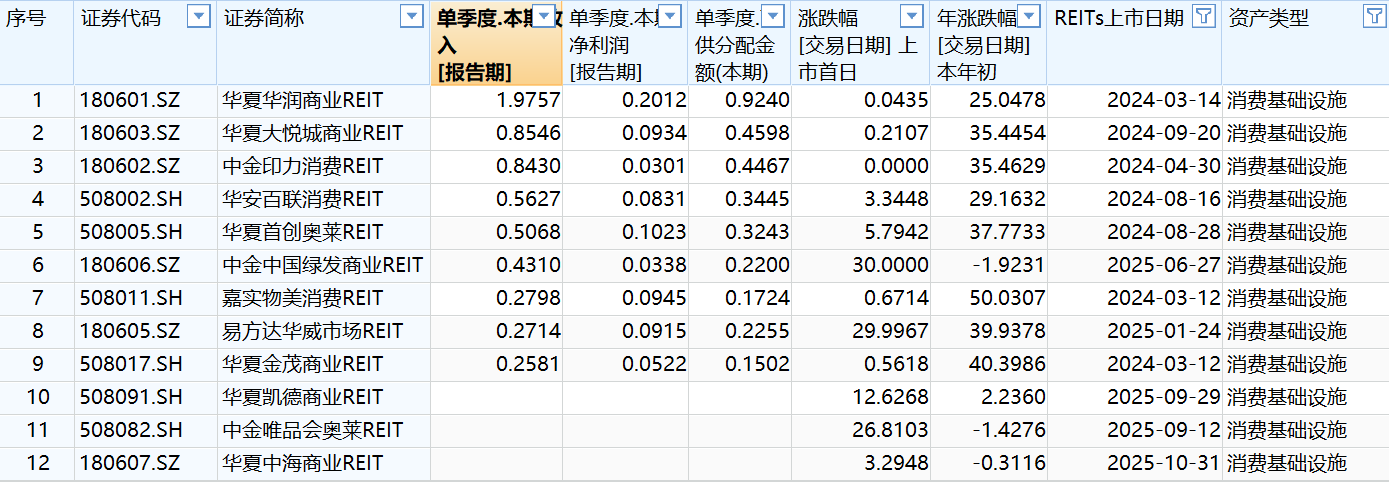
消费旺季助推市场升温,消费REITs年内平均涨幅达24%
Di Yi Cai Jing· 2025-11-09 07:10
Core Insights - The consumer market's heat has significantly boosted the REITs market, particularly in consumer infrastructure REITs, driven by the consumption peak during events like "Double Eleven" [1][2] - The overall public REITs market has shown strong performance this year, with consumer infrastructure REITs leading in growth due to consumption subsidy policies and improved market expectations [2][3] Group 1: Market Performance - As of November 9, the average increase for 12 listed consumer REITs this year is 24%, with notable performers like the Jiashi Wumei Consumer REIT exceeding 50% growth and Huaxia Jinmao Commercial REIT over 40% [3] - The total market capitalization of the 12 consumer REITs has surpassed 42 billion [3] Group 2: Investment Trends - The recent surge in consumer REITs has led to high subscription rates, with the Huaxia Zhonghai Commercial REIT receiving nearly 160 billion in subscriptions before its listing [5] - The demand reflects market recognition of quality commercial assets and the scarcity of foreign brands in the public REITs sector [5] Group 3: Performance Disparities - In Q3, consumer REITs collectively reported revenues of 598 million and net profits of 20.11 million, with Huaxia Huarun Commercial REIT leading in revenue [7] - There is a notable performance disparity among different REITs, with some achieving significantly higher revenues than others [7] Group 4: Future Outlook - The operational capabilities of shopping centers, including renovation and innovation, remain core competitive advantages for consumer REITs [8] - The macroeconomic environment and interest rates will continue to influence REIT pricing and investor returns [9]

支持超2200个项目,5000亿元新型政策性金融工具投放完毕
Sou Hu Cai Jing· 2025-10-30 10:36
Core Insights - The newly established policy financial tools have successfully allocated a total of 500 billion yuan within one month, aimed at supporting project capital [1][3][4] - The funds are primarily directed towards key economic provinces and sectors, including digital economy, artificial intelligence, and consumption [1][2][3] Group 1: Fund Allocation and Impact - The allocation of the 500 billion yuan is divided among three policy banks: 250 billion yuan to the National Development Bank, 150 billion yuan to the Agricultural Development Bank, and 100 billion yuan to the Export-Import Bank [1][2] - The National Development Bank has completed its allocation of 250 billion yuan, supporting 1,054 projects, which is expected to stimulate a total investment of approximately 3.85 trillion yuan [1][3] - The Export-Import Bank has allocated 100 billion yuan, supporting over 360 projects, with an anticipated total investment of more than 1.3 trillion yuan [2][3] - The Agricultural Development Bank has completed its allocation of 150 billion yuan, supporting 881 projects, with an expected total investment exceeding 1.93 trillion yuan [2][3] Group 2: Focus Areas and Regional Distribution - The funds are concentrated in 12 major economic provinces, including Guangdong, Zhejiang, and Sichuan, with 690 projects receiving 1,949.5 billion yuan, accounting for 78% of the total allocation [1][3] - The focus areas for investment include digital economy, artificial intelligence, and consumption, with 317 projects in these sectors receiving 980.2 billion yuan, representing 39.2% of the total allocation [1][2] - The policy tools are designed to enhance private investment, with 128 projects supported by private capital, amounting to 685.9 billion yuan, which is 27.4% of the total allocation [1][2] Group 3: Economic Implications - The total expected investment impact from the 500 billion yuan allocation is approximately 7.08 trillion yuan, with contributions from all three policy banks [3][4] - Analysts suggest that this initiative could potentially drive infrastructure investment growth by 3-4 percentage points annually over the next three years [4]
国家喊话“涨工资”,开始了
商业洞察· 2025-10-26 09:25
Core Viewpoint - The article discusses the recent nationwide increase in minimum wage standards in China, highlighting the implications for workers and the economy as a whole. Group 1: Minimum Wage Increase - The Ministry of Human Resources and Social Security has announced that the minimum wage standards across various provinces have increased, with the first tier now exceeding 2000 yuan for the first time [5][19]. - The increase in minimum wage is consistent with the government's directive to "reasonably raise minimum wage standards," with many provinces seeing increases of over 10% compared to last year [8][12]. - The top provinces for minimum wage include Shanghai (2740 yuan), Beijing, Tianjin, Guangdong (all above 2500 yuan), and Jiangsu, Zhejiang (2490 yuan) [11][12]. Group 2: Economic Context - The increase in minimum wage is part of a broader initiative to enhance wage growth mechanisms and promote income growth among residents, which is crucial as wage income constitutes about 60% of household income in China [28][30]. - The government has emphasized that raising wages is not just a matter for individual companies but a national priority, impacting consumption, fertility rates, and overall economic development [36][37]. Group 3: Future Implications - The rise in minimum wage is expected to have a cascading effect, positively influencing all workers, not just those earning minimum wage, as it sets a new baseline for wage negotiations [32][33]. - The government's focus on wage increases is seen as a strategy to stimulate consumption and address long-term economic challenges, marking a shift from merely issuing consumption vouchers to prioritizing income growth [40][41].