消费潜力释放

Search documents
11月消费增长1.3%,增速连续六个月放缓
Sou Hu Cai Jing· 2025-12-16 08:37
Group 1 - The growth rate of total retail sales of consumer goods in China has slowed down, primarily due to a high base from the same period last year [2][4] - In November, the total retail sales reached 43,898 billion yuan, with a year-on-year growth of 1.3%, marking six consecutive months of decline [2][3] - The decline in consumer confidence and spending is influenced by expectations regarding income and employment, leading to cautious consumer behavior [2][3] Group 2 - Urban retail sales in November amounted to 37,684 billion yuan, growing by 1.0%, while rural retail sales reached 6,214 billion yuan, with a growth of 2.8% [3] - The retail sales of goods were 37,841 billion yuan, with a growth of 1.0%, while dining revenue grew by 3.2% [3] - The automotive market has seen a decline in sales for two consecutive months, with November retail sales of passenger vehicles dropping by 8.1% year-on-year [3][5] Group 3 - From January to November, the total retail sales of consumer goods reached 456,067 billion yuan, with a year-on-year growth of 4.0% [5] - Online retail sales during the same period were 144,582 billion yuan, growing by 9.1%, with physical goods online retail accounting for 25.9% of total retail sales [5] - The sales of household appliances and communication equipment have seen significant growth, driven by policies encouraging the replacement of old products [5][6] Group 4 - Consumer prices have shown signs of recovery, with a year-on-year increase of 0.7% in November, marking a continuous rise for three months [6] - The core Consumer Price Index (CPI), excluding food and energy, has stabilized with a year-on-year increase of 1.2% [6] - Industrial profits have also shown growth, with revenues for large-scale industrial enterprises increasing by 1.8% year-on-year from January to October [6]

11月我国CPI同比上涨0.7% 物价水平进一步企稳
Zhong Guo Jing Ying Bao· 2025-12-11 12:15
Group 1: CPI Analysis - In November, the CPI increased by 0.7% year-on-year, the highest level since March 2024, with an increase of 0.5 percentage points from the previous month [1] - The rise in CPI was primarily driven by a significant increase in vegetable prices, which turned from a decline of 2.9% in October to an increase of 0.2% in November, contributing positively to the CPI [2] - Core CPI, excluding food and energy, rose by 1.2% year-on-year in November, indicating a continued upward trend [2][3] Group 2: PPI Analysis - The PPI increased by 0.1% month-on-month in November, marking the second consecutive month of growth, attributed to seasonal demand increases and rising prices in certain industries [4] - Year-on-year, the PPI decreased by 2.2%, with the decline rate widening by 0.1 percentage points compared to the previous month, influenced by high comparison bases from the previous year [4][5] - The prices in key industries such as coal mining and photovoltaic equipment manufacturing showed a narrowing decline, indicating improvements in market competition and capacity management [5] Group 3: Future Outlook - The economic outlook suggests that core CPI will continue to rise steadily, supported by coordinated policy efforts to boost consumption and improve living standards [3][6] - The PPI is expected to decline by approximately 0.5% year-on-year in 2026, with a significant narrowing of the decline, driven by ongoing "anti-involution" policies and the rapid development of emerging industries [6]
核心CPI同比涨幅连续3个月保持在1%以上——扩内需政策措施继续显效
Jing Ji Ri Bao· 2025-12-10 22:23
Group 1: Consumer Price Index (CPI) Insights - In November, the CPI increased by 0.7% year-on-year, marking the highest growth since March 2024, with a month-on-month decrease of 0.1% [2][3] - The rise in CPI was primarily driven by a shift in food prices from decline to increase, with fresh vegetable prices rising by 14.5% after a nine-month decline [2][3] - Core CPI, excluding food and energy, rose by 1.2% year-on-year, maintaining above 1% for three consecutive months, indicating stable inflationary pressures [2][3] Group 2: Producer Price Index (PPI) Insights - The PPI increased by 0.1% month-on-month in November, marking the second consecutive month of growth, influenced by seasonal demand increases in certain industries [4] - Year-on-year, the PPI decreased by 2.2%, with the decline slightly widening compared to the previous month, primarily due to high comparison bases from the previous year [4] - Input factors such as international commodity prices have led to a mixed impact on domestic prices, with some sectors experiencing price increases while others faced declines [4] Group 3: Market Trends and Future Outlook - The ongoing "anti-involution" measures are showing results, with price declines in certain industries narrowing, indicating improved market competition [5] - Emerging industries are driving price increases in related sectors, with significant year-on-year price rises in new materials and technology sectors [6] - Future inflation is expected to remain low, providing room for growth-stimulating policies, with a gradual recovery in consumer prices anticipated [7][8]
1.2%↑!创2024年3月以来新高!
Zheng Quan Shi Bao Wang· 2025-12-10 03:53
Group 1: Consumer Price Index (CPI) Trends - In November, the Consumer Price Index (CPI) increased by 0.7% year-on-year, with the growth rate expanding by 0.5 percentage points compared to the previous month, marking the highest increase since March 2024 [2] - Food prices contributed to the CPI increase, with fresh vegetable prices rising by 14.5% after a decline of 7.3% in the previous month, significantly impacting the CPI [2] - The core CPI, excluding food and energy, rose by 1.2% year-on-year, maintaining a growth rate above 1% for three consecutive months [3] Group 2: Producer Price Index (PPI) Trends - The Producer Price Index (PPI) decreased by 2.2% year-on-year in November, with the decline rate expanding by 0.1 percentage points compared to the previous month, influenced by a high comparison base from the previous year [4] - The PPI showed signs of improvement in specific industries, with price declines narrowing in coal mining, photovoltaic equipment manufacturing, and lithium-ion battery manufacturing [4][5] - Emerging industries are driving price increases, with external storage devices and components rising by 13.9% year-on-year, and other sectors like integrated circuit manufacturing and carbon product manufacturing also showing positive trends [5]

新品“挑花眼”、首展首秀亮点频出 多样首发活动释放消费新潜力
Yang Shi Wang· 2025-11-24 11:12
Core Insights - Guangzhou is becoming a preferred location for international brands to open their first stores, with over 600 international brands entering the market from 2021 to 2024, reflecting an annual growth rate of 25% in the number of first stores [1][4] - In 2025, Guangzhou was selected as one of the first pilot cities for national retail innovation, with the number of duty-free shops increasing to 1,305 [4] - The city is also hosting various promotional events, such as themed pop-up activities in shopping centers, to enhance consumer engagement and showcase new products [5] Group 1 - Guangzhou is hosting a series of inaugural events in multiple commercial districts to boost consumer potential [1] - The city has seen a significant increase in the number of first stores, with a focus on international brands [1] - Duty-free shopping options are expanding, contributing to Guangzhou's attractiveness for new retail ventures [4] Group 2 - The shopping centers in Guangzhou are actively organizing themed events to attract consumers and promote new product launches [5] - The growth in first stores and retail innovation initiatives indicates a robust retail environment in Guangzhou [4][1]

10月份全社会用电量 同比增长10.4%
Zhong Guo Zheng Quan Bao· 2025-11-21 22:56
Core Insights - In October, China's total electricity consumption reached 857.2 billion kilowatt-hours, marking a year-on-year increase of 10.4%, the highest monthly growth rate this year [1] - From January to October, total electricity consumption accumulated to 8.6246 trillion kilowatt-hours, with a year-on-year growth of 5.1%, indicating a positive trend in the national economy [1] Factors Contributing to Growth - The high growth rate in October is attributed to multiple factors, including a low base from the previous year and the effective release of consumer potential during the overlapping National Day and Mid-Autumn Festival holidays [2] - The "autumn tiger" phenomenon, characterized by significant temperature increases in southern China, led to a surge in residential cooling electricity consumption, with notable increases in Jiangxi (65.9%), Zhejiang (63.2%), and Shanghai (47.0%) [2] Sector Performance - The primary industry showed steady growth, with October electricity consumption at 12 billion kilowatt-hours, up 13.2% year-on-year [3] - The secondary industry, as the main electricity consumer, recorded 568.8 billion kilowatt-hours in October, a 6.2% increase, with high-tech and equipment manufacturing sectors performing particularly well, growing by 11% [3] - The tertiary industry emerged as one of the fastest-growing sectors, with October electricity consumption at 160.9 billion kilowatt-hours, up 17.1% year-on-year, driven by the retail and information technology services sectors [3] Long-term Economic Outlook - From January to October, the tertiary industry's electricity consumption reached 1.67 trillion kilowatt-hours, growing by 8.4%, reflecting the deepening transition of China's economic dynamics [4] - The overall electricity consumption data indicates an improvement in economic activity, consumer potential release, and optimization of industrial structure, reinforcing a positive long-term economic outlook [4]
10月份全社会用电量同比增长10.4% 创今年以来月度用电量增速新高
Zhong Guo Zheng Quan Bao· 2025-11-21 22:32
Core Insights - In October, China's total electricity consumption reached 857.2 billion kilowatt-hours, marking a year-on-year increase of 10.4%, the highest monthly growth rate this year [1] - From January to October, total electricity consumption accumulated to 8.6246 trillion kilowatt-hours, with a year-on-year growth of 5.1%, indicating a positive trend in the national economy [1] Group 1: Factors Driving Electricity Consumption Growth - The significant increase in electricity consumption in October is attributed to multiple factors, including a low base from the previous year and the effective release of consumer potential during the overlapping National Day and Mid-Autumn Festival holidays [2] - The "autumn tiger" phenomenon, characterized by high temperatures in southern China, particularly in Jiangxi, Zhejiang, and Shanghai, led to a surge in residential cooling electricity usage, with increases of 65.9%, 63.2%, and 47.0% respectively [2] Group 2: Sectoral Electricity Consumption Analysis - The primary industry showed steady growth, with October electricity consumption at 12 billion kilowatt-hours, a year-on-year increase of 13.2% [3] - The secondary industry, as the main electricity consumer, recorded 568.8 billion kilowatt-hours in October, with industrial electricity consumption growing by 6.4% [3] - The high-tech and equipment manufacturing sectors performed notably well, with October electricity consumption increasing by 11%, particularly in the electrical machinery and automotive manufacturing sectors [3] Group 3: Tertiary Industry and Overall Economic Indicators - The tertiary industry emerged as one of the fastest-growing sectors, with October electricity consumption at 160.9 billion kilowatt-hours, a year-on-year increase of 17.1% [3] - The cumulative electricity consumption of the tertiary industry from January to October reached 1.67 trillion kilowatt-hours, reflecting a year-on-year growth of 8.4% [4] - The overall electricity consumption data indicates a positive trend in economic activity, consumer potential release, and industrial structure optimization in China [4]
锐财经|消费潜力持续释放
Ren Min Ri Bao Hai Wai Ban· 2025-11-21 03:37
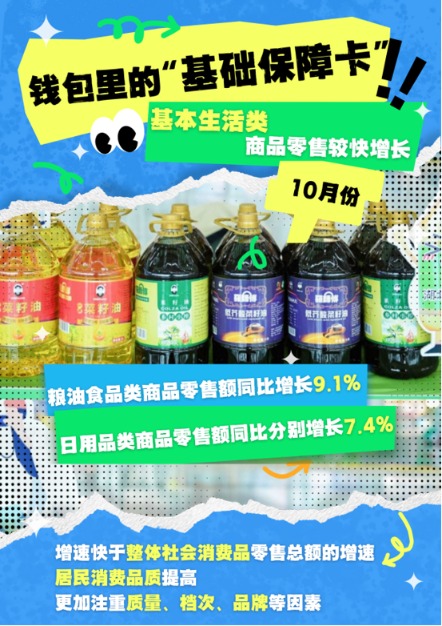
Core Insights - The overall retail sales of consumer goods in China increased by 4.3% from January to October, with online retail sales growing by 9.6% year-on-year, indicating a stable growth trend in the consumer market [1][2] - The National Bureau of Statistics reported that the retail sales in October reached 4.63 trillion yuan, a year-on-year increase of 2.9%, driven by the National Day and Mid-Autumn Festival holidays [2][3] Consumer Market Stability - From January to October, the total retail sales of consumer goods amounted to 41.2 trillion yuan, reflecting a growth rate of 4.3% [2] - In October, retail sales of goods grew by 2.8%, with significant increases in categories such as communication equipment (23.2%), cultural and office supplies (13.5%), and furniture (9.6%) [2] - Basic living goods saw rapid growth, with food and clothing retail sales increasing by 9.1% and 6.3%, respectively [2] - Upgraded consumer goods, including jewelry (37.6%), sports and entertainment products (10.1%), and cosmetics (9.6%), showed strong demand [2] - Service retail sales grew by 5.3% from January to October, outpacing goods retail sales by 0.9% [2] Impact of Holidays on Consumption - The overlapping National Day and Mid-Autumn Festival holidays led to increased spending on dining, accommodation, and entertainment, with restaurant income rising by 3.8% in October [3] - The number of inbound tourists during the holidays reached 751,000, marking a 19.8% increase [3] E-commerce Growth - E-commerce played a significant role in boosting consumption and modern industry development, with online retail sales increasing by 9.6% from January to October [4] - Notable growth was observed in smart products and online services, with sales of smart wearables increasing by 23.1% and online service consumption rising by 21% [4] - Agricultural products and rural online retail sales grew by 9.5% and 7.5%, respectively, indicating the positive impact of e-commerce on rural economies [4] New Consumption Trends - New consumption models are emerging, with sales of smart health devices and wearable technology increasing significantly [7] - Rural consumption is outpacing urban consumption, with rural retail sales growing by 4.1% in October, compared to urban areas [7] - The synergy between new urbanization and rural revitalization is enhancing county-level commercial facilities and market potential [7]
数览10月消费市场 从钱包多样“打开方式”看消费潜力释放
Ren Min Wang· 2025-11-15 01:59
Group 1 - The core viewpoint of the article highlights the ongoing efforts to boost consumption across various regions and sectors in China, with a focus on initiatives such as trade-in programs for consumer goods and the promotion of digital and service consumption [1][6] - In October, retail sales of sports and entertainment products increased by 10.1% year-on-year, while cosmetics retail sales grew by 9.6%, indicating a shift in consumer spending towards upgraded experiences and products [3][4] - The trade-in policy for consumer goods has shown significant effects, with retail sales of communication equipment rising by 23.2% and cultural office supplies by 13.5% in October, both outpacing the overall retail sales growth [4] Group 2 - Service consumption has also seen positive growth, with retail sales accelerating by 0.1 percentage points compared to the previous months, driven by the National Day and Mid-Autumn Festival holiday effects [5] - Retail sales in the tourism, information services, and cultural and recreational services categories maintained a growth rate of nearly 10% in October, reflecting strong consumer demand in these sectors [5]
今年前十个月河南省进出口超七千四百亿元 “新三样”出口增势迅猛
He Nan Ri Bao· 2025-11-13 23:44
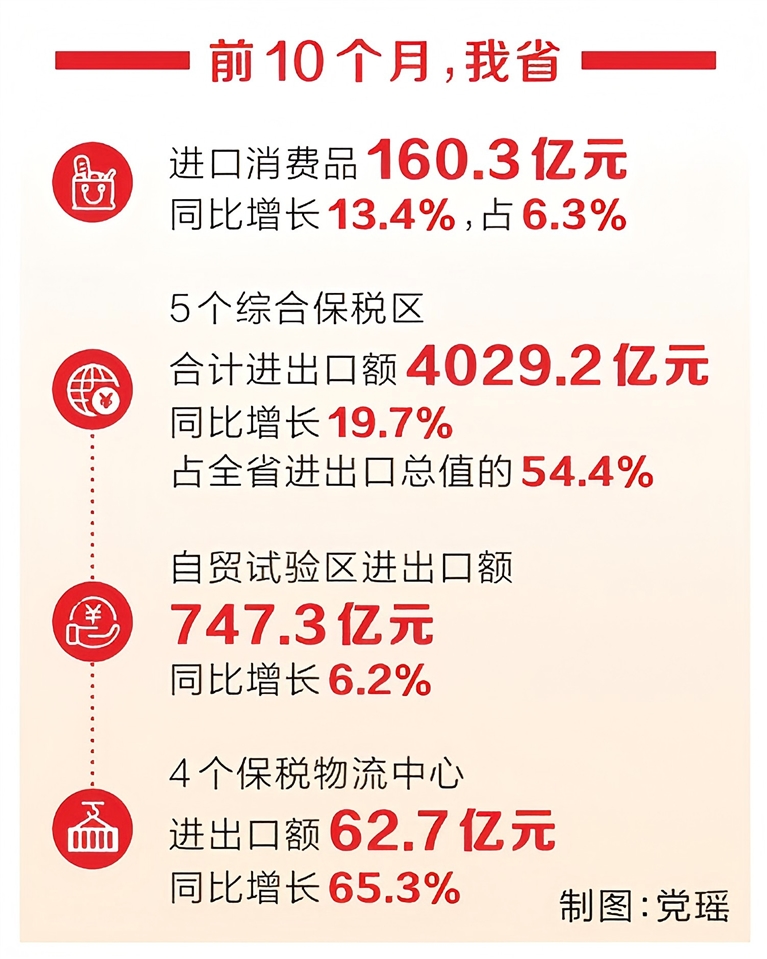
Core Insights - The foreign trade performance of Henan province in the first ten months of the year shows a total import and export value of 741.12 billion yuan, with a year-on-year growth of 14.5%, surpassing the national average growth rate of 10.9% [2] - Exports reached 488.17 billion yuan, increasing by 21.8%, while imports totaled 252.95 billion yuan, growing by 2.6% [2] Trade Performance - The province's import and export value for the first ten months was 741.12 billion yuan, with exports at 488.17 billion yuan and imports at 252.95 billion yuan [2] - In October alone, the province's import and export value was 97.81 billion yuan, marking a month-on-month increase of 5.2% and the highest monthly export value of the year [2] Business Activity - The number of foreign trade enterprises with import and export performance reached 13,700, an increase of 11.5%, with 923 enterprises having an import and export value exceeding 50 million yuan, up by 12.6% [4] - Private enterprises accounted for 68.6% of the province's total foreign trade value, with an import and export value of 508.34 billion yuan, growing by 14.7% [4] Market Dynamics - ASEAN remains the largest trading partner for the province, with a total import and export value of 99.45 billion yuan, growing by 11.7%, followed by the EU at 98.58 billion yuan, which grew by 20.1% [4] - Trade with countries involved in the Belt and Road Initiative reached 353.04 billion yuan, increasing by 14.3%, while trade with other RCEP member countries was 218.77 billion yuan, growing by 14.9% [4] Export Trends - The trend of exporting "new, intelligent, and green" products is becoming more pronounced, with mechanical and electrical products exported valued at 317.23 billion yuan, a growth of 28.6%, accounting for 65% of total exports [4] - Exports of "new three samples" products (electric vehicles, lithium batteries, photovoltaic products) reached 23.35 billion yuan, increasing by 163.2%, with electric vehicle exports alone valued at 21.35 billion yuan, growing by 254.4% [4] Consumption and Import - The import of consumer goods reached 16.03 billion yuan, growing by 13.4%, accounting for 6.3% of total imports, with significant increases in textiles, food, and daily chemical products [5] - Imports of mechanical and electrical products totaled 153.87 billion yuan, growing by 5%, while metal ores and grain imports increased by 4.5% and 3.3%, respectively [5] Trade Facilitation - The five comprehensive bonded zones in the province had a combined import and export value of 402.92 billion yuan, growing by 19.7%, accounting for 54.4% of the province's total import and export value [5] - The province's free trade pilot zone recorded an import and export value of 74.73 billion yuan, increasing by 6.2%, while four bonded logistics centers had an import and export value of 6.27 billion yuan, growing by 65.3% [5]