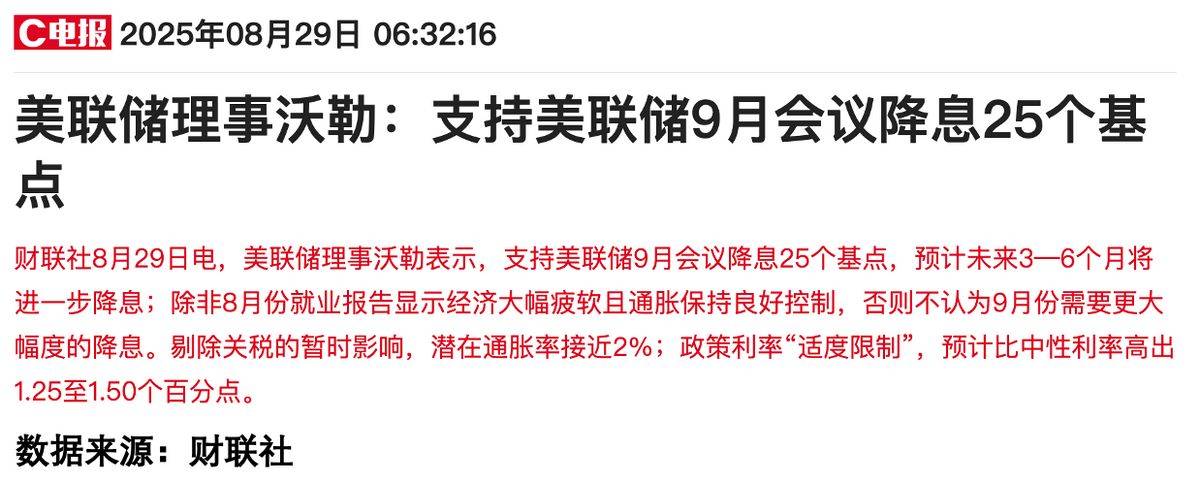
预期差

Search documents
【笔记20251105— 大A免疫《大空头》】
债券笔记· 2025-11-05 11:31
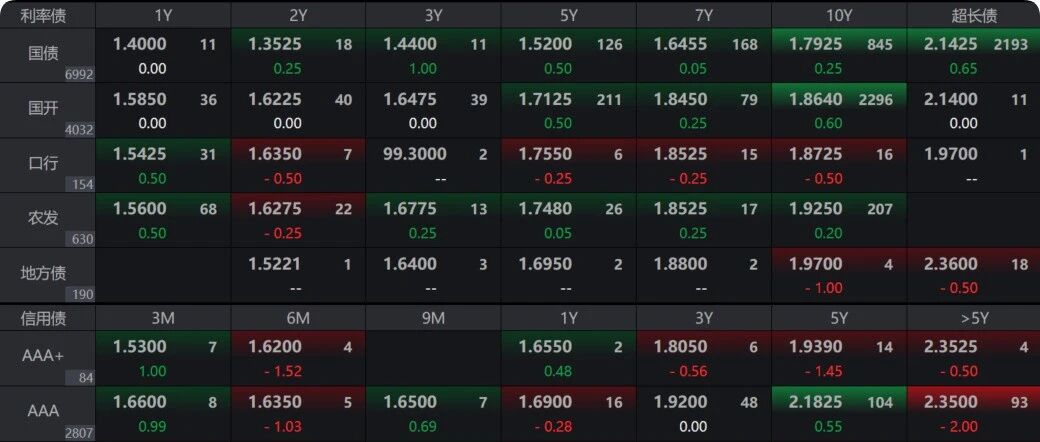
Core Viewpoint - The article emphasizes that not all information impacts the market; only information that creates a difference in expectations can lead to significant price fluctuations [1]. Market Overview - The funding environment is balanced and slightly loose, with long-term bond yields experiencing a slight increase. The central bank conducted a 655 billion yuan reverse repurchase operation, with 5,577 billion yuan of reverse repos maturing today, resulting in a net withdrawal of 4,922 billion yuan [3]. - The overnight overseas risk assets experienced a broad decline, leading to a lower opening for the stock market, which later rebounded. The 10-year government bond yield opened slightly lower at 1.787% and fluctuated down to around 1.78% [5]. - The stock market showed resilience, with a notable "green" performance amidst a backdrop of declining overseas markets, indicating a strong domestic market [6][8]. Bond Market Dynamics - The bond market reacted to the fluctuations in the stock market, with yields initially declining before rising again. The sentiment in the bond market was influenced by the performance of the stock market, which was described as a "see-saw" effect [5][8]. - The weighted rates for various repo codes remained stable, with R001 at 1.36% and R007 at 1.46%, indicating a steady funding rate environment [4]. Investor Sentiment - There is a mixed sentiment among investors regarding monetary policy, with bulls expecting a decrease in reverse repo rates while bears anticipate regulatory changes affecting redemption periods [9].

兴华基金黄生鹏:坚持深度研究“掘金”小市值板块
Shang Hai Zheng Quan Bao· 2025-10-26 15:37
Core Viewpoint - The article emphasizes the strategy of investing in small-cap stocks to uncover hidden value and generate sustainable long-term returns through deep research and a focus on fundamental analysis [1][2]. Group 1: Investment Strategy - The company aims to identify undervalued small-cap stocks in a liquidity-rich environment, which inherently possess higher uncertainty and potential for greater returns [1][2]. - The approach involves a defensive strategy that prioritizes safety by selecting high-quality assets based on fundamental research, which helps in controlling drawdowns while maximizing upside potential [2][3]. Group 2: Market Conditions - The current A-share market exhibits significant structural differentiation, with concentrated trading in sectors like AI, semiconductors, and robotics, leading to relative weakness in small-cap stocks [4][5]. - Historical patterns suggest that extreme market structures are often unsustainable, indicating that investment opportunities may become more diversified in the near future [5]. Group 3: Valuation Insights - As of October 22, the Wind data shows that the micro-cap stock index has a price-to-book (PB) ratio of 2.49, lower than the 2.81 of the CSI 2000, highlighting a relative valuation gap for small-cap assets [5]. - The current market sentiment may shift, providing accumulation opportunities for small-cap stocks that have solid fundamentals, low previous gains, and are aligned with industrial policy but not yet fully recognized by the market [5].
健友股份10连买!但90%人不懂门道
Sou Hu Cai Jing· 2025-10-20 11:45
Core Insights - The article discusses the phenomenon of continuous net buying by institutional investors in certain stocks, highlighting the disparity between retail and institutional investor behavior [1][3][7] - It emphasizes the importance of understanding the underlying data behind stock movements, particularly the "institutional inventory" data, to differentiate between sustainable growth and temporary spikes [5][7][8] Group 1: Market Behavior - The current market is characterized as a "liquidity bull market," where retail investors often react too late to market movements, leading to missed opportunities and losses [3][7] - The article draws a parallel to the quote from Qian Zhongshu's "Fortress Besieged," illustrating the conflicting desires of investors inside and outside the market [3] Group 2: Institutional vs. Retail Investors - Retail investors tend to enter the market after institutional investors have already made their moves, resulting in a detrimental time lag that can lead to significant losses [3][7] - The analysis of two contrasting stocks reveals that while one stock had a strong rebound, it lacked institutional support, indicating a potential trap for retail investors [5][7] Group 3: Stock Analysis - The article highlights 84 stocks that have seen continuous net buying from major funds, questioning whether this buying behavior is part of a strategic long-term investment or a short-term tactical move [7] - Historical data shows that stocks with a sustained upward trend in "institutional inventory" are more likely to experience long-term growth, while those with erratic inventory patterns may only see temporary gains [7] Group 4: Earnings Reports and Market Expectations - As the third-quarter earnings reports approach, the focus will shift to performance expectations, with "expectation gaps" being more critical than the earnings figures themselves [7] - The article suggests that monitoring changes in "institutional inventory" around earnings announcements can provide insights into whether institutions are selling on good news or buying into the stock [7][8]


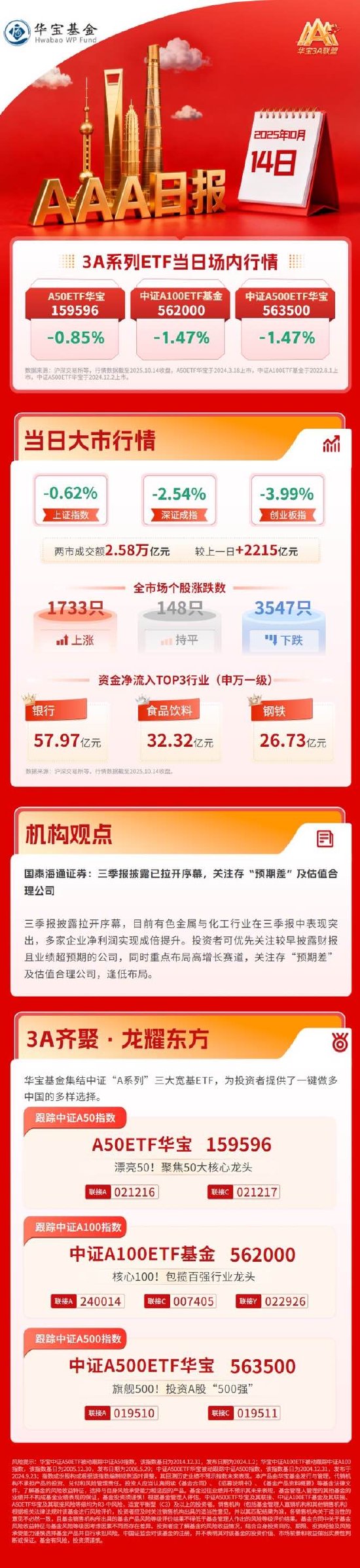
突变!大科技全面回调,白酒、保险板块低位走强 | 华宝3A日报(2025.10.14)
Xin Lang Ji Jin· 2025-10-14 09:39
Group 1 - The article highlights the performance of various ETFs, including A50ETF, A100ETF, and A500ETF, with specific focus on their market movements and upcoming listings [1][2] - The overall market performance shows a decline, with the Shenzhen Component Index down by 3.99% and the Shanghai Composite Index down by 2.54%, while the total trading volume reached 2.58 trillion yuan, an increase of 221.5 billion yuan from the previous day [1][2] - The article emphasizes the importance of the upcoming third-quarter earnings reports, particularly in the non-ferrous metals and chemical industries, where several companies have reported significant profit increases [2] Group 2 - The article mentions that investors should focus on companies with early earnings disclosures and those that exceed expectations, while also considering high-growth sectors and companies with reasonable valuations for potential investments [2] - The A50ETF, A100ETF, and A500ETF are presented as diversified investment options for investors looking to gain exposure to leading companies in China [2]
白银暴涨75%,散户为何总在接盘?
Sou Hu Cai Jing· 2025-10-12 15:58
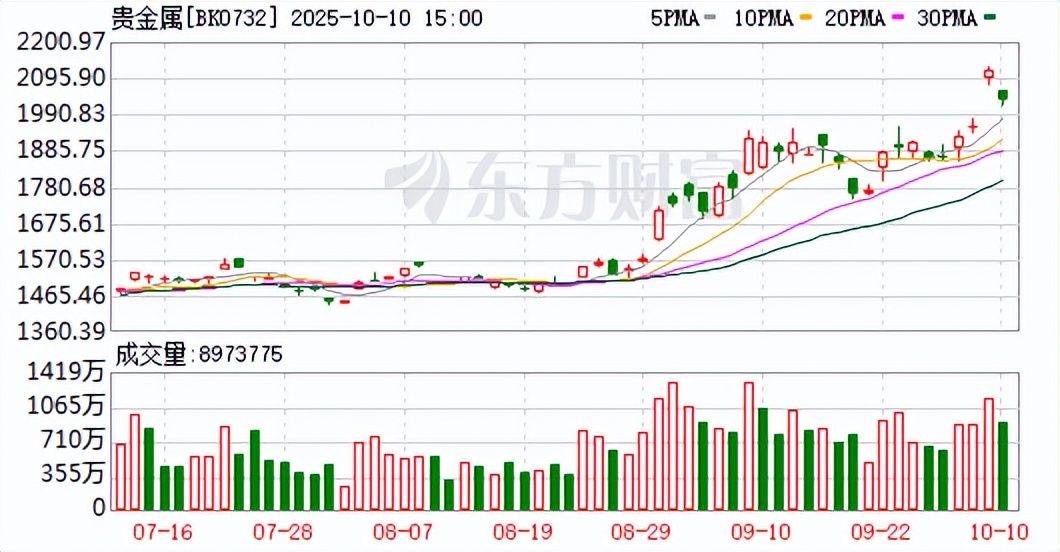
Core Insights - Recent surge in precious metal prices, with gold surpassing $3993 per ounce and silver reaching $50.67, reflecting significant year-to-date increases of over 50% and 75% respectively [1][3] - Market dynamics are influenced by factors such as risk aversion, Federal Reserve rate cut expectations, and central bank gold purchases, but the real opportunities often arise before consensus is reached [3][10] Market Behavior Analysis - Market trading behavior is complex, with different phases indicating various investor actions: bullish dominance, profit-taking, bearish dominance, and short covering [5] - Historical data shows that significant price movements can occur even when positive news is announced, as seen in a silver mining stock that dropped 15% despite a positive discovery announcement due to prior profit-taking [7][9] Current Precious Metals Market - The increase in silver ETF holdings by 1000 tons this year does not necessarily indicate retail investor buying, as commercial short positions are at historical lows, suggesting miners and refiners are reducing hedging [10][12] - The recent gold market surge is driven by more than just risk aversion; a multi-dimensional analysis reveals deeper insights into market behavior and potential pitfalls for investors [10][12] Investment Principles - Three key investment principles are highlighted: the need for data-driven decision-making, understanding market discrepancies, and the importance of dynamic tracking of market momentum [12][13] - The current precious metals market resembles past trends where early identification of industry turning points led to significant profits, emphasizing the importance of information processing capabilities in investment strategies [11][12]
黄金暴涨53%,散户为何总慢半拍?
Sou Hu Cai Jing· 2025-10-09 13:24
Core Insights - The recent surge in gold prices has reached a historic high of over $4000 per ounce, with a year-to-date increase of 53.6% [3][4] - Institutional investors have capitalized on this trend, while ordinary investors are still contemplating their next moves [1][3] Market Dynamics - The rise in gold prices is attributed to various factors including U.S. government shutdowns, global political instability, and risks associated with tech stock corrections [3][4] - The concept of "expectation difference" plays a crucial role in market movements, where future expectations outweigh current realities [4] Information Asymmetry - There exists a significant information gap between institutional investors and ordinary investors, with the former having access to advanced research tools and data [5][8] - Early movers in the market often capitalize on information that is not yet widely available, as seen in the case of the Yaxia Hydropower Station stocks [5][8] Quantitative Analysis - Quantitative data serves as a valuable tool for ordinary investors to navigate information asymmetry and identify market trends [8][14] - The trading behavior of stocks like "Tibet Tianlu" and "Poly United" indicates institutional activity prior to price surges, highlighting the importance of monitoring such data [10][12] Investment Strategy - The focus should not solely be on whether to buy gold now, but rather on the ability to assess market expectation changes [14][15] - Recommendations for ordinary investors include building a diverse information network, emphasizing quantitative data, monitoring institutional behavior, and maintaining independent thought [15][16]




金荣中国:白银早盘高位震荡小跌,关注回落支撑位多单布局
Sou Hu Cai Jing· 2025-09-23 01:56
Group 1: Market Overview - Silver has reached a 14-year high, outperforming gold, driven by its dual financial and industrial attributes, particularly in the renewable energy sector [1] - The simultaneous rise of gold and U.S. tech stocks indicates a complex market sentiment, balancing risk appetite and concerns over economic outlook [3] - The increase in U.S. Treasury yields, despite Fed rate cuts, suggests market expectations of economic resilience or persistent inflation [4] Group 2: Technical Analysis - Current silver market is characterized by price consolidation, with support at 43.53 and a cautious trading approach recommended [7] - Suggested trading strategy includes entering long positions around 43.63 with a stop loss at 43.20 and a target of 45.00-45.30 [7]

A股怎么敢炒新能源了?
Hu Xiu· 2025-09-12 06:02
Core Viewpoint - The A-share market is experiencing fluctuations with capital shifting between sectors, particularly between AI computing power and new energy sectors [1][2][3]. Group 1: AI Computing Power - The recent surge in AI computing power stocks is driven by unexpected advancements in application and computing power industries, leading to a significant increase in capital expenditure from major cloud service providers like Meta, Google, and AWS [6][7]. - Companies in the AI computing power supply chain, such as Zhongji Xuchuang, Xinyi Sheng, and Tianfu Communication, reported substantial profit growth in the first half of 2025, with net profits increasing by 69.40%, 355.68%, and 37.46% respectively [7]. - Despite the high expectations, the AI computing power sector has seen a decline in stock prices following the announcement of significant investments by Meta, indicating that the market may have fully priced in these expectations [10][11]. Group 2: New Energy Sector - The new energy sector, particularly solid-state batteries and energy storage, is experiencing renewed interest due to potential demand growth and supportive government policies aimed at reducing overcapacity [12][13]. - Solid-state batteries are gaining attention for their safety and performance advantages, with companies like Qian Dao Intelligent and Yiwei Lithium Energy making significant advancements and securing orders for production lines [13][14]. - The energy storage market has seen record-high orders, with a reported 25.8 GW and 69.4 GWh of systems and EPC orders in August 2025, indicating strong domestic demand and a shift towards independent energy storage business models [15][16]. Group 3: Market Dynamics - The market is currently in a phase of "high-cut low," where funds are moving towards sectors with less growth potential, such as new energy, due to a lack of new stories or expectations in the AI computing power sector [10][11]. - The new energy sector's recovery is contingent on the successful implementation of policies aimed at reducing supply chain pressures, particularly in the silicon material segment of the photovoltaic industry [18][19][20]. - The solid-state battery and energy storage sectors are expected to continue to attract investment, while the photovoltaic sector awaits clearer policy directions to confirm supply-demand balance [21][22].
中泰资管天团 | 唐军:资产配置需建立稳定分析框架,重视多元配置丰富回报流
中泰证券资管· 2025-09-11 11:33
Core Viewpoint - The article emphasizes the importance of a stable analytical framework and diversified asset allocation to avoid the pitfalls of chasing trends in investment, highlighting that there is no optimal solution in asset allocation [1][4]. Group 1: Asset Allocation Strategies - The performance of FOF funds has been strong this year, attributed to effective diversified allocation strategies [6]. - The manager, Tang Jun, adjusts the allocation between A-shares and Hong Kong stocks based on market conditions, demonstrating a responsive approach to market changes [1][6]. - Tang Jun actively participates in sectors like innovative pharmaceuticals and military ETFs, capitalizing on structural opportunities in a complex market environment [1][8]. Group 2: Professional Background and Insights - Tang Jun's career spans quantitative investment, fund evaluation, and macro research, providing a solid foundation for his current asset allocation work [3][4]. - His experience in quantitative research has enhanced his ability to identify various market factors, which is crucial for effective asset allocation [3][4]. - The "Zhongtai Clock" research incorporates policy analysis to better fit the domestic market, addressing the limitations of the previously used Merrill Lynch Clock [4]. Group 3: Dynamic Adjustment and Market Trends - Tang Jun believes that while macro trends provide guidance for asset allocation, the timing of price reflections can be uncertain, necessitating continuous monitoring and dynamic adjustments [6][8]. - The current allocation shows a shift towards A-shares over Hong Kong stocks, indicating a responsive strategy to market conditions [6][8]. Group 4: Avoiding Common Investment Mistakes - The article discusses the common mistake of "chasing trends," where investors buy high and sell low, and suggests establishing a stable analytical framework to counter this behavior [10][11]. - Diversification is recommended to enhance the return stream and provide confidence in maintaining the analytical framework during market fluctuations [11]. - Understanding "expectation differences" is crucial to avoid chasing trends, as short-term asset performance is often driven by the gap between fundamentals and market expectations [12].

美联储放鸽生变,A股压力来了!
Sou Hu Cai Jing· 2025-09-01 13:50
Group 1 - The core viewpoint of the article revolves around the implications of Federal Reserve Governor Waller's dovish remarks, suggesting a potential 25 basis point rate cut in September, which has stirred significant market reactions [1][2] - Waller's statements highlight the current economic conditions, including a potential inflation rate nearing the 2% target and increasing risks in the labor market, which appear to support the case for a rate cut [2][4] - The article emphasizes the disparity between market expectations and actual economic conditions, suggesting that market movements are often driven by perceived changes in expectations rather than the reality of economic data [5][15] Group 2 - There exists a cognitive gap between institutional investors and retail investors, with the former often having access to more sophisticated data analysis tools that inform their trading decisions [6][8] - The article illustrates that institutional trading behavior can be more indicative of underlying stock value than surface-level performance metrics, as seen in examples of stocks with contrasting institutional participation [11][13] - Waller's dovish comments are interpreted as having deeper implications, suggesting that investors should focus on actual market actions rather than solely on verbal statements from Federal Reserve officials [14][16] Group 3 - Recommendations for ordinary investors include avoiding superficial interpretations of Federal Reserve communications, focusing on real data regarding institutional fund flows, and developing a personal analytical framework for decision-making [15] - The article concludes that in an era of information overload, those who can discern the underlying truths in data will be better positioned to capitalize on market discrepancies [16]