债市

Search documents
10年国债收益率逼近1.8% 债市“黄金坑”还是“半山腰”?
Zhong Guo Zheng Quan Bao· 2025-08-26 15:51
Group 1 - The bond market has experienced significant adjustments in August, leading to pressure on the net value of many medium- and long-term pure bond funds due to rising interest rates and fund redemptions [1] - Fund managers are adopting different strategies in response to the current market conditions, with some actively positioning for what they see as a buying opportunity, while others are taking a more cautious approach by shortening duration and enhancing liquidity [1][2] - The 10-year government bond yield has fluctuated, dropping below 1.65% in early July and approaching 1.8% by late August, indicating a volatile bond market [2] Group 2 - Some fund managers, like Wang Peng, have begun to increase their positions in the bond market, believing that current yields present a good buying point, with expectations of a potential market rally by year-end [2] - Other managers, such as Hu Zhilei, suggest that the bond market's current pricing offers high value, and they recommend gradually increasing positions to capitalize on potential market recovery [2][3] - There is a cautious optimism among some fund managers regarding the bond market, with expectations of maintaining a low interest rate environment and continued monetary policy support, while also acknowledging the potential for short-term volatility [3]
10年国债收益率逼近1.8%,债市“黄金坑”还是“半山腰”?
Zhong Guo Zheng Quan Bao· 2025-08-26 12:23
Group 1 - The bond market has experienced significant adjustments in August, leading to pressure on the net value of many medium- and long-term pure bond funds due to rising interest rates and fund redemptions [1][2] - Fund managers are adopting different strategies in response to the current market conditions, with some actively increasing positions, viewing current yields as a buying opportunity, while others are cautiously observing and prefer to shorten duration and enhance liquidity [1][2] - The 10-year government bond yield has fluctuated, dropping below 1.65% in early July and approaching 1.8% by late August, indicating a volatile bond market [2] Group 2 - Some fund managers believe that while the value of certain bond types is becoming more apparent, it is not yet the right time for a right-side layout, expecting short-term volatility in the bond market [3] - The outlook for the bond market remains cautiously optimistic, with expectations of a low interest rate environment and continued monetary policy support, which will help maintain liquidity in the market [3] - Strategies include gradually increasing positions in long bonds when the 10-year government bond yield exceeds 1.75%, as the foundation of the bond market remains intact despite short-term disturbances from commodities and equity markets [3]
债市日报:8月26日
Xin Hua Cai Jing· 2025-08-26 09:03
Group 1 - The bond market showed a "weak first, strong later" performance, with interbank bond yields generally declining in the afternoon and government bond futures closing higher [1] - The central bank conducted a reverse repurchase operation of 405.8 billion yuan with a rate of 1.40%, resulting in a net withdrawal of 174.5 billion yuan for the day [5] - The sentiment in the bond market is currently extreme, with the risk of a significant decline being low, but stability may depend on equity assets [1][7] Group 2 - In the North American market, U.S. Treasury yields collectively rose, with the 10-year yield increasing by 0.78 basis points to 4.269% [3] - In the Eurozone, the 10-year German bond yield rose by 3.6 basis points to 2.755%, while the Italian and Spanish 10-year yields increased by 7 basis points [3] - The China bond market saw a decline in yields for various government bonds, with the 30-year bond yield down by 1 basis point to 1.9875% [2] Group 3 - The issuance of financial bonds by the Agricultural Development Bank saw competitive bidding, with the 2-year bonds having a bid-to-cover ratio of 4.63 and 3.88 respectively [4] - The China Development Bank's 5-year fixed-rate bond had a winning rate of 1.7052% with a bid-to-cover ratio of 4.37 [4] Group 4 - Institutional views suggest that the market should not interpret recent comments from Powell as a starting point for a series of easing measures, highlighting challenges in monetary policy due to employment and inflation targets [6] - Citic Securities noted that the equity market has continued to perform well, while the bond market has experienced volatility, indicating a shift in market dynamics [7]
机构继续看多债市,本轮债市调整以来平安公司债ETF(511030)净值相对稳健且回撤可控
Sou Hu Cai Jing· 2025-08-26 07:00
Group 1 - The core viewpoint indicates that the stock market has decoupled from the bond market, with a continued bullish outlook on bonds [1] - The overall profit growth rate for all A-shares in the first half of 2025 has not improved compared to the first quarter, with revenue growth remaining sluggish [1] - Since September 24, 2024, the current stock bull market has lasted nearly one year, with the All A Index doubling in value [1] Group 2 - The bond market has seen a net issuance of 14.3 trillion yuan in the first seven months of this year, with banks increasing their bond investments significantly [1] - The stock bull market has not impacted the total deposits in the banking system, indicating a structural shift in financing needs [1] - The convertible bond index is nearing historical highs, suggesting a cautious optimism for convertible bonds, with future attention on stock market changes and approval for new convertible bond issuances [2] Group 3 - The recommendation is to cherish yields above 2% for 30-year government bonds and 5-year capital bonds, as there may be opportunities to approach 1.6% for 10-year government bonds in the coming months [2] - The recent performance of the Ping An Company Bond ETF (511030) has shown the best control over drawdowns, indicating relative stability and manageable risk [2]
华泰证券:短期债市仍处逆风,但利率大概率“上有顶”
Xin Lang Cai Jing· 2025-08-24 23:53
Core Viewpoint - The current bond market is characterized by weak coupon protection, heavy speculation, and strong sentiment-driven trading, leading to suboptimal investment experiences [1] Group 1: Market Conditions - The short-term bond market is still facing headwinds, but interest rates are likely to have an upper limit [1] - The upper limit for the ten-year government bond is around 1.8%, with a maximum position at 1.9%, indicating potential overshoot risks mainly from institutional behavior [1] Group 2: Future Outlook - After October, a "counterattack" opportunity may arise due to a supply off-season, sentiment turning point, and high base effects in consumption [1] - The risk of continued tightening in the funding environment is low, and a recommendation for a steepening curve trade is suggested [1] Group 3: Investment Recommendations - 30-year government bonds and perpetual bonds are likely to act as sentiment amplifiers, and it is advised to temporarily avoid these [1] - Bonds with maturities of 5-7 years and below possess defensive characteristics, with shallow leverage arbitrage suggested [1] - For credit bonds, a focus on the mid to short end is recommended, as 3-5 year ordinary credit bonds have become relatively attractive after recent declines [1] - Convertible bonds should maintain equity beta exposure [1]

期货,为什么总是拉爆债市、股市、油价?
Hu Xiu· 2025-08-22 09:05
Group 1 - The article discusses the intense competition and strategic maneuvers surrounding futures trading in the financial markets [1] - It highlights how a seemingly normal financial derivative can significantly impact bond markets, stock markets, and oil prices [1] - The underlying logic and mechanisms driving these market movements are explored [1]
债券不香了 居民“钱袋子”加速流向权益市场
2 1 Shi Ji Jing Ji Bao Dao· 2025-08-22 02:12
Group 1: Market Overview - The equity market has shown strong performance in August, with the Shanghai Composite Index reaching a 10-year high and the total A-share market capitalization surpassing 100 trillion yuan [2] - In contrast, the bond market has faced significant adjustments, with the 10-year government bond yield rising from 1.72% to 1.79% within a few days, indicating a shift in investor sentiment [2][4] - The overall investment environment has led to a decline in the attractiveness of low-risk fixed-income products, prompting some investors to shift towards equities for potentially higher returns [1][6] Group 2: Fund Performance - Equity funds have performed exceptionally well, with an average total return of 21.87% year-to-date, a significant increase from -10.77% in the same period last year [3] - Conversely, bond funds have struggled, with an average total return of only 0.45% year-to-date, down from 2.44% the previous year, highlighting a stark contrast in performance [3][4] - Recent data shows that bond funds have even recorded negative returns in the short term, indicating a challenging environment for fixed-income investors [3] Group 3: Banking and Wealth Management - Bank wealth management products have seen a decline in yields, primarily due to a conservative investment approach focused on fixed-income assets, which are now under pressure from falling interest rates and market volatility [4][8] - The average annualized yield for cash management products dropped to 1.35%, while pure fixed-income products saw yields fall to 1.87%, reflecting the broader trend of diminishing returns in the fixed-income space [4] - There is a noticeable shift in resident savings, with a significant outflow from traditional savings accounts and fixed-income products towards equities, driven by the search for higher returns [6][7] Group 4: Investor Behavior - A growing number of young investors are entering the stock market, with some expressing confidence in sectors like military and robotics, while others are taking a more cautious approach focused on technology and consumer electronics [1][6] - Recent financial data indicates a substantial decrease in resident deposits, with a drop of 1.1 trillion yuan, suggesting a migration of funds towards the equity market [7] - Despite the bullish sentiment in the stock market, some industry professionals caution that investors should remain vigilant and assess their risk tolerance, especially given the increased market volatility [8]
债市日报:8月21日
Xin Hua Cai Jing· 2025-08-21 07:57
Core Viewpoint - The bond market showed signs of recovery with increased buying from funds, as liquidity conditions improved following the end of the tax payment period, leading to a decrease in funding costs [1][5]. Market Performance - The majority of government bond futures closed higher, with the 30-year main contract rising by 0.34%, and the 10-year and 5-year contracts both increasing by 0.06% [2]. - The interbank market saw a slight divergence in early trading, but yields generally declined in the afternoon, with the 30-year government bond yield decreasing by 2.45 basis points [2]. Overseas Market Trends - In North America, most U.S. Treasury yields fell, with the 10-year yield down by 1.94 basis points to 4.287% [3]. - In Asia, Japanese bond yields mostly rose, while in the Eurozone, yields on 10-year bonds from France, Germany, Italy, and Spain all decreased [3]. Primary Market Activity - The Export-Import Bank's 1-year fixed-rate bond had a winning bid rate of 1.2991%, with a total bid-to-cover ratio of 2.44 [4]. - The China Development Bank's 3-year and 7-year financial bonds had winning bid rates of 1.6599% and 1.8451%, respectively, with bid-to-cover ratios of 2.89 and 4.61 [4]. Liquidity Conditions - The central bank conducted a 7-day reverse repo operation with a total amount of 2,530 billion yuan, resulting in a net injection of 1,243 billion yuan for the day [5]. - Short-term Shibor rates mostly declined, with the overnight rate down by 0.7 basis points to 1.466% [5]. Institutional Insights - Institutions noted that while bond fund shares may decrease temporarily, they are expected to rebound as the stock market matures [6]. - The trading volume of convertible bonds has significantly increased, indicating heightened market activity, although high valuations may suppress further buying [7]. - The current focus in the bond market is on defensive strategies, with a recommendation to avoid certain long-duration bonds while considering short to medium-term opportunities [7].
近11天获得连续资金净流入近60亿元,30年国债ETF(511090)红盘上扬,规模续创新高!
Sou Hu Cai Jing· 2025-08-21 06:19
Group 1 - The 30-year Treasury ETF (511090) has seen a price increase of 0.27%, reaching 120.06 yuan as of August 21, 2025, with active market trading reflected by a turnover rate of 34.46% and a transaction volume of 9.438 billion yuan [1] - The latest scale of the 30-year Treasury ETF has reached a record high of 27.373 billion yuan, with the number of shares also hitting a new high of 229 million [1] - The ETF has experienced continuous net inflows over the past 11 days, with a maximum single-day net inflow of 1.274 billion yuan, totaling 5.923 billion yuan in net inflows [1] Group 2 - Analysts suggest that in the context of a moderate economic recovery and manageable inflation pressures, monetary policy is expected to remain accommodative, limiting the risk of significant interest rate increases, while long-term bond yields may exhibit a range-bound fluctuation pattern [2] - The 30-year Treasury ETF closely tracks the China Bond 30-Year Treasury Index, which consists of publicly issued 30-year government bonds, serving as a benchmark for investment performance in this category [2]
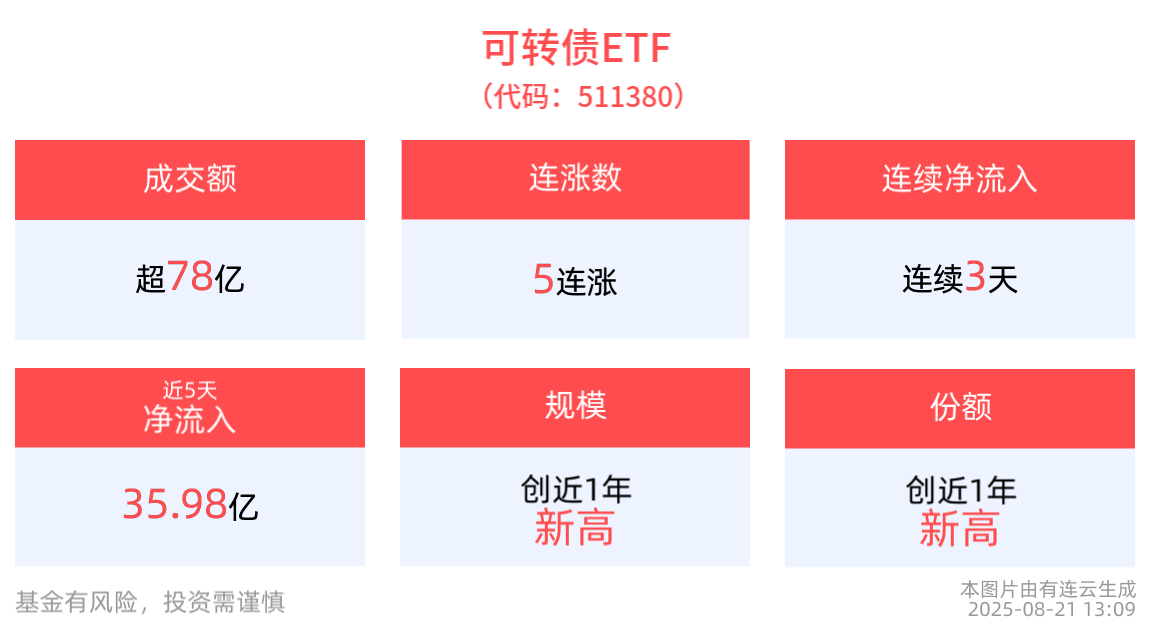
冲击5连涨!可转债ETF(511380)连续3日获资金净流入,最新规模突破550亿元创历史新高
Sou Hu Cai Jing· 2025-08-21 05:26
截至2025年8月21日 13:09,中证可转债及可交换债券指数(931078)上涨0.69%。可转债ETF(511380)上涨0.51%, 冲击5连涨。最新价报13.53元。拉长时间 看,截至2025年8月20日,可转债ETF近1周累计上涨1.95%。 流动性方面,可转债ETF盘中换手14.01%,成交78.22亿元,市场交投活跃。拉长时间看,截至8月20日,可转债ETF近1周日均成交107.33亿元。 消息面上,日前重要文章指出,事实充分证明,"更加积极有为的宏观政策"是务实管用的、有力有效的。降准、降息等货币政策工具已留有充分调整余地, 财政赤字、专项债、特别国债等视情仍有进一步扩张空间,当前,我国宏观政策工具箱依然充足。下一步,我们要在宏观政策上持续发力、适时加力,既推 动存量政策、既定政策持续落地,保持政策连续性稳定性,又做好政策储备,根据需要及时推动出台实施,增强灵活性预见性,进而以宏观治理之效应对外 部形势之变。 华源证认为,当前债市不具备大幅走熊条件,资金面偏宽松,当前无趋势性收紧信号,显示货币政策整体维持宽松基调。机构指出,在银行转债规模下降的 背景下,机构投资者需调整策略,可关注公用事业、 ...