
全球化

Search documents
美媒:美国单极霸权已经落幕,新的世界秩序即将到来
Sou Hu Cai Jing· 2026-01-12 23:34
Group 1 - The article argues that while the United States remains the most powerful country, its era of unilateral hegemony has ended, with the Trump administration's unilateralism being a reaction to this decline [1][4][8] - The global response to U.S. tariffs was unexpected, as few countries retaliated, and many signed agreements with the U.S., often at the cost of their own interests [2][4] - Despite the U.S. imposing tariffs, many countries, especially developing nations, continue to deepen trade integration, with new bilateral trade agreements being signed by countries like Canada, India, and Indonesia by 2025 [5][6] Group 2 - The U.S. has abandoned the principle of mutually beneficial trade, imposing unequal agreements in key mineral sectors, yet countries like Vietnam and Zimbabwe are increasing their resource development efforts [6][7] - The BRICS nations, representing developing countries, are committed to defending multilateralism, with new members like Indonesia joining and enhancing the group's international credibility [6][7] - The emerging global order is characterized by a blend of various elements and powers, emphasizing collaborative autonomy among nations rather than top-down control [7][8]

年终盘点2025汽车市场的“龙门一跃”:油退电进,全球登顶
3 6 Ke· 2026-01-12 10:37
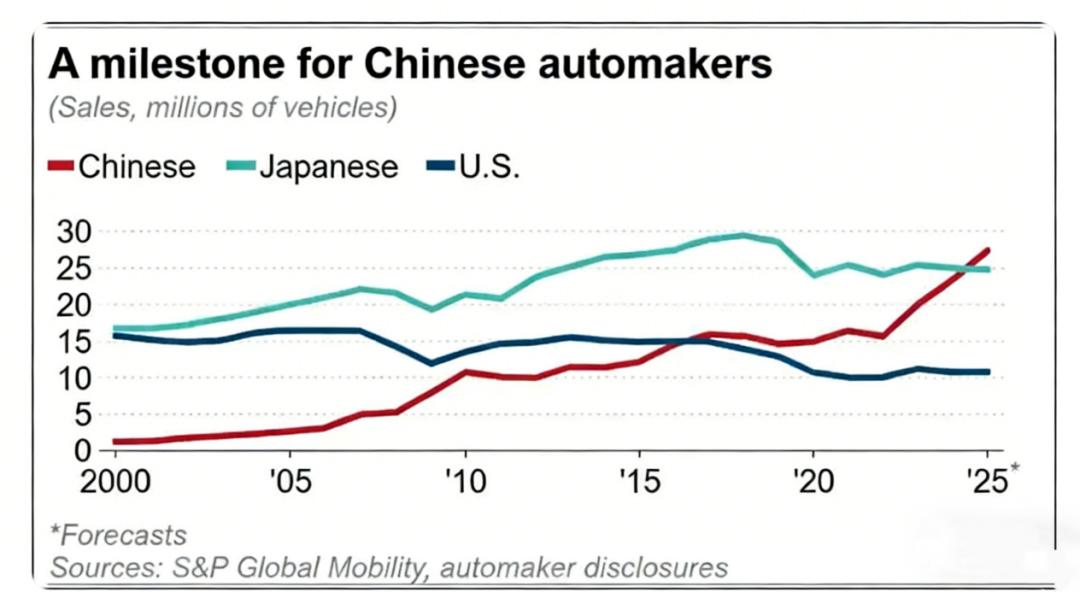
Core Insights - The penetration rate of new energy vehicles (NEVs) in China has surpassed 50%, marking a significant shift in the automotive market dynamics, transitioning from a "policy-driven" to a "product-driven" model [1][10] - The year 2025 is seen as a pivotal moment for the Chinese automotive industry, with the market experiencing a fundamental transformation akin to a "Nokia moment" [1] - The competition is evolving from price wars to value wars, emphasizing technology and product quality over mere volume [11] Industry Overview - In 2025, China's automotive manufacturers are projected to achieve global sales of 27 million vehicles, securing the top position in the global new car sales rankings for the first time [2] - China has overtaken Japan to become the world's largest automobile exporter, with NEVs accounting for a significant portion of this growth [4] - The domestic market's NEV sales are nearing 60%, reflecting a structural change in consumer preferences [4] Sales and Market Penetration - By November 2025, the retail penetration rate of NEVs reached 53.6%, with projections for the full year estimating a rate of 54.0% [6] - The rapid increase in NEV penetration is attributed to a combination of policy support, technological advancements, infrastructure development, and market demand [7] Policy and Technological Developments - The exit of purchase subsidies in 2023 has been offset by continued tax exemptions and various local incentives, which have helped maintain consumer interest in NEVs [7] - 2025 is expected to be a year of technological breakthroughs in NEVs, with advancements in high-voltage platforms, solid-state batteries, and smart driving technologies [8] Infrastructure and Consumer Experience - The expansion of charging infrastructure is crucial for alleviating consumer concerns about range anxiety, with projections of 20 million charging stations by the end of 2025 [9] - The cost advantages of NEVs are becoming increasingly apparent, with electric vehicles offering significantly lower operating costs compared to traditional fuel vehicles [9] Competitive Landscape - The shift from price competition to value competition is reshaping the industry, with companies focusing on technological innovation and profitability [11] - Some companies, like Leap Motor, have emerged as strong competitors, achieving significant sales growth and profitability [13] Global Expansion - In 2025, China's automotive exports are expected to exceed 7 million units, with NEV exports alone projected to reach 2.315 million units, marking a 102.9% increase [21] - Chinese automakers are transitioning to a "global + local" model, emphasizing localized production and R&D to better penetrate international markets [22] Challenges and Future Outlook - Despite rapid growth, challenges such as trade protectionism and compliance costs remain significant hurdles for Chinese automakers in global markets [24] - The automotive industry is expected to continue evolving, with a focus on sustainable growth and value creation as it navigates the transition from a subsidy-driven to a market-driven environment [25]





WTO已成弃子?温铁军揭露:全球化本质不在自由贸易
Sou Hu Cai Jing· 2026-01-12 07:24
有人至今还把全球化简单理解为自由贸易,以为这只是市场自发发展的结果。但温铁军一句话就打破了这种幻想:全球化从一开始就不是单纯的自由贸易, 而是霸权体系的一部分!所谓自由贸易只是表面现象,背后的真相是,规则的制定者从未真正参与公平博弈,而是以国家利益为最终考量,在制定、修改甚 至废除规则时,始终把自身利益放在首位。 二战后,美国是无可争议的最大赢家。它不仅经济实力雄厚,还承担了西方大部分战后重建工作。通过出口装备,美国成为全球最大的债权国,其他国家不 得不赚美元来偿还债务。为了让美国商品、资金和货币顺利渗透全球,美国建立了三大利器:GATT(关税与贸易总协定)、世界银行(WB)和国际货币 基金组织(IMF)。 GATT帮助美国工业品出口扫清关税障碍,推动全球降税;世界银行和国际货币基金组织则名义上提供发展援助,实质上让其他国家对美元资本形成结构性 依赖。美国一边出口商品,一边放贷,同时控制各国货币命脉——你买我的货、用我的钱、还得用我发的货币偿债。这才是真正的世界经济霸主地位。 即便拥有这三大工具,美国在农业和金融两块仍然动不了。农业方面,大多数国家土地有限、人口众多,难以抗衡美国大型农场机械化低成本的冲击。如 ...

何小鹏:小鹏汽车海外和国内销量比例未来有望达到1:1
Xin Lang Cai Jing· 2026-01-12 03:15
Core Viewpoint - Xiaopeng Motors aims to expand its core product lines, including smart cars, Robotaxi, robots, and low-altitude flying cars, into global markets from 2026 to 2030, emphasizing local R&D and manufacturing [1] Global Expansion Strategy - By 2025, Xiaopeng Motors plans to enter 60 countries and regions, with further expansion into more markets in 2026 [1] - The company intends to deepen local R&D and manufacturing efforts to introduce more globalized models suitable for both left-hand and right-hand drive markets [1]
何小鹏:国内国外市场都很大 值得中国企业加速走出去
Zhong Guo Xin Wen Wang· 2026-01-12 00:59
Group 1 - The core viewpoint of the article is that XPeng Motors is committed to global expansion of its core product lines, including smart cars, Robotaxi, and robotics, from 2026 to 2030 [1] - As of now, XPeng Motors has established 9 R&D centers and 3 localized production projects globally [1] - The company's global charging network covers 31 countries and regions, with over 2.66 million charging piles connected [1] Group 2 - Currently, XPeng Motors has operations in 60 countries and regions [1] - The pace of overseas manufacturing layout is expected to accelerate further in 2026 [1]

美国对世贸说再见?亚洲出口逆势爆发,关税乱局引发全球大洗牌
Sou Hu Cai Jing· 2026-01-11 09:56
Group 1 - The core issue is that the global trade system is under significant stress due to unilateral actions by the United States, particularly through increased tariffs, which have not had the intended suppressive effect on other countries [1][5] - Southeast Asia, particularly Cambodia, has seen a dramatic increase in exports to the U.S., with garment exports doubling, indicating a shift in trade dynamics as countries adapt to new tariffs [1][5] - The U.S. domestic issues, including factory closures and stagnant wages, have fueled public discontent, leading to a political environment that supports aggressive tariff policies [3][5] Group 2 - The World Trade Organization (WTO) has become ineffective in managing the trade disputes arising from U.S. tariff policies, as it lacks the authority to enforce rules against the largest economy [7][9] - Despite the turmoil caused by U.S. tariffs, global markets have not collapsed; Asian countries continue to leverage their export advantages, and companies are finding new opportunities within the adjusted supply chains [11][13] - The future of global trade may not revert to complete openness but will likely evolve into a system that balances national interests with the need for continued international trade, suggesting a shift towards new rules of engagement [13]
徐高:美元全球大循环的衰落是一个长期、渐进的过程
Di Yi Cai Jing Zi Xun· 2026-01-11 07:17
Core Viewpoint - The core position is that the dominance of the US dollar in the global economy is entering a decline phase due to internal economic structures and policy choices in the US, rather than external challenges [1]. Group 1: Global Economic Changes - The global economic landscape is undergoing profound changes, leading to structural pressures on the dollar's core position in international trade and finance [1]. - The long-term imbalance in modern global trade has been sustained since the dollar decoupled from gold in 1971, allowing some countries to maintain trade surpluses while the US continues to act as a global liquidity provider [3]. Group 2: Risks to the US Dollar - The main risks to the dollar's global circulation stem from changes in the US domestic economic structure, including a declining manufacturing sector and widening income distribution gaps, making it difficult for the US to maintain balanced economic growth through globalization [3]. - The US faces a policy dilemma: continuing to push dollars abroad to sustain global demand may lead to structural issues and social conflicts domestically, while reducing dollar outflow to stabilize the domestic economy could decrease global trade demand [3]. Group 3: Implications for China - For China's economic development, three key insights are highlighted: 1. The internationalization of the renminbi should focus on maintaining trade stability rather than attempting to replace the dollar, as excessive pursuit of becoming a reserve currency may increase outflow pressures and impact domestic industrial structure [4]. 2. In response to the trend of reduced global demand from the US, China should accelerate domestic demand construction through consumption upgrades and investment to buffer export pressures [4]. 3. Short-term attention should be paid to the impact of US domestic policies on external demand, including adjustments in fiscal and monetary policies, which will directly affect China's exports and external demand trends [4]. Group 4: Long-term Outlook - The decline of the dollar's global circulation is expected to be a long-term and gradual process, potentially lasting 20 to 30 years [5]. - For China, the strategic focus should be on stabilizing external demand, accelerating domestic demand development, and promoting the steady internationalization of the renminbi, rather than pursuing a short-term goal of replacing the dollar [5].
我们为什么还在拼命“造车”?
汽车商业评论· 2026-01-10 23:05
Core Viewpoint - The automotive industry is undergoing significant transformation driven by electrification, intelligence, and globalization, with new energy vehicles (NEVs) being a key focus in the Chinese market. [5][6] Group 1: Industry Trends - From January to November 2023, domestic sales of NEVs reached 12.466 million units, a year-on-year increase of 23.2%, with passenger vehicles at 11.715 million units (up 21.3%) and commercial vehicles at 750,000 units (up 62.4%) [5] - The penetration rate of NEVs in China is expected to exceed 40% by 2024, with some months reaching 50%, indicating rapid growth and opportunity in the sector [15] - The competition among domestic NEV manufacturers has intensified, leading to a prolonged price war that has lasted nearly four years, with companies employing price cuts and limited-time offers to capture market share [5][6] Group 2: Supply Chain Transformation - The traditional linear supply chain model is being replaced by a networked ecosystem that emphasizes co-creation among manufacturers, technology companies, and suppliers to enhance product quality and cost control [6][20] - Long-term strategies are being developed to address compliance pressures from EU battery regulations and carbon emissions, necessitating improvements in supply chain resilience and green compliance [6][20] - Changan Automobile has implemented a systematic supplier certification process and expanded its supplier base to over 1,500, including 100 overseas suppliers, to build a global supply chain resource system [25][27] Group 3: Technological Advancements - The integration of advanced technologies such as AI and smart driving systems is reshaping the automotive landscape, with a focus on enhancing user experience while maintaining safety standards [17][20] - Changan is pursuing a modular and platform-based approach to vehicle design, allowing for greater flexibility and adaptability in production processes [28][29] - The company is also focusing on digital transformation, improving procurement and supply chain systems to enhance efficiency and connectivity [43] Group 4: Strategic Partnerships - Collaborative efforts with suppliers and technology partners are being emphasized to create a win-win ecosystem, fostering transparency and mutual support in the supply chain [36][40] - Changan is exploring diverse cooperation models with traditional Tier 1 suppliers and ICT giants, aiming for strategic alliances that address technological challenges [35][36] - The company is committed to building a shared, open, and win-win networked ecosystem, transitioning from short-term transactional relationships to strategic collaborations [21][36]


小鹏汽车何小鹏:2026年海外生产制造布局的节奏还会进一步加快
Zheng Quan Shi Bao Wang· 2026-01-10 12:51
Core Viewpoint - The CEO of XPeng Motors, He Xiaopeng, emphasizes the importance of global expansion for Chinese companies, particularly in the fields of smart vehicles, Robotaxi, robotics, and low-altitude flying cars, with a commitment to accelerate this process from 2026 to 2030 [1] Group 1: Global Expansion Strategy - XPeng Motors has established 9 R&D centers and 3 localized production projects overseas [1] - The company's global charging network covers 31 countries and regions, with over 2.66 million charging stations connected [1] - Currently, XPeng Motors has operations in 60 countries and regions, with plans to further accelerate overseas manufacturing layout by 2026 [1]
何小鹏:目前业务已落地60个国家和地区,未来五年全力推进全球化
Xin Lang Cai Jing· 2026-01-10 12:10
Core Viewpoint - Xiaopeng Motors aims to expand its global presence across all core product lines, including smart vehicles, Robotaxi, and robotics, with a strong focus on globalization from 2026 to 2030 [1] Group 1: Global Expansion Strategy - The company has established 9 major R&D centers and 3 localized production projects overseas [1] - Xiaopeng Motors' global charging network covers 31 countries and regions, with over 2.66 million charging piles connected [1] - Currently, the business has been implemented in 60 countries and regions, with plans to accelerate overseas manufacturing layout by 2026 [1]