
稳增长

Search documents
【财经分析】需求高度有限 成本支撑较强 黑色系四季度或稳中趋好
Zhong Guo Jin Rong Xin Xi Wang· 2025-09-23 08:22
转自:新华财经 新华财经北京9月22日电(郭洲洋)黑色系商品价格2025上半年在整体供应宽松的格局中呈现下行趋 势。三季度以来,价格重心受"反内卷"政策预期支撑大幅回升,尤其是焦煤的强势对产业链上下游均形 成了提振, 但随着市场情绪的降温,黑色系又再次陷入震荡。 总的来看,需求的阶段性走弱使得焦煤价格跟随成材进行了回调,但是"反内卷"预期仍对价格底部形成 有效支撑。永安期货预计,焦煤已较难回到前期低点,向上空间主要取决于成材表现,同时也受到动力 煤的制约。 此外,铁矿石目前供需双增,基本面矛盾总体较为缓和。"考虑到钢厂盈利比例依然不错,我们预计短 期铁水难跌,对铁矿价格仍有不小支撑。"中金公司表示,预计四季度铁矿价格运行区间100-110美元/ 吨,焦煤现货价格可能维持在1200-1300元/吨以上。 黑色系有望稳中趋好 四季度重点关注需求表现 在双焦价格持续走强的压力下,下游钢厂利润受到明显压缩,原料需求逐渐走弱,在期货盘面保持强势 的同时,焦炭现货市场出现了多次的钢厂提降,压制了原料价格的上涨趋势。永安期货指出,"可以 说,钢材偏弱的现实是黑色品种在7月冲高后面临价格阻力的关键所在,其后续需求表现将决定整 ...
华宝期货黑色产业链周报-20250922
Hua Bao Qi Huo· 2025-09-22 11:09
Report Summary 1. Report Industry Investment Rating No information provided regarding the industry investment rating. 2. Core Views of the Report - **成材**: Short - term outlook is oscillating with a slight upward bias, but the upside is limited. The trading logic is mainly based on industry fundamentals, with the price of finished steel showing signs of recovery, yet the weak downstream demand may constrain the price rebound [9]. - **煤焦**: In the short - term, there is an increase in both supply and demand. The downstream is actively replenishing inventory before the National Day holiday, which supports the confidence in price support. The futures market is expected to maintain a wide - range oscillation [10]. - **铁合金**: Silicon manganese and ferrosilicon continue to face a situation of strong supply and weak demand, with pressure on inventory. However, the short - term restocking demand before the National Day holiday may support prices. It is expected that prices will be in a weak consolidation state [11]. 3. Summary by Relevant Catalogs 01. Weekly Market Review - **Futures and Spot Prices**: From September 12 to September 19, 2025, most black commodity futures and spot prices increased. For example, the futures price of coke J2601 rose from 1625.5 to 1738.5, a 6.95% increase, and the spot price of Rizhao Port's quasi - first - grade coke increased from 1390 to 1500, a 7.91% increase [7]. 02. This Week's Black Market Forecast - **成材** - **Logic**: The blast furnace utilization rate and daily hot metal output of 247 steel mills increased, while the average capacity utilization rate and average operating rate of 90 independent electric arc furnace steel mills decreased. The finished steel rebounded last week, but the weak downstream situation remains unchanged. The Ministry of Industry and Information Technology has set an average annual growth target of about 4% for the steel industry in the next two years [9]. - **View**: Short - term oscillation with a slight upward bias. - **Future Focus**: Macroeconomic policies and downstream demand. - **煤焦** - **Logic**: The Fed cut interest rates by 25bp last week, and the futures price of coal and coke oscillated with an upward bias. On the spot side, coal prices in Shanxi rebounded slightly, and some coke enterprises in Inner Mongolia planned to raise prices. The environmental protection policy in Tangshan affected market sentiment, but the overall rigid demand for raw materials remained strong [10]. - **View**: Short - term supply and demand both increase, and the market will maintain a wide - range oscillation. - **Future Focus**: The resumption process of coal, coke, and steel production and changes in imported coal clearance. - **铁合金** - **Logic**: Overseas, the Fed cut interest rates by 25bp. Domestically, the market has entered the traditional peak season, but demand is still weaker than expected. On the supply side, the output and operating rate of silicon manganese decreased slightly, while those of ferrosilicon remained stable. On the demand side, the weekly demand for silicon manganese and ferrosilicon of the five major steel types decreased for three consecutive weeks. On the inventory side, silicon manganese inventory increased significantly, while ferrosilicon inventory decreased. The cost of silicon manganese and ferrosilicon has certain support [11]. - **View**: Prices are expected to be in a weak consolidation state. - **Future Focus**: Domestic macro - policies, terminal demand, steel mill profits, production, and domestic production restrictions. 03. Variety Data - **成材** - **螺纹钢**: Last week, the output was 206.45 tons, a week - on - week decrease of 5.48 tons; the apparent demand was 210.03 tons, a week - on - week increase of 11.96 tons. The total inventory was 650.28 tons, a week - on - week decrease of 3.58 tons [13][20]. - **热轧**: Last week, the output was 326.49 tons, a week - on - week increase of 1.35 tons; the apparent demand was 321.82 tons, a week - on - week decrease of 4.34 tons. The total inventory was 377.99 tons, a week - on - week increase of 4.67 tons [24][29]. - **基差**: The basis of rebar and hot - rolled coil in different regions and delivery months showed different changes, such as the 1 - month basis of rebar in Shanghai being 88 yuan/ton last Friday, a week - on - week decrease of 5 yuan/ton [32]. - **煤焦** - **焦炭**: The total inventory last week was 915.2 tons, a week - on - week increase of 8.99 tons. The independent coke enterprise inventory was 66.4 tons, a week - on - week decrease of 1.4 tons [47]. - **焦煤**: The total inventory last week was 2550.09 tons, a week - on - week increase of 66.68 tons. The independent coke enterprise inventory was 940.4 tons, a week - on - week increase of 56.9 tons [55]. - **Other Data**: Data such as the profit per ton of coke for independent coke enterprises, inventory availability days, and the ratio of coke to coking coal prices also showed corresponding changes [63][67]. - **铁合金** - **Spot Prices**: The spot price of manganese ore in Tianjin Port, silicon manganese, and ferrosilicon all increased last week. For example, the spot price of silicon manganese in Inner Mongolia (6517) increased from 5650 to 5730 yuan/ton [79]. - **Inventory**: The port inventory of manganese ore increased. The inventory of silicon manganese increased significantly, while the inventory of ferrosilicon decreased [81][92]. - **Output and Demand**: The output of silicon manganese decreased slightly, while the output of ferrosilicon remained stable. The demand for both silicon manganese and ferrosilicon decreased for three consecutive weeks [83][89]. - **Import and Production**: In July, the import of manganese ore was 274.35 tons, a month - on - month increase of 2.23%. In August, the production of silicon manganese was 90.93 tons, a month - on - month increase of 10.94% [96].
周报:四季度政策性限产落地仍可期,再次提示重视钢铁板块配置-20250921
Xinda Securities· 2025-09-21 05:53
Investment Rating - The investment rating for the steel industry is "Positive" [2] Core Viewpoints - The report emphasizes the importance of the steel sector in investment allocation, particularly in light of expected policy-driven production limits in the fourth quarter [1][2] - Despite current supply-demand imbalances and declining overall industry profits, the steel demand is anticipated to stabilize or slightly increase due to supportive policies in real estate, infrastructure, and manufacturing sectors [3][2] - The report suggests that the industry is likely to maintain a stable supply-demand situation, with a focus on high-margin specialty steel companies and leading enterprises with strong cost control [3][2] Supply Situation - As of September 19, the capacity utilization rate for blast furnaces among sample steel companies is 90.4%, a week-on-week increase of 0.17 percentage points [25] - The average daily pig iron production is 2.41 million tons, with a week-on-week increase of 0.47 tons and a year-on-year increase of 176,400 tons [25] - The total production of five major steel products is 7.437 million tons, a week-on-week decrease of 11,500 tons [25] Demand Situation - The consumption of five major steel products reached 8.503 million tons as of September 19, with a week-on-week increase of 70,000 tons [35] - The transaction volume of construction steel by mainstream traders is 107,000 tons, reflecting a week-on-week increase of 3.32% [35] Inventory Situation - The social inventory of five major steel products is 11.014 million tons, a week-on-week increase of 62,700 tons [43] - The factory inventory of five major steel products is 4.184 million tons, a week-on-week decrease of 1.14% [43] Price & Profit Situation - The comprehensive index for ordinary steel is 3,507.3 yuan/ton, with a week-on-week increase of 17.52 yuan/ton [49] - The profit for rebar produced in blast furnaces is 22 yuan/ton, a significant week-on-week increase of 257.14% [58] - The average cost of pig iron is 2,381 yuan/ton, with a slight week-on-week increase [58] Raw Material Prices - The spot price index for Australian iron ore (62% Fe) is 802 yuan/ton, a week-on-week increase of 6.0 yuan/ton [72] - The price of primary metallurgical coke is 1,715 yuan/ton, with a week-on-week decrease of 55.0 yuan/ton [72]


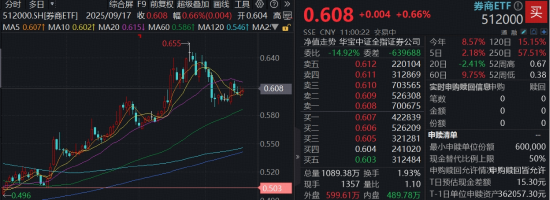
“旗手”躁动,首创证券再涨停,顶流券商ETF(512000)连续吸金超48亿元,机构:高盈利与低估值推升性价比
Xin Lang Ji Jin· 2025-09-17 05:34
Group 1 - The market showed a positive trend with the new energy sector leading the gains, and the ChiNext Index rose over 1% to reach a new high [1] - The brokerage sector was active, with the top brokerage ETF (512000) increasing by 0.66%, recovering above the 5-day moving average, and achieving a trading volume exceeding 600 million yuan [1] - Recent A-share market activity indicates a short-term recovery in sentiment, supported by expectations of a potential interest rate cut by the Federal Reserve and enhanced domestic policy measures [1][3] Group 2 - Financial analysts suggest that the current A-share valuations remain attractive, with future policies aimed at "de-involution" and demand-side support being crucial for market performance [3] - The brokerage sector's performance improved significantly in the first half of the year, highlighting a mismatch between high profitability and low valuations, which enhances the sector's investment appeal [3][4] - The brokerage ETF (512000) has seen continuous net inflows for 14 trading days, totaling 4.832 billion yuan, indicating strong investor interest [3] Group 3 - The brokerage ETF (512000) has surpassed 34 billion yuan in size, setting a new historical high, with an average daily trading volume of 957 million yuan this year [6] - The ETF tracks the CSI All Share Securities Companies Index, encompassing 49 listed brokerage stocks, with a significant portion of its holdings in leading brokerages [6] - The current market environment, characterized by adequate liquidity and improved investor confidence, is expected to drive the brokerage sector's growth [3][6]


王晓在咸阳市调研省“十五五”规划编制、稳增长、高质量项目建设、西咸一体化和安全生产等工作
Shan Xi Ri Bao· 2025-09-17 00:37
Core Points - The provincial government is focusing on the "14th Five-Year Plan" and is actively engaging in discussions to gather opinions and suggestions for the upcoming "15th Five-Year Plan" [1][2] - Emphasis is placed on promoting high-quality project construction, economic stability, and safety production across various sectors [2] Group 1 - The provincial government is conducting research on the integration of Xi'an and Xianyang, aiming to enhance economic recovery and growth [2] - There is a strong focus on technology innovation and the integration of industrial development, with an aim to improve the conversion and industrialization of scientific achievements [2] - The government is committed to enhancing project quality and regulatory oversight to maximize investment efficiency and promote new growth points [2] Group 2 - The government is implementing policies to support employment, businesses, and market stability, while also addressing safety production management [2] - The initiative includes a collaborative approach to innovation and industry cooperation, reinforcing the importance of both human and material investments [2] - The provincial leadership is dedicated to delivering a solid performance in the "14th Five-Year Plan" and is strategically planning for key tasks in the "15th Five-Year Plan" [2]
不止稳增长:新一轮十大行业政策发布,背后是国家战略的深刻转变
2 1 Shi Ji Jing Ji Bao Dao· 2025-09-16 09:45
Core Viewpoint - The new round of ten key industry growth stabilization plans has been launched to support industrial growth amid external and internal economic challenges, focusing on maintaining reasonable growth rates in key industries to stabilize the overall economy [1][2]. Group 1: Industry Growth Plans - The plans include the "Electronic Information Manufacturing Industry Action Plan (2025-2026)", "Power Equipment Industry Growth Stabilization Work Plan (2025-2026)", and "Automobile Industry Growth Stabilization Work Plan (2025-2026)" [1]. - The ten key industries targeted are steel, non-ferrous metals, petrochemicals, chemicals, building materials, machinery, automobiles, power equipment, light industry, and electronic information manufacturing, which collectively account for about 70% of the industrial economy [3][4]. Group 2: Specific Industry Goals - The "Automobile Plan" aims for annual vehicle sales of approximately 32.3 million by 2025, a year-on-year increase of about 3%, with new energy vehicle sales expected to reach 15.5 million, a growth of about 20% [3]. - The "Power Equipment Plan" sets a target for traditional power equipment to maintain an average annual revenue growth rate of around 6%, while the advanced manufacturing cluster in the power equipment sector aims for a 7% annual revenue growth [4]. - The "Electronic Information Manufacturing Plan" anticipates an average growth rate of 7% for major electronic equipment manufacturing, with a target of over 40% market penetration for large-screen televisions by 2026 [4][6]. Group 3: Policy Focus and Changes - The current stabilization policies emphasize quality and efficiency alongside growth, shifting from a focus on quantity to structural optimization and long-term high-quality development [2][8]. - The policies aim to enhance supply through technological innovation and address irrational market competition, promoting a unified national market [2][7]. - The emphasis on creating new demand and exploring new markets marks a shift from the previous focus on restoring consumer growth [7][8].
解读8月经济“成绩单”:韧性十足|全球财经连线
2 1 Shi Ji Jing Ji Bao Dao· 2025-09-15 14:12
Group 1 - The core theme of the article is the resilience of the Chinese economy, highlighted by steady industrial production and strong growth in new momentum industries [2] - The service sector is experiencing accelerated development, with modern service industries growing at a rate exceeding double digits [2] - Consumption policies are showing gradual effectiveness, contributing to the overall economic performance [2] Group 2 - Investment structure is optimizing, with high-tech manufacturing and equipment upgrades emerging as key highlights [2] - The article raises questions about which new momentum sectors are accelerating and where the focus for future growth will lie [2]
【招银研究|宏观点评】波动修复——中国经济数据点评(2025年8月)
招商银行研究· 2025-09-15 11:13
Core Viewpoint - The economic data for August indicates a slowdown in China's economy, with key indicators falling short of market expectations, highlighting persistent supply-demand imbalances and increasing downward pressure on growth [1][4]. Group 1: Consumption - Retail sales growth in August was 3.4%, below the expected 3.8%, influenced by adjustments in national subsidies and the emergence of consumption loan interest subsidies [3][5]. - Commodity consumption growth declined by 0.4 percentage points to 3.6%, marking the third consecutive month of slowdown, with notable performance in upgraded goods like jewelry and sports equipment [5]. - Service consumption remained resilient, with retail sales growth slightly decreasing to 5.1%, driven by increased demand for travel and leisure activities during the summer [8][10]. Group 2: Fixed Asset Investment - Fixed asset investment growth was only 0.5% in August, a significant drop of 1.1 percentage points from the previous month, with infrastructure and manufacturing investments also declining [11][12]. - Real estate investment saw a year-on-year decline of 12.9%, with new construction and sales continuing to weaken, indicating ongoing challenges in the property market [12][15]. - The government is expected to implement policies to stimulate investment, including early issuance of local government debt limits to alleviate financial burdens [15][28]. Group 3: Trade - Export growth in August was 4.8% year-on-year, down from 7.2%, primarily due to a significant drop in exports to the U.S., which fell by 33.1% [19][21]. - Imports also slowed to a growth rate of 1.3%, with declines in energy and agricultural product imports, while trade surplus expanded to $102.33 billion, up 11.8% year-on-year [19][20]. Group 4: Supply - Industrial production growth slowed to 5.2%, below the expected 5.7%, with ongoing supply-demand imbalances and a decline in the production of consumer goods [22]. - High-tech manufacturing sectors showed robust growth, with a 9.3% increase, while overall production faced challenges from weak domestic and external demand [22]. Group 5: Inflation - CPI inflation rose to 0.9%, marking the fourth consecutive month of increase, while PPI inflation improved to -2.9%, indicating some recovery in industrial prices [25][27]. - The divergence in CPI and PPI trends suggests potential for marginal recovery in prices, supported by various favorable factors [27]. Group 6: Outlook - The economic outlook suggests a potential GDP growth rate of around 4.7% for the third quarter, with increasing pressure to stabilize growth and the likelihood of new policies to support consumption and investment [28].

股指期货:风偏再度积极,偏强震荡
Guo Tai Jun An Qi Huo· 2025-09-15 02:14
Report Summary 1. Investment Rating The report maintains a cautiously optimistic view on the stock index futures market [2]. 2. Core View Last week, the market regained its upward momentum, with the growth style showing excess performance. The core drivers of the rise were the stable policy environment after the early - month adjustment, positive news, increased dovish expectations from the Federal Reserve overseas, and improved risk appetite. Looking ahead, this week, the release of domestic economic data and the Federal Reserve's interest - rate decision will be key events. The potential resistance for the market approaching the phased high lies in regulatory risks. Without further risk - prevention actions, the market is expected to maintain a bullish pattern [1][2]. 3. Summary by Directory Market Review and Outlook - **Global Stock Index Performance**: Last week, most global stock indexes rose. In the US, the Dow Jones Industrial Average rose 0.95%, the S&P 500 rose 1.59%, and the Nasdaq rose 2.03%. In Europe, the UK's FTSE 100 rose 0.82%, Germany's DAX rose 0.43%, and France's CAC 40 rose 1.96%. In the Asia - Pacific market, the Nikkei 225 rose 4.07% and the Hang Seng Index rose 3.82% [8]. - **Domestic Index Performance**: Since 2025, major domestic indexes have risen. Last week, all major domestic indexes also showed an upward trend. In terms of sectors, electronics, real estate, and agriculture, forestry, animal husbandry, and fishery led the gains, while comprehensive, banking, and petroleum and petrochemical sectors led the losses [1][8]. - **Factors Affecting the Market**: Positive factors include stable policy, positive news, improved geopolitical expectations, and stable US inflation data. Potential risks include regulatory risks [1][2]. Strategy Recommendations - **Short - term Strategy**: For intraday trading, refer to the 1 - minute and 5 - minute K - line charts. Set stop - loss and take - profit levels for IF, IH, IC, and IM at 76/95 points, 58/31 points, 66/121 points, and 84/142 points respectively [4]. - **Trend Strategy**: Adopt a bullish approach but avoid over - chasing. The core operating ranges for IF2509, IH2509, IC2509, and IM2509 are 4388 - 4614 points, 2915 - 3050 points, 6911 - 7374 points, and 7129 - 7609 points respectively [4]. - **Cross - variety Strategy**: Try the strategy of shorting IF (or IH) and going long on IC (or IM) [5]. Spot Market Review - **Industry Performance in Indexes**: In the CSI 300 index, industries showed mixed performance last week, with the information industry rising 6.81% and the pharmaceutical industry falling 1.17%. In the CSI 500 index, most industries rose, with the information industry rising 6.82% [10]. Index Valuation Tracking As of September 5, the price - to - earnings ratios (TTM) of the Shanghai Composite Index, CSI 300 Index, SSE 50 Index, CSI 500 Index, and CSI 1000 Index were 16.36 times, 13.98 times, 11.81 times, 33.25 times, and 46.19 times respectively [20][21]. Market Fundamentals Review - **Margin Trading Balance**: The balance of margin trading in the two markets and the share of newly established equity - biased funds are presented in the report. - **Funding Rates and Central Bank Operations**: Last week, funding rates declined, and the central bank had a net injection of funds [22].
宝城期货煤焦早报-20250915
Bao Cheng Qi Huo· 2025-09-15 02:12
Report Summary 1. Report Industry Investment Rating No information provided. 2. Report's Core View - For the 2601 contract of coking coal, it is expected to fluctuate in the short - and medium - term, rise intraday, with an overall view of oscillation due to the coexistence of long and short factors [1]. - For the 2601 contract of coke, it is expected to fluctuate in the short - and medium - term, be slightly stronger intraday, with an overall view of oscillation because of policy disturbances [1]. 3. Summary by Related Catalogs Coking Coal (JM) - **Supply**: As of the week ending September 12, the daily average output of raw coal from 523 coking coal mines nationwide was 185.6 million tons, a week - on - week increase of 15.5 million tons, still 17 million tons lower than the same period last year; the daily average output of clean coal was 72.8 million tons, a week - on - week increase of 3.5 million tons and 6 million tons lower than the same period last year [5]. - **Demand**: The combined daily average output of coke from independent coking plants and steel mill coking plants was 113.36 million tons, a week - on - week increase of 3.32 million tons per day. Short - term demand faces some pressure due to the contraction of steel mill profits [5]. - **Market Outlook**: The supply of coking coal has gradually stabilized after the previous "anti - involution" capacity verification. The fundamentals are slightly bearish, but the policy expectations of "anti - involution" and "stable growth" support market sentiment. The main contract of coking coal will maintain range - bound operation, and attention should be paid to subsequent policy changes [5]. Coke (J) - **Supply**: The combined daily average output of coke from independent coking plants and steel mill coking plants was 113.36 million tons, a week - on - week increase of 3.32 million tons per day. Due to the implementation of coke price cuts, the latest weekly profit per ton of coke decreased by 29 yuan/ton to 35 yuan/ton [6]. - **Demand**: The daily average output of hot metal from 247 steel mills nationwide was 240.55 million tons, a week - on - week increase of 11.71 million tons per day, returning to the pre - parade production level [6]. - **Inventory**: The total inventory of coke within the statistical scope increased slightly this week, reaching 906.24 million tons, with inventory mainly accumulating in steel mills [6]. - **Market Outlook**: With a mix of long and short factors in the market, coke will operate in a range. Attention can be paid to whether there are new positive policies for "stable growth" and "anti - involution" [6].