
资金面

Search documents
超2万亿逆回购将到期,9月资金面怎么走
Bei Jing Shang Bao· 2025-09-03 12:57
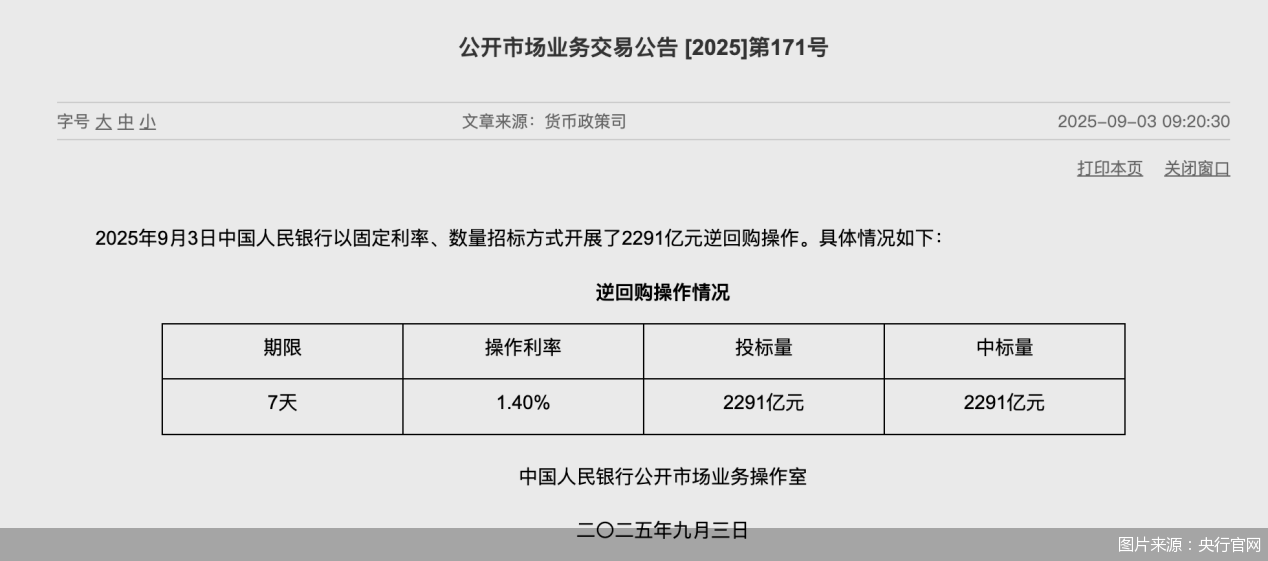
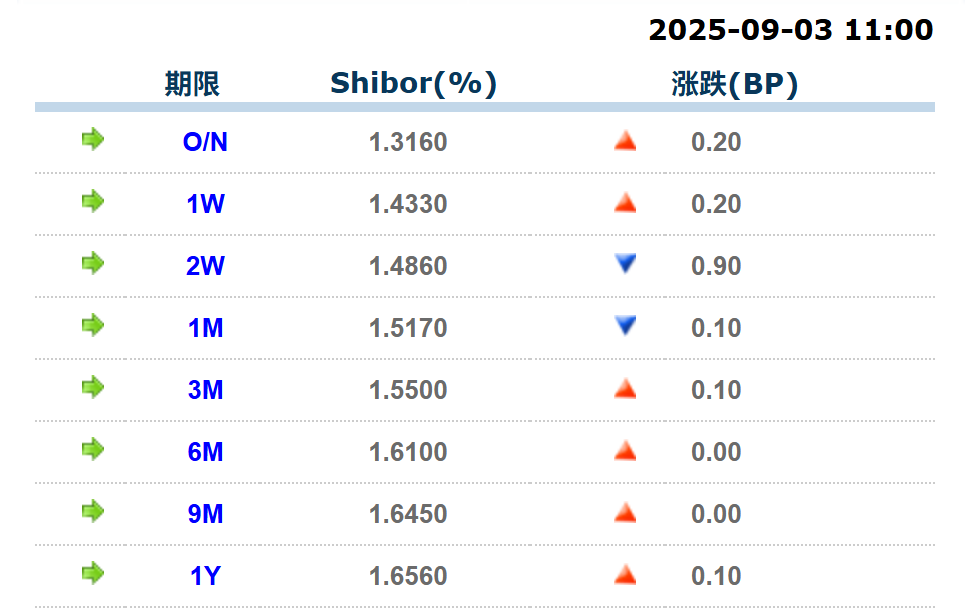
Core Viewpoint - The People's Bank of China (PBOC) is actively managing liquidity in the market through various monetary policy tools, including reverse repos, to maintain a stable and reasonably ample liquidity environment in September, despite significant reverse repo maturities and other factors affecting the funding landscape [1][6][7]. Group 1: Market Operations - From September 1 to 5, over 2 trillion yuan in reverse repos are set to mature, marking the highest weekly maturity volume this year [1]. - On September 3, the PBOC conducted a 229.1 billion yuan 7-day reverse repo operation at a fixed rate of 1.40%, maintaining the previous rate, resulting in a net withdrawal of 150.8 billion yuan for the day [1][4]. - Despite the net withdrawal, the overall funding rates remained stable, with the overnight Shibor slightly rising to 1.316% and the 7-day Shibor at 1.433% as of September 3 [6]. Group 2: Economic Analysis - Analysts suggest that the liquidity in August was relatively abundant, with net injections from reverse repos and Medium-term Lending Facility (MLF) exceeding July levels, contributing to the large reverse repo maturities in September [6][7]. - The market is expected to maintain a stable and low-interest rate environment, as the PBOC is likely to continue its reverse repo operations to guide short-term market rates [8]. - Factors such as the issuance of government bonds and the high volume of interbank certificates of deposit maturing in September are anticipated to influence the liquidity landscape, but overall, the funding environment is expected to remain reasonably ample [7][8].

货币市场日报:9月3日
Xin Hua Cai Jing· 2025-09-03 12:31
Monetary Policy Operations - The People's Bank of China conducted a 7-day reverse repurchase operation of 229.1 billion yuan, with both the bidding and winning amounts at 229.1 billion yuan, and the operation interest rate set at 1.40% [1] - On the same day, 379.9 billion yuan of 7-day reverse repos matured, resulting in a net withdrawal of 150.8 billion yuan [1] Interbank Offered Rates - The Shanghai Interbank Offered Rate (Shibor) showed mixed movements, with the overnight Shibor rising by 0.20 basis points to 1.3160%, and the 7-day Shibor also increasing by 0.20 basis points to 1.4330%. In contrast, the 14-day Shibor decreased by 0.90 basis points to 1.4860% [2][4] - The 1-month Shibor was reported at 1.5170%, up by 0.10 basis points, while the 3-month Shibor stood at 1.5500%, also up by 0.10 basis points [2] Repo Market Activity - In the interbank pledged repo market, the 7-day rates showed mixed results, with DR001 and R001 weighted average rates remaining unchanged at 1.3141% and 1.3543%, respectively, while DR007 and R007 rates increased by 0.4 basis points and 0.2 basis points to 1.4415% and 1.4644% [4] - The trading volume for DR001 and R001 increased by 6.4 billion yuan and 126.4 billion yuan, respectively, while DR007 and R007 saw decreases in trading volume by 13.3 billion yuan and 362.7 billion yuan [4] Market Liquidity - The liquidity in the market was described as generally loose, with overnight rates trading around 1.30% to 1.45% throughout the day, indicating a stable and balanced liquidity environment [8] - The issuance of interbank certificates of deposit reached 88, with a total issuance volume of 150.78 billion yuan, reflecting active trading sentiment as market rates declined [9] Private Banking Sector Growth - Several banks reported double-digit growth in the number of private banking clients and assets under management (AUM) in the first half of the year, with 15 banks collectively surpassing 1.63 million clients, an increase of nearly 150,000 clients [11] - Major state-owned banks, including ICBC, ABC, CCB, and BOC, each reported AUM exceeding 3 trillion yuan, while Industrial Bank's AUM surpassed 1 trillion yuan, marking its entry into the "trillion club" for private banking [11] Future Market Outlook - Analysts predict that the liquidity in the market will remain reasonably ample, supported by increased fiscal spending and effective central bank measures, despite potential disturbances in mid-September [11]
国债期货日报:如期反弹-20250903
Nan Hua Qi Huo· 2025-09-03 10:35
Report Summary Investment Rating - No investment rating for the industry is provided in the report. Core View - The report suggests a band - trading approach. It notes that on September 3, 2025, treasury bond futures rebounded as expected. Given the current situation where the 10 - year treasury bond yield has returned to 1.75% and the bond market lacks catalytic factors, caution should be exercised regarding the further upside potential. It advises against chasing high prices, setting profit - taking when bottom - fishing, and keeping a small long position at low levels [1][2]. Summary by Relevant Content 1. Market Performance - On Wednesday, treasury bond futures opened higher, rose in the morning and then declined, fluctuated in the afternoon, and rose again at the end of the session, with all varieties closing up. Spot bond yields generally declined. There was a net withdrawal of 150.8 billion from the open market, and the funds were loose with DR001 at 1.31% [1]. - The A - share market continued to decline with a large adjustment range on this day. The morning rebound in the stock market reduced the bond market's gains, but the stock market's inability to stop the decline in the afternoon led to an expansion of the bond market's gains at the end of the session. The stock market had a volume - shrinking adjustment, and if it enters a range - bound state in the future, its impact on the bond market will gradually weaken [2]. 2. Contract Data | Contract | 2025 - 09 - 03 Price | 2025 - 09 - 02 Price | Price Change | 2025 - 09 - 03 Position (Lots) | 2025 - 09 - 02 Position (Lots) | Position Change | | --- | --- | --- | --- | --- | --- | --- | | TS2512 | 102.44 | 102.41 | 0.03 | 75575 | 74372 | 1203 | | TF2512 | 105.69 | 105.55 | 0.14 | 139553 | 138200 | 1353 | | T2512 | 108.12 | 107.93 | 0.19 | 213046 | 205357 | 7689 | | TL2512 | 117.03 | 116.61 | 0.42 | 142705 | 140312 | 2393 | | TS Basis (CTD) | - 0.0225 | - 0.04 | 0.0175 | TS Main Contract Trading Volume (Lots) | 25604 | 21492 | 4112 | | TF Basis (CTD) | 0.0846 | 0.0256 | 0.059 | TF Main Contract Trading Volume (Lots) | 62433 | 52692 | 9741 | | T Basis (CTD) | 0.4403 | 0.3548 | 0.0855 | T Main Contract Trading Volume (Lots) | 86857 | 60757 | 26100 | | TL Basis (CTD) | 0.7408 | 0.5696 | 0.1712 | TL Main Contract Trading Volume (Lots) | 156936 | 116176 | 40760 | [3] 3. Other Information - U.S. technology stocks led the decline in the U.S. stock market, and the 30 - year treasury bond yields of the UK, Germany, and France reached multi - year highs. Gold futures broke through $3600, hitting a record high [2]. - Trump stated that he would request the Supreme Court to make a "quick ruling" on the global tariff case. If he wins, the stock market will rise sharply; otherwise, it will experience a huge shock. Bessent predicted that the Supreme Court would support Trump's tariff policy but was also considering alternative plans [2].
9月资金面迎考:超2万亿逆回购到期叠加市场火热
第一财经· 2025-09-03 08:02
Core Viewpoint - The financial market is experiencing increased attention on liquidity as multiple factors contribute to a funding gap in September, but overall liquidity is expected to remain reasonably ample with low volatility in interest rates [2][9]. Group 1: Market Liquidity and Central Bank Operations - In early September, the central bank conducted reverse repos but faced a net withdrawal of funds due to the amount of reverse repos maturing exceeding the amount of new operations [4][5]. - The central bank's operations resulted in a cumulative net withdrawal of 2.558 billion yuan over the first two days of September, with significant amounts of reverse repos maturing throughout the month [6][9]. - Despite the pressures from maturing funds, the overall interest rates remained stable, with the overnight Shibor rate at 1.315% and the 7-day Shibor at 1.438% on September 1 [6][7]. Group 2: Expectations for September - Analysts expect that the funding situation will remain reasonably ample due to supportive central bank policies and increased fiscal spending, leading to a likely continuation of low and stable interest rates [9][10]. - September is typically a month of increased fiscal spending, which is expected to provide support for liquidity, especially towards the end of the month [9][10]. - Historical trends indicate that funding rates in September often show a pattern of oscillation, with the first half of the month typically remaining stable before increasing volatility later on [10][11]. Group 3: Seasonal and Non-Seasonal Factors - The funding landscape in September is influenced by both seasonal factors, such as increased liquidity demand at the end of the month, and non-seasonal factors, including the strong performance of the equity market [11][12]. - The potential for increased credit issuance at the end of the month may lead to more pronounced liquidity fluctuations compared to previous years, driven by the need for banks to meet regulatory assessments [11][12].

每日债市速递 | 银行间主要利率债收益率多数下行
Wind万得· 2025-09-02 23:09
Group 1: Open Market Operations - The central bank announced a 7-day reverse repurchase operation of 255.7 billion yuan at a fixed rate of 1.40% on September 2, with a total bid amount of 255.7 billion yuan and a successful bid amount of 255.7 billion yuan [1] - On the same day, 405.8 billion yuan of reverse repos matured, resulting in a net withdrawal of 150.1 billion yuan [1] Group 2: Funding Conditions - The central bank's reverse repos continued to net withdraw, maintaining an overall balanced funding condition in the interbank market, with overnight repurchase rates for deposit institutions slightly rising to around 1.31% [3] - The latest overnight financing rate in the U.S. was reported at 4.34% [3] Group 3: Interbank Certificates of Deposit - The latest transaction rate for one-year interbank certificates of deposit was approximately 1.66%, showing a slight decrease from the previous day [10] Group 4: Bond Market Overview - The yields on major interbank bonds mostly declined, with the 30-year main contract down by 0.18%, the 10-year down by 0.03%, the 5-year down by 0.02%, and the 2-year down by 0.02% [14] Group 5: Government Debt Issuance - The Ministry of Finance announced the issuance of 20 billion yuan in 63-day and 30 billion yuan in 91-day discount treasury bonds on September 3 [19] - Agricultural Development Bank will issue up to 32.5 billion yuan in financial bonds on the same day [19] Group 6: Global Macro Insights - The Deputy Governor of the Bank of Japan commented on the appropriateness of recent Japanese government bond yield movements, suggesting that a predictable reduction in bond purchases is suitable [17] - The European Central Bank's Executive Board member stated there is no reason for further rate cuts, indicating that rates are already moderately accommodative [18]

超2万亿逆回购到期叠加市场火热 9月资金面迎考
Sou Hu Cai Jing· 2025-09-02 16:41
Core Viewpoint - The financial market is experiencing increased attention on liquidity as over 20 trillion yuan in reverse repos are set to expire this week, alongside other factors such as MLF expirations and government bond issuances, indicating a tightening liquidity environment [1][3]. Group 1: Market Liquidity Dynamics - The People's Bank of China (PBOC) has conducted reverse repo operations totaling 4.384 billion yuan over the first two days of September, while the total reverse repos maturing during this period amounted to 6.942 billion yuan, resulting in a net withdrawal of 2.558 billion yuan [2][3]. - The PBOC is expected to maintain a reasonable liquidity level in September, with analysts predicting that funding rates will likely continue to operate at low levels with minimal fluctuations due to supportive monetary policy and anticipated fiscal spending [5][6]. Group 2: Seasonal and Non-Seasonal Factors - September is characterized by increased seasonal disturbances in liquidity, particularly as fiscal spending typically accelerates towards the end of the month, which may provide some support to the liquidity environment [6][7]. - The strong performance of the equity market and heightened risk appetite may drive funds to reallocate across various asset classes, while the end-of-quarter credit issuance may be more pronounced than in previous years, potentially amplifying liquidity fluctuations [7].
货币市场日报:9月2日
Xin Hua Cai Jing· 2025-09-02 13:07
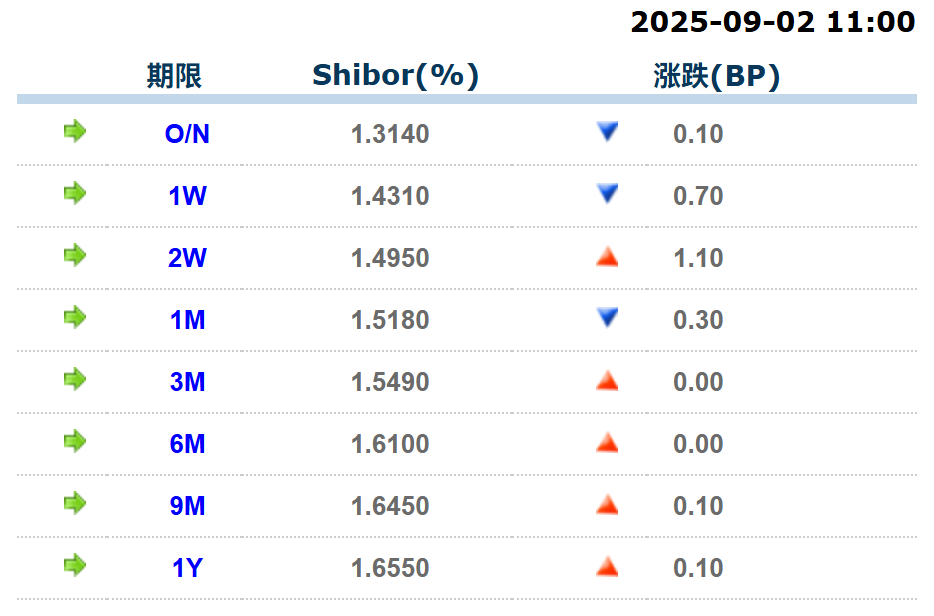
Group 1 - The People's Bank of China conducted a 7-day reverse repurchase operation of 255.7 billion yuan at an interest rate of 1.40%, with a net withdrawal of 150.1 billion yuan on the day [1][10] - The Shanghai Interbank Offered Rate (Shibor) showed mixed movements, with the overnight Shibor down by 0.10 basis points to 1.3140%, and the 7-day Shibor down by 0.70 basis points to 1.4310% [1][3] - The interbank pledged repo market saw fluctuations, with the weighted average rates for DR001 and R001 rising slightly, while DR007 and R007 rates decreased [3][7] Group 2 - The funding environment on September 2 was characterized as balanced and slightly loose, with overnight rates around 1.45% and 7-day rates also near 1.45% [7][10] - The issuance of interbank certificates of deposit was reported at 119.36 billion yuan, with 72 issues on the day [7][8] - The sentiment in the primary market for certificates of deposit improved compared to the previous day, with slight increases in rates across various maturities [8][10] Group 3 - The central bank reported a net injection of 300 billion yuan through Medium-term Lending Facility (MLF) and a net withdrawal of 160.8 billion yuan through Pledged Supplementary Lending (PSL) in August [10][11] - Zheshang Bank announced a capital increase of 999.4 million yuan for its subsidiary, Zhejiang Zhiyin Financial Leasing Co., increasing its stake from 51.00% to 54.04% [10]
债市分析框架之资金面
Tai Ping Yang Zheng Quan· 2025-09-02 13:07
1. Report Industry Investment Rating - There is no information provided regarding the report industry investment rating. 2. Core Viewpoints of the Report - The capital market is a crucial hub in the macro - economy, connecting monetary policy, financial markets, and the real economy. Analyzing the capital market helps reflect the financing environment, assist in pricing regulation, and provide early - warning of risks [4]. - The capital market is a key driver of the bond market's trend. Its tightness, structural changes, and related policies affect the bond market from aspects such as supply - demand, yield, and investor expectations. Different capital environments require corresponding adjustments to bond market investment strategies [5]. - This year, China's economy has shown a moderate recovery. Monetary policy has maintained a moderately loose tone but with dynamic adjustments. The bond market has shown high volatility along with the capital market and multiple factors. In the future, official statements indicate a caring attitude towards the capital market, and liquidity is expected to remain reasonably abundant to support the bond market, but the scope for further loosening may be limited [5]. 3. Summary According to the Table of Contents 3.1 What is the Capital Market? - The capital market is a key link in the macro - economic system, comprehensively reflecting the total supply - demand relationship of funds. It can be understood from narrow and broad perspectives, and the two are linked through the "finance - real economy" cycle [10]. - The capital market reflects the transmission effect of monetary policy from the financial system to the real economy, forms the pricing basis for assets, is an important indicator for observing the real - economy financing environment, and affects market risk preference and systemic risks [14][15]. 3.2 Capital Market Analysis Framework 3.2.1 Supply and Demand Perspective - Supply involves policy - driven liquidity injection and credit creation. The central bank injects base money into the banking system through policy tools, and the banking system creates broad money through credit creation [19][20][23]. - Demand is related to various economic entities. The financing activities of the private sector, financial markets, and the government jointly determine the total scale and structural characteristics of capital demand [24]. 3.2.2 Policy Perspective - Monetary policy is the core driver of capital supply and demand. Its goals determine the direction of capital market changes, and a variety of policy tools precisely regulate the total amount and structure of capital to achieve dynamic balance [26]. - The transmission effect of monetary policy on the capital market can be understood from the supply and demand sides. On the supply side, it affects the total amount of bank - system funds and credit creation; on the demand side, it affects the real - economy's financing demand and expectations [31]. 3.2.3 Tracking Indicators - Quantity indicators focus on the total amount of circulating funds in the market, including base money scale, broad money supply, social financing scale, and bank - system liquidity level [32]. - Price indicators reflect changes in capital supply - demand and costs, mainly tracking different interest rates. The differences between different interest rates can also convey structural signals [41][42]. - Quantity and price indicators are inter - related, and special time points, affected by seasonal and policy factors, are also important dimensions for analyzing capital supply - demand changes [48][49]. 3.3 Capital Market and Bond Market 3.3.1 How the Capital Market Affects the Bond Market - The tightness of the capital market directly affects the supply - demand and pricing of the bond market; structural changes in the capital market cause differentiation within the bond market; and related regulatory policies affect market expectations of the bond market [54]. - Historically, the cyclical fluctuations of the bond market have been closely related to changes in the capital market. For example, in 2013, a tightened capital market triggered bond - market risks; in 2016, financial de - leveraging led to a downward adjustment in the bond market [55]. 3.3.2 Bond Market Strategies Adjusted According to Capital Tightness - In a loose capital environment, long - term interest - rate bonds and high - grade credit bonds can be increased, and leverage can be moderately added; in a tight capital environment, the duration should be shortened, and leverage should be reduced [57]. 3.4 Summary and Outlook 3.4.1 Fluctuations in the Bond Market and Capital Market Due to Multiple Factors - The capital market has evolved from a tight - balance to a moderately loose state. The bond market has shown high volatility this year, with downward adjustments in the early stage, a shock - recovery in the middle, and increased fluctuations in the policy observation period [64][72][73]. 3.4.2 Expected Reasonable and Abundant Liquidity - Official statements indicate a caring attitude towards the capital market, and liquidity is expected to remain reasonably abundant to support the bond market. However, the scope for further loosening of the capital market may be limited [77].
9月资金面迎考:超2万亿逆回购到期叠加市场火热 央行操作引关注
Di Yi Cai Jing· 2025-09-02 11:26
Core Viewpoint - The financial market is experiencing increased attention on liquidity as multiple factors contribute to a funding gap at the beginning of September, although the overall funding rates remain stable and are expected to continue in a "low and stable" manner [1][5]. Group 1: Funding Gap and Central Bank Operations - The central bank has conducted reverse repos totaling 4,384 billion yuan over the first two days of September, while 6,942 billion yuan in reverse repos matured, resulting in a net withdrawal of 2,558 billion yuan [3]. - On September 1, the central bank conducted a 1,827 billion yuan 7-day reverse repo at a rate of 1.40%, with 2,884 billion yuan maturing, leading to a net withdrawal of 1,057 billion yuan [2]. - On September 2, the central bank conducted a 2,557 billion yuan 7-day reverse repo at the same rate, with 4,058 billion yuan maturing, resulting in a net withdrawal of 1,501 billion yuan [2]. Group 2: Market Liquidity and Interest Rates - Despite the pressures from maturing funds, the short-term liquidity has not shown significant volatility, with the overnight Shibor rate decreasing by 1.6 basis points to 1.315% on September 1 [3]. - The Shibor rates for various tenors showed mixed trends, with the overnight Shibor at 1.314% and the 7-day Shibor at 1.431%, both showing slight declines [4]. - Analysts expect that the funding rates will likely remain low and stable due to the central bank's supportive policies and anticipated fiscal spending [5][6]. Group 3: Seasonal and Non-Seasonal Factors - September is expected to see increased seasonal disturbances in liquidity, particularly due to heightened bank liquidity demands and cash preparation needs ahead of holidays [6]. - The capital market's performance is a significant factor to monitor, as a strong equity market may drive funds to reallocate across various assets [6]. - The combination of government bond supply, maturing medium- and long-term liquidity, and the expiration of certificates of deposit may amplify funding volatility [6].

9月资金面迎考:超2万亿逆回购到期叠加市场火热,央行操作引关注
Di Yi Cai Jing· 2025-09-02 10:05
Core Viewpoint - The financial market is experiencing a strong performance in the equity market, which is boosting market risk appetite and may continue to drive fund reallocation across various asset classes [1] Group 1: Market Conditions - In early September, the focus on liquidity in the financial market has intensified, with over 20 trillion yuan in reverse repos maturing [1] - Despite the central bank's net withdrawal operations, overall funding rates remained stable, indicating market expectations for future central bank policies and fiscal spending [1][4] - The central bank's operations resulted in a net withdrawal of 2.558 billion yuan over the first two days of September due to a larger amount of reverse repos maturing than the amount operated [2][3] Group 2: Funding Pressure - The upcoming month of September will see significant maturities, including 30 billion yuan in six-month reverse repos and 30 billion yuan in Medium-term Lending Facility (MLF) [3] - The total amount of reverse repos maturing from September 1 to September 5 is 22.731 billion yuan, indicating increasing funding pressure [2][3] Group 3: Interest Rates and Liquidity - Funding rates are expected to maintain a "low and stable" trend despite the pressures from multiple maturities and supply factors [4] - The Shanghai Interbank Offered Rate (Shibor) showed a downward trend in early September, with the overnight Shibor falling to 1.314% and the seven-day Shibor to 1.431% [3] - Analysts expect that the funding environment will remain reasonably ample, supported by central bank policies and increased fiscal spending [4][5] Group 4: Seasonal and Non-Seasonal Factors - September typically sees a seasonal increase in funding demand due to quarter-end liquidity needs and pre-holiday cash requirements [5][6] - The strong performance of the equity market and heightened risk appetite may drive further fund reallocation across asset classes [6] - Non-seasonal factors, such as government bond supply and maturing deposits, may also amplify funding volatility [6]