通胀预期

Search documents
大越期货贵金属早报-20251210
Da Yue Qi Huo· 2025-12-10 02:13
Report Summary 1. Report Industry Investment Rating No industry investment rating is provided in the report. 2. Core Viewpoints - **Gold**: On the eve of the Fed's interest - rate decision, the number of job openings in the US unexpectedly increased, and risk appetite decreased, causing the gold price to rise slightly. The premium of Shanghai gold has expanded to around - 4.6 yuan/gram. Based on historical performance, the gold price may reach a stage high on the day before the Fed meeting, so cautious operation is recommended [4]. - **Silver**: The market is waiting for the Fed meeting, and risk appetite has decreased. Shanghai silver saw an increase of 50,000 lots at night, pushing the silver price to a new high. The premium of Shanghai silver has converged to 380 yuan/gram, and domestic sentiment remains strong. However, the sustainability of overnight capital inflows is questionable, and attention should be paid to the intraday position changes [5]. 3. Summary by Directory 3.1. Previous Day's Review - **Gold**: The US 10 - year JOLTS job openings unexpectedly increased before the Fed's interest - rate decision. The US three major stock indices closed mixed, European three major stock indices closed mixed, US bond yields rose, the US dollar index rose 0.14% to 99.24, and COMEX gold futures rose 0.45% to $4236.6 per ounce. The basis shows that the spot is at a discount to the futures, the inventory remains unchanged, the 20 - day moving average is upward with the k - line above it, and the main net position is long but the long position is decreasing [4]. - **Silver**: Before the Fed's interest - rate decision, Shanghai silver saw an increase of 50,000 lots at night. The US three major stock indices closed mixed, European three major stock indices closed mixed, US bond yields rose, the US dollar index rose 0.14% to 99.24, and COMEX silver futures rose 4.72% to $61.16 per ounce. The basis is neutral, the inventory of Shanghai silver futures increased, the 20 - day moving average is upward with the k - line above it, and the main net position is long but the long position is decreasing [5]. 3.2. Daily Tips - **Gold**: Pay attention to the Fed's interest - rate decision and Powell's speech early the next morning, and China's November CPI, speeches by the ECB president and officials, and the UK Chancellor of the Exchequer's defense of the tax - increase plan today. The market is waiting for the Fed's meeting decision, and the increase in job openings in October has cooled risk appetite, causing the gold price to rise slightly. Be cautious as the gold price may reach a stage high on the day before the Fed meeting [4]. - **Silver**: The market is waiting for the Fed meeting, and the increase in positions at night has pushed the silver price to a new high. The sustainability of capital inflows is questionable, and attention should be paid to intraday position changes [5]. 3.3. Today's Focus - **Events**: At 09:30, China's November CPI and PPI; the UK Chancellor of the Exchequer will attend a hearing to defend a £26 billion tax - increase budget; at 18:45, the Bank of England Governor Bailey will speak; at 18:55, the ECB President Lagarde will speak in London; at 20:30, ECB Governing Council member Sharon Donnery will host a panel discussion; at 22:45, the Bank of Canada will announce its interest - rate decision; early the next morning, various central bank officials will speak, and the Fed will announce its FOMC interest - rate decision, economic outlook, and the US November government budget, followed by a press conference by Fed Chairman Powell; at 05:30, the Central Bank of Brazil will announce its interest - rate decision [14]. 3.4. Fundamental Data - **Gold**: The basis is - 4.82, indicating that the spot is at a discount to the futures; the inventory of gold futures is 91,299 kg and remains unchanged; the 20 - day moving average is upward with the k - line above it; the main net position is long but the long position is decreasing [4]. - **Silver**: The basis is - 5, the inventory of Shanghai silver futures increased by 18,497 kg to 717,788 kg; the 20 - day moving average is upward with the k - line above it; the main net position is long but the long position is decreasing [5]. 3.5. Position Data - **Gold**: The main net position is long, but the long position is decreasing. The long position of the top 20 holders decreased by 3.02% to 173,310 lots, the short position decreased by 1.39% to 58,766 lots, and the net long position decreased by 3.83% to 114,544 lots [4][29]. - **Silver**: The main net position is long, and the long position of the top 20 holders decreased by 0.70% to 406,455 lots, the short position decreased by 1.81% to 300,238 lots, and the net long position increased by 2.56% to 106,217 lots [5][31]. - **ETF Positions**: The SPDR gold ETF position decreased slightly, while the silver ETF position increased again [33][35]. - **Warehouse Receipts**: The Shanghai gold warehouse receipts increased slightly, the COMEX gold warehouse receipts continued to decrease but remained at a high level, the Shanghai silver warehouse receipts continued to increase and were at the lowest level in the past six years, and the COMEX silver warehouse receipts started to decrease [37][38][40].
美股观察|美股小幅上涨,关注本周FOMC会议
Xin Lang Cai Jing· 2025-12-09 12:48
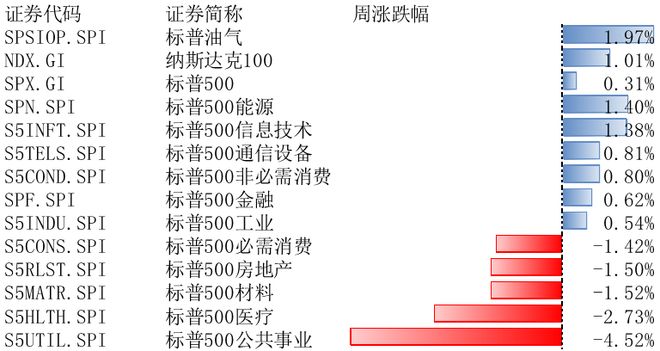
Group 1: US Macroeconomic Data - The US PCE price index for September remained high, with a year-on-year increase of 2.8%, matching expectations and up from the previous value of 2.7% [1] - The month-on-month PCE price index for September rose by 0.3%, consistent with expectations and the previous value [1] - The core PCE price index for September increased by 2.8% year-on-year, in line with expectations but lower than the previous value of 2.9% [1] - The month-on-month core PCE price index for September rose by 0.2%, matching expectations and the previous value [1] - Personal consumption expenditures in September increased by 0.3% month-on-month, in line with expectations but lower than the previous value of 0.5% [1] - Actual personal consumption expenditures for September showed no growth, falling short of the expected increase of 0.1% and the previous value of 0.2% [1] - The ISM manufacturing index for November recorded 48.2, below expectations of 49 and the previous value of 48.7, indicating continued contraction in manufacturing [1] - The ISM services index for November recorded 52.6, exceeding expectations of 52 and the previous value of 52.4, indicating accelerated expansion in services [1] - The ADP employment report for November showed a decrease of 32,000 jobs, significantly below the expected decrease of 10,000 and the previous decrease of 42,000 [1] - Consumer confidence improved significantly in December, with inflation expectations declining [1] Group 2: Consumer Confidence and Inflation Expectations - The preliminary consumer confidence index from the University of Michigan for December recorded 52.3, better than the expected value of 52 and the previous value of 51 [2] - The one-year inflation expectation from the University of Michigan for December was 4.1%, lower than both the expected and previous values of 4.5% [2] - The five-year inflation expectation from the University of Michigan for December was 3.2%, lower than both the expected and previous values of 3.4% [2] Group 3: Major Index Performance - The S&P Oil & Gas Index rose by 1.97% during the week of December 1-5, while the Nasdaq 100 Index increased by 1.01% and the S&P 500 Index rose by 0.31% [3] - Among the 11 sectors covered by the S&P 500, 6 sectors experienced gains, with the S&P 500 Energy sector leading with a 1.40% increase, while the S&P 500 Utilities sector lagged with a 4.52% decline [3] Group 4: Market Outlook - US stocks experienced slight gains during the week of December 1-5, driven by disappointing employment data and stable interest rate cut expectations [5] - The market is closely monitoring the upcoming FOMC meeting for voting and dot plot information [6]

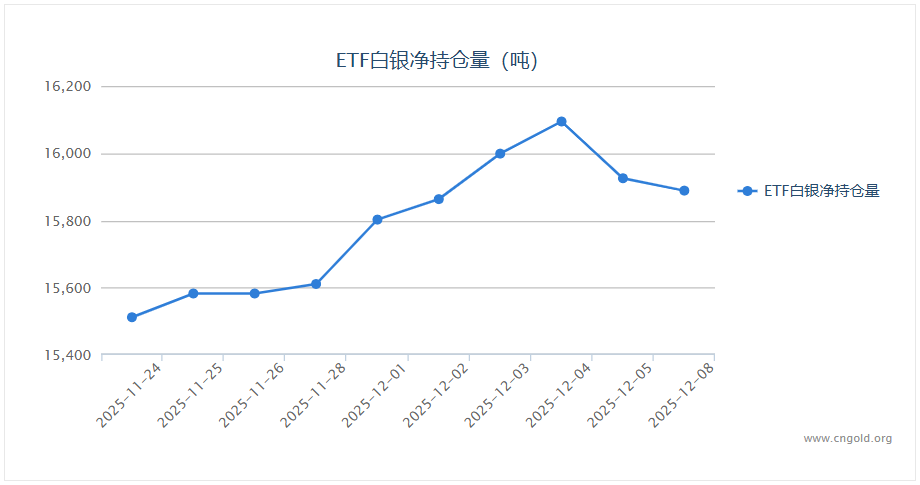
【白银etf持仓量】12月8日白银ETF较上一交易日减少36.67吨
Jin Tou Wang· 2025-12-09 08:36
Group 1 - The iShares Silver Trust, the world's largest silver ETF, reported a holding of 15,888.54 tons of silver as of December 8, a decrease of 36.67 tons from the previous trading day [1] - On December 8, the spot silver price closed at $58.11 per ounce, down 0.29%, with an intraday high of $58.61 and a low of $57.52 [1] Group 2 - The New York Federal Reserve's report indicated that while U.S. households' expectations for future inflation remained stable, their views on current and future financial conditions became more pessimistic in November [3] - Respondents reported a "notable deterioration" in their views on current financial conditions, while their outlook for the next year showed a "slight deterioration" [3] - However, perceptions of the job market improved in November, with expectations for rising unemployment over the next year decreasing, and the likelihood of unemployment reaching its lowest level since December 2024 [3] - Households also lowered their probability of voluntary job quitting [3] - The report showed that inflation expectations remained moderate, with a one-year inflation expectation steady at 3.2%, and three- and five-year expectations also holding at 3% [3] - Home price expectations remained stable, with an anticipated increase of 3%, while outlooks for various commodity prices showed little change [3] - However, the one-year expectation for medical costs rose to 10.1%, the highest level since January 2014 [3]
邦达亚洲:澳洲联储如期按兵不动 澳元小幅收涨
Xin Lang Cai Jing· 2025-12-09 08:19
Group 1: US Consumer Inflation Expectations - The New York Fed's survey indicates that US consumer inflation expectations remained stable in November, with a one-year inflation expectation of 3.2% and three- and five-year expectations also at 3% [1][7]. - Respondents' perception of unemployment probability decreased to 13.8%, marking the lowest level of the year [1][7]. - There is a general market expectation that the Federal Reserve will lower the benchmark interest rate for the third consecutive time to prevent deterioration in the labor market [1][7]. Group 2: Australian Central Bank Policy - The Reserve Bank of Australia maintained its cash rate target at 3.60%, aligning with market expectations [2][8]. - RBA Governor Philip Lowe emphasized the need for caution regarding monthly CPI data, stating that inflation and employment data will be crucial for the February meeting [2][8]. - The RBA sees an upward bias in inflation risks and has not ruled out the possibility of tightening policy if inflation remains high [2][8]. Group 3: Market Reactions and Currency Movements - Gold prices experienced a slight decline, trading around 4180, influenced by profit-taking and a rebound in the US dollar index due to expectations of a hawkish signal from the Fed [4][9]. - The Australian dollar also saw a slight decrease, trading around 0.6650, affected by profit-taking and the strengthening US dollar [5][10]. - The USD/CAD pair rose slightly, trading around 1.3850, supported by technical buying and a rebound in the US dollar index [6][11].
【UNFX财经事件】政策预期反复升温 黄金跌破4200进入震荡区间
Sou Hu Cai Jing· 2025-12-09 04:49
科技与 AI 主题仍贡献一定支撑,但整体风险偏好在收益率变化与政策不确定性的影响下趋于谨慎。 纽约联储最新调查显示,消费者对未来一年通胀的预期仍维持在 3.2% 左右,对长期通胀的看法也保持 稳定。同时,受访家庭对就业环境的未来判断有所改善。但现实情况并不轻松,更多家庭表示当前财务 状况较去年更紧张,呈现出"预期乐观但现实承压"的状态。若 ADP 或 JOLTS 等就业数据接下来继续出 现分化,市场对政策路径的理解可能随数据波动而出现快速切换。 围绕总统解职权的最高法院讨论引发市场关注。若相关议题朝扩大行政权力方向推进,投资者将更留意 美联储的政策独立性,从而提升市场对政策沟通的敏感度。同时,美乌与美俄之间的互动仍存在不稳定 因素,虽短线难以显著推升黄金,但为避险情绪提供底部支撑。制度性风险与地缘局势叠加宏观数据, 使得市场处于"高预期、高敏感度"的运行环境。 以区间思路为主:短线关注 4170–4220 美元区域,在政策信号明确前,区间震荡概率更高,避免追涨或 在不确定区间重仓做空。 周二亚洲盘,黄金在周初强势触及高位后出现回调,短线跌破 4200 美元并在每盎司 4195 美元附近整 理。市场普遍押注美联 ...
11月通胀预期温和白银td走涨
Jin Tou Wang· 2025-12-09 03:55
今日周二(12月9日)亚盘时段,白银td目前交投于13651一线上方,今日开盘于13653元/千克,截至发 稿,白银td暂报13673元/千克,上涨0.47%,最高触及13717元/千克,最低下探13526元/千克,目前来 看,白银td盘内短线偏向看涨走势。 报告还指出,与上月相比,未来收入和薪资增长的预期在11月保持积极。 【最新白银td行情解析】 日图来看,白银td走势区域震荡,价格小幅上涨,目前DMI数据重新显示上行动能,处于正值区间,行 情呈上涨趋势,短期仍然看涨,白银td走势下方关注13000-13500支撑;上方关注13800-14000阻力。 纽约联储周一发布的报告显示,尽管美国家庭对未来通胀走势的预期保持稳定,但他们在11月对当前和 未来财务状况的看法却更加悲观。该地区联储在调查中指出,受访者对当前财务状况的看法"明显恶 化",而对一年后的展望则"略有恶化"。 不过,受访者对就业市场的看法在11月有所改善。报告称,对未来一年失业率上升的预期有所减弱,而 在未来一年内失业的可能性降至自2024年12月以来的最低水平。家庭也下调了主动离职的概率。 此外,纽约联储报告显示,11月通胀预期方面总体温和 ...
纽约联储调查:11月消费者通胀预期保持稳定,劳动力市场担忧缓解
Sou Hu Cai Jing· 2025-12-09 02:55
当地时间12月8日,纽约联储公布的最新调查结果显示,美国消费者对11月的通胀预期保持稳定,家庭对当前及未来财务状况的看法更加悲观。 消费者对医疗费用增长的预期升至自2014年1月以来的最高水平,同时对就业前景的看法有所改善。 具体来看,消费者对于 未来一年的通胀预期为3.2%, 几乎没有变化; 对未来三年和五年的通胀预期维持在3%。 受访者们认为,失业概率下滑 至13.8%,且为今年最低水平。 通胀预期持稳 报告显示,消费者对于未来一年的通胀预期保持不变,为3.2%;对未来三年和五年的通胀预期保持稳定,维持在3%。 受访者对于房价的预期同样保持稳定,预计未来房价保持上涨3.0%不变。 食品的价格展望上涨5.9%,汽油价格上涨4.1%,大学教育费用上涨8.4%,租金上涨8.3%。 这些生活必需品价格的上涨,是消费者感受到财务压力上升的核心原因。 值得一提的是,受访者预计未来一年医疗成本上涨至10.1%,且为2014年1月以来的最高值。 劳动力市场方面,消费者对于未来一年失业率上升的担忧稍有缓解,对未来一年失去工作的预期降至自2024年12月以来的最低水平。 同时,预计主动离职的概率也有所下降,还表示如果失业后找 ...
港股异动 | 有色股跌幅居前 市场关注各国央行后续利率政策路径 有色金属全线承压
智通财经网· 2025-12-09 02:30
Group 1 - The article highlights a significant decline in the prices of non-ferrous stocks, with Jiangxi Copper Co. falling by 6.57% to HKD 33.56, Luoyang Molybdenum Co. down 6.27% to HKD 17.93, China Aluminum Corporation decreasing by 4.73% to HKD 10.88, and Zijin Mining Group dropping 4.54% to HKD 32.4 [1] - Market expectations indicate that the Bank of Japan may adjust its interest rate hike pace, while the European Central Bank's executive Schnabel's hawkish remarks have led to increased market speculation about rate hikes next year [1] - Analysts suggest that the market has largely priced in the Federal Reserve's expected rate cut this week, but investors believe that the policy statement and Chairman Powell's comments may indicate a higher threshold for further rate cuts [1] Group 2 - Dongfang Securities previously noted that the current rate cut cycle may signal the arrival of a super cycle for industrial metals, particularly copper and aluminum [1] - The firm is optimistic about the demand for copper driven by U.S. electricity investments by 2026, as well as the demand for aluminum spurred by energy storage and alternative needs [1] - The anticipated significant rise in industrial metal prices is expected to influence inflation expectations, leading to a recommendation to focus on the copper and aluminum sectors [1]

大越期货贵金属早报-20251209
Da Yue Qi Huo· 2025-12-09 02:27
Report Summary 1. Report Industry Investment Rating No information provided. 2. Core Viewpoints - For gold, the market is waiting for the Fed meeting and ECB officials are taking a hawkish stance, causing risk appetite to cool and gold prices to decline slightly. However, with the Fed meeting approaching, gold prices still have support. The premium of Shanghai gold has expanded to around -4.7 yuan/gram [4]. - For silver, the market is also waiting for the Fed meeting and ECB officials' hawkish stance has led to a cooling of risk appetite. Shanghai silver is oscillating at a high level. The premium of Shanghai silver remains at 400 yuan/gram, with strong domestic sentiment. The expectation of Fed rate cuts has returned, and before the Fed meeting, the rate - cut expectation still supports silver prices [5]. 3. Summary by Directory 3.1. Previous Day Review - **Gold**: COMEX gold futures fell 0.54% to $4219.90 per ounce. The 10 - year US Treasury yield rose 2.92 basis points to 4.164%, and the US dollar index rose 0.12% to 99.10. The basis of gold is -5.45, indicating that the spot price is at a discount to the futures price. Gold futures warehouse receipts increased by 429 kilograms to 91299 kilograms. The 20 - day moving average is upward, and the K - line is above the 20 - day moving average. The main net position is long, but the long position of the main force is decreasing [4]. - **Silver**: COMEX silver futures fell 0.94% to $58.50 per ounce. The basis of silver is -28, which is neutral. Shanghai silver futures warehouse receipts increased by 33858 kilograms to 699291 kilograms. The 20 - day moving average is upward, and the K - line is above the 20 - day moving average. The main net position is long, but the long position of the main force is decreasing [5]. 3.2. Daily Tips - **Gold**: The Fed meeting is approaching, and although the market sentiment has cooled, gold prices still have support. The premium of Shanghai gold has expanded [4]. - **Silver**: Before the Fed meeting, the expectation of rate cuts still supports silver prices. Shanghai silver is oscillating at a high level, and the domestic sentiment is strong [5]. 3.3. Today's Focus - Possible release of China's November M2 and other money supply data, new RMB loans from January to November, and incremental social financing scale. - At 11:30, the Reserve Bank of Australia will announce its interest rate decision. - At 12:30, RBA Governor Bullock will hold a monetary policy press conference. - Japanese Central Bank Governor Ueda Kazuo will speak at an event in London (time to be determined). - At 16:00, ECB Governing Council member and President of the German Bundesbank Nagel will speak in Frankfurt. - Possible "emergency early" release of OpenAI's GPT 5.2. - At 22:15, Bank of England officials will attend a parliamentary hearing. - At 23:00, the US October JOLTS job openings data will be released [14]. 3.4. Fundamental Data - **Gold**: The inflation expectation has shifted to an economic recession expectation, and gold prices are difficult to fall. The recent expectation of Fed rate cuts and the optimistic expectation of Russia - Ukraine peace talks have both positive and negative impacts on gold prices. The upward impetus for gold prices still exists but is limited [9]. - **Silver**: Silver prices still mainly follow gold prices. The concern about tariffs has a stronger impact on silver prices, and there is a risk of an enlarged increase in silver prices. There are both positive and negative factors affecting silver prices, such as global turmoil, inflation concerns, and the expectation of Fed rate cuts on the positive side, and the large internal divergence of the Fed, the less - than - expected European fiscal expansion, and the optimistic expectation of Russia - Ukraine peace talks on the negative side [12][13]. 3.5. Position Data - **Gold**: The long position of the top 20 in Shanghai gold increased by 1.37% to 178,700 on December 8, 2025, compared with December 7, 2025. The short position decreased by 0.54% to 59,594, and the net position increased by 2.36% to 119,106 [29]. - **Silver**: The long position of the top 20 in Shanghai silver increased by 3.17% to 409,333 on December 8, 2025, compared with December 5, 2025. The short position increased by 2.87% to 305,764, and the net position increased by 4.06% to 103,569 [31]. - **ETF Positions**: The gold ETF position decreased slightly, and the silver ETF position also decreased slightly [33][35]. - **Warehouse Receipts**: Shanghai gold warehouse receipts increased slightly, COMEX gold warehouse receipts continued to decrease but remained at a high level. Shanghai silver warehouse receipts continued to increase and were at the lowest level in the past 6 years, and COMEX silver warehouse receipts increased [37][38][40].
金荣中国:特朗普或公布利好经济消息,金价扩大回落维持震荡回落
Sou Hu Cai Jing· 2025-12-09 01:35
Market Overview - International gold prices experienced fluctuations and closed lower on December 8, with an opening price of $4,197.61 per ounce, a high of $4,218.88, a low of $4,176.12, and a closing price of $4,182.85 [1] Economic Indicators - The New York Federal Reserve's report indicated that while American households' inflation expectations remained stable, their views on current and future financial conditions became more pessimistic in November. Respondents reported a "notable deterioration" in their current financial outlook and a "slight deterioration" in their one-year outlook [3] - The report noted a decrease in the likelihood of unemployment in the coming year, reaching the lowest level since December 2024, while inflation expectations for the next year remained at 3.2%, unchanged from the previous month [3] - Medical cost expectations for the next year rose by 10.1%, the highest since January 2014, while expectations for income and wage growth remained positive [3] Federal Reserve Insights - Goldman Sachs' chief U.S. economist, David Mericle, suggested that the Federal Reserve may not completely rule out the possibility of action in January, emphasizing the need for flexibility based on labor market data [4] - White House National Economic Council Director Hassett stated that it would be "irresponsible" for the Federal Reserve to announce its interest rate path for the next six months, advocating for data-driven adjustments [5] Geopolitical Developments - Ukrainian President Zelensky met with leaders from the UK, France, and Germany to discuss a peace plan aimed at resolving the Ukraine crisis, emphasizing the importance of unity between Europe and Ukraine [6] - Reports indicated that Zelensky is facing increasing pressure from the U.S. to accept significant territorial concessions as part of a peace plan proposed by Trump [7] Gold ETF Holdings - The largest gold ETF, SPDR Gold Trust, saw a decrease in holdings by 1.14 tons, bringing the total to 1,049.11 tons [7] Market Predictions - According to CME's "FedWatch," there is an 89.4% probability of a 25 basis point rate cut by the Federal Reserve in December, with a 68.5% chance of a cumulative 25 basis point cut by January [7] Technical Analysis - Gold prices showed signs of a downward trend, with short-term indicators suggesting a potential bottoming risk. The market is advised to maintain a cautious trading strategy [10]