
供给侧结构性改革

Search documents
【理响中国】习近平经济思想原创性贡献如何理解和把握?
Ren Min Wang· 2025-08-04 06:25
Core Viewpoint - The seminar on Xi Jinping's Thought on Socialism with Chinese Characteristics for a New Era highlighted the originality and systematic nature of Xi Jinping's economic thought, emphasizing its role in addressing complex international challenges and advancing Chinese modernization [1] Group 1: Original Concepts and Theoretical Contributions - Xi Jinping's economic thought introduces a series of original concepts such as "new normal" in economic development, "supply-side structural reform," "high-quality development," and "modern economic system," which are rooted in China's realities and aimed at solving practical issues [2] - The theory of improving the socialist market economy system is a significant theoretical contribution, emphasizing the market's decisive role in resource allocation while enhancing government functions [2] - The theory of promoting high-quality development is defined as development that meets the growing needs of the people, serving as a fundamental guideline for economic policy and macroeconomic regulation [3] Group 2: Structural Reforms and New Development Patterns - The supply-side structural reform theory identifies supply-side constraints as the main challenge to economic development, marking a critical focus for enhancing high-quality growth [3] - The concept of constructing a new development pattern emphasizes the interplay between domestic and international cycles, aiming to enhance China's economic resilience and competitive advantages in a complex global environment [4] Group 3: Systematic Economic Theory - Xi Jinping's economic thought aims to establish a systematic economic theory based on China's unique conditions and development practices, with concepts like new development philosophy and Chinese-style modernization as key components [4][6] - The new development philosophy addresses various theoretical and practical questions regarding development, providing a framework for exploring innovative development patterns and principles [5][6] - Chinese-style modernization represents a theoretical innovation that integrates the common characteristics of modernization with China's specific context, addressing critical issues related to the goals and pathways of socialist modernization [6]
站在政策主线角度回顾2016年焦煤行情
Wu Kuang Qi Huo· 2025-08-04 01:25
专题报告 2025-08-04 站在政策主线角度回顾 2016 年焦煤行情 报告要点: 黑色研究员 从业资格号:F03098415 交易咨询号:Z0020771 0755-23375161 chenzy@wkqh.cn 我们完整回顾了 2016 年焦煤从底部 515.5 元/吨一路攀升至 1650.5 元/吨的过程。观察到了政 策是如何一步步从提出、细化、强化到最终落地,盘面行情又是如何一步步从混沌、质疑最后 到坚信、狂热的过程。单纯站在"供给侧结构性改革"政策主线的视角之下,我们能够清晰的 感受到高级别政策的强大意志以及其对于行情的强烈指引性。我们认为这是在基本面之上更为 清晰而且底层的主线,且领先于品种自身的基本面情况。 陈张滢 黑色金属研究 | 黑色 站在政策主线角度回顾 2016 年焦煤行情 "看它的过去,就可以知道它的现在;看它的过去和现在,就可以知道它的将来。" 借着"反内卷"之下对于当前这轮浩浩荡荡行情的思考,我们尝试换一个视角去观察焦煤 2016 年"供给侧结构性改革"之下的行情。全文我们将主要以"供给侧结构性改革"政策相关的主 要会议、文件为展开脉络(按时间顺序),并对应到当时焦煤盘面的价格 ...
中经评论:减税降费精准发力,要提质更要持续
Sou Hu Cai Jing· 2025-08-03 00:07
Group 1 - The cumulative tax cuts and fee reductions in China from 2021 to the first half of this year reached 9.9 trillion yuan, expected to reach 10.5 trillion yuan by the end of this year, averaging over 2 trillion yuan annually [1] - Tax cuts and fee reductions are crucial for reducing the burden on enterprises and stimulating market vitality, allowing more funds for reinvestment and enhancing the multiplier effect of investments [1][2] - Structural tax cuts aim to allocate more resources to critical areas for national development, supporting the construction of a modern industrial system, with significant tax incentives for R&D expenditures [1] Group 2 - The manufacturing sector is a key focus of structural tax cuts, with measures like lowering VAT rates and increasing VAT refunds, contributing to the growth of manufacturing enterprises [2] - From 2021 to 2024, the sales revenue of manufacturing enterprises is expected to maintain around 29% of total enterprise sales, with high-end and high-tech manufacturing sectors showing annual growth rates of 9.6% and 10.4% respectively [2] - Tax cuts not only expand production and exchange but also enhance resource allocation efficiency and support the construction of a unified national market [2] Group 3 - The emphasis on improving the quality and efficiency of tax policies is essential, with a focus on utilizing tax data to better implement policies and support innovation and manufacturing [3] - Future tax policies should be refined to support foundational R&D and the transformation of technological achievements, particularly in emerging sectors like new energy and robotics [3] - The approach of using tax reductions to enhance enterprise efficiency and market vitality is a vital pathway for promoting high-quality economic development in China [3]
这个行业“反内卷”+涨价+停产,机构关注哪些个股?丨行业风口
2 1 Shi Ji Jing Ji Bao Dao· 2025-08-01 11:00
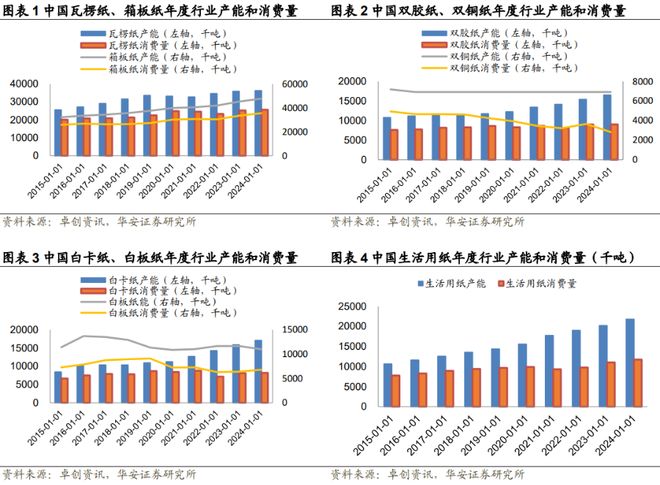
Core Viewpoint - The paper industry is experiencing a significant shift with the introduction of the first "anti-involution" initiative, aimed at promoting high-quality development and addressing structural overcapacity issues in the sector [1][6]. Group 1: Anti-Involution Initiative - The Guangdong Paper Industry Association has issued the first "anti-involution" initiative in the domestic paper industry, emphasizing the need to resist low-price competition and maintain market order [1][6]. - The initiative encourages companies to set prices based on actual costs, reasonable profits, and market demand, aiming to protect the overall value of the industry [1][6]. Group 2: Market Conditions - Despite steady growth in consumption for certain paper types like corrugated paper and household paper, overall capacity expansion has outpaced demand growth, leading to low utilization rates, with some types below 55% [4]. - The industry is facing a prolonged supply-demand imbalance, characterized by declining operating rates and slow inventory reduction, indicating a typical cyclical bottom phase [6][9]. Group 3: Price Adjustments - Several paper companies, including Nine Dragons Paper and Jiangxi Lee & Man Paper, have announced price increases due to rising costs, marking the fourth round of price hikes in July alone [7]. - The overall paper industry has been under significant pricing pressure, with major paper types experiencing price declines since 2021, reflecting weak market demand and overcapacity [7][9]. Group 4: Institutional Focus - Institutions are focusing on companies like Sun Paper, which has integrated pulp and paper production, and others in the sector that are expected to benefit from the "anti-involution" initiative and potential market restructuring [10][13]. - Analysts suggest monitoring companies that are diversifying product lines and those with integrated operations, as the industry may see improvements in profitability due to reduced competition and optimized capacity [10][13].




利率债8月报:如何理解“反内卷”对债市的影响?-20250801
Ping An Securities· 2025-08-01 10:02
Key Information Summary 1. Report Industry Investment Rating No information about the industry investment rating is provided in the given content. 2. Core Viewpoints of the Report - Both domestic and international markets are experiencing a risk - on trend. Overseas, the risk sentiment is positive with the extension of tariff exemptions and agreements, while inflation needs to be observed in the next two months. Domestically, although the GDP growth in the first half of the year was strong, the high - frequency PMI data in July showed a decline in production and domestic and foreign demand. The bond market sentiment was suppressed, and the yield curve was bear - steep. [2] - The concept of "anti - involution" has been repeatedly mentioned at the central level and by official media. Currently, the supply - side focuses on directional deployment and industry self - discipline, and the demand - side includes the continuation of previous consumption policies and new measures such as birth subsidies and large - scale project investments. Compared with the supply - side reform in 2015, there are still uncertainties in the current "anti - involution" policy. [3] - Since July, the 10 - year Treasury bond rate has risen by a maximum of 10BP, improving the odds. Considering the current fundamentals and capital situation, the 10Y Treasury bond above 1.70% still has investment value. Attention should be paid to the continuation of the risk - preference improvement in the equity and commodity markets and the implementation of demand - side policies. [4] 3. Summary by Relevant Catalogs PART1: Overseas and Domestic Risk - on Trends - **Overseas Market** - The risk sentiment is positive, with the extension of tariff exemptions and agreements with the EU and Japan. The US stock market continued to rise, and the US dollar rebounded from a low level, although affected by the issue of the Fed's independence. [7] - In June, the year - on - year inflation of US core commodities rebounded from 0.3% to 0.7%, and the next two months are the inflation observation window. The labor market remained resilient, with the number of initial jobless claims falling for many consecutive weeks and the unemployment rate dropping by 0.1 percentage points in June. [13] - **Domestic Market - Fundamental Aspects** - The GDP growth in the first half of the year was strong, and the proportion of domestic demand components increased. However, high - frequency PMI data showed a decline in production, domestic and foreign demand in July. [15] - **Domestic Market - Bond Market and Institutional Behavior** - Since late April, the capital has been running smoothly, but the bond market sentiment was suppressed by the strong performance of the commodity and equity markets, resulting in a bear - steep yield curve and a decline in the inter - bank leverage ratio. [17] - Different institutions showed different investment behaviors in July. Large banks significantly increased their bond allocation, especially short - term Treasury bonds; rural commercial banks actively bet on duration; funds faced pressure on the short - term liability side, reducing duration and positions; wealth management products continued to have a relatively stable liability side and maintained a high allocation of inter - bank certificates of deposit; insurance companies maintained a certain level of bond - buying in July and are expected to increase their net inflow in August. [24][29][32][37][43] PART2: Understanding the Impact of "Anti - Involution" on the Bond Market - **Background and High - level Deployment of "Anti - Involution"** - Since the concept of "involution - type competition" was first proposed in July 2024, it has been repeatedly mentioned at the central level and by official media. As of June 2025, the year - on - year PPI growth has been negative for 33 consecutive months, reflecting the problem of excessive price - cutting competition among enterprises. After the Sixth Meeting of the Central Financial and Economic Commission on July 1, 2025, more industries have responded. [49] - **Supply - side and Demand - side Measures** - The supply - side focuses on directional deployment and industry self - discipline, with multiple industries such as steel, cement, photovoltaic, and coke issuing self - discipline mechanisms or holding seminars. The demand - side includes the continuation of previous consumption policies and new measures such as birth subsidies and large - scale project investments. [52] - **Comparison with the 2015 Supply - side Reform** - In 2015, after the supply - side reform was proposed, the 10 - year Treasury bond rate bottomed out in January 2016, and there was an adjustment period of about 5 - 6 months, with the 10 - year Treasury bond rate rising by a maximum of about 30BP. Compared with the current "anti - involution" policy, there are differences in terms of quantitative targets, demand - side stimulus intensity, and the central bank's attitude towards the capital. [59] PART3: Bond Market Strategy - **Policy Stance in the July Politburo Meeting** - The Politburo meeting in July showed stronger policy determination. It positively evaluated the economic performance in the first half of the year, and the expression of monetary and fiscal policies was mostly about continuation or emphasis on implementation, with a relatively mild tone. [61] - **Investment Value of the 10 - year Treasury Bond** - Since July, the 10 - year Treasury bond rate has risen by a maximum of 10BP, improving the odds. Considering the current fundamentals and capital situation, the 10Y Treasury bond above 1.70% still has investment value. Attention should be paid to the continuation of the risk - preference improvement in the equity and commodity markets and the implementation of demand - side policies. [63]
再增一家!银行AIC公司阵列继续扩容|银行与保险
清华金融评论· 2025-08-01 09:21
Core Viewpoint - The establishment of financial asset investment companies (AIC) by major state-owned banks in China marks a new phase in the market-oriented debt-to-equity swap business, enhancing the financial support for the transformation and upgrading of the real economy [4][11]. Group 1: Development of AIC Companies - On July 16, 2025, China Postal Savings Bank announced the establishment of a financial asset investment company, completing the layout of AICs under the six major state-owned banks [4][11]. - The approval of AICs has surged this year, with several banks including Industrial Bank, CITIC Bank, and China Merchants Bank receiving approval, bringing the total number of AICs in China to nine [3][11]. - The establishment of AICs is a response to the need for market-oriented debt-to-equity swaps, aimed at alleviating financial system pressure and preventing systemic financial risks [6][7]. Group 2: Historical Context and Policy Framework - The inception of AICs can be traced back to 2016, when the Chinese economy faced issues like overcapacity and rising financial risks, prompting the government to implement supply-side structural reforms [6][7]. - The State Council issued guidelines in 2016 to initiate market-oriented debt-to-equity swaps, marking the start of a new round of such initiatives [6][8]. - In 2018, the China Banking and Insurance Regulatory Commission established the legal status and operational scope of AICs, providing a regulatory framework for their development [8]. Group 3: AICs vs. AMCs - AICs primarily focus on market-oriented debt-to-equity swaps, targeting high-debt but potential growth enterprises, while AMCs (Asset Management Companies) are more oriented towards debt recovery [12][14]. - AICs leverage their connections with state-owned banks to access lower-cost funding and identify potential non-performing assets early, emphasizing long-term value recovery [14][15]. - Both AICs and AMCs aim to mitigate financial risks and support the real economy, but they operate in a complementary manner, providing different pathways for asset management [15]. Group 4: Future Prospects - The recent policy changes have expanded the pilot scope for AICs, allowing them to operate in 18 cities and increasing their investment limits, which is expected to drive a new growth cycle for AICs [9][10]. - The financial regulatory authority has confirmed that more commercial banks will be allowed to establish AICs, indicating a significant opportunity for the banking sector to engage in asset management [10][11]. - The parallel development of AICs and AMCs reflects a multi-layered and differentiated approach to financial risk management in China, enhancing the stability of the financial system [15].


“反内卷”后的首个PMI
CAITONG SECURITIES· 2025-08-01 05:46
Price Index Insights - In July, the main raw material purchase price index and the factory price index were 51.5% and 48.3%, respectively, increasing by 3.1 and 2.1 percentage points from the previous month[8] - The main raw material purchase price index returned above the threshold for the first time in five months, indicating a strong response from enterprises to price expectations under the "anti-involution" policy[8] - The black metal smelting and rolling industry had the highest factory price index at 88.9%, with a month-on-month increase of 80.1 percentage points and a year-on-year increase of 74.5 percentage points[14] PMI Performance by Sector - The comprehensive PMI for "anti-involution" industries recorded 48% in July, up from 47.8% in the previous month, but still below the critical point[21] - Non-"anti-involution" industries maintained a PMI of 50.1%, down from 50.9%, indicating continued expansion[21] - Different enterprise sizes showed varied performance, with large, medium, and small enterprises' PMI at 50.3%, 49.5%, and 46.4%, respectively, reflecting a decline for large and small enterprises while medium enterprises improved[25] Policy and Seasonal Effects - The July Politburo meeting calibrated market expectations for the "anti-involution" policy, suggesting that the manufacturing PMI may remain below the threshold in August[26] - Extreme weather conditions, including record rainfall in Hebei and Inner Mongolia, are expected to further impact production in July and August, leading to a weaker PMI outlook[39] - The "anti-involution" policy's first month showed a divergence in PMI across sectors and enterprise types, influenced by both policy and seasonal effects[25] Risk Factors - Potential risks include domestic policy effectiveness falling short of expectations and unexpected changes in international geopolitical situations[45] - Measurement errors in PMI indicators related to "anti-involution" industries may arise due to incomplete industry self-regulation[45]
中兰环保2025年中报简析:净利润减55.05%,公司应收账款体量较大
Zheng Quan Zhi Xing· 2025-07-31 22:11
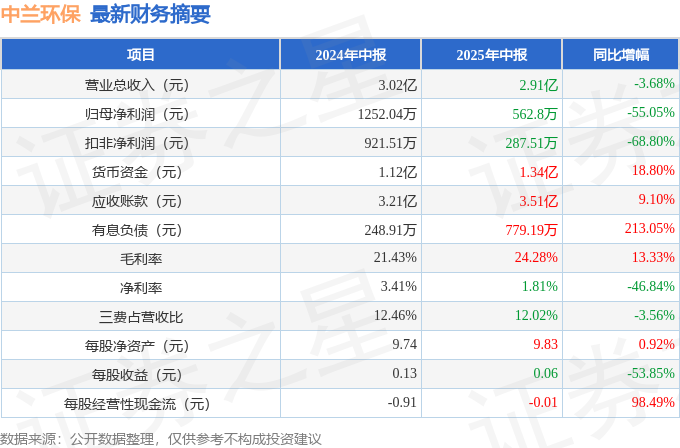
Core Viewpoint - The financial performance of Zhonglan Environmental Protection (300854) for the first half of 2025 shows a decline in revenue and net profit compared to the previous year, indicating potential challenges in the company's operations and cash flow management [1] Financial Performance Summary - Total revenue for the first half of 2025 was 291 million yuan, a decrease of 3.68% year-on-year [1] - Net profit attributable to shareholders was 5.628 million yuan, down 55.05% year-on-year [1] - The gross profit margin improved to 24.28%, an increase of 13.33% year-on-year, while the net profit margin decreased to 1.81%, down 46.84% year-on-year [1] - The company's accounts receivable reached 351 million yuan, representing a 9.10% increase year-on-year, with accounts receivable to net profit ratio at 2678.1% [1] Expense and Cash Flow Analysis - Total sales, administrative, and financial expenses amounted to 34.981 million yuan, accounting for 12.02% of revenue, a slight decrease of 3.56% year-on-year [1] - Operating cash flow per share was -0.01 yuan, showing a significant improvement of 98.49% year-on-year [1] - The company reported a decrease in investment cash flow by 62.02% due to reduced recovery from financial investments [6] Asset and Liability Changes - Accounts receivable decreased by 2.45% due to uncompleted projects and slow collections, leading to increased bad debt provisions [2] - Contract assets decreased by 2.19% due to uncollected project payments and increased impairment provisions [2] - Short-term borrowings increased, indicating a need for liquidity [4] - Contract liabilities increased by 56.03% due to a rise in advance payments for projects [5] Industry Outlook - The environmental protection and governance industry is expected to benefit from government policies promoting investment in pollution control, driven by energy structure adjustments and carbon neutrality strategies [12] - The company aims to focus on ecological restoration and resource recycling, leveraging its core competitive advantages to enhance profitability [12]
债市专题研究:如何看待债市波动加剧?
ZHESHANG SECURITIES· 2025-07-31 05:15
证券研究报告 | 债券市场专题研究 | 债券研究 债券市场专题研究 报告日期:2025 年 07 月 31 日 第一,风险偏好压制逻辑,高风偏资产分流债市资金;第二,通胀/滞涨预期逻辑, 部分债市机构投资者对于价格紧缩的信心出现实质性动摇;第三,情绪及脆弱性 扰动逻辑,当出现反内卷、权益上涨等行情驱动时,止盈或止损诉求均较强,调 整开始的初期担心及抢跑均较为严重。 ❑ 长期层面,债市反而可能演绎反转利多逻辑 第一,市场对于反内卷概念的预期可能自行纠偏;第二,需求政策配套预期可能 弱化,反内卷定价上可能走出"先定价通胀→后定价需求走弱"的利率反转下行 节奏;第三,中美谈判持续进行中,内需政策层面或还需走一步看一步。 ❑ 资产荒驱动配置盘买债的底层逻辑没有明显变化 在基于中期利率下行的判断下,波动依然对应做多机会,负债端较稳定的机构或 许合理把握本轮调整给予的空间。在本轮市场调整中,除了基金恐慌性抛售外, 其他配置型机构均明显增加了净买入力度,农商行承接利率债的意愿在市场调整 初期已有较为充分展现,普信债和二级债配置盘需求较弱但也有所展现,资产荒 驱动配置盘买债的底层逻辑没有明显变化。 ❑ 风险提示 如何看待债市 ...
解决企业“三不”“四缺”问题,广东人大开出“三化”融合药方
Sou Hu Cai Jing· 2025-07-31 04:48
Core Viewpoint - Traditional industries play an irreplaceable role in stabilizing Guangdong's economy, particularly in growth, employment, and foreign trade, but face challenges in transformation and upgrading [1] Group 1: Current Challenges - Some enterprises in Guangdong exhibit "three no's" (unwilling, afraid, unable) towards transformation, lacking technical foundation, talent, experience, and investment capacity for trial and error [1] - There is an overcapacity in low-end production and insufficient high-end supply in certain traditional industries, indicating an unbalanced industrial structure [1] - The precision of transformation policies is inadequate, with a gap between universal policies and the specific needs of enterprises [1] Group 2: Recommendations for Transformation - Optimize the development environment for traditional industries by enhancing policies that support high-quality manufacturing, aligning with trends in AI and green energy [2] - Promote innovation-driven development by improving intellectual property protection and supporting the conversion of research achievements [2] - Strengthen the steel industry through consolidation, mergers, and upgrades to increase high-end product supply [2] - Provide customized transformation solutions for different industries to facilitate a shift from passive to proactive upgrades [2] - Leverage artificial intelligence to empower various sectors, addressing challenges faced by small and medium-sized enterprises in R&D [2] Group 3: Collaborative and Legislative Support - Create a conducive environment for enterprise development by introducing models that connect leading enterprises with smaller ones, enhancing application support mechanisms [3] - Strengthen legal support for traditional industries, optimize the policy framework for industrial development, and encourage more enterprises to transition from observation to active transformation [3]