
智能驾驶

Search documents
猜想谁是26年“易中天”系列——地平线机器人
格隆汇APP· 2026-02-02 10:56
Core Viewpoint - The article emphasizes that the smart driving industry is transitioning from a "technology frontier demonstration" phase to a stage characterized by large-scale implementation, where engineering stability and delivery reliability are becoming key competitive factors [4][11]. Industry Stage Assessment - The smart driving industry is currently in a phase of engineering and large-scale competition, shifting focus from technical capabilities to stable and replicable operation in complex environments [11][12]. - Companies that prioritize engineering capabilities are more likely to gain advantages in mass production and scale expansion [12]. Organizational and Governance Structure - The company has maintained a focused strategic path since its inception, emphasizing an "edge AI computing platform" and selecting smart driving as a primary application area [15]. - The organization promotes a production-oriented engineering logic, where chip architecture, algorithm capabilities, and customer delivery systems are developed in a coordinated manner [15]. Business Model Analysis - The company positions itself as a smart driving computing platform provider rather than a traditional chip supplier, offering scalable solutions through self-developed AI chip architecture [17]. - The platform business model allows for continuous iteration and optimization based on engineering experience and data feedback [17]. Production Capacity and Client Relationships - The company has achieved significant milestones, with over 10 million units of its chips produced and deployed in various mainstream vehicle models [21]. - Mass production signifies higher demands for chip stability, algorithm robustness, and system consistency, which can deepen customer relationships [21]. Technical Pathway - The company focuses on system-level efficiency rather than aggressive competition on computing power, balancing power consumption, cost, and computational efficiency [23]. - This strategy is advantageous during mass production, aiding in vehicle energy management and cost control [23]. Ecosystem and Collaboration - The company emphasizes collaborative development with OEMs and Tier 1 suppliers rather than standard supply, fostering a continuous iterative process within the same technical framework [25]. - This approach enhances customer loyalty but may reduce flexibility in customer structure due to reliance on a single platform [25]. Industry Trends - The penetration rate of smart driving technology is still on the rise, supported by policy environments, consumer acceptance, and automotive strategies [28]. - However, the increase in penetration does not guarantee market share growth for any single manufacturer due to industry dynamics and competitive pricing [29]. Financial Characteristics and Valuation Discussion - As a growth-stage technology company, the company exhibits financial characteristics of "high investment with effects released upon scaling" [31]. - Projected revenue for 2026 is estimated between 5.2 billion to 6.2 billion RMB, reflecting a year-on-year growth of approximately 53% to 70% [31]. Conclusion - The company possesses certain platform and engineering capability advantages as the smart driving industry transitions to engineering and large-scale competition [34]. - Long-term value realization is highly dependent on industry development pace, customer structure stability, and the company's execution capabilities [34].


上汽集团2026年“开门红”:1月销量同比大涨23.9%
Nan Fang Du Shi Bao· 2026-02-02 10:01
Core Insights - SAIC Motor Corporation reported a strong start to 2026 with January vehicle sales reaching 327,000 units, a year-on-year increase of 23.9%, leading both wholesale and retail sales in the domestic automotive industry [1] Group 1: Sales Performance - In January, SAIC's self-owned brands sold 214,000 units, up 39.6%, accounting for 65.3% of total sales, an increase of 7.3 percentage points from the previous year [3] - SAIC Passenger Cars sold 77,000 units, a 53.8% increase year-on-year; SAIC Maxus sold 18,000 units, up 18.2%; and SAIC-GM-Wuling sold 105,000 units, a 37% increase [3] - New energy vehicle sales reached 85,000 units in January, a 39.7% increase year-on-year, with significant growth in various segments, including a 576.9% increase in SAIC Passenger Cars' new energy vehicle sales [3] Group 2: International Market - In January, overseas sales reached 105,000 units, a 51.7% increase year-on-year, with SAIC MG maintaining its position as the top-selling Chinese brand in Europe for 11 consecutive years [3] - SAIC MG delivered nearly 26,000 units in Europe in January, a year-on-year increase of approximately 15% [3] Group 3: Strategic Initiatives - SAIC Motor's overseas strategy 3.0, known as the "Glocal Strategy," aims to create a localized ecosystem and global automotive brand, transitioning from "product export" to "value chain export" [4] - Over the next three years, SAIC plans to launch 17 new overseas models, including SUVs, sedans, MPVs, and pickups, featuring advanced HEV hybrid systems and solid-state battery technologies [4] Group 4: Future Development Plans - SAIC aims to deepen reforms in 2026, focusing on user-centric innovation and the application of cutting-edge technologies such as AI, smart driving, and solid-state batteries [6] - The company is committed to enhancing its market presence both domestically and internationally, striving for a strong start to its "15th Five-Year Plan" [6]

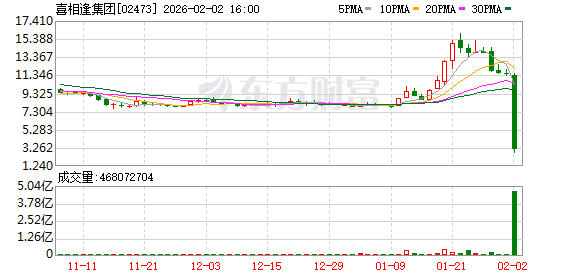
喜相逢暴跌超73% 市值一天蒸发130亿港元 股价仅剩3港元
Mei Ri Jing Ji Xin Wen· 2026-02-02 09:54
Core Viewpoint - The stock price of Xixiangfeng Group (HK02473) experienced a dramatic decline, dropping by 73.25% to HKD 3.05, resulting in a market capitalization loss of approximately HKD 12.917 billion, despite no significant adverse news reported [2]. Group 1: Stock Performance - On February 2, Xixiangfeng Group's stock fell by 76.4% during trading, reaching a new low since October 2024, with trading volume hitting a record high since its listing [2]. - The stock had previously surged from HKD 7.81 on January 9 to a peak of HKD 15.96 on January 22, marking a maximum increase of 104% [2]. Group 2: Business Developments - Xixiangfeng Group's core business includes "rent-to-buy" automotive retail, ride-hailing leasing, and related after-sales services [2]. - The company announced a memorandum of understanding on January 12, 2025, for a potential acquisition of 51% of Xiamen Kuangshi Technology Co., which specializes in millimeter-wave radar solutions for smart driving [2][4]. - A strategic cooperation agreement was signed on December 18, 2024, with New Stone Technology, focusing on the procurement and operation of unmanned vehicle products [4]. Group 3: Financial Performance - For the first half of 2025, Xixiangfeng Group reported revenues of HKD 769 million and a net profit of HKD 22.57 million, reflecting year-on-year growth of 16.8% and 15.9%, respectively [4]. - The revenue growth was primarily driven by significant increases in direct automotive retail and the expansion of its self-operated sales network, which grew from 89 to 110 locations [5]. - Revenue from automotive retail and financing reached HKD 607 million, with a year-on-year increase of 7.2%, while related automotive services generated HKD 104 million, up 16.6% [5].
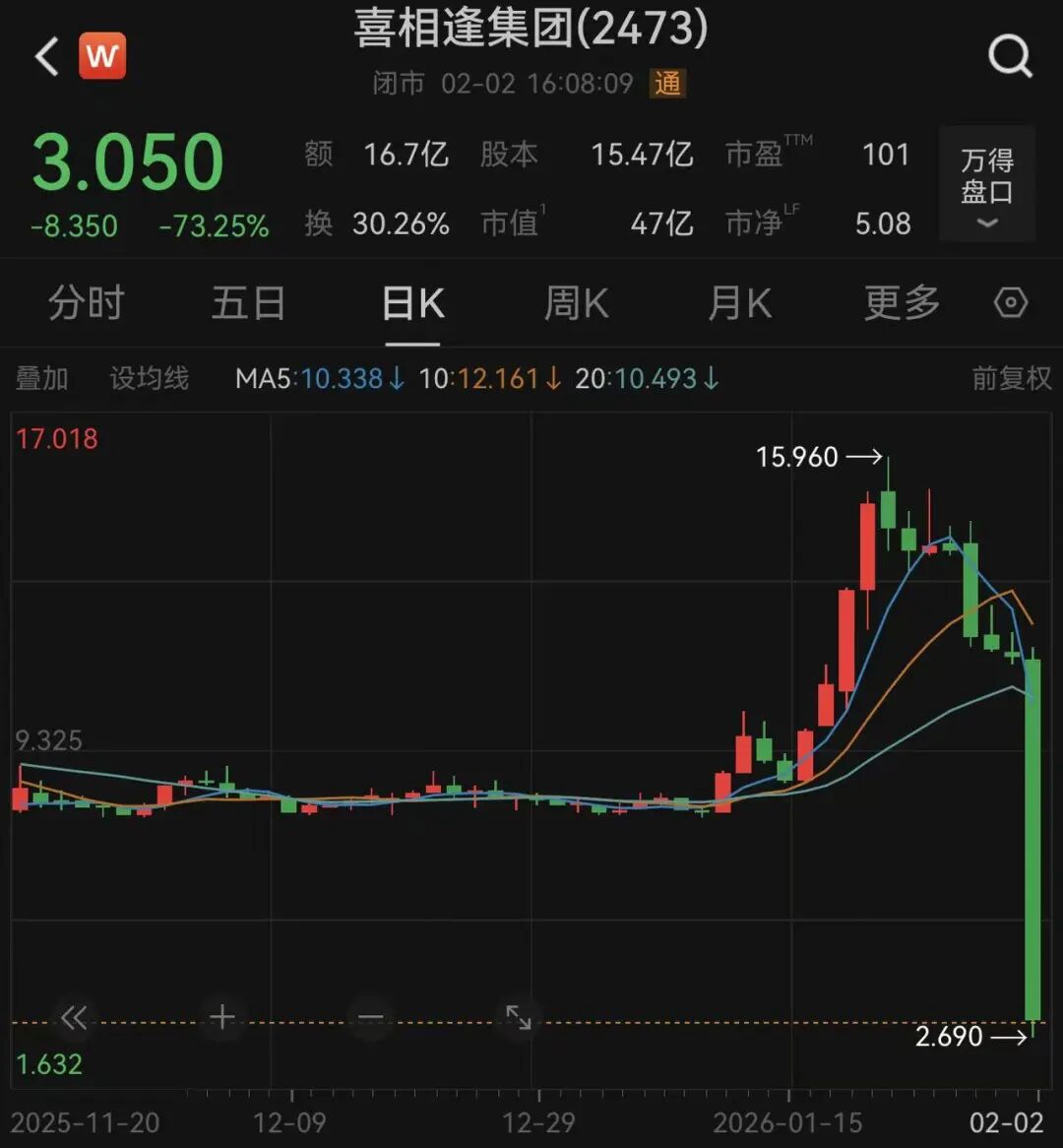
喜相逢暴跌超73%,市值一天蒸发130亿港元,股价仅剩3港元
Mei Ri Jing Ji Xin Wen· 2026-02-02 09:15
Core Viewpoint - The stock price of Xixiangfeng Group (HK02473) experienced a dramatic decline, dropping by 73.25% to HKD 3.05, resulting in a market value loss of approximately HKD 12.917 billion in one day [1][3]. Group 1: Company Overview - Xixiangfeng Group was established in 2007 and went public on the Hong Kong Stock Exchange in November 2023, with plans to be included in the Hong Kong Stock Connect by September 2025 [3]. - The company's core business includes "rent-to-buy" automotive retail, ride-hailing leasing, and related after-sales services [3]. Group 2: Recent Stock Performance - Since January 2023, the stock has gained significant attention, with a peak increase of 104% from HKD 7.81 on January 9 to HKD 15.96 on January 22 [3]. - The stock price decline on February 2 marked a new low since October 2024, with a trading volume reaching a record high since its listing [1]. Group 3: Strategic Developments - On January 12, 2023, the company announced a memorandum of understanding with Xiamen Kuangshi Technology Co., aiming to acquire a 51% stake in the latter, which specializes in millimeter-wave radar solutions for smart driving [3][5]. - A strategic cooperation agreement was signed with New Stone Technology on December 18, 2022, focusing on the procurement and operation of unmanned vehicle products [5]. Group 4: Financial Performance - For the first half of 2025, the company reported revenues of HKD 769 million and a net profit of HKD 22.57 million, reflecting year-on-year growth of 16.8% and 15.9%, respectively [5][6]. - The revenue growth was primarily driven by significant increases in direct automotive retail and the expansion of its self-operated sales network, which grew from 89 to 110 locations [6].
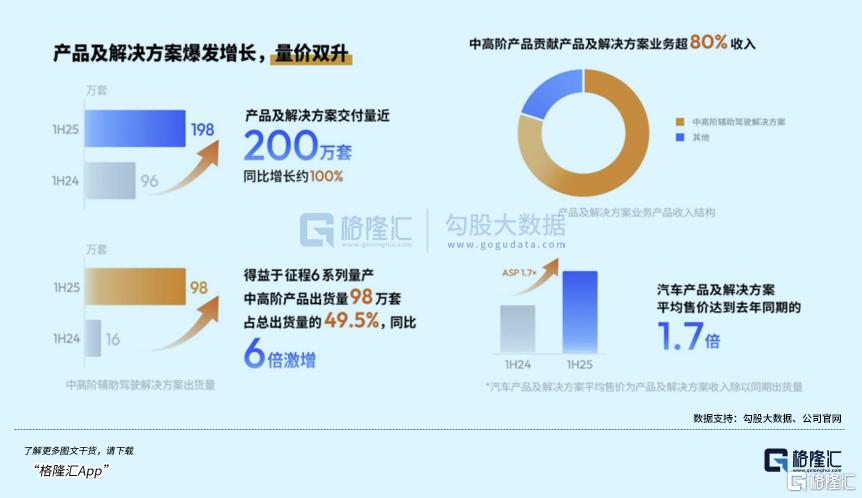
猜想谁是26年“易中天”系列——地平线机器人
Ge Long Hui· 2026-02-02 07:25
Core Viewpoint - The transition of intelligent driving from a "technology frontier display" phase to an industrialization phase characterized by large-scale implementation is highlighted, with a focus on the importance of engineering systems and continuous delivery capabilities for competitive advantage [1][4]. Industry Stage Assessment - Intelligent driving is entering a phase of engineering and large-scale competition, where the focus shifts from technical capabilities to stable and replicable operation in complex environments [3][4]. - The competitive landscape is evolving, emphasizing the need for scalable deployment solutions that meet cost, power consumption, stability, and long-term supply requirements [4]. Organizational and Governance Structure - The company has maintained a focused strategic path since its inception, emphasizing an "edge AI computing platform" and targeting the complex application of intelligent driving [6][7]. - The organization prioritizes production-oriented engineering logic, integrating chip architecture, algorithm capabilities, and customer delivery systems within the same product framework [7]. Business Foundation Analysis - The company is positioned as a provider of intelligent driving computing platforms rather than a traditional chip supplier, utilizing self-developed AI chip architecture (BPU) to offer scalable solutions [8][9]. - The platform business model allows for continuous iteration and optimization based on engineering experience and data feedback, adapting to the shift in automotive demand from high-end to mainstream models [9]. Customer and Production Capability - Achieving mass production deployment is a critical indicator of a company's capabilities in the intelligent driving sector, with the company having established partnerships with several major automakers [12]. - Mass production requires higher standards for chip stability, algorithm robustness, and system consistency, which can deepen customer relationships but also increase quality responsibilities and delivery pressures [12][13]. Ecosystem and Collaboration - The company emphasizes collaborative development with automakers and Tier 1 suppliers rather than standard supply, fostering a continuous iteration within the same technical framework [14][15]. - This collaborative model enhances customer loyalty but may reduce flexibility in customer structure due to higher dependency on a single platform [15]. Industry Trends - The penetration rate of intelligent driving is still on the rise, supported by policy, consumer acceptance, and automaker strategies, with demand for computing platforms expected to expand beyond high-end configurations [16]. - However, uncertainties related to industry rhythm, price competition, and technological differentiation must be monitored, as increased penetration does not guarantee market share growth for any single vendor [16]. Financial Characteristics - As a growing tech company, the company exhibits financial characteristics of "high investment, with effects released after scaling," with revenue predictability expected to improve as the number of mass-produced models increases [17]. - Projected revenue for 2026 is estimated between 5.2 billion to 6.2 billion RMB, reflecting a year-on-year growth of approximately 53% to 70%, with a market valuation range of about 160 billion HKD based on a 30x PS valuation assumption [17]. Conclusion - The company's core asset value lies in its "industrial certainty" as it transitions from technology validation to engineering and large-scale implementation in the intelligent driving sector [21][22]. - Long-term value realization is highly dependent on industry development pace, customer structure stability, and the company's execution capabilities, with stability, replicability, and scalability becoming crucial evaluation metrics [22].

蔚来汽车1月交付新车2.72万台,累计交付突破102万辆
Ju Chao Zi Xun· 2026-02-02 03:04
Core Insights - NIO reported a strong sales performance with 27,182 vehicles delivered in January 2026, marking a year-on-year growth of 96.1% [2] - The total cumulative deliveries have surpassed 1 million units, reaching 1,024,774 vehicles, solidifying NIO's position in the high-end electric vehicle market [2] - The new ES8 model celebrated its 60,000th owner within just 134 days of launch, indicating robust demand for large electric SUVs [2] Group 1: Sales Performance - NIO delivered 27,182 vehicles in January 2026, achieving a remarkable year-on-year growth of 96.1% [2] - The cumulative delivery milestone of 1,024,774 vehicles has been reached, officially crossing the 1 million mark [2] - The new ES8 model reached 60,000 deliveries in only 134 days, showcasing strong market demand [2] Group 2: Product and Technology - NIO continues to lead in technology upgrades with the rollout of the latest 1.4.0 version of its intelligent system across multiple models [2] - The new features include enhanced world model-assisted driving capabilities, promising a smarter and safer driving experience [2] Group 3: Financial and Service Initiatives - NIO introduced attractive financing options with a 7-year low-interest purchase plan, offering rates as low as 0.49% [3] - The company announced that its global battery swap network has surpassed 99 million swaps, expected to reach 100 million soon, reflecting user acceptance of the battery swap model [3]

汽车与汽车零部件行业周报、月报:智驾科技向上,海外新能源加速
Guoyuan Securities· 2026-02-02 00:30
Investment Rating - The report maintains a "Recommended" investment rating for the automotive industry [5] Core Insights - The automotive industry is experiencing a significant transformation towards intelligent driving and AI integration, with major players like Li Auto and NIO announcing strategic shifts towards embodied intelligence and humanoid robotics [1][19] - The overseas new energy vehicle market is rapidly growing, with strong demand for models like the new electric GLC from Mercedes-Benz, which has seen order backlogs extending into the second half of 2026 [2][29] - The report emphasizes the importance of focusing on technological growth opportunities in smart driving and AI, as well as the potential for Chinese supply chains to expand internationally [3] Summary by Sections Weekly Market Review (2026.01.24-01.30) - The automotive sector saw a decline of 5.08% during the week, with most related sub-sectors also experiencing downturns. The Shanghai Composite Index rose slightly by 0.08% [11] - Notable stock performances included declines in passenger vehicle stocks like Seres (-11.8%) and Haima (-6.0%), while commercial vehicle stocks like China National Heavy Duty Truck rose by 7.9% [11][15] Industry News (2026.01.24-01.30) - Li Auto's CEO announced a major shift towards AI, stating that 2026 is the last opportunity to become a leading AI company, with plans to develop humanoid robots [19][20] - The Ministry of Public Security reported that by 2025, the total number of motor vehicles in China will reach 469 million, with 43.97 million being new energy vehicles [21] - NIO's new version of the World Model (NWM) is set to enhance driving capabilities through advanced AI features [22] - BYD launched its Tian Shen Yan 5.0 system, which utilizes reinforcement learning for improved driving performance [24] - Volkswagen announced the production of its new CEA architecture in China, aimed at enhancing vehicle performance and reducing complexity [25][26] Investment Recommendations - The report suggests focusing on the growth opportunities presented by intelligent driving, autonomous driving, and the rapid expansion of the overseas new energy market [3]
理想汽车-W1月交付新车27668辆,同比下降7.5%
Zhi Tong Cai Jing· 2026-02-02 00:14
Core Viewpoint - Li Auto reported a year-on-year decline of 7.5% in new vehicle deliveries for January 2026, with a total of 27,668 units delivered, bringing the cumulative delivery total to 1.5679 million units as of January 31, 2026 [1] Group 1: Vehicle Deliveries - In January 2026, Li Auto delivered 27,668 new vehicles, representing a 7.5% decrease compared to the same month last year [1] - As of January 31, 2026, the historical cumulative delivery volume reached 1.5679 million units [1] Group 2: Software and Technology Updates - Li Auto pushed an OTA 8.2 system update in January, introducing 40 new features and 25 experience optimizations [1] - The enhanced VLA driver model shows significant improvement in understanding and responding to complex urban driving conditions, approaching human driving levels [1] Group 3: Retail and Service Network - As of January 31, 2026, Li Auto has established 547 retail centers across 159 cities [1] - The company operates 547 after-sales service and authorized service centers, covering 221 cities [1] - Li Auto has deployed 3,966 charging stations nationwide, with a total of 21,945 charging piles in operation [1]

黑芝麻智能与萝卜快跑达成战略合作;何小鹏回应IRON人形机器人摔倒丨汽车早参
Mei Ri Jing Ji Xin Wen· 2026-02-01 23:05
Group 1: New Energy Vehicles and Charging Infrastructure - The Ministry of Transport predicts that the total travel volume of new energy vehicles during the Spring Festival will reach a historical high of 380 million trips, indicating a significant increase in market penetration and user acceptance of electric vehicles [1] - The prediction enhances market confidence in the actual demand for mainstream vehicle manufacturers' products and highlights the strategic value and commercial potential of charging services, battery endurance, and related infrastructure [1] Group 2: Charging Infrastructure Development - Cui Dongshu emphasizes the importance of developing private slow charging lines, stating that the rapid development of charging infrastructure in China has created the largest and most diverse charging network globally, although issues like oversupply and suboptimal layout remain [2] - The focus on optimizing private charging infrastructure rather than merely increasing the number of public charging stations may attract capital towards community charging and smart charging solutions, reflecting a new phase in investment in new energy infrastructure [2] Group 3: Strategic Partnerships in Autonomous Driving - Black Sesame Intelligence and Baidu's萝卜快跑 have signed a strategic cooperation agreement, with Black Sesame providing technical support for product development and萝卜快跑 offering guidance for solution validation [3] - This partnership is expected to strengthen Black Sesame's market presence in the autonomous driving chip sector and highlights the trend of collaboration within the smart driving industry, potentially attracting more investment towards companies with practical ecosystems and partnerships [3] Group 4: Robotics Industry Challenges - Xiaopeng Motors' chairman responded to a viral incident involving the company's IRON humanoid robot falling, likening it to a child's learning to walk, which underscores the early-stage volatility of the humanoid robot sector [4] - This incident highlights the need for ongoing scrutiny of technological advancements and practical progress in the market, especially in the context of disruptive innovation [4]

汽车行业周报(20260126-20260201):有色波动影响中上游短期议价,继续看好新产业方向
Huachuang Securities· 2026-02-01 13:30
Investment Rating - The report maintains a "Buy" recommendation for the automotive industry, focusing on new energy vehicles and related technologies [1]. Core Insights - The automotive market is currently experiencing a cautious atmosphere, with stakeholders observing the recovery of terminal demand and the impact of policies and costs on profitability. Short-term fluctuations in the non-ferrous sector are affecting pricing negotiations in the upstream and midstream segments. The report suggests monitoring factors that could lead to a rebound in vehicle sales in Q1, including retail and export performance, while remaining optimistic about the automotive parts sector, particularly in areas like intelligent driving, liquid cooling, and robotics [1][3]. Data Tracking - In late January, the industry discount rate decreased to 9.5%, showing a year-on-year increase of 0.6 percentage points but a month-on-month decrease of 0.1 percentage points. The average discount amount was 21,541 yuan, up by 1,294 yuan year-on-year but down by 718 yuan month-on-month [3]. - December saw a decline in wholesale and retail sales of passenger vehicles, with wholesale sales at 2.85 million units, down 8.7% year-on-year and 6.3% month-on-month. Retail sales of domestic passenger vehicles were 2.28 million units, down 16.8% year-on-year but up 13.7% month-on-month [3]. - The report highlights specific automotive companies to watch, including Geely, JAC Motors, and BYD, with Geely being favored due to its low valuation and expected better-than-expected performance in domestic sales [5]. Industry News - In January, the China Passenger Car Association reported that the automotive industry generated revenues of 1,117.96 billion yuan in 2025, a year-on-year increase of 7.1%, while costs rose by 8.1% to 984.98 billion yuan, resulting in a profit of 46.1 billion yuan, up 0.6% [31]. - The report notes significant developments in the electric vehicle sector, including a partnership between a Vietnamese manufacturer and BYD to establish a commercial electric vehicle battery factory, and the launch of new electric models by various companies [31][32]. - The report also mentions the implementation of new national standards for automotive steering systems and automatic emergency braking systems, which are expected to enhance safety and technology in the industry [31][32].
