
股债跷跷板效应

Search documents
【笔记20250814— 大A“豹子顶”:3666】
债券笔记· 2025-08-14 11:16
Core Viewpoint - The article discusses the recent fluctuations in the stock market and bond yields, highlighting the impact of central bank operations and market sentiment on financial conditions [2][4]. Group 1: Market Overview - The stock market experienced a rise in the morning, with the Shanghai Composite Index reaching 3700 points, but later fell to close at 3666.44, down from a high of 3688.63 [4][5]. - The bond market showed stability in sentiment, with the 10-year government bond yield slightly decreasing to 1.715% before rising again to 1.732% by the end of the trading day [4][5]. - The central bank conducted a 128.7 billion yuan reverse repurchase operation, with a net withdrawal of 32 billion yuan due to 160.7 billion yuan of reverse repos maturing [2][3]. Group 2: Interest Rates and Funding Conditions - The funding conditions showed a slight tightening, with the DR001 rate around 1.32% and DR007 at approximately 1.44% [2]. - The weighted average rates for various repo codes were reported, with R001 at 1.35% and R007 at 1.47%, indicating stable rates over the past 30 days [3]. - The central bank announced a fixed quantity, interest rate tender for a 500 billion yuan buyout reverse repo operation set for August 15, 2025, with a term of 6 months [2][4].

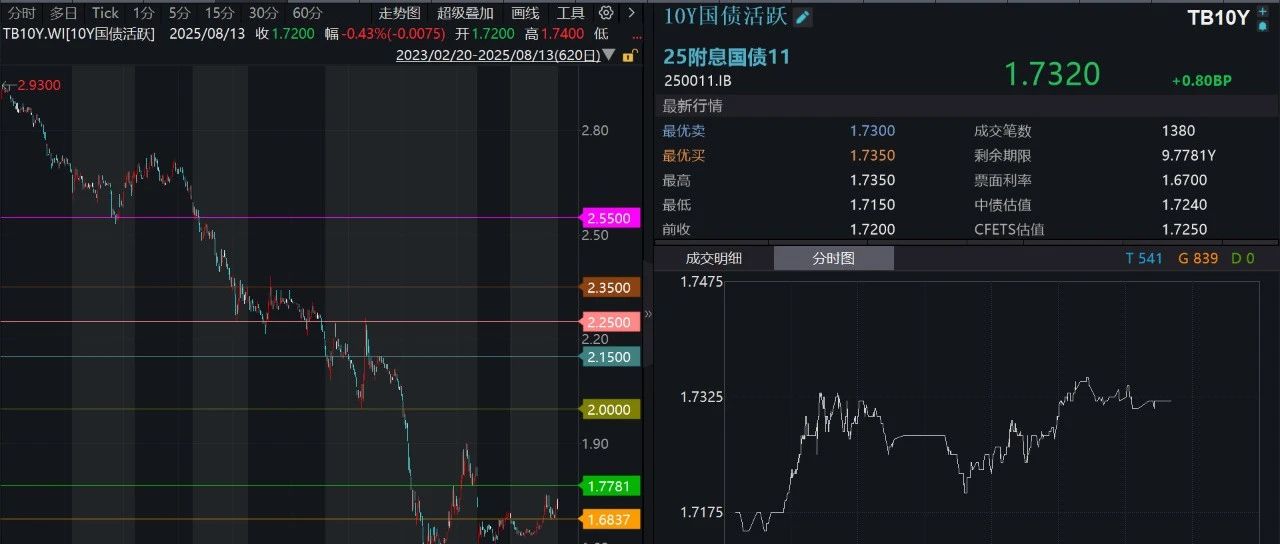
股市呈现积极态势,债市情绪有所修复
Zhong Xin Qi Huo· 2025-08-14 04:20
1. Report Industry Investment Rating - The investment ratings for stock index futures, stock index options, and Treasury bond futures are "volatile and bullish", "volatile", and "volatile and cautious" respectively [7][8][9] 2. Core Viewpoints of the Report - The stock market shows a positive trend, and the bond market sentiment has improved. The sentiment in the equity market has entered a positive feedback loop. Before the September military parade, a positive attitude towards the equity market is maintained. The bond market needs to remain cautious overall, but the financial data structure may support the bullish sentiment in the bond market to some extent [1][3] 3. Summary by Relevant Catalogs 3.1 Market Views 3.1.1 Stock Index Futures - **Viewpoint**: The Shanghai Composite Index reached a new high, and the trading volume exceeded 2 trillion. The basis, spread, and total positions of IF, IH, IC, and IM contracts changed. The trading volume of the two markets reached a new high, approaching 2.2 trillion. The Shanghai Composite Index broke through the previous high in October 2024, and the ChiNext Index was close to the previous high. Before the September military parade, a positive attitude towards the equity market is maintained due to factors such as the Fed's expected interest - rate cut, policy support, and positive capital flow signals. The short - term strategy is to follow the trend [7] - **Operation Suggestion**: Hold IM contracts [7] 3.1.2 Stock Index Options - **Viewpoint**: Continue to hold the offensive strategy. The equity market continued to fluctuate strongly, and the ChiNext Index rose significantly. The trading volume of options exceeded 10 billion again since April 9th, with the trading volume of ChiNext ETF options increasing by 143.43% in a single day. The option sentiment index strengthened, and the implied volatility increased rapidly. It is recommended to follow the trend and continue to hold the bull spread portfolio [2][7] - **Operation Suggestion**: Continue to hold the bull spread portfolio [2][7] 3.1.3 Treasury Bond Futures - **Viewpoint**: The bond market sentiment has improved. The Treasury bond futures strengthened overall, but the stock market's strength may still have a negative impact on the bond market. The sentiment in the commodity market weakened, reducing the negative impact on the bond market. After continuous adjustments, the wait - and - see sentiment in the bond market increased. The July financial data showed that the social financing growth rate continued to rise, but the RMB loan segment needed further improvement. The financial data structure may support the bullish sentiment in the bond market, but overall, caution is still needed [3][8][9] - **Operation Suggestion**: The trend strategy is to be volatile and cautious. The hedging strategy is to pay attention to short - hedging at low basis levels. The basis strategy may have limited arbitrage space for the main contracts. The curve strategy is to pay attention to steepening the yield curve [9] 3.2 Economic Calendar - The economic data of the United States and China from August 12th to 15th, 2025 are presented, including the US July CPI annual rate, China's July M2 money supply annual rate, and other indicators [10] 3.3 Important Information and News Tracking - **Crude Oil**: The IEA stated that the global oil market will face a record supply surplus next year. OECD countries' oil demand is "resilient" due to low oil prices. The global crude oil processing volume in August is expected to reach a record high, and the observable global oil inventory in June reached a 46 - month high [11] - **Macro - economy**: The central bank released the July financial statistics report. The RMB deposits, loans, and social financing scale from January to July are detailed, including the changes in various sectors and sub - items [11][12] 3.4 Derivatives Market Monitoring - The report includes data on stock index futures, stock index options, and Treasury bond futures, but specific data details are not fully presented in the given text [13][17][29]
“股债双牛”罕见同框 机构:市场将对“跷跷板效应”逐步“脱敏”
Xin Hua Cai Jing· 2025-08-13 13:57
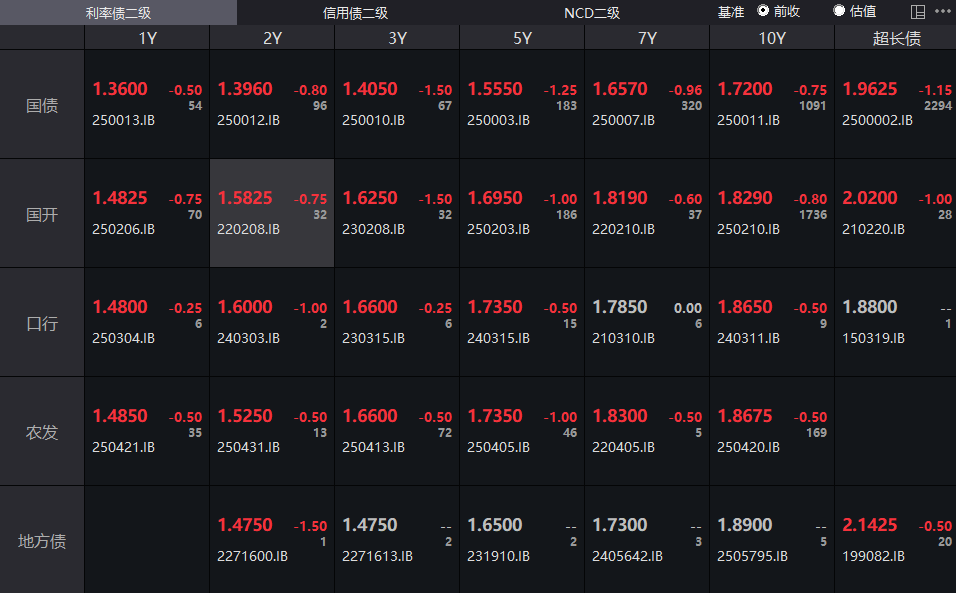
Core Viewpoint - The equity market has shown significant growth, with the Shanghai Composite Index achieving an 8-day winning streak, while the bond market has also performed well, indicating a new trend of "dual bull" in both markets [1][2][4]. Group 1: Equity Market Performance - The stock market experienced a strong upward trend, with the Shanghai Composite Index surpassing the high point from October 8 of the previous year, reaching a nearly 4-year high [2]. - The total trading volume in the Shanghai and Shenzhen markets reached 2.15 trillion yuan, marking a return to above 2 trillion yuan after 114 trading days [2]. Group 2: Bond Market Performance - The bond market saw a comprehensive increase in government bond futures, with the 30-year main contract rising by 0.10% to 118.270 yuan, and the 10-year main contract increasing by 0.02% to 108.435 yuan [2]. - Major interest rate bonds in the interbank market experienced a decline in yields, with the 10-year government bond yield falling by 0.75 basis points to 1.72% [2]. Group 3: Market Dynamics and Future Outlook - Analysts suggest that the market is becoming desensitized to the "stock-bond seesaw" effect, indicating a potential return to fundamental factors driving both equity and bond markets [4][6]. - Future expectations indicate that the 10-year government bond yield may stabilize around 1.65%-1.70% as new bonds are issued, leading to a revaluation of interest rate bonds [4]. - The outlook for the second half of the year suggests a "dual bull" market, with equity investments focusing on structural opportunities in the new economy, while the bond market is characterized by a low-growth, low-inflation, and low-interest-rate environment [6].
刘郁:债牛,虽迟但到
Sou Hu Cai Jing· 2025-08-13 11:20
Group 1 - The core viewpoint of the article indicates that the pressure of the stock market on the bond market may be nearing its end, as the recent stock market rally is not supported by fundamental data improvements but rather by confidence in state intervention [2][26] - The stock market's upward movement has two main effects on the bond market: the "water extraction effect" which reduces liquidity in the bond market, and the enhancement of market risk appetite, which can suppress bond market sentiment [20][29] - The recent stock market rally has led to a significant increase in financing balances, suggesting a peak in equity speculation sentiment, with potential for a market correction in the coming weeks [26][30] Group 2 - There is an expectation that interest rate cuts may gain traction, driven by weak demand reflected in low PPI figures and anticipated disappointing credit data [3][29] - The bond market is entering a recovery phase, with a notable rebound in credit bonds and short-duration government bonds, while the sentiment in the bond market is gradually improving [7][13] - The upcoming weeks are critical for the bond market, with a focus on financial data releases and the evolution of Sino-US relations, which could impact market dynamics [16][30] Group 3 - The government bond issuance schedule is slowing down, with planned issuance significantly reduced compared to the previous week, indicating a potential shift in supply dynamics [62] - The issuance of local government bonds has also seen a decrease, with a notable increase in net issuance, reflecting ongoing fiscal strategies [65][66] - The overall bond market is expected to experience a "bond bull" phase in August and September, suggesting a favorable environment for extending portfolio durations [5][30]
国债期货日报:期债全线反弹-20250813
Nan Hua Qi Huo· 2025-08-13 08:56
Group 1: Report Overview - Report Date: August 13, 2025 [1] - Analyst: Xu Chenxi from Nanhua Research Institute [1] - Investment Advisory Qualification: China Securities Regulatory Commission Permit [2011] No. 1290 [1] Group 2: Market Performance - On Wednesday, Treasury bond futures opened lower and closed higher across the board, with all cash bond yields declining, and the medium - and long - end yields falling more significantly [1] - The open market had a net withdrawal of 20 billion yuan, but the money market remained loose, with DR001 at 1.316% [1] - The US July CPI rose 2.7% year - on - year, lower than expected, while the core CPI growth reached the highest since February, which strengthened the expectation of interest rate cuts [2] Group 3: Market Analysis - The A - share market continued to rise strongly, and the Shanghai Composite Index broke through the high point formed on October 8, 2024, but the impact on the bond market was limited, and the stock - bond跷跷板 effect weakened [3] - In terms of institutional behavior, funds continued to sell, while securities firms turned to buying. In the bullish atmosphere of the A - share market, active funds such as securities firms and funds may sell from time to time, but there is no need to worry too much [3] - After the continuous rise of the A - share market, it may fluctuate, which may provide some space for the bond market. Traders should not chase the rising market, control positions, and lay out next - quarter contracts on dips [3] Group 4: Data Summary Futures Contracts | Contract | 2025 - 08 - 13 Price | 2025 - 08 - 12 Price | Price Change | Last Week's Price | | --- | --- | --- | --- | --- | | TS2509 | 102.37 | 102.338 | 0.032 | 102.37 | | TF2509 | 105.75 | 105.695 | 0.055 | 105.78 | | T2509 | 108.46 | 108.41 | 0.05 | 108.565 | | TL2509 | 118.31 | 118.15 | 0.16 | 119.34 | [4] Contract Positions | Contract Position | 2025 - 08 - 13 | 2025 - 08 - 12 | Change | Last Week | | --- | --- | --- | --- | --- | | TS Contract Position (lots) | 102880 | 105870 | - 2990 | 31605 | | TF Contract Position (lots) | 177009 | 178301 | - 1292 | 186234 | | T Contract Position (lots) | 236925 | 236006 | 919 | 236282 | | TL Contract Position (lots) | 153096 | 153569 | - 473 | 153142 | [4] Basis | Basis | 2025 - 08 - 13 | 2025 - 08 - 12 | Change | Last Week | | --- | --- | --- | --- | --- | | TS Basis (CTD) | 0.0396 | 0.0284 | 0.0112 | 0.0136 | | TF Basis (CTD) | 0.023 | 0.0339 | - 0.0109 | 0.0031 | | T Basis (CTD) | 0.0072 | 0.0165 | - 0.0093 | 0.0147 | | TL Basis (CTD) | 0.0322 | 0.1906 | - 0.1584 | 0.0147 | [4] Trading Volume | Contract | 2025 - 08 - 13 Volume | 2025 - 08 - 12 Volume | Volume Change | Last Week's Volume | | --- | --- | --- | --- | --- | | TS Main Contract Volume (lots) | 39500 | 34415 | 5085 | 27216 | | TF Main Contract Volume (lots) | 47424 | 48505 | - 1081 | 47098 | | T Main Contract Volume (lots) | 77715 | 76952 | 763 | 64393 | | TL Main Contract Volume (lots) | 125564 | 123182 | 2382 | 78797 | [4] Repo Rates | Repo Rate | 2025 - 08 - 13 Rate | 2025 - 08 - 12 Rate | Rate Change | Last Week's Rate | | --- | --- | --- | --- | --- | | DR001 | 1.3162% | 1.3144% | 0.0018% | 0.0019% | | DR007 | 1.4444% | 1.4404% | 0.004% | - 0.0001% | | DR014 | 1.4688% | 1.4833% | - 0.0145% | - 0.0065% | [4][5] Repo Trading Volume | Repo | 2025 - 08 - 13 Volume (billion yuan) | 2025 - 08 - 12 Volume (billion yuan) | Volume Change (billion yuan) | Last Week's Volume (billion yuan) | | --- | --- | --- | --- | --- | | DR001 | 28708.9799 | 28708.9799 | 0 | 28816.6772 | | DR007 | 1081.5185 | 810.5676 | 270.9509 | 957.0987 | | DR014 | 107.5447 | 90.8441 | 16.7006 | 144.4292 | [4][5]
国债期货日报:股债跷跷板效应明显,国债期货大多收跌-20250813
Hua Tai Qi Huo· 2025-08-13 07:00
国债期货日报 | 2025-08-13 股债跷跷板效应明显,国债期货大多收跌 市场分析 宏观面:(1)宏观政策:7月政治局会议明确提出要落实落细更加积极的财政政策和适度宽松的货币政策,依法依 规治理企业无序竞争,积极稳妥化解地方政府债务风险,严禁新增隐性债务等一些列政策指引;2025年8月1日, 财政部与税务总局发布公告称,自2025年8月8日起,对在该日及以后新发行的国债、地方政府债券和金融债券的 利息收入将恢复征收增值税。此前已发行的上述债券(包括8月8日后续发行的部分)仍享受免征增值税政策,直 至到期;关税方面,中美发布斯德哥尔摩经贸会谈联合声明,自2025年8月12日起再次暂停实施24%的关税90天。 (2)通胀:7月CPI同比持平。 资金面:(3)财政:2025年上半年,全国财政运行总体平稳,支出扩张力度加大、收支结构持续优化。一般公共 预算收入达11.56万亿元,同比微降0.3%,其中税收收入占比超八成,尽管总体下降1.2%,但增值税、消费税、个 税等主要税种保持增长,显示税源恢复态势逐步确立。支出方面,一般公共预算支出14.13万亿元,同比增长3.4%, 聚焦社会保障、教育、科技、卫生等民生和发 ...
方正富邦区德成:8月债市不应过分悲观的五大理由
Zhong Guo Jing Ji Wang· 2025-08-13 06:15
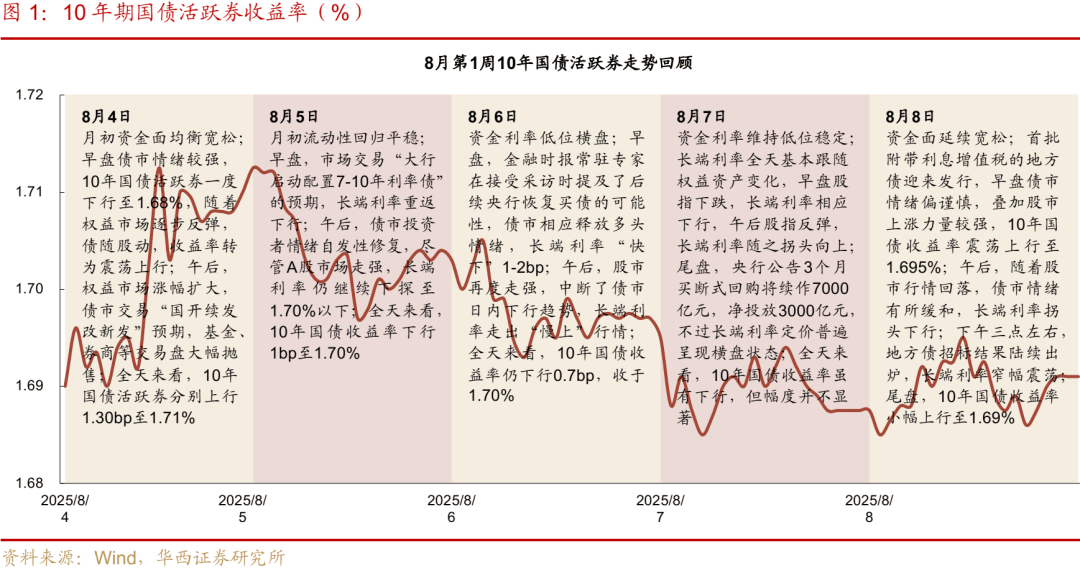
Group 1 - The bond market has experienced a correction from mid to late July, with the 10-year government bond yield rising from 1.66% to 1.72% and the 30-year bond yield increasing from 1.87% to 1.99% during the period from July 16 to August 11 [1] - In contrast to the bond market's decline, the stock market and commodities have shown strong performance, driven by supply reduction policies, economic recovery expectations, and global liquidity easing, leading to a significant rise in commodity prices and a rebound in the A-share market [1] - The adjustment in the bond market is attributed to three main factors: tight funding conditions, inflation expectations raised by "anti-involution" policies, and the impact of rising equity markets on the bond market [1] Group 2 - Recent PMI data indicates a marginal pressure scenario for the second half of the year, with production, domestic and external demand orders, and inventory indicators showing varying degrees of decline, suggesting that inflation expectations may not persist for long [2] - The commodity market is cooling down, which is favorable for the bond market, as the first phase of significant price increases in commodities may have passed, leading to a more rational market risk appetite [2] - Historically, August sees stable funding conditions, with funding rates typically rising before month-end; recent data shows overnight and 7-day funding rates declining to 1.35% and 1.49% respectively, indicating liquidity easing [2] Group 3 - The current adjustment in the bond market is driven more by sentiment and trading factors rather than a fundamental reversal of the bond market's core logic, suggesting that the long-term bullish outlook for the bond market remains unchanged [3] - The recent phase of decline in the bond market presents a more attractive opportunity for rational investors to position themselves [3]
期债 短线震荡思路对待
Qi Huo Ri Bao· 2025-08-13 05:23
Group 1: Macroeconomic Trends - Recent fluctuations in treasury futures are driven by macroeconomic data and policy changes, with the Ministry of Finance announcing the resumption of VAT on interest income from newly issued government bonds starting August 8, leading to increased demand for older bonds [1] - Domestic economic resilience is evident, with a rising risk appetite in the A-share market and the central bank maintaining ample liquidity, while the Federal Reserve keeps interest rates unchanged, causing upward momentum in treasury futures to weaken [1] Group 2: Trade Performance - In July 2025, China's total import and export volume reached $545.32 billion, a year-on-year increase of 5.9%, with exports at $321.78 billion, up 7.2%, outperforming market expectations [2] - The increase in exports is attributed to fluctuating U.S. tariff policies, leading to a "rush to export" effect, particularly with accelerated growth in exports to the EU, South Korea, Taiwan, and Belt and Road countries, despite a significant decline in exports to the U.S. [2] Group 3: Import Dynamics - Import growth continued to rebound in July, driven by rising prices of bulk commodities, with the CRB index increasing from 3.5% in June to 6.0% year-on-year, positively impacting both import volume and value [3] - The decline in imports from the U.S. narrowed from 15.5% to 10.3%, indicating a slight alleviation of the overall import pressure [3] Group 4: Price Levels - The Consumer Price Index (CPI) remained flat year-on-year in July, with a slight decrease in the growth rate compared to June, while the core CPI increased by 0.1 percentage points to 0.8%, the highest since March 2024 [4] - Food prices showed a moderate improvement, with the year-on-year growth rate of fresh vegetables and pork prices contributing to a downward adjustment in CPI [4] Group 5: Producer Price Index (PPI) Trends - The Producer Price Index (PPI) decreased by 3.6% year-on-year in July, consistent with June, reflecting low construction industry sentiment and price pressures in export-oriented sectors due to international trade uncertainties [5] - Recent government meetings emphasized maintaining a "moderately loose" monetary policy, indicating that the foundation for a "bull market" in bonds remains solid, although upward momentum in the bond market may weaken due to economic resilience and commodity price recovery [5]
权重股“20CM”涨停,这类ETF霸榜
Zhong Guo Zheng Quan Bao· 2025-08-12 14:28
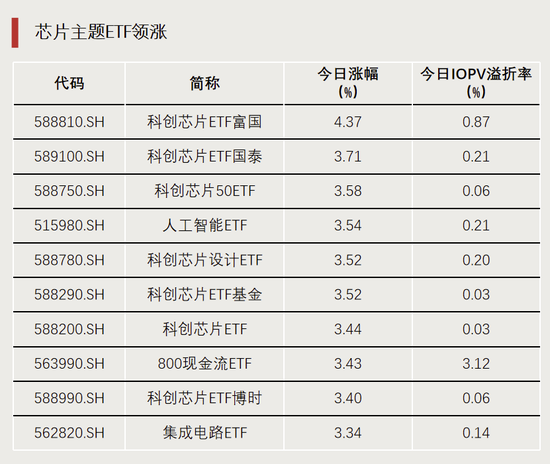
Market Performance - On August 12, A-shares in the AI hardware sector surged, with Cambrian's "20CM" hitting the daily limit, and multiple chip and AI-themed ETFs rising over 3% [1][3] - The STAR 50 ETF (588000) increased nearly 2%, with trading volume rising by nearly 3 billion yuan compared to the previous day [6] - The STAR Chip ETF (588200) and Semiconductor ETF (512480) also saw significant trading volume increases [6] Fund Flows - The short-term bond ETF (511360) experienced a significant outflow of over 11 billion yuan, with a trading volume of only 102.93 billion yuan, down more than 12 billion yuan from the previous day [6][9] - Conversely, the 30-year Treasury bond ETF (511090) attracted over 6 billion yuan in net inflows [9] ETF Highlights - The STAR Chip ETF (588810) rose by 4.37%, marking its largest increase in nearly four months, with a premium rate of 0.87% [4] - Other notable ETFs in the chip and AI sectors also saw gains, with several rising over 3% [4][3] - The Hong Kong Stock Connect Internet ETF (159792) recorded a net inflow of over 3.5 billion yuan since August, leading non-cash ETFs [2][8] Sector Insights - The AI sector is expected to trigger a structural market rally due to sufficient capital allocation and ongoing demand for computing power and capital expenditure [3] - The market is currently experiencing a "stock-bond seesaw" effect, with notable shifts in fund flows between equity and bond ETFs [6][9] Upcoming Developments - The Shenzhen Stock Exchange will launch the Shenzhen AAA State-Owned Enterprise Credit Bond Index and the Shenzhen AAA Private Enterprise Credit Bond Index on August 15, aimed at reflecting the performance of high-grade credit bonds [11]

国债期货日报:债市仍受压制-20250812
Nan Hua Qi Huo· 2025-08-12 11:09
国债期货日报 2025年8月12日 债市仍受压制 观点:逢低布局下季合约 南华研究院 徐晨曦(Z0001908) 投资咨询业务资格:证监许可【2011】1290号 盘面点评: 期债日内探底回升,全线收跌,TF相对较强,TL最弱。现券收益率今日继续上行,短端幅度较小,超长端上 行幅度较大,但整体幅度较昨日缓和。公开市场净回笼461亿元。资金利率略微上行,DR001在1.32%左右。 日内消息: 1.中美斯德哥尔摩经贸会谈联合声明:自2025年8月12日起再次暂停实施24%的关税90天。 行情研判: 债市目前仍受股债跷跷板效应影响。盘前中美关税如期暂缓90天的消息一定程度上对股市继续上涨提供了情 绪助力,今日上证指数继续向去年10月8日形成的高点发起冲击。机构行为方面,基金与券商在卖出债券。当 下股市牛市氛围浓厚,即便出现一定震荡,大盘还将继续向上,对债市的压制将在一段时间内持续,但债市 在基本面与政策面主导下,调整存在边界。交易盘可逢低布局下季合约,可将买入间隔适当拉大。 | 数据一览 | | | | | | | | | | | --- | --- | --- | --- | --- | --- | --- | ...