
适度宽松货币政策

Search documents
6月流动性月报:跨半年以呵护为主,资金压力可控-20250606
Huachuang Securities· 2025-06-06 15:19
1. Report Industry Investment Rating Not mentioned in the content. 2. Core View of the Report In May 2025, with the implementation of double cuts and the coordination of multiple tools by the central bank, the capital market remained stable, and the DR007 capital center declined. In June, although there is a liquidity gap, the pre - operation of the outright reverse repurchase and the central bank's usual care during the half - year period are expected to keep the risk of significant capital convergence relatively controllable, and the DR007 price is expected to be in the range of 1.5 - 1.65% [1][3]. 3. Summary According to the Directory 3.1 May Capital and Liquidity Review: Double Cuts Implemented, Capital Center Declined 3.1.1 Capital Review: Slightly Enlarged Capital Fluctuation Range In May 2025, the central bank coordinated multiple tools. After the double cuts, the capital price decreased, and the DR007 capital center dropped from 1.7% to around 1.6%. The fluctuation range of overnight and 7D weighted prices increased. The spread between 7D and overnight funds widened from 2bp at the beginning of the month to 18bp at the end of the month without inversion. The capital stratification pressure was small, and the volatility was at a low level. The trading volume and average daily trading volume of inter - bank pledged repurchase increased slightly compared with April. The net lending scale of state - owned banks recovered, while that of joint - stock banks was at a seasonal low, and the net lending of money market funds declined [8][9][14]. 3.1.2 Liquidity Review: Reserve Requirement Cut, Bank Liquidity Increased The end - of - month excess reserve may increase by 93.84 billion yuan, and the excess reserve ratio may be around 1.3%. The narrow - sense excess reserve level after deducting reverse repurchases may be around 0.7%, still at a relatively low seasonal level. In terms of open - market operations, the central bank actively increased reverse - repurchase investments. MLF had a net investment of 37.5 billion yuan, and the outright reverse - repurchase had a net withdrawal of 20 billion yuan. There was no restart of treasury bond purchases, and treasury deposits were issued for 24 billion yuan [28][33][41]. 3.2 May Monetary Policy Tracking: "Steady Growth" Priority, Double Cuts Implemented in May In May 2025, the double cuts were implemented slightly ahead of market expectations. After the double cuts in the first ten - day period, the capital price decreased. In the middle and last ten - day periods, the central bank gradually shifted from net withdrawal to large - scale net investment. At the end of the month, various tools were used to support the market. The pre - operation of the outright reverse repurchase in June helps stabilize capital expectations. Policy tools include comprehensive use of reserve requirement cuts, interest rate cuts, and adjustments to structural monetary policy tools [46][49][52]. 3.3 June Gap Forecast: Pre - operation of Outright Reverse Repurchase, Limited Capital Gap Pressure 3.3.1 Rigid Gap: Reserve Requirement Releases Excess Reserves, Large - scale Maturity of Outright Reverse Repurchases In June, the reserve requirement for general deposit growth may freeze around 22.56 billion yuan of liquidity, and the MLF maturity is 18.2 billion yuan. The outright reverse - repurchase maturity is 1.2 trillion yuan, with 1 trillion yuan already pre - operated [3][58]. 3.3.2 Exogenous Shocks: Cash Withdrawal and Non - financial Institution Deposits Have a Small Impact on Excess Reserves Cash withdrawal and non - financial institution deposits may slightly consume around 11.52 billion yuan of liquidity [3][60]. 3.3.3 Fiscal Factors: Large - scale Government Bond Issuance, Fiscal Expenditure Concentrated at the End of the Quarter The government deposit may supplement around 40 billion yuan of liquidity, slightly lower than last year's level [3][64]. 3.3.4 Comprehensive Judgment: Pre - operation of Outright Reverse Repurchase, Relatively Stable Capital The total liquidity gap in June is around 1.4 trillion yuan. Considering the 1 - trillion - yuan outright reverse - repurchase already invested, the overall capital gap pressure is relatively limited. The central bank usually provides support during the half - year period, and the DR007 price is expected to be in the range of 1.5 - 1.65% [3][65][69].
钢材周报:终端需求不佳,期价震荡偏弱-20250526
Tong Guan Jin Yuan Qi Huo· 2025-05-26 02:11
Report Industry Investment Rating - Not provided in the content Core Viewpoints - The macro - level shows that from January to April, the national real estate development investment was 277.3 billion yuan, a year - on - year decrease of 10.3%. The housing construction area of real estate development enterprises was 6.20315 billion square meters, a year - on - year decrease of 9.7%. The new housing construction area was 178.36 million square meters, a decrease of 23.8%. The housing completion area was 156.48 million square meters, a decrease of 16.9% [1][4][10]. - In terms of fundamentals, last week, the output of rebar was 2.31 million tons, a month - on - month increase of 50,000 tons, the apparent demand was 2.47 million tons, a decrease of 130,000 tons. The rebar factory inventory was 1.88 million tons, an increase of 30,000 tons, the social inventory was 4.16 million tons, a decrease of 180,000 tons, and the total inventory was 6.04 million tons, a decrease of 160,000 tons. The output of hot - rolled coils was 3.06 million tons, a decrease of 60,000 tons, the factory inventory was 770,000 tons, a decrease of 10,000 tons, the social inventory was 2.63 million tons, a decrease of 60,000 tons, the total inventory was 3.4 million tons, a decrease of 70,000 tons, and the apparent demand was 3.13 million tons, a decrease of 160,000 tons [1][5]. - Overall, the industrial data last week was poor. The overall steel production increased, the apparent demand for rebar and hot - rolled coils decreased significantly month - on - month, and the inventory continued to decline. The real estate continued its weak trend, infrastructure investment was stable but not strong, terminal data was poor. Coupled with the seasonal weakening of rebar demand and the impact of tariffs on hot - rolled coil exports, steel demand was weak, and steel prices were expected to fluctuate weakly [1][5]. Summary by Directory Transaction Data | Contract | Closing Price | Change | Change Rate (%) | Total Trading Volume (Lots) | Total Open Interest (Lots) | Price Unit | | --- | --- | --- | --- | --- | --- | --- | | SHFE Rebar | 3046 | - 36 | - 1.17 | 6951630 | 2902476 | Yuan/ton | | SHFE Hot - Rolled Coil | 3189 | - 37 | - 1.15 | 2170566 | 1353196 | Yuan/ton | | DCE Iron Ore | 718.0 | - 10.0 | - 1.37 | 1542621 | 756347 | Yuan/ton | | DCE Coking Coal | 801.5 | - 51.0 | - 5.98 | 2192852 | 568597 | Yuan/ton | | DCE Coke | 1383.0 | - 62.5 | - 4.32 | 110769 | 56994 | Yuan/ton | [2] Market Review - Last week, steel futures fluctuated downward. The real estate investment at the terminal was weak, industrial data was poor, and the expectation of weak consumption increased, leading to a decline in both futures and spot prices. In the spot market, the price of Tangshan billet was 2940 (- 10) yuan/ton, the Shanghai rebar was quoted at 3180 (- 30) yuan/ton, and the Shanghai hot - rolled coil was 3260 (- 30) yuan/ton [4]. Industry News - The central bank governor, Pan Gongsheng, presided over a symposium on financial support for the real economy, requiring the implementation of a moderately loose monetary policy to meet the effective financing needs of the real economy and maintain a reasonable growth of the financial aggregate. It also emphasized increasing support for key areas such as technological innovation, consumption boosting, private small and micro - enterprises, and stable foreign trade, making full use of existing and incremental policies, strengthening the implementation and transmission of monetary policy, and maintaining a fair market competition order [6][7]. Related Charts - The content provides multiple charts including the trend of rebar futures and monthly spreads, the trend of hot - rolled coil futures and monthly spreads, the rebar basis trend, the hot - rolled coil basis trend, the rebar spot regional price difference trend, the hot - rolled coil spot regional price difference trend, the smelting profit of long - process steel mills, the profit of short - process electric furnaces in the East China region, the blast furnace operating rate of 247 national steel mills, the daily average hot - metal output of 247 steel mills, rebar output, hot - rolled coil output, rebar social inventory, hot - rolled coil social inventory, rebar factory inventory, hot - rolled coil factory inventory, rebar total inventory, hot - rolled coil total inventory, rebar apparent consumption, and hot - rolled coil apparent consumption [9][11][13]
利率周记(5月第4周):探究今年央行对债市的表态变化
Huaan Securities· 2025-05-25 13:25
1. Report Industry Investment Rating No relevant information provided in the content. 2. Core Viewpoints of the Report - The bond market in Q1 2025 was affected by "tight funds" and "negative Carry", with the central bank's stance and operations playing important roles. The central bank's statements and actions in Q1 led to a multi - level impact on the bond market, including the reversal of expectations, actual operational impacts, and the collapse of the long - position [4][9]. - Since Q2, the central bank has rarely mentioned concerns about bond market yields, with the key objective shifting to stable growth. The central bank has repeatedly mentioned increasing counter - cyclical adjustment, maintaining ample liquidity, and strongly supporting the real economy [16]. - Looking ahead, if interest rates show a rapid downward trend, the central bank may issue risk warnings again. The bond market is currently in a range - bound oscillation, and in terms of strategy, it is necessary to maintain duration and increase the weight of band trading in an environment of low coupons and expensive funds [16]. 3. Summary by Relevant Directory 3.1 Q1 Bond Market and Central Bank's Concerns - The bond market in Q1 was characterized by "tight funds" and "negative Carry". The central bank mentioned the excessive decline of long - term bond yields in several articles in January. The bond market showed some immunity to the central bank's "verbal intervention", and long - term bond yields remained in the range of 1.60% - 1.65% [4][5]. - The central bank's influence on the bond market in Q1 was multi - faceted. It reversed the expectation of a "moderately loose" monetary policy, increased the central level of capital interest rates while maintaining reasonable and ample liquidity, and led to the collapse of long - positions in the bond market in February [8][9]. - From the perspective of the interval returns of medium - and long - term bond funds, 75% of public funds in January - February 2025 were in a loss state, indicating that the short - term long - position clustering in the bond market was actually broken [10]. 3.2 Marginal Changes in the Central Bank's Stance on the Bond Market - There may be no so - called "desirable point". The central bank's articles this year mainly focused on "curbing the excessive decline of long - term bonds" and "preventing interest rate risks". Referring to the first article after the bond market correction at the beginning of the year, minus a 10bp policy interest rate cut, the corresponding 10 - year treasury bond yield may be 1.55% [13][16]. - Since Q2, the central bank has rarely mentioned concerns about bond market yields, and its key goal has shifted to stable growth. After the equal - tariff implementation on April 3, the central bank's short - term policy goal shifted from "preventing idle funds" and "stabilizing the exchange rate" in Q1 to "stable growth" [16]. - Historically, the central bank's risk warnings in Q1 preceded the inflection point of interest rates. If interest rates decline rapidly in the future, the central bank may issue risk warnings again. Currently, the bond market is in a range - bound oscillation, and strategies should focus on maintaining duration and increasing band trading [16].
中信银行青岛分行宣贯一揽子金融政策促区域经济发展
Zhong Guo Jin Rong Xin Xi Wang· 2025-05-23 07:49
Group 1 - The core viewpoint emphasizes the importance of implementing a comprehensive financial policy in response to national economic strategies and monetary policy adjustments [1][2] - The bank is committed to supporting the real economy, expanding domestic demand, and reinforcing risk management as part of its strategic goals [2] Group 2 - The bank has initiated both online and offline promotional activities to enhance the effectiveness of policy communication, including placing informational materials in branch locations and utilizing digital media [3] - A feedback loop mechanism has been established to optimize and promote successful policy communication cases internally [3] Group 3 - The bank focuses on key sectors such as inclusive finance, foreign trade, and technological innovation, providing tailored financial services to address specific financing challenges faced by businesses [4] - A successful case involved a specialized enterprise receiving a 3 million yuan loan through a collaborative effort between government and bank, showcasing effective public-private partnerships [4] Group 4 - The bank has also achieved a 10 million yuan personal business loan by identifying and addressing the needs of existing customers through customized solutions [5] - Future strategies will prioritize the balance between functional and profit-driven services, aiming to enhance financial support for regional high-quality development [5]

港股红利指数ETF(513630)跟踪指数创近五年新高,强势三连涨,重要会议强调实施好适度宽松的货币政策
Sou Hu Cai Jing· 2025-05-22 00:18
Market Performance - As of May 21, 2025, Hong Kong's three major indices collectively rose, with sectors such as electrical equipment, non-ferrous metals, and textiles leading the gains, while household goods and food & beverage sectors saw declines [1] - The S&P Hong Kong Stock Connect Low Volatility Dividend Index achieved a three-day consecutive rise, reaching a nearly five-year high during intraday trading [1] ETF Insights - The Hong Kong Dividend Index ETF (513630) recorded a trading volume of 310 million yuan on May 21, 2025, with a total size of 10.578 billion yuan and 7.583 billion shares, making it the largest among Wind's cross-border strategy index ETFs [1] - Including the off-market index fund, the total size of Morgan's products tracking the S&P Hong Kong Stock Connect Low Volatility Dividend Index exceeds 12.8 billion yuan [1] Performance Comparison - The S&P Hong Kong Stock Connect Low Volatility Dividend Index posted a 12.88% increase over the past year, significantly outperforming the CSI Dividend Index at -3.96% and the CSI Low Volatility Dividend Index at 0.76% [1] Policy and Market Outlook - The People's Bank of China continues to increase gold reserves, enhancing market confidence and sustaining a global trend of central bank gold purchases, indicating a bullish outlook for gold in the medium to long term [2] - A recent meeting led by the central bank governor emphasized the implementation of a moderately loose monetary policy to support effective financing for the real economy, focusing on technology innovation, consumption, and stabilizing foreign trade [2] Investment Strategies - Under the influence of policy, the market is expected to further focus on high-dividend state-owned enterprises in Hong Kong, with an increasing emphasis on investor returns and improved dividend systems [2] - Morgan Asset Management has launched an international "Dividend Toolbox" series of funds, providing diversified dividend investment solutions covering A-shares, Hong Kong stocks, and Asian markets [2] Fund Highlights - The Morgan Free Cash Flow ETF (563900) closely tracks the CSI Free Cash Flow Index, focusing on high cash flow quality "cash cow" enterprises [3] - The Morgan Dividend Select Equity Fund aims to exceed benchmark returns by utilizing a quantitative stock selection model based on the CSI Dividend Index [3] - The Morgan Asia Dividend Fund focuses on high-dividend assets in the Asia-Pacific region, having won the "Golden Bull Overseas Mutual Fund" award for three consecutive years [3] Additional Fund Information - The Morgan CSI A50 ETF (560350) emphasizes core A-share assets and incorporates a quarterly mandatory dividend mechanism, with nearly 100 million yuan in cumulative dividends for 2024 [3] - The Morgan CSI A500 ETF (560530) targets quality A-share assets and has introduced a quarterly dividend mechanism, also being one of the first index funds included in personal pension plans [4] Investment Philosophy - Morgan Asset Management is committed to identifying relatively "certain" quality asset investment opportunities in the new normal of interest rates, leveraging global market insights and research capabilities to enhance client experience and satisfaction [5]
重磅数据发布,央行释放重要信号! 中证A500指数ETF(563880)能否周度连阳?全球资管巨头发声:战术超配!
Sou Hu Cai Jing· 2025-05-16 01:50
Group 1 - The central bank's recent financial statistics for April indicate that the moderately loose monetary policy is effective, supporting credit expansion and economic recovery [3][6] - M2 balance reached 325.17 trillion yuan, with a year-on-year growth of 8%, exceeding market expectations of 7.2% [3][5] - The total social financing (TSF) increased by 1.16 trillion yuan in April, with a cumulative increase of 16.34 trillion yuan in the first four months, showing a year-on-year increase of 3.61 trillion yuan [5][6] Group 2 - The issuance of government bonds is the main driver of social financing growth, with net financing of 4.85 trillion yuan in April, a year-on-year increase of 3.58 trillion yuan [5] - A series of monetary policies have been implemented since September 24, with a significant reduction in the reserve requirement ratio (RRR) expected to provide approximately 1 trillion yuan in long-term liquidity [6][7] - Global asset management giants have turned optimistic about Chinese stocks, with firms like Nomura raising their ratings and reallocating funds to China, indicating a positive outlook for Chinese assets [7][8] Group 3 - The CSI A500 Index ETF (563880) is highlighted as a preferred investment option, focusing on high-quality new assets and attracting long-term capital [8] - The CSI A500 Index has a unique index compilation advantage, including a mechanism for mutual connectivity and ESG screening, making it appealing to global investors [8] - The CSI A500 Index ETF has the lowest comprehensive fee rate in the market and offers a monthly evaluation of dividends, providing investors with predictable returns [8]

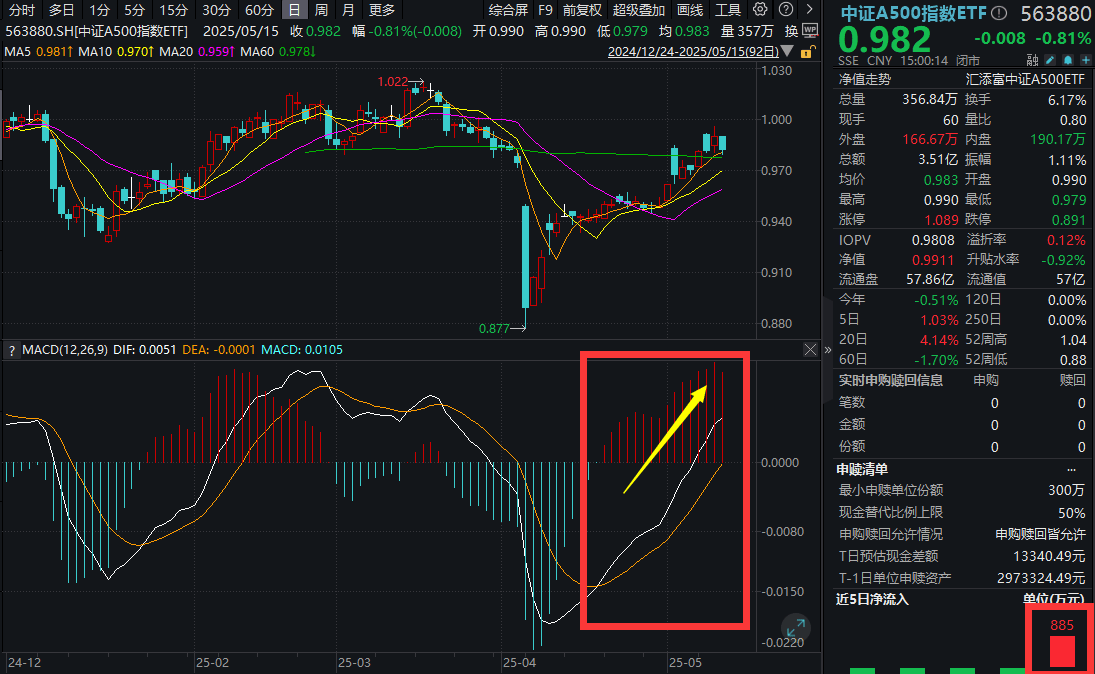
如何看待货币政策的“超常规”调整?
Cai Jing Wang· 2025-05-15 08:02
Monetary Policy - The People's Bank of China (PBOC) announced a series of easing measures including a 0.5 percentage point reduction in the reserve requirement ratio (RRR) starting May 15, which is expected to provide approximately 1 trillion yuan in long-term liquidity to the market [1] - The PBOC also lowered the policy interest rate by 0.1 percentage points, with the 7-day reverse repo rate decreasing from 1.5% to 1.4%, which is anticipated to lead to a similar decline in the Loan Prime Rate (LPR) [2] - Specific interest rates were reduced more significantly, such as the first home loan rate for five years or more dropping from 2.85% to 2.6%, and the rate for structural monetary policy tools decreasing from 1.75% to 1.5% [2] Structural Policies - The PBOC increased the re-lending quota for technological innovation and transformation from 500 billion yuan to 800 billion yuan, and established a 500 billion yuan re-lending facility for service consumption and elderly care [3] - An additional 300 billion yuan was allocated for agricultural and small business re-lending, supporting the "two new" and "two重" policies aimed at boosting service demand and promoting high-quality development [3] Capital Market Focus - The current monetary policy has shown a heightened focus on the capital markets, incorporating market volatility into policy considerations to stabilize both the stock and real estate markets [4] - The PBOC and the China Securities Regulatory Commission (CSRC) discussed the role of state-owned entities in stabilizing the stock market through policy tools in April, indicating future actions will be more significant [4] - New structural policies include optimizing support for the capital market with a combined quota of 800 billion yuan for securities fund insurance company swaps and stock repurchase re-lending [4] Economic Context - The announced policies are a response to external pressures and aim to stabilize market expectations following a 5.4% growth in the first quarter, which exceeded expectations [5] - The measures are designed to prepare for potential negative impacts from ongoing external shocks, particularly related to U.S.-China trade tensions, while focusing on maintaining stable growth [5][6]
一揽子金融政策超预期落地 适度宽松货币政策有力有效
Jin Rong Shi Bao· 2025-05-14 10:03
4月25日中央政治局会议指出,我国经济持续回升向好的基础还需要进一步稳固,要强化底线思维,加 紧实施更加积极有为的宏观政策。金融部门快速响应中央决策部署,5月7日集中发布了一揽子政策措 施,为支持经济回升向好进一步营造良好的货币金融环境。 总体来看,一揽子金融政策的力度超出市场预期。人民银行去年先后实施了几轮力度较大的货币政策调 整,持续显现支持性货币政策的立场;今年在面临外部冲击的关键时点,又及时推出降准降息、创设并 优化结构性工具等政策组合。 从价格来看,利率水平已经处于历史低位,央行也多次表态,通过强化利率政策的执行和监督,降低银 行负债成本,能够进一步拓宽降息空间,在前期一系列利率工作成效的支撑下,此次降息在调降所有结 构性货币政策工具利率的同时,又再次下调政策利率至1.4%的低位,体现了货币政策稳经济的决心。 从总量来看,本次降准除了针对大型银行和中型银行下调0.5个百分点外,还阶段性将汽车金融公司、 金融租赁公司存款准备金率从5%调降至0%,整体效果看也超过去年的两次降准力度。此外,央行还下 调了再贷款利率和部分机构的准备金率,也被视为结构性的举措,同样能起到降息降准的作用,再次印 证货币政策工具 ...
央行再提利率风险,短期长端利率波动或有所加大
China Post Securities· 2025-05-13 07:31
Monetary Policy Insights - The central bank maintains a moderately loose monetary policy, shifting from "timely adjustments" to "flexible grasp" of policy implementation, indicating a focus on existing monetary policy rather than new incremental policies[2] - The central bank emphasizes interest rate risks, suggesting potential short-term adjustments in both short-term and long-term bond yields, with the 10-year government bond yield currently in the 1.6%-1.65% range[3] - The central bank's focus on the health of commercial banks may lead to a downward trend in deposit rates, as the net interest margin continues to narrow, impacting the stability of the banking system[4] Credit and Financing - There is an intention to increase credit supply to lower overall financing costs, with a shift towards total credit volume as constraints ease, while promoting consumption remains a key focus of monetary policy[4] - The weighted average interest rate for new loans in Q1 was 3.44%, up by 0.16 percentage points from the end of the previous year, indicating a need for improved efficiency in monetary policy transmission[25] - The report highlights a transition in real estate policy towards optimizing existing policies, particularly focusing on expanding financing support for affordable housing[26] Inflation and Demand - Effective demand improvement is crucial for stabilizing inflation, with fiscal policy expected to be more effective than monetary policy in this context, as current demand remains insufficient[28] - The report notes that the growth rate of social financing and broad money supply (M2) is maintained at 7%-8%, while the CPI growth rate is below 1%, indicating limited effectiveness of monetary policy in stimulating demand[28] Risk Factors - Risks include escalating geopolitical conflicts, unexpected financial crises abroad, and potential adjustments in long-term interest rates[5]
金融支持稳市场稳预期的“势能”更充足更有力
Guo Ji Jin Rong Bao· 2025-05-12 06:19
Core Viewpoint - The press conference held by the State Council's Information Office emphasized a comprehensive financial policy package aimed at stabilizing market expectations and addressing the complex domestic and international economic landscape [1] Monetary Policy Measures - The central bank announced ten monetary policy measures, including a 0.5 percentage point reduction in the reserve requirement ratio (RRR), releasing approximately 1 trillion yuan in long-term liquidity [2] - The policy interest rate was lowered by 0.1 percentage points, with the 7-day reverse repurchase rate decreasing from 1.5% to 1.4%, expected to lead to a similar decline in the Loan Prime Rate (LPR) [2] - Structural adjustments included a 0.25 percentage point reduction in various special tool interest rates to 1.5% and an increase in the re-lending quota for technological innovation by 300 billion yuan to 800 billion yuan [2] Support for Key Sectors - The policy aims to enhance support for agriculture and small enterprises by increasing the re-lending quota by 300 billion yuan, coupled with interest rate reductions to stimulate demand [3] - The personal housing provident fund loan interest rate was reduced by 0.25 percentage points, lowering the first home loan rate from 2.85% to 2.6%, which is expected to stabilize the real estate market [3] Market Impact - The measures are expected to optimize liquidity and funding costs, enhancing financial support for market stability and reducing the debt burden for enterprises and residents [4] - The emphasis on "counter-cyclical adjustment" and "moderately loose monetary policy" is likely to boost market confidence and stabilize expectations for economic recovery [4][5] Structural Support and Capital Market - The targeted support for sectors such as technological innovation and inclusive finance is anticipated to create market hotspots and improve confidence in the capital market [5] - The capital market is expected to maintain active trading, with the Shanghai Composite Index stabilizing around 3300 points, potentially attracting new capital into the market [6]