实体经济

Search documents
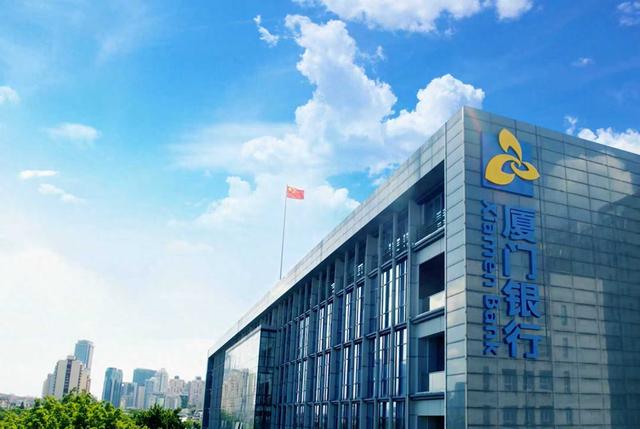
厦门银行2025年半年报:对公贷款提质增量 赋能实体经济向好发展
Huan Qiu Wang· 2025-09-01 03:51
Core Viewpoint - Xiamen Bank has demonstrated strong operational resilience and steady growth in its business scale and profitability in the first half of 2025, despite a complex market environment [1][3][10] Financial Performance - As of June 30, 2025, total assets reached CNY 4340.01 billion, a 6.43% increase from the end of the previous year [3] - Total loans and advances amounted to CNY 2209.14 billion, up 7.52% year-on-year [3] - Total deposits reached CNY 2299.01 billion, reflecting a 7.35% increase from the previous year [3] - Operating income for the first half of 2025 was CNY 26.89 billion, with Q2 income of CNY 14.75 billion, a quarter-on-quarter increase of 21.45% [3] - Net profit attributable to shareholders was CNY 11.58 billion, with net interest income of CNY 19.92 billion [3] - The net interest margin improved by 4 basis points compared to Q1, with a year-on-year decline in net interest income narrowing to -0.47% [3] Asset Quality - The non-performing loan ratio stood at 0.83%, maintaining a favorable level among A-share listed banks [4] - The corporate loan non-performing rate remained stable at 0.55%, with a provision coverage ratio of 321.67% [4] Dividend Policy - The bank has maintained a stable and sustainable dividend policy, with a cash dividend rate of 32.62% for the first time in 2024, the highest since its listing [4] Business Strategy - Xiamen Bank has focused on high-quality development strategies, enhancing customer interaction through differentiated services, resulting in a 7.83% increase in strategic customers [5] - Corporate deposits (excluding margin deposits) reached CNY 1286.91 billion, a 4.79% increase from the previous year [5] - The average interest rate on corporate deposits decreased by 38 basis points compared to the previous year, reinforcing funding cost advantages [5] Support for Small and Micro Enterprises - The bank has implemented mechanisms to support small and micro enterprises, with a balance of re-loans for agriculture and small businesses exceeding CNY 12 billion [6] - Green credit balance reached CNY 169.36 billion, a 29.58% increase year-on-year, with the issuance of CNY 30 billion in green bonds [6] Cross-Strait Financial Cooperation - Xiamen Bank has enhanced its financial services for Taiwanese enterprises, with a 51% increase in loans to Taiwanese companies compared to the previous year [7] - The number of Taiwanese clients and credit accounts grew by 7%, with Taiwanese clients holding 1.42 times the average deposits of all corporate clients [7][8] Future Outlook - The bank aims to continue leveraging its regional advantages and deepen cross-strait financial cooperation to contribute to local economic development and cross-strait integration [10]

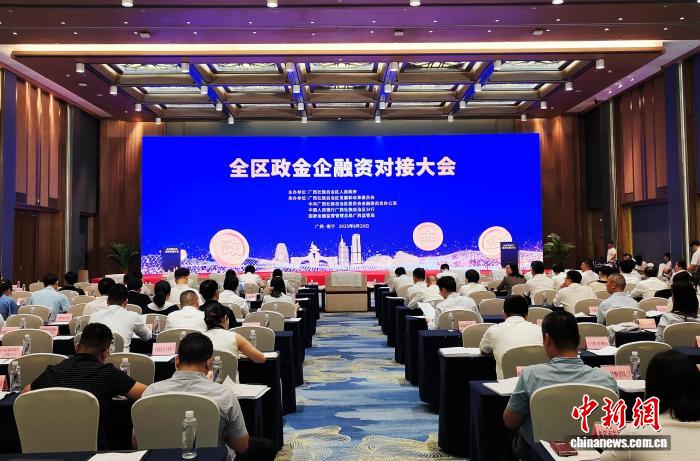
广西举行政金企融资对接大会 优化升级金融惠企政策
Zhong Guo Xin Wen Wang· 2025-08-30 00:39
Core Viewpoint - The Guangxi government is enhancing financial services for the real economy by facilitating private capital investment and improving credit demand to promote a healthy economic and financial cycle [1][3]. Group 1: Financing Initiatives - The Guangxi government held a financing matchmaking conference where 22 key project credit agreements were signed, amounting to 91.9 billion RMB, covering strategic emerging industries such as new energy, artificial intelligence, low-altitude economy, and advanced manufacturing [3]. - A mechanism was announced to promote projects to private capital and coordinate service guarantees, aimed at improving the financing accessibility for private enterprises [3]. Group 2: Policy and Support Measures - The conference included policy interpretations regarding the three-year action plan for financial benefits to enterprises, as well as updates on the financing matchmaking mechanism in the region [3]. - The Guangxi government plans to optimize financial policies, enhance the connection between financial policies and other sectors like technology, industry, and taxation, and improve financial services for major projects and key industries [3]. Group 3: Focus on Small and Micro Enterprises - There is an emphasis on increasing financial supply in weak areas and coordinating financing efforts for small and micro enterprises, with a goal to direct credit funds quickly to these market entities [3]. - The government aims to cultivate a multi-tiered capital market and promote direct financing for enterprises, utilizing various industrial investment funds to further broaden financing channels [3].
中信银行:上半年实现归属于本行股东的净利润364.78亿元,同比增长2.78%
Cai Jing Wang· 2025-08-28 01:33
Core Insights - CITIC Bank reported a net profit attributable to shareholders of 36.478 billion yuan for the first half of 2025, representing a year-on-year increase of 2.78% [1] - The bank's total operating income reached 105.762 billion yuan, with net interest income of 71.201 billion yuan and non-interest income of 34.561 billion yuan [1] - The asset quality remains stable, with a non-performing loan balance of 67.134 billion yuan and a non-performing loan ratio of 1.16%, unchanged from the end of the previous year [1] Financial Performance - The net profit for the second quarter increased by 4.11% year-on-year, showing an improvement of 2.45 percentage points compared to the first quarter [1] - The total assets of the bank reached 9,858.466 billion yuan, growing by 3.42% compared to the end of the previous year [1] - Total loans and advances (excluding accrued interest) amounted to 58,019.00 billion yuan, reflecting a growth of 1.43% from the end of the previous year [1] Risk Management - The provision coverage ratio stood at 207.53%, which is an increase of 0.42 percentage points from the end of the first quarter [1] - The bank continues to support the real economy, with good growth in key areas such as green credit, strategic emerging industries, and inclusive finance [1] - Customer deposits (excluding accrued interest) totaled 61,069.07 billion yuan, marking a growth of 5.69% from the end of the previous year [1]

沪铜产业日报-20250827
Rui Da Qi Huo· 2025-08-27 08:56
Report Summary 1. Report Industry Investment Rating No information provided. 2. Core Viewpoints - The main contract of Shanghai copper shows a volatile trend, with a decrease in open interest, a premium in the spot market, and a weakening basis. The copper concentrate TC spot index has rebounded but remains in the negative range, and the firmness of copper mines still supports copper prices. [2] - On the supply side, the copper concentrate at ports continues to decline, and the demand of domestic smelters has increased. It is expected that the domestic refined copper supply may increase slightly. [2] - On the demand side, due to the continued impact of the off - season, downstream consumption remains weak. However, as the peak season approaches, downstream may have some pre - stocking demand, so the overall demand is expected to gradually improve. [2] - Overall, the fundamentals of Shanghai copper may show a slight increase in supply, stable but improving demand, and industry inventories remain in the medium - low range. [2] - In the options market, the call - put ratio of at - the - money options is 1.27, with a month - on - month decrease of 0.0012. The market sentiment is bullish, and the implied volatility has slightly decreased. [2] - Technically, on the 60 - minute MACD chart, the double lines are above the 0 - axis, and the green bars are expanding. The operation suggestion is to go long on dips with a light position, paying attention to controlling the rhythm and trading risks. [2] 3. Summary by Relevant Catalogs 3.1 Futures Market - The closing price of the main futures contract of Shanghai copper is 79,190 yuan/ton, unchanged; the LME 3 - month copper price is 9,789.50 dollars/ton, down 47.50 dollars. [2] - The spread between the main contract and the next - month contract is 0 yuan/ton, down 10 yuan; the open interest of the main contract of Shanghai copper is 174,997 lots, down 491 lots. [2] - The net position of the top 20 futures holders of Shanghai copper is - 12,244 lots, down 1,967 lots; the LME copper inventory is 155,000 tons, down 975 tons. [2] - The inventory of cathode copper in the Shanghai Futures Exchange is 81,698 tons (weekly), down 4,663 tons; the LME copper cancelled warrants are 13,250 tons, up 1,500 tons. [2] - The warehouse receipts of cathode copper in the Shanghai Futures Exchange are 21,287 tons, down 2,856 tons. [2] 3.2 Spot Market - The SMM 1 copper spot price is 79,545 yuan/ton, down 40 yuan; the Yangtze River Non - ferrous Market 1 copper spot price is 79,585 yuan/ton, down 100 yuan. [2] - The CIF (bill of lading) price of Shanghai electrolytic copper is 60 dollars/ton, unchanged; the average premium of Yangshan copper is 55 dollars/ton, unchanged. [2] - The basis of the CU main contract is 355 yuan/ton, down 40 yuan; the LME copper cash - to - 3 - month spread is - 84.82 dollars/ton, down 6.44 dollars. [2] 3.3 Upstream Situation - The import volume of copper ore and concentrates is 256.01 million tons (monthly), up 21.05 million tons; the rough smelting fee (TC) of domestic copper smelters is - 41.15 dollars/kiloton (weekly), down 3.47 dollars. [2] - The price of copper concentrate in Jiangxi is 69,880 yuan/metal ton, down 110 yuan; the price of copper concentrate in Yunnan is 70,580 yuan/metal ton, down 110 yuan. [2] - The processing fee of blister copper in the south is 800 yuan/ton (weekly), down 100 yuan; the processing fee of blister copper in the north is 750 yuan/ton, unchanged. [2] - The output of refined copper is 127 million tons (monthly), down 3.20 million tons; the import volume of unwrought copper and copper products is 480,000 tons, up 20,000 tons. [2] 3.4 Industry Situation - The social inventory of copper is 41.82 million tons (weekly), up 0.43 million tons; the price of 1 bright copper wire scrap in Shanghai is 55,690 yuan/ton, up 100 yuan. [2] - The ex - factory price of 98% sulfuric acid of Jiangxi Copper is 640 yuan/ton, unchanged; the price of 2 copper scrap (94 - 96%) in Shanghai is 68,350 yuan/ton, up 150 yuan. [2] 3.5 Downstream and Application - The output of copper products is 216.94 million tons (monthly), down 4.51 million tons; the cumulative completed investment in power grid infrastructure is 331.5 billion yuan (monthly), up 40.434 billion yuan. [2] - The cumulative completed investment in real estate development is 5,357.977 billion yuan (monthly), up 692.221 billion yuan; the monthly output of integrated circuits is 4,689,220,700 pieces, up 183,435,300 pieces. [2] 3.6 Option Situation - The 20 - day historical volatility of Shanghai copper is 8.10%, down 0.01%; the 40 - day historical volatility of Shanghai copper is 9.29%, down 0.00%. [2] - The implied volatility of at - the - money options in the current month is 9.23%, down 0.0127%; the call - put ratio of at - the - money options is down 0.0012. [2] 3.7 Industry News - The 13th plenary session of the 14th Standing Committee of the National Committee of the Chinese People's Political Consultative Conference was held. It is necessary to place the development of new - quality productivity according to local conditions in a more prominent strategic position, promote the in - depth integration of the digital economy and the real economy, and accelerate the process of industrial intelligent development. [2] - Premier Li Qiang emphasized during the 15th special study of the State Council that it is necessary to actively expand the import of high - quality services, promote the high - quality development of the service industry through high - level opening - up, and promote the institutional opening of service trade. [2] - US President Trump said in a cabinet meeting that he may appoint Stephen Milan to serve on the Federal Reserve Board for a long - term. Trump said that he will soon have a majority on the Federal Reserve. [2] - Trump said that he may visit China this year or as soon as possible. The Ministry of Foreign Affairs responded that head - of - state diplomacy plays an irreplaceable strategic leading role in Sino - US relations, and the two heads of state maintain close exchanges and communication. [2]
瑞达期货碳酸锂产业日报-20250827
Rui Da Qi Huo· 2025-08-27 08:56
Report Summary 1. Industry Investment Rating No investment rating is provided in the report. 2. Core View - The lithium carbonate futures main contract first rose and then fell, closing down 0.23%. The open interest increased month - on - month, the spot was at a premium, and the basis strengthened. - Fundamentally, on the raw material side, lithium ore prices fluctuate sharply with the spot price of lithium carbonate. On the supply side, the previous relatively strong market quickly turned weak as some smelters in Jiangxi resumed production after equipment maintenance. Currently, domestic supply may increase slightly. On the demand side, downstream buyers are more cautious, but the procurement demand has rebounded as lithium prices fall rapidly. Overall, the supply and demand of lithium carbonate are both increasing, and the inventory is still high but decreasing. - In the options market, the put - call ratio of open interest is 75.35%, up 0.0109% month - on - month. The call open interest dominates, and the market sentiment is bullish with a slight decline in implied volatility. - Technically, the 60 - minute MACD shows that the two lines are below the 0 - axis and the red bars are contracting. - The operation suggestion is to short at high levels with a light position and control risks by paying attention to trading rhythm. [2] 3. Summary by Relevant Catalogs 3.1 Futures Market - Main contract closing price: 78,860 yuan/ton, down 160 yuan. - Main contract open interest: 351,322 lots, up 1,826 lots. - Net position of the top 20: - 138,531 lots, up 13,645 lots. - Spread between near and far contracts: 580 yuan/ton, up 20 yuan. - Warehouse receipts on GZEE: 26,690 lots/ton, up 1,060 lots. [2] 3.2 Spot Market - Average price of battery - grade lithium carbonate: 81,600 yuan/ton, down 100 yuan. - Average price of industrial - grade lithium carbonate: 79,300 yuan/ton, down 100 yuan. - Basis of Li₂CO₃ main contract: 2,740 yuan/ton, up 60 yuan. [2] 3.3 Upstream Situation - Average price of spodumene concentrate (6% CIF China): 961 US dollars/ton, unchanged. - Average price of amblygonite: 7,775 yuan/ton, up 40 yuan. - Average price of lepidolite (2 - 2.5%): 2,645 yuan/ton, unchanged. [2] 3.4 Industry Situation - Lithium carbonate production: 44,600 tons, up 500 tons. - Lithium carbonate imports: 13,845.31 tons, down 3,852.31 tons. - Lithium carbonate exports: 366.35 tons, down 63.31 tons. - Lithium carbonate enterprise operating rate: 48%, down 4 percentage points. - Power battery production: 133,800 MWh, up 4,600 MWh. - Price of lithium manganate: 33,000 yuan/ton, unchanged. - Price of lithium hexafluorophosphate: 55,800 yuan/ton, unchanged. - Price of lithium cobalt oxide: 235,000 yuan/ton, unchanged. - Price of ternary material (811 type, China): 147,000 yuan/ton, down 1,500 yuan. - Price of ternary material (622 power type, China): 123,000 yuan/ton, down 1,500 yuan. [2] 3.5 Downstream and Application Situation - Price of ternary material (523 single - crystal type, China): 130,000 yuan/ton, down 1,000 yuan. - Operating rate of ternary cathode materials: 52%, up 1 percentage point. - Price of lithium iron phosphate: 34,300 yuan/ton, unchanged. - Operating rate of lithium iron phosphate cathode: 51%, down 1 percentage point. - New energy vehicle monthly production (CAAM): 1,243,000 vehicles, down 25,000 vehicles. - New energy vehicle monthly sales (CAAM): 1,262,000 vehicles, down 67,000 vehicles. - Cumulative penetration rate of new energy vehicle sales (CAAM): 44.99%, up 0.68 percentage points. - Cumulative new energy vehicle sales and year - on - year increase: 8,220,000 vehicles, up 2,286,000 vehicles. - New energy vehicle monthly exports: 225,000 vehicles, up 20,000 vehicles. - Cumulative new energy vehicle exports and year - on - year increase: 1.308 million vehicles, up 600,000 vehicles. - 20 - day average volatility of the underlying: 52.75%, down 0.03 percentage points. - 40 - day average volatility of the underlying: 56.43%, down 0.07 percentage points. [2] 3.6 Options Situation - Total call open interest: 205,910 contracts, up 4,714 contracts. - Total put open interest: 155,156 contracts, up 3,574 contracts. - Put - call ratio of total open interest: 75.35%, up 0.0109 percentage points. - At - the - money implied volatility: 0.37%, down 0.0168 percentage points. [2] 4. Industry News - The 13th plenary session of the 14th National Committee of the Chinese People's Political Consultative Conference emphasized developing new - quality productive forces, promoting the integration of the digital and real economies, boosting consumption, and enhancing innovation capabilities. - Premier Li Qiang stressed expanding high - quality service imports, promoting institutional opening - up of service trade, and building a unified national market. - He Xiaopeng, Chairman of XPeng Motors, said the elimination stage in China's auto industry will last about five years, and about five domestic enterprises may remain. - The National Energy Administration stated that during the 14th Five - Year Plan period, China built the world's largest EV charging network and the largest and fastest - growing renewable energy system, with the proportion of renewable energy power generation capacity increasing from 40% to about 60%. [2]
瑞达期货铝类产业日报-20250827
Rui Da Qi Huo· 2025-08-27 08:56
Report Summary 1. Investment Rating No investment rating for the industry is provided in the report. 2. Core Views - **Alumina**: The fundamentals may show a situation of both supply and demand growth, with a slight reduction in social inventory and an increase in exchange inventory. It is recommended to trade with a light - position and a weak - oscillating strategy [2]. - **Electrolytic Aluminum**: The fundamentals may be in a situation of a slight increase in supply, temporarily weak but expected to recover demand, and a slight accumulation of industrial inventory. It is recommended to trade with a light - position and an oscillating strategy [2]. - **Cast Aluminum Alloy**: The fundamentals may be in a stage of a slight reduction in supply and weak demand. It is recommended to trade with a light - position and sell on rallies strategy [2]. 3. Summary by Catalog 3.1 Futures Market - **Prices and Spreads**: The closing price of the Shanghai Aluminum main contract is 20,810 yuan/ton, up 95 yuan; the closing price of the Alumina futures main contract is 3,046 yuan/ton, down 2 yuan. The LME aluminum three - month quotation is 2,638.50 US dollars/ton, up 16.50 US dollars [2]. - **Inventory**: LME aluminum inventory is 478,075 tons, down 650 tons; Shanghai Aluminum SHFE inventory is 124,605 tons, up 3,952 tons; Alumina inventory is 103,364 tons, up 14,952 tons [2]. - **Open Interest**: The open interest of the Shanghai Aluminum main contract is 269,866 lots, up 18,457 lots; the open interest of the Alumina main contract is 237,684 lots, up 8,959 lots [2]. 3.2 Spot Market - **Prices**: The Shanghai Non - ferrous A00 aluminum price is 20,840 yuan/ton, up 60 yuan; the Alumina spot price in Shanghai Non - ferrous is 3,170 yuan/ton, down 10 yuan [2]. - **Basis**: The basis of Alumina is 124 yuan/ton, up 13 yuan; the basis of electrolytic aluminum is 30 yuan/ton, down 35 yuan [2]. 3.3 Upstream Situation - **Supply**: Alumina production is 756.49 million tons, down 18.44 million tons; the import volume of Alumina is 12.59 million tons, up 2.47 million tons [2]. - **Demand**: The demand for Alumina from electrolytic aluminum plants remains high, especially in the southwest region during the July - August wet season [2]. 3.4 Downstream and Application - **Production**: Aluminum product production is 548.37 million tons, down 39 million tons; automobile production is 251.02 million vehicles, down 29.84 million vehicles [2]. - **Export**: The export volume of unwrought aluminum and aluminum products is 61.89 million tons, up 0.29 million tons [2]. 3.5 Option Situation - **Volatility**: The 20 - day historical volatility of Shanghai Aluminum is 6.02%, up 0.20%; the 40 - day historical volatility is 8.36%, up 0.08% [2]. - **Implied Volatility and Put - Call Ratio**: The implied volatility of the Shanghai Aluminum main contract at - the - money is 8.72%, down 0.0050%; the put - call ratio is 1.09, up 0.0131 [2]. 3.6 Industry News - The 13th Plenary Session of the 14th National Committee of the Chinese People's Political Consultative Conference emphasized the development of new - quality productivity [2]. - Premier Li Qiang stressed the expansion of high - quality service imports and the promotion of high - quality development of the service industry [2]. - Trump may let Stephen Milan serve on the Federal Reserve Board for a long time and may visit China this year [2]

新华保险前7个月保费1378亿元 三大维度诠释高质量发展
Sou Hu Cai Jing· 2025-08-27 07:52
Core Insights - Xinhua Insurance achieved a cumulative original insurance premium income of 137.8 billion yuan in the first seven months of 2025, representing a year-on-year growth of 23%, continuing its steady growth trend this year [1] Group 1: High-Quality Development - The company emphasizes high-quality development as the core driving force, integrating into the national development strategy and focusing on customer-centric, professional, market-oriented, and systematic reforms [1] - Xinhua Insurance has enriched its product offerings with over 100 products available, focusing on the second and third pillar business opportunities, particularly in the aging economy [2] - The company aims to enhance customer satisfaction through improved claims experiences, achieving a total of 2.41 million claims with a payout amount of 7.3 billion yuan in the first half of 2025, with an average claim processing time of just 0.72 days [2] Group 2: Serving National Strategy - Xinhua Insurance supports the real economy with investments exceeding one trillion yuan, aligning its operations with national strategies [3] - The company has provided risk protection for over 30,000 corporate clients, amounting to approximately 14.5 trillion yuan, and has undertaken 20 public welfare insurance projects [3] - Investments in key national areas have increased by nearly 60% year-on-year, focusing on technology innovation, industrial upgrades, and low-carbon development [3] Group 3: Reform and Innovation - The company is committed to deepening its reforms across products, services, teams, and institutional construction to build multiple core advantages [4] - Xinhua Insurance is enhancing its product framework to offer comprehensive insurance coverage and is actively transforming its dividend insurance products to meet customer wealth preservation needs [4] - The company is also upgrading its service capabilities and expanding its service offerings across various domains, including healthcare and legal services [4] Group 4: Industry Outlook - The insurance industry is entering a golden opportunity period for high-quality development, supported by national policies and regulatory guidance [5] - Xinhua Insurance aims to implement the new national guidelines, focusing on large-scale products, markets, services, and investments to enhance its development capabilities [5]

月度美国宏观洞察:关税大致尘埃落定,9月剑指重启降息?-20250826
SPDB International· 2025-08-26 07:05
Trade Policy Insights - The uncertainty surrounding U.S. tariff policies has significantly decreased following agreements with major trading partners like Japan and the EU, with new tariff rates announced on July 31[5] - The new tariff framework categorizes countries into three groups, with tariffs ranging from 10% to over 50%, depending on trade agreements and trade balances with the U.S.[5] - The U.S. Department of Commerce is conducting up to 8 ongoing "Section 232 investigations," which could lead to additional tariffs on sectors like semiconductors and pharmaceuticals[6] Economic Data Overview - The U.S. core CPI inflation rate slightly increased in July, but the impact of tariffs on consumer prices is still emerging, with expectations that the influence will be less than previously anticipated[2] - Non-farm payroll data showed a weaker performance in July, with only 73,000 jobs added, significantly below the market expectation of 104,000[13] - The unemployment rate rose from 4.117% in June to 4.248% in July, indicating potential labor market weakness[13] Monetary Policy Outlook - The Federal Reserve is expected to restart interest rate cuts in September, with predictions of two additional 25 basis point cuts by the end of the year[3] - The potential for a 50 basis point rate cut is being considered, influenced by recent economic data trends[3] Currency and Market Predictions - The U.S. dollar index is projected to continue depreciating, with a year-end target of 95, reflecting concerns over economic momentum and labor market data[37] - The dollar index fell by 2.3% from the end of July to August 22, with significant declines against the euro, yen, and pound[36]
并购贷款政策十年大修,科技、房地产等领域并购活动有望率先受益
Hua Xia Shi Bao· 2025-08-22 08:40
Core Viewpoint - The National Financial Regulatory Administration has released a draft for the "Management Measures for Mergers and Acquisitions Loans by Commercial Banks," marking a significant revision of the previous guidelines from 2015, aimed at enhancing the merger and acquisition market and supporting the real economy, particularly in technology innovation [2][3]. Summary by Relevant Sections Loan Policy Changes - The new measures increase the loan-to-value ratio for mergers and acquisitions, extending the maximum loan term and introducing "equity-type acquisition loans," thereby broadening the funding channels for mergers and acquisitions [2][4]. - The maximum loan proportion for controlling mergers has been raised from 60% to 70%, while the maximum for equity-type loans is set at 60% [5][6]. Risk Management and Assessment - The measures emphasize the assessment of the acquirer's repayment ability, considering the risks associated with the merger and the future development prospects of the acquired company [5][6]. - The new regulations require banks to have a good regulatory rating and meet specific asset size requirements to engage in these loan types, with a minimum asset balance of 50 billion RMB for controlling loans and 100 billion RMB for equity-type loans [4][5]. Impact on Industries - The technology sector, advanced manufacturing, real estate, and green industries are expected to benefit significantly from these changes, as the increased loan limits will alleviate funding pressures for companies seeking to acquire key technologies and resources [7][8]. - The extended loan terms are particularly advantageous for manufacturing firms undergoing transformation, allowing for better long-term investment returns and easing short-term repayment pressures [7][8]. Regulatory Environment - The draft reflects a differentiated regulatory approach, where smaller banks may face challenges in meeting the risk management requirements necessary for engaging in equity-type acquisition loans [9].

「经济发展」李扬:金融要想好 实体经济必须好
Sou Hu Cai Jing· 2025-08-21 14:26
Economic Development - The development of the asset management industry is crucial for reducing the proportion of indirect financing, as it transforms debt into equity through mechanisms like trusts and asset management [3][4] - The current financial system in China primarily supports indirect financing, with a significant reliance on bank loans, while the need for equity capital remains unmet [4][5] - The asset management sector has seen growth but requires further reform, particularly in legal frameworks, to enhance its role in supporting the real economy [6][8] Capital Market and Financing - The "14th Five-Year Plan" emphasizes improving the capital market's foundational systems and increasing the proportion of direct financing, especially equity financing [4] - As of June 2023, the total stock of RMB loans reached 228.86 trillion, with an increase of 16.43 trillion from December 2022, while A-share equity financing in the first half of 2023 was 587.1 billion, a decrease of 353 billion from the second half of 2022 [4] - Despite efforts to promote direct financing, indirect financing remains dominant in social financing, indicating a need for more effective measures to enhance equity financing [4][5] Global Economic Trends - The global economy is experiencing a slowdown, with the IMF projecting growth rates of 3.0% for 2023 and 2.9% for 2024, indicating potential recessionary conditions [8][9] - Current global inflation poses challenges, with the need for careful monetary policy to avoid exacerbating economic downturns [8][9] - The trend of de-globalization is emerging, impacting global supply chains and economic efficiency, necessitating a reevaluation of economic strategies [9][10] Financial System and Risk Management - The financial system's primary role is to serve the real economy, with a focus on managing risks effectively [12] - The recent depreciation of the RMB against the USD by 4.8% in the first three quarters of the year raises concerns about currency stability and its impact on asset prices [12][13] - Recommendations suggest prioritizing foreign exchange reserves over currency stabilization, emphasizing the importance of maintaining reserves as a more critical factor [13]