
以旧换新政策

Search documents
【周度分析】车市扫描(2025年9月1日-9月7日)
乘联分会· 2025-09-11 08:41
Market Overview - In the first week of September, the national retail sales of passenger cars reached 304,000 units, a year-on-year decrease of 10% and a month-on-month decrease of 4%. Cumulative retail sales for the year reached 15.069 million units, a year-on-year increase of 9% [1][3] - Wholesale of passenger cars in the same period was 307,000 units, down 5% year-on-year but up 9% month-on-month, with cumulative wholesale reaching 18.349 million units, a year-on-year increase of 13% [1][4] New Energy Vehicles - Retail sales of new energy vehicles during the first week of September were 181,000 units, a year-on-year decrease of 3% and a month-on-month decrease of 1%. The penetration rate for new energy vehicles reached 59.6%, with cumulative retail sales for the year at 7.752 million units, a year-on-year increase of 25% [1][3] - Wholesale of new energy vehicles was 179,000 units, a year-on-year increase of 5% and a month-on-month increase of 12%, with a cumulative wholesale of 9.122 million units, a year-on-year increase of 33% [1][3] Market Dynamics - The market is experiencing a shift with local subsidy policies favoring high-priced models, which is detrimental to the development of entry-level vehicles and the penetration of cars in smaller towns [4] - The introduction of new models at the Chengdu Auto Show has highlighted a mismatch between supply and demand, particularly for high-end models, while the lack of popular entry-level models has resulted in lower-than-expected contributions from new products [3][4] Price Trends and Promotions - The car market is seeing a rational return to promotions and price reductions, with a total of 129 new models experiencing price cuts from January to August 2025. The average price reduction for new energy vehicles was 21,000 yuan, with a reduction rate of 10.9% [8][9] - The average price of passenger cars in August 2025 was 169,000 yuan, a decrease of 700 yuan from 2024, indicating a trend of declining prices in the new energy vehicle segment [10][11] Company Performance - In the first half of 2025, some domestic and international automotive companies reported revenue growth exceeding 11%, but net profits declined. Domestic new energy vehicle companies saw a growth rate of 25%, while traditional companies showed zero growth [12][13] - The gross profit margin for the automotive industry in 2025 was around 15%, with domestic private companies maintaining a higher margin compared to state-owned and international companies [13][14]


家电行业2025年中报总结:家电收入利润延续增长,关税扰动逐渐明晰
Shenwan Hongyuan Securities· 2025-09-11 05:44
Investment Rating - The report maintains a positive outlook on the home appliance industry, indicating a "Look Forward" investment rating for 2025 [3][5]. Core Insights - The home appliance industry experienced a year-on-year revenue growth of 7.34% in Q2 2025, with total revenue reaching 482.5 billion yuan [4][19]. - The net profit for the industry in Q2 2025 was 37.41 billion yuan, reflecting a year-on-year increase of 3.14% [4][22]. - The report identifies three main investment themes: 1) White goods benefiting from real estate policy changes and trade-in incentives; 2) Export opportunities driven by large customer orders; 3) Core components seeing increased demand due to the favorable market conditions for white goods [4][6]. Summary by Sections 1. Industry Performance Overview - The home appliance sector underperformed the market, with a decline of 5.3% from April 1 to June 30, 2025, compared to a 1.3% increase in the CSI 300 index [14][18]. 2. Q2 2025 Home Appliance Industry Performance - Revenue growth of 7.34% year-on-year, with total revenue of 482.5 billion yuan [4][19]. - Net profit growth of 3.14% year-on-year, totaling 37.41 billion yuan [4][22]. - The gross margin decreased by 1.36 percentage points to 23.21% [25]. 3. Sub-Industry Performance 3.1 White Goods - Revenue reached 300.21 billion yuan, growing by 5.81% year-on-year [41]. - Net profit was 30.38 billion yuan, with a year-on-year growth of 5.86% [42]. 3.2 Kitchen Appliances - Revenue declined by 8.36% to 7.944 billion yuan, with net profit down 13.80% to 0.813 billion yuan [46]. 3.3 Small Appliances - Revenue increased by 14.10% to 37.23 billion yuan, but net profit fell by 14.68% to 2.599 billion yuan [51]. 3.4 Black Goods - Revenue grew by 8.23% to 100.34 billion yuan, with net profit increasing by 13.93% to 1.342 billion yuan [55]. 4. Key Investment Targets - The report recommends investing in leading companies in the white goods sector, such as Hisense, Midea, Haier, and Gree, due to their favorable valuation and growth potential [4][5][6].



Air太贵,Pro更有“性价比”,基础版“能获得中国补贴”--摩根大通点评苹果发布会:喜忧参半
硬AI· 2025-09-10 06:22
Core Viewpoint - Morgan Stanley provides a mixed evaluation of Apple's 2025 fall launch, indicating that the favorable pricing of the iPhone 17 series is offset by the moderate market outlook for the iPhone Air [3][4]. Group 1: iPhone Air Pricing Concerns - The iPhone Air, priced at $999, may face sales challenges due to its high price relative to its features, which are seen as lacking compared to the Pro models [3][6]. - The iPhone Air is described as the "thinnest iPhone ever" but has limited advantages over the Pro versions, leading to expectations of modest sales growth [3][6]. - Historical data suggests that Plus series models typically account for only a small percentage of total iPhone sales, and while the Air may see some incremental sales, it is unlikely to meet optimistic market growth expectations [6]. Group 2: Pro Series Advantages - The iPhone 17 base model maintains a favorable starting price of $799, with storage increased to 256GB, aligning with Chinese subsidy policies, which may support Apple's recovery in that market [3][8]. - The Pro models have seen significant upgrades in features while maintaining competitive pricing, which is expected to drive consumer interest and improve Apple's average selling price and profit margins [9]. - The Pro series is anticipated to be the main driver for improving the product mix, with substantial upgrades in camera systems and overall functionality [9]. Group 3: Trade-In Offers and Accessories - U.S. carriers are offering more generous trade-in incentives for the iPhone 17 series compared to the previous iPhone 16 cycle, which may stimulate consumer upgrade demand [11][12]. - In terms of accessories, while there are notable innovations in products like the Apple Watch and AirPods, their impact on overall investment logic is considered limited, with the primary growth driver expected to come from the iPhone product line [13].


旧经济深蹲 新经济蓄力
Hua Xia Shi Bao· 2025-09-05 21:17
Economic Recovery - The manufacturing PMI for August is at 49.4%, indicating a slight recovery from July, but overall economic growth momentum may have peaked [1] - The economy is expected to show a non-linear characteristic due to increasing uncertainties in the external environment, with a projected GDP growth target of around 5% for the year [1][2] - The market is anticipated to exhibit a dual bull structure in stocks and bonds, driven by nominal GDP growth [1][2] Industrial Production - Industrial production is expected to maintain stability, with a projected year-on-year growth rate of 5.5% for August [3] - The "Two New" policies are supporting domestic industrial demand, while export activities are still providing some support during the US-China tariff exemption period [3][4] - The manufacturing new orders index for August is at 49.5%, indicating a contraction in market demand [4] Consumer Spending - The expected year-on-year growth for social retail sales in August is 3.5%, slightly down from 3.7% in July [5] - The "Eight Provisions" are expected to continue suppressing public consumption, particularly affecting the restaurant and tobacco sectors [6] - The impact of the "old-for-new" policy on consumer spending is diminishing, with a reduction in fiscal support leading to pressure on retail sales [7][8] Investment Demand - Fixed asset investment growth for January to August is projected at 1.1%, with manufacturing investment growth at 5.2% and infrastructure investment at 3.0% [9][10] - The real estate sector continues to experience a decline, with investment down by 12.7% [15] - The overall capital expenditure in the real estate chain is lagging behind economic recovery, indicating a need for policy acceleration [10][14] Export Trends - Export growth for August is expected to be 6.9%, with a potential downtrend approaching due to previous over-importing by the US [17] - The import growth rate is projected at 2.8%, influenced by domestic demand policies and base effects [17] Inflation and Prices - CPI is expected to remain stable, while PPI continues to decline, with August projections at -3.4% year-on-year [18][21] - Consumer goods prices are expected to show limited elasticity, with pork prices stabilizing and oil prices remaining weak [19][21] Employment Situation - The urban unemployment rate for August is projected at 5.3%, with seasonal pressures from recent graduates [22] - Employment policies are being implemented to alleviate youth unemployment, with a focus on creating new job opportunities [22] Financial Data - New social financing for August is expected to be 2.47 trillion yuan, with a year-on-year decrease [23] - M2 growth is projected at 8.7%, reflecting weak credit demand and a shift towards non-bank financial products [25][26]
顺威股份(002676) - 2025年9月4日投资者关系活动记录表
2025-09-04 13:44
Group 1: Company Overview - The company is Guangdong Shunwei Precision Plastic Co., Ltd., with stock code 002676 and abbreviation Shunwei Co. [1] - The company specializes in plastic air conditioning fan blades and automotive parts [3][4]. Group 2: Financial Performance - In the first half of 2025, the revenue from plastic air conditioning fan blades was 967 million CNY, representing a year-on-year growth of 8.94% [3]. - The revenue from automotive parts was 338 million CNY, accounting for 21.34% of total revenue [3]. Group 3: Market Impact and Strategy - The downturn in the domestic real estate sector is expected to have some impact on the fan blade business, but factors like the old-for-new policy, increased demand in overseas emerging markets, and the trend towards smart home air conditioning are providing strong support [2][3]. - The company’s core competitiveness lies in its leading design and technology R&D advantages, complete industrial chain, and management strengths [3]. Group 4: Customer Base and Payment Situation - The main customers for the automotive parts business include overseas Tier 1 suppliers like Magna and Inteva [3]. - The payment situation with downstream customers, primarily well-known domestic and international home appliance and automotive parts companies, is reported to be normal [3]. Group 5: Research and Development - The company has 432 R&D personnel as per the 2024 annual report [3]. - The R&D model for plastic air conditioning fan blades involves meeting specific technical requirements from manufacturers and utilizing advanced computational techniques for optimal design [4].

国联民生证券:8月重卡批发五连涨 全年销量有望超预期
Zhi Tong Cai Jing· 2025-09-03 05:55
Group 1 - The heavy truck wholesale sales in August reached approximately 84,000 units, showing a slight month-on-month decrease of 1% but a year-on-year increase of about 35%, indicating a strong performance in the off-season [1] - Cumulative wholesale sales of heavy trucks from January to August amounted to approximately 708,000 units, reflecting a year-on-year growth of 13% [1] - The domestic terminal sales of heavy trucks in August are expected to grow by about 50% year-on-year, benefiting from the trade-in policy [1] Group 2 - The demand for gas vehicles has rebounded significantly in August, with terminal sales expected to increase by over 15% month-on-month and over 30% year-on-year, returning to positive growth [2] - The penetration rate of gas vehicles increased from less than 22% in July to 26%-27% in August [2] - The terminal sales of electric heavy trucks are expected to exceed 16,000 units in August, representing a year-on-year increase of over 160% [2] Group 3 - Both China National Heavy Duty Truck Group and Weichai Power reported their Q2 revenues, with China National Heavy Duty Truck at 133 billion and Weichai Power at 557 billion, showing a quarter-on-quarter increase of 3% and a decrease of 3% respectively [3] - The net profits for China National Heavy Duty Truck and Weichai Power were 3.6 billion and 29.3 billion respectively, with quarter-on-quarter increases of 15% and 8% [3] - The heavy truck industry is expected to see an upward trend in the second half of 2025, with leading companies likely to benefit significantly [3] Group 4 - The heavy truck industry is anticipated to recover in 2024, with domestic sales remaining stable and overseas markets continuing to grow [4] - The trade-in policy is expected to stimulate demand for terminal replacements, driving domestic sales towards the central level in 2025 [4] - The increase in export and natural gas sales proportions is expected to optimize the profit structure significantly, with profit elasticity likely to exceed sales elasticity [4]


九州通:上半年公司医疗器械业务发展持续向好
Quan Jing Wang· 2025-09-03 04:20
Group 1 - The company held its 2025 semi-annual performance briefing on September 3, highlighting a strong growth in its medical device business, with total sales revenue reaching 19.529 billion yuan, a year-on-year increase of 18.34% [1] - The company benefited from the State Council's policy on promoting large-scale equipment updates and the "old-for-new" consumption scheme, leading to rapid growth in both OTC and medical device sales [1] - The OTC business has established strategic partnerships with well-known brands such as Yuyue, Omron, Sanofi, and Durex, leveraging a comprehensive online and offline channel network [1] Group 2 - In the medical device sector, the company focuses on major surgical, vascular intervention, orthopedics, IVD, nursing consumables, and other high-value consumables, collaborating with over 60% of the world's top 100 multinational companies and over 80% of domestic top 100 industrial enterprises [2] - The medical device sales revenue reached 3.64 billion yuan in the first half of the year, reflecting a year-on-year growth of 41% due to the "old-for-new" policy [2] - The company has signed contracts for 23 SPD projects in the first half of the year, with a cumulative total of 132 SPD projects awarded [2]

港股异动 | 天能动力(00819)午后跌超4% 贸易业务规模收缩拖累上半年营收 铅酸电池毛利率有所改善
智通财经网· 2025-09-02 06:25
Core Viewpoint - TianNeng Power (00819) reported a significant decline in mid-term performance, with revenue dropping by 51.53% year-on-year to 24.192 billion RMB and net profit attributable to shareholders decreasing by 11.68% to 820 million RMB, which fell below market expectations [1][1][1] Financial Performance - Revenue for the first half of the year was 24.192 billion RMB, a decrease of 51.53% compared to the previous year [1] - Net profit attributable to shareholders was 820 million RMB, down 11.68% year-on-year [1] Market Dynamics - The decline in revenue was attributed to a contraction in trade business scale and a significant drop in demand in the aftermarket due to macroeconomic conditions and reduced government subsidies [1][1] - The new national standards and the trade-in policy stimulated demand in the two-wheeler front-loading market, leading to good growth in front-loading market shipments [1][1] - However, the aftermarket experienced weak demand, influenced by macroeconomic conditions and the trade-in policy, resulting in a year-on-year decline in aftermarket shipments [1][1] Cost and Margin Analysis - The fluctuation in lead prices compared to the same period last year significantly narrowed, which improved the gross margin of lead-acid batteries [1] - The company's lithium battery business saw high revenue growth, but the decrease in non-operating income and interest income negatively impacted overall performance [1][1]
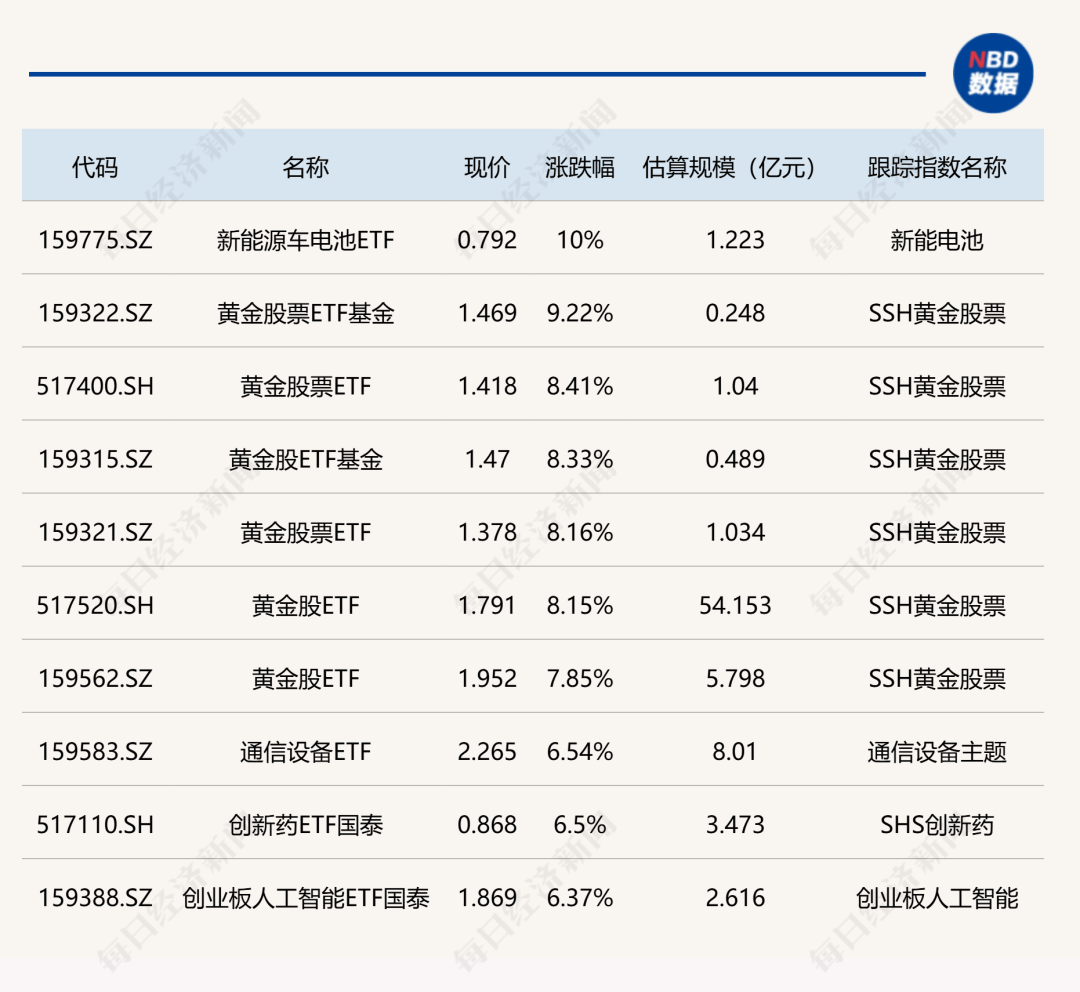
ETF市场风云:新能源车电池ETF强势涨停,黄金ETF领涨超8%
Sou Hu Cai Jing· 2025-09-01 15:48
Market Overview - The market is showing a mixed trend, with the ChiNext Index performing well and leading the upward trend, while the Shanghai Composite Index remains in a narrow fluctuation [1] - Gold concept stocks have seen significant increases, while the large financial sector is experiencing collective adjustments, with insurance stocks leading the market decline [1] ETF Performance - The New Energy Vehicle Battery ETF has performed exceptionally well, closing at a limit-up, reflecting strong investor interest in the new energy vehicle supply chain [1] - Gold-related ETFs have also shown significant gains, with most rising over 8%, driven by expectations of potential interest rate cuts by the Federal Reserve [2] - The New Energy Vehicle Battery ETF has a closing premium rate of 11.24%, indicating a high premium risk in the secondary market [1] Sector Analysis - The technology sector, represented by the Nasdaq Technology ETF, has seen a decline of over 2%, indicating pressure on this sector [3] - Despite the decline in Hong Kong automotive-related ETFs, brokerages remain optimistic about the automotive sector's future, anticipating strong sales driven by vehicle replacement policies in 2024 and 2025 [3]
国信证券发布爱玛科技研报,2025年上半年利润同比提升,产品及渠道拓展促进增长
Sou Hu Cai Jing· 2025-09-01 09:38
Group 1 - The core viewpoint of the report is that Guosen Securities maintains an "outperform" rating for Aima Technology (603529.SH) based on several positive factors [1] - The company is expected to benefit from policies such as trade-in programs, leading to rapid growth in revenue and profit in the first half of 2025 [1] - The combination of trade-in policies and alleviation of price wars in 2025 is anticipated to improve profitability [1] Group 2 - Aima Technology is developing segmented product lines to better meet diverse customer needs [1] - The company is actively expanding the number of terminal channels [1] - There are ongoing optimizations and upgrades to terminal stores, which are expected to continuously enhance store efficiency [1] Group 3 - The electric tricycle market in China presents significant growth potential, which could become a new growth point for the company [1]
