
经济增长

Search documents
拉加德:欧央行利率水平处于良好位置 通胀风险范围已明显收窄
智通财经网· 2025-11-28 23:25
Group 1 - The European Central Bank (ECB) President Christine Lagarde stated that the current borrowing costs in the Eurozone are at an appropriate level, and the central bank's policy is well-positioned to ensure inflation remains under control [1] - Lagarde expressed satisfaction with the current economic and inflation trends, noting that consumer price growth is nearing the 2% target, and most policymakers expect no interest rate adjustments in December [1] - There are discussions within the ECB regarding potential inflation risks, particularly if U.S. tariffs increase or global supply chains are disrupted, despite a general consensus that current policies are sufficient to handle shocks [1] Group 2 - Lagarde expressed optimism about Eurozone economic growth, stating that the expansion is exceeding expectations, with forecasts of growth at 0.9% by early 2025 and potentially rising to 1.2% by September [2] - Despite challenges in Germany's economy and political tensions in France due to budget issues, Lagarde maintained a positive outlook, emphasizing the need for quick action and optimism in a transforming world [2]
2025年第二季度阿尔及利亚经济增长3.9%
Shang Wu Bu Wang Zhan· 2025-11-28 16:25
Economic Growth - Algeria's economy is projected to grow by 3.9% in Q2 2025, slightly above the same period last year [1] - The non-hydrocarbon sector is becoming the true engine of economic growth, with a growth rate of 5.3% [1] - Manufacturing is recovering with a growth of 6.4%, while trade has increased by 6.7% [1] - Agriculture, despite unstable production, has grown by 4.5% and remains a pillar of the economy [1] - The electricity and gas sector has seen a significant growth of 9.7% due to increased capacity and demand [1] - The hydrocarbon sector experienced a slight decline of 1.2% in production [1] Domestic Demand and Investment - Domestic demand and investment have become the new drivers of economic growth, with domestic demand increasing by 10.2%, up from 6.8% in the same period last year [1] - Investment has risen significantly by 12.4% [1] - Government spending has increased by 3.1%, higher than the 2.3% growth in the previous year [1] - Household consumption has slightly decreased by 3.9%, but the decline is less than the previous year's drop of 4.1% [1] Inflation and Consumer Behavior - Inflation has significantly slowed down to 1.1%, down from 4.1% in the same period last year [2] - Food prices have decreased by 1.4%, largely due to a drop in vegetable prices, although some food items like chicken and fruits have seen price increases of 19% and 21.6% respectively [2] - The overall price of processed foods has decreased by 0.7%, while children's clothing and school supplies have seen declines of 1.6% and 7.7% respectively [2] - The data indicates a diversification of the economy, but consumer spending growth is slowing, reflecting more cautious household consumption habits [2]
无惧关税影响,印度三季度经济增长8.2%超预期
Hua Er Jie Jian Wen· 2025-11-28 13:02
印度经济在美国高额关税的阴影下展现出超预期韧性。 数据公布后,印度10年期国债收益率上涨4个基点至6.50%。不过多位专家警告,随着与美国的贸易谈 判悬而未决以及节日消费刺激效应减退,经济增长势头可能在未来几个季度放缓。 制造业和服务业驱动增长 数据显示,除消费外,强劲的经济表现主要由制造业部门主导,该部门同比增长9.1%。政府发布的声 明称,金融、房地产和专业服务在7月至9月期间"保持了可观的增长率",达到10.2%。 印度名义GDP——未剔除通胀或通缩因素——在9月当季增长8.7%,略低于前一季度的8.8%。上一季度 7.8%的实际增速曾因较低的平减指数而意外提振,平减指数衡量通胀如何影响总产出价值。 私人消费在本季度出现显著跳升,这主要归功于政府的刺激措施。据Axis Bank首席经济学家Neelkanth Mishra表示,9月季度的国内消费在商品服务税计划削减前"有所抑制",为后续反弹蓄积了动能。 10月份需求急剧回升,汽车和黄金销售创下纪录,商品服务税削减和此前个人所得税税率下调提升了民 众可支配收入。 面对美国8月生效的50%关税冲击,印度政府迅速推出应对措施。政府于9月22日宣布全面削减商品服 ...
东京核心通胀超预期,日本离加息再近一步
Hua Er Jie Jian Wen· 2025-11-28 03:46
Core Inflation and Economic Indicators - Tokyo's core CPI rose by 2.8% year-on-year in November, slightly above the market expectation of 2.7%, primarily driven by rising electricity prices, offsetting the slowdown in processed food price increases [1] - The industrial output in October unexpectedly increased by 1.4%, mainly due to strong automobile production, exceeding market expectations [1][3] - The unemployment rate remained stable at 2.6% in October, with a job-to-applicant ratio of 1.18, indicating a tight labor market [2] Inflation Drivers - The overall inflation in Tokyo remains sticky, largely driven by food costs, with rice prices soaring by 38.5%, and coffee beans and chocolate prices increasing by 63.4% and 32.5% respectively [2] - The number of price-increased items from major food companies in Japan is expected to reach 20,609 this year, a 64.6% increase from the previous year, indicating companies are passing on rising costs to consumers [2] Manufacturing Outlook - Despite the positive industrial output data, manufacturers expect a decline in production by 1.2% and 2.0% in November and December respectively, suggesting potential external demand shocks in the coming months [3] Interest Rate Hike Speculation - The recent economic data may bolster the Bank of Japan's confidence in the economic outlook, fueling speculation of a possible interest rate hike as early as December [4] - Analysts believe the window for an interest rate hike is approaching, with expectations of a tightening cycle resuming in the coming months [5] Yen's Role in Policy Decisions - The ongoing weakness of the yen is a critical variable influencing the policy shift, with warnings from Bank of Japan officials about the risks of delaying rate hikes [6] - The Japanese government has introduced a fiscal stimulus plan to alleviate living costs, complicating the timing of the central bank's decisions [6]
贸易协议没救?IMF下调印度明年GDP预测
Sou Hu Cai Jing· 2025-11-28 02:52
Core Insights - The International Monetary Fund (IMF) has revised India's economic growth outlook downwards, indicating a cautious stance due to ongoing trade tensions with the United States [1][3] - Despite the Indian government's emphasis on a forthcoming trade agreement aimed at reducing tariffs, the IMF remains skeptical about the short-term alleviation of high tariffs imposed by the U.S. [1][3] Economic Growth Forecast - The IMF projects India's economic growth rate for the fiscal year starting April next year to be 6.2%, a decrease from the previous forecast of 6.4% made in July [3] - For the current fiscal year, the IMF maintains a growth forecast of 6.6%, reflecting better-than-expected economic performance from April to June and positive effects from the Goods and Services Tax reform [3] - The sustainability of this economic resilience is uncertain, raising questions about how long it can last [3] Trade and Tariff Implications - High tariffs imposed by the U.S. on Indian goods are identified as a major uncertainty for the upcoming year [3] - The outcome of ongoing trade negotiations between India and the U.S. remains uncertain, with significant variables that could affect the removal of these trade barriers [3] - Overall, while India's growth has not stalled, the outlook has become less optimistic [3]

英国预算案“画饼”2029?市场不买账,国债英镑齐回吐
Zhi Tong Cai Jing· 2025-11-27 13:13
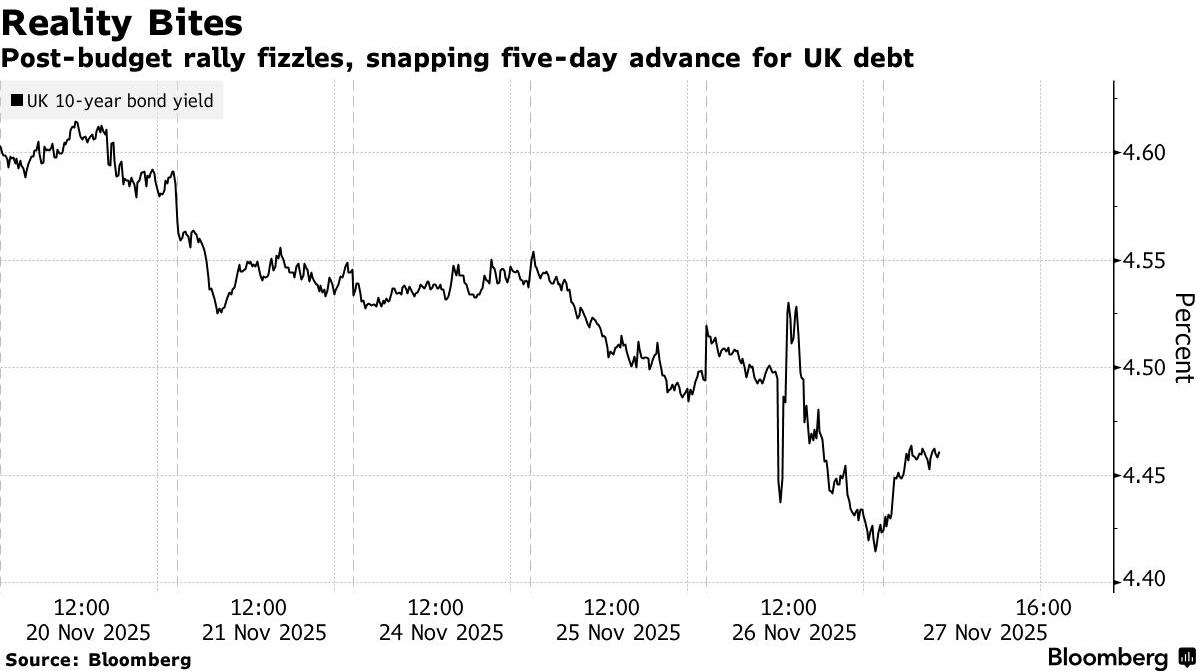
Group 1 - The UK government bond and pound have reversed gains following the budget announcement, with the 10-year bond yield rising to 4.46% and the pound dropping 0.2% against the dollar to 1.3221 [1][5] - The budget plan includes a tax increase of £26 billion (approximately $34 billion) that will not take effect until 2029/30, raising concerns among market participants about the lack of immediate revenue impact [4] - Business leaders from various sectors, including hotels, insurance, and banking, criticized the budget for failing to lay a foundation for economic growth, with some suggesting it is a "spending tomorrow's money" budget [4] Group 2 - Despite the challenges, UK bonds and the pound have seen cumulative gains this week, with traders focusing on the potential for a Bank of England rate cut next month, with a nearly 90% probability of a 25 basis point cut in December [5] - The Resolution Foundation, a prominent fiscal think tank, stated that the budget does not adequately repair the UK's public finances, indicating that further budget tightening is necessary [5] - The UK Debt Management Office plans to reduce long-term bond issuance in the current fiscal year, which may lead to decreased supply in the coming months [5]
“寅吃卯粮”式预算?英国财相加税260亿 遭商界领袖集体吐槽
智通财经网· 2025-11-27 11:45
Group 1: Taxation and Economic Impact - The UK Chancellor Rachel Reeves plans to raise £26 billion ($34 billion) in taxes to strengthen the national finances, which has faced collective criticism from CEOs of major UK companies [1] - Business leaders from various sectors, including hotels, insurance, and banking, argue that the budget fails to lay a foundation for economic growth, with some describing it as a "living off borrowed time" budget [1][2] - The increase in business tax rates is expected to force companies to slow down investments in the UK and reduce planned hiring [1][3] Group 2: Industry-Specific Concerns - Butlin's CEO Jon Hendry Pickup criticized the rising business tax rates, stating it would impact their investment and hiring plans, and expressed concern that the burden is not shared equally [1][2] - Peel Hunt Ltd. CEO Steven Fine expressed disappointment over the lack of bold measures in the budget, calling it a series of small-scale initiatives that do not benefit long-term economic development [2] - Phoenix Group Holdings Plc CEO Andy Briggs raised concerns about new limits on salary sacrifice for workplace pensions, suggesting it could discourage pension contributions [2] Group 3: Sector Reactions - Young & Co.'s Brewery Plc CEO Simon Dodd highlighted the negative impact of increased alcohol taxes and minimum wage hikes, which could lead to hiring freezes in the hospitality sector [3] - Funding Circle Holdings Plc CEO Lisa Jacobs described the budget as "relatively mild" for small businesses, noting potential benefits from adjustments in business tax rates but lamenting the lack of changes to financing support [4] - Associated British Foods Plc CEO George Weston welcomed the commitment to close tariff loopholes for low-value imports but expressed disappointment over high tax rates on large properties [4] Group 4: Electric Vehicle Policy - Auto Trader Group Plc CEO Nathan Coe criticized the government's confusing approach to electric vehicles, as new mileage-based taxes are set to be introduced while promoting zero-emission vehicles [5] Group 5: Digital Economy Initiatives - Sage Plc CEO Steve Hare praised the budget for its "robust" approach benefiting small businesses and welcomed plans for mandatory electronic invoicing, highlighting the government's commitment to digitalizing the economy [6]
瑞银:盈利增长将驱动MSCI中国指数明年实现双位数增长
2 1 Shi Ji Jing Ji Bao Dao· 2025-11-27 10:59
Group 1: MSCI China Index Outlook - UBS expects the MSCI China Index to reach a target of 100 points next year, indicating a double-digit upside from current levels driven by strong corporate earnings growth [1] - The optimistic outlook for the MSCI China Index is primarily based on confidence in corporate earnings growth, with an anticipated overall earnings growth rate of 13% for Chinese companies in 2026, significantly higher than the 2% forecast for 2025 [1] - The technology sector, which comprises nearly 50% of the MSCI China Index, is particularly favored, with expected earnings growth of 37% in 2026 [1] Group 2: Economic Growth Projections - UBS forecasts China's economic growth to reach 4.5% in the fourth quarter and 4.9% for the entire year of 2025, with a target range of 4.5% to 5% for 2026 [2] - Consumer spending is expected to continue its growth trend, projected to increase by 3% next year, while real estate investment is anticipated to decline for the next 1 to 3 years after a drop of over 10% for three consecutive years [2] Group 3: Monetary Policy and Asset Allocation - UBS predicts the RMB/USD exchange rate may strengthen to 7.0 by the end of this year and potentially return to the "6 era" at 6.9 by June next year, alongside expectations of 20 to 30 basis points of interest rate cuts and two reductions totaling 50 to 100 basis points [3] - The company recommends diversifying investment portfolios by including private equity and private debt products, alongside traditional stocks and bonds, to mitigate market volatility risks [3] - UBS maintains a positive outlook on gold, suggesting a 5% to 8% allocation in investment portfolios due to geopolitical risks and the anticipated dollar interest rate cuts [3]
韩国央行连续第四次维持基准利率不变 金融稳定成政策首要考量
Xin Hua Cai Jing· 2025-11-27 05:02
韩国央行周四宣布,将7天期回购利率维持在2.5%不变,连续第四次按兵不动。这一决定符合市场预 期,24位受访经济学家中有21位此前预测利率将保持不变,其余3位则预计降息25个基点。 韩国央行行长李昌镛将于下午举行新闻发布会,预计将就政策利率路径、委员投票情况及房地产与汇率 风险作出进一步说明。市场关注其是否仍将宽松视为可行选项,或转向更强调金融稳定的立场。 同日,韩国央行更新了宏观经济预测:将2025年实际GDP增长预期上调至1.0%,2026年增长预期由8月 预测的1.6%上调至1.8%。这一调整主要反映第三季度在强劲出口和私人消费稳步复苏支撑下的产出表 现。通胀方面,2026年消费者物价指数(CPI)预测从1.9%上调至2.1%。 (文章来源:新华财经) 尽管整体价格趋势基本符合预期,但10月份核心CPI同比上涨2.4%,为2024年7月以来最快增速,略高 于预期。央行指出,未来通胀"预计将逐渐放缓",理由包括油价同比下行及旅游成本趋于稳定。 另一位分析师Hyosun Kwon则认为,当前暂停"看起来不像是暂停,而更像是宽松周期的结束",因更坚 实的增长和房价上行压力使政策制定者有空间等待。 韩国央行表示 ...
英国秋季预算案出炉
Guo Ji Jin Rong Bao· 2025-11-26 16:16
Core Viewpoint - The UK government, led by Chancellor Rachel Reeves, has announced a second fiscal budget that includes a significant measure of extending the freeze on the personal income tax threshold for an additional three years, which is expected to generate £8 billion in revenue for the government [1]. Tax Policy Changes - The personal income tax threshold, which was previously adjusted annually based on the Consumer Price Index, has been frozen since 2021, leading to more individuals being pushed into higher tax brackets as wages rise [1]. - The government plans to cancel the cap on subsidies for families with two children starting in April, which is expected to cost over £2.3 billion [2]. - A new mansion tax will be imposed on properties valued over £2 million, projected to raise £4 billion [2]. - The gambling tax rate will be increased, including the introduction of a new comprehensive gambling tax, expected to generate £1.1 billion [2]. Economic Context - The UK economy has faced stagnation since the 2008 financial crisis, with local government funding increasingly strained despite rising allocations to healthcare and welfare [3]. - The government debt stands at £2.9 trillion, with annual interest payments exceeding £100 billion, raising concerns about the sustainability of the current fiscal model [3]. - The rising costs associated with an aging population and geopolitical tensions, such as the Russia-Ukraine conflict, have exacerbated the fiscal challenges [3]. Public Sentiment and Political Pressure - Public sentiment shows a significant portion of the population (42%) believes fiscal issues can be resolved without increasing taxes on ordinary citizens, while 63% feel that current tax levels are already high [6]. - The Labour Party, under Reeves, faces scrutiny for potentially breaking campaign promises not to raise taxes on the working population, with 69% of the public believing the party has deviated from its commitments [6]. - The relationship between Reeves and Prime Minister Keir Starmer has become strained, with internal party pressures mounting as Starmer's approval ratings decline [7]. Market Reactions - Following the announcement of the budget, the yield on the UK benchmark 10-year government bonds rose by 4 basis points to 4.535% [1]. - The retail sector has shown significant declines in confidence, with a recent survey indicating the largest drop in 17 years, reflecting concerns about future economic conditions [8]. - Analysts predict that the uncertainty surrounding fiscal policies may lead to increased borrowing costs, with the bond market showing little tolerance for unpredictability [9].