
基差修复

Search documents
中辉期货热卷早报-20250701
Zhong Hui Qi Huo· 2025-07-01 08:15
钢材:缺乏持续驱动,重回区间运行 | 品种 | 核心观点 | 主要逻辑及价格区间 | | --- | --- | --- | | 螺纹钢 | 区间运行 | 在短期反弹后,期货重新回落。目前钢厂盈利水平较高,铁水产量仍然高 | | | | 企,螺纹产量继续上升,表观需求基本持平,钢材整体出口需求仍然较好, | | | | 库存变化不大,供需矛盾比较有限。上行缺少驱动支撑,但在基差修复背 | | | | 景下行情重回区间运行。【2970,3010】 | | 热卷 | 区间运行 | 热卷产量小幅上升,表观需求环比略降,库存变化不大。供需总体相对平 | | | | 衡,出口需求仍在,矛盾有限。前期上行主要受情绪改善推动,基本面支 | | | | 撑比较有限,重回区间运行状态。【3090,3130】 | | | | 基本面看,需求端铁水产量转增,后期钢企利润仍支撑铁矿需求维持高位。 | | 铁矿石 | 区间参与 | 供给端发货冲量结束,后期外端港口有检修,发货难增。整体供需结构环 | | | | 比继续改善,矿价偏强运行。观点:短期区间参与【700,730】 | | 焦炭 | 震荡 | 独立焦企产量近期有所回落,但钢厂 ...
黑色金属数据日报-20250701
Guo Mao Qi Huo· 2025-07-01 05:36
Report Summary 1. Report Industry Investment Rating No investment rating is provided in the report. 2. Core Viewpoints - The upward momentum of the steel sector has slightly narrowed. In the off - season, there is still concern about a decline in demand, and the black - metal sector lacks a strong rebound driver. [4][5] - For coking coal and coke, although the fundamentals are improving, the futures prices lack upward drive after reaching certain levels. Attention should be paid to the resumption of coal mine production in July. [6][7] - The prices of ferrosilicon and silicomanganese mainly fluctuate following coal and steel prices. [7] - Iron ore prices have risen with the overall recovery of industrial products. The price is currently in a trading range, and it can be short - sold near the upper limit. [7] 3. Summary by Related Catalogs Steel - On Monday, the futures market rose slightly and then fell back, with weak upward - continuation momentum. Spot trading volume and prices improved slightly compared to the previous two weeks. The prices of coal and coke futures declined at the end of the session due to production - resumption news and capital outflows. The basis of black - metal varieties has been rapidly repaired. [5] - Suggestion: Wait and see for single - side trading. Focus on the opportunity of cash - and - carry arbitrage as the basis approaches the re - entry point. Short - term long the spread between hot - rolled coil and rebar. [7] Coking Coal and Coke - Spot: Coking coal auctions were fully completed with most prices rising, while port - traded coke was weak. Downstream enterprises replenished stocks moderately. Some previously shut - down coal mines have started to resume production. [6] - Futures: The prices of coking coal and coke futures declined rapidly after reaching 830 and 1430 respectively, lacking upward drive. The fundamentals are improving, but downstream replenishment motivation is limited. [7] - Suggestion: For speculators, set a stop - loss at the previous high and short on rebounds. Industrial customers can take advantage of the premium for selling hedging. [7] Ferrosilicon and Silicomanganese - Ferrosilicon: Supply has increased slightly. Demand has risen as steel tenders are settled, iron - making is at a high level, and the demand for metal magnesium has recovered. Short - term supply and demand are acceptable. The price mainly follows coal and steel. [7] - Manganese silicon: Supply has continued to rise, and the supply - demand structure is relatively loose with rising inventories. The price mainly fluctuates and follows steel, with attention on coal and manganese ore prices. [7] - Suggestion: Buy call options at low prices for their high price elasticity. [7] Iron Ore - The spot price has declined to narrow the basis, and the optimal deliverable is orbf. The steel mill's profit remains high, and iron - making is expected to stay above 240. The steel data has exceeded expectations, and the iron ore price is in a trading range. [7] - Suggestion: Short - sell near the upper limit of the trading range. [7]
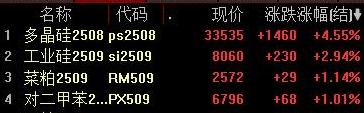
期货收评:工业硅多合约盘中触及涨停 多晶硅连续三日涨近10%!
news flash· 2025-06-30 07:03
Group 1 - Industrial silicon and polysilicon have rebounded strongly due to production cut news, with industrial silicon contracts hitting the daily limit and polysilicon rising nearly 10% over three days [1] - The market is experiencing a price rebound in polysilicon futures, with the main contract rising over 5% in early trading [3] - Despite the recent price increases, the overall supply-demand dynamics suggest that polysilicon prices may still face downward pressure due to weak fundamentals [5] Group 2 - Industrial silicon futures saw multiple contracts hitting the daily limit with a price increase of 6% [6] - The fundamentals for industrial silicon have slightly improved due to production cuts, but demand remains weak, limiting the upward price movement [8] - Four positive factors for industrial silicon include a 21 furnace reduction in Xinjiang, strong coal prices, underwhelming production during the flood season, and a continuous decline in social and warehouse inventories [8]

氯碱日报:供需格局仍偏弱,PVC低位震荡-20250626
Hua Tai Qi Huo· 2025-06-26 03:17
1. Report Industry Investment Ratings - PVC: Cautiously bearish [4] - Caustic Soda: Neutral [4] 2. Core Views - The PVC market remains in a weak supply - demand situation, with the supply surplus unchanged and cost - side support weak, while the caustic soda market faces increasing supply pressure and lack of positive drivers [3][4] 3. Summary by Relevant Catalogs Market News and Important Data PVC - Futures price and basis: The closing price of the PVC main contract was 4,871 yuan/ton (+27), the East China basis was - 141 yuan/ton (-27), and the South China basis was - 41 yuan/ton (-17) [1] - Spot price: The East China calcium carbide - based PVC was quoted at 4,730 yuan/ton (+0), and the South China calcium carbide - based PVC was quoted at 4,830 yuan/ton (+10) [1] - Upstream production profit: The semi - coke price was 575 yuan/ton (+0), the calcium carbide price was 2,880 yuan/ton (+0), the calcium carbide profit was 130 yuan/ton (+0), the gross profit of PVC calcium carbide - based production was - 494 yuan/ton (+18), the gross profit of PVC ethylene - based production was - 640 yuan/ton (-80), and the PVC export profit was - 1.0 US dollars/ton (+10.3) [1] - Inventory and开工: PVC factory inventory was 40.2 million tons (+0.5), social inventory was 35.5 million tons (+0.0), the calcium carbide - based PVC开工 rate was 79.62% (-0.83%), the ethylene - based PVC开工 rate was 69.23% (+1.87%), and the overall PVC开工 rate was 76.74% (-0.09%) [1] - Downstream order situation: The pre - sales volume of production enterprises was 64.8 million tons (+1.0) [1] Caustic Soda - Futures price and basis: The closing price of the SH main contract was 2,279 yuan/ton (+5), and the basis of 32% liquid caustic soda in Shandong was 159 yuan/ton (-5) [1] - Spot price: The price of 32% liquid caustic soda in Shandong was 780 yuan/ton (+0), and the price of 50% liquid caustic soda in Shandong was 1,300 yuan/ton (+0) [2] - Upstream production profit: The single - variety profit of caustic soda in Shandong was 1,446 yuan/ton (+0), the comprehensive profit of chlor - alkali in Shandong (0.8 tons of liquid chlorine) was 783.3 yuan/ton (+0.0), the comprehensive profit of chlor - alkali in Shandong (1 ton of PVC) was 111.28 yuan/ton (+20.00), and the comprehensive profit of chlor - alkali in the Northwest (1 ton of PVC) was 1,233.53 yuan/ton (-50.51) [2] - Inventory and开工: The liquid caustic soda factory inventory was 36.65 million tons (-3.88), the flake caustic soda factory inventory was 2.85 million tons (+0.00), and the caustic soda开工 rate was 81.20% (+0.30%) [2] - Downstream开工: The alumina开工 rate was 80.74% (-0.13%), the dyeing and printing East China开工 rate was 60.73% (-0.63%), and the viscose staple fiber开工 rate was 80.80% (+0.24%) [2] Market Analysis PVC - The supply - demand pattern remains weak, with the supply surplus unchanged due to high production and expected new capacity in 6 - 7 months, and the cost - side support is weak. The downstream demand is weak domestically, while the export is increasing, but the sustainability of exports is uncertain [3] Caustic Soda - The supply pressure is expected to increase due to planned new capacity, the market trading is weak, and the comprehensive profit of chlor - alkali is shrinking. The demand of the main downstream alumina is increasing, but the non - aluminum downstream demand is weak. The factory inventory is still high, and the caustic soda market lacks positive drivers [3] Strategy - PVC: Adopt a cautiously bearish approach and continue to monitor macro - export policies and downstream demand recovery [4] - Caustic Soda: The price is expected to fluctuate at a low level, and the comprehensive profit of chlor - alkali still has room to compress, with the market remaining under pressure [4]
国泰君安期货商品研究晨报:黑色系列-20250626
Guo Tai Jun An Qi Huo· 2025-06-26 01:42
2025年06月26日 国泰君安期货商品研究晨报-黑色系列 观点与策略 【基本面跟踪】 铁矿石基本面数据 | 铁矿石:预期反复,区间震荡 | 2 | | --- | --- | | 螺纹钢:宏观情绪扰动,宽幅震荡 | 3 | | 热轧卷板:宏观情绪扰动,宽幅震荡 | 3 | | 硅铁:宏观情绪扰动,宽幅震荡 | 5 | | 锰硅:宏观情绪扰动,宽幅震荡 | 5 | | 焦炭:情绪释放,震荡偏强 | 7 | | 焦煤:情绪释放,震荡偏强 | 7 | | 动力煤:需求仍待释放,宽幅震荡 | 9 | | 原木:基差修复,宽幅震荡 | 10 | 国 泰 君 安 期 货 研 究 所 请务必阅读正文之后的免责条款部分 1 期货研究 商 品 研 究 商 品 研 究 2025 年 6 月 26 日 铁矿石:预期反复,区间震荡 张广硕 投资咨询从业资格号:Z0020198 zhangguangshuo@gtht.com | | | | | 昨日收盘价(元/吨) | 涨跌(元/吨) | 涨跌幅 | | --- | --- | --- | --- | --- | --- | --- | | 期 货 | | | | 703.0 | ...
国泰君安期货商品研究晨报:黑色系列-20250624
Guo Tai Jun An Qi Huo· 2025-06-24 01:46
1. Report Industry Investment Ratings - No specific industry investment ratings are provided in the report. 2. Core Views of the Report - The report analyzes various commodities in the black series, including iron ore, rebar, hot - rolled coil, ferrosilicon, silicomanganese, coke, coking coal, thermal coal, and logs, and predicts that they will all experience wide - range fluctuations [2]. 3. Summary by Commodity Iron Ore - **Market Trend**: Expected to fluctuate within a range due to repeated expectations [2][4]. - **Fundamentals**: The futures closed at 706.0 yuan/ton, up 3.0 yuan or 0.43%. The positions increased by 4,370 hands. Among spot prices, the price of most ores decreased slightly, and the basis and spreads also changed to varying degrees [4]. - **News**: On June 20, the 5 - year LPR was 3.5% and the 1 - year LPR was 3%, unchanged from the previous month [4]. Rebar and Hot - Rolled Coil - **Market Trend**: Both are expected to have wide - range fluctuations [2][6][7]. - **Fundamentals**: For rebar RB2510, the closing price was 2,995 yuan/ton, up 1 yuan or 0.03%. For hot - rolled coil HC2510, the closing price was 3,112 yuan/ton, down 5 yuan or - 0.16%. In terms of inventory and demand, there were corresponding changes in production, inventory, and apparent demand [7][8][9]. - **News**: In May 2025, national steel production data showed a decline in crude steel and pig iron production year - on - year, and an increase in steel production. On June 19, steel production increased, inventory decreased, and apparent demand changed [8][9]. Ferrosilicon and Silicomanganese - **Market Trend**: Ferrosilicon is affected by sector sentiment resonance and silicomanganese has a firm ore - end quotation, both with wide - range fluctuations [2][10]. - **Fundamentals**: The closing prices of ferrosilicon and silicomanganese futures contracts changed, and there were also changes in spot prices, basis, and spreads [10]. - **News**: On June 23, the prices of ferrosilicon and silicomanganese in different regions changed, and a steel mill in Shandong finalized the ferrosilicon purchase price [10]. Coke and Coking Coal - **Market Trend**: Both are expected to have wide - range fluctuations. Four rounds of coke price cuts have been implemented [2][13]. - **Fundamentals**: The closing prices of coke and coking coal futures changed, and there were also changes in spot prices, basis, and spreads. The positions of coking coal JM2509 and coke J2509 contracts also changed [13][15]. - **News**: On June 23, the prices of coking coal in some regions changed, and the positions of the top 20 members in the DCE showed that the long positions of coking coal increased and the short positions decreased, while for coke, both long and short positions decreased [13][14][15]. Thermal Coal - **Market Trend**: Demand remains to be released, with wide - range fluctuations [2][17]. - **Fundamentals**: The ZC2507 contract had no trading on the previous day, with an opening price of 931.6 yuan/ton, a closing price of 840.0 yuan/ton, down 51.4 yuan. There were corresponding prices for domestic and foreign trade thermal coal, and the positions of the top 20 members in the ZCE did not change [18][19]. Logs - **Market Trend**: The basis is being repaired, with wide - range fluctuations [2][21]. - **Fundamentals**: The closing prices, trading volumes, and positions of log futures contracts changed, and the prices of various types of logs in the spot market were mostly stable [21]. - **News**: On June 20, the 5 - year LPR was 3.5% and the 1 - year LPR was 3%, unchanged from the previous month [23].
原木:基差修复,宽幅震荡
Guo Tai Jun An Qi Huo· 2025-06-20 05:08
Report Summary 1. Report Industry Investment Rating - Not provided in the given content 2. Core View of the Report - The log market shows basis repair and wide - range fluctuations [1] 3. Summary by Relevant Catalogs 3.1 Fundamental Tracking - **Futures Contract Data**: For the 2507 contract, the closing price on June 19, 2025, was 798, with a daily increase of 0.3% and a weekly increase of 4.0%. The trading volume was 21,160, a daily decrease of 34.0% and a weekly increase of 39%. The open interest was 22,957, a daily decrease of 1.9% and a weekly increase of 9%. Similar data is presented for 2509 and 2511 contracts [1] - **Basis Data**: The basis between spot and 2507 contract was - 48 on June 19, 2025, with a daily increase of 5.5% and a weekly increase of 75%. The basis between 2507 - 2509 contract had a daily increase of 700.0% and a weekly decrease of 124% [1] - **Spot Market Data**: In the log spot market, most prices remained stable on June 19, 2025, with some showing minor weekly changes. For example, the price of 3.9 - meter 30 + radiata pine in the Shandong market was 750 yuan/m³, with a weekly increase of 1.4%. In the wood square spot market, prices were mostly unchanged [1] 3.2 Macro and Industry News - From January to May 2025, the national real - estate development investment was 362.34 billion yuan, a year - on - year decrease of 10.7% [3] 3.3 Trend Intensity - The log trend intensity is 0, indicating a neutral view [3]
格林:基差修复,宽幅震荡
Guo Tai Jun An Qi Huo· 2025-06-19 01:19
Report Summary 1. Report Industry Investment Rating - The report does not mention the industry investment rating. 2. Core View - The report indicates that the log market is experiencing basis repair and wide - range fluctuations. The trend strength of logs is rated as 1, suggesting a neutral - to - slightly positive outlook [1][3]. 3. Summary by Relevant Catalogs 3.1 Fundamental Tracking - **Futures Contracts**: For the 2507 contract, the closing price on June 18 was 795.5 with a daily increase of 0.3% and a weekly increase of 4.0%. The trading volume decreased by 32.0% daily but increased by 116% weekly, and the open interest decreased by 2.8% daily and increased by 5% weekly. Similar data is presented for 2509 and 2511 contracts, showing different price, volume, and open - interest trends [1]. - **Basis**: The basis between spot and futures contracts, as well as between different futures contracts, showed significant changes. For example, the basis of spot - 2507 decreased by 14.2% daily and increased by 82% weekly [1]. - **Spot Prices**: Different types of logs in various regions had different price changes. For instance, the price of 3.9 - meter 30 + radiata pine in the Shandong market increased by 1.4% both daily and weekly, while the price of 5.9 - meter 40 + radiata pine in the Jiangsu market decreased by 2.4% weekly [1]. 3.2 Macro and Industry News - From January to May, the national real estate development investment was 362.34 billion yuan, a year - on - year decrease of 10.7% [3]. 3.3 Trend Intensity - The log trend intensity is 1, within the range of [-2, 2], indicating a neutral - to - slightly positive view [3].
黑色金属数据日报-20250613
Guo Mao Qi Huo· 2025-06-13 07:48
Report Summary 1. Report Industry Investment Rating No information provided. 2. Core Views - Steel prices returned to weakness after touching the 20 - day moving average on Thursday, with both spot volume and price falling. After basis repair, prices may face pressure again if there is no better bullish story in the industry. For hot - rolled coils and rebar, pay attention to the 20 - day moving average on the disk as the resistance level and the re - entry hedging point range [5]. - The Sino - US talks disturbed market sentiment. Coking coal spot continued to weaken, with many auctions failing and the cost of coking coal decreasing. The futures market of coking coal and coke weakened due to the less - than - expected Sino - US negotiation results. Macro uncertainties are large, and the market has no stable expectation. In the industry, the demand for five major steel products is seasonally weakening, and the coking coal supply may increase in the future [6]. - For steel, focus on short - side trading. Prefer hot - rolled coils with better liquidity for hedging. Buy put options on steel at high prices [8]. - For coking coal and coke, based on the judgment that the medium - to - long - term bottom of coking coal has not been found, continue to take a bearish view on the single - side trading [9]. - For ferrosilicon and silicomanganese, their fundamentals are stable and follow the steel market. The prices of both are expected to be under pressure, and attention should be paid to subsequent steel tenders [9]. - For iron ore, the trend remains unchanged, and a high - short strategy should be maintained. The decline in the output of five major steel products did not lead to inventory accumulation. Iron ore shipments are expected to rise to a high level, and the market should consider the changes in inventory after the peak season and the stability of steel exports [9]. 3. Summary by Related Catalogs Futures Market - **Prices and Changes**: - On June 12, for far - month contracts, RB2601 closed at 2962 yuan/ton, down 20 yuan (- 0.67%); HC2601 at 3079 yuan/ton, down 22 yuan (- 0.71%); I2601 at 671 yuan/ton, up 0.5 yuan (0.07%); J2601 at 1348 yuan/ton, down 20 yuan (- 1.46%); JM2601 at 779 yuan/ton, down 15.5 yuan (- 1.95%). - For near - month contracts, RB2510 closed at 2968 yuan/ton, down 21 yuan (- 0.70%); HC2510 at 3080 yuan/ton, down 27 yuan (- 0.87%); I2509 at 704 yuan/ton, down 1.5 yuan (- 0.21%); J2509 at 1328.5 yuan/ton, down 24 yuan (- 1.77%); JM2509 at 766.5 yuan/ton, down 22 yuan (- 2.79%) [2]. - **Spreads and Ratios**: - On June 12, the spread between RB2510 and RB2601 was 6 yuan/ton, unchanged; between HC2510 and HC2601 was 1 yuan/ton, down 5 yuan. - The coil - to - rebar spread was 112 yuan/ton, down 5 yuan; the rebar - to - iron ore ratio was 4.22, down 0.01; the coal - to - coke ratio was 1.73, unchanged; the rebar disk profit was 184.4 yuan/ton, down 4.3 yuan; the coking disk profit was 309.06 yuan/ton, down 4.89 yuan [2]. Spot Market - Steel: On June 12, Shanghai rebar was 3070 yuan/ton, down 30 yuan; Tianjin rebar was 3220 yuan/ton, unchanged; Guangzhou rebar was 3230 yuan/ton, unchanged; Tangshan billet was 2890 yuan/ton, down 30 yuan. Shanghai hot - rolled coil was 3160 yuan/ton, down 50 yuan; Hangzhou hot - rolled coil was 3240 yuan/ton, unchanged; Guangzhou hot - rolled coil was 3190 yuan/ton, down 20 yuan [2]. - Coking Coal and Coke: Coking coal prices continued to weaken, with many auctions failing. The price index of coking coal was 951.7, down 6.1. Port - traded quasi - first - class coke was quoted at 1180 yuan/ton. For Mongolian coal, prices were under pressure, with downstream buyers having strong price - cutting intentions [6]. Different Product Analysis - **Steel**: After the basis repair, prices may face pressure again. For trading, focus on short - side trading, and prefer hot - rolled coils for hedging. Buy put options on steel at high prices [5][8]. - **Coking Coal and Coke**: The Sino - US talks disturbed market sentiment. Spot coking coal weakened, and the futures market also showed weakness. Continue to take a bearish view on the single - side trading based on the judgment that the medium - to - long - term bottom of coking coal has not been found [6][9]. - **Ferrosilicon and Silicomanganese**: Their fundamentals are stable and follow the steel market. Prices are expected to be under pressure due to factors such as weakening demand, approaching off - season, and decreasing costs [9]. - **Iron Ore**: The trend remains unchanged, and a high - short strategy should be maintained. Iron ore shipments are expected to rise, and pay attention to inventory changes and steel export stability [9].
黑色金属数据日报-20250611
Guo Mao Qi Huo· 2025-06-11 11:20
1. Report Industry Investment Rating No relevant content provided. 2. Core Viewpoints of the Report - The steel market has no prominent contradictions, with prices oscillating at low levels. After the basis repair, prices may face pressure again if there is no better bullish story in the industry. The resistance levels for the rebound of hot-rolled coils and rebar are around the 20-day moving average on the surface, which is also the point range for re-entering hedging [6]. - In the coking coal and coke market, coking coal auctions remain weak, but the lower support on the futures price is strong. Although the medium - and long - term bottom of coking coal has not been determined, short - term rebounds may continue due to capital games. There may be a short - term restocking market similar to that in March if the futures price continues to rise [6]. - The silicon - iron and manganese - silicon markets have fluctuating sentiment and enhanced price elasticity. Supply and demand are relatively balanced, but there is a trend of marginal increase in supply and a decline in costs. Prices are expected to be under pressure [6]. - The iron ore market is mainly influenced by short - term news and sentiment. The downward trend remains unchanged, and it is necessary to pay attention to the changes in iron ore inventory and steel exports after the peak season [6]. 3. Summary According to Related Catalogs Futures Market - On June 10, for far - month contracts, RB2601 closed at 2970 yuan/ton, down 0.13%; HC2601 at 3085 yuan/ton, unchanged; I2601 at 663.5 yuan/ton, down 0.75%; J2601 at 1364.5 yuan/ton, up 0.07%; JM2601 at 791.5 yuan/ton, down 0.38%. For near - month contracts, RB2510 closed at 2974 yuan/ton, down 0.07%; HC2510 at 3089 yuan/ton, unchanged; I2509 at 698.5 yuan/ton, down 0.85%; J2509 at 1349 yuan/ton, up 0.48%; JM2509 at 785 yuan/ton, up 0.51% [3]. - The cross - month spreads, spreads/ratios/profits, and basis of various varieties also showed corresponding changes on June 10 [3]. Spot Market - On June 10, the prices of Shanghai rebar, Tianjin rebar, and Guangzhou rebar were 3100 yuan/ton, 3220 yuan/ton, and 3190 yuan/ton respectively. The price of Shanghai hot - rolled coil was 3180 yuan/ton, and the prices of other spot products also had specific values and changes [3]. Market Analysis of Different Varieties - **Steel**: The spot trading is lackluster. There is no strong upward - driving force in the industry. The recent coal - coke market fluctuations are due to short - covering by short - sellers. After the basis repair, prices may face pressure again [6]. - **Coking Coal and Coke**: The coking coal auction is weak, with many unsuccessful auctions. The cost of coal for furnaces is decreasing, and there is still an expectation of price cuts. The futures price of coking coal may continue to rebound in the short term, but the medium - and long - term bottom has not been determined [6]. - **Silicon - Iron and Manganese - Silicon**: Supply has recovered, direct demand has weakened marginally, and cost support has declined. Prices are expected to be under pressure [6]. - **Iron Ore**: The short - term fundamentals have not changed significantly. The downward trend remains unchanged. Attention should be paid to the changes in inventory and exports after the peak season [6]. Investment Suggestions - For steel, take a wait - and - see approach for single - side trading. For futures - spot trading, choose hot - rolled coils with better liquidity for hedging and open - position management [6]. - For coking coal and coke, be aware that the short - term rebound may not be over [6]. - For silicon - iron and manganese - silicon, participate through buying options due to the high price elasticity at low levels, and pay attention to futures - spot positive arbitrage [6].