高市交易

Search documents
片山皋月与贝森特齐声担忧 日元汇率依旧持续走低
Xin Lang Cai Jing· 2026-01-13 10:30
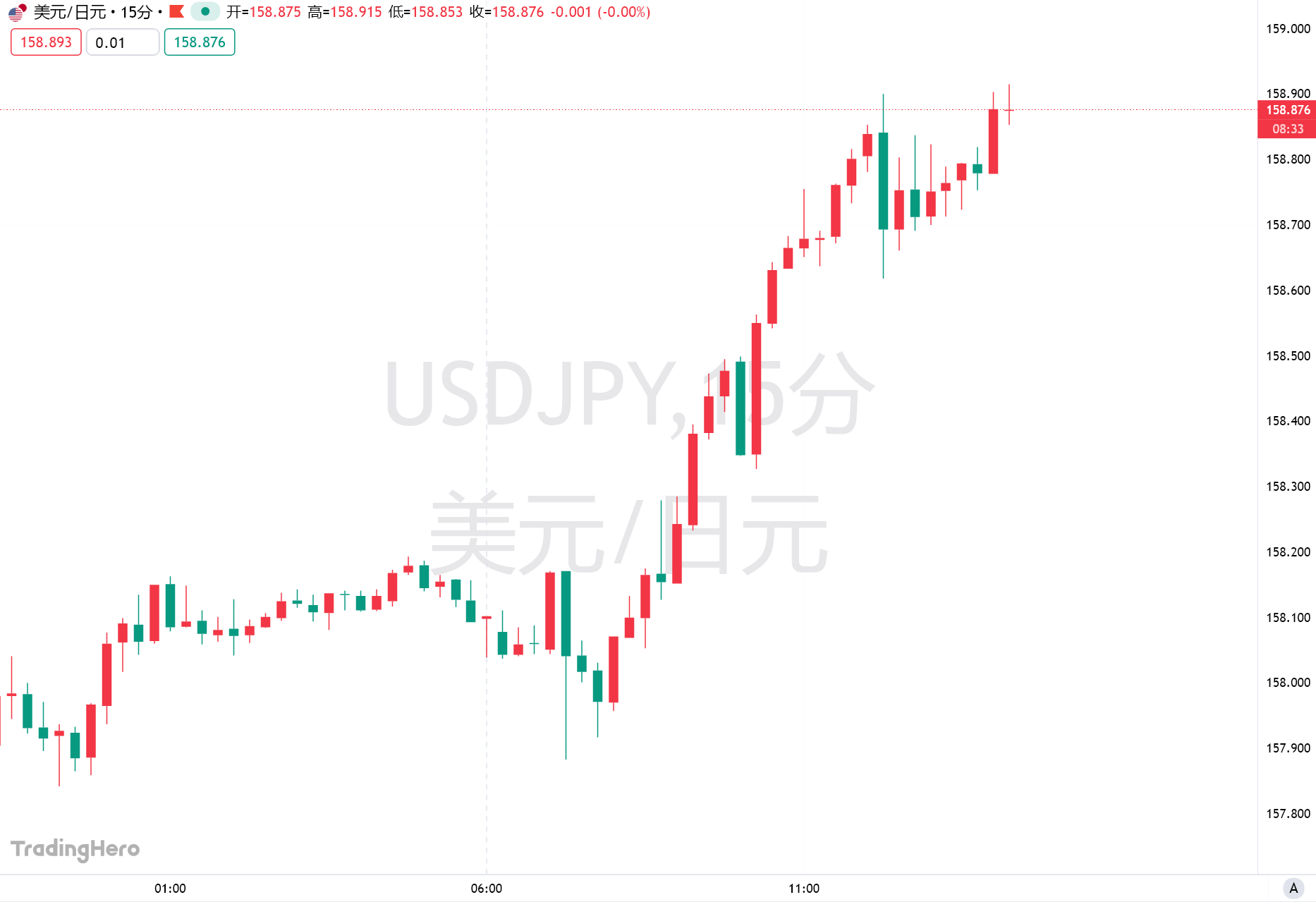
Core Viewpoint - The Japanese yen has depreciated to its lowest level in 18 months, reaching 159.05 yen per dollar, despite concerns from both Japanese and U.S. officials about the currency's decline [1][2][3]. Currency Exchange Rate Dynamics - The yen's exchange rate dropped by 0.6% against the dollar, influenced by reports of Prime Minister Fumio Kishida's intention to call for early elections, which further exacerbated the yen's decline [1][2]. - The Japanese Finance Minister, Shunichi Suzuki, expressed concerns about the "one-sided depreciation" of the yen during a meeting with U.S. Treasury Secretary Janet Yellen, indicating a potential for increased communication on exchange rate trends [1][3]. Market Reactions and Predictions - Market analysts suggest that the possibility of currency intervention may become a focal point, particularly as the dollar approaches the 160 yen mark, which is seen as a critical threshold for intervention [1][2][3]. - The head of the Japan Business Federation, Tokui Nobutaka, emphasized the need for the yen to strengthen, warning that excessive depreciation could necessitate intervention in the foreign exchange market [2][8]. Economic Implications - The depreciation of the yen is expected to increase import costs, potentially leading to higher domestic inflation, prompting the Japanese government to introduce a substantial economic stimulus plan to alleviate rising living costs [3][10]. - The Bank of Japan raised its benchmark interest rate to a 30-year high in December, with expectations that further rate hikes may be accelerated due to the yen's ongoing depreciation [10]. International Relations and Policy - U.S. Treasury Secretary Yellen previously called for the Bank of Japan to raise interest rates as a means to support the yen's value [4][10]. - The recent meeting between Suzuki and Yellen occurred amid concerns regarding potential political interference in U.S. monetary policy, which may impact international economic relations [5][10].
日经涨3.10%创新高,“高市交易”进第二幕
日经中文网· 2026-01-13 07:53
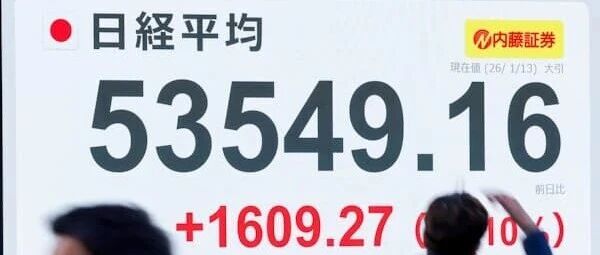
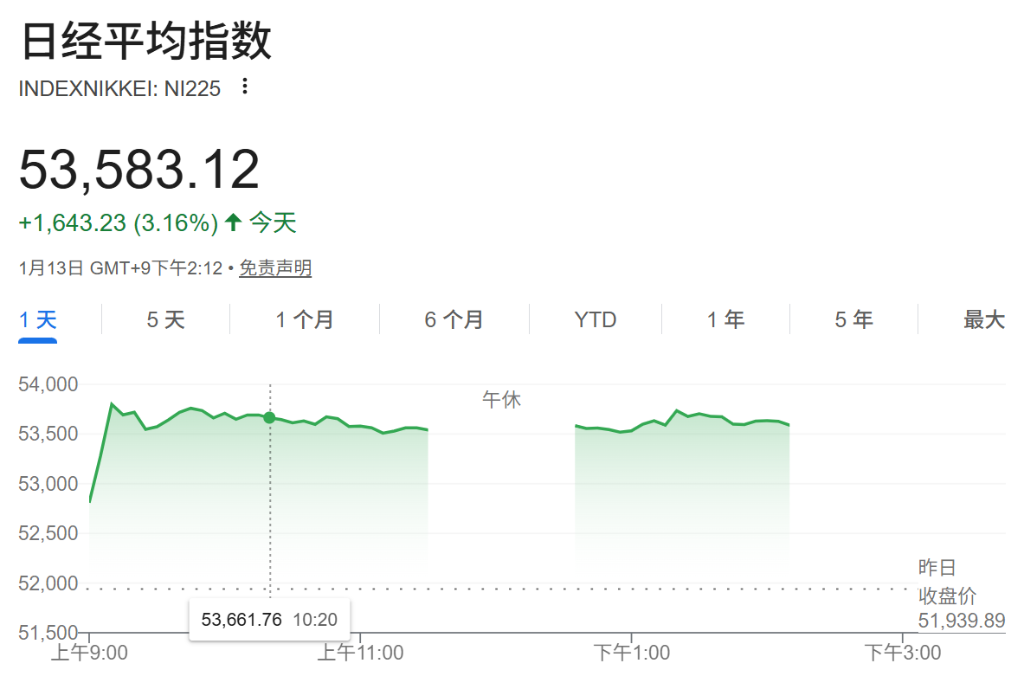
Core Viewpoint - The Japanese stock market is experiencing significant gains, driven by expectations surrounding Prime Minister Fumio Kishida's potential dissolution of the House of Representatives and increased government policy execution capability, particularly in defense and semiconductor sectors [2][4]. Group 1: Market Performance - On January 13, the Nikkei average rose by 1,609 points (3.10%) to close at 53,549, marking a historical high alongside the TOPIX index [2]. - The market saw widespread buying, with the Nikkei's increase at one point exceeding 1,800 points, particularly benefiting defense-related stocks [4]. - Companies like Kawasaki Heavy Industries and IHI saw significant stock price increases, with Kawasaki rising approximately 10% and IHI up 6.33%, both reaching their highest prices since their listings [4]. Group 2: Sector Performance - Semiconductor stocks joined the upward trend, with companies like Lasertec hitting new highs, and Advantest and Tokyo Electron contributing approximately 870 points to the Nikkei average [5]. - The banking sector also benefited from rising interest income expectations, with Mizuho Financial Group increasing by 6.13% and Mitsubishi UFJ Financial Group rising over 5% [5]. Group 3: Political Context and Investor Sentiment - Kishida's government enjoys a support rate exceeding 70%, which is expected to bolster the government's policy execution and provide support for the stock market [5][6]. - The anticipation of a general election under a high support rate is seen as a factor that could solidify the government's power and enhance policy implementation [6]. - However, there are concerns about the rapid increase in the Nikkei average, which has risen by approximately 3,000 points since late 2025, prompting investors to closely monitor corporate earnings changes [6].

有传言称高市将解散众议院,日元贬值重燃
日经中文网· 2026-01-13 07:53
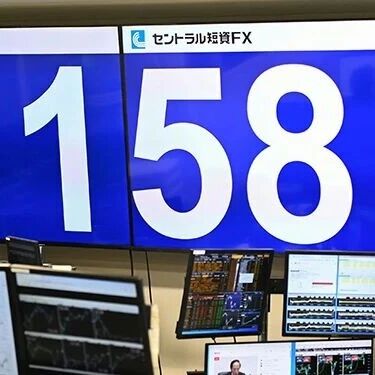
Core Viewpoint - The Japanese yen has depreciated significantly, reaching a new low of 158.20 yen per dollar, influenced by political developments and market dynamics, leading to increased speculation in currency depreciation trades [2][4]. Group 1: Currency Market Dynamics - On January 12, the yen's exchange rate fell to 158.20 yen per dollar, marking the lowest level since January 2025, driven by speculation surrounding the potential dissolution of the Japanese House of Representatives [2]. - The "debasement trade" has gained traction among overseas speculators, with the dissolution of the Japanese parliament seen as a catalyst for further yen depreciation [4]. - If the yen breaks through the 158 yen level, the next significant resistance level is projected at 160 yen [4]. Group 2: Market Sentiment and Positioning - The Chicago Mercantile Exchange's report indicated that non-commercial positions in yen were overbought by 8,815 contracts, reflecting a balanced buying and selling sentiment despite a decrease in total positions compared to December 2025 [5]. - Concerns over the independence of the Federal Reserve have emerged, contributing to a bearish outlook on the dollar and influencing trading strategies [5]. Group 3: Resource Currency Trends - There is a growing interest in currencies of resource-producing countries, such as the Australian dollar and South African rand, with the rand reaching 9.60 yen and the Australian dollar hitting 106 yen, both marking significant highs [5]. - The potential for the Reserve Bank of Australia to raise interest rates as early as February is increasing, driven by strong economic indicators [6]. - Despite the risks associated with resource currencies, there is a trend of buying these currencies even in risk-averse scenarios, as both the yen and dollar exhibit weaknesses [6].
日股破顶、汇债双杀!“高市交易”卷土重来
Xin Lang Cai Jing· 2026-01-13 07:49
Group 1 - Speculation about Prime Minister Sanae Takaichi potentially calling for early elections has ignited the Japanese market, leading to a historic high in the Nikkei 225 index and a significant drop in the yen and Japanese government bond yields [1][8] - The Nikkei 225 index closed at 53,549.16 points, up 1,609.27 points or 3.10%, marking a new all-time high, while the yen fell 0.5% against the dollar, reaching its lowest level since July 2024 [1][10] - The yield on Japan's 30-year government bonds surged by 12 basis points to 3.52%, reflecting market reactions to Takaichi's high approval ratings and potential fiscal expansion [1][10] Group 2 - Analysts suggest that sectors likely to benefit from Takaichi's spending policies include defense, artificial intelligence, and nuclear power, which have led the Tokyo stock market's rise [5][11] - Notable stock performances include Kawasaki Heavy Industries rising over 10%, semiconductor equipment manufacturers Lasertec and Tokyo Electron increasing by over 9%, and nuclear engineering firm Toyo Engineering climbing 15% [5][11] - The weakening yen is also favorable for Japanese export companies, with Toyota's stock rising over 7% and Hitachi's stock increasing by 3.8% [6][11] Group 3 - Market expectations indicate that if the yen falls below the 161 mark against the dollar, it could trigger intervention from the Japanese Ministry of Finance [4][11] - Concerns about further fiscal expansion by the ruling Liberal Democratic Party (LDP) could accelerate the sell-off of Japanese government bonds and the yen, as the LDP currently holds a minority in both houses of parliament [3][10] - The ongoing depreciation of the yen has become a politically sensitive issue in Japan, contributing to rising food and energy prices, contrasting with the country's long-standing deflationary environment [12]
日股破顶、汇债双杀!“高市交易”卷土重来
Jin Shi Shu Ju· 2026-01-13 07:43
Core Viewpoint - Speculation about Japanese Prime Minister Sanae Takaichi announcing an early election has led to a surge in the Japanese stock market, reaching historical highs, while the yen and Japanese government bonds have significantly declined [1][3]. Market Reaction - The Nikkei 225 index closed up 1,609.27 points, a 3.10% increase, reaching 53,549.16 points, marking a historical high [1]. - The yen fell 0.5% against the US dollar, hitting its lowest level since July 2024 [1]. - The yield on Japan's 30-year government bonds surged by 12 basis points to 3.52% [1]. Political Context - Takaichi has informed senior members of the ruling Liberal Democratic Party (LDP) about her intention for an early election, which has raised market expectations for further fiscal expansion [3]. - The LDP currently holds a minority position in both houses of parliament, but the possibility of gaining a majority is seen as realistic [3]. Investment Opportunities - Sectors expected to benefit from Takaichi's spending policies include defense, artificial intelligence, and nuclear power, leading to significant stock price increases in companies like Kawasaki Heavy Industries (up over 10%) and Tokyo Electron (up over 9%) [4]. - The weakening yen is favorable for Japanese export companies, with Toyota Motor Corporation's stock rising over 7% and Hitachi's stock increasing by 3.8% [4]. Analyst Insights - Analysts predict that "Takaichi stocks," including those related to energy and space, will see substantial gains in the short term [5]. - However, there are concerns about internal divisions within the LDP regarding the election, which may lead to a temporary recovery of the "Takaichi trade" [5]. - The ongoing depreciation of the yen has become a politically sensitive issue in Japan, contributing to rising food and energy prices [5]. Economic Outlook - Some analysts view Japan's debt situation as more optimistic, noting that inflation rates exceed interest rates, leading to a decline in net debt [6]. - Despite expectations of further interest rate hikes by the Bank of Japan, the yen continues to weaken, attributed to fiscal concerns and the slow pace of rate increases [5][6].
“高市交易”卷土重来!日股创新高、债汇双杀
Hua Er Jie Jian Wen· 2026-01-13 06:08
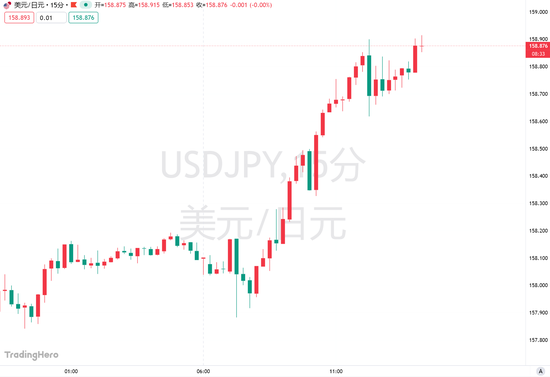
Core Viewpoint - The return of "high market trading" in Japan's financial market is driven by Prime Minister Sanna Takashi's intention to dissolve the House of Representatives and hold early elections, leading to a significant rise in the Nikkei 225 index and a decline in Japanese government bonds [1][4]. Group 1: Market Reactions - The Nikkei 225 index surged over 3%, reaching a historical high following the announcement of early elections [1]. - Japanese government bonds experienced a sharp decline, with the 10-year bond yield rising to its highest level since February 1999, and the 20-year bond yield hitting a historical peak [1][5]. - The Japanese yen fell to 158.91 against the US dollar, marking its lowest level since July 2024 [1][9]. Group 2: Economic Implications - If Prime Minister Takashi secures a stronger mandate in the early elections, it could reinforce his expansionary fiscal stance and preference for loose monetary policy, which has boosted the stock market but raised concerns about Japan's debt sustainability [4][5]. - Japan's debt-to-GDP ratio has exceeded 200%, making it one of the most indebted developed countries, which has led to investor anxiety regarding future fiscal discipline [8]. Group 3: Currency and Intervention Concerns - The yen has become the worst-performing currency among G10 currencies due to political instability and the widening US-Japan interest rate differential [9]. - Japanese officials, including Finance Minister Katsuyuki Kitagawa, have expressed concerns over the yen's unilateral depreciation and indicated a willingness to intervene in the market if necessary [12]. - Market analysts are closely monitoring the potential for government intervention to support the yen amid ongoing capital outflows and negative real interest rates [12].
报应来了,日元成“最弱货币”遭全球抛售,日财务大臣苦诉撑不住
Sou Hu Cai Jing· 2025-11-25 15:22
Core Viewpoint - The election of Sanae Takaichi as the president of the Liberal Democratic Party has led to a significant depreciation of the Japanese yen, raising concerns about the impact on the Japanese economy and the potential for a prolonged period of currency weakness [3][5][17]. Group 1: Yen Depreciation - Since Takaichi's election on October 4, the yen has depreciated over 3.7%, with the exchange rate against the US dollar hitting a low of 153.003 on October 8, the lowest since mid-February [3][5]. - The yen has also weakened against other major currencies, reaching a historical low of 177.86 against the euro, marking the lowest level since the euro's inception in 1999 [5][11]. Group 2: Economic Policies - Takaichi's economic policies are characterized by a continuation of "Abenomics," advocating for loose monetary policy and active fiscal measures, which are exerting downward pressure on the yen [7][9]. - Analysts note that Takaichi's approach includes a more aggressive stance on fiscal policy while maintaining a dovish position on monetary policy, which may delay interest rate hikes by the Bank of Japan [9][15]. Group 3: Economic Challenges - Japan's economy is facing multiple downward pressures, including rising prices and stagnant wage growth, with nominal wages increasing by only 1.9% in September while real wages fell by 1.4% [11][13]. - The number of bankruptcies among small and micro enterprises has risen, with 965 companies filing for bankruptcy in October, a 6.2% increase year-on-year, highlighting the economic strain on these businesses [13][15]. Group 4: Market Reactions and Future Outlook - The financial markets reacted swiftly to Takaichi's election, with a notable drop in the yen's value, leading to a consensus among traders to sell the yen [5][17]. - While the yen is currently undervalued, its future trajectory will depend on Takaichi's policy execution and her influence within the government [17][19].
国泰海通 · 晨报1114|宏观、汽车、投资银行业与经纪业
国泰海通证券研究· 2025-11-13 11:03
Macroeconomic Overview - The current economic backdrop for Japan under Prime Minister Kishi is characterized by moderate recovery amidst ongoing re-inflation, contrasting with the deflationary stagnation faced by former Prime Minister Abe [3] - Kishi's economic strategy emphasizes demand-side management to combat external inflation while also pursuing structural supply-side reforms to stimulate new growth sectors [3] Fiscal Policy - Kishi plans to implement an "expansionary but responsible fiscal policy," with expectations of an increase in Japan's fiscal deficit ratio by 2026, although the overall expansion may be limited due to debt risks [3] Monetary Policy - Despite a dovish stance, the Bank of Japan is expected to continue raising interest rates in 2026, with a potential increase of 30 to 50 basis points, while also slowing the pace of balance sheet reduction [3] Industrial Policy - Kishi aims to enhance strategic investments in 17 key industries over the next five years, focusing on sectors such as AI, semiconductors, shipbuilding, quantum technology, biotechnology, aerospace, and cybersecurity [3] Market Impact - The "Kishi trade" observed in October indicates a strengthening of Japanese stocks, while the yen and Japanese bonds weaken, with expectations of a bullish stock market and continued upward pressure on bond yields [4] - The yen is projected to remain under pressure in the short term, with a potential for slight appreciation if U.S. dollar credit declines [4] Automotive Industry - The wholesale prices of passenger vehicles have stabilized in October, with an average discount rate of 18.5%, reflecting a shift from price competition to refined operations in the domestic market [7] - Traditional fuel vehicles maintain a high average discount rate of 26.3%, while new energy vehicles show a more stable discount rate of 12.8%, indicating a dual advantage in cost control and market demand for new energy products [7][8] Investment Fund Trends - As of October 2025, the total net asset value of public funds in China is 36.02 trillion yuan, with a net outflow observed in stock and bond funds, while money market funds saw an increase [12] - Individual investors' risk appetite has been affected by market volatility, leading to a decline in shares of ordinary stock and mixed funds, while QDII and FOF funds have gained traction as safe-haven investments [13] - Mixed FOF products have performed well, with a 63.10% increase in new issuance, as they provide a balance of risk and return for retail investors [14]

华泰证券今日早参-20251107
HTSC· 2025-11-07 06:57
Group 1: Macroeconomic Overview - In October, the issuance of policy financial tools is expected to marginally boost credit, although government bond issuance is projected to decline year-on-year due to a high base, leading to a decrease in new social financing [1][2] - The manufacturing sector in the US and Europe showed unexpected recovery in October, indicating a global manufacturing cycle still in recovery despite ongoing US government shutdowns [1][2] - Japan's economic recovery is supported by stable export growth and a resilient labor market, with the Nikkei 225 index reaching a historical high [2] Group 2: Electric Power Equipment and New Energy - The Q3 performance of the electric power equipment sector showed significant divergence, with non-UHV main networks outperforming other segments, driven by strong overseas demand and domestic construction needs [4] - Non-UHV main networks reported a 38.2% year-on-year increase in net profit, while distribution and meter segments faced declines of 23.6% and 28.4% respectively [4] - The outlook for the sector remains positive, with expectations of continued high capacity utilization and revenue growth from overseas markets [4] Group 3: Semiconductor Industry - Huahong Semiconductor reported Q3 revenue of $635.2 million, a year-on-year increase of 20.7%, with a gross margin of 13.5%, exceeding company guidance [7] - The company anticipates Q4 revenue between $650 million and $660 million, indicating a sequential growth of approximately 3.1% [7] - The strong performance is attributed to high capacity utilization and price increases, particularly in the analog and power management segments [7] Group 4: Aluminum Industry - China Hongqiao, a leading player in the electrolytic aluminum sector, is expected to benefit from rising aluminum prices and is implementing share buybacks and high dividends to enhance investor returns [8] - The supply-demand imbalance in the electrolytic aluminum market is projected to become more pronounced in 2025-2026 due to near-capacity domestic production and slow overseas capacity release [8] Group 5: Pharmaceutical Industry - Xiansheng Pharmaceutical is entering a phase of commercializing multiple innovative products, with significant growth potential in overseas markets [11] - The company has achieved approvals for several new indications for its innovative drugs, indicating a strong pipeline and potential for revenue growth [11] Group 6: Consumer Goods - Uni-President China reported a net profit of 2.01 billion yuan for the first three quarters of 2025, a year-on-year increase of 23.1%, with Q3 profit rising by 8.4% [12] - The company is focusing on enhancing its brand and optimizing its cost structure, which has led to improved profit margins [12] Group 7: Gaming Industry - Giant Network highlighted the strong performance of its new game "Supernatural" and the potential of AI applications in its gaming business during the recent investment summit [15] - The company is actively developing new products, which are expected to drive future growth [15] Group 8: Financial Services - CITIC Securities reported steady growth in its wealth management and investment business, with a strong project pipeline in its investment banking division [15] - The company maintains a buy rating due to its solid competitive position and positive business outlook [15]






鹰派美联储+鸽派日央行=日元贬值?
Hua Er Jie Jian Wen· 2025-11-03 06:20
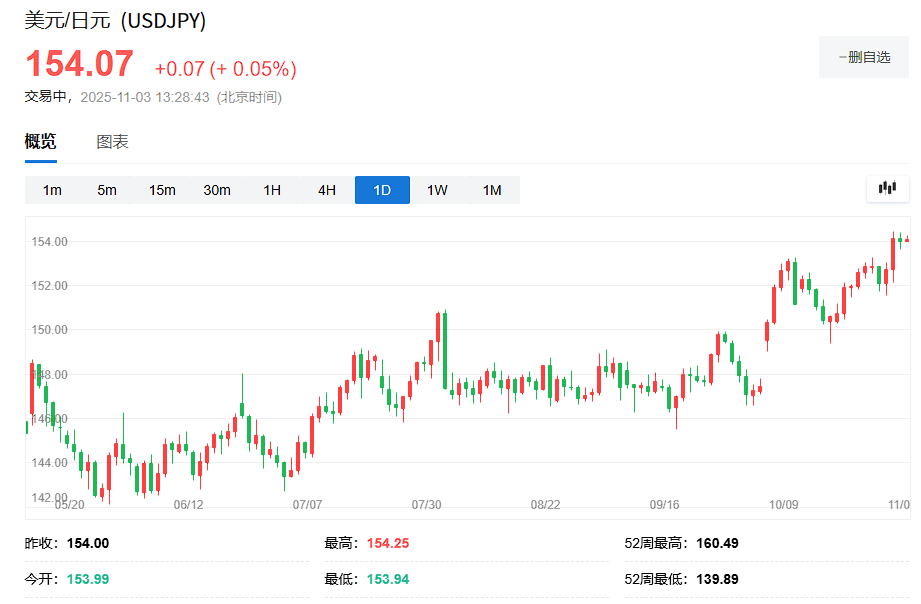
Core Viewpoint - The divergence in monetary policy between the Federal Reserve and the Bank of Japan is significantly impacting the foreign exchange market, with the Japanese yen being particularly affected [1]. Group 1: Federal Reserve's Hawkish Stance - The Federal Reserve's unexpected hawkish tone during the October FOMC meeting has raised doubts about the anticipated interest rate cuts in December, leading to a stronger dollar outlook [6][8]. - Market reactions indicate a shift in expectations, with a notable reduction in the likelihood of rate cuts for December and January, while adjustments for subsequent meetings in 2026 remain limited [6][8]. - The Fed's internal tensions regarding employment and inflation targets are becoming more pronounced, especially with nominal growth rates around 5% [6][8]. Group 2: Bank of Japan's Dovish Position - Contrary to market expectations, the Bank of Japan decided to maintain its policy rate at 0.50% during the October meeting, which led to a significant depreciation of the yen [10][12]. - The Bank's decision reflects a respect for the current government's preference for inflation and yen depreciation, with expectations for a potential rate hike now pushed to January 2024 [10][12]. - The yen's rapid decline was evident as the USD/JPY exchange rate surged from approximately 152.20 to over 154 following the Bank's announcement [10][12]. Group 3: Market Dynamics and Predictions - The current market dynamics are driven by a "high market policy trade," characterized by buying Japanese stocks while selling yen, which is expected to continue as long as the Bank of Japan remains inactive [5][11]. - Morgan Stanley's model suggests that the fair value of USD/JPY is around 154.5, indicating potential for further upward movement in the short term [11]. - However, there are concerns about intervention risks if the exchange rate exceeds 155, with warnings from Japan's new finance minister signaling heightened scrutiny of foreign exchange market movements [12][12]. Group 4: Future Outlook - Morgan Stanley has revised its USD/JPY forecasts significantly, projecting 156 for Q4 2025, up from a previous estimate of 142 [13]. - The expectation is that after the Bank of Japan's next rate hike in January, the USD/JPY will gradually trend downward [14].