
关税政策

Search documents
“对等关税”被美国高院驳回,特朗普还有什么招?
Xin Lang Cai Jing· 2026-02-21 00:19
Core Viewpoint - The U.S. Supreme Court's ruling does not dismantle the tariff barriers established by former President Trump, as he may still utilize various legal tools to reinstate large-scale tariffs [1][8]. Group 1: Legal Tools for Tariffs - The 1962 Trade Expansion Act's Section 232 is the most relied upon tool for tariffs, allowing the President to impose tariffs on imports for national security reasons without limits on rates or duration [2][9]. - Section 301 of the 1974 Trade Act empowers the U.S. Trade Representative to impose tariffs on countries deemed discriminatory against U.S. businesses, with no upper limit on rates [3][10]. - Section 122 of the 1974 Trade Act permits the President to impose tariffs of up to 15% for a maximum of 150 days in response to significant international payment imbalances, without prior investigation [12][13]. Group 2: Limitations and Challenges - Section 232 requires a Department of Commerce investigation, which can take up to 270 days, limiting its immediate implementation [2][9]. - Section 301 involves a complex process of investigation and public consultation, making it cumbersome for targeting multiple smaller countries [4][11]. - Section 201 of the 1974 Trade Act allows tariffs if increased imports threaten U.S. manufacturers, but it also requires an investigation and has a maximum tariff rate of 50% [6][14]. Group 3: Controversial Options - The 1930 Smoot-Hawley Tariff Act's Section 338 allows the President to impose tariffs of up to 50% without prior investigation, but it has not been used historically due to concerns about its impact on global trade [5][15]. - There are political concerns regarding the potential use of Section 338, as evidenced by a resolution from five Democratic Congress members seeking its repeal [7][16].


今日国际国内财经新闻精华摘要|2026年2月21日
Sou Hu Cai Jing· 2026-02-21 00:07
International News - The U.S. Supreme Court rejected President Trump's comprehensive tariff policy under the International Emergency Economic Powers Act, ruling it lacks clear legal authorization, which may lead to the U.S. needing to refund up to $170 billion in tariff revenues [1] - In response, Trump plans to sign an order imposing a 10% global baseline tariff on all countries, expected to take effect in three days, and threatens additional tariffs of 15% to 30% on automobiles [2][3] - U.S. Treasury Secretary Mnuchin stated that tariff revenues are expected to be around $130 billion, falling short of the $175 billion target, while the Illinois governor has submitted a request for an $8.6 billion tariff refund for approximately 5.1 million households [6][7] - Geopolitical tensions with Iran are escalating, with Trump demanding an agreement within 10-15 days, and reports suggest a potential limited military strike by the U.S. [8] - The U.S. military has deployed the USS Gerald R. Ford carrier strike group to the Mediterranean, joining the USS Abraham Lincoln, along with 17 ships and dozens of aircraft to the Middle East [9][10][11][12] Market Overview - Safe-haven sentiment has driven significant increases in precious metal prices, with spot gold rising 2.15% to $5,104.90 per ounce, and New York futures surpassing $5,130 per ounce, marking a daily increase of 2.65% [13][14][15][16][17] - Silver prices also surged, with spot silver breaking $84 per ounce and New York futures exceeding $85 per ounce, showing daily increases of 7.21% and 8.67% respectively [13][14][15][16][17] - Palladium futures surpassed $1,800 per ounce, with a daily increase of 4.54% [13][14][15][16][17] - The Commodity Futures Trading Commission (CFTC) reported that bearish sentiment towards the dollar has reached its highest level since 2021 [18] - U.S. stock markets saw gains, with the Dow up 0.48%, Nasdaq up 0.90%, and S&P up 0.71%, while major European indices also rose, including Germany's DAX30 up 0.92% and France's CAC40 up 1.39% [19][20] Corporate Developments - OpenAI plans to invest approximately $600 billion in computing power by 2030 [21] - Google is exploring the expansion of its AI chip market to compete with Nvidia [22] - Amazon reported that hackers used AI tools to breach over 600 firewalls across 55 countries in five weeks, aiming to deploy ransomware [23] Economic Data - The Federal Reserve's Musalem noted ongoing corporate cost pressures and public inflation concerns, while Bostic indicated that interest rate hikes may be considered if inflation rises [24][25][26][27] - U.S. inflation expectations for February showed a one-year rate of 3.4% and a five-to-ten-year rate of 3.3%, both slightly below expectations [28] Domestic News - The Nasdaq China Golden Dragon Index fell 0.05%, with significant declines in stocks such as Tims China down 5.61% and Huya down 5.71% [30][31]
美最高法裁决关税政策违法,特朗普称有备选方案
Xin Lang Cai Jing· 2026-02-20 23:49
来源:新华社 作者: 施春 美国最高法院当天上午以6比3的结果作出裁决,认定美国《国际紧急经济权力法》没有授权总统征收大 规模关税。这意味着特朗普政府的关税政策受到重大挫折。 特朗普政府官员此前称,如果关税政策被判违法,将考虑通过其他途径重新实施相关关税。 新华社纽约2月20日电美国总统特朗普20日称,针对最高法院认定其大规模关税政策违法,他已有备选 方案。 美国有线电视新闻网援引 知情人士的话报道,当天在白宫与各州州长共进工作早餐时,特朗普表示, 他已有备选方案来应对最高法院的裁决。 ...
关税违法,市场大涨
Zhong Guo Ji Jin Bao· 2026-02-20 23:46
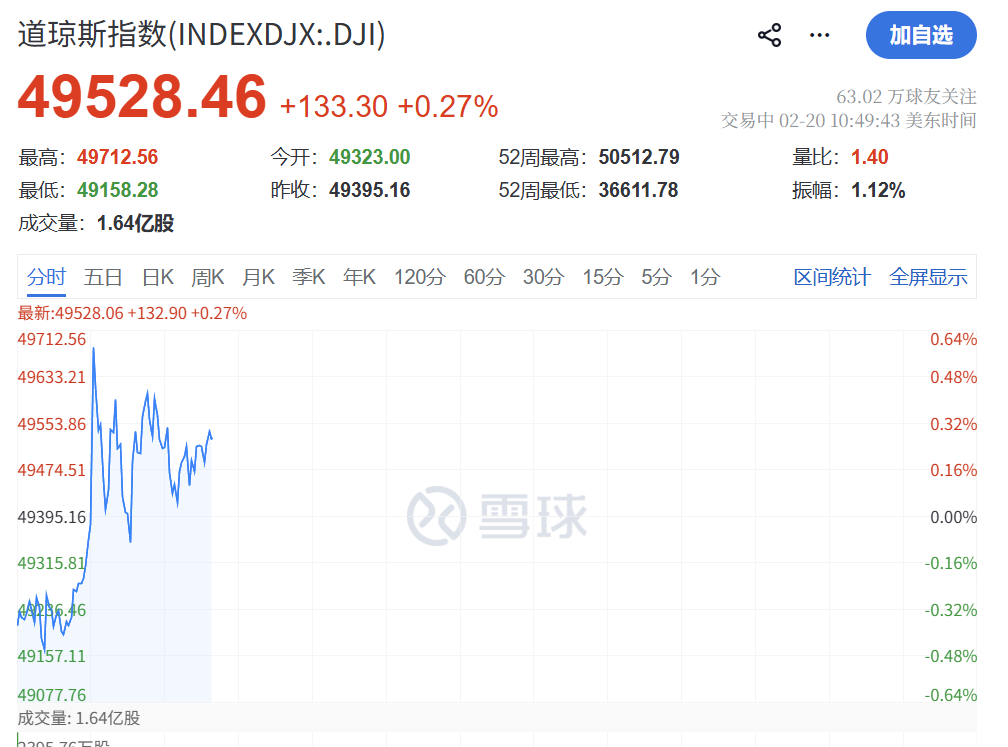
2月20日晚间,美股三大指数盘中直线拉升。 黄金、白银剧烈波动,截至发稿,白银暴涨近5%,黄金涨超1%。分析师James Athey指出,市场似乎不太确定该如何应对美国最高法院的裁 决。 | 中国资产方面,中概股指数低开高走转涨。富时中国A50指数直线拉升涨近1%,人民币短线拉升! | | --- | 消息面上,全球迎来史诗级利好。 美国最高法院作出裁决:特朗普对等关税和芬太尼关税违法!大法官们以6比3裁定,认为特朗普政府依据1977年的《国际紧急经济权力法》 (IEEPA),对全球进入美国的商品征收激进关税的做法,不被该法律所允许。 这项裁决由首席大法官罗伯茨执笔,他与三位自由派大法官以及两位保守派大法官:尼尔·戈萨奇和艾米·科尼·巴雷特,组成多数意见。 | 最高: 6909.87 | 今开:6843.26 | 52周最高: 7002.28 | 量比: 1.17 | | --- | --- | --- | --- | | 最低: 6836.33 | 昨收:6861.89 | 52周最低: 4835.04 | 振幅: 1.07% | | 成交昌: 8.15亿股 | | | | 美元指数直线跳水。 这是特朗普今 ...
美三大股指应声上涨!特朗普关税遭驳回,亚马逊涨超2.5%,美国四季度GDP爆冷
Di Yi Cai Jing· 2026-02-20 23:45
Market Reaction - Investors reacted positively to the Supreme Court ruling, which rejected President Trump's global tariffs, alleviating cost pressures on businesses and reducing concerns about persistent inflation in the U.S. economy [2][4]. Stock Market Performance - All three major U.S. stock indices closed higher, with the Dow Jones up 230.81 points (0.47%) at 49,625.97, the Nasdaq up 203.34 points (0.90%) at 22,886.07, and the S&P 500 up 47.62 points (0.69%) at 6,909.51 [2]. - For the week, the Dow rose 0.25%, the S&P 500 increased by 1.07%, and the Nasdaq gained 1.51% [3]. Sector Performance - The technology sector saw gains, with major companies like Alphabet up 4.01%, Netflix up 2.17%, Meta up 1.69%, Apple up 1.54%, and Nvidia up 1.02%. However, Microsoft experienced a slight decline of 0.31% [3]. - Retail stocks also rose in response to the Supreme Court ruling, with Home Depot up 0.97% and Five Below up 1.91% [4]. Economic Data - The U.S. GDP growth for the fourth quarter was reported at 1.4%, significantly below the expected 2.5%, primarily due to the government shutdown impacting economic growth by approximately 1 percentage point [6]. - The core Personal Consumption Expenditures (PCE) index remained stable at 3%, which is above the Federal Reserve's target of 2% [7].

美最高法裁决关税政策违法 特朗普称有备选方案
Xin Hua She· 2026-02-20 23:30
新华社纽约2月20日电(记者施春)美国总统特朗普20日称,针对最高法院认定其大规模关税政策违 法,他已有备选方案。 美国有线电视新闻网援引知情人士的话报道,当天在白宫与各州州长共进工作早餐时,特朗普表示,他 已有备选方案来应对最高法院的裁决。 美国最高法院当天上午以6比3的结果作出裁决,认定美国《国际紧急经济权力法》没有授权总统征收大 规模关税。这意味着特朗普政府的关税政策受到重大挫折。 特朗普政府官员此前称,如果关税政策被判违法,将考虑通过其他途径重新实施相关关税。 责编:张青津、卢思宇 ...
被判违法后,特朗普为何能宣布额外征收10%全球关税?还有牌?
Di Yi Cai Jing· 2026-02-20 23:25
美国总统特朗普并在记者会上点明了其他征收关税的潜在途径,即《1962年贸易扩展法》第232条、《1974年贸易法》第201条、301条以及《1930年关税 法》第338条。 据央视新闻,当地时间2月20日,美国总统特朗普表示,他将签署一项命令,依据美国《1974年贸易法》第122条,在目前已经征收的常规关税基础上,额外 对全球商品加征10%的关税。 当天,美国最高法院公布裁决,认定特朗普政府援引《国际紧急经济权力法》(IEEPA)实施的大规模关税政策违法。随后,特朗普在记者会上作出上述表 述。 他并在记者会上点明了其他征收关税的潜在途径,即《1962年贸易扩展法》第232条、《1974年贸易法》第201条、301条以及《1930年关税法》第338条。 美国贸易代表格里尔在当天也表示,(基于)第122条的关税将于今日实施并签署。同时,301条款调查在法律上具有极强持久性。 英国杜伦大学法学院副院长、跨国法教授兼全球政策研究所联合主任杜明对第一财经记者表示,特朗普政府在关税问题上"骑虎难下",只能继续亮牌。 杜明对记者强调,所谓可以立即使用的"122条",允许美国政府在150天内对贸易伙伴征收高达15%的关税,而 ...

特朗普暗示违法征收的关税不退了,美财长称今年关税收入将“基本保持不变”
Hua Er Jie Jian Wen· 2026-02-20 23:09
被美国最高法院裁定去年实施的大部分关税措施违法后,美国总统特朗普暗示不会退还相关征税,美国 财长贝森特预计,2026年的政府关税收入几乎不会发生变化。这些表态意味着,即使面临据估算超过 1700亿美元的关税被退还的风险,特朗普政府也要力保关税壁垒,并未因重大法庭败绩而退缩。 据央视新闻,当地时间20日周五临时召开的白宫记者会上,特朗普称,他将签署行政令,对全球商品加 征10%的进口关税,取代被美国联邦最高法院认定违法的、此前基于美国《国际紧急经济权力法》 (IEEPA)征收的大规模关税。 而贝森特表示,美国联邦政府的关税收入更接近1300亿美元,而非上述研究机构模型暗示的1750亿美 元。如果发生关税退款,可能会类似于"企业福利"。新关税相比基于IEEPA的关税将稍微更复杂一些。 央视提到,被现场记者问到此前征收的大约1750亿美元关税收入是否要退还时,特朗普称,最高法院的 裁决有缺陷,没有提及"保留这笔钱"或"不保留这笔钱"——他猜"接下来两年,甚至是五年,这事都得 打官司"。 同在周五,贝森特在达拉斯经济俱乐部的演讲中表示,特朗普政府将援引国会授予的替代法律权力,包 括《1974年贸易法》的第122条款和 ...
特朗普痛批最高法院裁决,宣布对全球加征10%的关税
Sou Hu Cai Jing· 2026-02-20 22:51
当地时间2月20日,美国最高法院裁定,美国总统特朗普标志性的大规模关税政策非法,特朗普痛批最 高法院,并宣布对全球加征10%的关税。 据美国福克斯新闻报道,在美国最高法院以6比3做出对特朗普不利的裁决后,特朗普召开记者会,宣布 对全球加征10%的关税。 特朗普20日下午在白宫新闻发布会上说:"我们将采用其他方案来取代被最高法院错误驳回的那些方 案。我们有其他方案,非常好的方案,可以获得更多资金。我们会获得更多资金,这也会让我们变得更 加强大。我们正在获得数千亿美元的资金,而且我们将继续这样做。" 特朗普还宣布,他将征收10%的"全球关税"。 特朗普说:"今天我将签署一项行政命令,根据《1974年贸易法》第122条规定,在现有关税的基础上, 对全球商品加征10%的关税。此外,我们还将启动多项第301条及其他调查,以保护我国免受其他国家 和公司不公平贸易行为的侵害。" 当地时间20日,美国最高法院裁定,特朗普政府依据《国际紧急经济权力法》实施的相关大规模关税措 施缺乏明确法律授权。 当天,美最高法院大法官以6比3的结果维持下级法院裁决,认定特朗普援引《国际紧急经济权力法》实 施关税政策超出了其法定权限。最高法院是 ...
特朗普称美最高法院关税裁决可耻
Xin Lang Cai Jing· 2026-02-20 22:46
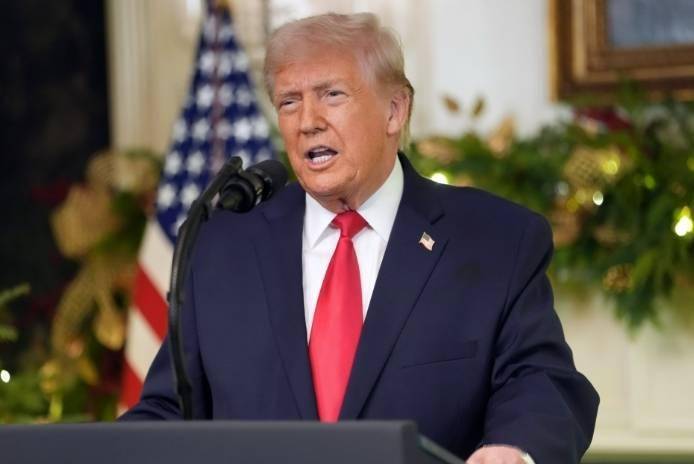
【#特朗普称美最高法院关税裁决可耻#】#特朗普称已有备选方案# 据央视新闻,记者当地时间2月20日 获悉,美国总统特朗普表示,美最高法院作出关税政策违法的裁决"可耻"。#美最高法院裁定特朗普关 税违法#知情人士称,在当天白宫举行的州长早餐会期间,特朗普表示,他已考虑好备选方案,以应对 法院裁决带来的影响。目前,白宫尚未公布具体替代措施细节。此前,政府官员曾表示,如果关税政策 被判违法,将考虑通过其他贸易法律恢复相关关税。当天稍早,美国最高法院裁定,特朗普政府依据 《国际紧急经济权力法》实施的相关大规模关税措施缺乏明确法律授权。这意味着特朗普政府的关税政 策受到重大挫折。(视频内容为此前报道) ...