
消费升级

Search documents
2025年中国餐饮品牌力白皮书
Sou Hu Cai Jing· 2026-01-19 15:43
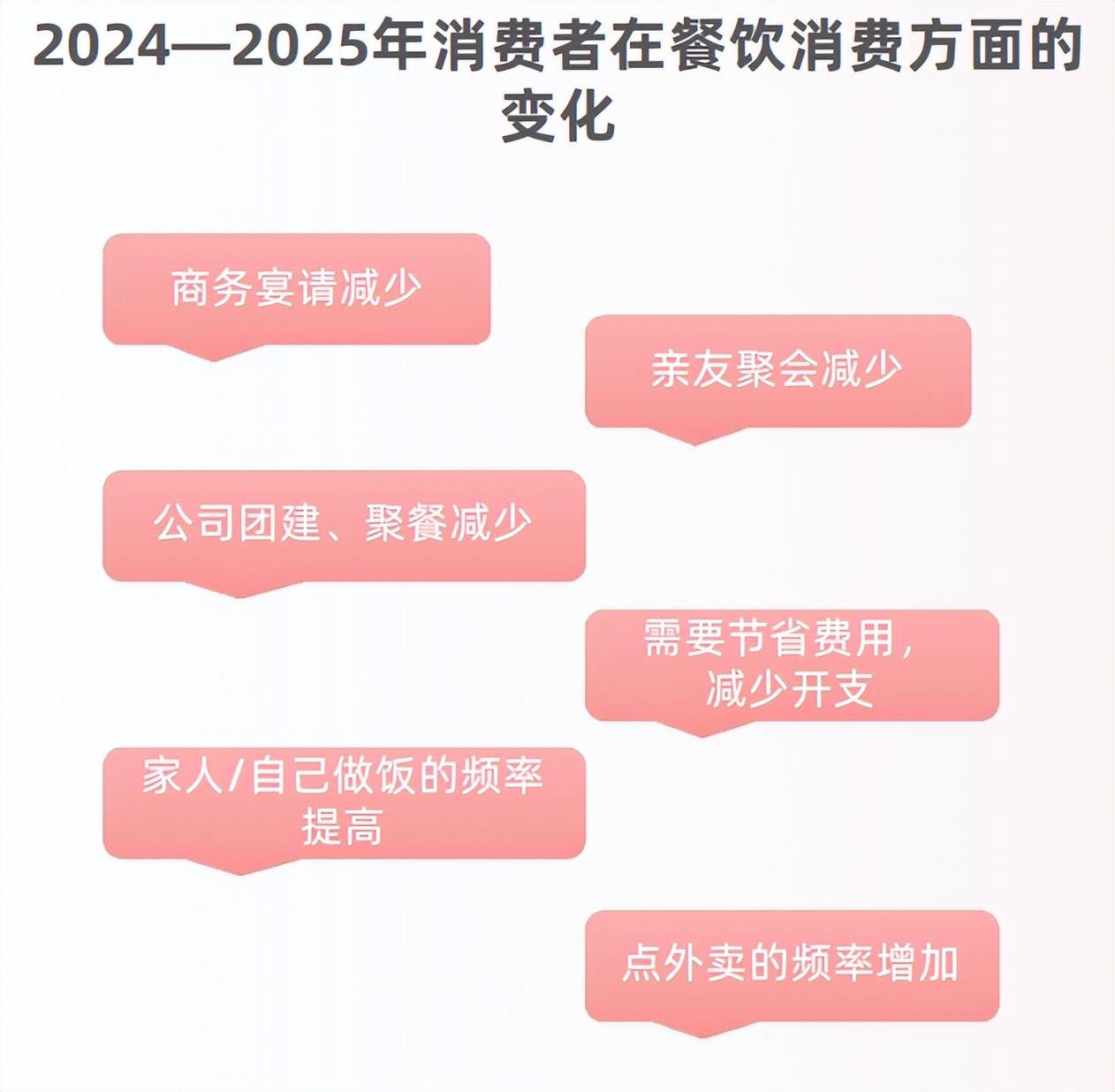
Core Insights - The Chinese catering industry is experiencing a significant slowdown, with a 3.6% year-on-year growth in revenue from January to August 2025, down from 6.6% in the same period of 2024, indicating a shift to a "micro-profit era" [1] - The total number of catering outlets in China has seen a rare negative growth, decreasing by 1.9% year-on-year to over 7.6 million by August 2025, marking a transition from "incremental competition" to "stock competition" [1] Industry Trends - Different segments within the catering industry show a clear divergence in outlet growth, with ready-to-drink beverages and Chinese cuisine being among the few segments experiencing growth, while fast food, bakery, barbecue, hot pot, Western cuisine, and Asian cuisine have all seen declines [2] - The overall operating efficiency of the industry is under pressure from rising costs and changing consumer demand, leading to the elimination of underperforming outlets and the survival of those with brand advantages and high operational efficiency [2] - The chain rate in the catering industry has steadily increased from 15% in 2020 to an expected 25% in 2025, highlighting the growing importance of brand and scale in the industry [2][3] Consumer Behavior - Consumer spending on dining is becoming more cautious, with a significant drop in the proportion of consumers planning to increase their dining expenditures in 2025 compared to 2024 [5] - A notable shift in dining habits is observed, with 24.2% of consumers reducing business meals and gatherings, while over 40% are cooking more at home, indicating a move towards more economical and healthier dining options [6] Market Dynamics - The takeaway market is undergoing a historic transformation, with the market size expected to exceed 1.4 trillion yuan in 2025, driven by a new competitive landscape following the entry of JD.com and Alibaba's "Taobao Flash Purchase" [4][5] - The competitive landscape in the takeaway market has shifted to a three-way competition among Meituan, Alibaba, and JD.com, moving beyond mere subsidy wars to focus on service quality and technological innovation [5] Operational Strategies - Brands are increasingly optimizing their store models to reduce costs and improve efficiency, with various new store formats emerging, such as satellite stores and delivery-focused outlets [10][11] - The average lifespan of catering outlets is decreasing, with projections indicating a further reduction to around 15 months in 2025, emphasizing the need for strong operational capabilities and brand differentiation [8] Product Innovation - The number of new products launched by brands has surged, with over 5,263 new items introduced from January to July 2025, reflecting a focus on regional ingredients and flavors to meet consumer demand for diversity [9] - Brands are leveraging regional specialties to create unique product offerings, enhancing brand value and consumer engagement through localized flavors [9]

国泰海通|宏观:总量稳健,结构优化——2025年四季度经济数据点评
国泰海通证券研究· 2026-01-19 15:02
Core Viewpoint - In 2025, China's economy is expected to achieve its annual GDP growth target of 5.0%, with a quarterly growth rate of 4.5% in Q4, reflecting a slight decline due to base effects. The economy exhibits dual differentiation, characterized by a strong industrial production but structural mismatches in capacity and demand, as well as a resilient external demand contrasted with sluggish internal demand [2][4][5]. Economic Structure and Performance - The economic structure continues to show differentiation, with emerging forces performing well during the transition period. Industrial production in December reversed previous slowdowns, driven by high-end manufacturing and green transformation, while the service sector's production index grew by 5.0% year-on-year [2][7][9]. - The investment sector remains under pressure due to funding constraints, insufficient project reserves, and weak demand, with fixed asset investment declining by 3.8% year-on-year [6][23][25]. Supply and Demand Dynamics - There is a persistent contradiction between supply and demand, with industrial production showing strong supply but weak demand. The sales rate of industrial products in December was 98.2%, down 0.7 percentage points year-on-year, indicating that production expansion is outpacing demand recovery [5][8]. - External demand remains robust due to optimized export structures, while internal demand is constrained by slow recovery in consumption and investment. In 2025, cumulative year-on-year growth rates for investment, consumption, and exports were -3.8%, 3.7%, and 5.5%, respectively [6][12]. Policy Focus - The next phase of policy will focus on expanding domestic demand, enhancing consumption quality, and effective investment. This includes promoting the replacement of old consumer goods, supporting new growth points in service consumption, and increasing investment in new infrastructure and equipment updates [7][22]. Consumer Behavior and Trends - In Q4, retail sales of consumer goods showed steady growth for the year but faced year-end pressure, with a 0.9% year-on-year increase in December. Rural consumption outperformed urban consumption, with rural retail sales growing by 4.1% for the year [13][14][18]. - Online consumption remains a stable growth driver, with a year-on-year increase of 8.6% in 2025, significantly higher than the overall retail growth [14][19]. Investment Landscape - Investment continues to face challenges, with fixed asset investment in December showing a year-on-year decline of 15.1%. The real estate sector remains sluggish, with new construction and completion areas decreasing significantly [23][26]. - Manufacturing investment is hindered by weak demand and profit pressures, while infrastructure investment is constrained by funding shortages and insufficient project availability [25][27].

中国经济“稳进新韧”
Di Yi Cai Jing Zi Xun· 2026-01-19 14:13
Core Viewpoint - China's GDP for 2025 reached 140 trillion yuan, achieving a growth rate of 5%, meeting the initial target set at the beginning of the year [2][3]. Economic Growth - The GDP growth rate for 2025 was consistent with the previous year, with quarterly growth rates of 5.4%, 5.2%, 4.8%, and 4.5% respectively [3][4]. - The contribution rates of final consumption expenditure, gross capital formation, and net exports to economic growth were 52.0%, 15.3%, and 32.7% respectively for the year [5]. Industrial Production - Industrial production value reached 41.7 trillion yuan, growing by 5.8%, contributing 35% to economic growth [7][8]. - The manufacturing sector's output increased by 6.1%, maintaining a stable share of around 25% of GDP [7][8]. Consumer Trends - Retail sales of consumer goods surpassed 50 trillion yuan, with a growth rate of 3.7%, indicating a shift towards service consumption [5][6]. - Service consumption accounted for 46.1% of per capita consumer spending, with significant growth in sectors like tourism and entertainment [6]. Future Outlook - Despite challenges, the economic foundation remains strong, with expectations for steady growth in 2026 supported by various favorable conditions [2][4]. - The focus for 2026 will be on enhancing industrial quality and promoting technological innovation to sustain economic stability [10].
中国经济“稳进新韧”
第一财经· 2026-01-19 13:57
Core Viewpoint - In 2025, China's GDP reached 140 trillion yuan, achieving a growth rate of 5%, meeting the initial target set at the beginning of the year, and maintaining stability in economic performance amidst various challenges [2][3]. Economic Growth and Structure - The GDP growth for 2025 was consistent across quarters: Q1 at 5.4%, Q2 at 5.2%, Q3 at 4.8%, and Q4 at 4.5% [4]. - The contribution rates to economic growth from final consumption expenditure, capital formation, and net exports were 52.0%, 15.3%, and 32.7% respectively for the year [5][6]. Consumer Behavior and Retail - The total retail sales of consumer goods surpassed 50 trillion yuan, growing by 3.7% year-on-year, with service retail sales increasing by 5.5%, indicating a shift towards service consumption [5][6]. - Service consumption accounted for 46.1% of per capita consumption expenditure, reflecting a growing trend towards diverse and quality consumption preferences [6][7]. Industrial Performance - Industrial production value reached 41.7 trillion yuan, growing by 5.8%, with manufacturing value added at 34.7 trillion yuan, increasing by 6.1% [8][9]. - The high-tech manufacturing sector showed significant growth, with increases of 9.4% in high-tech manufacturing and 9.2% in equipment manufacturing, indicating a shift towards advanced industrial capabilities [8][9]. Future Outlook - Despite challenges in 2026, the economic foundation remains strong, with expectations for continued growth driven by domestic demand and policy support [5][10]. - The focus for 2026 will be on stabilizing key industries, expanding effective demand, and fostering innovation to enhance industrial growth [10].

年入15亿!国货洗护龙头半亩花田赴港IPO
Xin Lang Cai Jing· 2026-01-19 13:16
Core Viewpoint - The Chinese skincare and personal care brand, Banmu Huatian, has officially submitted its main board listing application to the Hong Kong Stock Exchange, with CITIC Securities (Hong Kong) as the exclusive sponsor [1][6]. Company Overview - Banmu Huatian, headquartered in Jinan, Shandong, has focused on flower-based skincare for over a decade, adhering to the philosophy of "delighting skin with flowers" [2][7]. - By 2024, the brand has become the leading domestic brand in China for body lotion, body scrub, and cleansing mousse, ranking second in the overall market for body scrubs and cleansing mousse [2][7]. Financial Performance - The company reported a revenue of 1.199 billion yuan in 2023, projected to increase to 1.499 billion yuan in 2024, representing a year-on-year growth of 25.0%. For the first three quarters of 2025, revenue further rose to 1.895 billion yuan, with a year-on-year increase of 76.7% [4][9]. - Adjusted net profit grew from 23.7 million yuan in 2023 to 82.8 million yuan in 2024, and reached 148 million yuan in the first three quarters of 2025, marking a year-on-year growth of 197.2% [4][9]. - Online sales accounted for 76.3% of total revenue in the first three quarters of 2025, with offline channel revenue increasing by 71.2% [4][9]. Research and Development - R&D and product innovation are core competencies for Banmu Huatian, which has established a comprehensive R&D system covering raw material development, basic research, technology transfer, product implementation, and efficacy verification [4][9]. - The company has invested over 88.7 million yuan in R&D from 2023 to the first three quarters of 2025, with research centers in Shanghai, Jinan, and Guangzhou, and over 70% of the R&D team holding master's degrees or higher [4][9]. Fundraising and Strategic Plans - The funds raised from the listing will primarily be used for channel development, brand building, enhancing R&D capabilities, team building, digital infrastructure upgrades, and working capital [5][10]. - The company plans to deepen its "big product + full category" strategy to consolidate its existing advantages while also expanding into international markets [5][10]. Market Outlook - The Chinese skincare and personal care market is expected to continue expanding, with forecasts indicating that the market sizes for body wash, hair care, and facial cleansing will reach 111 billion yuan, 112.1 billion yuan, and 365.7 billion yuan respectively by 2024, and grow to 145.5 billion yuan, 151 billion yuan, and 522.1 billion yuan by 2029 [6][11]. - This growth presents significant opportunities for Banmu Huatian to enhance its brand influence and solidify its position as a leading domestic brand [6][11].

2025消费新变化 从“买得起”到“买得好”
Xin Lang Cai Jing· 2026-01-19 11:02
Core Insights - The core viewpoint of the article highlights the significant growth in consumer spending in 2025, with retail sales of consumer goods exceeding 50 trillion yuan for the first time, indicating a shift from "affordable" to "quality" purchases [1] Group 1: Economic Performance - In 2025, the contribution rate of final consumption expenditure to economic growth reached 52%, an increase of 5 percentage points compared to the previous year, underscoring the vital role of consumption in the economy [1] - The implementation of the old-for-new consumption policy is expected to further stimulate high-quality durable goods in daily life [1] Group 2: Retail Growth - Retail sales in categories such as cultural and office supplies, furniture, household appliances, and audio-visual equipment all achieved double-digit growth rates [1]
新华鲜报丨140万亿元!中国经济再上新台阶
Xin Hua Wang· 2026-01-19 10:32
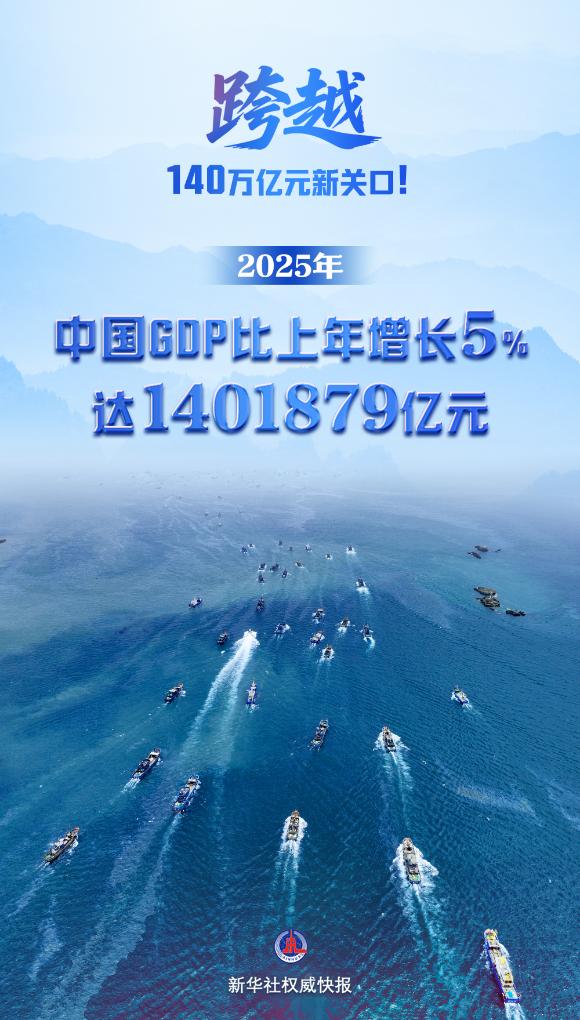
Core Viewpoint - China's GDP is projected to exceed 140 trillion yuan by 2025, with a growth rate of 5% compared to the previous year, marking a significant milestone in the country's economic development [1][4]. Economic Growth - The National Bureau of Statistics reported that during the "14th Five-Year Plan" period, China's economy achieved a "four consecutive jumps" in total economic output, reaching milestones of 110 trillion, 120 trillion, 130 trillion, and now 140 trillion yuan [6]. - China's contribution to global economic growth is expected to be around 30%, making it a stable and reliable engine for global economic growth [6]. Economic Resilience - China's agricultural output has stabilized at 1.4 trillion jin for two consecutive years, and the manufacturing value added has remained the highest in the world for 16 years [7]. - The service sector's contribution to GDP has increased to 57.7%, supported by the world's largest and most comprehensive network infrastructure, which enhances the country's ability to withstand risks [7]. Innovation and Technology - China has entered the top ten in global innovation index rankings, with R&D expenditure intensity reaching 2.8%, surpassing the OECD average for the first time [8]. - Significant advancements in technology and innovation are evident, with notable achievements in various sectors, including the successful launch of the "Nine Days" drone and the entry of the first electromagnetic aircraft carrier [8]. Consumer Market Dynamics - The total retail sales of consumer goods have surpassed 50 trillion yuan, reflecting a 3.7% increase from the previous year, with new retail models like unmanned stores and warehouse membership stores experiencing double-digit growth [9]. - The per capita disposable income of residents has increased by 5.0%, and the urbanization rate has reached 67.89%, indicating positive progress in social welfare and public services [9].
国家统计局权威解读2025中国经济年报
证券时报· 2026-01-19 08:05
Core Viewpoint - China's economy is expected to achieve a stable and positive growth trajectory in 2026, with opportunities outweighing challenges and favorable conditions prevailing over unfavorable factors [2][20]. Economic Performance - In 2025, China's GDP reached 140 trillion yuan, marking a 5.0% increase from the previous year, solidifying its position as a leading global economy [2][4]. - The contribution rate of China's economy to global growth is projected to be around 30% during the "14th Five-Year Plan" period [4]. - The total economic output has consistently increased, surpassing significant milestones of 110 trillion, 120 trillion, 130 trillion, and 140 trillion yuan [5]. Industrial Development - The proportion of high-tech manufacturing value added in the total industrial value added rose to 17.1% in 2025 [8]. - The growth rates for industrial robots and civilian drones were 28% and 37.3%, respectively, indicating rapid development in new sectors [9]. - The manufacturing sector's value added in high-tech industries grew by 9.4% [35]. Consumer Trends - Final consumption expenditure contributed over 50% to economic growth in 2025, with total retail sales of consumer goods exceeding 50 trillion yuan, a 3.7% increase from the previous year [13][32]. - Service retail sales grew by 5.5%, outpacing goods retail sales, highlighting a shift towards service consumption [16]. - The proportion of service consumption in per capita household expenditure remained stable at 46.1% [17]. Innovation and R&D - R&D expenditure intensity reached 2.8%, surpassing the OECD average for the first time [10][35]. - Significant advancements in technology and innovation were noted, with breakthroughs in artificial intelligence, quantum technology, and other frontier fields [11]. Policy and Future Outlook - A series of proactive macroeconomic policies are set to support economic development in 2026, including measures to boost consumption and stabilize market expectations [22][23]. - The government plans to implement actions to enhance consumer spending and address restrictions in the consumption sector [24]. - The overall economic environment remains resilient, with positive signals emerging from various economic indicators [21].

东吴证券芦哲:服务消费持续升温 政策助力释放潜力
Di Yi Cai Jing· 2026-01-19 07:42
Core Viewpoint - In 2025, service consumption in China is expected to significantly outperform goods consumption, with a projected annual growth rate of 5.5% for service retail, compared to 3.8% for total social retail sales, indicating a continuous improvement in service consumption [1] Group 1: Service Consumption Growth - The growth of service retail reflects a rising enthusiasm among residents for cultural and sports services, showcasing a trend of consumption upgrading and an increasing share of service consumption in overall spending [1] - The policy framework is supportive, as six ministries jointly released a document at the end of November aimed at enhancing supply-side adjustments to further unleash the potential of service consumption [1] Group 2: Economic Implications - The positive momentum in service consumption is seen as a crucial driver for optimizing economic structure and facilitating consumption upgrades, highlighting the significant future development space in this sector [1]

提振消费政策协同显效 消费市场实现扩容提质
Guo Jia Tong Ji Ju· 2026-01-19 07:38
Core Insights - The consumption market in China is expected to continue expanding and upgrading, driven by policies aimed at boosting consumption and improving people's livelihoods in 2025 [1] Group 1: Consumption Scale and Growth - The total retail sales of consumer goods are projected to exceed 50 trillion yuan, reaching 50,120.2 billion yuan, with a year-on-year growth of 3.7%, accelerating by 0.2 percentage points compared to the previous year [2] - Retail sales in rural areas are growing faster than in urban areas, with rural retail sales increasing by 4.1%, outpacing urban growth of 3.6% by 0.5 percentage points [2] - The county and township market's share of total retail sales is expected to be 38.7% in 2025, indicating a steady release of consumption potential in these areas [2] Group 2: Service Retail Growth - Service retail is anticipated to grow by 5.5%, with an acceleration of 0.3 percentage points compared to the previous year, outpacing goods retail growth by 1.7 percentage points [3] - The film industry is experiencing significant growth, with box office revenue reaching 51.83 billion yuan, a 21.7% increase from the previous year [3] - New service models such as online consultations and training are thriving, contributing to a continued rapid growth in information consumption [3] Group 3: Sales of Upgraded and Replacement Goods - The "trade-in" policy is showing positive effects, with retail sales of goods in key units increasing by 3.4%, an acceleration of 0.7 percentage points from the previous year [4] - Retail sales of communication equipment and cultural office supplies have surged by 20.9% and 17.3%, respectively, with furniture sales growing by 14.6% [4] - The retail volume of new energy passenger vehicles reached 12.809 million units, marking a 17.6% increase, with a penetration rate of 53.9%, up by 6.3 percentage points [4] Group 4: New Consumption Models and Trends - Online retail sales are expected to grow by 8.6%, with physical goods online retail increasing by 5.2%, contributing 1.3 percentage points to total retail sales [5] - The live-streaming e-commerce sector is thriving, with transaction volumes increasing by 11.3%, while instant delivery services are rapidly developing to meet consumer demands [5] - Physical retail stores are also seeing growth, with retail sales in key units increasing by 1.7%, driven by new business models that cater to quality and personalized consumer needs [5]