
滞胀

Search documents
美联储穆萨莱姆:不要认为美国处于滞胀环境。
news flash· 2025-07-10 14:22
Core Viewpoint - The Federal Reserve's Musalem emphasizes that the U.S. should not be perceived as being in a stagflation environment [1] Group 1 - Musalem argues that the current economic indicators do not support the notion of stagflation, which is characterized by stagnant economic growth and high inflation [1] - The Federal Reserve is focused on managing inflation while supporting economic growth, indicating a proactive approach to monetary policy [1] - Musalem highlights that recent economic data shows resilience, suggesting that the U.S. economy is not facing the dire conditions typically associated with stagflation [1]
DLS MARKETS:美联储会被迫在通胀与就业之间重新做选择吗?
Sou Hu Cai Jing· 2025-07-10 09:58
Group 1 - The latest Federal Reserve meeting minutes indicate a complex signal regarding monetary policy amid external shocks, particularly inflationary pressures from tariffs [1][3] - If tariff-induced price increases are sustained and exceed expectations, the Federal Reserve may consider maintaining a stricter monetary policy stance, even if core inflation data temporarily declines [3] - The minutes acknowledge a potential "stagflation" scenario where rising inflation coincides with a weakening labor market, forcing the Federal Reserve to make difficult trade-offs between inflation and employment targets [3][4] Group 2 - Following the release of the minutes, short-term interest rate futures experienced increased volatility, reflecting investor uncertainty about potential rate cuts in September [4] - The Federal Reserve's policy path is becoming highly data-dependent, with no clear signals indicating whether inflation expectations are out of control or if there is significant deterioration in employment [4] - The current environment is characterized by political risks, disrupted global supply chains, and misaligned expectations between domestic prices and employment, making upcoming data crucial for future policy decisions [4]

关税战步步紧逼,特朗普屠刀砍向8国,鲍威尔再遭死亡点名!
Sou Hu Cai Jing· 2025-07-10 05:43
Group 1: Tariff Imposition - The Trump administration announced new tariffs on products from several countries, including a 50% tariff on all Brazilian products starting August 1, 2025, which exceeded market expectations [2] - Tariffs of 25% will be imposed on products from Brunei and Moldova, 30% on Algeria, Iraq, Libya, and Sri Lanka, and 20% on the Philippines [2] - The announcement led to a significant depreciation of the Brazilian real, with the USD/BRL exchange rate surpassing 5.60, reflecting a nearly 2.9% increase in the dollar's value [2] Group 2: International Reactions - Leaders from Japan and South Africa expressed regret and deemed the U.S. tariff actions as unreasonable, indicating a potential need for stronger countermeasures [3] - The European Union is preparing to respond to the U.S. tariffs, with ongoing disputes primarily focused on specific industries such as steel, automotive, and pharmaceuticals [3] - Analysts suggest that the trade war initiated by the Trump administration may accelerate a trend of "de-Americanization" as countries reassess their economic dependencies on the U.S. [3] Group 3: Federal Reserve Criticism - The Trump administration intensified criticism of Federal Reserve Chairman Jerome Powell, claiming that current interest rates are at least 3 percentage points too high [4] - If the Fed were to lower rates as Trump suggested, it would bring rates down to a range of 1.25%-1.50%, the lowest in three years [5] - The administration's criticism is linked to rising national debt levels due to the passage of the "Big and Beautiful" bill, prompting urgency in addressing interest rates [6]
美股“金发姑娘”面临三大风险! 高盛警示滞胀、长债风暴与美元大滑坡
智通财经网· 2025-07-10 02:30
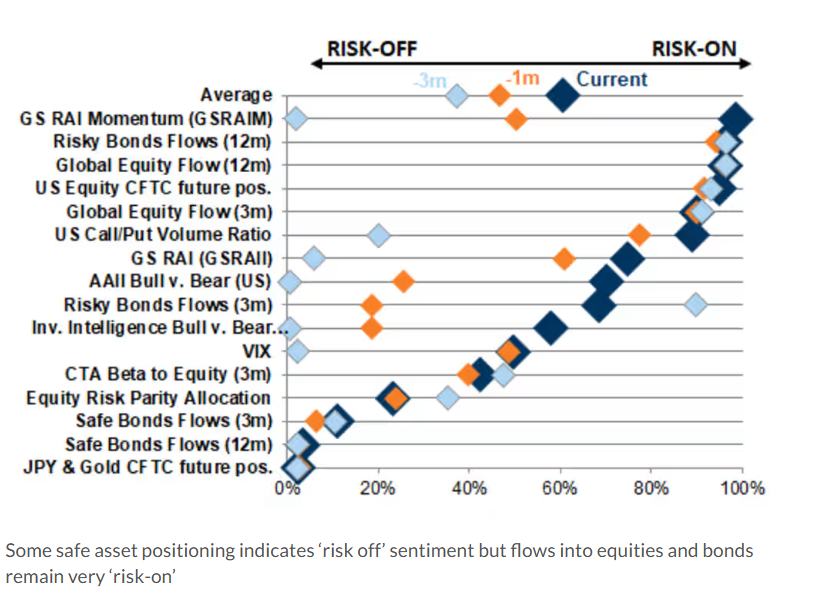
Core Viewpoint - The U.S. stock market, particularly the S&P 500 and Nasdaq 100 indices, has experienced a rapid recovery driven by strong performances from major tech companies amid an unprecedented AI boom, but faces significant risks that could disrupt this optimistic environment [1][2]. Group 1: Market Performance - The S&P 500 index closed at 6263 points, up 29% from its April low, nearing its historical peak of 6284 points [1]. - The MSCI global index also reached a historical high, influenced by the AI surge and easing geopolitical tensions, alongside expectations of interest rate cuts from the Federal Reserve [1]. Group 2: Economic Risks - Goldman Sachs identified three key risks threatening the "Goldilocks" market environment: economic stagnation or downturn, rising long-term bond yields, and a disordered decline of the dollar [2][6]. - The current market sentiment is characterized by high risk appetite, despite the S&P 500 reaching record highs, indicating a potential for negative asymmetry in the short term [3][5]. Group 3: Investment Strategies - To mitigate the identified risks, Goldman Sachs recommends diversifying into gold, select emerging markets, short-duration bonds, low-volatility defensive stocks, and financial stocks [2][7]. - The firm emphasizes the importance of hedging against potential declines in the dollar and inflationary pressures, as well as preparing for possible turbulence in the bond market due to rising yields [6][7].

美联储降息决策面临复杂局面 FOMC内部分歧日益浮现
Xin Hua Cai Jing· 2025-07-09 07:28
美联储6月会议纪要将于周三公布,市场关注FOMC内部对降息时点与节奏的详细讨论。 当前市场定价已反映美联储年内两次降息,任何超预期信号都将引发重新定价。会议纪要若呈现鸽派基 调,市场或进一步计价9月降息。若后续经济数据向好,9月降息概率亦可能下降。 6月会议的点阵图显示了美联储内部明显的分歧。一些政策制定者预计今年将有两次降息,而另一些人 则预测根本不会降息。摩根士丹利分析师表示,他们将寻找导致这种分歧的线索。更鹰派的委员可能会 表示,他们正在等待失业率上升,或者他们需要更多时间来评估关税和其他财政政策对通胀的影响。而 美联储主席鲍威尔曾表示,他预计关税的通胀效应将在今年夏天显现,并暗示美联储与宽松政策之间的 唯一障碍是这些价格压力的不确定性。如果会议纪要显示出对这一观点的部分认同,它可能标志着美联 储转向更积极主动的立场。 近期特朗普频繁批评鲍威尔降息迟缓,美联储理事沃勒与鲍曼先后提及7月降息可能性,引发市场对提 前行动的预期升温。沃勒指出招聘放缓迹象,初请与续请失业金人数持续上升支持其观点。鲍曼在6月 会议后罕见放鸽,与当时声明中"通胀上行、增长放缓"基调形成反差。沃勒与鲍曼此前并非典型鸽派, 其转变令市 ...
惊天警告!各国央行都开始担心美国“赖账”
Jin Shi Shu Ju· 2025-07-08 06:07
Group 1 - A survey commissioned by UBS found that nearly half of the central bank reserve managers believe a U.S. debt restructuring is a possible scenario [1] - Two-thirds of respondents expressed concerns about the independence of the Federal Reserve, and nearly half were uneasy about the quality of U.S. economic data and the weakening of the rule of law [1] - Despite concerns, 80% of respondents predict that the dollar will remain the world's reserve currency, although there is a growing drive for reserve diversification [1] Group 2 - Geopolitical issues remain a primary concern for central banks, but the potential impact of the Trump administration's trade and international alliance policies has become the top risk, with 74% of respondents mentioning it [2] - There is a significant increase in pessimism regarding the global economic outlook, with an equal number of respondents now expecting "stagflation" as the most likely outcome [2] - Nearly all reserve managers maintain a belief in diversification, with 67% considering gold to be the best-performing asset class until the end of the decade, a significant drop from 21% in the previous year's survey [2] Group 3 - Only one participant indicated that their central bank is considering investing in Bitcoin, although 13% believe Bitcoin will be the best-performing asset over the next five years [3]

华尔街到陆家嘴精选丨关税大限临近 市场何去何从?美国会发生滞涨?美元无可替代?AI芯片与主权AI双驱动 HBM赛道持续火热?
Di Yi Cai Jing· 2025-07-08 01:39
Group 1: Tariff and Economic Impact - The U.S. has extended the tariff suspension period to August 1, with new tax rates announced for 14 countries, impacting market expectations and causing a sell-off in U.S. stocks and bonds [1] - The current U.S. economy faces challenges such as declining GDP, high effective tax rates, and record fiscal and trade deficits, leading to speculation about potential tariff reductions [2] - The volatility in policy expectations, particularly regarding tariffs, is a significant factor behind the recent decline in U.S. stocks, with predictions of a further 5% adjustment if tariff threats remain unresolved [2] Group 2: Inflation and Economic Outlook - Renowned economist Nouriel Roubini predicts a "mini-stagflation shock" in the U.S. economy, with core PCE potentially reaching 3.5% by year-end, and suggests that the Fed may not lower interest rates until December [3] - Despite concerns about stagflation, corporate earnings remain strong, with S&P 500 companies reporting a 13% year-over-year profit increase, indicating resilience in certain sectors [3] Group 3: HBM Market Dynamics - The HBM (High Bandwidth Memory) market is expected to experience supply-demand tightness until 2027, driven by AI chip demand and technological advancements [7] - Major players like SK Hynix and Micron dominate the HBM market, which is projected to grow significantly, with a compound annual growth rate of 90% from $2.3 billion in 2022 to $30 billion by 2026 [7] Group 4: Japanese Economic Challenges - Japan's real wages have seen a significant decline of 2.9% year-over-year, the largest drop in 20 months, indicating challenges in consumer purchasing power despite a rise in consumer spending [9][10] - The disparity in wage growth between unionized and non-unionized workers highlights structural imbalances in the Japanese economy, which may be further impacted by U.S. tariff policies [10][11]

减税刺激难掩赤字隐忧,美国“大而美”法案经济效应几何
2 1 Shi Ji Jing Ji Bao Dao· 2025-07-07 11:43
Core Points - The "Big and Beautiful" tax and spending bill signed by President Trump on July 4 marks a significant legislative move, reflecting Republican priorities and diminishing Democratic political capital [1][2] - The bill extends many provisions of the 2017 Tax Cuts and Jobs Act, increasing tax exemptions and military spending while cutting social welfare programs [1][3] - Critics argue that the bill disproportionately benefits high-income earners and exacerbates income inequality, with potential negative impacts on low-income households [2][6] Tax and Spending Provisions - The bill raises tax exemption thresholds, including a $25,000 exemption for tip income and a $12,500 exemption for overtime income, while also increasing military spending by $157 billion [1][3] - It eliminates subsidies for clean energy and imposes stricter work requirements for Medicaid, affecting over 7 million people by 2034 [3][4] - Food stamp benefits will be reduced for approximately 40 million people, impacting vulnerable populations including children and the elderly [3][4] Economic Implications - The effectiveness of the tax cuts in stimulating economic growth is questioned, with historical data suggesting limited impact on growth and increasing federal debt [7][8] - The new tariffs are expected to have a negative effect on the economy, with rising consumer costs and potential inflationary pressures [8][9] - Employment levels may not improve significantly, as the bill's measures to increase work requirements could overlook the contributions of undocumented workers [9] Political Context - The passage of the bill reflects a partisan divide, with Republicans leveraging their slim majority to push through legislation that may disadvantage Democrats ahead of the midterm elections [2][6][10] - The upcoming midterm elections will serve as a referendum on the bill, influencing the political landscape for both parties [10]
研客专栏 | 非农为啥“吓不到”市场?
对冲研投· 2025-07-04 11:19
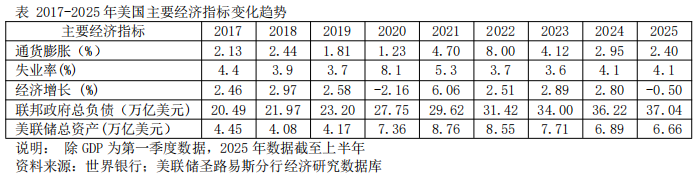
Core Viewpoint - The article discusses the recent U.S. employment data, highlighting its implications for the economy and market sentiment, particularly regarding the Federal Reserve's interest rate decisions and the potential for market volatility. Employment Data Analysis - The June non-farm payrolls showed a surprising increase of 147,000 jobs, exceeding the expectation of 110,000, indicating strong resilience in the labor market [6][10] - The unemployment rate unexpectedly dropped from 4.2% to 4.1%, breaking the market expectation of 4.3% [13] - State and local government hiring was a significant contributor to the job growth, with an increase of 48,000 jobs [10] Market Reactions - Following the employment data release, U.S. stock indices like the S&P 500 and NASDAQ reached new highs, while the dollar stabilized [8] - The market's confidence was reflected in the continued rise of stock prices despite a decrease in interest rate expectations [8][6] Federal Reserve's Position - The employment data provides a relatively comforting signal for the Federal Reserve, reducing the urgency for intervention in the labor market [6] - Market expectations for interest rate cuts have been adjusted, with the anticipated number of cuts for the year reduced to two [6] Wage and Hour Growth - Average hourly earnings increased by only 0.2% month-over-month, below the expected 0.3%, indicating a slowdown in wage growth [20] - The average workweek for private non-farm employees slightly decreased by 0.1 hours to 34.2 hours, suggesting potential recruitment demand risks [20] Sector-Specific Insights - Private sector employment saw a surprising decline of 63,000 jobs, primarily due to a slowdown in service sector demand [17] - Manufacturing employment continued to face challenges, with negative growth persisting due to tariff impacts and rising costs [17] Potential Risks - The article notes potential downward risks, including the impact of federal government layoffs and a decrease in private sector demand, which could affect future economic growth [15][17]

【民生证券:降息救不了美国】7月3日讯,美国总统特朗普持续施压美联储降息,市场也因应近期就业数据逊预期而加大今年降息预期,利好短期股市表现。民生证券研究院首席经济学家陶川与团队指出,现在降息难以解决当下美国政府债务与滞胀环境问题,一来美元贬值带来的输入性通胀会影响降息的执行,二来过去高息环境导致美国私人部门持有愈来愈多美国国债,降息反而会损害美国人的财富。
news flash· 2025-07-03 06:22
Core Viewpoint - The current interest rate cuts in the U.S. may not effectively address the issues of government debt and stagflation, as highlighted by Minsheng Securities' chief economist Tao Chuan and his team [1] Group 1: Economic Environment - President Trump is pressuring the Federal Reserve to lower interest rates, which has led to increased market expectations for rate cuts this year due to disappointing recent employment data [1] - The depreciation of the dollar is causing imported inflation, which complicates the implementation of interest rate cuts [1] Group 2: Impact on Debt and Wealth - The high-interest environment in the past has resulted in the private sector holding an increasing amount of U.S. government debt, suggesting that lowering interest rates could negatively impact American wealth [1]