
低利率

Search documents
股神卸任前的最后一份财报来袭:伯克希尔哈撒韦现金再创新高
Feng Huang Wang· 2025-11-01 13:52
Group 1 - Berkshire Hathaway reported a 33.6% year-over-year increase in operating profit for Q3, with a record cash reserve of $382.7 billion [1] - Total revenue for Q3 reached $94.972 billion, a 2% increase year-over-year, exceeding market expectations of $91.55 billion; net profit was $30.796 billion, up 17% and also surpassing expectations of $12.73 billion [1] - The operating profit, which is highly valued by Buffett, was $13.485 billion, significantly up from $10.09 billion in the same period last year [1] - For the first nine months of the year, total revenue was $277.212 billion, a 0.25% year-over-year increase, while net profit fell over 30% to $47.993 billion [1] - Berkshire remains cautious about the market and valuations, having not repurchased any stock by the end of September, indicating a belief that the current stock prices are too high [1] Group 2 - This financial report is the last one before Buffett steps down as CEO, with Greg Abel set to take over at the end of the year [2] - Since the announcement of Buffett's retirement, Berkshire's Class B shares have dropped by 11%, while the S&P 500 has risen by 20%, raising concerns about the company's future operations post-Buffett [2] - Analysts have downgraded Berkshire Hathaway's stock rating to "underperform" due to potential pressures on its insurance business from falling prices in property catastrophe reinsurance and geopolitical conflicts affecting railway revenue [2] - Despite recent stock price declines, some investors, like Henry Asher from Polaris Group, continue to hold Berkshire shares, believing that the company's cash flow generation will remain strong regardless of Abel's performance [2] Group 3 - Buffett is expected to deliver a Thanksgiving address to shareholders on November 10, which may be his last speech to them [3]
低利率:繁荣的开始,还是灾难的序章?
伍治坚证据主义· 2025-10-31 01:23
Core Insights - The article discusses the South Sea Bubble and the subsequent railway mania in 18th and 19th century Britain, highlighting the role of low interest rates, compelling narratives, and financial innovations in creating speculative bubbles [2][17][20] Group 1: South Sea Bubble - In the early 18th century, Britain faced a financial crisis with national debt exceeding £35 million, prompting the creation of the South Sea Company to convert debt into equity [2][3] - The South Sea Company was established in 1711, allowing creditors to exchange government bonds for company shares, effectively reducing the government's interest payments from 8% to 5% [2][3] - By 1720, the company's stock price skyrocketed from £128 to over £950 within months, fueled by speculative investments despite the lack of actual trade with Spanish colonies [5][8] - The company's profits were largely illusory, as actual trade was minimal, leading to a collapse when the illusion of wealth was exposed [8][9] - A political scandal involving bribery further eroded investor confidence, resulting in a dramatic fall in stock prices and widespread financial ruin [10][11] Group 2: Railway Mania - Following the South Sea Bubble, the 1830s saw a new wave of speculation during the railway boom, with the Bank of England lowering discount rates to 2% to stimulate investment [11][15] - The rapid expansion of the railway network saw investments soar, with the number of railway companies and stock prices doubling within a few years [13][14] - However, by 1846, the railway bubble began to burst as rising costs and a lack of actual funding led to a significant decline in stock prices, with an average drop of 30%-40% [15][16] - The financial panic of 1847 resulted in widespread bank failures and a collapse of the railway stock market, with losses amounting to £80 million, equivalent to 15% of the GDP at the time [16][17] Group 3: Common Themes - Both the South Sea Bubble and railway mania illustrate how low interest rates, enticing narratives, and financial innovations can lead to speculative excesses [17][20] - The article emphasizes that low interest rates can create a false sense of security, leading to over-leveraging and eventual market corrections [20][22] - Historical patterns of greed and fear are highlighted, suggesting that speculative bubbles are a recurring phenomenon driven by human psychology rather than isolated incidents [20][22]


浙商早知道-20251031
ZHESHANG SECURITIES· 2025-10-30 23:35
Market Overview - On Thursday, the Shanghai Composite Index fell by 0.7%, the CSI 300 decreased by 0.8%, the STAR Market 50 dropped by 1.9%, the CSI 1000 declined by 1.1%, the ChiNext Index fell by 1.8%, and the Hang Seng Index decreased by 0.2% [4] - The best-performing sectors on Thursday were steel (+0.9%), non-ferrous metals (+0.8%), utilities (+0.1%), transportation (+0.1%), and banking (+0.1%). The worst-performing sectors were telecommunications (-2.8%), electronics (-2.2%), defense and military (-2.0%), media (-1.9%), and comprehensive (-1.8%) [4] - The total trading volume of the Shanghai and Shenzhen markets on Thursday was 24,217 billion yuan, with a net inflow of southbound funds amounting to 13.64 billion Hong Kong dollars [4] Important Insights Fixed Income Credit Bonds - The report defines exiting the low-interest rate environment as the 10-year government bond yield rising trend-wise above 2%. It notes that overseas economies typically exit low rates due to a combination of improving fundamentals and tightening monetary policy. In contrast, while China's economy is in a mild recovery phase, there is a lack of fundamental and policy support for a significant rise in interest rates in the short term, suggesting that the low-interest rate environment may persist for a longer duration. Based on overseas experiences, the median duration for major economies to exit low rates is 4.77 years, implying that China may require an additional 4 years to exit this phase [5] Macroeconomic Research - The report discusses the hawkish guidance from Powell regarding a potential rate cut in December, stating that there is "no conclusion yet." Market expectations for rate cuts may narrow, with no change in viewpoints. The driving factors include data releases, and there is a focus on the potential for the Federal Reserve to restart normalizing balance sheet expansion in 2026 [7][8]
低利率为何成为“超级央行周”共识?
2 1 Shi Ji Jing Ji Bao Dao· 2025-10-30 23:04
Group 1 - The Federal Reserve officially announced a 25 basis point interest rate cut on October 29, lowering the target range for the federal funds rate to 3.75%-4.00% [2] - The rationale behind the rate cut includes rising inflation rates and increased uncertainty in economic prospects, with a focus on achieving maximum employment and a 2% inflation rate in the long term [2][3] - The latest core inflation (PCE) in the U.S. is reported at 2.7%, showing an upward trend from previous values of 2.6%, 2.5%, and 2.3% [2] Group 2 - The U.S. GDP growth rate for the first quarter was -0.6%, marking the first negative growth since Q1 2022, while the second quarter saw a growth of 3.8%, which is still concerning compared to historical data [3] - The unemployment rate has risen to 4.3%, up from 4.2% and 4.1% in previous months, triggering the Federal Reserve's monetary policy adjustment mechanisms [3] Group 3 - The Federal Reserve's independence may be compromised due to political pressures, with changes in the FOMC voting committee composition expected next year [4] - The current trend indicates a likelihood of global interest rates declining, as evidenced by the European Central Bank's continuous rate cuts since June of the previous year [4] Group 4 - Japan's central bank maintained its benchmark interest rate at 0.5% despite rising core CPI, indicating that trade tensions may have a more significant impact on economic growth than inflation and employment [5] - Global central banks are increasingly concerned about economic growth uncertainties, reflected in fluctuations in international gold prices and long-term bond sell-offs [5]

理财公司加大多元产品布局,非固收产品占比提升
2 1 Shi Ji Jing Ji Bao Dao· 2025-10-28 09:12
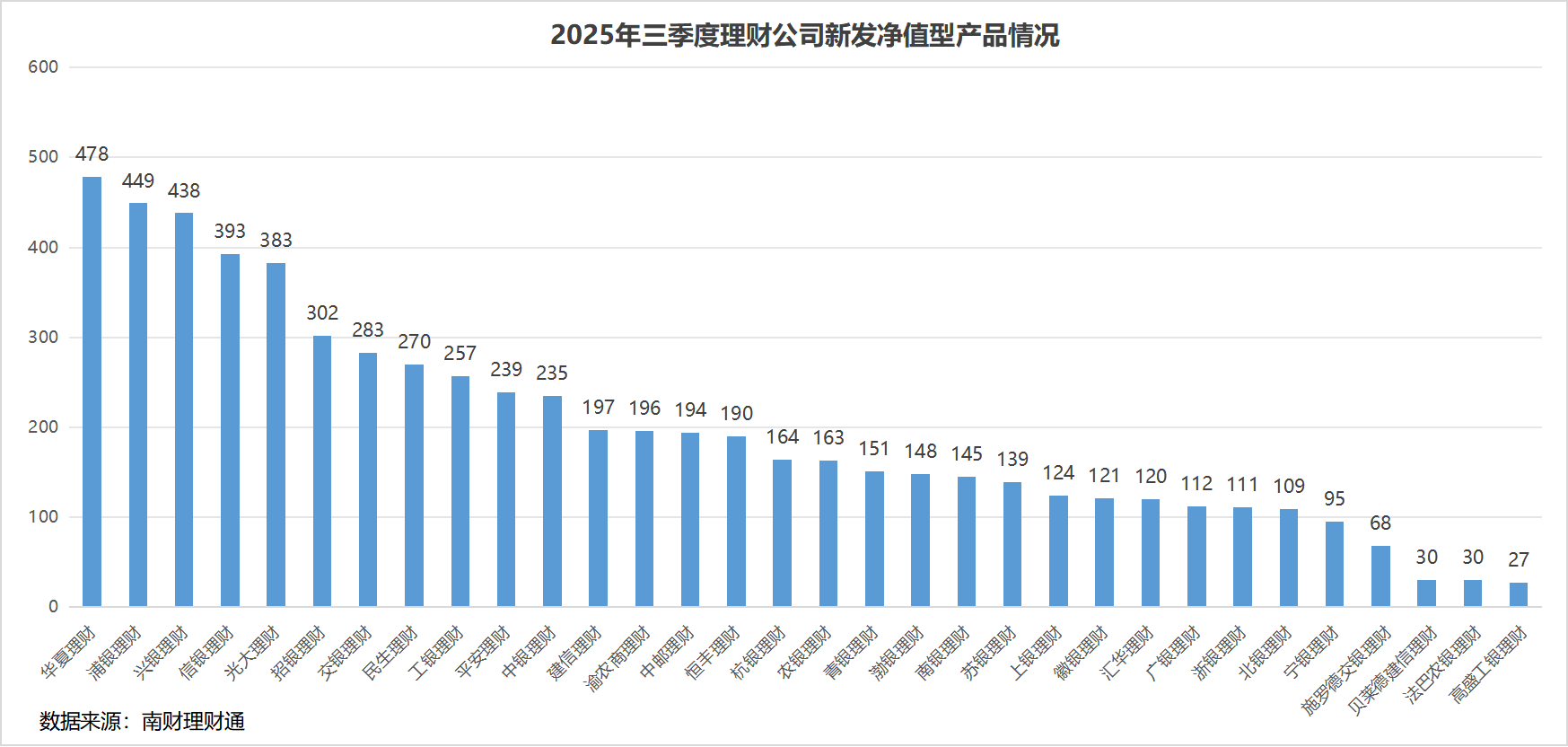
Core Insights - The issuance of wealth management products has steadily increased, with 32 companies issuing 6,361 net value-based products in Q3 2025, representing a year-on-year increase of over 40% compared to Q3 2024 [1][2] - The overall market size for wealth management products reached 32.13 trillion yuan by the end of Q3 2025, reflecting a year-on-year growth of 9.42% [1] - There is a notable shift towards short-term, open-ended, and high-liquidity products, as well as a diversification in asset allocation strategies among wealth management companies [7] Product Issuance - In Q3 2025, the number of net value-based products issued increased by 42.21% year-on-year, with the highest issuance from Huaxia Wealth Management, Puyin Wealth Management, and Xingyin Wealth Management [2][4] - The proportion of fixed-income products decreased slightly to 97.89%, while mixed and equity products saw an increase in issuance [4] - Publicly offered products accounted for over 95.6% of the total, while privately offered products made up 4.4% [4] Investment Trends - The trend towards shorter investment durations is evident, with products having a maturity of less than one month exceeding 20%, reaching 22.6%, an increase of 3.76 percentage points year-on-year [5] - The proportion of products with maturities of 6-12 months has decreased significantly, dropping by 5.03 percentage points compared to Q3 2024 [5] Pricing Trends - The performance benchmark for wealth management products has been on a downward trend since 2024, with the average rate for products with a maturity of less than one month falling to 1.88% by June 2025 [8][9] - The pricing consensus among wealth management companies indicates a long-term low interest rate environment, with many products now priced below 2.5% for maturities over three years [8] Fundraising Performance - The total fundraising amount for newly issued products in Q3 2025 was approximately 946.59 billion yuan, with an average fundraising size of 258 million yuan, reflecting an 8.83% decline year-on-year [10] - The top fundraising products were primarily low to medium-risk, closed-end, fixed-income products, indicating a conservative investment approach among investors [11][13]
理财季度盘点①丨理财公司加大多元产品布局,非固收产品占比提升
2 1 Shi Ji Jing Ji Bao Dao· 2025-10-28 08:49
Core Insights - The issuance of wealth management products has steadily increased, with 32 wealth management companies issuing 6,361 net value-based products in Q3 2025, representing a year-on-year increase of over 40% compared to Q3 2024 [1][2] - The total market size of wealth management products reached 32.13 trillion yuan by the end of Q3 2025, reflecting a year-on-year growth of 9.42% [1] - There is a notable shift towards higher liquidity and shorter-term products, with a significant increase in the issuance of mixed and equity products [1][4] Product Issuance - In Q3 2025, the issuance of wealth management products saw a 42.21% increase year-on-year, with 6,361 products compared to 4,473 in Q3 2024 [2] - The proportion of fixed-income products decreased to 97.89%, while mixed and equity products saw an increase, with 106 mixed products and 11 equity products issued [2] - Major contributors to product issuance include Huaxia Wealth Management, with 478 products, and other leading firms like Ping An and Xingyin [2] Product Structure - Publicly offered products accounted for 95.6% of total issuance, while privately offered products made up 4.4% [3] - The proportion of closed-end net value products fell below 60% to 57.7%, a decrease of 10.77 percentage points year-on-year, while open-end products rose to over 40% [3] - Short-term products (less than 1 month) now account for 22.6%, an increase of 3.76 percentage points from the previous year [3] Pricing Trends - The performance benchmark for bank wealth management products has been on a downward trend since 2024, driven by lower underlying asset yields and stricter regulations [5] - The average pricing for products across various terms has generally declined, with products under 1 month dropping to 1.88% by June 2025 [6] Fundraising Performance - The overall fundraising scale for newly issued products in Q3 2025 was 946.59 billion yuan, with an average fundraising size of 258 million yuan, down 8.83% from the previous year [7] - The most successful product in terms of fundraising was "Anying Xiang Fixed Income Stable Profit No. 14," which raised over 100 billion yuan [7] - The top products in fundraising were primarily low to medium risk, closed-end, and fixed-income products, indicating a conservative investment approach among investors [7]
央行动态跟踪系列14:类QE:央行恢复国债买卖意欲何为?
Changjiang Securities· 2025-10-27 23:31
Group 1: Government Debt Supply and Fiscal Pressure - The total new government bonds, local bonds, replacement bonds, and quota space usage in 2025 is estimated to be approximately CNY 14.4 trillion, leading to a total government debt balance of about CNY 96 trillion by year-end, representing a year-on-year growth rate of 17%[2] - By the end of 2024, the balance of national and local government bonds is expected to be around CNY 35 trillion and CNY 48 trillion respectively, totaling approximately CNY 82 trillion[8] - The average interest rate on government bonds and local general bonds is approximately 2.6%, with total interest payments around CNY 2 trillion in 2024[8] Group 2: Monetary Policy and Market Impact - The central bank's resumption of national bond trading is timely, given the current economic pressures and uncertainties, including U.S.-China tariff disputes[10] - The combination of "big fiscal" and "low interest rates" is expected to create a favorable environment for both stock and bond markets, similar to Japan's experience during the 1%+ interest rate era[11] - The central bank's actions aim to maintain liquidity and control interest rates at acceptable levels amidst increasing fiscal pressure and rising interest rates[9] Group 3: Risks and Economic Outlook - There are uncertainties regarding overseas monetary policies, which may affect domestic economic recovery and fiscal sustainability[12] - The economic growth in Q4 may face pressure due to fiscal contraction and high base effects, necessitating supportive monetary policies[10] - The potential for economic recovery may be weaker than expected, with insufficient confidence among residents and businesses impacting social financing and M2 growth[12]
专家:利率机制对实体经济的传导效应进一步提升
Xin Hua Cai Jing· 2025-10-15 14:15
Core Viewpoint - The People's Bank of China reported that as of the end of September, the total social financing stock exceeded 430 trillion yuan, indicating a substantial financial scale that meets the financing needs of the real economy, aligning with the shift from high-speed to high-quality economic development [1] Financial Metrics - As of September, M2 balance surpassed 330 trillion yuan, while the balance of RMB deposits exceeded 320 trillion yuan and loan balance exceeded 270 trillion yuan [1] - The average weighted interest rate for newly issued corporate loans and personal housing loans in September was approximately 3.1%, which is about 40 and 25 basis points lower than the same period last year, respectively [1] Economic Context - Current macroeconomic conditions are characterized by insufficient demand, low inflation, and low interest rates, with private sectors being more sensitive to interest rates [1] - The financial impact on the real economy will primarily occur through interest rate pathways, emphasizing the importance of understanding interest rate implications and the coordination between different market rates [1]
These 2 gold ETFs are up nearly 400 percent in 2025
Yahoo Finance· 2025-10-07 23:37
Group 1: Gold Price and Market Performance - Gold reached $4,000 an ounce for the first time on October 7, marking a 50% increase in prices so far in 2025 [1] - Gold ETFs have seen over $36 billion in net inflows in 2025, making it one of the year's most successful asset classes [1] Group 2: Gold Miners' Performance - Gold miners have benefited from rising gold prices, leveraging fixed mining costs to improve profits and margins significantly [2] - The VanEck Gold Miners ETF (GDX) has increased by 132% year-to-date through October 6, with leveraged versions performing even better [3] Group 3: Leveraged ETFs - Leveraged gold miner ETFs, such as Direxion Daily Gold Miners Index Bull 2X Shares ETF (NUGT) and Direxion Daily Junior Gold Miners Index Bull 2X Shares ETF (JNUG), have seen returns nearly 400% [7] - Leveraged ETFs are designed to deliver a multiple of the daily return of the underlying asset, making them suitable for upward-trending markets [5][6] Group 4: Market Drivers - Safe haven demand has increased due to concerns about the labor market, inflation, and global demand, prompting investors to reduce risk [8] - Central banks globally have been increasing gold reserves as part of de-dollarization efforts [8] - Lower interest rates enhance the attractiveness of non-yielding assets like gold [8]
Gold price today, Thursday, October 9: Gold opens at $4,061.80 as geopolitical tensions ease
Yahoo Finance· 2025-10-06 11:57
Core Insights - Gold futures opened at $4,061.80 per ounce, reflecting a 0.5% increase from the previous day's close of $4,043.30, with a year-to-date gain of 54.3% [1][2] - Geopolitical conflicts, particularly in the Middle East and Ukraine, have significantly contributed to the rise in gold prices, with a recent ceasefire agreement between Israel and Hamas marking a potential turning point [1] - Economic uncertainty in the U.S., central bank demand for gold, and the possibility of lower interest rates later this year are additional factors supporting high gold values [2] Price Trends - The opening price of gold futures on Thursday is up 5.3% from the opening price of $3,856.20 one week ago [2] - In the past month, gold futures have increased by 11.4% from the opening price of $3,647.10 on September 9 [2] - Over the past year, gold prices have risen by 56% from the opening price of $2,603 on October 9, 2024 [2] Industry Monitoring - Investors can track gold prices continuously through platforms like Yahoo Finance, which offers 24/7 monitoring [3] - There are opportunities to explore top-performing companies in the gold industry using screening tools available on financial platforms [3] Investment Opportunities - Establishing a gold IRA can provide tax benefits while diversifying retirement wealth through the holding of gold and other precious metals [4] - A gold IRA is a specialized self-directed IRA designed specifically for precious metals, allowing for potential tax perks [4]