
债务可持续性

Search documents
2025年中展望:宏观、股票、零售、基金、住房抵押贷款支持证券、商业抵押贷款支持证券和贷款抵押债券洞察
Refinitiv路孚特· 2025-09-04 06:02
Core Viewpoint - The global market is showing cautious optimism in the first half of 2025, rebounding from tariffs, interest rate uncertainties, and debt concerns, with stocks, bonds, and commercial real estate (CRE) sectors demonstrating resilience [5][6]. Group 1: Macroeconomic Themes - De-globalization, monetary policy divergence, and debt sustainability are the three dominant themes in the global macroeconomic landscape [6][8]. - Concerns over tariffs and trade tensions have highlighted the trend of de-globalization, with initial fears easing as the year progressed [6][8]. - The debt-to-GDP ratio in the US and UK has surpassed 100%, raising concerns about government debt sustainability and leading to a steeper yield curve [6][8]. Group 2: Market Performance - After a sharp sell-off in the first quarter due to tariff announcements, the stock market experienced a V-shaped recovery, with the S&P 500 showing strong earnings performance [8][10]. - Global market earnings revisions appear to have bottomed out, indicating a potential turning point as earnings expectations remain resilient [10]. - The retail sector saw a decline in earnings growth, with a projected -1.7% in the second quarter, marking the first negative growth since the pandemic [14]. Group 3: Real Estate and Mortgage-Backed Securities - The institutional residential mortgage-backed securities (RMBS) market showed resilience due to stable new issuance and improving market sentiment [16]. - Housing activity has slightly rebounded, supported by increased inventory and builder incentives, helping to offset affordability pressures [16]. - The outlook for commercial real estate (CRE) and commercial mortgage-backed securities (CMBS) issuance is expected to improve, with refinancing volumes anticipated to rise due to expected Fed rate cuts [8][19]. Group 4: Credit Market Outlook - Expectations of Fed rate cuts later in the year are providing new momentum for the collateralized loan obligation (CLO) market, with revised forecasts for refinancing and reset issuance [19]. - The overall credit fundamentals for CLOs are expected to remain stable, with a slowdown in rating downgrades anticipated by year-end [19]. - The projected issuance for BSL new AAA and BB rated bonds is expected to narrow to 125 basis points and 500 basis points, respectively, by year-end [19].


不确定的财政预算及央行前景导致全球债券被抛售
Xin Hua Cai Jing· 2025-09-03 13:56
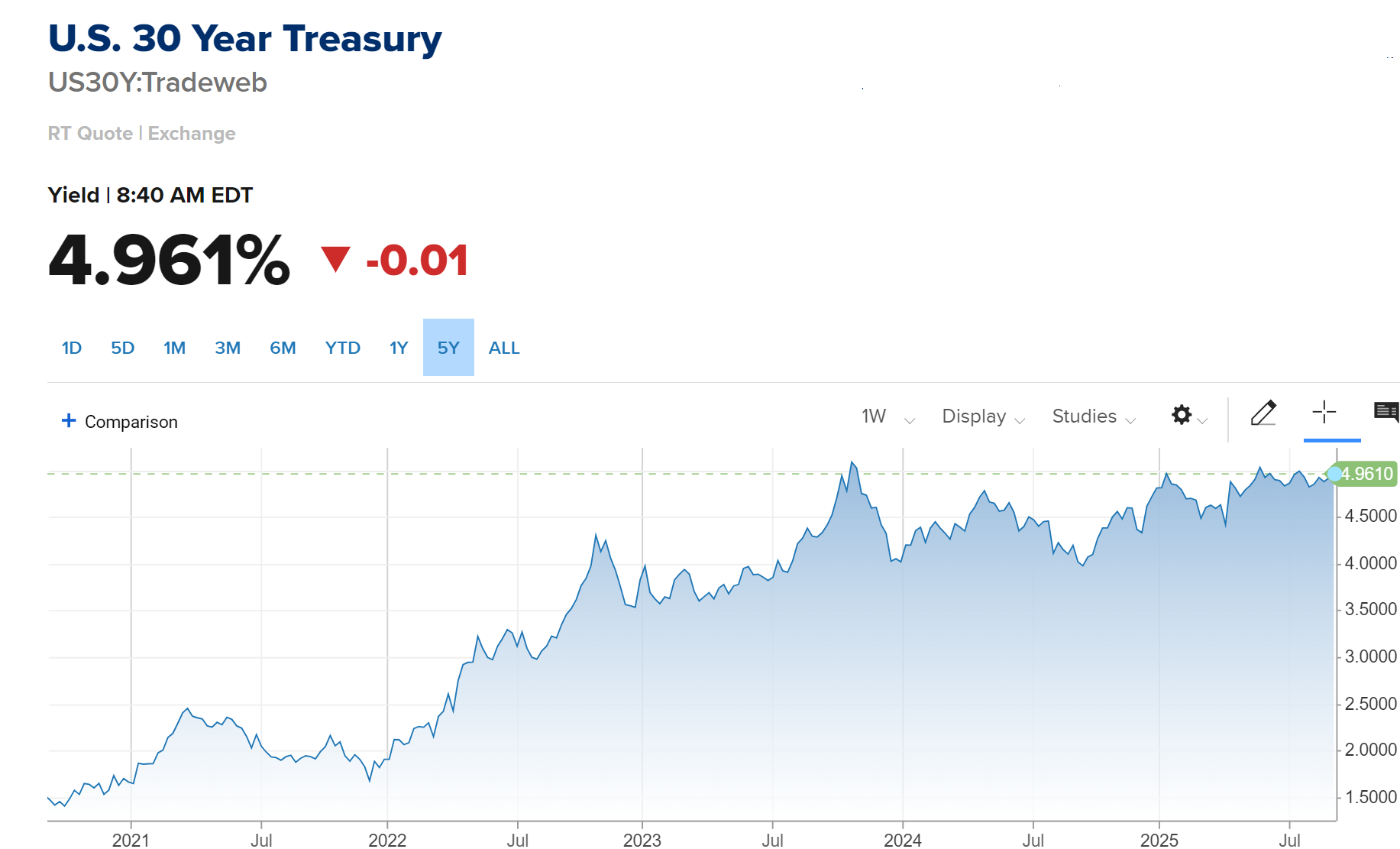
Group 1 - The core viewpoint of the articles indicates that the U.S. Treasury yields are experiencing fluctuations due to concerns over trade policies, budget deficits, and overall economic conditions, leading to a decline in market sentiment [1][4][6] - As of September 3, 2023, the 2-year Treasury yield decreased by 0.6 basis points to 3.649%, the 10-year yield fell by 0.2 basis points to 4.275%, and the 30-year yield dropped by 1 basis point to 4.963% [1] - The yield spread between the 10-year and 2-year Treasuries narrowed by 3 basis points to 62 basis points, indicating changing investor sentiment towards long-term debt [1][4] Group 2 - Concerns over increasing government debt and political pressures on central banks are causing investors to withdraw from government bonds, with gold prices reaching a record high of $3,550 [4][6] - The yield on 30-year French government bonds has surged to 5%, the highest level since 2009, raising sustainability concerns regarding France's debt [4][6] - The U.S. Treasury is expected to issue $650 billion in short-term debt this week, reflecting the need for significant funding despite the current market conditions [8]
谁持有主权债,以及它为什么重要 | 论文故事汇
清华金融评论· 2025-08-30 10:48
Core Viewpoint - The article discusses the increasing global debt levels over the past two decades and emphasizes the importance of understanding the composition of sovereign debt holders, which has been underexplored in existing literature [3][5]. Group 1: Research Background and Data Construction - The paper constructs a dataset of sovereign debt holders across 101 countries from 1991 to 2018, categorizing investors into six types: domestic banks, private non-banks, official investors, foreign banks, foreign private non-banks, and foreign official investors [5][4]. - The dataset integrates data from multiple sources, including the IMF, World Bank, and central banks, covering 24 developed countries, 48 emerging markets, and 29 developing countries [5][4]. Group 2: Marginal Holders of Government Debt - The study finds that private non-bank investors hold 62% of newly issued debt on the margin, despite averaging only 44% of total sovereign debt holdings [7]. - In developed, emerging, and developing countries, private non-bank investors are the most active marginal investors, with emerging markets showing significant contributions from both domestic and foreign private non-banks [7]. Group 3: Analysis of Private Non-Bank Institutions - The paper segments private non-bank investors into domestic and foreign categories, revealing that in the U.S. Treasury market, 70% of marginal holdings by domestic private non-banks come from money market funds and hedge funds [9]. - In the UK, insurance and pension funds account for 50% of domestic private non-bank marginal holdings, while in the Eurozone, investment funds dominate with 78% of marginal holdings in foreign sovereign debt [9]. Group 4: Demand Elasticity Analysis of Sovereign Debt - The paper develops a framework to analyze the demand elasticity of sovereign debt, focusing on how price changes affect investor demand [10][12]. - It finds that private non-bank institutions exhibit higher demand price elasticity compared to banks, with foreign private non-bank investors showing a demand price elasticity of -9.74, indicating a strong sensitivity to price changes [12].

Gold Might Be Frontrunning The Fed
Benzinga· 2025-08-29 16:55
Core Viewpoint - Gold has experienced a consolidation phase after reaching an all-time high of $3,500 per ounce in April, forming an ascending triangle that may lead to a breakout and new highs [1] Market Sentiment - Gold is not waiting for the Federal Reserve's next announcement and is already responding to dovish remarks from Chairman Jerome Powell [2] - Traders are anticipating a potential rate cut in September and a policy direction influenced by Powell and possibly his successor, as markets react to expectations rather than confirmations [3] Political Influence - President Donald Trump's comments regarding the Federal Reserve and monetary policy are causing unease among investors, which may benefit gold as credibility concerns rise [4] Central Bank Behavior - For the first time since 1996, foreign central banks hold more gold than U.S. Treasuries in their reserves, reflecting concerns about U.S. debt sustainability and a desire for a neutral reserve asset [5] - This official-sector demand for gold provides a supportive price floor, independent of short-term interest rate fluctuations or dollar movements [5] Geopolitical Factors - Geopolitical uncertainties, including energy markets and trade disputes, are driving investors towards hard assets like gold, which is already factoring in various political risks and shifts in the global monetary landscape [6] Technical Analysis - Gold has been forming higher lows against a flat resistance level between $3,430 and $3,450, indicative of an ascending triangle pattern that typically leads to upward breakouts [7] - The target price for gold, based on the triangle's height, is projected to be approximately $3,800, calculated by adding the triangle's height of about $360 to the breakout level [9] Short to Medium Term Outlook - The immediate focus is on whether gold can surpass the $3,450 resistance and retest the $3,500 level, with a successful breakout potentially targeting the $3,800 area in the medium term [10] - Breakout volume will be crucial for investors to assess the validity of the breakout, which could occur suddenly and sharply without a clear fundamental catalyst [10]

德债、法债、英债、日债 齐齐遭遇“黑色八月”
财联社· 2025-08-29 02:19
Core Viewpoint - The global bond market is experiencing significant volatility, with major government bonds in Germany, France, the UK, and Japan all showing substantial declines in August, indicating a challenging environment for investors and governments alike [1][4]. Group 1: Bond Market Performance - In August, the 30-year bond yields for Germany and France reached their highest levels since 2011, while Japan's 30-year bond yield hit a historical high [1]. - The yields for German and French long-term bonds increased by approximately 15 basis points and 27 basis points, respectively, marking the largest monthly rise since March [6]. - The demand for Japanese 20-year bonds showed signs of weakness, with the auction subscription ratio dropping to 3.09 times, down from 3.15 times in July [10]. Group 2: Government Challenges - Governments are facing higher spending demands and increased debt repayment costs, complicating their ability to issue more bonds [4]. - Political uncertainty in France and concerns over the independence of the Federal Reserve are causing investors to remain cautious [5]. - The upcoming trust vote on France's debt reduction plan highlights the challenges faced by policymakers in addressing public finance issues [6]. Group 3: Economic Outlook - The International Monetary Fund (IMF) predicts a slowdown in global economic growth from 3.3% in 2024 to 3% this year, making it harder for countries to reduce debt [9]. - Analysts expect that the bond issuance in Europe will exceed €100 billion (approximately $117 billion) in September and October [9]. - The Dutch pension sector's reform, transitioning to a fixed contribution system, is anticipated to further suppress demand for long-term European debt [9]. Group 4: Market Sentiment - The increase in bond supply may lead to an imbalance in supply and demand, pushing yields higher [10]. - Concerns over the independence of the Federal Reserve are leading investors to demand higher premiums for holding U.S. Treasuries [11]. - The global bond market is described as being in a "fragile state," with rising borrowing levels posing risks to the global economy [11].

美债“升升不息”威胁全球经济
Jing Ji Ri Bao· 2025-08-15 22:59
Group 1 - The total U.S. national debt has surpassed $37 trillion, a figure that exceeds earlier predictions by several years, indicating a rapid increase in debt levels [1][2] - The U.S. government is facing significant pressure due to $9.3 trillion in short-term debt maturing by 2025, requiring daily repayments of approximately $25 billion [2] - Interest payments on the national debt are projected to reach $1.2 trillion annually, becoming the second-largest expenditure for the federal government, surpassing military spending [2] Group 2 - The U.S. fiscal policy is characterized by a "path dependency" that makes it easier to loosen than to tighten, as evidenced by the recent $5 trillion debt increase authorized by the "Big and Beautiful" act [2][3] - The U.S. GDP for 2024 is estimated at $29.18 trillion, with national debt accounting for approximately 126.8% of GDP, highlighting severe fiscal imbalance [2] - The current economic environment has led to rising mortgage and auto loan rates, reduced business investment, and increased prices for goods and services, indicating a potential recession [3] Group 3 - The long-term outlook for the U.S. debt situation appears bleak, with historical attempts at bipartisan debt reform failing and a lack of fundamental reform motivation [4] - The credibility of U.S. Treasury bonds is declining, as evidenced by the loss of the AAA rating from major credit agencies and a decrease in international demand for long-term bonds [4] - The inversion of yield curves between short-term and long-term bonds suggests a pessimistic market outlook for the U.S. economy, with investors favoring short-term securities [4] Group 4 - The International Monetary Fund warns that U.S. fiscal expansion is driving up national debt yields, which could lead to liquidity shocks and increased global financial uncertainty [5] - There is a growing demand in Asia for local currency transactions as a response to the risks associated with U.S. debt, indicating a shift towards a more diversified currency system [5]
每日机构分析:7月22日
Xin Hua Cai Jing· 2025-07-22 11:45
Group 1 - Goldman Sachs reports that global investment, manufacturing employment, spending, and overall economic activity remain robust despite uncertainties and challenges [2] - Global trade remains active, indicating the persistence and importance of international trade, with significant rebounds in stock markets across the Atlantic [2] - Moody's analysis suggests that the outcome of Japan's Senate elections may hinder the government's efforts to advance fiscal consolidation in the post-pandemic era [2] Group 2 - Deutsche Bank strategists warn that if the US confirms tariff increases on August 1 alongside disappointing employment reports, it could trigger renewed recession fears [3] - Concerns over the sustainability of US debt may become a central topic of discussion in the market for the second half of the year, with long-term Treasury yields facing upward pressure [3] - Current 10-year US Treasury yield has risen by 2 basis points to 4.392% [3]


宏观| “解雇”鲍威尔?
2025-07-21 00:32
Summary of Conference Call Records Industry Overview - The current external demand sector is experiencing intense competition, leading companies to increase supply and reduce prices to capture market share, resulting in fixed asset turnover rates dropping to historical lows, indicating potential oversupply in strong demand areas compared to internal demand sectors which remain at historical median levels [1][5] Key Insights and Arguments - The recent "anti-involution" policy is not a comprehensive contraction of upstream supply but focuses on downstream industries such as automotive and food delivery, contrasting significantly with the 2016 supply-side reforms [1][2] - To address "sneaky" new production capacity in manufacturing, measures such as self-discipline talks, industry mergers and acquisitions, raising technical standards, and strengthening regulation to eliminate outdated equipment can be implemented [1][6] - The policy to eliminate old equipment can significantly alleviate involution in the short term without major impacts on employment, potentially increasing the Producer Price Index (PPI) by one percentage point and boosting industrial enterprise profit growth by two percentage points [1][7] - Current demand-side policies should avoid stimulating demand in oversupplied areas and instead guide demand in non-oversupplied sectors, such as services, to achieve a rebalancing of demand structure [1][8][9] Additional Important Points - High-energy-consuming industries have undergone significant capacity upgrades and equipment updates, with capacity growth near zero but fixed asset investment growth at 20%-30%, indicating improved production efficiency and reduced energy consumption [1][4] - The external demand sector shows more severe competition, with fixed asset turnover rates declining to historical lows despite good revenue performance, while internal demand sectors remain closer to historical median turnover rates [1][5] - The real estate market is currently experiencing a divergence in transactions, with first-hand housing sales improving in first-tier cities but declining in second and third-tier cities, while second-hand housing sales show a contrasting trend [1][10][12] - The recent Japanese Senate election results may significantly impact fiscal policy, with the ruling party focusing on fiscal sustainability amid global discussions on debt sustainability [1][13] Conclusion - The conference call highlighted the complexities of current market dynamics, particularly the differences between external and internal demand sectors, the implications of recent policy changes, and the ongoing adjustments within high-energy industries. The insights provided a comprehensive understanding of the challenges and opportunities present in the current economic landscape.
美国政府债务正在向美国学生贷债务看齐
财富FORTUNE· 2025-07-16 13:01
Core Viewpoint - The article discusses the increasing severity of the U.S. budget deficit and its potential to lead to a debt crisis, particularly highlighting the issues surrounding student loans and government spending [1][5][11]. Group 1: Budget Deficit and Debt Crisis - Jared Bernstein, former chair of the Council of Economic Advisers, has shifted from a "dove" to a "hawk" stance on budget deficits, acknowledging that the situation has worsened [2][3]. - Bernstein emphasizes the relationship between economic growth and debt interest rates, citing that if GDP growth exceeds debt interest rates, the government can sustain budget deficits [3][6]. - The number of Americans with federal student loan debt has increased from 21 million to 45 million between 2000 and 2020, with total debt rising from $387 billion to $1.8 trillion, indicating a significant growth in financial burden [5][12]. Group 2: Government Spending and Economic Policies - Bernstein notes that the cost of U.S. debt has historically not been burdensome, but recent changes have led to a convergence of debt costs and economic growth rates, raising concerns about debt sustainability [6][7]. - The article mentions that the Biden administration's spending has contributed to a substantial increase in debt, although Bernstein does not directly address this issue [8][12]. - Bernstein suggests that Congress should establish "red lines" and mandatory fiscal responses to prevent a debt crisis, as interest payments on debt are projected to exceed spending on Medicare and defense [11]. Group 3: Future Projections and Economic Impact - Goldman Sachs reports that the current budget deficit is unsustainable, with the debt-to-GDP ratio nearing post-World War II highs, and the trajectory of debt and interest payments as a percentage of GDP is expected to steepen [13][12]. - The article highlights that Trump's tax cuts and spending policies are anticipated to result in trillions of dollars in additional deficits over the coming years [12].

每日机构分析:7月15日
Xin Hua Cai Jing· 2025-07-15 14:35
Group 1: Global Investor Sentiment - Global investor sentiment has reached its most optimistic level since February 2025, with the increase in profit optimism being the largest since July 2020 [1] - The proportion of cash in investment portfolios has dropped to 3.9%, typically indicating an overbought market and triggering a "sell signal" [1] - Investors have the highest overweight position in Eurozone assets since January 2005, despite viewing trade wars as the biggest potential systemic risk [1] Group 2: U.S. Debt and Fiscal Policy - Deutsche Bank forecasts that U.S. debt interest expenses will increase by approximately $100 billion this year, driven mainly by rising outstanding debt [2] - The passage of the "Inflation Reduction Act" has heightened concerns regarding U.S. fiscal health and debt sustainability [2] - The market expects the U.S. Treasury to rely more on short-term bonds to control interest costs in the short term [2] Group 3: Japanese Economic Policy - RBC indicates that the outcome of the Japanese Senate elections could lead to tax cuts and fiscal stimulus, potentially worsening fiscal conditions and delaying interest rate hikes by the Bank of Japan [3] - Japan's 20-year government bond yield has reached a new high of 2.657% since 1999, reflecting rising long-term financing cost pressures [3] Group 4: Asian Currency and Market Dynamics - Barclays notes that low yields on Asian currencies make them less attractive to yield-seeking investors, especially with potential increases in U.S. tariffs [3] - Discussions on de-dollarization are limited by insufficient liquidity and mature domestic markets in many Asian countries [3] Group 5: German Economic Outlook - The ZEW Institute reports that market sentiment is bolstered by hopes for a swift resolution to U.S.-EU tariff disputes and immediate investment stimulus plans from the German government [4] - Despite ongoing global trade conflicts, nearly two-thirds of experts predict an improvement in the German economy [5]


