
就业数据

Search documents
TMGM外汇:美元兑加元低位盘整 市场静待美加关键数据指引
Sou Hu Cai Jing· 2025-12-15 08:55
Core Viewpoint - The USD/CAD currency pair is experiencing fluctuations near a three-month low, influenced by the recent weak performance of the USD and ongoing assessments of the US interest rate outlook for 2026 [1] Group 1: USD Performance - The US Dollar Index, which measures the dollar against six major currencies, is trading cautiously near an eight-week low of 98.13, with limited overall volatility [3] - Market expectations indicate a 64.3% probability of at least two interest rate cuts by US authorities by the end of 2026, although the dot plot suggests a decline in the federal funds rate to 3.4% by that time [4] - Current market sentiment towards a more accommodative US interest rate policy is linked to a weak labor market, with investors awaiting the November non-farm payroll data for insights into the employment situation [4] Group 2: CAD Performance - The Canadian dollar has shown strong performance against major trading partners in recent days, attributed to market expectations regarding the Bank of Canada's policy [4] - The Bank of Canada is not expected to implement further interest rate cuts in the short term, as indicated in its recent monetary policy statement, which suggests current rates are appropriate for maintaining inflation near the 2% target [4] - Key economic data, specifically the November Canadian Consumer Price Index (CPI), is set to be released, with market predictions indicating a core CPI year-on-year increase of 2.4%, up from 2.2% in October, which will significantly impact CAD exchange rate movements [5]


Jobs and Inflation Data Are Coming. Plus, Micron, Nike, and More Stocks to Watch.
Barrons· 2025-12-14 19:00
Group 1 - The week will feature delayed November jobs and consumer-price data, which are critical economic indicators [1] - Earnings reports from major companies such as FedEx, Darden, and Accenture are expected, providing insights into their financial performance [1]


美联储决议全文:降息25个基点,30天内购买400亿国库券
美股研究社· 2025-12-12 11:07
Core Viewpoint - The Federal Reserve has lowered the benchmark interest rate by 25 basis points to a range of 3.50%-3.75%, marking the third consecutive meeting of rate cuts, while also indicating a cautious approach to future monetary policy adjustments [4][6]. Group 1: Interest Rate Decision - The Federal Reserve's decision to cut the federal funds rate is based on a moderate expansion of economic activity, a slowdown in job growth, and rising unemployment rates [6][7]. - The long-term goal remains to achieve maximum employment and a 2% inflation rate, with the committee acknowledging increased risks to employment in recent months [6][7]. - The median dot plot indicates a cumulative rate cut of 25 basis points by 2026 [10]. Group 2: Asset Purchases - The Federal Reserve plans to purchase $40 billion in Treasury securities over the next 30 days to maintain adequate reserve supply [5][21]. - This move is a response to recent volatility in the short-term lending market, which is crucial for the overall financial system [22]. - The expansion of the balance sheet is not part of an economic control strategy but aims to alleviate pressure in the repurchase market by increasing banks' access to reserves [22][23]. Group 3: Economic Outlook and Data Monitoring - Economists express concerns about the potential for rising unemployment and inflation, with upcoming employment data expected to influence future policy decisions [17][18]. - The Federal Reserve is closely monitoring inflation indicators, with the current key inflation metric at 2.8%, above the target of 2% [20]. - The committee is prepared to adjust monetary policy as necessary based on evolving economic conditions and risks [6][21].
刘长景:黄金收官行情分析及黄金操作策略
Xin Lang Cai Jing· 2025-12-12 05:18
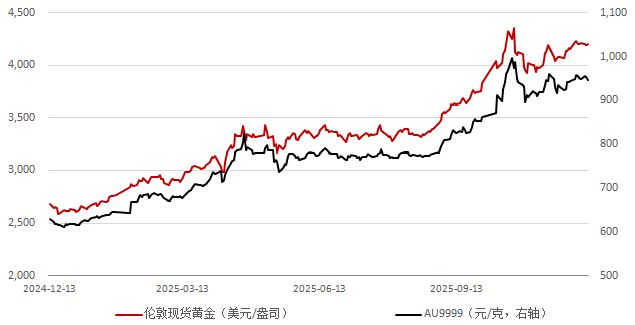
Group 1: Economic Indicators - US employment data fell short of expectations, leading to a continued decline in the US dollar index, which closed down 0.60% at 98.65 [1][5] - The 10-year US Treasury yield closed at 4.1610%, while the 2-year yield, sensitive to Federal Reserve policy rates, closed at 3.5510% [1][5] - Initial jobless claims in the US reached the largest weekly increase since the pandemic [1][5] Group 2: Gold Market Performance - Spot gold reached its highest level in over a month, closing up 1.21% at $4279.89 per ounce [1][5] - The gold market opened at $4229.6 per ounce, peaked at $4286.3, and closed at $4281, indicating a bullish trend [6] - The market is expected to focus on resistance levels between $4285 and $4310, with support levels between $4262 and $4240 [6] Group 3: Silver Market Performance - Spot silver reached a historic high, closing up 3% at $63.57 per ounce [1][5] Group 4: Nasdaq Performance - The Nasdaq opened at $25751.35, fluctuated between a low of $25353.31 and a high of $25836.31, and closed at $25807.2 [3][7] - The Nasdaq is maintaining a high-level oscillation, with potential for breaking its current range [3][7]
【日报】哈塞特称美联储降息空间充足 国际金价震荡收涨
Sou Hu Cai Jing· 2025-12-10 23:12
Group 1: International Gold Market - On Tuesday, international gold prices fluctuated and closed higher, opening at $4,190.11 per ounce, reaching a high of $4,221.40, and a low of $4,169.85, ultimately closing at $4,206.59 per ounce [1][8] - COMEX gold futures closed at $4,236.60 per ounce [8] - The London spot gold price increased by 0.40% from the previous day, while year-to-date it has risen by 60.30% [9] Group 2: Economic Data and Market Sentiment - The latest data from ADP indicates that U.S. private employers added an average of 4,750 jobs per week over the past four weeks, ending a streak of job losses [1][23] - The JOLTS job openings for October were reported at 7.67 million, significantly exceeding the expected 7.12 million [1][23] - President Trump stated that his support for immediate significant interest rate cuts will be a "litmus test" for selecting the new Federal Reserve Chair, and he may adjust tariff policies to help lower some commodity prices [1][23] Group 3: Currency and Interest Rates - The onshore RMB closed at 7.0693 against the USD, appreciating by 20 basis points from the previous trading day [1][19] - The central bank conducted a 7-day reverse repurchase operation of 117.3 billion yuan, with 156.3 billion yuan maturing on the same day, resulting in a net withdrawal of 39 billion yuan [1][14] - The 10-year U.S. Treasury yield was reported at 4.18%, while the 10-year Chinese government bond yield was at 1.84% [17][18] Group 4: Stock Market Performance - The U.S. major stock indices showed mixed results, with the Dow Jones down by 0.38% to 47,560.29 points, and the S&P 500 down by 0.09% to 6,840.51 points [20][21] - The A-share indices in China both closed lower, with the Shanghai Composite Index down by 0.37% [20][21]
How Investors Can Make Sense Of Key Economic Data
Youtube· 2025-12-10 18:45
Economic Data Overview - Economic data is crucial for understanding the state of the economy, encompassing various indicators such as jobs data, housing data, consumer confidence, and inflation [1][2][3] Jobs Data - Key reports include weekly jobless claims, job openings, and the monthly jobs report from the Bureau of Labor Statistics, which are essential for assessing labor market health [4][9] - Weekly jobless claims serve as a leading indicator of the labor market, with rising claims indicating a potential slowdown and falling claims suggesting job growth [5][6] - The monthly jobs report provides a comprehensive view of job growth, unemployment rates, and wage growth, while the job openings and labor turnover survey (JOLTS) offers insights into hiring and resignations [7][8] Consumer Data - Consumer sentiment, retail sales, and the Consumer Price Index (CPI) are vital for gauging consumer behavior and economic health [10][12] - CPI is a key measure of inflation, influencing Fed policy decisions and market trends [11][12] - The University of Michigan's consumer sentiment index reflects consumer optimism and is used to inform policymakers [13] Retail Sales - Retail sales data provides insights into total revenue generated by retailers, indicating economic strength or weakness based on sales growth rates [14][15] GDP - Gross Domestic Product (GDP) is released quarterly and indicates economic growth, with two consecutive quarters of negative growth signaling a recession [16][17] Housing Data - Housing-related data, including pending home sales, housing starts, and various price indices, is critical for understanding economic health [18][19] - Pending home sales indicate future market activity, while housing starts reflect construction activity and its impact on jobs and consumer spending [20][22] Manufacturing Data - The Institute for Supply Management (ISM) manufacturing index is a leading indicator of the manufacturing sector's health, influencing Fed policy decisions [23][24] - An index reading above 50 indicates expansion, while below 50 signals contraction, tracking key indicators like production and new orders [25] Summary of Economic Data Importance - Economic data significantly influences market trends and investor decisions, necessitating awareness of upcoming data releases and their potential impact on stocks and Fed interest rate decisions [26]

瑞达期货沪锡产业日报-20251210
Rui Da Qi Huo· 2025-12-10 10:39
Report Summary 1. Report Industry Investment Rating No investment rating information is provided in the report. 2. Core View of the Report The report anticipates that Shanghai Tin will fluctuate with a bullish bias, suggesting attention be paid to the range of 320,000 - 330,000 yuan/ton. The macro - economic situation shows the US "small non - farm" ADP improvement, and the Federal Reserve has "ample room" to cut interest rates. Fundamentally, the supply of domestic tin ore imports remains tight, processing fees are low, refined tin production is expected to be limited, and imports are likely to decline. On the demand side, downstream acceptance of high - priced goods is limited, and overall trading volume is low. Technically, the increase in positions and price rise indicates a warming of the bullish sentiment [3]. 3. Summary by Relevant Catalogs 3.1 Futures Market - The closing price of the main futures contract of Shanghai Tin is 322,630 yuan/ton, up 10,310 yuan; the 1 - 2 month contract closing price is - 770 yuan/ton, down 180 yuan. - The LME 3 - month tin price is 39,850 US dollars/ton, up 50 US dollars. - The main contract position of Shanghai Tin is 47,499 lots, up 4,075 lots; the net position of the top 20 futures is 753 lots, up 1,084 lots. - LME tin total inventory is 3,050 tons, down 25 tons; LME tin cancelled warrants are 260 tons, down 25 tons. - The Shanghai Futures Exchange inventory of tin is 6,865 tons, up 506 tons; the Shanghai Futures Exchange warehouse receipts of tin are 7,151 tons, down 86 tons [3]. 3.2 Spot Market - The SMM 1 tin spot price is 316,700 yuan/ton, up 700 yuan; the Yangtze River Non - ferrous Market 1 tin spot price is 317,140 yuan/ton, up 1,550 yuan. - The basis of the Shanghai Tin main contract is - 5,930 yuan/ton, down 9,610 yuan; the LME tin premium (0 - 3) is 41 US dollars/ton, down 5 US dollars. - The import volume of tin ore and concentrates is 11,600 tons, up 2,900 tons [3]. 3.3 Upstream Situation - The average price of 40% tin concentrate is 302,000 yuan/ton, down 800 yuan; the processing fee is 10,500 yuan/ton, unchanged. - The average price of 60% tin concentrate is 306,000 yuan/ton, down 800 yuan; the processing fee is 6,500 yuan/ton, unchanged [3]. 3.4 Industry Situation - The monthly output of refined tin is 14,000 tons, down 1,600 tons; the monthly import volume of refined tin is 983.25 tons, down 518.38 tons [3]. 3.5 Downstream Situation - The price of 60A solder bar in Gejiu is 203,370 yuan/ton, up 500 yuan. - The cumulative output of tin - plated sheets (strips) is 1,245,400 tons, up 136,100 tons; the monthly export volume of tin - plated sheets is 222,600 tons, up 25,000 tons [3]. 3.6 Industry News - The US "small non - farm" ADP improved, with private enterprises adding an average of 4,750 jobs per week, ending four consecutive weeks of job losses. The Federal Reserve's October JOLTS job vacancies rose to a five - month high, but recruitment decreased and lay - offs reached a two - year high. - The Bank of Japan Governor hinted at future interest rate hikes "more than once". - Trump considered two candidates for the new Federal Reserve Chairman, and there were speculations about interest rate cuts and tariff adjustments [3].

加拿大央行政策 支撑加元偏强
Jin Tou Wang· 2025-12-10 02:40
Group 1 - The USD/CAD exchange rate is currently at 1.3853, showing a slight increase of 0.0001 from the previous trading day, with a fluctuation range indicating stability in the market [1] - Recent Canadian employment data exceeded expectations, reinforcing the Bank of Canada's strong policy stance, which supports the Canadian dollar [1] - Global trade concerns are affecting the Canadian export environment, limiting the appreciation potential of the Canadian dollar [1] Group 2 - The USD/CAD pair is experiencing a balance of forces, with key resistance at 1.3875 and support at 1.3800, indicating a potential range-bound movement [2] - Technical indicators suggest a market in a wait-and-see mode, with MACD convergence and RSI in a neutral zone [2] - Upcoming U.S. employment data and central bank policy decisions are expected to influence short-term volatility in the USD/CAD exchange rate [2]
【美债价格在美国职位空缺数据发布后显著下挫】周二(12月9日)纽约尾盘,美国10年期基准国债收益率涨1.76个基点,报4.1819%,北京时间21:53刷新日低至4.1410%,随后在23:00发布美国职位空缺(美联储青睐的就业数据)时快速拉升,美国财政部拍卖10年期美债之后一段时间刷新日...
Sou Hu Cai Jing· 2025-12-09 20:48
两年期美债收益率涨3.59个基点,刷新日高至3.6105%,21:53刷新日低至3.5628%,职位空缺数据发布 时快速拉升大约4个基点。 【美债价格在美国职位空缺数据发布后显著下挫】周二(12月9日)纽约尾盘,美国10年期基准国债收 益率涨1.76个基点,报4.1819%,北京时间21:53刷新日低至4.1410%,随后在23:00发布美国职位空缺 (美联储青睐的就业数据)时快速拉升,美国财政部拍卖10年期美债之后一段时间刷新日高至 4.1859%。 ...
周二(12月9日)纽约尾盘,ICE美元指数涨0.13%,报99.217点,北京时间17:48跌至98.954点刷新日低,随后持续
Sou Hu Cai Jing· 2025-12-09 20:24
Core Viewpoint - The ICE Dollar Index experienced fluctuations, initially dropping to a low of 98.954 points before rising sharply after the release of favorable job vacancy data from the Federal Reserve, reaching a high of 99.312 points [1]. Group 1 - The ICE Dollar Index increased by 0.13% to close at 99.217 points [1]. - The Bloomberg Dollar Index rose by 0.03%, with a trading range of 1212.64 to 1215.70 points during the day [1]. - The significant movement in the dollar index occurred after the release of job vacancy data, indicating a positive market reaction [1].